



Abstract
Disengagement by high-ability students from general educational programs has traditionally been examined from a student-centered perspective. This article examines this phenomenon through a relational lens. It focuses on understanding the interactions of these students with the classroom culture and the consequent impact on their creativity. The range of student interactions implicated in creative activity in classroom culture are analyzed using the Five A’s framework. This framework combines psychological and socio-cultural paradigms. It is used to analyze the characteristics of engaged and disengaged high-ability students and to identify strategies that support student engagement and creativity in formal education. The analysis shows the limitations of formal education in catering to students who are unable to show their knowledge in culturally acceptable ways. It provides insights for educators and policymakers to better understand and support the learning profiles of high-ability students in formal education.
Highlights
- Proposes a framework for understanding classroom cultures facilitate creativity - Student’s interactions with the classroom culture impacts their creativity - Classroom cultures respond differentially to these interactions - Supported interactions are more likely to lead to talented or creative outcomes
High-Ability Students and Disengagement
It has long been recognized that conventional formal education does not work for all students. This includes many individuals who, as adults, are recognized for their creativity, talent, or innovation (West, 2020). Their biographies and autobiographies report that they disengaged from regular classroom learning and frequently left school relatively early. This article examines a model for understanding the disengagement of high-ability 1 students in formal classroom cultures and why some disengaged students show the inclination to be creative outside of school. It also recommends strategies for ameliorating supporting student engagement with formal education.
One approach to understanding the disengagement of high-ability students from mainstream schooling has been from the perspective of the ability and intelligence of the students. This focus on student ability can be exclusionary if defined narrowly (Renzulli, 2005). Disengaged high-ability students may not exhibit the learning profiles typified by academically achieving students (Betts & Neihart, 1988; Kim & VanTassel-Baska, 2010). Some indicative behaviors include acting and thinking in unexpected and novel ways, finding problems, or questioning authority. Because of these behaviors, these students can be seen as a problem by teachers (Kim, 2008; Kim & VanTassel-Baska, 2010; Westby & Dawson, 1995). Karwowski (2010) showed that “creative students were perceived as more intellectually efficient, dynamic, and excitable, whereas ‘good’ students were more agreeable and conscientious” (p. 1235). Previous research also indicates that even when a teacher speaks of the value of creativity, the classroom culture may not allow it to flourish amid the pressures of curriculum, testing, and the complexities of classroom dynamics (Baldwin, 2010; Beghetto, 2013; Gajda et al., 2017).
Given that high creative ability manifests in classrooms in many ways and can be seen as a problem by teachers, this article focuses on engagement with the goal of improving school students’ learning outcomes through fostering creative ability (Kim, 2008; Kim & VanTassel-Baska, 2010). Indicative creative behaviors that may be viewed as problematic include acting and thinking in unexpected and novel ways, finding problems, impulsivity, or questioning authority (Westby & Dawson, 1995). While there is abundant research on how to facilitate creativity in engaged students (Beghetto & Kaufman, 2014; Lee et al., 2021), there has been less focus on how to develop the creative ability of disengaged high-ability students (Camilleri, 2021). This article provides a framework for understanding high-ability student’s perceptions of their classroom culture as a place that facilitates their creativity and relates to their engagement with learning at school. The framework permits the examination of the characteristics of engaged and disengaged high-ability students and draws on Kahu’s (2013) suggestion that a combination of psychological and socio-cultural perspectives offers the best representation of student engagement.
Teaching More than Just a Brain
The model explored in this article adopts an alternative perspective to solely focusing on the individual in relation to student engagement within school settings. It investigates the phenomenon in terms of students’ interactions within the classroom culture (Camilleri, 2021). It proposes that identifying how disengaged students perceive and respond to cues in their classroom can provide insights into how to support successful participation at school as well as the development of their creative ability. Being able to recognize classroom cues (e.g., when to listen, vocabulary in tasks, transition to different lessons) allows an individual to utilize the affordances in that environment. “Affordances” refers to the action potentials, opportunities that the environment presents to an individual. These can be both symbolic and material cues that the individual can utilize to interact with the environment. In other words, the affordances of the environment are what it offers to the individual, what it provides or furnishes, either for good or ill (Gibson, 2000). Acting on the correct cues is crucial for success in classroom as these cues are the keys to unlock further learning.
Student learning depends on a variety of factors, significant among them being the actions of their teacher. For example, Roorda et al. (2017) found stronger associations between engagement in secondary school and positive teacher-student relationships when compared to primary school. Roorda et al. (2017) theorize that these results might “indicate a cumulative effect in which negative relationships and disengagement strengthen each other over time” (p. 252).
All learning begins with what students know (Witherby & Carpenter, 2022). Their existing knowledge of a domain is multi-faceted. From an “integrated learner” perspective (Munro, 2007), it can be represented (a) in multiple forms or aspects—abstractly, experientially, procedurally, emotionally; (b) through their reasoning; (c) in their identity as a knower and learner of the domain; and (d) through what they know about relevant cultural perspectives on the domain. These forms of knowledge are linked in networks and contribute to a student’s understanding at any time.
Regardless of the age of the student, teaching is based on assumptions about the quality of students’ knowledge in each of the facets as well as conceptions of “creativity.” This includes what students know and can retrieve, how they learn, their self-efficacy and attitude towards what is being taught and their motivation and goals for learning it. When a mismatch occurs between a teacher’s beliefs about what a student can do and what the student can actually do, successful learning is less likely, and the probability of student disengagement from the classroom increases.
It is crucial to understand some of the assumptions underpinning the teaching of some high-ability students. Examples of these assumptions or expectations made while teaching high-ability students in mainstream classrooms include: 1. Frequently expecting students to engage academically by using their verbal knowledge and skill. Disengaged high-ability students frequently show higher fluid than verbal intelligence (Seeley, 2004; VanTassel-Baska et al., 2007). 2. Assuming that students are motivated to engage by thinking abstractly. Many disengaged high-ability students prefer real-world thinking and open-ended problem-solving situations that value ideational fluency and flexibility (VanTassel-Baska, 2018). 3. Assuming students see that teaching has cultural and functional relevance. Some high-ability students, often from disadvantaged or low socio-economic status backgrounds, or from juvenile detention, judge it to be challenging, irrelevant or culturally misaligned (Dogra, 2004; Goss et al., 2017).
Additionally, because many high-ability students don’t match the assumptions or expectations of formal provision, they underachieve at school (Kim & VanTassel-Baska, 2010). They perceive their knowledge to be misunderstood or not valued, and their ability to be underestimated (Galton et al., 1999). As a consequence, they frequently display indicators of disengagement such as boredom or disruption and exit either at the end of their compulsory schooling or earlier (Smyth & Hattam, 2004). In summary, they are more likely to be marginalized from formal institutional settings because they do not show their ability in culturally acceptable ways.
Interactional Classroom Culture
Students learn by interacting with the material, social, and symbolic dimensions of their classroom environment. Each classroom operates as a culture that is defined by its goals, values, and accepted ways of learning and achieving. The sources of information include the teaching, the teacher and other mentors, the social group of peers, and physical resources such as reference data bases and materials. Teachers play a critical role in the school and psychosocial adjustment of adolescents (Özdemir & Özdemir, 2020).
These interactions influence the display of high level and creative outcomes. Since Amabile’s work in the 1980s and 1990s, an abundance of research has further strengthened the proposition that supportive teacher behavior is positively influential in the development of creativity (Baer & Kaufman, 2012; Barbot et al., 2011; Beghetto & Kaufman, 2014; Gajda et al., 2017; Lee et al., 2021). For instance, recognizing and rewarding creative ideas and products through positive and constructive feedback enables the development of new ideas (Shah & Ali, 2012). Sternberg (1997) agreed that evaluative feedback should be positive and constructive: it should avoid shaming students for thinking above and beyond what is expected while also tolerating ambiguity and enabling sensible risk-taking.
A classroom culture shapes whether high ability or potential is translated into performance (Runco, 2007). The link between creativity and engagement in the classroom can be seen through the concept of “educational capital” as an “exogenous learning resource” (Ziegler & Stoeger, 2017, p. 27). This concept highlights the importance of a supportive classroom culture, including the availability of resources, the influence of individuals and social institutions, and the value systems and thinking patterns that shape the classroom environment. These factors can impact the emergence of talented outcomes for high-ability students, who need to interact in socioculturally endorsed or functional ways (Barab & Plucker, 2002). In other words, a classroom culture that fosters creativity and engagement can help high-ability students reach their full potential.
Student interactions with these sources in the classroom culture are reciprocal or bi-directional; students act and receive feedback information from the sources. The interpretations students make of this information shape their subsequent learning activity, including characteristics of engagement (Havnes et al., 2012; Rakoczy et al., 2013; Van der Kleij & Lipnevich, 2021). They are more likely to use it and engage positively in their subsequent learning activity if they perceive it as timely, useful, relevant, and applicable (Jonsson & Panadero, 2018; Lipnevich & Smith, 2009).
Engagement in Classroom Learning
The quality of the interactions is influenced by the preparedness of students to engage. Student engagement in education has been examined from multiple perspectives (Trowler & Trowler, 2010) and defined and conceptualized in a range of ways (Kahu, 2013). This variety has been attributed in part to a failure by some researchers to define student engagement explicitly or precisely (Balwant, 2018) and to a consequent broad variation in how it is measured.
One conceptualization of student engagement is from a psychological perspective. Engagement has generally been investigated in terms of three dimensions (Fredricks et al., 2011): behavioral engagement, when students participate actively in classroom activities; emotional/affective engagement, when students invest positive affect in the learning activity; and/or cognitive engagement, when students interact intentionally to learn or know more. The three dimensions are interrelated. An engaged student participates appropriately both physically and mentally, with the participation underpinned by an emotional commitment. This conceptualization has been used to inform research examining student engagement (Fredricks et al., 2004). A limitation of this perspective is that it neglects or ignores the role of the situation, context, or culture on student engagement.
An alternative is the socio-cultural perspective. It shifts the focus from the individual to the cultures and environments in which they interact. The context in which students engage can affect the three dimensions of psychological engagement. Conditions in classroom environments that foster positive teacher-student relationships, competence, and autonomy enhance student engagement (van Uden et al., 2014). Positive teacher-student relationships are a necessary condition for both behavioral and emotional student engagement and for successful academic outcomes (Lee, 2012, 2014). Students represent their experiences of these relationships in dynamic working models of attachment (Verschueren & Koomen, 2012). These models encode the interactions in time and place between the student, significant others, and the contexts or ecologies in which they occur.
These perspectives lead to a definition of student engagement that can be useful for understanding high-ability students. Engagement is a highly activating and pleasurable emotional, behavioral, and cognitive form of involvement in academic activities. It is characterized by high levels of activity and pleasure (Schaufeli et al. 2002a; 2002b).
Disengagement
Student disengagement is a complex phenomenon. It has been conceptualized and identified in multiple ways (Rickinson et al., 2018) and varies in its scope; a student can disengage from a specific academic subject or domain, the classroom more generally, the school or from the education system.
Disengagement is frequently conceptualized on a continuum, as the polar opposite of engagement, from a psychological perspective. In terms of Fredricks et al.’s (2011) three dimensions of engagement, student disengagement reflects a lack of affective (e.g., a decline in interest), behavioral (e.g., a lack of participation) and cognitive (e.g., a lack of attention) engagement. The various perspectives on disengagement share some common features that have been organized in terms of these dimensions (Hancock & Zubrick, 2015): • Emotional disengagement is characterized by low interest in or boredom with the curriculum, negative emotions such as anxiety linked with the teaching, minimal connection to teachers, or a low perceived value of education or what is being taught. • Cognitive disengagement is shown in poor self-regulation or self-agency in learning the content, a lack of attention to learning tasks, a negative disposition towards classroom activities, and the belief that what is being taught is irrelevant. • Behavioral disengagement is displayed in disruptive classroom behaviors, rejection or avoidance of classroom activities, absenteeism from classes or school.
While most of research examining disengagement has followed the psychological perspective and uses Fredricks and her colleagues’ (2011) three dimensions, there is a strong case for disengagement being reimagined as relational (Hancock & Zubrick, 2015). Teacher assumptions about how high-ability students learn, for example, impact on the students’ subsequent disengagement. High-ability students who violate the cultural expectations and assumptions of the classroom often receive “biased evaluations of their classroom performance” from their teachers (Kolb & Jussim, 1994, p. 29).
Those who don’t conform to normative behavioral standards in the classroom (e.g., appear unmotivated or misbehave) are likely to be assigned lower grades. In addition, those who do not engage in productive social interactions and then reject traditional routes to success, ultimately disengage. They seek alternative supportive and accommodating groups for prosocial connections (Albert, 1994; VanTassel-Baska et al., 2007). These outcomes are evidence of cultural influences on the likelihood of disengagement. They support the possibility that disengagement by high-ability students could be explained in terms of interactions with the classroom culture.
Reimagining Disengagement
To investigate why some students disengage from school, educators require a framework that focuses on students’ perceptions of their interactions in the culture of the classroom and the extent to which the classroom culture facilitates this opportunity. Fredricks et al. (2004) and Carmichael et al. (2017) emphasized the importance of enjoyment, effort, and curiosity for student engagement. Consequently, when a school assumes that all students express their creative thinking in the same way, some students will disengage, fall behind, miss out on crucial learning, and become alienated from formal education. Student engagement becomes an important factor to consider when seeking to develop creative ability in all educational settings. Understanding the intersection between creativity and engagement is thus crucial for understanding how to support students to develop their creative ability.
Glăveanu’s (2013) Five A’s model of creativity offers the possibility of such a framework. This model proposes that creative outcomes emerge from interactions between a person and their physical and sociocultural environment, in this case, the classroom context. Creativity is a goal-oriented action in and on one’s world. It involves the individual “perceiving, exploiting, and generating novel affordances, or action potentials, during socially and materially-situated activities” (Glăveanu, 2012, p. 192). Given that “creative” action is a cultural, social, and psychological event, the development of creative ability within a classroom requires consideration of symbolic and material affordances available to students (Hennessey, 2017). This article proposes that the Five A’s framework may be applied to understanding engagement (i.e., being “engaged” within a specific classroom) as a socially and materially situated activity.
The proposition that creativity emerges out of a system or culture of ideas after interaction between an individual and their environment has wide support from confluence theories, such as the Csikszentmihalyi’s (1998) Systems Theory. Ziegler et al. (2019) argued against “traditional individualistic approaches to the study of high abilities and talents that neglect environmental aspects” (p. 48). Subotnik et al. (2011) concluded that general ability is “necessary but not sufficient to explain optimal performance or creative productivity” (p. 13). They recommend that researchers understand more about the role of “domain specific abilities, psychosocial skills, motivation, and opportunity” in optimal performance (p. 13). Glăveanu (2015) noted that creativity and culture are inextricably linked and the importance of explaining the “whole” as a product of relations between the components, rather than simply focusing on isolated components. Hennessey (2017) proposed that “Cultural expression and the process of enculturation impact every stage of the creative process” and that creative behavior never occurs in isolation (p. 343).
This perspective challenges the commonly held view that creative outcomes are a consequence of “the talents and efforts of idealized lone ‘geniuses’” (Hennessey, 2017, p. 343). It leads to the inference that developing creative ability entails engaging students through providing appropriate material and symbolic opportunities. Consequently, classroom engagement emerges from the interaction between material and symbolic opportunities within the classroom culture. Engagement as with creativity involves more than the individual, it is a product of the “whole.”
The Five A’s Model
The interactions in the Five A’s model involve five entities; the actors, the actions they implement, the cultural artifacts, the socio-cultural audience and affordances or opportunities individuals perceive in their cultures for creative expression (Glăveanu, 2010, 2013, 2014). The actor is an individual in a social context. Actions refer to the repertoire of psychological and behavioral activity used to achieve an individual’s goals. The artifacts are culturally defined products, symbolic, and/or material in nature. The audience refers to the social context in which the creative activity is implemented. The affordances in an environment are the opportunities that environment offers the individual to act creatively.
Glăveanu (2015) suggests the creative actor is always able to take on the perspective of an audience; doing so allows the actor to imagine and pursue new action pathways afforded by the material and symbolic environment. Glăveanu’s (2015) diagram as shown in Figure 1, represents the “relatively narrow tunnel of options emerging from the artifact” (p. 167). This key point that the actor takes on the perspective of their audience when they are creative is crucial for understanding disengagement in school. When a student takes on the perspective of their teacher, they are more likely to exploit the intended opportunities found in artifacts in their classroom. These students’ actions match the affordances endorsed by the audience, which in turn leads to accessing more positively oriented opportunities and achievement within that culture. They are an embodiment of the teacher’s expectations around responding to learning opportunities. These opportunities are represented by the blue circles. The red lines symbolize an extra socio-cultural space where perceptions of the affordances relating to an artifact may lead to actions that are deemed inappropriate or denounced by the audience or culture. Adapted from (Glăveanu, 2015).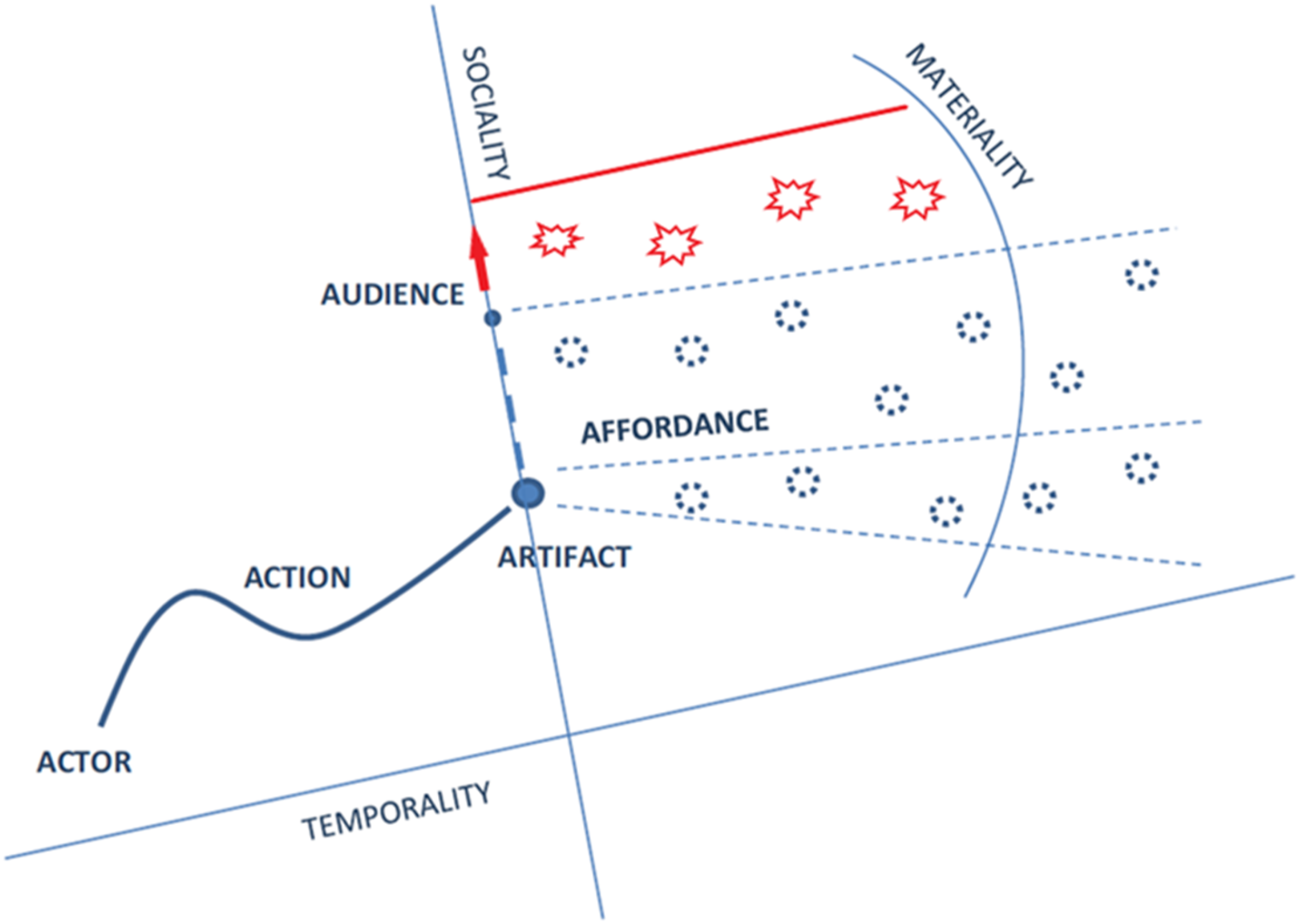
Given its focus on actions within a culture, Glăveanu’s model can provide a framework for exploring high-ability students’ experiences in school. It offers a language for describing engaged interactions and relations involved in displays of creativity in a classroom as well as understanding engagement as the embodiment of the perspective of the teacher. The extension of the Five A’s framework presented here is based on a PhD project 2 by Camilleri (2021), which examined how students’ creative ability is affected by their perceptions of classroom culture and relevance to their learning. The study identified differences in learning characteristics between engaged and disengaged high-ability adolescent students. The latter felt marginalized and exhibited non-academic learning profiles. The results highlighted the importance of engagement and social connectedness for creative expression, which is shaped by the interactions and transactions between students, teachers, and the classroom/school environment. The study showed that for culturally acceptable creative expression and classroom engagement, high-ability students needed to appropriately perceive and utilize symbolic and material affordances during socially and materially situated activities when creating artifacts. Details of the framework are unpacked below.
Actor Dimension
The student as an actor is the individual interacting with others and using cultural resources in a range of social contexts. Actors learn from their interactions and use their knowledge in subsequent interactions to inform their actions. The knowledge they acquire is a composite of what they know abstractly, through their experiences, their thinking, their emotions and attitudes, their self-identity and what they know about of social relationships and the cultures to which they belong. This framework repositions the student in relation to disengagement and directs attention to the conditions in which the disengagement emerges. Rather, the student is one part of a context which is constructed through relations and interactions in their classroom culture. These cultural relations and interactions determine if the student has “what it takes” to be successful in their classroom. Therefore, “ability does not reside in the head of the learner but is best conceptualized as a collection of functional relations distributed across persons and particular contexts through which individuals appear knowledgeably skillful” (Barab & Plucker, 2002, p. 2).
We have already noted the importance of knowledge and the acceptance of social and cultural norms and rules of the classroom for effective learning interactions. In terms of Fredricks et al.’s (2011), students need to display different types of engagement in their interactions, behaviors, affect, and cognition that are aligned with and regulated by rules and norms. As students learn the system of social relations and appropriate cultural traditions, they are disposed to learning and applying the socially and culturally referenced actions necessary to create high level outcomes. They can recognize possibilities in their cultural contexts to achieve these outcomes and can interact in socially appropriate ways.
The actor dimension draws attention to how high-ability students perceive themselves in the classroom culture in terms of their types of creative interactions. For engagement, students perceive they have (a) the freedom to pursue creative activity and to communicate its outcomes, (b) the opportunity to exercise agency, and (c) self-efficacy to be creative in the classroom and to connect with the audience in the classroom and maintain positive relations with their peers and teachers. Within the classroom, a teacher does not demand conformity and instead values diversity in thinking and understanding. When students perceive social inclusion and validation for their thinking, they consequently enjoy taking risks and actively exploring ideas.
Ideally, students have a level of autonomy in what and how they learn (Elffers, 2011; Fredricks et al., 2004; Morrison & Allen, 2007; Walker & Graham, 2019). When this occurs, they are more likely to engage in cultures that give them the opportunity to decide topics that interest them, allow them to respond to issues and challenges they perceive as important, and cultures in which they can investigate their novel thinking and actions and share them socially (Camilleri, 2021). Students are, in these cases, supported to respond constructively to social feedback and evaluation. Supporting creative thinking in a classroom means encouraging creativity through fair and constructive feedback, rewarding and recognizing creative ideas and products, and providing structures that enable development of new ideas (Amabile, 1996; Shah & Ali, 2012). Beghetto (2006) also found a significant association between teacher feedback and creative self-efficacy: “teachers can boost students’ creative self-efficacy by providing supportive feedback” (p. 454).
The actor dimension implies that disengagement is more likely when the actor-audience interactions lead to the actor perceiving a lack of acceptance or, even more, exclusion, leading to reduced participation. They are less likely to see their creative thinking and interpretations of artifacts valued or relevant or their interests represented. They are more likely to experience negative consequences for non-conformity rather than access to autonomy and positive participation in the classroom. Acceptance and understanding are symbolic affordances that lead to social inclusion and validation. Teachers’ words and actions help support connection and trust.
Action Dimension
The action dimension refers to the activity that leads to learning outcomes. This activity includes both the thinking and the associated physical action or behavioral repertoires. It is goal-oriented or purposeful. Actions are performed on entities or artifacts in one’s environment and elicit responses or feedback from it, both from the artifacts and from the audience. The actions and their feedback contribute to the meaning the actor constructs about the situation.
For high-ability students, the action dimension refers to the activity that leads to high level and creative outcomes. These students are diverse in how they know, think, and act. Previous research has shown disengaged high-ability students often act and think in unconventional and individualistic ways, identify problems or challenges not obvious to others, and may question authority (Kim, 2008; Kim & VanTassel-Baska, 2010; Westby & Dawson, 1995).
Engagement for high-ability students is likely to be optimized when they have opportunities for using their academic and creative ability, for responding to challenges and provocations in teaching, for engaging in active learning, for exploring ideas (including the outcomes of divergent thinking, problem-solving), and for exercising choice in what and how they will learn. Implementing divergent and creative thinking and actions requires stimulating, supportive, and positively challenging environments (Amabile, 1996). These students frequently need to resist peer group and adult pressure to conform. Those who have a higher sense of relatedness with their teacher believe that their actions are valued by their audience and show higher levels of emotional and behavioral engagement (Furrer & Skinner, 2003).
One might expect that disengagement is more likely when the thinking and action repertoires used by high-ability students, including their interpretation and understanding of artifacts, are not valued by their teachers. In these cases, the students are less likely to get the opportunity to engage in the assigned learning, think and act divergently or creatively, engage in problem-solving, or exercise choice in their learning. They are also less likely to have positive relationships with their teacher. Focusing on positive interactions with the disengaged student and explicit valuing of their actions will increase the likelihood of engagement in subsequent interactions.
Artifact Dimension
Artifacts are products formed by their creator, in interaction with the sociocultural environment, in ways that explicitly reference the cultural participation that led to their production and the cultural activity that is associated with them. Artifacts can represent the outcomes of creativity materially, conceptually and in terms of the action or behavioral repertoires associated with it. They are not static.
Individuals use these objects or representations to interact in their world, generally, and in the classroom, in particular. New creative outcomes derive from these objects or representations. They are formed by the creator or by audiences, interacting with objects and using creative action repertoires in various cultural contexts while knowing how each culture considers the initial artifact.
Engagement for high-ability students is more likely when they are encouraged to form rich and complex actor-audience-artifact relationships. This can include students building an awareness of the cultural contexts in which particular artifacts emerged, the cultural problems or challenges they were intended to resolve and the cultural and individual thinking that led to them. Students can also be given the opportunity to have a greater choice when creating artifacts to show their learning, rather than their teachers determining how and what the artifact should “look like” and guiding their creative expression.
Disengagement from formal schooling is less likely when the classroom environment includes activities and assessments (artifacts created by the teacher) that are of interest to high-ability students and that enable them to understand what they are being asked to do, and/or when the demands of the task match what a student can do. Some of these students have non-academic interests and are more likely to engage in learning when they have the freedom to generate or construct material or tangible outcomes rather than more academic written outcomes (Camilleri, 2021). They learn by analyzing the material artifacts and actions of others and by sharing their own creations with their peers. Echoing this finding, VanTassel-Baska (2018) highlighted the importance of open-ended real-world tasks that require ideational fluency and flexibility to engage students of all ability levels. Providing students with an array of materials and opportunities to discuss their development will help student create spaces for their personal growth.
Many high-ability, disengaged students engage in learning and achieve creative outcomes in out-of-school contexts. They display high-level intrinsic motivation in these contexts that is directed towards personal growth (Forgeard & Mecklenburg, 2013). This is consistent with Fredricks et al.’s (2004) claim that a focus on producing artifacts through personal knowledge and insight, achieved through greater student choice and flexibility, is more likely to support these students to re-engage in formal classroom learning than a focus on scoring good grades. Classroom learning involves interpretion of an artifact’s intended purpose which is based on assumptions about how the student’s will interact with the cues in the task. Reflecting on these assumptions is crucial.
Audience Dimension
The classroom environment is experienced as a socio-cultural context that is shaped by a range of interactions between the individual and their environment that vary in their complexity. We noted that students, during learning, interact with others, both implicitly or explicitly, who respond to and shape their subsequent learning activity. The “others” include their peers, their teachers, and instructors, other adults who directly influence their learning activity and the broader culture that may have a less direct impact. Teachers can facilitate intentional, supportive environments by providing appropriate challenges and encouraging students through their successes and failures (Lee et al., 2021).
Creativity results from on-going interactions between the creator and their audience (Csikszentmihalyi, 1998). The audience can provoke or stimulate thinking about an issue, and shape the student’s evolving understanding by discussing, evaluating, questioning, or rejecting aspects of it. As well, the audience responds to various iterations of the artifact and/or the actions that led to it. It evaluates the outcome in terms of its relevance, value, and use to the culture and its novelty and capacity to extend the knowledge of that particular cultural context. This is communicated as feedback to the creator.
Engagement is more likely when high-ability students learn and accept the beliefs and norms of their classroom culture and of its relevant artifacts. Outstanding performance or talent largely depends on opportunities available to the individual, which includes having the opportunity to balance learning independently and collaboratively (Subotnik et al., 2011). Approachable, supportive teachers and constructive feedback positively influence engagement, effort, perseverance, and achievement (Amabile, 1996; Shah & Ali, 2012). Students perceive that diversity in ideas and unconventional ways of thinking and understanding are accepted and valued.
High-ability students respond positively to teachers encouraging individual diversity and independence, and form and maintain positive relationships with students. As well, teachers provide opportunities for student choice, relative freedom from external controls such as rewards and grades and support student autonomy (Fredricks et al., 2011). Many students define their connection to school through “the opportunities given to them by the school” (Gowing & Jackson, 2016, p. 64). Students appreciate being given a chance to succeed.
Disengagement is more likely when the audience responds negatively to unconventional thinking and unexpected creative expression. This can occur in a range of ways, for example, when students perceive their ways of thinking and understanding as not tolerated or devalued, or when their relationships with their teachers are negative (Fredricks et al., 2004; Klem & Connell, 2004; Roorda et al., 2017). It can also occur when high-ability students have a twice exceptional learning profile. The culture may assume that all of these students have appropriate literacy skills, even though some have literacy learning difficulties. These types of assumptions restrict participation in classroom learning. Students become alienated due to not being like they are expected to be.
Development of student’s creative ability starts with engaging a student’s imagination. Doing so involves connecting teaching with what students’ care about and value. The metaphor or “capturing” someone’s imagination implies a compulsion to think about something. The disengaged student’s imagination resists being occupied by the topic of study. The resistance to be captivated or programmed by the teaching comes from previous interactions in their classrooms with audience (teachers and peers), affordances, and artifacts. Students will develop their creative ability when they feel their classroom is a safe place to share what they know and can do. Feeling safe is relational.
Affordances Dimension
Creativity involves interacting with material or physical entities in one’s world. Each object focuses or directs how we interact with it; it structures our actions. Objects are used in particular ways by a culture; they have a meaning that is constructed by the culture. Each object offers or “affords” ways of interacting with it or relating to it. Physical entities provide or allow the use of particular action sequences.
High-ability students may respond to the affordances in their environment in creative, innovative ways. They may differ in how they use an object or entity, that is, the affordances they link with it, and discover or create novel affordances. These discoveries can lead to changes in how a culture, in this case a classroom culture, uses objects. As well, they can represent the discoveries in a range of ways; instrumentally, functionally, and symbolically. Each representation offers affordances or opportunities. More generally the affordances offered by an object are not fixed; they can change as a culture evolves. Authentic problem finding and solving experiences provide appropriate learning opportunities for high-ability students to display the affordances they perceive (Lee et al., 2021).
The interactions between actors and affordances in the classroom are influenced by the opportunities presented through intentional and unintentional teaching. Teachers influence what students think about, and how and when students’ creative ideation is translated into artifacts (Runco, 2007). Engagement for high-ability students is likely to be enhanced when classroom cultures are less structured, and when students are encouraged to think divergently and creatively in open-ended ways about affordances in their environments, to generate new artifacts, and to research the possibilities the affordances offer (Barab & Plucker, 2002). Enhancing their ability to perceive options and possibilities improves their capacity to act creatively.
Disengagement by high-ability students is more likely when the affordances in the classroom do not match students’ interests or values, when their thinking about the artifacts is restricted and when the artifacts they design and create are not valued. This is more likely in classrooms that limit access to material affordances that restrict the choice of subjects and the opportunities for hands-on learning and active investigation and for discovering new symbolic and material affordances. While material affordances might be present in the classroom, it is the symbolic affordances that shape norms about how objects are perceived and the interactions with them that are valued in that culture.
Discussion
Student disengagement with classroom learning, from the perspective of the Five A’s framework, can be analyzed in terms of the range of student interactions supported by the classroom culture. This perspective shifts the focus on engagement from an individualistic standpoint to one that focuses on interactions and relationships between psychological and socio-cultural factors. This has significant implications for students who struggle to act in “culturally acceptable” ways.
Engagement and disengagement are assumed to lie on a continuum. This approach proposes that the state or condition of engagement by high-ability students can be understood and analyzed in terms of the interplay or reciprocity of their interactions in their classroom cultures. The interactions comprise the student’s action repertoires and the various types of cultural or environmental feedback or response repertoires that they elicit. Each interaction will, in terms of Fredricks et al.’s (2011) three dimensions, comprise cognitive, emotional/affective, and behavioral aspects. They underpin both the student’s action repertoires and the cultural or environmental feedback.
Regular classroom cultures respond differentially to these interactions; some are scaffolded and supported while others are discouraged, devalued, or rejected. The interactions that are judged by students as supported are more likely to lead to talented or creative outcomes in the classroom. Those judged to elicit negative responses lead to disengagement. Some of these high-ability students who become disengaged from the classroom do show engagement in other cultures and achieve creative outcomes. These alternative environments can be characterized by differences in the sets of audience values, the appropriate actions, the actor characteristics (e.g., personality characteristics), the perception of an artifact, and the affordances.
Students’ perceptions of the affordances and artifacts in their classroom, and the thinking actions they can perform, lead to patterns of action that are judged as appropriate or inappropriate by their audience. The display of appropriate patterns of action requires the student to learn the actions and actor attributes deemed acceptable to the audience. For example, writing is a crucial element of schooling in so far as it is the primary mode through which students show their knowledge. A disengaged student has not internalized fundamental actions and actor attributes expected for success in a regular classroom, such as attentional habits and motivations, and this leads to an unwillingness, and inability, to act appropriately in certain conditions. Their learning profile does not match the material and symbolic affordances within their classroom.
Student engagement in classroom learning can be analyzed in terms of the range of student interactions supported by the classroom culture. The Five A’s framework shifts from a narrow view of engagement to one that focuses on interactions between psychological, socio-cultural, and material factors. The interactions between students and the classroom culture, including cognitive, emotional/affective, and behavioral aspects, influence how engaged students and the development of their creative ability significantly. High-ability students who are disengaged in the classroom may still be engaged and achieve creative outcomes in other environments such as street arts, music, cooking, sports, and repairing mechanical objects (Camilleri, 2021).
All students are inherently creative following Kaufman and Beghetto’s (2009) conception of mini c (novel and personally meaningful interpretations of experience, actions, and events). Complimentary to this view of creativity, Glăveanu (2018) asserts that “there is a lot of creativity involved in everyday life activities, from cooking to driving and solving mundane problems at home or at work, and yet this kind of creative expression often flies ‘under the radar’ of creativity researchers” (p. 29). Narrow conceptions of creativity have not only been popular in research but also schooling. These everyday pursuits, offered as hands-on and practical activities, could enable a deeper and increasingly interactive engagement with curriculum. This has been shown as effective as a means of retaining early school leavers (Deloitte Access Economics DAE, 2016; Rice & Lamb, 2008). Offering opportunities for these pursuits increases inclusion and active participation in their school culture.
Disengagement can be framed in terms of engagement as a set of socio-culturally endorsed patterns of behavior in a classroom culture. “Engaged” students conform to a set of behavioral patterns that match audience expectations and are endorsed by the school. They are a successful embodiment of formal schooling with their “appropriate forms of cultural display” (McLeod, 2006, p. 51). Sequential processing ability is an important learning characteristic that differentiates engaged and dis-engaged high-ability students in their ability to engage with text-based tasks and to express creative outcomes in their classroom (Camilleri, 2021). A consequence of lower sequential thinking ability is that students may misunderstand relevant teaching information by mis-perceiving verbal cues when following instructions. This can impact detrimentally a student’s learning trajectory, and lead, in turn to an inability to produce culturally acceptable artifacts, leading to further disengagement.
To engage students with low sequential thinking actions requires creating an environment in which these students can respond appropriately to important cultural information. Teaching a student with sequential processing issues requires consideration of the type of affordances offered, but also attention to how information about affordances is communicated to the student. If a student is to fit into a classroom, access to culturally valued information is crucial.
All teachers, be it primary or secondary school, are well-positioned to reflect on their expectations and assumptions relating to the types of transactions and interactions that constitute acceptable patterns of behavior within their classroom. For example, what types of thinking and behaviors are challenging a specific classroom? And why? Do tasks allow students to show what they know about a topic? How so? Secondly, prioritize early engagement in grades one to three as a foundation for future success at school. Encourage and nurture student effort and attention during these formative years, as they can significantly impact later achievements. Thirdly, encourage students to actively utilize opportunities in the environment to create meaningful artifacts that demonstrate their understanding. Students may not perceive cultural approval to be creative and simply saying “be creative” is not enough. Fourthly, student success involves both intention (their goals and motives) and attention (what they focus on in the learning environment). These aspects are not isolated within the individual but are influenced by the classroom culture, including material and social affordances. Finally, provide individualized support to enable the expression of their ideas, intentions, and motivations.
Conclusion
Creativity is acknowledged as a quality to be nurtured and promoted in educational discourse around the world. The framework used in this article identifies the role of the classroom culture in this activity. This culture has a dynamic influence on the learning activity and the likelihood of reaching surprising or creative outcomes. The Five A’s framework provides a novel approach to understanding and analyzing student engagement in classroom learning. It shifts the focus from a psychological perspective to one that considers the interactions between psychological, socio-cultural, and material factors. The state of engagement by high-ability students can be understood in terms of the reciprocity of their interactions in their classroom culture. Classroom cultures respond differentially to these interactions; some are scaffolded and supported while others are discouraged, devalued, or rejected. The interactions that are supported are more likely to lead to creative outcomes in the classroom.
The framework can provide a protocol for investigating explicitly the characteristics of interactions that discriminate between engaged and disengaged high-ability students and could lead to diagnostic tools for evaluating the quality of interactions and for intervening to modify the qualities of classroom cultures to improve the likelihood of engagement. The importance of nurturing and promoting creativity in education is widely acknowledged, and this framework identifies the role of the classroom culture in this activity.
Footnotes
Declaration of Conflicting Interests
The author(s) declared no potential conflicts of interest with respect to the research, authorship, and/or publication of this article.
Funding
The author(s) received no financial support for the research, authorship, and/or publication of this article.
