




Abstract
This article describes the cultural characteristics of four elite African American high schools, initiated prior to Brown v. Board of Education, that produced outstanding graduates. Positive school culture characteristics examined were leadership, faculty, curriculum and instruction, student qualities, the environment, and internal and external relationships. The authors posed questions investigating how educators and alumni of Gary, Indiana’s Theodore Roosevelt High School viewed the characteristics of its culture and how the culture compared to other elite African American high schools in the extant literature. Using surveys, archival information, and the research literature, the authors collected information describing the high school’s distinctive features. Comparing the results of Roosevelt
Keywords
Culture influences school norms, unwritten rules, expectations, teaching and learning approaches, and the ways people interact with one another.”
Introduction
“I was taught how to succeed in life through preparation and adaptability. The sense of community has always been a major part of my life. My classmates respected each other when we collectively put in the work and preparation to have successful study projects, organizations, and teams.” (Graduate from Roosevelt High School, Class of 1961, Participant #28, orthopedic surgeon)
After the Civil War, Plessy v. Ferguson, and prior to Brown v. Board of Education Topeka 1 , pressures from Black communities compelled leaders in the White power structure to build public schools designated specifically for African American students. While under-resourced and underfunded, students from these schools that focused on a rigorous college preparatory curriculum and extracurricular opportunities outscored their peers in White schools, won state-wide awards, went on to higher education at renowned White universities and Historically Black Colleges or Universities (HBCU), and became well known in their chosen professions (Pelegrino et al., 2013; Rife, 2010).
Today, African American students are under-identified and underrepresented in services and programs for students with gifts and talents. This persistent underrepresentation and limited access to advanced programming exacerbates achievement gaps, reduces opportunities for post-secondary education, and limits the range of career goals for many students (Fergus, 2017; Gentry et al., 2019; Howard, 2010; Kotok, 2017; Plucker et al., 2010, 2013).
Given the underrepresentation and retention of Black students in gifted education and advanced programs, what lessons can educators and policymakers learn by studying these early urban elite African American public high schools? What were the characteristics of the school culture and the extended school community that influenced their success? How might these characteristics be implemented in today’s schools?
Definition of Culture
The school culture is derived from the broader community, key stakeholders, and the shared values, beliefs, and relationships among or across the individuals in a school (Çakiroğlu et al., 2012). Culture influences school norms, unwritten rules, expectations, teaching and learning approaches, and the ways people interact with one another. Culture is more deeply ingrained than the climate of a school, which refers to the individual experiences and feelings that students, teachers, staff, and stakeholders have about the school—an overarching experience or feel of the school (Kane et al., 2016; National School Climate Center). As a consequence, culture may only be altered over a longer period through systematic change in a school’s climate (Gruenert, 2008). Therefore, understanding schools from a social-historical perspective helps us understand the important characteristics of the school culture and extended school community that influence individuals and how these characteristics have evolved.
Characteristics of School Cultures Influencing High Achievement
In examining the literature and studies related to positive school cultures that lead to academically successful students, specific characteristics have been identified. These relate to the leadership, faculty, the curriculum and instruction, qualities of the student, the environment, and the internal and external relationships among and between the faculty, students, support staff, administrators, and the community.
Leadership
Marzano et al. (2005) identified 21 leadership responsibilities that affect school achievement. Among these responsibilities is the importance of developing a positive school culture. To achieve this goal, leadership (a) selects quality staff, (b) creates and communicates a school vision and high standards, (c) distributes leadership among teacher leaders, (d) becomes the lead learner in a learning community, (e) uses data to drive decisions, and (f) supervises classroom learning (Kane et al., 2016; Smith & Shouppe, 2018). Leaders who allow teachers flexibility, a latitude and freedom of action are more likely to create collaborative environments that encourage shared decision-making and ultimately results in high student academic achievement (Velasco et al., 2012).
Faculty
Teachers in high achieving cultures have knowledge and expertise in their field, a passion toward their subject, instructional strategies that promote active participation, and social-emotional characteristics that connect them to their students (Bodovski et al., 2013; Gentry et al., 2011; VanTassel-Baska, 2005). They create a climate of high expectations where learning occurs and develop good relationships with their students, which result in students who are more satisfied with school and exhibit less disruptive behaviors (Vogl & Preckel, 2014). These same characteristics are included in the Dimensions of School Climate and Culture Scale (Kane et al., 2016): Support for Learning (encouragement, varied opportunities to demonstrate knowledge and skills, individual attention); Interpersonal Relationships (mutual respect for individual differences), and Social Support (pattern of caring adult relationships for students).
Curriculum and Instruction
To create a high achieving culture, students have access to advanced, challenging courses. The curriculum is tailored to the individual student, using test results to adjust the curriculum, and include acceleration, both content and grade-based, enrichment opportunities, and real-life learning activities and competitions that appeal to student interests and prepare them for post-secondary education (Almond, 2012; Tomlinson et al., 2006). Instructional strategies encourage more critical and creative thinking, problem solving, and independent research so that students see themselves as thinkers and problem solvers and are prepared for life (NAGC, 2019; Wiggan, 2008). Since students leave school because of boredom, challenging instruction is critical to student success in and out of school (Garza et al., 2009; Reis et al., 2005). The curriculum is also culturally responsive, affirming the students’ culture, and includes individuals from diverse backgrounds and communities with different perspectives and experiences (Jemison-Ewing & Cummings, 2022; Tomlinson et al., 2006).
Students
Within the school culture, students learn to be successful and develop responsible behaviors (Brown, 2010; Smith & Shouppe, 2018). They have high expectations, commitments to achievement, academic aspirations, and self-efficacy (Brand et al., 2003). Supported by their teachers and peers, students have better prosocial behaviors and are more involved in class and school activities (Brand et al., 2003). Moreover, these characteristics strengthen not only their social competence, but also their ethnic identity (Nishina et al., 2019). Nishina and her colleagues (2019) found that students who are more secure in their identity are also more confident in their social skills, better at understanding others, and more likely to contribute to an inclusive school environment.
Environment
An accepting, equitable, and safe physical and social school environment is important to creating a positive culture that supports learning and retains teachers and students (Minkos et al., 2017). When new teachers feel nurtured, they are more likely to develop professional and pedagogical skills and stay in education, which leads to higher student achievement (Velasco et al., 2012). Similarly, when students feel safe socially as well as physically, they are more likely to view the school environment positively, achieve, and graduate (Thapa et al., 2013). A strategy that influences school safety is the implementation of evidence-based classroom management practices (Gregory et al., 2010). These practices create a positive environment where prosocial behaviors are practiced and taught (Johnsen et al., 2021). An equitable and collaborative environment also encourages shared decision-making and results in high student academic achievement (Velasco et al., 2012). To address equity, environments are inclusive, multilingual, and multicultural (Minkos et al., 2017). Moreover, the facility quality (i.e., lighting, sound, heating, maintenance, surrounding grounds, and so on) and each person’s contribution to the operation of the school and the care of the physical environment also influences the school culture and is correlated with improved academic performance (Kane et al., 2016; School Climate Council, 2007).
Internal and External Relationships
One of the five major areas identified by the National School Climate Center that contributes to school climate is interpersonal relationships. Long-term, genuine, caring relationships among teachers, students, school leaders, families, and the community ultimately influence the overall culture of the school (Smith & Shouppe, 2018; Velasco et al., 2012). These relationships build a positive social environment and a sense of belonging within the school and the community (Jones & Fleming, 2021). Researchers have found that classroom environments in which students have strong and supportive relationships with their teachers are associated with students’ positive peer relationships and social adjustment, which reduces aggressive behaviors in the classroom and in the school (Leff et al., 2011; Meehan et al., 2003). These social relationships also contribute to a positive interracial climate and feelings of inclusivity within the school for all students (Nishina et al., 2019). Moreover, teachers, who validate student worth and communicate an intense level of caring and sense of regard, influence students to stay in school and consequently increase student academic success (Garza et al., 2009; Reis et al., 2005; Tomlinson et al., 2006). As Hyslop (2006) reported, “schools remain one of the best opportunities for connecting youth and adults in positive ways, giving students the sense that they are valued and cared for, and reinforcing the message that whether they succeed or fail actually matters to someone” (p. 34). Knowing the importance of these relationships, successful school leaders develop strong relationships with parents, students, faculty members and the community (Velasco et al., 2012). They foster a positive, caring, and supportive school culture, while developing open communications, collegiality, and effective feedback. Effective educational leaders also develop collaborative relationships with the home by creating authentic avenues for parent participation such as parent liaisons, workshops, and involvement in student programming (Robinson, 2017). All of these relationships are essential for student achievement and building a positive school culture.
The Culture of Elite Urban Public High Schools for African American Students Prior to 1954
Characteristics of positive school cultures producing outstanding academic performance were also identified in urban public high schools for African American students that were established and developed prior to Brown v. Board of Education Topeka. While many schools for African American students were created, including the Rosenwald-funded schools, very few elite public high schools’ cultures have been discussed in the extant literature. The strengths of the culture of these schools have not received much attention possibly because of assumptions that homogeneous, segregated Black communities imply inferiority (Gleibermann, 2018). These schools were established and located in the Black community, were academically oriented, and produced outstanding students. A brief overview of the characteristics of these urban Black high schools’ cultures is presented below. Following this discussion, we will provide a more in-depth study of a school that has not been previously described—Theodore Roosevelt High School in Gary, Indiana.
Dunbar (Washington, DC)
Established in 1870, Dunbar (formerly Preparatory High School for Colored Youth, M Street School) became the first academic high school for Black students that used public funds. Until 1954, it was the only purely academic public high school available to African American children in Washington, DC. Dunbar was named for Paul Laurence Dunbar, a nationally recognized Black poet and an “intelligent and gifted man, despite his original station as the son of slaves, who persevered and became the best and the first of his kind in the field” (Stewart, 2013, p. 83). It served approximately 1200 students. Because of its academic reputation, Black families and Black educators who were seeking employment moved to the area. Following desegregation in the fifties and sixties and the demolition of its original facility in the seventies, the school’s prestige diminished significantly. Researchers describe Dunbar as having these cultural characteristics (Bonner et al., 2010; Mitchell, Jr., 2012; Pellegrino et al., 2013; Stewart, 2013): 1. Leadership: The lead educators who were the founders and influenced the culture of Dunbar were Ivy League and honors graduates. For example, Richard Greener, the first Black graduate of Harvard was Dunbar’s principal in 1873; another, F. L. Cardozo Sr. earned degrees from Glasgow University and the London School of Theology and served from 1884 to 1896. He was followed by Robert H. Terrell, a Harvard graduate, a lawyer, and a judge. During Terrell’s tenure, the students scored higher than the White students on standardized tests. Anna Julia Cooper, an Oberlin graduate, and a principal of M Street School, followed Terrell and built the rigorous, challenging classical curriculum. (See a complete listing of principals in Mitchell, Jr., 2012). 2. Faculty: Lead educators were Ivy League and honors graduates, with many having graduate degrees. Dunbar had three PhDs on its teaching staff in the 1920s. The teachers were far more educated than some of the teachers in the White schools in the DC District. They prepared their students to pass rigid college entrance exams for the college curriculum. They cared about what happened to the students. 3. Curriculum and Instruction: Curriculum was rigorous and challenging and prepared students for college. Curriculum was matched to the student with frequent monitoring and evaluation of progress. Those who were unable to perform with Dunbar’s early intervention program were transferred to vocational schools. Dunbar was accredited finally in 1929. Students were encouraged to take advantage of extensive activities offered after school (e.g., banking, biology, chemistry, contemporary literature, debating, dramatics, sports, home nursing, race relations, and social service). Dunbar also developed “the college bureau,” which served as an after-hours coaching program for students to prepare for college entrance examinations. 4. Students: To be admitted, students had to pass the eighth-grade exit exam or a high school entrance exam, if living outside the school district. Students rejected any concept of inferiority and had high self-esteem and self-efficacy. Students outscored White students in statewide tests. Many of the graduates earned admission to some of the most prestigious institutions (e.g., Harvard, Yale, Dartmouth, Oberlin) and played significant roles in the civic, social, and economic life of Washington, DC and beyond (see Bonner et al., 2010; Mitchell, Jr., 2012). 5. Environment: The Dunbar facility was modeled after London’s Hampton Court Palace and opened in 1916. The principal presented the ground rules and expectations on the first day of school. These rules included living in harmony with one another in a large community, doing one’s best in academics and in behavior, and living up to the highest ideals of scholarship and behavior. New students were informed that to be at Dunbar, they had to have a serious purpose to succeed. Students were given instructions on how to enter, exit, and walk in the hallways. Each student also received a handbook on not only how to behave in school but also how to act in public. High ideals and standards were expected within and outside of school. Because of Dunbar’s reputation, it served students within the community and outside of the Maryland and Virginia areas. 6. Internal and External Relationships: Each student was assigned a teacher who would see the student three times a day to guide, support, and mentor them. Students saw role models in their caring teachers and in Black speakers, businessmen, and scholars. Students also had close friendships with their peers during their times at Dunbar and beyond (i.e., alliance of alumni classes). Relationships with and transition support to colleges and universities were established. The community, which was one of the nation’s oldest free Black communities before the Civil War and following the war, viewed the school as serving Washington’s Black elite. The community saw themselves as providing leadership and instilled racial pride in their families. Because of the faculty and the community, the students believed they could achieve anything if they put their mind to it.
Sumner High School (Kansas City, KS)
Established in 1905, Sumner was the only segregated Black high school in Kansas. The school was initiated because of a Black student’s alleged killing of a White student. The incident was followed by White students blocking the entrance to the integrated high school and the eventual segregation of Black students within the school. The following year, a bond issue passed for the construction of the “Kansas City Manual Training High School.” The superintendent and faculty changed the name to Sumner in honor of abolitionist and statesman Charles Sumner. The faculty hoped that every student would learn to “emulate the courage, broadmindedness, virtues, and character of the man whose name the school bore” (Bonner et al., 2010, p. 39). It served approximately 700–900 students in grades 9–12. In 1978, Sumner was closed and reopened as Sumner College Preparatory Academy, an integrated magnet program. The primarily White magnet school destroyed its identity. Researchers describe Sumner as having these cultural characteristics (Bonner et al., 2010; Manheim & Hellmuth, 2006; Rife, 2010): 1. Leadership: The school had sustained, strong principal leadership. There were only six different principals in its history with one serving 35 years and another 20 years. They pushed for a college preparatory curriculum, created close ties with the community, and demanded professionalism from the students. 2. Faculty: Teachers and principals were caring and highly qualified. The two longest serving principals had advanced degrees in chemistry and biology from major state universities. In 1930, 44 percent of Sumner’s teachers had master’s degrees and by the 1950s, there were several doctoral degrees. Educators had high expectations and demanded professionalism from students. They taught students about the importance of the community, respect for self and others, and that “a good education is serious business” (Bonner et al., 2010, p. 101). 3. Curriculum and Instruction: Sumner had a college preparatory, liberal arts curriculum. It was accredited by the Kansas North Central Association of Secondary Schools and Colleges in less than a decade after it was established. Professionals in various fields frequently spoke at the school and co-curricular activities were offered outside of school (e.g., clubs, science fairs, literary societies, business, band competitions, debates, and athletics). 4. Students: Students were academically successful, usually surpassing most schools in the greater Kansas City area (see Bonner et al., 2010 for a listing of graduates’ accomplishments). Between 1952 and 1959, the students won more science fair competitions than any other school in the city and dominated all majority White Metropolitan Kansas City high schools in awards for science presentations in the newly initiated National Science Fairs program and throughout the 1950s. 5. Environment: Along with the faculty’s high expectations for academic achievement, they expected students to be respectful and conform to standards of excellence as well as keeping the premises clean and clutter-free. Students shared this expectation of excellence and treated their peers, teachers, and community members with respect. 6. Internal and External Relationships: In anecdotes and reflections, students cite teachers, classmates, and activities that were enjoyable. Students noted that teachers “were more than teachers; they seemed to really be concerned about their students” (p. 88, Bonner et al., 2010). Along with showing care within the school, faculty had close ties with parents and the community. Black educators who lived in the community were held in high esteem; everyone knew everyone. Faculty taught students that the community was important and that individuals must give back to ensure their community’s continued survival. The community also often shielded students from direct experience with racial discrimination.
I. M. Terrell High School (Ft. Worth, TX)
Established in 1882, I. M. Terrell High School (formerly Fort Worth Colored School, Ninth Street Colored High School) was the first free public high school for Blacks in Ft. Worth. It served 1747 students. Nearly all-Black high school students from not only the Ft. Worth area but also surrounding counties, including parts of Dallas, attended. In 1921, the school was named after the long-term principal of the school who became an influential educator in Texas and eventually became president of Prairie View A&M. It was closed in 1973 during racial integration of Fort Worth’s schools. Researchers describe I. M. Terrell as having these cultural characteristics (Defelice, 2022; Wilson, 2012): 1. Leadership: I. M. Terrell had sustained, strong principal leadership. Only five principals served during its existence. Isaiah M. Terrell was the first principal from 1882–1915; William Bundy (1916–1920), L. M. Johnson (1921–1945), Haymon King (1945–1968), and Knox Walker (1968–1973). Each is remembered as qualified and caring. 2. Faculty: The teachers were highly qualified and went out of state to secure graduate degrees at universities such as Colorado, Columbia, Northwestern, Purdue, USC, Vassar. One teacher, Hazel Harvey Peace who taught English and debate, had an enormous effect on building the foundation of the high level of academics at the school where she from 1924–1972. All of the teachers had high expectations and held the students to high and rigid standards. They modeled appropriate behaviors not only in school but also in church and in their neighborhoods. Teachers cared about the students and taught the students to have respect and show respect. Students recalled that the teachers really had an interest in what they were doing similar to their families. 3. Curriculum and Instruction: The school adopted a classical liberal arts curriculum that was rigorous and prepared students for college. There were also a variety of extra- and co-curricular activities (e.g., children’s theater, plays, debate, Spanish, high school orchestra, ukulele, historical pilgrimage, school newspaper). The school built a legacy in music and journalism. They were also outstanding in sports, winning state championships in basketball and football. Students attended school all day and then each evening and weekends they would continue schooling. 4. Students: Students viewed the school as superior to other schools. Students had a drive to succeed and were taught they were destined to be great. Students were prepared for college and fared as well as or even better that some of the White schools in successful completion of college. Students had alumni who contributed to the world—lawyers, politicians, teachers, physicians, reporters. 5. Environment: Initially Terrell, a small wooden building, was located in a community of African Americans that lived on the east side of Fort Worth. In 1921, the school district built a large brick building with modern conveniences that was better than most of the White schools. Its relocation near downtown Fort Worth was outside the bounds of most communities that had students who attended the school. Students were taught to respect their teachers and other students and that their behavior reflected on their teachers and parents. 6. Internal and External Relationships: Community support and institutional polices set Terrell above many other Black schools in Texas and the South. Schooling was viewed as a collective responsibility. It was not uncommon for students to interact with teachers outside of the classroom to continue their lessons. Many students called teachers at night with questions or met with them for tutoring after school and attended church with them. There was an exceptional level of support from parents and the community. It was a source for community pride and a beacon of hope and inspiration for future students. The closing of the school did more damage to the community than segregation. Alumni formed an association, with close to 5000 attending the first reunion in 1982.
Theodore Roosevelt High School (Gary, Indiana)
Given the limited literature related to elite African American high schools, we decided to examine the culture of Theodore Roosevelt High School in Gary, Indiana, which is the alma mater of one of the authors. It was a segregated, community high school that served Black students. These questions were posed: 1. How did educators and alumni of the school view the characteristics of its culture? 2. How did its culture compare to the other elite African American high schools in the extant literature?
Method
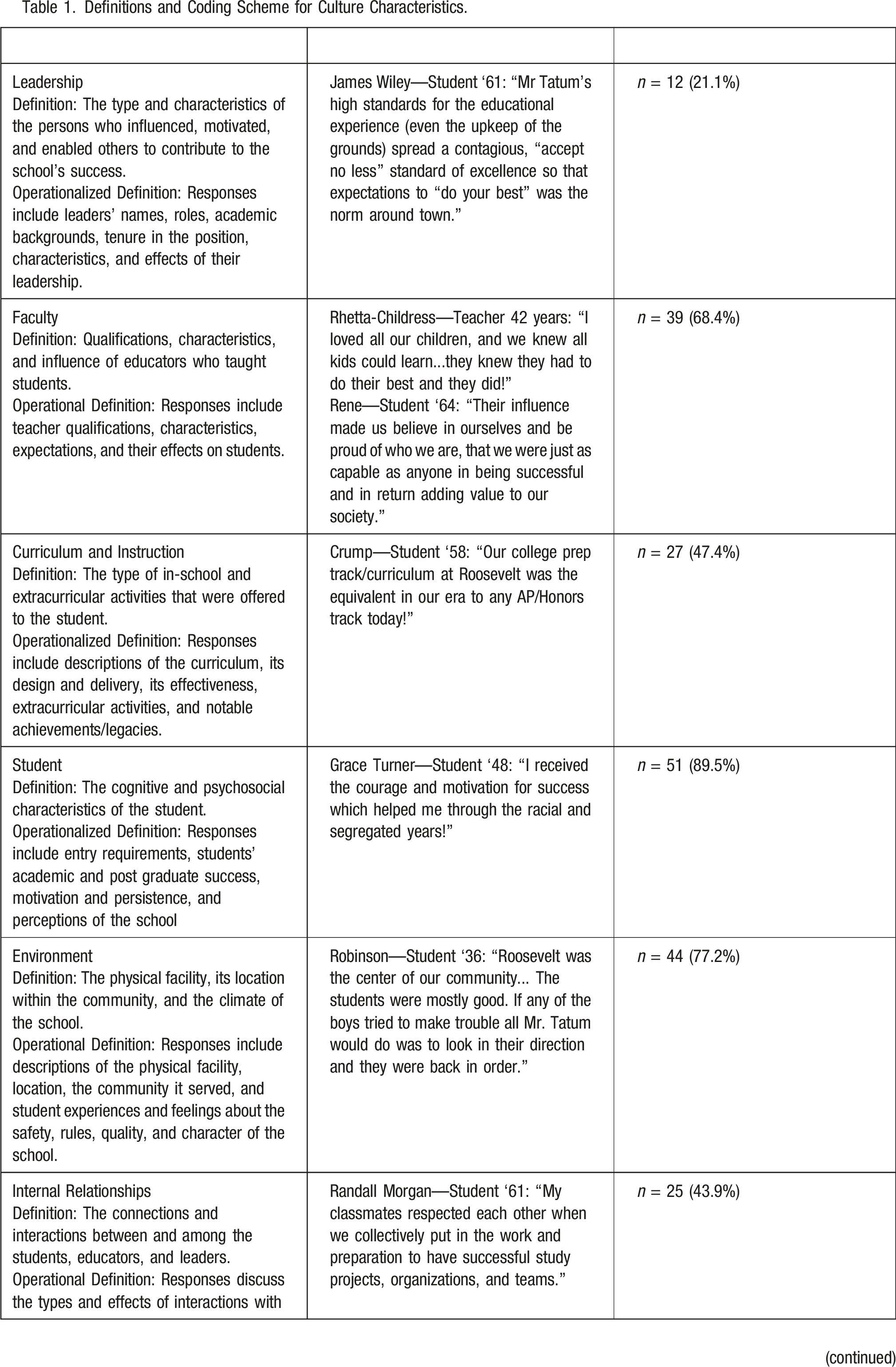
Definitions and Coding Scheme for Culture Characteristics.
Participants
Characteristics of Survey Participants Who Were Students at Roosevelt.
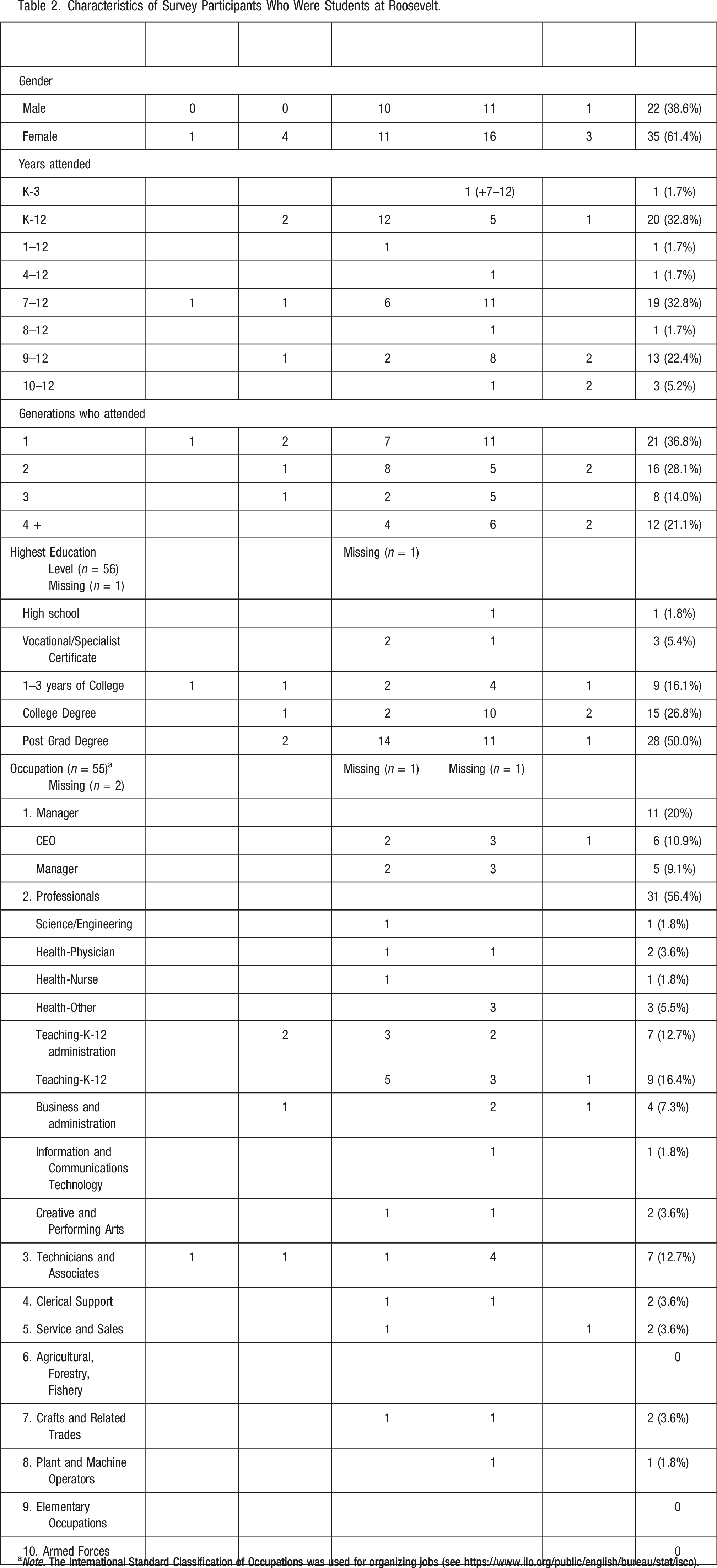
aNote. The International Standard Classification of Occupations was used for organizing jobs (see https://www.ilo.org/public/english/bureau/stat/isco).
Data Collection and Procedure
There were three sources of data that we used in addressing the questions: surveys, archival information, and research literature related specifically to Roosevelt.
Survey
Each participant received an online survey that asked for demographic information, the length of time they attended, their graduation date, highest level of formal education, current and past occupations, and how many generations of their family attended Roosevelt. The survey also asked the participants to rate their experience related to academics, athletics, school climate/culture, extracurricular activities, faculty and staff, and preparation for life. These three open-ended questions followed the descriptive information and the participants’ ratings: What characteristics special to Roosevelt would benefit students today? How did Roosevelt prepare you for life? What role did Roosevelt play as an influence in the greater community?
While most of the participants provided one or two sentences in responding to the questions, 20 wrote elaborate responses, which supplied more insight into the culture of the high school. Two of the survey recipients called to answer the survey questions. One other participant was called to elaborate her responses.
Archival Information
Archival information included memoirs, letters, and newspaper articles. These are listed below: • Warren Anderson, former teacher, assistant principal, and principal, personal letters • Pauline Bennett, Class of 1931 (1968, February). McFarlane originator of fabled Roosevelt “tradition” (newspaper article) • Indiana Historic School Structures (articles) • G. Fields and V. Thrower (1973). Fifth in a series. The Post Tribune, p. C1
Research Literature Related to Roosevelt
Research literature related specifically to Roosevelt included the following dissertations and books. • Lillian D. Drakeford’s dissertation: What’s Race Got to do With It? A Historical Inquiry into the Impact of Color-Blind Reform on Racial Inequality in America’s Public Schools (2010) • Jacob L. Reddix, math teacher at Roosevelt from 1927–1940: Recorded memoir: A Voice Crying in the Wilderness (1974) • Smith, J. D. (1982). Great Gary athletes and coaches of the 20th century. John D. Smith Publisher. • Smith, J. D. (n.d.). Distinguished Gary Rooseveltians in profile (1932–1999). John D. Smith Publisher. • Marsha L. D. Sullivan’s dissertation: A Study of African American Males Focusing on Indicators Motivating Their Academic Success in a Predominantly Black Inner City High School (2002). • Bernard C. Watson, former student, teacher, and assistant principal: Colored, Negro, Black: Chasing the American Dream (1997)
Analysis
The first step in the analysis process was to examine and summarize information related to the participants’ demographics and personal data. The second step was to use the seven operationalized definitions to classify the responses to the open-ended questions on the survey and from the focus group (see Table 1). After the initial classification, each of the authors examined independently the anecdotal information to determine whether or not the responses matched the critical characteristics of the cultural definitions and if other characteristics were identified. These classifications were then reviewed by all of the authors to provide a member check to improve internal validity.
Results
Using the survey data, archival information, and research literature related to Roosevelt, we organized the results into these categories: Background and Context (Gary Plan and Community School) and Operationalized Definitions (Leadership, Faculty, Curriculum and Instruction, Student, Environment, Internal Relationships, External Relationships). Within each of the definitions, we then examined the related information from the surveys, archives, research literature. We then added new categories as needed.
Background and Context
Gary, Indiana was founded in 1906 as a company town to house the laborers working for U.S. Steel in what was to become the largest steel mill in the world, located at the southern end of Lake Michigan bordering Illinois and Chicago. Large numbers of first generation Eastern European immigrants followed by African Americans from the South came to work in the mills. They settled in segregated neighborhoods and by the early 1920s as the numbers grew and racial tensions escalated, segregated schools emerged.
Gary Plan
A new type of school system grew with the new city. Dr. William A. Wirt, a graduate of DePauw University and the University of Chicago and a progressive educator, became the first school superintendent and originated the “work-study-play” plan (i.e., the Gary Plan), which became the organizing principle for the Gary Public Schools. He designed the work-study-play plan to accommodate parents who worked round the clock shifts at U.S. Steel. In the early days laborers worked 12‐hour shifts, 7 days a week. The schools provided what we term today as wrap around services for the community.
Roosevelt High School was the quintessence of William Wirt’s work-study-play model of education as advanced in the Gary Plan. It was a part of the innovative progressive education movement, espoused by John Dewey and Francis Parker, that embraced education as “the way to acquire freedom,” (Thornburn, p. 2) and championed education as a manifestation of democracy, touting the professionalization of teaching (Dewey 1980; Parker, 2013; Reese, 2013). The Gary plan was a model that was implemented to “instill the values of family, work and productivity among urban students” (Kaluf & Rogers, 2011, p. 14) to develop students who were prepared to make “the most intelligent use of their own capabilities and of their environment” (Dewey & Dewey, 1962, p. 181) and produce an efficient orderly society of solid productive citizens (Cohen & Mohl, 1979). Schools like Roosevelt that followed the work-study-play structure were designed to enable students to “learn by doing,” as advanced by Dewey, and to participate in project-based learning and “hands-on activities that provided students with problem solving and opportunities to hone their career-related skills” (Kaluf & Rogers, 2011, p. 14).
Under the Gary Plan, schools were organized as community schools where students attended schools in their own community from kindergarten through 12th grade, engaging in academic, social, cultural, and recreational experiences in their home community (Reddix, 1974, p. 106). Students were taught to value education, mindfulness about developing a sense of community, and social and civic responsibility. Roosevelt, like schools in the Gary Plan were microcosms of communities in schools combining elementary and secondary students in the same facility where they could learn from one another and where school operations and management could be maximized (Volk, 2005).
The Gary Plan was also known as the platoon system and organized students by age into platoons or groups so that they could rotate through the classroom offerings of academic subjects during one-half of the day and then rotate through “specialized studies” during the other half of the day (Mohl, 1977). These activities often included a mix of learning experiences in venues such as classrooms for traditional subjects, labs for science, workshops for manual arts (i.e., painting, carpentry, or plumbing), music, theater (dramatics) in the gymnasiums and sports on the athletics fields (Mohl, 1977). Wirt’s platoon or Gary plan was envisioned to integrate elements of the traditional curriculum with vocational or manual, and recreational experiences (Gyure, 2001). The educational model emphasized Fred Taylor’s vision of scientific management coupled with productivity, and “business-like efficiency” (Volk, 2005) wherein students would be exposed to varied experiences and the school would fully utilize all school facilities and resources throughout the day (Mohl, 1977).
The “work-study-play” plan had these unique characteristics*: • “Each community in the city had one school center with a principal and/or assistants responsible” [for primary, junior, and senior high school in the school center]. • All public playgrounds and recreational facilities of the city were located on the community school grounds under the general administration of the principal of the school center. • Formal classes were held from eight in the morning until four in the afternoon 5 days a week; informal classes met on Saturdays and in the evenings … [year-round]. • A gymnasium, swimming pool, and sports field as well as adequate trades and vocational shops were provided at each community school; a branch of the public library was located near each school center. (Reddix, 1974, pp. 105–106)
Community School
In the early years Gary had true community schools. “A child began kindergarten and completed high school in his own community. He could play, study, read, and attend concerts and football games in his own community” (Reddix, 1974, p. 106). Economy of scale was achieved by operating schools for long hours each day and on weekends year-round. Administrative expenses were reduced by combining educational and recreational activities. Also, this system offered the maximum opportunity to provide cultural enrichment to children in their own community. Students were introduced to the school culture at an early age. They were steeped in the culture by the time they reached high school. They observed close up the upper grades and wanted to emulate the high school students. They identified with the school’s sports teams, attended music, drama, and other cultural enrichment activities offered by the school at an early age. The cohesiveness of the school and the community was apparent year-round with the development of a well-educated and collaborative society. A strong sense of community was high and permeated all social and educational aspects.
Leadership
The importance of visionary and stable leadership is central to creating and sustaining a welcoming and inclusive school culture and environment. Strong and visionary administrators were tapped to lead Roosevelt School. Reddix (1974) indicated that, Roosevelt High School was fortunate to have “good leadership in its efforts to develop excellence in scholarship” (p. 112). Respondents to the survey, archival sources, and the research literature all emphasized the crucial roles played by Roosevelt’s administrators and teachers.
Archival Information and Research Literature
From its earliest years, Roosevelt’s leaders envisioned an institution of high academic achievement. McFarlane, born in the Virgin Islands (Danish at the time) received his early education in the Danish language. He became fluent in English and “received a scholarship to a teacher training college in Denmark” (Reddix, 1974, p. 108). He completed college work with honors and returned to the Virgin Islands (now an American territory) to teach. After receiving “a fellowship to the Teacher’s College of Columbia University where he earned a master’s degree in education, ... he came to Gary where he brought a well-defined philosophy of Black education” (Reddix, 1974, p. 108–109). McFarlane summarized his philosophy in this way: “The public schools are already segregated throughout the nation. Would it not be better to have good Black schools, completely segregated for the present, than to sit in the back of White classes or to attend segregated classes in a White school?” (McFarlane in Reddix, 1974, p. 109). “In good Black schools, Negro children could develop dignity, pride, and self-respect” (Reddix, 1974, p. 109). McFarlane “spent a great deal of time in classrooms where he electrified students with historic accounts of Black empires and their accomplishments worldwide” (Bennett, 1968, p. 13). The stories convinced them that they, too, could achieve.
Upon Mr. McFarlane’s resignation in June 1933, H. Theo Tatum, another educator with a master’s degree from the Teacher’s College of Columbia University, became principal. Between 1933 and 1989 Roosevelt had only three principals: Tatum (1933–1961); Warren Anderson (1961–1970); and Robert Jones (1970-1990). Tatum was an honor graduate from Wiley College in Texas. He had taught chemistry in New Orleans prior to coming to Gary as principal of East Pulaski School. Both Anderson and Jones had been teachers and assistant principals at Roosevelt prior to being named principal. These three men represented 56 years of leadership (Bennett, 1968; Reddix, 1974).
Under Tatum’s leadership, the school climate and culture initiated in the first few years were institutionalized, and the values and traditions set in place were perpetuated, reinforced, and expanded. “Tatum strove for personal excellence and discipline and expected the same from teachers and students” (Drakeford, 2010, p. 286). “There were no discipline problems” (Drakeford, 2010, p. 287). “Teaching was the central, the defining activity... [discipline] was a product of respect, cooperation, and a sense of doing something worthwhile” (Watson, pp. 37–38). Tatum’s long tenure appeared to leave an indelible imprint on the climate and culture of Roosevelt. “Mr. Tatum was an icon in the community, well respected, and admired. He exemplified the trained, educated person that the Black community perceived as a leader of the race” (Sullivan, 2002, p. 92). His influence was felt well beyond Roosevelt and the Gary community. He conducted seminars at Columbia University and for years he taught in the graduate summer program at Hampton Institute (now Hampton University). Tatum exerted a great deal of influence in the hiring of faculty and staff. He is quoted as saying: “Our teachers had degrees from top universities all over the country. They had a definite purpose, and they knew their stuff” (Sullivan, 2002, p. 91). In 1956 at the time of Roosevelt’s 25th anniversary, Mr. Tatum wrote, “Roosevelt School has taken a prominent part in accomplishing for its students the development of qualifications necessary to become well-educated and far sighted members of the social and economic life of the community” (Sullivan, 2002, p. 92).
Warren M. Anderson succeeded Tatum as principal in 1961. Having come to Roosevelt as a Latin, economics, and history teacher in 1932, he became assistant principal in 1937. He was a product of the Terre Haute, Indiana public schools. He graduated from the academic high school (Wiley) as an honor graduate. He went on to Indiana State Normal School (which became Indiana State University) and graduated with high honors with a degree in education and was certified to teach English, Latin, and Social Studies. He was awarded the Hines Medal in 1926 as the graduate with the highest grade point average among varsity athletes. In 1993 Indiana State University created the Warren M. Anderson Scholarship in his honor. In 1939, Mr. Anderson became the first African American member of the Indiana State Board of Education. He completed a Master’s in English at the University of Michigan and additional graduate work in administration at Indiana University.
Mrs. Lucretia Tolliver, who taught at Roosevelt for 43 years, recalled being recruited by Mr. Anderson in 1961. She received a phone call from him “out of the clear blue sky” saying that he had seen her name on the employment list at Howard University and he needed an English and Spanish teacher. She had planned to enter the Peace Corps, but instead went to Gary Roosevelt. Tolliver described Mr. Anderson as being “almost like a father figure,” finding her housing and acting like a mentor her first year (Drakeford, pp. 295–296).
While Tatum influenced the school positively through a top-down approach, Principal Anderson created a family atmosphere. “A gentle man by nature, Mr. Anderson was soft-spoken but powerful” (Drakeford, 2010, p. 295). He was a caring example of leadership that permeated the building and inspired teachers to treat students and colleagues with respect. While under his administration, educators worked together collegially and collaboratively (Drakeford, 2010).
Robert Jones succeeded Anderson as principal, having served as a teacher, guidance counselor, and assistant principal. Jones was a product of the Indianapolis and Terre Haute public schools. He graduated from Ball State University and completed graduate work at Purdue, Indiana State University and Loyola of Chicago. Jones built upon the legacy of his predecessors: “Many of the faculty send their children here rather than to private schools. This is because more National Achievement Scholars come from our school than any other in the area” (Robert Jones as cited by Sullivan, 2002, p. 94). Mr. Jones tried to know all of the students on a first name basis because this gave them the feeling that staff cared about them (Fields & Thrower, 1973). Jones set up a Principal Advisory Council that met after school every other week. The meetings were open to all students who felt they had a gripe. He also installed suggestion boxes for those students not able to attend the meetings. “Our principal, Mr. Jones, is a rarity. There are not many like him around who will take the time to view the problems of the school and then to go about trying to solve them” (Roosevelt student as cited by Fields and Thrower, 1973, p. C2). Fields and Thrower (1973) summarized Robert Jones tenure as principal: “The Jones administration stressed the following ideas: schools exist for youth; order and discipline are a must; pupil and staff management procedures are best approached in a manner that is firm and forceful, friendly and fair with a family atmosphere, emphasizing togetherness and unity; the best discipline is self-discipline; the curriculum is determined by what takes place when the teacher closes the classroom door; constant change and experimentation are essential; and accurate, continuous evaluation is necessary.” (p. C2)
These tenets describe the unifying thread that set the tone and culture for Gary Roosevelt throughout the time period from the 1930s through 1978. It is important to include students as leaders in shaping and reinforcing a culture of inclusion and excellence in their schools. Roosevelt offered its students many avenues and opportunities to develop and practice leadership skills from early in elementary school through high school. These will be examined in a later section of this study.
Survey Responses
While only 12 of the participants mentioned the administration and leadership explicitly (21.1%), administrators may have been included when participants discussed faculty and teachers. It was clear from the participants’ responses that leadership established high standards for behavior at Roosevelt (Participant #1, Class of 1936; Participant #19, Class of 1956). As a kindergarten teacher for 42 years noted, “Mr. Tatum was a good administrator and ran a tight ship.” “If any of the boys tried to make trouble all Mr. Tatum would do was to look in their direction and they were back in order” (Participant #1, Class of 1936). Administrators emphasized “the importance of honesty, great values, and principles” (Participant #24, Class of 1958).
Moreover, administrators were dedicated to mentoring, preparing students to succeed (Participant #57, Class of 1978), and serving as role models (Participant #28, Class of 1961). Participant #56 (Class of 1975) described their involvement in this way: “The administration and faculty took a personal interest in the future and success of most students. They also got involved in school spirit activities.” In elaborating the roles they served, Participant #28 (Class of 1961) said, “I was taught how to succeed in life through preparation and adaptability.” “They invested so much of themselves in us and our success in a nurturing environment” (Participant #18, Class of 1956).
The administration also made a concerted effort to include parents: “The school expected and wanted parent involvement.” As Participant #43 (Class of 1966) noted, “The middle school principal ... Mr Weingard ... took the initiative to visit my home to have a discussion with my mother to encourage me to register for college preparatory courses for 9th grade. I took the courses.”
Participant #28 (Class of 1961) described the administrators as “outstanding and often overqualified for their positions” because of “Institutional Racism and segregation.” Eventually, “Roosevelt administrators became administrators of the city-wide Gary School System and several of them ultimately held elected office and board and commission positions in the Civil City of Gary. Two of our coaches became athletic directors for the Gary Schools and one of our former principals became a School Board member. Several of our faculty became principals of other Gary schools” (Participant #24, Class of 1958).
Faculty
Archival information, research literature, and survey respondents all emphasized how caring and committed teachers convinced them that they could thrive and succeed in the greater world, despite its many challenges.
Archival Information and Research Literature
From the beginning, Roosevelt and its leaders attracted the best and brightest teachers. For example, the French teacher during the first three decades of the school had completed graduate work at the Sorbonne in Paris. A beloved math and physics teacher had worked on the Manhattan Project during World War II at the University of Chicago. Tatum, Anderson, and Jones exerted a great deal of influence in the hiring of faculty and staff. They selected the best teachers they could find from across the country, graduates from HBCU’s and major colleges and universities.
As a teacher, Sullivan (2002) recalled that she held very high expectations and let the students know that she expected them to do well. Moreover, students were successful because they were taught their heritage and had role models in the school (Sullivan, 2002). “These men and women paved the way for what African American youngsters could be. They were all interested in these youngsters and taking them down the path towards success. I was able to see myself as an African American professional very easily because that’s all I knew, that was all that was around me, so it never struck me as being an exception” (Sullivan, 2002, p. 105). Roosevelt’s positive atmosphere was orchestrated by the institutionalization of rituals and school customs. Roosevelt students believed that “Black pride and the Roosevelt traditions would carry them forward” (Drakeford, 2010, p. 345).
Similar to the administration, most of the faculty remained at Roosevelt throughout their professional careers. These teaching careers spanned 30–40 years. A good number of graduates returned to Roosevelt to teach. In fact, Roosevelt’s first and only graduate in 1930, Evelyn Baptiste, became a teacher at Roosevelt. However, human and physical resources were limited. Anderson, who taught Latin, history, and economics in 1932, described teaching six classes his first semester—including one class in Latin 1 and one class in Latin 3. He also wrote about teaching Saturday school and night school from 1932 through the 1935–36 school year. Supplies were also “woefully short and such resources must be cousined considerably” (Anderson, personal correspondence, October 29, 1932). He told his Latin supervisor, who was visiting his classroom, that he needed more textbooks.
After the Brown v. Board decision, Roosevelt faculty members were recruited to teach at top universities across the country. “Central office tried to entice some of the Black teachers identified as being ‘superior’ into leaving Roosevelt to teach at White schools. The segregated setting at Roosevelt, however, did not seem to bother most teachers or students ... the vast majority of students enjoyed going to Roosevelt” (Drakeford, 2010, p. 299).
Survey Responses
Participant responses covering 42 years indicate that the quality and commitment of the faculty had been consistent. A large majority of (n = 39; 68.4%) described these teacher influences on their students’ performance at Roosevelt and beyond: personal qualities, inclusion of psychosocial skills and enrichment in the curriculum, attention to individual students, leadership in the community, and responses to external cultural challenges and racism.
Participants consistently reported how the faculty “stressed the importance of education as preparation for life” (Participant #12, Class of 1955), set high expectations—“My teachers expected high performance and were good motivators” (Participant #44, Class of 1966), “taught me to work at my highest level and be dedicated to my career” (Participant #40, Class of 1965), were caring—“provided me with teachers who showed concern, care ...” (Respondent #6, Class of 1951), and served as models. “The discipline of the faculty generated a sense of discipline from the students. I wanted to become a teacher because of some of my teachers’ influence on me” (Respondent #6, Class of 1951). In a later follow-up telephone interview, Respondent #6 described a “lesson on love” that has remained with her throughout her life. When she and other students laughed at the unattractive and rough hands of one of her ninth grade teachers, in a quiet and dignified manner her teacher told them about working as a child in the fields on Sapelo Island in Georgia. This was a teachable moment and a lesson in humility.
Faculty also encouraged student engagement through enrichment and their attention to the students’ psychosocial development. For example, a 1956 graduate who became an art teacher in Albany, NY and later the director of all federal education funds that came to the state of New York spoke about her Roosevelt art teacher who often took her on Saturday field trips to the Art Institute in Chicago. In the psychosocial skills area, students were taught independence and self-respect, leadership skills, time management, multitasking, methods for staying focused, how to set priorities, organization skills, discipline, and tools for becoming independent. One participant summarized this focus by saying that faculty “prepared us to be high achievers” and “instill[ed] the basic value in us that anything worth doing is worth doing well” (Participant #24, Class of 1958).
The faculty also tailored the learning experiences to individual students by providing “one on one attention in learning” (Participant #53, Class of 1969), “taking a personal interest in their future and success” and “recognizing students for their work and special talents” (Participant #56, Class of 1975). Students felt that “counselors, nurses, and teachers were people we could talk to if we needed to do so” (Participant #10, Class of 1954) and that they had “love and genuine concern for each of us” (Participant #15, Class of 1955). One participant described the effects of this personal attention. Participant #13, a 1955 graduate and studio artist/instructor at the Institute of American Indian Arts in Santa Fe, NM described the profound influence his geography teacher had on the trajectory of his career. When he arrived at Roosevelt from Alabama and entered the seventh grade, this teacher noticed his potential and after a few weeks had him moved to a class with a more academically advanced group of students who were serious about their education and motivated to succeed. These students remained together throughout their years at Roosevelt and became his close life-long friends. “My group of friends kept me moving along. The teachers and friends made me aware of the benefits of higher education. I went on to the Rhode Island School of Design and the Royal College of the Arts in London for my master’s degree.”
Faculty were also actively involved in after school activities, the central school district, and the community. A graduate from the class of 1949 (Participant #5) and a retired Gary teacher wrote: “Roosevelt was respected as the source for excellent leaders who participated in the community offering their knowledge in many areas for improvement and unity.” This activism resulted in Roosevelt’s visibility. As one graduate from the class of 1975 wrote: “You took pride in attending the historical ‘Velt and as a result it was a boost to your confidence to go out in the world and represent (it) because everyone in Indiana knew of Roosevelt’s status’” (Participant #56).
The faculty also responded to external challenges of teaching the students about racism by keeping “one step ahead.” For example, a graduate responded, “We had excellent teachers, and they would always tell us how we would be looked (at) differently than our White peers” (Participant #1, Class of 1936). Other participants reflected on the challenges faced by the faculty. A 1964 graduate and retired human resources/labor relations manager in New Mexico wrote about not realizing until later on in life that: “Our teachers were special. They experienced the Jim Crow era and did their best to beat that ongoing suppression by insuring we got the best education possible to compete in life. Their influence made us believe in ourselves and be proud of who we are, that we were just as capable as anyone in being successful and in return adding value to our society” (Participant #39, Class of 1964).
Most participants recognized that the faculty were very well-educated (Participant #12, 1955). They realized that the faculty were “often overqualified for their positions as they dealt with Institutional Racism and segregation” (Participant #28, Class of 1961) and “hampered by segregation in moving elsewhere” (Participant #29, Class of 1961). He concluded, “we were taught by the ‘best and the brightest—dedicated mentors—most holding advanced degrees and dozens of years of experience’” Participant #29).
Curriculum and Instruction
Survey respondents, archival information, and the research literature describe a rigorous college preparatory academic curriculum and a vocational/technical curriculum modeled after the Gary Plan. The important effects of athletics are also noted as not only the third leg of the Work-Study-Play Plan but also as a source of pride among Roosevelt students, faculty, and the community.
Archival Information and Research Literature
Under McFarlane’s leadership, the faculty launched a crusade to improve the scholarship at Roosevelt. Reddix (1974) one of the original faculty members, writes, “In the new Roosevelt High School building dedicated in 1930, the faculty and students settled down to the serious academic and extracurricular activities. . . . Most of the original faculty members participated in a planned program of remedial instruction designed to encourage potentially able students toward excellence in academic achievement” (Bennett, 1968, p. 13). Faculty members worked extra time and received extra pay for remedial instruction on Saturdays and in summer school. “With almost religious fervor, McFarlane devoted his time to individual instruction for the students at Roosevelt High School” (Bennett, 1968, p. 13).
Roosevelt ultimately offered both a rigorous college preparatory academic curriculum and a vocational/technical curriculum as did the other Gary schools modeled after Superintendent Wirt’s “Work-Study-Play” plan (see Gary Plan above). There were seven periods in the school day. Students usually enrolled in four academic courses (math, science, English, foreign language, or social studies), two electives, and one study period. A student with a straight “A” grade point average could take five academic courses and two study periods. There were two libraries, a junior library for grades 4 through 8, and a senior library for grades 9 through 12. The spacious senior library was adjacent to the study hall and available for students during their study period. As part of the Gary plan, a branch of the Gary Public Library was next door to the Roosevelt campus and students could get permission to walk to the branch library and make use of those resources during the school day or after school.
The Work-Study-Play plan was designed to introduce the students to a wide variety of academic, non-academic, and cultural experiences and move the students through these experiences on a daily basis. When students rotated through the Auditorium Department, they could be assigned to speech for one marking period or choral music for another. On Fridays the students might see a film on the lives of Schumann and Brahms or Madame Curie along with a discussion. In addition, over 30 extracurricular opportunities were available for the students. A teacher commented, “On any given day there might be 500 students staying after school to participate in over 30 extracurricular activities” (Drakeford, 2010, p. 300).
Athletics was always an important component in the Roosevelt experience. As Mr. Tatum wrote, “The development of mankind through physical as well as mental and intellectual procedures has been an effective educational and social goal” (Smith, 1982, p. 3). Play was the third leg of the “Work-Study-Play” plan. An excellent and dedicated coaching staff led the Roosevelt “Panthers” to football, basketball, and track championships from the 1930s onward. In the 1930s, Roosevelt could play only Black teams and had to travel out of state as far away as Virginia and North Carolina to compete. In 1955 Roosevelt played Indianapolis Attucks in the state basketball championship game and lost. At that time Gary Roosevelt and Indianapolis Attucks were two of the three designated all-Black high schools in the state. This was the first time an all-Black team had reached the state finals. Roosevelt lost in 1955 but came back to win the coveted Indiana State High School Basketball Championship in 1968. Through the years Roosevelt coaches and team members have been inducted into the Indiana State Hall of Fame and remain a source of pride to this day.
Survey responses
Almost half of the participants (n = 27; 47.4%) described the qualities and variety of curricular options available to Roosevelt students. One of the participants described the curriculum as having two tracks: academic and workforce preparation (Respondent #21, Class of 1956); however, there were not only core academic and practical or trade courses but also advanced courses, and enrichment or extracurricular activities.
Practical or trade courses mentioned by participants included home economics, life-skills, shop, and options related to specific jobs and careers. Advanced courses provided college prep in core subject areas and individualized projects. Most of these classes “were demanding and required constant preparation for the next class” (Respondent #44, Class of 1966). Respondent #24 (Class of 1958) summarized “Our College Prep Track/Curriculum at Roosevelt was the equivalent, in our era to any AP/honors Track today.” Extracurricular and enrichment activities occurred within and outside the school setting. Besides athletics, students were able to choose from a variety of options: ROTC, marching band, music, drama, peer clubs, community events, field trips, competitions, and activities related to different types of careers. Participants described the outcomes of this curriculum as preparing them for college and learning, developing their abilities and leadership skills, and training for life’s challenges. As one participant summarized: From practical “shop” classes to the marching band, the advanced science projects, after-school athletics and peer clubs, the Roosevelt experience provided the broad, well-rounded foundation needed for the rest of my future (Respondent #29, class of 1961).
Athletics also appeared as a springboard to future opportunities. Participant #12, class of 1955 noted that “I did not take education very seriously in high school. Athletics saved me. Athletics turned my entire future around. I went to the basketball court every day 4 to 5 hours honing my skills.” After Participant #12 graduated, he played in college and in the National Basketball Association, becoming the first African American to be named to the National All-American team. He was also an All-American, won two NBA championships, and was inducted into the Indiana Basketball Hall of Fame, the Tennessee Sports Hall of Fame, and the National Collegiate Sports Hall of Fame.
Students
What do the students say about the Roosevelt experience? Survey responses, archival information, and the research literature offer similar descriptions of the lived experiences of Roosevelt students from the 1936 until 1978.
Archival Information and Research Literature
The faculty’s drive for academic excellence and their early focus on remedial instruction resulted in the students’ performing at a high level. “Within a few short years, the Black students of Roosevelt began to achieve high scores on city and state tests. A record number of Roosevelt graduates began to achieve good records in the best universities and colleges in the country” (Reddix, 1974, p.).
The continuity of faculty and administrative leadership reinforced the early vision and values of dignity, pride, integrity, self-respect, achievement, and persistence in the face of challenges and hardships. As Bernard Watson (1997), a former Roosevelt student, teacher, assistant principal, and professor at Temple University, described some of these lessons he learned at Roosevelt: “insistence on excellence ... standards of conduct and standards of performance ... criteria existed that were the basis for judgment” and “to recognize the importance of dreams, a vision for the future—and the necessity of backing them up with realistic plans, confidence, and the willingness to work hard” (p. 31). He also mentioned the longevity of friendships formed at Roosevelt.
Survey Responses
A positive school culture assists students in developing positive behaviors and learning how to be successful. Almost all of the participants (n = 51, 89.5%) mentioned how Roosevelt influenced and developed personal characteristics and its long-term effect on their success.
One third of the respondents, mentioned the pride they felt in attending Roosevelt. “As a student from kindergarten to graduation, there was no other place that I wanted to be” (Participant #20, Class of 1956). Roosevelt not only encouraged academics but an appreciation of culture, a pride in being Black, and a strong racial identity (Participant #9, Class of 1952; Participant #30, Class of 1962) so that students felt “important and heard” (Participant #49, Class of 1968). “The people therein exhibited pride that we were the best!” (Participant #42, Class of 1965); “I knew who I was and what I could accomplish” (Participant #30, Class of 1962); “I believed in myself and my abilities” (Participant #26, Class of 1958). The participants also learned what was expected and that they had to prove themselves every day, work harder than others, and set an example (Participant #18, Class of 1956; Participant #33, Class of 1963; Participant #35, Class of 1963).
Because of this pride, the Roosevelt students were motivated to do their best, had high expectations for themselves, and rose to the occasion (Participant #8, Class of 1952; Participant #18, Class of 1956; Participant #55, Class of 1974). As Participant #52 (Class of 1968) elaborated, “Roosevelt instilled confidence and pride in me that I could accomplish anything that I wanted to do.” The students excelled not only in general academic areas but also in specific areas of talent such as athletics, (Participant #2, Class of 1948; Participant #12, Class of 1955), the arts (Participant #13, Class of 1955), and fields leading to professional careers (e.g., teaching, business, medicine, social work). Participants felt that they would also be able to overcome existing challenges—preparing students to succeed in spite of poverty (Participant #57, Class of 1978) and receiving “the courage and motivation for success [to help them] through the racial and segregated years!” (Participant #5, Class of 1949).
The pride and high expectations engendered other psychosocial skills as well—self-confidence and belief in self, respecting self and others (responsibility and accountability), persistence and determination, independence, leading by example, supporting one another and principled behavior such as honesty and other values. (Participant #1, 1936; Participant #3, Class of 1949; Participant #24, Class of 1958; Participant #39, Class of 1964; Participant #45, Class of 1967; Participant #55, Class of 1974). The participants were also directly taught “self-control, hallway and class behavior, and how to meet people and how to conduct ourselves away from school. We were taught to respect all adults” (Participant #10, Class of 1954).
Not only did the pride and high expectations last in the short-term but also the long-term. As Participant #42 (Class of 1965) mentioned, “That [pride] stayed with me ... that was the educational foundation that launched my future endeavors...I can do anything.”
Participants were committed to learning from past mistakes (Participant #43, Class of 1966) and lifelong learning (Participant #21, Class of 1956; Participant #43, Class of 1966). As Participant #44 (Class of 1966) summarized, “Whether you were in grade school or junior high school, you looked forward to the day that you would become... We always felt that we could achieve at Roosevelt and beyond.”
Environment
The archival information, research literature, and survey responses offer similar descriptions about the characteristics of the school environment—physical beauty, safe, and positive school culture.
Archival Information and Research Literature
Roosevelt was located in the de-facto segregated neighborhood of African Americans in Gary, known as Midtown or the Central District. The Colonial Revival main building, built in 1931, was situated in a park-like setting on a 21-acre campus and was a source of community pride. William Butts Ittner, an architect responsible for many of the design concepts used in modern school architecture today, designed Roosevelt and four other schools in Gary. “He [Ittner] helped transform what he described as a ‘prison-like’ box into an efficient building that was highly functional, economically built and pleasing to the eye. ... His designs went beyond the utilitarian and provided structures that represented grace and style. … Roosevelt High School displays all of these innovations and treatments” (Indiana Historic School Structures, pp. 3–7). The building was added to the National Register of Historic Places on December 19, 2012.
Past students also noted the physical beauty and style of Roosevelt. Watson (1997) remembered, “Roosevelt was the envy of most people in the city. For Negroes, it was the pinnacle” (p. 27) and “... looked like a very small college campus. ... Inside the school, the environment was spotless, no graffiti anywhere” (p. 44) (see Figure 1 Roosevelt High School Alumni Committee.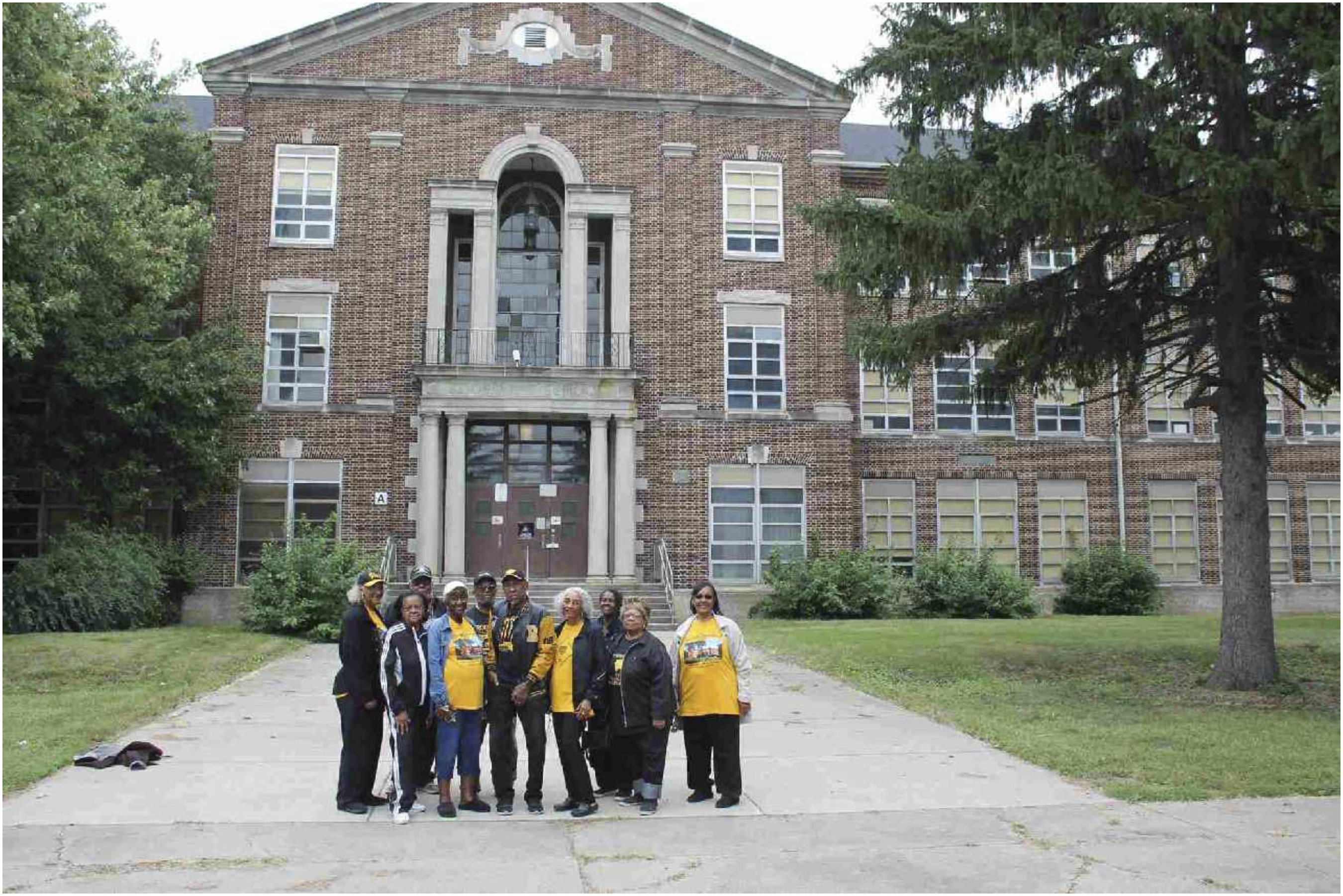
Survey Responses
Characteristics of the school environment were referenced by 44 (77.2%) of the participants. As Participant #2 (Class of 1936) observed, “The school provided a safe and cultural environment where its students thrived.” “Fighting was not allowed” (Participant #19, Class of 1956). Students “appreciated rules” (Participant #30, Class of 1962) and were “given rules to follow” (Participant #10, Class of 1954). Students were taught “self-control, hallway and class behavior, and how to meet people ... When parents and other people visited Roosevelt, they were welcomed and treated with respect.” (Participant #10, Class of 1954).
Along with rules, the campus and the surrounding grounds influenced academic and social behaviors. “The campus was kept clean” (Participant #10, Class of 1954) and was “beautiful, well-maintained, and expansive ... in a park-like setting” (Participant #18, Class of 1956). “Who would dare walk on the beautiful school lawn of ours? If you did, you got called out...” (Participant #39, Class of 1964). This “mighty physical structure” and the faculty and staff influenced students’ pride—“we were the best! I can do anything!” (Participant #42, Class of 1965).
The environmental culture was viewed positively and supported at Roosevelt. “It was one of the first schools built for Black students of Gary” (Participant #34, Class of 1963). “Everybody was so proud to have a school for us with teachers that were like us” (Participant #1, Class 1936). As Participant #3 noticed, “[It was] the only place where Blacks would experience the culture of the Black race and self-respect” (Participant #3, Class of 1949). “Roosevelt prepared me to always be proud of my race and take pride in my family and Gary” (Participant #8, Class of 1952). New students to Roosevelt noted that “these opportunities were not available to me coming from Alabama” (Participant #13, Class of 1955). Indeed, “Other than the Black churches, Roosevelt was the center of the Black community. It was our symbol of excellence, achievement, and our future” (Participant #26, Class of 1958). The community viewed Roosevelt very positively, “if something was going on at Roosevelt, it was good and right” (Participant #38, Class of 1967).
Because of this positive view and positive outcomes, multiple generations from the same families attended. Over 66% of the respondents noted that Roosevelt was the school of their older brothers and sisters, parents, and grandparents. It was their “heritage” (Participant #57, Class of 1978). Because of this legacy, students already had a positive set of expectations: Once I entered the school, I knew what was expected of me by the school and my family and my friends. The students were many and they knew what we expected of them when they entered the building. ... As I advanced through Roosevelt, there were always a group of older students that I tried to emulate (Participant #20, Class of 1956).
This environment influenced the prosocial behaviors mentioned by the majority of the participants (e.g., respect, honesty, perseverance, responsibility, honesty, independence, goal setting) and had long-term effects on their future. “The school climate and culture produced a loving, respectful environment; a focus on achieving—everyone’s life was of value!” (Participant #5, Class of 1949). “Without Roosevelt, I would not have been as successful throughout my life” (Participant #46, Class of 1967).
Internal Relationships
Internal relationships with teachers, students, and school leaders contribute to a school’s culture. These relationships were described by the participants and were found in the archival information and research literature.
Archival Information and Research Literature
As mentioned previously, Principal Anderson created a family atmosphere, which inspired teachers to treat students and colleagues in the same way (Drakeford, 2010). Beginning teachers felt mentored by their colleagues who were happy to listen and share their expertise. Drakeford (2010) attributes this close network of educators as the stability of the staff and the frequent contacts with the department chairperson who would provide support and respond to any needs teachers might have. “The cooperative culture contributed to the teachers’ willingness to give of their free time, without compensation, to mentor students, purposively serve as role models, and sponsor numerous clubs and extracurricular activities” (Drakeford, 2010, pp. 297–298). In response to the teachers, the students trusted the teachers and felt they could talk to them about any situations that might arise (Sullivan, 2002). With all of the out-of-school activities, students also created close relationships. As Watson (1997) recalls, “Graduation was a turning point for everyone. We would scatter. Some would always be friends” (p. 30).
Survey Responses
Almost half of the participants (n = 25, 43.9%) described relationships within the school that influenced them. The described relationships were with other students, teachers, administrators, and coaches. With students, respondents mentioned a “comradery” (Participant #27, Class of 1960) and a “social network” (Participant #18, Class of 1956) where classmates “respected each other” and “collectively put in the work and preparation to have successful study projects, organizations, and teams.” Their group of friends and, in some cases, siblings “kept them moving along” and even “had higher goals” at times (Participants #13, Class of 1955; Participant #35, Class of 1963).
With administrators, faculty, and coaches, they described how they “could talk to [them] if we needed to do so” (Participant #10, Class of 1954), how they were nurtured (e.g., “They were like parents away from home” (Participant #24, Class of 1958), and how they were mentored (e.g., “The teachers across the board delivered a very personal education demonstrating the deep dedication and high resourcefulness of a mother robin seeing to it that every student felt individually known and well taken care of” Participant #28, Class of 1961). Faculty taught students how “to help others when possible” (Participant #23, Class of 1958), “... to think before acting, to be thoughtful and try to understand the other view” (Participant #37, Class of 1963), and how “to be loyal and stay in contact with others” (Participant #53, Class of 1969).
These internal relationships had long-term impacts on the students: lifelong friendships (e.g., “I still communicate with friends I’ve known for over 75 years!” Participant #15, Class of 1955), a “resource of caring faculty” (Participant #36, Class of 1963), and even marriage (e.g., “I am still married to the same first wife for 60+ years,” Participant #17, Class of 1956). As Participant #22 (Class of 1957) summarized, “I truly believed teachers, especially when a student would come back to visit who had done well and even exceptional. Just work hard, move up, and bam, you would get a talented teacher who cared about you.”
External Relationships
Developing strong external relationships among parents, students, faculty members and the community influence the overall culture of the school. These types of external relationships existed at Roosevelt and were supported by the surveys, research literature, and archival information.
Archival Information and Research Literature
Researchers mention the connections that Roosevelt had to the community and beyond. Roosevelt was viewed as a symbol of excellence and pride not only in Gary but in the entire state. Many community organizations offered scholarships or other awards for academic excellence, such as the school’s alumni groups, as well as the Parent-Teacher Association, which was nourished, enriched, and grew throughout the years (Drakeford, 2010; Watson, 1997).
Roosevelt recognized the importance of viewing parents as critical partners in the education of their children. For this reason, the teachers met regularly and worked with the parents to ensure that students would succeed (Sullivan, 2002). Students also recognized that both parents and teachers played a major role in shaping and molding what they thought of themselves (Sullivan, 2002).
Teachers at Roosevelt also had connections to higher education and used their connections to open doors for students (Drakeford, 2010). One of the students recalled how a teacher asked him what school he wanted to attend. After responding, Howard University, she said: “come on and go with me.” She went into the office, picked up the telephone and called James [Nabrit]. He was President of the school. She said, “James, I got this boy here at Roosevelt School. He needs a scholarship,” and when she finished on the telephone, I had a scholarship. (p. 299)
Survey Responses
The majority of the participants (n = 37, 64.9%) described relationships with their families and the community. Primary among these relationships was with families. This relationship was reciprocal with the family supporting the school (e.g., “The family was the basic source of your aspirations, then the family supported the school,” Participant #5, Class of 1949), and the faculty supporting the family (e.g., “The administrators and teachers were cooperative and worked with families to solve student problems; when necessary, encourage and directed students/graduates to job opportunities, higher learning institutions, and athletic opportunities,” Participant #19, Class of 1956). The administrative staff expected this cooperation: “If the school was doing their part, the school expected and wanted parent involvement,” Participant #20, Class of 1956). The success of the student was definitely a shared responsibility (Participant #28, Class of 1961).
Because faculty were involved in community activities, they knew not only the families and community members but also were volunteers (e.g., “faculty and staff served as volunteers in civic organizations and were active in the local churches,” Participant #18, Class of 1956) and leaders in the community at large (e.g., “Roosevelt was respected as the source for excellent leaders who participated in the community offering their knowledge in many areas for improvement and unity!” Participant #4, Class of 1949). Moreover, they were involved in the civic, government, and social affairs of the City of Gary and the School District of Gary (Participants #24, Class of 1958; Participant #29, Class of 1961). Because of their leadership and involvement in the community, Roosevelt was the community’s center (Participant #1, Class of 1936), and “became a symbol of community pride and cohesion” (Participant #18, Class of 1956).
Roosevelt also “was the cultural center of the neighborhood offering adult education, athletics (including an indoor swimming pool), art, drama, music, social and service clubs” (Participant #18, Class of 1956). As Participant #28 (Class of 1961) shared, “As we, who were raised in a de-facto segregated community as Gary was in the 1940s to the 1960s, the excellence of our school created a better quality of life for the greater community of Northwest Indiana.” “It was a beacon that people could point to with pride” (Participant #8, Class of 1952) and “was genuinely respected throughout the state of Indiana and beyond” (Participant #28, Class of 1961). The community “saw young people who could advance with pride and confidence, even though coming from an all-Black school” (Participant #33, Class of 1963). “People knew if you went to Roosevelt you were prepared for the life you would encounter as an adult” (Participant #51, Class of 1968).
Discussion
There is a renewed sense of urgency and clarion call for the strengthening of self-sufficient educational institutions that can bolster the promising trajectories of African American students. This earnestness is exacerbated by the recent rulings by the US Supreme Court, that has reversed 45 years of legal precedent regarding Affirmative Action in higher education admissions. This legal action will potentially have far-reaching rippling effects on the entire ecosystem in education including in K-12.
Consequently, educational professionals will need to consider the distinctive features of the exemplary high school cultures of Dunbar, Sumner, Terrell, and Roosevelt, and endeavor to capture the elements that offer promising approaches to foster and sustain strong student advancement. These elements must be coupled with the creation and evaluation of “high quality, advanced curriculum designed for culturally and linguistically diverse students” (NAGC, 2011, p. 1).
This article draws on valuable insights that can be gleaned from the culture of the four elite African American High Schools with a more in-depth focus on Theodore Roosevelt High School as a newly highlighted Black high school in the literature. Much has been learned from the experiences, the literature, and the anecdotal accounts regarding these elite educational incubators. These exemplars have all shown synergies between the educational expectations and practices both internally and externally that have proven records of strong schools and successful student trajectories. The emphasis on transformational and collaborative leadership coupled with pedagogical excellence from educators and the diligence from students offers the promise of the cultivation of institutions that can once again yield robust educational environments and excellent student outcomes.
Broadly, the discussions and findings presented in the article provide adequate insights into the cultural characteristics of four elite African American high schools, initiated prior to Brown versus the Board of Education, and illustrate key characteristics including—leadership, faculty, curriculum and instruction, qualities of the students, environment, and internal and external relationships. Of paramount importance is the high caliber and sustained leadership of individuals who served as champions for the cultivation of stellar school environments and who were determined to create institutions that were a distinctive blend of school and community. They respected the faculty and built collegial and collaborative school cultures.
An important finding in our research has been the emphasis on the highly educated and qualified faculty members in these schools. Many teachers had advanced degrees and came from prestigious universities, demonstrating a commitment to academic excellence (see Bonner et al., 2010; Defelice, 2022; Mitchell, Jr., 2012). This highlights the importance placed on providing a rigorous education to African American students and preparing them for college. The teachers were not only knowledgeable but also caring, forming strong relationships with the students and their parents, and serving as mentors and role models. These characteristics have been considered as key elements in evidence-based practices that support high achieving students. In particular, these characteristics were observed at Roosevelt and have been acknowledged in the literature (see Johnsen & Clarenbach, 2017; Kaul et al., 2015; NAGC & CEC, 2013; Novak et al., 2020; Subotnik et al., 2021; Vrabie & Cretu, 2022). Further, this culture toward excellence was also affirmed in surveys from Roosevelt alumni at their 50-year reunion. Survey respondents wrote positive, even enthusiastic comments about many of their teachers and the impact that Roosevelt had on their lives. “I felt instructors taught with love and gave me a tremendous sense of security. Teachers and counselors inspired, exposed, and encouraged me. Several visionary teachers helped mold my career both spiritually and creatively” (Focus Group respondent).
Additional findings reflect that a rigorous and challenging curriculum in these schools emphasized the preparation of students for higher education. The emphasis on the grouping of like-ability peers, a college preparatory curriculum, acceleration, and the expectation that students would excel academically contributed to successful student outcomes (see Assouline et al., 2015; Steenbergen-Hu et al., 2016). The schools also provided a range of choices of extracurricular activities, that intersected with students’ lives in the community, to foster students’ interests, personal growth, and development in various areas. All of these curricular practices are well-documented in the gifted literature and demonstrate significant impact on K-12 students’ academic achievement and career choices across all ability groups (see Hodges et al., 2017; Plucker & Callahan, 2014; Subotnik et al., 2011; Vrabie & Cretu, 2022).
The students in these elite African American high schools exhibited a strong sense of self-esteem, self-efficacy, and a rejection of the concept of inferiority. “Roosevelt fostered pride as an African American … provided tools to face a racist society and fight for rights of my people” (Focus group respondent). Students believed in their abilities and aspired to achieve greatness. Their high academic achievements—outperforming their white counterparts on standardized tests—and admission to prestigious universities is a testament to their success. They were not limited by their color or race; thus, they felt confident in achieving the education that they wanted for themselves and fostered a sense of self-awareness and appreciation. As noted in the literature, a strong scholar identity and these psychosocial skills are determining influences in the successful development of talent and ultimately outstanding achievement (Dexter et al., 2021; Flowers & Banda, 2019; Subotnik et al., 2011).
The school environments were supportive and nurturing for students, teachers, and educational leaders alike. Many spoke about the family-like environment that was welcoming inclusive and receptive to individuals from varied backgrounds. This climate fostered a strong sense of pride and efficacy in students and this sense of worth was encouraged by the adults. Collaborative and cooperative cultures were fostered by leading members of the school community to embrace the mutual responsibility for supporting and caring for the school facility. These cultural features perpetuated a feeling of inclusiveness and exclusiveness for all stakeholders and provided opportunities for self-directed learning and development (Anderson & Beach, 2022; Rudasill et al., 2018).
This ethic of care extended into interpersonal relationships and educators and students formed strong and authentic bonds. These characteristics were echoed throughout the 29 surveys from the class of 1956. An alumnus spoke to this and pointed out, “The cohesion, strong sense of community, lifelong friendships, and enduring loyalty to Roosevelt expressed in the responses to the survey may in part be a reflection of the number of years we grew up together and attended the same school, the stability of the community and the strength of its families.”
The sense of belonging and the sense of place experienced by internal and external stakeholders and administrators, teachers, students, and parents as well as community members were contributors to the familial climate. The atmosphere in these elite Black High Schools was much like the characteristics advanced by Siddle Walker (2000) in her account of segregated Southern schools, where educators possessed a fierce resolve to cultivate environments that were a composite of school practices and family values (p. 256). Strong alliances among stakeholders at Roosevelt fostered compatibility between school and community.
Common threads among these elite Black schools reflected an ethos that was built on a strong sense of community, with elements of care, mutual trust, and respect (Bonner et al., 2010; Ginn, 2021; Watson, 1997). School leaders and educational professionals set the tone for an environment where there were high expectations and where students were immersed in African American cultural traditions that mirrored their upbringing. As noted in the Sumner Story, “The faculty, parents, and community were all encouraging and insisting that we outperform and achieve more than students enrolled in white schools” (Theodore Madison, Class of 1948; Bonner et al., 2010, p. 81). Learning was a seamless process from school to home. Dunbar, Sumner, and Roosevelt alumni echoed perspectives provided by scholars and were consistent with insights from anecdotal sources as well. Regarding Terrell High School: “Preparation went beyond academics and extended into helping students live a life that was directed by values and citizenship” (Ginn, 2021, p. 58). It is clear that these schools fed the mind, body, and soul.
Implications
As we consider the rich legacy of thriving school cultures such as those at Dunbar, Sumner, Terrell, and Roosevelt high schools, we conclude that it is possible for nurturing, supportive school cultures to also be places with high academic standards that set high expectations for student success. The discussion of culture of these four schools coupled with the descriptive accounts of experiences at Roosevelt, underscore what is possible for future educational institutions that endeavor to prepare high achieving African American students. To sustain flourishing, vibrant, successful schools, where bright African American students can prosper, “equitable” and “culturally responsive” environments must be cultivated (Ford et al., 2018).
Ford et al.’s (2018) Bill of Rights for Gifted Students of Color offers fitting recommendations that can be appropriately applied to schools in creating deeply embedded, high achieving cultures that manifest the character of unique incubators of advanced learner programs for African American children. First and foremost, given the strong synergy apparent between school and community in these elite Black institutions, the Bill of Rights offers relevant recommendations for aspirational school communities. Specifically, the Bill promotes the importance of training and empowerment of communities and families of color so that they can be involved as collaborators with educators in supporting student success (p. 125). The Bill also champions the importance of having a spirit of collective responsibility between school and home. In this way, families can be prepared and respected as full-fledged “co-partners” with schools in guiding students toward successful trajectories (p. 125). Consistent with this notion, as families are equipped to fully realize their roles as educators and advocates for their children, Ford et al. suggest that families should be respected and appreciated for the assets they bring as a child’s first teacher.
Regarding the curriculum and what is learned, we suggest that schools serving predominantly Black students focus on the provision of evidence-based practices often seen in gifted education (Johnsen et al., 2022). This would include an emphasis on flexible grouping by ability and achievement level, accelerated courses, progress monitoring and continuous access to advanced curriculum, enrichment, and interest-based options based on student choices (see Assouline et al., 2015; Hodges et al., 2017; Kaplan, 2021; NAGC, 2019; Steenbergen-Hu et al., 2016) Further, we are suggesting that curricular innovations in schools are reflective of the experiences of the Black students being served and that foster a cultural milieu that can enrich the teaching and learning moment. This idea is supported by The Bill of Rights that calls upon educational professionals and leaders to be sensitive to the fact that children need to relate to the curriculum and must be able to imagine themselves in the content of educational material (p. 126).
In considering approaches to champion the re-creation of schools serving Black children as places that emulate some of the salient cultural aspects of these elite high schools and illustrated in this account there will need to be collective efforts from schools and community stakeholders. This important work will necessitate crusading from unrelenting champions in our schools, our communities, and throughout our institutions. These efforts will require advocacy from visionary leaders, educational professionals, and community champions.
Limitations
Limitations are inherent in all research and our study is no exception. First, given the time period of those participating in the survey, many of the former students have already passed away. Second, there is some personal bias given that two of the authors attended elite Black high schools, with one attending Roosevelt. Third, survey research does have its limitations—not all respondents may have been aware of the survey; former students may have decided not to respond based on their experiences at Roosevelt or may have decided to respond more favorably and not have provided accurate, honest answers. Therefore, the respondents may represent those who had more positive experiences at Roosevelt than others. However, even with these limitations, these data do appear to be corroborated by archival information, research literature, Roosevelt focus group information, and the experiences of students in other elite Black high schools. All of this corroborating evidence tends to support the cultural characteristics that lead to high performing African American students. Future researchers might want to compare African American students’ performance in contemporary high schools exhibiting varying degrees of these important cultural characteristics, noting the short- and long-term effects. This information will be helpful to school administrators, educators, and communities in creating environments that build relationships and encourage high performance among African American students.
Footnotes
Declaration of Conflicting Interests
The author(s) declared no potential conflicts of interest with respect to the research, authorship, and/or publication of this article.
Funding
The author(s) received no financial support for the research, authorship, and/or publication of this article.
