



Abstract
Purpose
A genome-wide association study of Europeans showed eNOS rs1799983 and DYRK1A rs720470 to be two stroke susceptibility loci. Hypothesizing that heritability of these polymorphisms may differ among those with different IS subtypes, we performed an observational study within a Chinese Han population.
Methods
Patients with a first IS were prospectively enrolled in the Wenzhou Stroke Registry Programme from October 2016 to June 2021. Binary logistic regression was used to investigate the effects of the selected SNPs on IS. Cases with large-artery atherosclerosis (LAA), cardioembolism (CE), and small-artery occlusion (SAO) were further evaluated in subgroup analyses. The cumulative risk of IS onset according to genotype was evaluated by Kaplan–Meier survival curve and compared by log-rank test. All cases were followed for 90 days and functional outcome was estimated by the modified Rankin Scale.
Results
A total of 1798 qualified patients with IS and 756 controls were enrolled. No significant association was found between rs1799983 or rs720470 polymorphism and IS risk. According to TOAST classification, 696 (38.71%) were LAA stroke, 308 (17.13%) were SAO stroke, 496 (27.58%) were CE stroke and 298 (16.57%) were stroke of other determined or undetermined etiology. In the subgroup analysis, for rs1799983, those with GT or TT genotypes had a significantly higher risk of LAA IS compared with those with the GG genotype (co-dominant model, P = .032; dominant model, odds ratio1.451; 95% confidence interval 1.09-1.94; P = .012). Patients with the GG genotype had a significantly later LAA IS onset age compared with patients with GT or TT genotypes (log-rank test, P = .002).
Conclusion
This study indicates that eNOS rs1799983 polymorphism may serve as a genetic biomarker of LAA stroke risk among Han Chinese.
Keywords
Introduction
Ischemic stroke (IS), an acute cerebrovascular disease, is the major cause of death and acquired disability in China. A multifactorial disease, IS is thought to be caused by interactions among environmental and lifestyle factors, multiple genes, and baseline characteristics.1–5 Studies have shown that the heritability estimate for IS is approximately 40%. 6 There are also significant heritability differences among different IS subtypes. 7 As a heterogeneous disease, according to the TOAST classification system, IS is divided into five subtypes: large-artery atherosclerosis (LAA), cardioembolism (CE), small-artery occlusion (SAO), stroke of other determined etiology, and stroke of undetermined etiology. 8 Among these subtypes, LAA has a higher genetic heritability compared with the other subtypes. 6
IS hereditability may play a role in multiple pathways. Identifying the common genetic variants in IS could facilitate susceptibility predictions and development of new therapies. However, identifying potential genes involved with IS is challenging. In a single genome-wide association study (GWAS), performing microarrays can genotype more than 1 million single nucleotide polymorphisms (SNPs). GWAS have achieved significant success in identifying potential genes for IS. A European-only genome-wide association meta-analysis identified eNOS rs1799983 and DYRK1A rs720470 as significant for stroke. 9 Association results for IS subtypes showed rs1799983 was the strongest association with CE. However, in their Mendelian randomization (MR) analysis, the aggregate effects of common variants in the NOS-NO pathway on stroke risk were in part mediated through blood pressure. The dual specificity tyrosine-phosphorylation-regulated kinase 1A (DYRK1A) phosphorylates different transcription factors, the over-expression of DYRK1A in the photothrombotic stroke induced penumbra could be pro-apoptotic. 10 Dyrk1a, as a target gene of miRNA-192-5p, might be mediated the neuronal apoptosis and neuroinflammation in middle cerebral artery occlusion mice. 11 No association signal with specific IS subtypes and DYRK1A was found. Previous studies have shown relations between rs1799983 polymorphism and IS.12–15 However, these results remain controversial. Furthermore, these studies did not consider the connection between genetic heritability and different etiological IS subtypes. To date, for rs720470, no study has evaluated an association with IS risk within the Han Chinese population. Herein, we conducted a prospective observational cohort study to investigate the connection between rs1799983 and rs720470 polymorphisms and IS among different IS subtypes within a Chinese Han population.
Methods
Subjects
In this hospital-based prospective observational study, consecutive patients diagnosed with IS were recruited into the Wenzhou Stroke Registry Programme (WSRP) from October 2016 to June 2021. Details of the WSRP database have been described previously. 16 The inclusion criteria for cases were: (1) first IS, (2) age ≥18 years, (3) time from symptom onset to IS diagnosis ≤7 days, and (4) Chinese Han ethnicity. The control group was recruited from among local residents who underwent hospital medical examinations during the study period. Control inclusion criteria were: (1) age ≥ 18 years, (2) Chinese Han ethnicity, (3) no clinically detectable cerebrovascular disease, and (4) no history of stroke or atherosclerotic disease.
DNA Isolation and Genotyping
Following the manufacturer instructions, genomic DNA was isolated from peripheral blood using the Magen DNA isolation kits (Guangzhou, China). Laboratory personnel blind to the participant's clinical status genotyped rs1799983 and rs720470 using SNP scan technology (GeneSky). To achieve high quality control, we randomly selected 5% of the samples for repeated genotyping; genotyping consistency of the selected samples was 100%.
Follow-up and Functional Outcome
All cases were prospectively followed for 90 days by clinical visit or telephone interview. Follow-up was conducted by qualified doctors who were blind to the patient's baseline data. Neurologic functional outcome at 90 days was estimated by the modified Rankin Scale (mRS).
Statistical Analysis
Basic clinical characteristics of both groups are reported as frequencies and percentages, and were assessed using Chi-square tests. To investigate the effects of rs1799983 and rs720470 polymorphisms on IS, binary logistic regressions were constructed. For homogeneous subgroup analyses, cases with LAA, SAO, and CE stroke types were combined. Three genetic models (co-dominant, dominant, and recessive) were performed for rs1799983 and rs720470polymorphisms. The effects of the selected SNP polymorphisms on age of IS onset is showed as a boxplot. The cumulative risk of IS onset according to genotype is presented by Kaplan–Meier survival curve and compared by log-rank test. Power and Sample Size Program (version 3.1.2) was used for power analyses. SPSS 16.0 for Windows (TEAM EQX) was used to perform statistical analyses. A two-sided P < .05 was considered statistically significant.
Results
Patient Characteristics
A total of 1800 cases and 757 controls were involved in the study. Genotyping was unsuccessfully performed for three participants (two cases, one control) with insufficient blood sample volumes. Overall, 1798 qualified patients with IS and 756 controls were included in analyses. Both groups’ baseline clinical characteristics and risk factors are presented in Table 1. Among the 1798 patients with IS, 861 (47.89%) were ≥ 65 years and 1044 (58.06%) were male. Among the 756 controls, 349 (46.16%) were ≥ 65 years and 441 (58.33%) were male. There were not significant age or gender differences between these groups (P = .426 and P = .900, respectively). Compared with controls, patients with IS were more likely to suffer preexisting hypertension (57.29% vs 52.91%, P = .042), smoke (33.09% vs 28.57%, P = .025), and drink alcohol (19.86% vs 16.40%, P = .042).
Baseline Characteristics of Participants.

Abbreviations: HTN, hypertension; SBP, systolic blood pressure; DBP, diastolic blood pressure; DM, diabetes mellitus; FBG, fasting blood glucose; L-DLC, low density lipoprotein cholesterol; BMI, body mass index; SD, standard deviation.
Chi-squrerd test.
t-test.
* P value <.05 was considered statistically significant.
Rs1799983 and rs720470 Polymorphisms and IS Susceptibility
The impacts of rs1799983 and rs720470 polymorphisms on IS risk are presented in Table 2. No SNP was found to be significantly associated with IS onset. For rs1799983, the genotype frequencies of GG, GT and TT were 74.97% (n = 1348), 23.19% (n = 417) and 1.84% (n = 33) respectively in the case group (n = 1798) and 80.03% (n = 605), 19.91% (n = 143) and 1.06% (n = 8) respectively in the control group (n = 756). In the crude model, those with the GT or TT genotype had a significantly higher risk of IS onset compared with those with the GG genotype (co-dominant genetic model, P = .017; dominant model, odds ratio [OR]1.34; 95% confidence interval [CI]1.09-1.65, P = .006). After adjusting for potential confounders (age, sex, dyslipidemia, hypertension, hyperglycemia, drinking alcohol, and smoking), the significant relation disappeared (co-dominant genetic model, adjusted P = .179; dominant model, OR 1.23, 95% CI 0.96-1.59, adjusted P = .103). For rs720470, the genotype frequencies of CC, CT and TT were 40.43% (n = 727), 34.32% (n = 617) and 25.25% (n = 454) respectively in the case group (n = 1798) and 38.62% (n = 292), 35.85% (n = 271) and 25.53% (n = 193) respectively in the control group (n = 756). No significant association was found for any genetic model for risk of IS onset.
Association Between rs1799983 and rs720470 Polymorphisms and the Susceptibility of Ischemic Stroke.

Adjusted for age, sex, dyslipidaemia, hypertension, hyperglycaemia, drinking and smoking.
Associations Between rs1799983 and rs720470 Polymorphisms and Risk for IS Subtypes
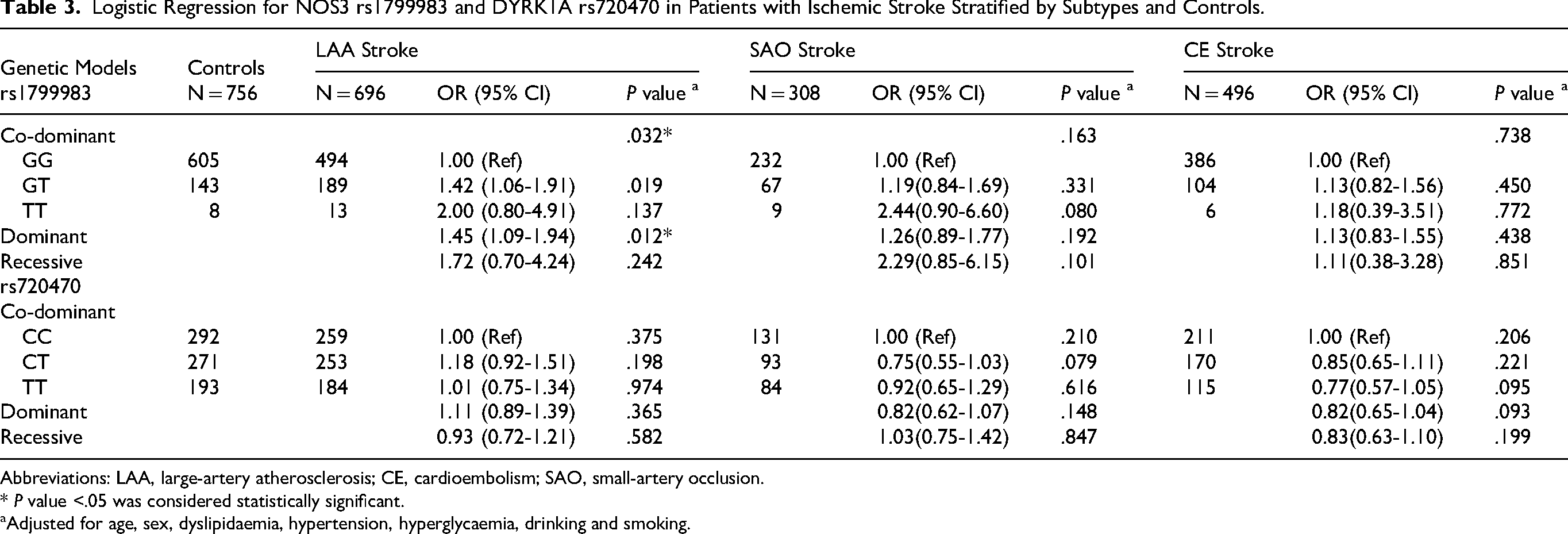
The 1798 patients with IS were stratified by TOAST classification as follows: 696 with LAA, 496 with CE, 308 with SAO, and 298 with stroke of undetermined etiology or other determined etiology. Subgroup characteristics are shown in Table 3. For rs1799983, after adjusting for potential confounders, those with the GT or TT genotype had significantly higher risk of LAA IS compared with those with the GG genotype (co-dominant genetic model, GG vs GT, OR 1.42, 95% CI 1.06-1.91, P = .019; GG vs TT, OR 2.000, 95% CI 0.80-4.91, P = .137; dominant model, OR 1.45, 95% CI 1.09-1.94, P = .012). In order to further explore the impact of age and sex on the results, we performed binary logistic regressions using age-squared and age*sex as additional confounders, respectively. The result showed that the rs1799983 polymorphism is still related to susceptibility to LAA IS (Table 4). There was not a significant correlation between rs720470 polymorphism and susceptibility of different IS etiologies.
Logistic Regression for NOS3 rs1799983 and DYRK1A rs720470 in Patients with Ischemic Stroke Stratified by Subtypes and Controls.
Abbreviations: LAA, large-artery atherosclerosis; CE, cardioembolism; SAO, small-artery occlusion.
* P value <.05 was considered statistically significant.
Adjusted for age, sex, dyslipidaemia, hypertension, hyperglycaemia, drinking and smoking.
Association Between rs1799983 Polymorphisms and the Susceptibility of LAA Stroke.

Abbreviation: LAA, large-artery atherosclerosis.
* P value <.05 was considered statistically significant.
Adjusted for age-squared, sex, dyslipidaemia, hypertension, hyperglycaemia, drinking and smoking.
Adjusted for age*sex, dyslipidaemia, hypertension, hyperglycaemia, drinking and smoking.
In the power analysis, because human is diploid, for rs1799983, in the LAA stroke group, the sample size for G allele and T allele were 1177 and 215 separately. In the control group, the sample size for G allele and T allele were 1353 and 159 separately. A type I error probability of 0.05, and an OR of 0.643 were used to estimate the power. The sample of this study yielded a power of 0.977.
Effects of rs1799983 Polymorphism on age of LAA IS Onset
We further assessed the effects of rs1799983 polymorphism on the age of LAA IS onset by genotype (Figure 1A). The ages of LAA IS onset for those with the GG, GT and TT genotypes were 66 (52, 72), 61 (53, 70), and 60 (54, 66) years, respectively. Patients with the GG genotype had a significantly later age of LAA IS onset compared with those with the GT or TT genotypes (log-rank test, P = .002; Figure 1B).

Association Between the Polymorphisms of rs1799983 and the Age of Large-Artery Atherosclerosis (LAA) Stroke Onset (IS). (A) The Ages of LAA IS Onset for Those with the GG, GT and TT Genotypes were 66 (52, 72), 61 (53, 70), and 60 (54, 66) Years, Respectively. Box Plot of Age at Onset Among Large-Artery Atherosclerosis Stroke Patients with the GG, GT and TT Genotypes (ANOVA test, F = 5.024, P = .007). After Bonferroni Correction, Patients with GT Genotype had a Significantly Earlier LAA IS Onset Age Compared with Patients with GG Genotype (P = .008); (B) Cumulative Incidence Curve of Large-Artery Atherosclerosis Stroke Patients with the Polymorphisms of rs1799983 (Log-Rank Test, Chi-square Value = 12.831, P = .002).
Rs1799983polymorphism and 90-Dayfunctional Outcome After LAA IS
Ninety-day follow-up of patients with LAA is shown in Figure 2 according to rs1799983 genotype. Neurologic function outcome is divided into favorable (mRS scores 0-2) and poor (mRS scores 3-6). There was not a significant difference in 90-day neurologic function among the rs1799983 genotypes (P = .919).

Scores on the Modified Rankin Scale (mRS) at 90 Days in Large-Artery Atherosclerosis Stroke Patients Across the Polymorphism of rs1799983. Neurologic Function Outcome is Divided into Favorable (mRS Scores 0-2) and Poor (mRS Scores 3-6). According to the Genotype of rs1799983, in the GG Genotype Group, 294 (59.51%) with Favourable Outcome and 200 (40.49%) with Poor Outcome; in the GT Genotype Group, 112 (59.26%) with Favourable Outcome and 77 (40.74%) with Poor Outcome; in the TT Genotype Group, 7 (53.85%) with Favourable Outcome and 6 (46.15%) with Poor Outcome. No Significant Difference was Found in the Neurologic Function at 90 Days among Different rs1799983 Genotypes (Kruskal-Wallis H Test, Chi-Square Value = 0.169, P = .919).
Discussion
This hospital-based prospective observation cohort study showed that eNOSrs1799983 and DYRK1A rs720470 polymorphisms are not significantly related to susceptibility to IS onset. However, subgroup analyses showed that the rs1799983 polymorphism is related to susceptibility to LAA IS. Interestingly, among patients with rs1799983, those with the GG genotype had a significantly later age of LAA IS onset compared with patients with the GT or TT genotype.
Previous studies have reported that the eNOS gene, which is in the 7q35-7q36 region of the chromosome, plays a significant role in regulating blood pressure. eNOS gene over expression in transgenic mice significantly decreases blood pressure. 17 Elevated blood pressure can lead to LDL oxidation, lipid accumulation in macrophages, and foam cells, which are prime factors in the pathogenesis of atherosclerosis. A common eNOS gene mutation, rs1799983 base substitution of G to T reduces nitric oxide (NO) production.18,19 A genetic predisposition to enhanced NO signaling is related to reduced risks of coronary heart disease, stroke, and peripheral arterial disease. 20
Multiple investigations have assessed whether the rs1799983 variant is a risk factor for IS onset, with conflicting results. Some studies have reported that the rs1799983 variant is associated with IS onset, and that the mutated allele T on rs1799983 may increase IS risk.9,12 Others have failed to replicate these results.13–15 Little is known about the impacts of the rs1799983 polymorphism on risk of different IS clinical subtypes. 9 Each IS subtype has a different underlying pathology, and may thus have a specific genetic architecture. A GWAS showed that variant rs1799983 increases CE IS risk among Europeans. 9 However, in their Mendelian randomization (MR) analysis, the authors found the aggregate effects of common variants in the NOS-NO pathway on stroke risk were in part mediated through blood pressure. 9 Herein, the rs1799983 polymorphism was not significantly associated with IS risk. However, when considering the IS clinical subtypes, we found the rs1799983 polymorphism to be related to LAA IS risk. Variants may play specific penetrating roles that differ, based on ethnicity, in susceptibility to IS subtypes. Potential mechanisms underlying the association between the rs1799983 polymorphism and the risk of LAA IS are yet unknown. We speculate that the variants of rs1799983 may affect the formation of atherosclerosis by regulating blood pressure, and then lead to the occurrence of LAA IS. The present study indicates that for patients with allele T on rs1799983, controlling blood pressure actively maybe helpful in preventing LAA IS.
To our knowledge, this is the first prospective observational study to assess the effects of the rs720470 polymorphism on IS and IS subtype susceptibility. Overall, no significant correlation was found between rs720470 variant and IS risk. The rs720470 variant is near the DYRK1A gene, which encodes a dual-specificity tyrosinephosphorylation-regulated kinase 1A, which regulates angiogenic responses in vascular endothelial cells. 21 A previous GWAS reported a connection between stroke and DYRK1. 9 There is thus a need for additional replication studies within other ethnic populations.
Herein, several potential limitations should be noted. First, we only assessed a connection between rs1799983 polymorphism and LAA IS risk; the molecular mechanisms of genetic association remain unclear, and functional research will be required to determine how genotype affects LAA IS. Second, participants here in were all Han Chinese, thus the results may not generalize to other ethnic and racial groups; additional studies of these groups will be needed to confirm the findings herein. Third, given the modest effect size and borderline P-values between rs1799983 and LAA stroke, our findings need to be confirmed in much larger samples in the future study.
Conclusion
The eNOS rs1799983 polymorphism is related to LAA IS susceptibility. Patients with the GG genotype have a significantly later age of LAA IS onset compared with patients with the GT or TT genotypes. These findings may facilitate assessing individual susceptibility to LAA among Han Chinese.
Footnotes

Ethics Statement
This study was approved by the ethics committee of the participating hospitals. The ethics number of the present study was 202306092326000446488. Each participant signed informed consent. There was no delay in treatment intervention due to participation in the study.
Consent to Participate
Consent to Participate Informed consents were taken from all patients included in the study.
Author Contributions
Xiaoya Huang and Zusen Ye designed the study and analyzed the data. Xiaoya Huang, Qiang Ye, Yanlei Zhang, Yanyan Chen, Jia Li, Rongrong Chen and Zusen Ye performed the experiment. Xiaoya Huang and Zusen Ye wrote the manuscript. Yanyan Chen and Jia Li prepared the figure and edited the manuscript. Xiaoya Huang and Zusen Ye provided financial support. All authors contributed to the article and approved the submitted version.
Funding
The authors disclosed receipt of the following financial support for the research, authorship, and/or publication of this article: The present study was supported by Wenzhou Science and Technology Bureau (Y2023129 and Y20220160) and Zhejiang Provincial Medical and Health Science Technology Project – China (2024KY1624).
Declaration of Conflicting Interests
The authors declared no potential conflicts of interest with respect to the research, authorship, and/or publication of this article.