




Abstract
Type 2 diabetes causes a significant risk of cardiovascular diseases, leading to 70% of deaths in patients with diabetes. The effective treatment of diabetes significantly reduces the risk of requiring the involvement of specialists from various fields of medicine. This research aimed to assess the risk of cardiovascular events based on selected biochemical parameters (glycoprotein [GP] IIb/IIIa, von Willebrand factor [vWf], fibrinogen) and their changes in response to physical exercise. The research group consisted of 52 patients with type 2 diabetes with micro- or macro-angiopathy at a mean age of 63.80 years (8.79). The control group consisted of 50 healthy volunteers (17 women and 33 men) at a mean age of 51.16 years (6.39). All the patients consented to have their venous blood tested to measure complete blood counts. Activated GP IIb/IIIa receptors were labeled and analyzed by flow cytometry. Mean values of vWF factor were higher when compared with the control group (196.59% [80.32%] vs 148.06% [90.34%], respectively). The GP IIb/IIIa receptor expression was much higher in test patients than in the control group (3.91% [2.91%] vs 2.79% [2.51%]). Physical exercise had a positive influence on GP IIb/IIIa receptor expression and vWF, decreasing their baseline percentage values.
Introduction
Human homeostasis maintains a natural balance between proclotting and anticlotting factors. Proclotting mechanisms consist of platelet adhesion, platelet aggregation, and the formation of fibrin clots. Anticlotting mechanisms are mainly natural inhibitors of clotting and fibrinolysis. In physiological conditions, homeostasis facilitates correct blood flow but, at the same time, is able to stop sudden bleeding in order to prevent bleeding out. When a blood vessel is damaged, platelets adhere to the damaged site, usually to its exposed layer of blood vessel endothelium. Platelet adhesion is mainly regulated by the von Willebrand factor (vWF), a large protein moiety that is also present in plasma and the extracellular endothelial space of blood vessels. It functions as “cellular adhesive,” providing a suitable force to resist compression forces aiming to separate platelet clots from the blood vessel wall by the active bloodstream. 1
von Willebrand factor describes the glycoprotein (GP) adhesion produced by endothelial cells and, to a smaller extent, megakaryocytes. Creating complex with factor VIII, it circulates in the bloodstream carrying and protecting it at the same time. 1 When present in circulation, vWF increases in concentration and delivers factor VIII to the site of the injured vessel wall.
Platelet aggregation involves platelet-to-platelet adhesion activated by a number of different agonists, such as adenosine diphosphate (ADP), present at the site of injured erythrocytes, thrombins, and collagen. This process is bound by fibrinogen moieties binding to major receptors on the surface of adjacent platelets, that is, the GP IIb/IIIa complex. 2
The GP IIb/IIIa complex has the most numerous receptors on the thrombocytes’ surface. Platelet activation changes typically inactive GP IIb/IIIa receptors into active form, enabling binding to fibrinogen and vWF. Each thrombocyte surface contains approximately 50 000 GP IIb/IIIa fibrinogen-binding sites. 3,4 This is why the majority of activated platelets sent to the site of an injured vessel may clump, creating an aggregation built by intercellular collagen bridges. A key element in thrombocyte aggregation, this receptor becomes a target of effective antiplatelet therapy. 5,6
Type 2 diabetes significantly increases the risk of coronary artery disease, cerebrovascular disease, and peripheral vascular disease. It also strongly correlates with other risk factors, such as hypertension and dyslipidemia. New diabetes management recommendations for treatment emphasize the need for the aggressive treatment of risk factors. 7 -11 Moreover, metabolic disorders occurring in patients with diabetes have a significant impact on morphology and platelet function and activation. They may also be considered a factor in the increased creation of micro- and macropatic complications. Abnormalities in the platelet membrane are also related to changes in platelet GP and their excessive expression, which leads to platelet aggregation being a stimulator of cardiovascular events. 12 –16
The aim of this research was to assess the concentration of GP IIb/IIIa receptors as a risk factor for cardiovascular diseases in patients with type 2 diabetes, as well as post-physical exercise evaluation. Researchers also made an attempt to analyze selected laboratory parameters such as vWF, fibrinogen, high-density lipoprotein (HDL), and triglycerides prior to physical activity.
Patients and Methods
The research group was comprised of 20 female and 32 male patients (group B, n = 52) with type 2 diabetes with micro- or macro-angiopathy, between the ages of 40 and 60 years (mean age: 63.80 [8.79] years) and diabetes duration from 5 to 15 years (mean: 10.25 [7.16] years). The patients had diabetic retinopathy (early stage of the disease) detected by ophthalmoscopy or fluorescent angiography (ophthalmology medical records) and diabetic nephropathy diagnosed on the basis of microalbuminuria or proteinuria. Proteinuria was detected on the basis of daily urinary protein excretion of ≥0.5 g/24 hours. Ischemic heart disease was diagnosed based on coronagraph results, stent implant procedures conducted after a heart attack, or coronary artery bypass grafting.
Group C, the control group (n = 50), consisted of healthy volunteers, 17 females and 33 males, between the ages of 40 and 60 years (mean: 51.16 [6.39] years), selected in reference to the research group’s age and gender.
Careful analysis of disease development, thorough physical examination, body mass index (BMI) determination, repeated measurement of blood pressure, and rest electrocardiography, was made in all patients prior to enrollment in the study.
The inclusion criteria were as follows:
– type 2 diabetes with duration more than 5 years;
– age above 18;
– lack of clinical symptoms regarding lower limb ischemia; and
– treatment with oral therapy and insulin.
Criteria for exclusion from the study were:
– active infections;
– dysfunction of organ movement;
– congestive heart failure of New York Heart Association grade >II;
– acute coronary syndrome in the last 4 weeks;
– antiplatelet therapy;
– poorly controlled diabetes assessed as hemoglobin A1c > 7.5%;
– dementia/mental disability confirmed in medical documentation or in Mini-Mental State Examination questionnaire (Table 1 shows the characteristics of the study groups in terms of gender, age, BMI, waist, and hypertension.);
– any inflammations which occurred within 3 months prior to the study or any acute vascular incidents suffered by a patient in the last 6 months;
– patients taking glucocorticoid or nonsteroidal anti-inflammatory drugs (excluding acetylsalicylic acid in a dose of 75-150 mg administered once a day); and
– patients with diagnosed cancers, liver failure, kidney failure, or any other serious disease.
Clinical Features of the Examined Patients With Selected Laboratory Parameters.a

Abbreviations: Ang, angiopathy; BMI, body mass index; HDL, high-density lipoprotein; LDL, low-density lipoprotein; NS, statistically insignificant; vWF, von Willebrand factor.
aThe results were presented as mean values (standard deviation).
Study Design
Eligible patients, who signed informed consent forms, participated in the uncontrolled, nonrandomized interventional study. Patients were instructed and trained in walking with trekking sticks during their hospital stay, and for 3 days later, the exercise was supervised by a physiotherapist and corrected if needed. Glucose levels were measured directly after exercise and an hour later. In the case glucose levels dropped too far, the patient’s hypoglycemic therapy was modified. The patients were required to perform exercises for 6 weeks, 5 days per week, for 30 minutes, and to record glucose levels. After 6 weeks of nonsupervised exercise, all patients underwent an examination, including blood tests (biochemistry) as part of an outpatient visit. The control group was not subject to the physical exercise program but was only used as a benchmark for the comparison to the diabetic group.
Every morning, all patients participated in a blood test. Venous blood was taken from the median cubital vein to evaluate complete blood count with the use of a 16-parameter hematology analyzer ABX MICROS OT. Said tests were conducted in the laboratory of the University Teaching Hospital in Wroclaw, Poland, according to procedures applicable herein.
In order to mark active GP IIb/IIIa receptors on the platelets’ surface, blood was taken in the morning from the median cubital vein. Blood specimens were obtained from the patients and placed within 3.2% sodium citrate glass tubes manufactured by Becton Dickinson. One part of the sample was activated by 25 µM ADP (Chrono-Log), and a second was suspended in CellFix (Becton Dickinson) in order to fix its biological activity. After 10 minutes’ incubation at room temperature and in darkness, the activated sample was also suspended in CellFix in order to inhibit the activity of blood platelets. After 15 minutes’ incubation, the 2 samples were centrifuged at 1000g for 10 minutes. Residual fluid was decanted and suspended in phosphate-buffered saline (PBS) without Ca++ and Mg++.
Such prepared samples were analyzed on the flow cytometer. Glycoprotein IIb/IIIa was labeled by Monoclonal Antibodies Detecting human Antigens PAC-1-FITc in IgMk, cat.no. 340507 (Becton Dickinson). The antibodies used in isotopic labeling were FITC Mouse Anti-Human IgM, cat.no. 555782 (Becton Dickinson). In labeling platelet population, researchers applied selective labeling (PE Mouse Anti-human CD 41a, cat.no. 555467; Becton Dickinson). The antibodies used in isotopic labeling were PE Mouse Anti-Human IgG, cat.no. 555787 (Becton Dickinson).
Researchers applied a 1-step staining procedure. Incubation lasted 40 minutes and took place at room temperature in darkness. Next, samples were decanted in 2% PBS/FCS (Institute of Immunology and Experimental Therapy of the Polish Academy of Science PAN:PBS; Sigma, Albumin, Bovin Serum Minimum 98% cat.no.A-7030-10G), centrifuged at 1000g for 5 minutes, and residual fluid of the labeled platelets was suspended in 0.5 mL PBS and analyzed by flow cytometry (Becton Dickinson FACS Canto). The level of receptors was expressed as percentage. 17,18
The vWF labeling activation/destruction of endothelial cells was evaluated on the basis of blood taken in the morning from the median cubital vein to 3.2% sodium citrate glass tubes. Tests were performed with the use of the enzyme-linked immunosorbent assay and Asserchrom VWF: Ag (cat.no. REF 00942; Diagnostica Stago). Concentration values were expressed as percentage of standard.
A questionnaire, unique to the study, investigated the sociodemographics of the patients, including their age, level of education, and place of living. Signs of the disease, its duration, result of previous treatment, and co-occurring illnesses were also subject to analysis. The study was approved by the local Bioethics Committee of the Medical University in Wroclaw (KB-185/2008).
The following tests were used for statistical analysis: Mann-Whitney U test, a nonparametric alternative to Student t test for 2 independent samples, Kruskal-Wallis test, Wilcoxon test, and Spearman’s nonparametric correlation coefficient. The significance level accepted in the study was P < .05.
Results
Vascular complications occurring in patients with type 2 diabetes mostly depended on the duration of the disease (P = .050). Both BMI index and waist diameter were much higher in the patients with diabetes (group B) than in the control group (group C; P = .001).
Hypertension was 4 times higher in patients with diabetes than in healthy controls (80% vs 20%). Labeled changes in the blood serum of the remaining biochemical parameters were within range of general laboratory standards. Mean vWF values constituted an exception since they were higher in comparison with the control group (196.59% [80.32%] vs 148.06% [90.34%], respectively) and reached a statistically significant level at P = .040. Similar correlations were observed in triglycerides (190.7% [74.95%] mg/dL vs 124% [8.66%] mg/dL, respectively), where P = .015 and HDL (41 [6.51] mg/dL vs 54.08 [12.63] mg/dL) where P = .008 (Table 1).
According to the research, the expression of GPIIb/IIIa receptors on the activated platelet surface was significantly higher in the research group than in the control (3.91% [2.91%] vs 2.79% [2.51%]). In patients with vascular complications, the differences were statistically significant (P = .002; Table 2).
Changes in the Level of GP IIb/IIIa Receptors Due to Platelet Activation.a

Abbreviations: Ang, angiopathy; GP IIb/IIIa, glycoprotein IIb/IIIa; NS, statistically insignificant.
aThe results were presented as mean values (standard deviation).
The research revealed: Physical exercise had a positive impact on the metabolic profile of patients with type 2 diabetes. It decreased values of the vWF factor from 196.59% to 151.26%, reaching statistical significance at P = .050. Also, changes in HDL values increased significantly in the research group from 44.0 (6.51) mg/dL versus 44.20 (6.31) mg/dL and P = .050. On the basis of the remaining results, one can observe that the research group did not significantly differ from the control group, confirming the efficiency of physical exercise (Table 3). The exercise the patients with diabetes with micro- and macro-angiopathy participated in turned out to be a trigger for the decreased expression of GP IIb/IIIa receptors in both resting and activated platelets. Differences in values after exercise were statistically significant at P = .001. Platelet activation before physical activity had a significant influence on GP IIb/IIIa receptor values at P = .002 (Table 4).
Comparison of the Baseline Laboratory Features of the Examined Research Group Pre- and Post-Physical Training.a
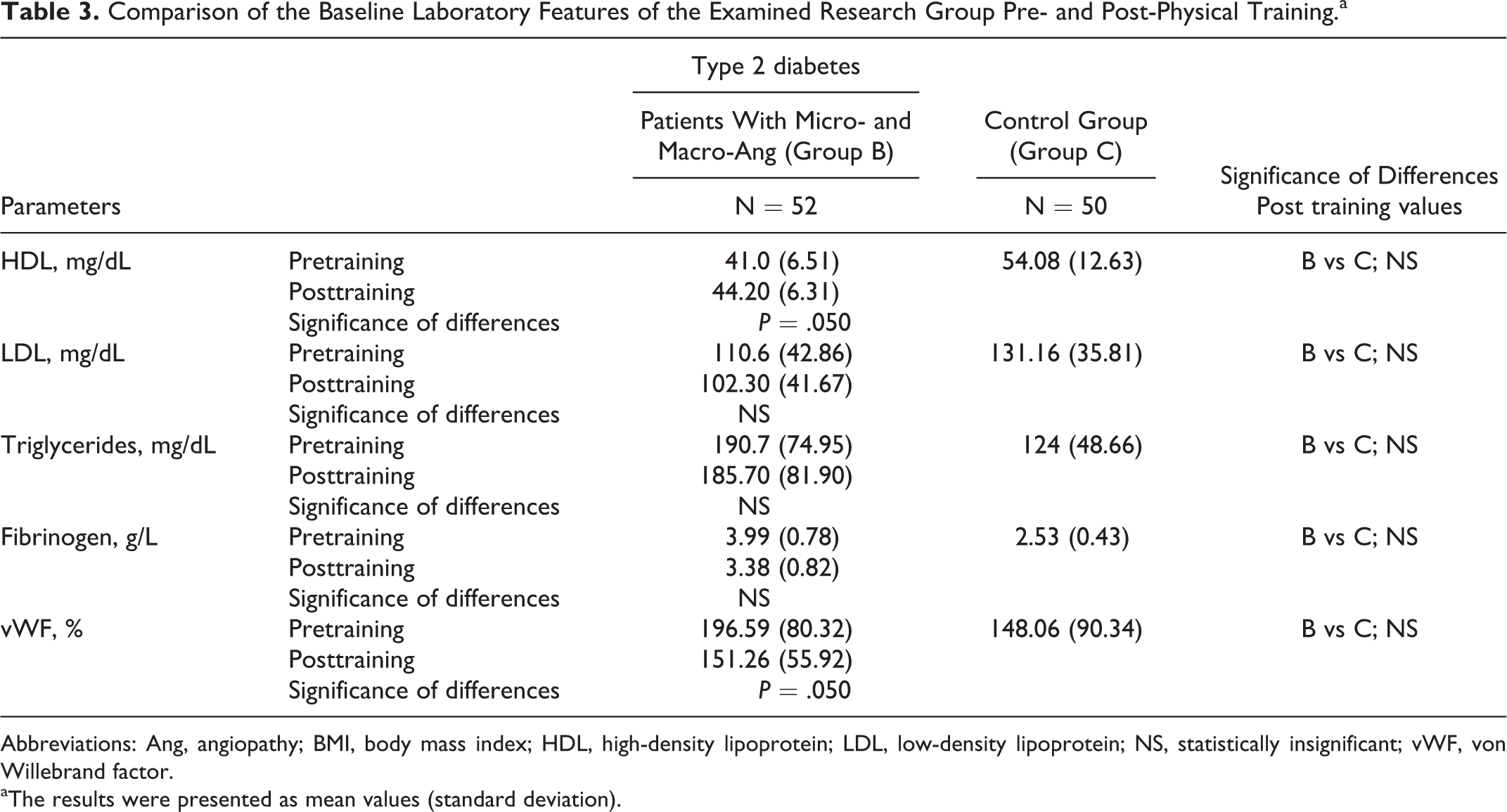
Abbreviations: Ang, angiopathy; BMI, body mass index; HDL, high-density lipoprotein; LDL, low-density lipoprotein; NS, statistically insignificant; vWF, von Willebrand factor.
aThe results were presented as mean values (standard deviation).
Expression of GP IIb/IIIa Receptors on the Platelet Surface Pre- and Post-Physical Training.a

Abbreviations: Ang, angiopathy; GPIIb/IIIa, glycoprotein IIb/IIIa; NS, statistically insignificant.
aThe results were presented as mean values (standard deviation).
Discussion
The lack of regular physical activity is becoming an increasing issue in health terms as it may lead to the premature existence and progression of cardiovascular diseases. Meta-analysis of clinical research has proven physical exercise to have a beneficial influence on atherosclerosis, decreasing mortality by 20% to 25%.
Regular physical activity positively affects energy balance, increase in muscle mass, and the development of new capillaries, while the improved function of endothelial cells and anti-inflammatory properties restore correct fibrinolytic function. 19 –21
The results obtained in the research confirmed the positive influence of regular physical exercise on factors significant to the risk of cardiovascular diseases. In patients with diabetes having micro- and macro-angiopathic complications, physical exercise increased the level of HDL cholesterol, reaching statistical significance (41.0 [6.51] mg/dL vs 44.20 [6.31] mg/dL) at P = .05. Low-density lipoprotein (LDL) values (110.6 [42.86] mg/dL preexercise vs 102.30 [41.67] mg/dL postexercise) and triglycerides (190.7 [74.95] preexercise vs 185.70 [81.90] postexercise) dropped, becoming statistically insignificant.
The 6-month research conducted by Bogdański et al 22 was based on guided exercise for overweight patients with hypertension. After the exercise period, the researchers observed a 16% increase in HDL cholesterol, 38% decrease in hypertension values, and 9% increase in the level of glycemia on an empty stomach. Additionally, the research indicated a statistically significant decrease in the concentration of triglycerides (1.7 [1.1] mmol/L vs 1.3 [0.7] mmol/L) and increase in concentration of HDL cholesterol (1.3 [0.3] mmol/L vs 1.4 [0.3] mmol/L) when P < .05.
Similar conclusions were drawn by Couillard et al 23 who, after a 20-week exercise period, observed a significant increase in HDL cholesterol concentration by 4.9% and 15.0% decrease in triglyceride, both being important predictors of cardiovascular events.
Regular physical activity improves the clearance of triglycerides through stronger β-oxidation of free fatty acids and increases the synthesis of the HDL cholesterol fraction.
A major reason for premature deaths among people with diabetes are cardiovascular diseases. One of the factors predisposing people to cardiovascular events are disorders of the dynamic balance between blood coagulation and fibrinolysis.
Research conducted by Telejko and Kinalska 24 confirmed the relatively higher concentration of fibrinogen in people with diagnosed diabetes than in healthy patients. The highest concentration was observed in patients with vascular complications and high values of glycated hemoglobin.
Higher fibrinogen values in patients diagnosed with diabetes in comparison to healthy people have also been confirmed by our own research (3.99 [0.78] g/L vs 2.53 [0.43] g/L). We cannot speak about statistically significant values characteristic for both of these groups; however, the discrepancies existing between them are high.
What is more, Telejko et al 25 observed an increased level of vWF, which is considered to be an indicator of damage to the endothelium. Such conditions were observed in the serum of patients with type 2 diabetes having microalbuminuria and cardiovascular diseases.
The authors of this research have confirmed increased values of vWF factor in patients with diabetes and vascular changes within the area of capillaries and large blood vessels. The level reached by this group was 196.59% (80.32%) versus 148.06% (90.34%) in the case of the control group. The difference between the quoted results is statistically significant for P = .04.
Analyzing the impact of physical activity on said parameters, Paczuski and Cieślicka 26 proved that 35 minutes swimming had a statistically significant impact on the increase in plasma concentration of the vWf. In the research group, when considered as a whole, such increase was quite significant, equaling 58% on average. According to previous research, the highest increase in plasma concentration was observed in long distance runners—3 times as high, in fact. Other research confirmed these findings; however, the values found in this research were not as high, ranging between 10% and 80%. 27 –29
Physical exercise via Nordic walking in this research has also shown to decrease vWF values from 196.59% (80.32%) before exercise to 151.26% (55.92%) after. In percentage terms, one can refer to a 22% drop. However, this result vastly differs from the results obtained by different authors.
Patients with diabetes belong to a special group of patients, since their body is characterized by stronger platelet aggregation, nonenzymatic glycosylation, and peroxidation. Activation of platelet GPIIb/IIIa receptors constitutes the final path of platelet aggregation. 30,31 In the research conducted by Telejko et al, 25 they observed the increased expression of GP receptors in cell adhesion molecules (P-selectin, lysosomal protein GP53, and active GPIIb/IIIa, thrombospondin) occurring on the surface of platelet membranes in patients recently diagnosed with type 1 diabetes. This may mean that platelet activation had already taken place in the prediabetes stage. 32 –34
Our own research revealed the expression of GPIIb/IIIa receptors on the surface of activated platelets was much higher in the research group than in the control group (3.91% [2.91%] vs 2.79% [2.51%] ). In patients with vascular complications, the differences were statistically significant (P = .002).
Koper et al 35 confirmed in their research the increased expression of GP IIb/IIIa receptors engaged in adhesion and platelet activation in a group of patients with diabetes.
In their research, Guo et al 36 evaluated the efficiency of ultrasound molecular imaging at detecting accumulation of GP IIb/IIa and activated platelets on the surface of atheromatous plaques. The results showed that the values obtained were higher in the case of advanced atherosclerosis in comparison to its mild form. Our own research also confirmed that output values of this correlation increased, while Tschöepe et al 37 suggested that both increased GP expression and increased binding of fibrinogen observed in sick patients may result from risk factors in the development of angiopathy. Wang et al observed a greater expression of GPIIb/IIIa in patients with diabetes in comparison to healthy controls. 38
There is no research describing the impact of physical activity on GP IIb/IIIa receptor values. One can only discuss the beneficial influence of exercise with an attempt to balance disorders taking place between coagulation and fibrosis systems in patients with diabetes.
The authors of this research have proven that physical exercise applied to patients with diabetes having micro- and macro-angiopathy turned out to be a trigger for the decreased expression of GP IIb/IIIa receptors in both resting and activated platelets. Differences in values after the exercise were statistically significant at P = .001.
Chen et al 39 studied the impact of high sheer stress on a blood vessel and its correlation with changes in GP IIb/IIIa concentration. An increase in shedding and exposure time was observed with an increase in the activation of platelet GP IIb/IIIa receptors. Our own research proved that physical exercise and its indirect impact on expanding blood vessels and decreasing vascular resistance decreased the level of GP IIb/IIIa. In the research conducted by Khaspekova et al, 40 they tested correlations between mean platelet count and its impact on an increase in GP IIb/IIIa receptor expression and activation of platelet aggregation. A positive correlation confirmed by the results indicates an increased risk of cardiovascular diseases. 41
Regular physical activity leads to many beneficial alterations in plasma lipids. Occasional exercise does not bring such positive results. Thus, it is crucial for patients with diabetes to perform regular and lengthy physical exercise. It is commonly known that physical activity is essential to stay healthy and maintain wellness; however, living and working conditions increase hypokinesis. The amount of moderate-intensity aerobic activity recommended by the World Health Organization to people between 18 and 64 equals to a minimum 150 minutes per week, with 75 minutes per week of vigorous aerobic activity. Activity up to 300 minutes per week gives additional health benefits, such as increased fat metabolism, decreased cholesterol levels, better muscle blood flow, and increased level of myoglobin responsible for the storage and transport capacity of oxygen. These expectations can be met through healthy exercise. 42
Limitations
The unique character of the research was its greatest limitation. Very few researchers carry out this type of study and hardly any Polish researcher is able to interpret the findings. Additional drawbacks concerned the research patients and their persistence in physical exercise. Thus, the number of participants may not be entirely satisfactory.
Future Directions
So far the research has produced only partial conclusions. The authors wish to conduct more research on a larger group of patients, as well as change the intensity or form of exercise. It should be considered that the study is challenging to conduct. The value of the GPIIb/IIIa parameter is a significant indicator of platelet activation. The activation is followed by an increase in anticlotting parameters that are the important risk factor for cardiovascular diseases, being a root cause of many 21st-century lifestyle diseases.
Conclusions
Physical exercise had a positive influence on the drop of GP IIb/IIIa receptor values and was statistically significant at P = .001. Physical exercise had a statistically significant impact on the decrease in vWF factor values from 196.59% to 151.26% at P = .05. Analysis of the laboratory parameters showed statistically significant parameters between the groups in the following values: waist, HDL, and triglycerides.
Footnotes
Authors’ Note
Żanna Fiodorenko-Dumas conceived the idea for the study. Krzysztof Mastej and Ilias Dumas contributed to the design of the research. All authors were involved in data collection. Urszula Jakobsche-Polight and Jadwiga Bittner analyzed the data. Rajmun Adamiec coordinated funding for the project. All authors edited and approved the final version of the manuscript.
Declaration of Conflicting Interests
The author(s) declared no potential conflicts of interest with respect to the research, authorship, and/or publication of this article.
Funding
The author(s) received no financial support for the research, authorship, and/or publication of this article.
