




Abstract
Mean platelet volume (MPV) is an indicator of thrombocyte volume and tendency to thrombosis can be mentioned in case of MPV elevation. Cancers are one of the important groups of thrombotic diseases. In the present study, MPV value was scrutinized in patients with cancer that developed thrombosis. Totally 43 patients followed in Kayseri Training and Research Hospital, in who thromboembolus has been developed, were prospectively recruited in the study. Thrombocyte, MPV, and platicrit (PCT) values were recorded at the time of cancer diagnosis and thrombosis development. Frequency analysis, crosstabs, and paired samples t test were used. Analyses showed that MPV values at the time of thrombosis development were significantly low as compared to those at the time of cancer diagnosis (P = .041). Thrombocyte count and PCT values were also low but not significant. The result of the present study is likely to show that thrombocytes have ignorable effect on thrombosis development in patients with cancer.
Introduction
Thrombocytes play an important role in arterial and venous thromboses and in atherosclerotic complications. 1 Mean platelet volume (MPV) is an indicator of thrombocyte volume and a marker of thrombocyte function. In case of MPV elevation, larger platelets with more dense granules and that produce more thromboxane A2 are present in blood circulation. 2 In vitro response to adenosine diphosphate and collagen is high and tendency toward aggregation is high as well. 3
In the literature, MPV elevation has been reported in myocardial infarction, 4 cerebrovascular thromboembolus, 5 pulmonary hypertension, 6 diabetes mellitus, 7 inactive chronic hepatitis B patients, 8 and in smokers. 9
Association between cancer and thrombosis was first defined in 1985 by Armand Trousseau. Thromboembolus is seen in approximately 11% of patients with cancer 10 and has been defined as the second leading cause of deaths from cancer following infection. 11 When the patients that have been hospitalized because of venous thrombosis or pulmonary embolus were investigated, it was seen that the number of patients with malignancy was higher than that without malignancy. 12
The risk of venous thromboembolism (VTE) is 4- to 6-fold higher in patients with cancer.13,14 Previous deep vein thrombosis, type of cancer, stage of cancer (localized vs distant metastasis), time from the diagnosis of cancer (greatest within the first 3 months), surgery, radiation therapy (pelvic radiation relative risk 2.0), and chemotherapy/biologic therapy/anti-angiogenesis/other agents are the factors that affect the risk of VTE development. 15 A pre-chemotherapy thrombocyte count higher than 350 000/mm 3 , elevated C-reactive protein, and acquired prothrombotic mutations increase the incidence of thrombosis. 16 Venous thromboembolism, which is an important predictive factor in terms of survival, shortens the survival of patients with cancer. 17 VTE in solid tumors are the most frequently seen in the tumors of lung, gastrointestinal system, and cerebral and renal system. 18
Arterial thromboembolism is less common than VTE, with a rate changing between 3.0% and 5.2%; its incidence in hospitalized patients with neutropenic cancer has been identified 19 as 1.9%. The risk of arterial thromboembolus has been significantly increased in chemotherapy combinations including Bevacizumab (anti-vascular endothelial growth factor [VEGF] agent) as compared to chemotherapy alone. 20 The prevalence of arterial thromboembolus was 3.8% in the patients receiving Bevacizumab and chemotherapy combination, whereas it was found 1.7% in the other arm receiving chemotherapy alone. 21
The present study was aimed to evaluate alterations in MPV and platicrit (PCT) in case of arterial and venous thromboses developed in the patients with cancer during the 18-month follow-up period.
Materials and Methods
Study participants were obtained from Kayseri Education and Research Hospital Medical Oncology Department. New patients that have presented beginning from August 1, 2009, were included in the study and prospectively followed until March 11, 2011. Patients that developed arterial and venous thromboses within that period were recorded. Serum levels of
Results
The data of all the 43 patients were evaluated. The mean age of the patients was 58 ± 10 years. Of the patients, 58% were male and 42% were female. Patients with breast and lung cancer accounted for the great proportion. Patient characteristics are given in Table 1.
Patient Characteristics.
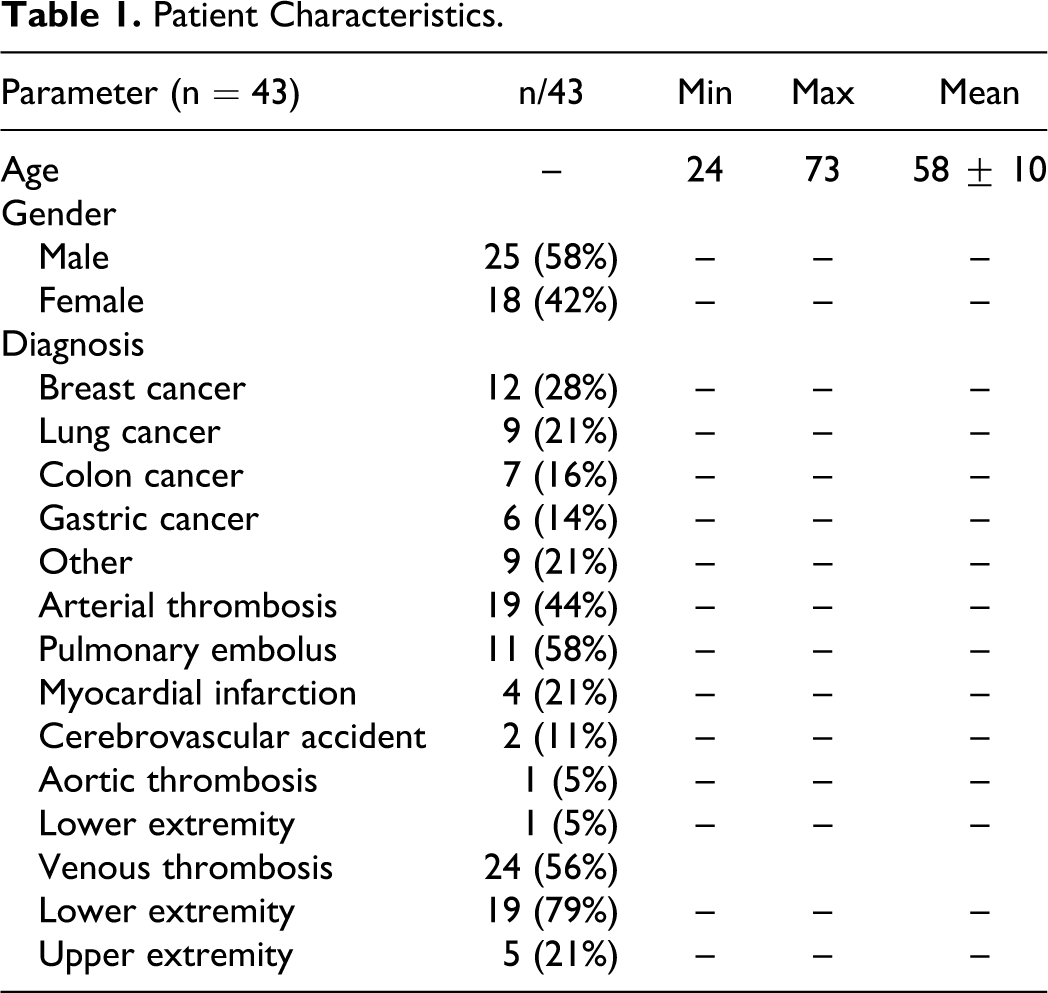
The prevalence of venous thrombosis was 53% and the prevalence of arterial thrombosis was 47%. The most common site for thromboembolus was lower extremity (79%), whereas the most common site for arterial thromboembolus was pulmonary arteries (21%).
Considering the patient groups, thrombosis was more prevalent among the patients with breast cancer. The types of the disease and localization of thrombosis are shown in Table 2. There were 7 arterial thromboembolus cases and 5 venous thromboembolus cases in breast cancer group. Breast cancer group was the only group with high prevalence of arterial thromboembolus. Thrombocyte, MPV, and PCT values of the patients at the time of diagnosis and thrombosis are given in Table 3. There was a decrease in PLT and PCT values at the time of thrombosis, but it was not significant. The MPV values were statistically significantly low at the time of thrombosis as compared to those at the time of diagnosis (P = .041)
Diagnosis and Thromboembolus Localizations.
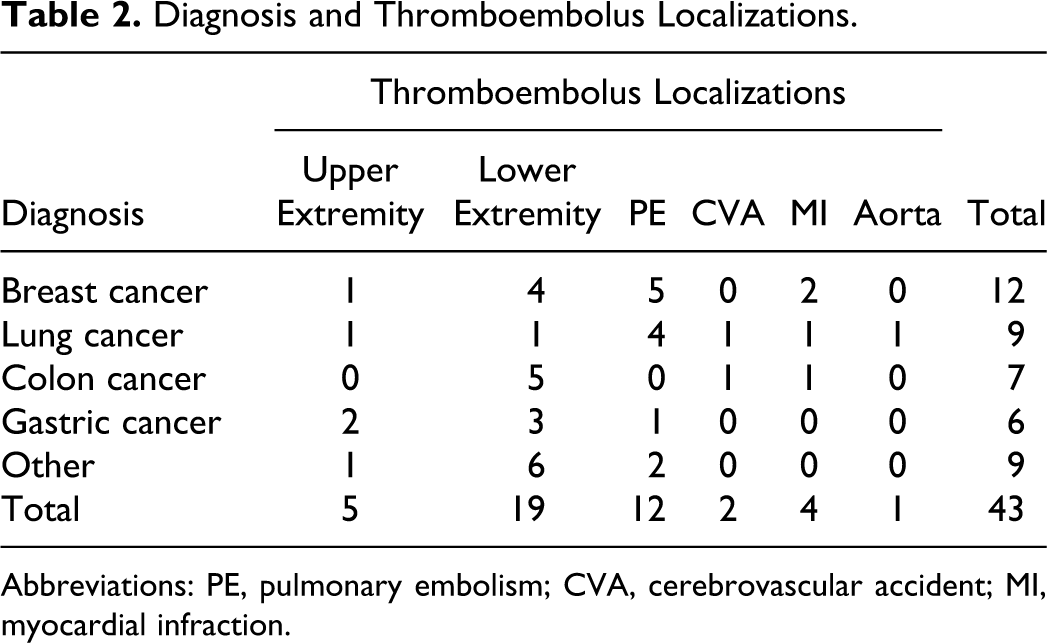
Abbreviations: PE, pulmonary embolism; CVA, cerebrovascular accident; MI, myocardial infraction.
PLT Count, MPV, and PCT Values.
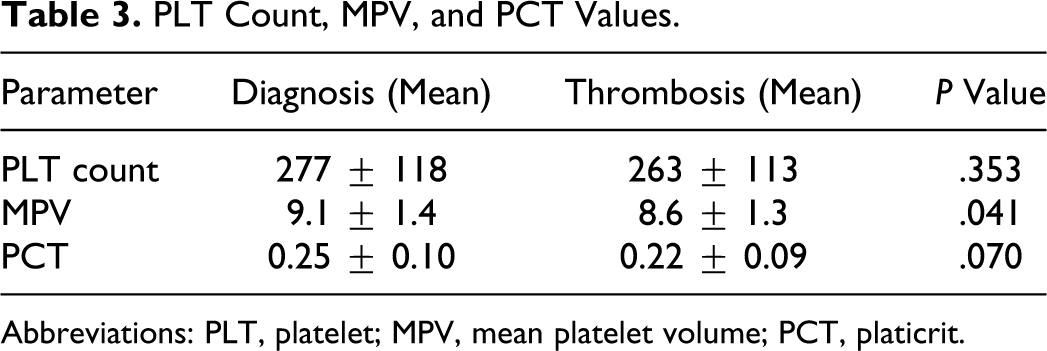
Abbreviations: PLT, platelet; MPV, mean platelet volume; PCT, platicrit.
Discussion
Thrombosis and infection are the 2 leading causes of mortality in patients with cancer. The MPV elevation may indicate tendency toward thrombosis2,3 and has been demonstrated in case of myocardial infarction and cerebrovascular embolus.4,5 However, the present study failed to show MPV elevation in case of thrombosis developed in the patients with cancer. Contrarily, it was significantly low as compared to the MPV values at the time of cancer diagnosis.
Basic factors for tendency toward thrombosis in patients with cancer have been mentioned above. Secretion of procoagulant molecules from tumor cells (tissue factor being the most important), inactivation of fibrinolytic system, and thrombocyte activation are the 3 important factors in the pathogenesis of prothrombotic process. 16 In a study, a pre-chemotherapy thrombocyte value higher than 350 000/mm 3 has been suggested as the risk factor. 16 In the present study, thrombocyte count was low at the time of thrombosis. Moreover, MPV value was also significantly low. Therefore, we can say that the role of thrombocytes as an initiating factor in cancer-related thrombosis is ignorable.
In conclusion, based on the result of the present study, we can say that thrombocytes are least responsible for the initiation of thrombosis in patients with cancer. However, cancer, to all points, is a strong thrombotic factor.
Footnotes
Declaration of Conflicting Interests
The authors declared no potential conflicts of interest with respect to the research, authorship, and/or publication of this article.
Funding
The authors received no financial support for the research, authorship, and/or publication of this article.