




Abstract
Based on the concept of cultural capital, this study explores the relationship between habitual behaviors of individuals regarding their past accumulation of such capital and current responses to a scientific institute’s public outreach activity. At an open house held at the Institute for Molecular Science (IMS), anonymous questionnaires were distributed among 1,350 visitors and collected from 785 of them (collection rate = 58.1%). The results, measuring the past five to six years, showed that the respondents accumulated cultural capital through participation in scientific activities as well as in activities involving art, music, and literature. Given these quantified values, correlations between citizens’ levels of accumulated cultural capital and their current scientific consumption behavior were studied. A statistical analysis of the two components of cultural capital (science and technology/art and literature) showed that people’s accumulated scientific capital influenced their current behavior and revealed a correlation between the two components.
Keywords
1. Introduction
In its Science and Technology Third Period Basic Plan (2006), the Ministry of Education, Culture, Sports, Science and Technology (MEXT) of Japan proposed that they “will promote the contributions of universities and public research institutions to the improvement of the people’s awareness of science and technology through social activities such as the opening to the public of their facilities and equipment and lectures on demand” and that “the government will also provide the public with an opportunity to experience the dream and excitement of science and technology through a variety of competitions and events” (MEXT, 2006: 62). The majority of public scientific research institutions in Japan have responded by arranging annual open houses to actively disseminate information to visitors; some research institutions draw thousands of open house visitors each year. 1
The question remains as to how the opportunity to experience “the dream and excitement of science and technology” is distributed among the citizens. Although equal access to open houses at public scientific research institutions is provided in the sense that admission is free and anyone is permitted to visit, those who do not take the opportunities offered will not receive them. For school-age children, in particular, as possible future scientists and science enthusiasts and presumably one of the most important target audiences, those opportunities are largely dependent on their parents and family environment. 2
Who are the actual citizens attending open house events at scientific research institutions and taking advantage of the opportunity to get “the dream and excitement of science and technology”? Based on the premise that science is a cultural production, this study proposes placing science communication studies in a wider social context by quantitatively analyzing the variety of people participating in scientific outreach activities, specifically, visitors to open houses at scientific research institutions. 3
This study focuses on three main topics: (a) the distinctiveness of visitors to an open house event at a public scientific research institution, (b) the relationship between their viewing behaviors at the current exhibit and the amount of cultural capital they accumulated through past cultural activities, and (c) the relationship between scientific and technical cultural capital and literary and artistic cultural capital.
2. Background and purpose
Science as culture
Science as culture is already a well-recognized concept in the humanities and social sciences. However, as a 2005 report by the 19th Science Council of Japan stated, “Promoting the physical sciences in Japan means creating an ethos in which science and technology are seen as culture”—an idea that still needs cultivation in Japan.
As of 2005, there were approximately 860 museums in Japan, according to the Museum Act, or about 18 museums per prefecture (MEXT, 2005). In 2000, according to a survey “The National Census of Planetarium” conducted by the Astronomical Society of Japan and the Japanese Society for Education and Popularization of Astronomy, there were approximately 350 planetariums in Japan with dome diameters of five meters or more (Watanabe, 2001). Yet, while cultural facilities for the sciences are readily accessible in Japan, there is a sense that scientific culture has not made its way into people’s daily lives. The habitual behavior of individuals may offer a partial explanation: people who visit scientific facilities will continue to do so, but people who do not, will not visit them even if the scientific facilities or events are close by.
If we consider science to be a form of cultural production, cultural capital is an effective concept for studying how scientific culture and people’s habitual lifestyles are related. On the basis of surveys of the French society of the 1960s and 1970s, French sociologist Pierre Bourdieu outlined how children from families with large amounts of cultural capital frequently grew up to be highly educated and how this in turn influenced the next generation and the reproduction of the social structure (Bourdieu and Passeron, 1979, 1996; Bourdieu, 1984). He argued that “the esthetic disposition demanded by the products of a highly autonomous field of production is inseparable from a specific cultural competence” (Bourdieu, 1984: 4). Given that science is a highly autonomous field of production in scientific knowledge, we assume that people with superior cultural competence (cultural capital) would tend to have more practical behaviors related to science. The present study tested this hypothesis by empirically examining how visitors’ accumulated cultural capital related to their current behaviors at an open house event hosted by a scientific research institution. To explore this premise, let us first consider the meaning of cultural capital.
Forms of cultural capital
The concept of cultural capital is an expansion of the idea of capital in general, which in economic terms refers to the surplus value of a product in the cycle of production and consumption as well as to the goods that are directly exchangeable for money. Beginning in the 1960s, economists such as Theodore W. Schultz and Gary Stanley Becker began to discuss the idea of human capital, using it to describe the value attached to individuals as members of the labor force (Becker, 1962, 1975; Schultz, 1981). Bourdieu uses the term cultural capital to explain aspects of what composes this human capital (Crossley, 2001, 2004; Lin, 2001).
Bourdieu (2001) proposed three forms of cultural capital: (a) the embodied, which involves people’s knowledge, interests, language, and skills; (b) the objectified, which involves people’s possession of paintings, books, tools, machines, and other cultural goods; and (c) the institutionalized, which involves people’s education and qualifications. In other words, people who frequently engage in cultural practices, such as going to museums or classical music concerts and acquiring a great amount of literature, possess a large amount of cultural capital. This study focuses on the particular measurements of the embodied (cultural practices) and institutionalized (educational) states of cultural capital as defined by Bourdieu.
Bourdieu (1984) further divided cultural capital into scientific and technical culture and literary and artistic culture and asserted that the latter is the more valued, “high culture.” Similar arguments have been heard in the West since Charles Percy Snow, an English scientist and novelist, first commented on the great divide between the “two cultures” of the sciences and humanities in a 1959 Rede lecture (Snow, 1964). Are the scientific and technical cultural capitals really so weakly linked to the literary and artistic capitals, and do they actually stand at opposite ends of our palatability in Japan? Bourdieu himself did not demonstrate if the two types of cultural capital differently determine people’s practical behaviors. Furthermore, interviews conducted as a prestudy for this empirical investigation suggest that in Japan there is a positive correlation between the two cultural capitals. This study further considers how people’s levels of cultural capital, with its subordinate concepts of scientific and technical cultural capital and literary and artistic cultural capital are correlated and how they affect people’s behaviors at scientific outreach events.
Consumption of scientific culture
In this study, consumption of scientific culture is defined as the act of viewing science exhibits at an open house event and is quantified by two variables: (a) the total number of exhibits viewed and (b) the total amount of time spent at the event.
Cultural consumption is a term that is often used by researchers studying the relationship between people’s behavior towards culture and the connection of their lifestyles to social hierarchy and status. Two large comparative studies that followed one another and were conducted internationally, “Cultures of Consumption” and “Social Status, Lifestyle, and Cultural Consumption,” offered examples of this consumption. The research project that produced these studies was launched in 2002 by Chan, Goldthorpe, and other sociologists at Oxford University in collaboration with research groups in England, France, the Netherlands, and the United States (Chan and Goldthorpe, 2007). Another example from Britain is the research project entitled “Cultural Capital and Social Exclusion.” In the book Culture, Class, Distinction, published under this project, Bennett with other researchers critically examined Bourdieu’s concept of cultural capital and applied his theory to systematically assess people’s cultural practices in contemporary British society (Bennett et al., 2009). The viewpoint of both those studies, however, differed from that of the present study in that they focused on literary and artistic cultural capital and did not address scientific and technical capital.
Science communication studies and the public as receivers of scientific information
There has been very little assessment of the variety of people’s behaviors via science outreach activities. In the field of science communication studies, Miller (2004) and Miller et al. (2006) studied how Americans form, or do not form, proper understandings of science. While Miller et al. do not refer to cultural capital per se, they discussed the correlation between an individual’s exposure to scientific knowledge, such as that gained by attending university-level lectures, reading scientific journals, and browsing science websites, and the individual’s own level of scientific knowledge. Miller et al. also introduced many variables for informal scientific learning that can be applied to the embodied states of scientific and technical cultural capital. Their findings suggested that people who receive more of their scientific information from informal scientific learning gained a high level of scientific knowledge. In contrast to Miller et al.’s findings, Bucchi and Neresini (2002) found no correlation between a person’s extent of exposure to scientific information and the amount of scientific knowledge they possess (Fujigaki and Hirono, 2008). Other relevant research includes early studies that analyzed the relationship between a person’s reception and science museum exhibits (Macdonald and Silverstone, 1992; Macdonald, 1995) and one that involved the relationship between a person’s level of scientific knowledge and their level of education (Parales-Quenza, 2004). These science communication studies have focused on the level of scientific knowledge or understanding that people possess and the relationships between the public and scientific culture; however, they do not explain these relationships in a wider cultural context. People’s habitual behaviors related to scientific culture can best be understood when contrasted with those related to other aspects of culture. Thus, this research seeks to place science within a wider cultural context.
This research aims to determine how the cultural capital accumulated by a person in the past explains the current behaviors, such as pursuing additional consumption of scientific culture in the expectation that it will lead to future benefits. This research continues the exploration of the two subordinate concepts of cultural capital, the scientific and technical cultural capital and the literary and artistic cultural capital, by investigating the differing levels at which each of these two concepts is possessed and how each affects the consumption of scientific culture. This study will enable science communication studies to be placed within a broader social background.
3. Method
Respondents
Questionnaires were administered to all 1,350 visitors to an open house at the Institute for Molecular Science (IMS), a public scientific research institution located in the Tokai area (central Japan). They were individually distributed at the reception desk and then collected as the visitors left. The response rate was 58.1%, and there were 785 responses in total (563 adults, 216 minors [under 20 years of age], 6 unidentified). The survey was conducted on October 17, 2009.
Structure of the survey instrument
The survey consisted of the following four parts: (a) the visitor’s demographic information: gender, age, education, and district of residence; (b) group formation (who accompanied the respondent to the visit), time of the visit, past visiting history, and total hours spent at the event; (c) cultural capital scale; and (d) exhibit viewing behavior.
Because there are no measures of scientific and technical cultural capital and literary and artistic cultural capital whose reliability and validity had been previously confirmed in the Japanese language, a new eight-item scale was created for this study, and factorial internal consistency (reliability) and validity were tested. Four of the items on the scale were taken from “The 1995 Social Stratification and Social Mobility Survey” 4 and partially revised in accordance with prestudy feedback received from respondents (Seiyama and Hara, 2006). To further subdivide the types of cultural capital, four items on the eight-item scale were assigned to measure scientific and technical cultural capital and the other four were assigned to measure literary and artistic cultural capital.
The survey also contains two items used to quantify the respondents’ behavior regarding scientific culture. These included the total number of exhibits they viewed on the day of the open house event and the total number of hours they spent in viewing the exhibits. In this context, these behaviors are regarded as “consumer behavior of scientific culture.” Respondents indicated whether they had visited the exhibits listed, and the number of visits was accordingly aggregated. The respondents also indicated the total amount of time spent at the open house event.
Response method
All responses were anonymous. For cultural capital scale, each item was answered on a 5-point scale (once or more per week equals 5 points, about once per month equals 4 points, once or a few times per year equals 3 points, once every few years equals 2 points, not in the past few years equals 1 point) according to respondents’ behavior in the past five to six years.
The questionnaire noted that data would be used for academic research and improvement of public outreach activities by the scientific research institution and that the survey data would be treated statistically and individuals would not be identified.
Analysis
Statistical analysis was conducted by using the following procedures:
To determine the distinctiveness of open house visitors at IMS, total scores for the questionnaire items were calculated according to their demographic information.
To measure the amount of cultural capital possessed by the visitors, a scale was constructed by conducting a factor analysis using the eight cultural capital items. The scale’s internal consistency and reliability were confirmed initially with Cronbach’s alpha reliability coefficients, and a confirmatory factor analysis was conducted to test factorial validity with factor loadings. Then, to analyze the relationship between cultural capital and consumption of scientific culture, a multiple regression analysis was performed using the total number of exhibits viewed and the total viewing time as the explained variables and the total scores for cultural capital items and the educational capital as the explanatory variables. Finally, to analyze the statistical differences between how the levels of the two subordinates of cultural capital affect consumption of scientific culture (a) a cluster analysis was conducted using individuals’ factor scores, dividing the respondents into four groups, (b) the average number of exhibits attended by the four groups was compared using statistical tests, and (c) Structural Equation Modeling (SEM) was applied to evaluate the compatibility of the data with the model derived from the hypothesis.
4. Results
Distinctiveness of open house visitors
To determine the distinctiveness of open house visitors at IMS, the total scores for questionnaire items pertaining to their attributes were calculated. With regard to education level, only responses from adults were used. Adults who had completed junior college, technical college, university, or graduate school were categorized in the highly educated group, and those who had completed elementary, junior high, high school, or vocational school were categorized in the other group. The education level was used to measure educational capital. As shown in Figure 1, there were 336 adults in the highly educated group and 153 in the other group, indicating that the majority of visitors were highly educated. According to the Statistics Bureau (2009), the rate of advancement to junior college and university during the years when respondents reached college age was 40%–45% for people in their 30s and nearly 40% for those in their 40s and 50s as well as in the prefecture where the research institute is located. This implies that less than half of the residents are categorized in the highly educated strata. Thus, the visitors were not representative of the educational background of the community and therefore a distinguishing feature of the visitors was described.
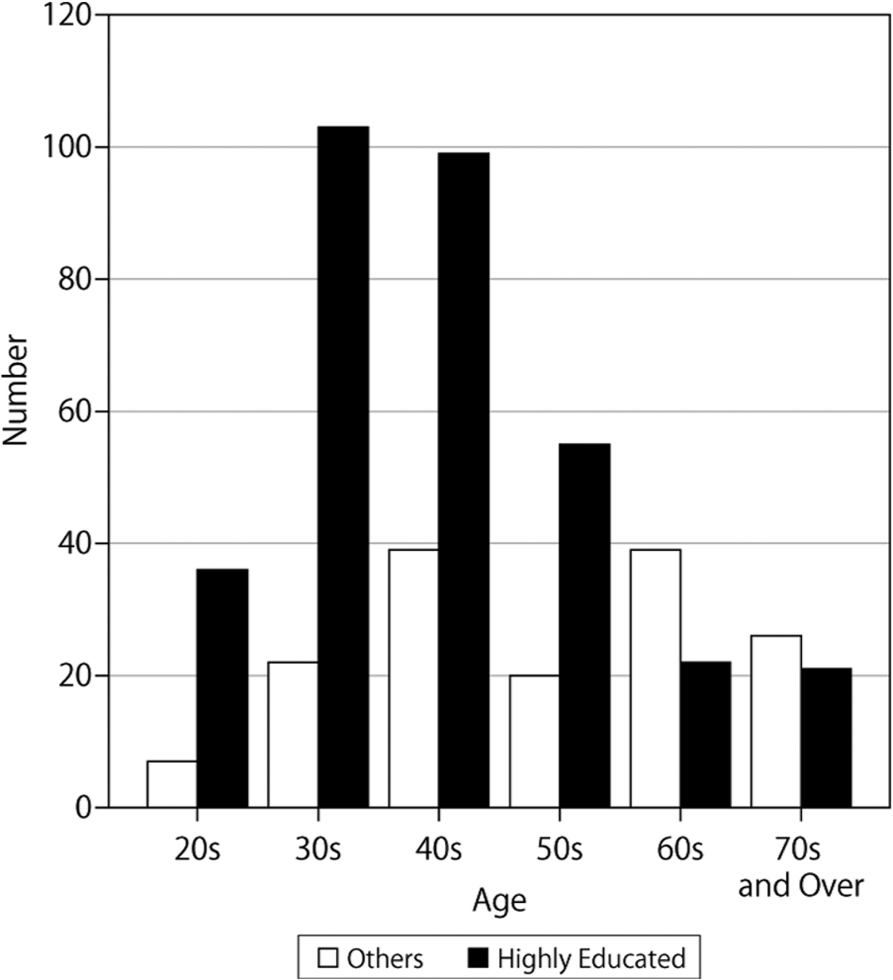
Adults, educational capital.
The ratio of male to female visitors was almost equal. As shown in Figure 2, the largest numbers of visitors were school-age children under 10 years old, school-age children in their teens, and adults in their 30s and 40s. There was only a small portion of visitors who were in their 20s, which is a very low number according to this age group’s representation in community demography (Statistics Bureau, 2009). More than half of the visitors were part of parent and child groups (50.5%). These results suggest that the open house visitors at IMS were highly educated parents accompanied by their school-age children.
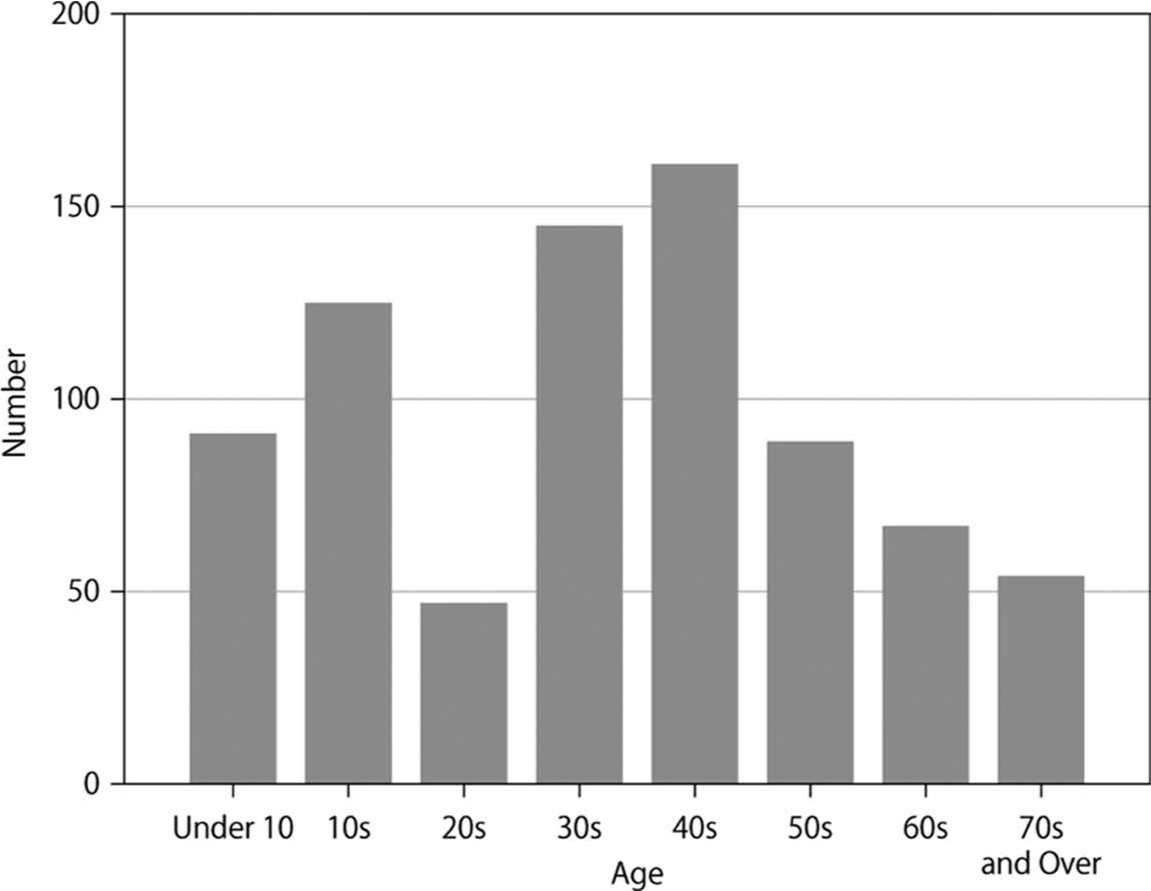
Distribution of age of the visitors.
Correlation between cultural capital and consumption of scientific culture
Cultural capital scale construction and reliability analysis
A cultural capital scale, consisting of a scientific and technical cultural capital scale and a literary and artistic cultural capital scale, was constructed using a total of eight cultural capital items. While the scientific and technical cultural capital scale with four observational variables had an α reliability coefficient of 0.74, the literary and artistic cultural capital scale with the other four observational variables had a relatively low coefficient of 0.69. The total coefficient for the combined cultural capital scale was 0.78, indicating adequate reliability and overall internal consistency.
In addition, a factor analysis (using a principal factor method, oblique rotation, and promax method) was conducted on 572 respondents (418 adults, 152 minors, 2 unidentified), after excluding 213 respondents who provided incomplete or unanswered questionnaires for these eight items. This was used to construct the following two scales:
Scale 1: Scientific and technical cultural capital scale
ST1: Going to a science museum or planetarium
ST2: Going to a science lecture, science event, or science cafe
ST3: Reading a science magazine or science book
ST4: Watching a science program on television or going to see a science movie
Scale 2: Literary and artistic cultural capital
LA1: Going to a classical music performance or concert
LA2: Going to an art museum or other (nonscience) museum
LA3: Reading novels or history books
LA4: Going to Kabuki, Noh, Bunraku, or other traditional Japanese art performances
A Kaiser-Meyer-Olkin sampling adequacy value of 0.801 suggests that applying the factor analysis for the data was appropriate.
Cultural capital scale validity analysis
To test the factorial validity of the constructed cultural capital scale, a confirmatory factor analysis was performed using the two cultural capital scales as the latent variables and each of the eight questionnaire items as the observed variables, which are explained by latent variables (N = 572). The Goodness of Fit Index (GFI) and Adjusted Goodness of Fit Index (AGFI), which address the model’s stability, were GFI = 0.957; AGFI = 0.918. These results suggested that the model has strong explanatory power. Standardized impact indicators for each of the latent variables on the observed variables were all above 0.50 and statistically significant (p < .001), indicating that the construct fits with the observed variables. These measures indicated a good fit between the model and the data.
Influence of cultural capital on consumption of scientific culture
To investigate the interaction between the amount of cultural capital and the consumption of scientific culture at the open house, a hypothesis was tested with multiple regression analyses that use forms of cultural capital (scientific and technical cultural capital, literary and artistic cultural capital, educational capital) as the explanatory variables and forms of consumption of scientific culture (number of exhibits viewing behavior, exhibit viewing time) as the explained variables. The hypothesis states, “Higher cultural capital increases consumption of scientific culture.” Data gathered from 335 adults were analyzed after excluding the unanswered or incomplete questionnaires from the total 563 respondents.
A forced entry method for estimation was chosen for analysis. Table 1 shows the standardized partial regression coefficients and the coefficients of determination, which were the results of multiple regression analysis. As shown in Table 1, significant coefficients of determination (R2) for both the explained variables of total exhibits viewed and total viewing time were obtained. Scientific and technical cultural capital had a positive influence on both the total number of exhibits viewed and the total viewing time. The results for literary and artistic cultural capital were not significant. Educational capital had a negative influence on the number of exhibits viewed but did not have a significant influence on total viewing time.
Regression analysis of the cultural capital and consumer behavior of scientific culture.
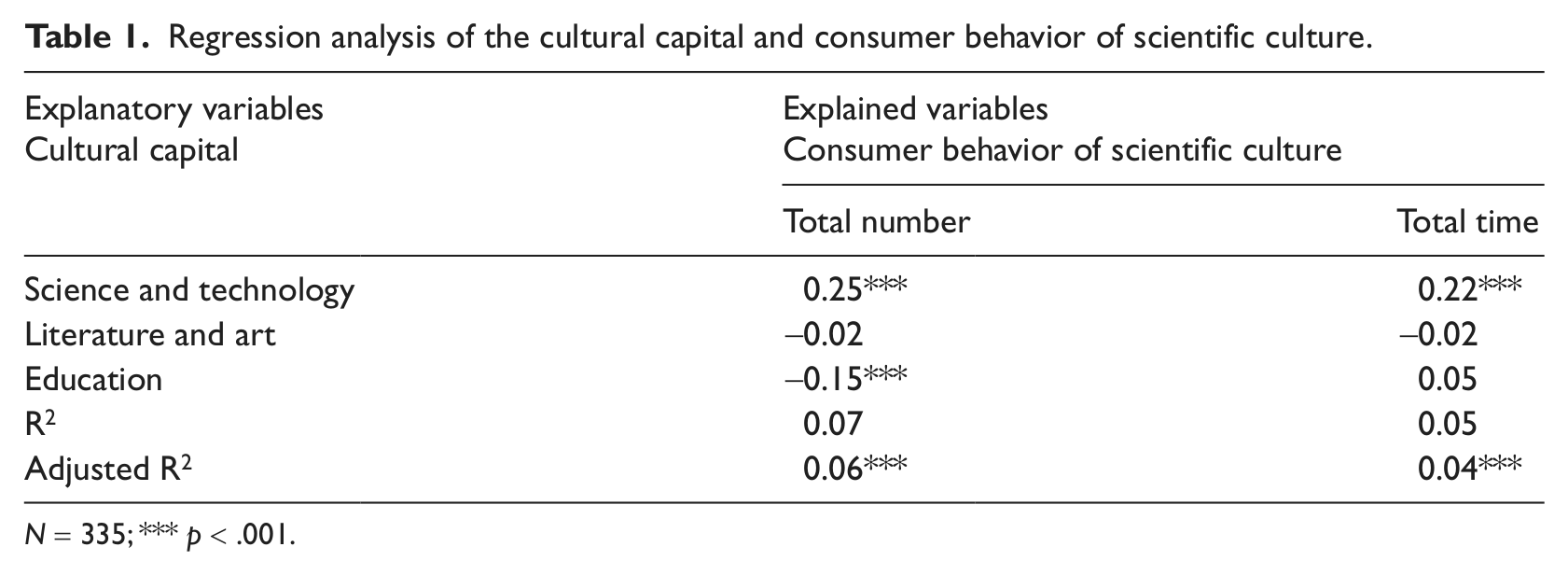
N = 335; *** p < .001.
The hypothesis was not supported for literary and artistic cultural capital and educational capital but was supported for scientific and technical cultural capital. Hence, increased scientific and technical cultural capital led to increased consumption of scientific culture.
Analysis of the consumption of scientific culture based on differences between the possession of scientific and technical cultural capital and literary and artistic cultural capital
First, to further examine how cultural capital and consumption of scientific culture are related, differences in the possession of scientific and technical cultural capital and literary and artistic cultural capital as well as the total number of exhibits viewed were analyzed. A cluster analysis was conducted using individuals’ factor scores for each of the two cultural capital types, from which the respondents were divided into four groups (N = 572). According to each group’s average and median factor scores for scientific and technical cultural capital and literary and artistic cultural capital, the following characteristics were observed for each group:
Group 1: This group had relatively small amounts of both scientific and technical cultural capital and literary and artistic cultural capital.
Group 2: This group had relatively greater amounts of literary and artistic cultural capital.
Group 3: This group had relatively greater amounts of scientific and technical cultural capital.
Group 4: This group had relatively large amounts of both scientific and technical cultural capital and literary and artistic cultural capital.
Figure 3 shows the distribution of visitors by factor scores for scientific and technical cultural capital and literary and artistic cultural capital. As shown in the distribution, visitors’ scientific and technical cultural capital and literary and artistic cultural capital were positively correlated. The distribution of four groups is color coded, as shown in Figure 3.
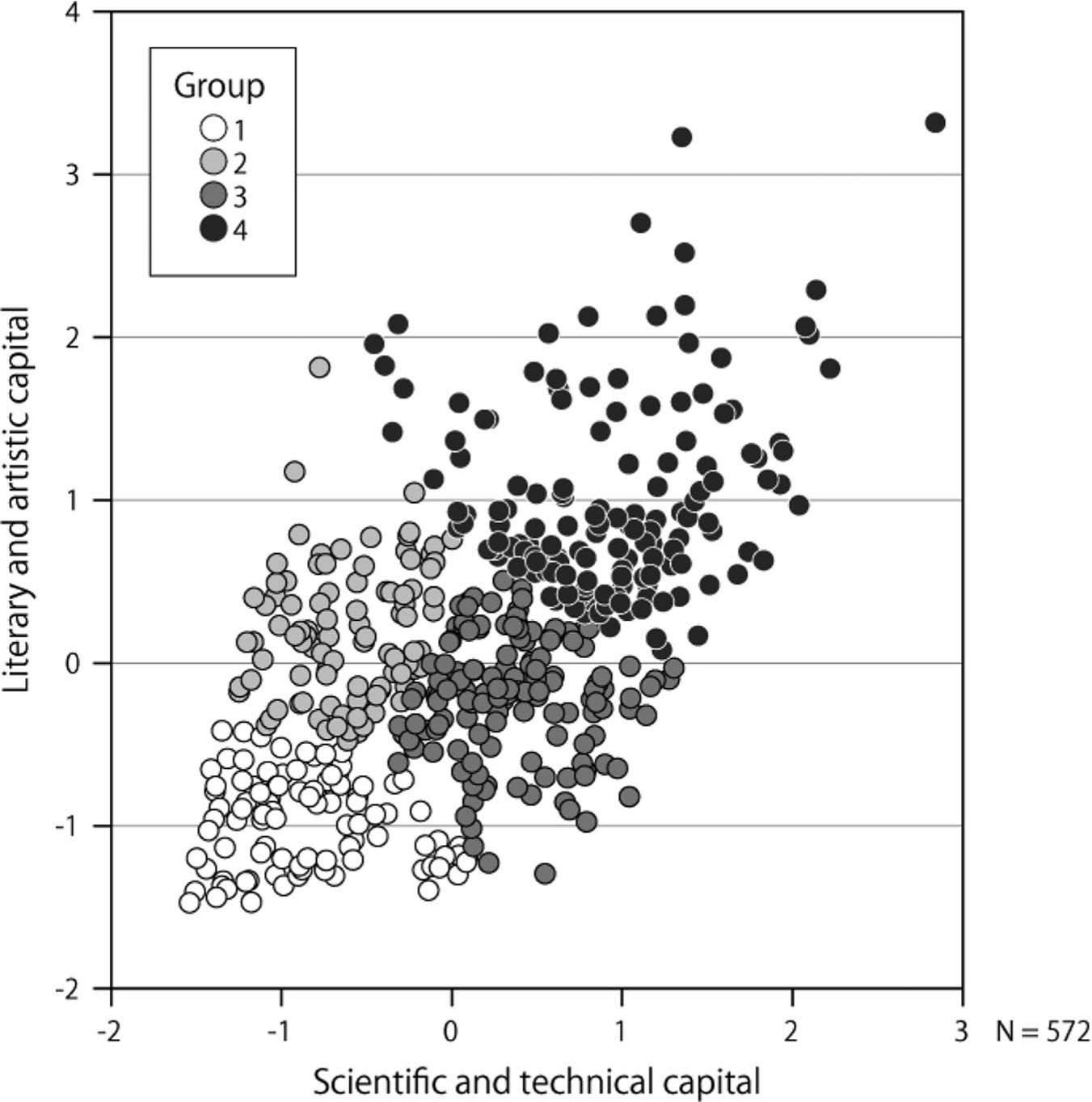
Distribution of the visitors by factor scores of scientific and technical capital and literary and artistic capital.
Then, the four groups were compared using the nonparametric Kruskall-Wallis and Mann-Whitney tests (p < 0.05) to identify differences between the median values for the total number of attended exhibits by each of the four groups.
The results from the statistical tests suggested the following:
There was no statistically significant difference between Groups 1 and 2.
There was no statistically significant difference between Groups 3 and 4.
There was a statistically significant difference among Groups 1, 3, and 4.
There was a statistically significant difference among Groups 2, 3, and 4.
There were statistical differences in the number of exhibits viewed based on the amounts of both scientific and technical cultural capital and literary and artistic cultural capital. The frequency with which the respondents viewed exhibits was greater in Groups 3 and 4. With regard to differences in the possession of scientific and technical cultural capital and literary and artistic cultural capital, the visitors were grouped into four categories; the categorization of the groups was made on the basis of whether a group had a larger or smaller amount of both types of cultural capital and whether a group was biased in terms of scientific and technical cultural capital or literary and artistic cultural capital. There was a statistical difference among the groups concerning the median values for the total number of attended exhibits.
Analysis with Structural Equation Modeling
SEM 5 was applied in order to comprehensively understand the relationship between cultural capital and consumption of scientific culture and to test the fit between the model derived from hypothesis and the data. The results are shown in Figure 4. The two observed variables relating to consumption of scientific culture are:
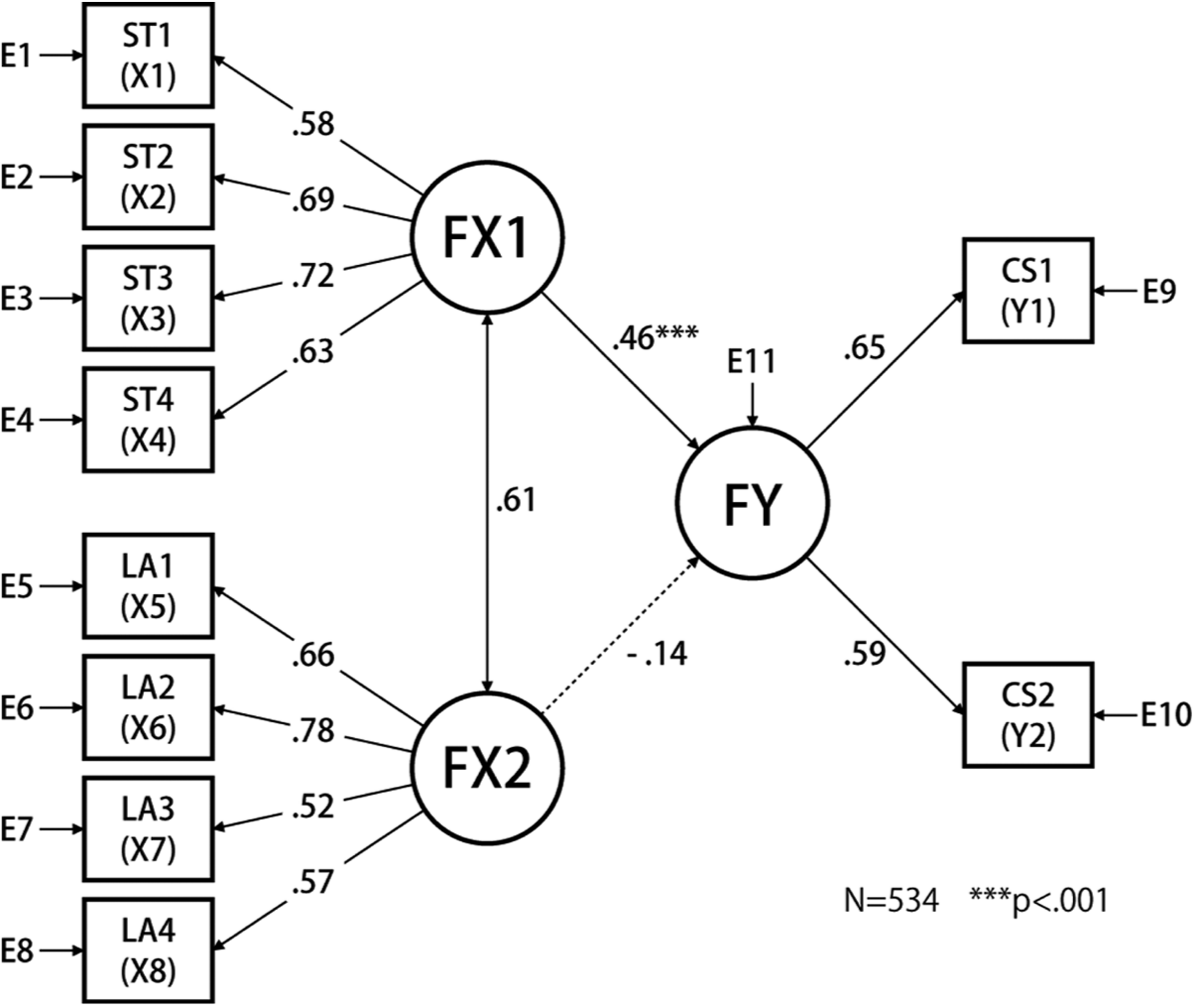
Cultural capital and consumer behavior of the scientific culture model.
CS1: total number of exhibits viewed
CS2: total exhibit viewing time
The indicators for the model fitness were CFI = 0.942 and RMSEA = 0.063, suggesting a good fit between model and survey data. 6 As was evident in Figure 3, scientific and technical cultural capital and literary and artistic cultural capital were positively correlated and had a correlation coefficient of 0.61. The standardized coefficient between scientific and technical cultural capital and consumption of scientific culture was 0.46. Increased scientific and technical cultural capital explained the increased consumption of scientific culture. The standardized coefficients between each latent variable and each observed variable were all greater than 0.52, suggesting a conformity between the constructs and the observed variables. All of these figures indicated that the theoretical model and the data are consistent and that the model provides a good explanation of the variance-covariance matrix for the data.
5. Discussion
The results of this study clearly indicate that scientific and technical cultural capital influences the consumption of scientific culture. Although it was not found that literary and artistic cultural capital directly relates to the consumption of scientific culture, its high correlation with scientific and technical cultural capital suggests that it may have played a background role. Of the visitors, 64.1% came as a family, either as parent–children pairs or as couples. An inherent assumption made on the basis of these results is that during the time spent together on weekends and holidays, members of a family expose each other to their respective interests and that, as in Bourdieu’s theory, this leads to increased total cultural capital. It is difficult to simply conclude that the large divide between the “two cultures,” which has been observed in the West, does not exist in Japan. Although the data suggest that as habitual behaviors, a taste for science and technology and a taste for literature and art are related at the individual level, we need to further explore why people generally differentiate between the humanities and sciences in society.
Educational capital has a negative influence on total exhibits viewed and a positive, although not significant, influence on total exhibit viewing time. This may to some degree reflect the fact that people either wanted to see as many exhibits as possible or spend more time at fewer exhibits of interest. The geographical separation of the three event areas at the open house also may have limited the number of exhibits that people were able to visit. In future, it will be necessary to develop a measure for the consumption of scientific culture at single events with such conditions.
The scales constructed for this study measured only the embodied and institutionalized states of Bourdieu’s three forms of cultural capital. Objectified cultural capital was not measured since the focus of this study was to understand a variety of people through the open house event, a scientific outreach activity. Because it would have been impossible to ensure the homogeneity of the measurement conditions if the answers of more than 1,000 visitors per day were filled out by investigators, a self-reporting method was chosen for this research. To lessen the burden on respondents, the number of questionnaire items was reduced on the basis of the prestudy results. Since the results of the confirmatory factor analysis supported the validity of the two-factor scientific and technical cultural capital and literary and artistic cultural capital models, we can still conclude that the purpose of this study was accomplished. Of course, if the purpose is to understand cultural capital itself in more detail, then it would be best to have a measure that encompasses all three forms of cultural capital.
This study suggests that Bourdieu’s theory of cultural capital is valid in the field of science communication studies by situating it within a wider social context. The approach of focusing on scientific outreach activities also clearly promotes an understanding of the varieties and social backgrounds of participants. Empirical research using even more science outreach activities is needed in the future. The findings from this study could apply to other countries where scientific facilities are readily accessible.
This study also contributes important practical information for involving scientific research institutions in public outreach strategies. The correlation between scientific and technical cultural capital and literary and artistic cultural capital found in this study should be particularly informative to the public relations activities of scientific research institutions that tend to focus chiefly on science and technological aspects in society.
Future research should also expand by making regional comparisons. Research by Bourdieu and Passeron (1979) on the relation between cultural capital and educational communication ability illustrated differences between students from Paris and those from rural areas. Regional comparisons of open houses held at public scientific research institutions would deepen our understandings of scientific culture across the country.
6. Concluding remarks
The results of this study reveal that visitors to open houses at scientific research institutions in Japan are highly educated adults and their school-age children. The results also suggest that regardless of whether an individual’s cultural tastes tend toward scientific and technical capital or literary and artistic capital, their total cultural capital increases through time spent with families who engage in various cultural activities. Those who frequently accumulate scientific and technical capital consumed the most science at the open house event.
Capital is the result of repeated investments that are made in anticipation of their value as future resources (Lin, 2001). As visitors to an open house event at a scientific research institution, most participants were presumably citizens who already had a certain engagement in scientific and technical cultural capital. That there is a statistical difference in the consumption of scientific culture even within this homogeneous group may suggest the possibility of a large distinction between people who came to the open house event and people who did not come to the event. Unfortunately, when using visitor surveys, the interpretation is limited to the measured result, and thus it is impossible to determine the habitual behaviors of the adults and children who do not attend science events. Rethinking the modality of science outreach activities should be considered to further reach out to the wider public.
Footnotes
Acknowledgements
I thank Masahiro Ehara, Hiroki Takikawa, Ritsuko Kawaguchi, and Kohji Hirata for their help in conducting the survey. I am deeply grateful to Takashi Nakamura, Tadahiko Maeda, and Koken Ozaki, who advised me on statistical analyses. The encouragement from Akira Sasaki, Masashi Tachikawa, and Sharon Traweek was invaluable. Satoru Ikeuchi, Hitomi Hongo, Naoki Abe, and Hiroya Hirakimoto gave me insightful comments and suggestions at various stages of writing this paper. I also appreciate the anonymous referees’ comments, which have greatly improved my presentation. Last, but not least, I would like to express my gratitude to the respondents of the questionnaire survey and the Institute for Molecular Science for their cooperation on this research project. This work is supported by Japanese Society for Science and Technology Studies and Hayama Center for Advanced Studies, the Graduate University for Advanced Studies.