



Abstract
Quantum technology is expected to have an impact on society. Earlier literature suggests that certain themes may either create barriers or facilitate effective science communication. We studied 385 Dutch newspaper articles for the use of these themes. Newspapers commonly explained quantum concepts when mentioning quantum technology. They also regularly presented quantum technology as beneficial and enigmatic, often in prominent positions of the articles. The themes on economic development/competitiveness, mystical viewpoint, social progress, and risks were less common. Although these barriers are only potential barriers, we encourage journalists to weigh them when communicating about quantum technology.
Introduction
In October 2019, Google claimed to have reached a milestone. They argued they had built a so-called quantum computer that could perform a task in 200 seconds, when—according to them—the world’s best supercomputer would take around 10,000 years to complete the task (Arute et al., 2019). News media worldwide paid attention to Google’s achievement, including Dutch newspapers.
Het Parool, for instance, wrote about possible benefits (Van Unen, 2019): 1
According to Google, the possibilities are endless in the long term. Think of connecting the data points from which weather forecasts are drawn up at lightning speed, or predicting changes in climate.
De Telegraaf, on the contrary, ended their article with concern (“Geheimschrift,” 2019): It [i.e. the quantum computer] offers many possibilities, but also potential problems. The encryption, which secures our e-mail traffic, can be cracked in the blink of an eye. And if I were the secret service, I would already start thinking of an alternative to my secret code.
The media coverage of Google’s achievement illustrates that quantum technologies, which include quantum computers, are communicated in different ways. Quantum technologies are emergent technologies that use quantum physics principles, which describe the behavior of particles at very small scales. These new technologies are categorized into the domains of quantum computing and simulation, quantum communication, and quantum sensing and metrology (Stichting Quantumdelta NL, 2020). There are several applications envisioned for quantum technologies, for example, quantum computers for drug discovery (Outeiral et al., 2021), a quantum internet for secure communication (Wehner et al., 2018), and quantum sensors for monitoring underground infrastructure (Stray et al., 2022).
Most of these technologies are still in their infancy, but it is expected that once they mature, they will start to impact society at large (European Quantum Flagship, 2020; Stichting Quantumdelta NL, 2020; Vermaas et al., 2019, 2022). Therefore, it is important already at this early stage to consider public engagement with quantum technology, which means dialogue and deliberation with the public early in the technology’s development (see “upstream engagement”; Mooney, 2010; Priest, 2010). One of the reasons for this is to ensure that the technology is built in a socially robust way (Roberson et al., 2021).
The different ways in which quantum technology is communicated to newspaper readers can impact public engagement in diverging ways. For one, Het Parool’s statement that quantum computing can accurately forecast the weather has been called “really far-fetched” (Ezratty, 2022, p. 8). Although it is feared that such hyped-up promises will result in a decline in public trust in scientists (Ezratty, 2022), they may also help by raising awareness and subsequently spark new discussions (Roberson, 2020). The “quantum computing as a threat” narrative, which De Telegraaf mentioned, could also affect public engagement. According to Seskir et al. (2023), this narrative, without presenting a realistic timeline or information on how organizations are already actively working on dealing with the threat, could place time restrictions on potential public engagement and deliberation activities.
As quantum technologies are expected to impact society in the future, there is a role for science communicators and journalists in the process of public engagement with quantum technology. In this article, we quantitatively examine how quantum science and technology are communicated in Dutch newspapers. The theoretical concepts on which our study is based are covered in detail in the next section.
Theory
Most members of the public become acquainted with scientific information through science-news articles published in (online) media (Schäfer, 2017). In the current online era, despite the emergence of new media platforms such as blogs, social networking sites, and video sharing sites, traditional news media continue to play an important role (Weimann & Brosius, 2017). In the Netherlands, for instance, both online and print newspapers are a frequently used source through which citizens interact with information about science and technology (Directorate-General for Communication, European Commission, 2021; Rathenau Instituut, 2021).
As newspapers and other forms of traditional news media emphasize certain news, for instance through the amount of coverage, they can impact what the public considers to be important topics (Lou et al., 2019). This is known as first-level agenda setting (McCombs & Shaw, 1972). In addition to this first level, agenda setting theory also includes a second level (Scheufele & Tewksbury, 2007; Weaver, 2007; Weimann & Brosius, 2017). While the first level is concerned with which topics are discussed in the media, the second level is concerned with how the media communicate about those topics (Weaver, 2007). For instance, when discussing a given topic, media outlets can focus on themes such as the benefits or risks involved in the issue at hand (Chuan et al., 2019; Lewenstein et al., 2010; Strekalova, 2015; Veltri, 2013), which can subsequently influence people’s attitudes toward the issue (Achterberg, 2014; Cobb, 2005; Druckman & Bolsen, 2011).
The influence of news media is particularly important in the case of emergent technologies (Scherrer, 2023; Scheufele & Lewenstein, 2005), as this is likely the first exposure people have to such a technology. News media coverage for emergent technologies usually seems to follow a typical attention cycle of a bell-shaped curve of salience: it starts off with a growing amount of coverage followed by a decline (Lewenstein et al., 2010; Nisbet et al., 2003; Veltri, 2013). Previous content analyses of emergent technologies, such as nanotechnology (Lewenstein et al., 2010; Strekalova, 2015), artificial intelligence (AI) (Chuan et al., 2019), and stem cells (Nisbet et al., 2003), show that the news media in general paint a positive picture when reporting on these technologies. The emphasis is, for instance, on themes such as business opportunities and social progress. At the same time, attention is also paid to the risks of the technologies. For example, a content analysis of nanotechnology in the Spanish news media showed that controversies were reported early on (Veltri, 2013). A content analysis of AI in the U.S. news media found that risks were covered less but in more depth than the benefits (Chuan et al., 2019).
An important emergent technology currently under development is quantum technology. It holds the potential to impact society at large once it arrives (Stichting Quantumdelta NL, 2020; Wehner et al., 2018). As with any new technology, quantum technology poses both benefits and risks for society. For example, quantum computers have the potential to design new types of materials and molecules that could save or extend lives through drug discovery (Outeiral et al., 2021), but they can also enable new forms of modern warfare that could fall in the hands of terrorist groups (Vermaas et al., 2019).
Because of the expected impact of quantum technology, it is important to establish good connections between quantum and society. This means engaging the public early in the technology’s development and building up trust in society (Mooney, 2010). However, literature warns of barriers to effective public communication about quantum, which could hinder public engagement (Seskir et al., 2023; Vermaas, 2017) and public trust (Grinbaum, 2017). At the same time, there is also a plea for sufficient attention to reflect on the impact of quantum technology on society (Roberson et al., 2021).
In terms of barriers to effective public communication about quantum, Vermaas (2017), for instance, argues that quantum is often communicated as enigmatic. He argues that this could hinder public understanding of quantum technology and subsequent engagement in societal dialogues to explore the implications of quantum technology on society. Furthermore, according to Seskir et al. (2023), describing quantum technology in terms of having to win a race poses a barrier to participatory efforts with quantum technology between different stakeholder groups. In a military context, for instance, it can lead to research having to be kept secret for certain groups. Third, Grinbaum (2017) states that popular media do not explain underlying quantum physics concepts when mentioning quantum technology, which he argues could influence the public’s trust in quantum technology. Finally, mystical viewpoints of quantum, often found in popular scientific talks (Meinsma et al., 2023), present a pseudoscientific, inaccurate image of quantum. As such, this potential barrier can result in misconceptions about its applications (Bondani et al., 2024).
In contrast, Roberson et al. (2021) advocated for focusing on themes that promote effective public communication about quantum. This includes highlighting ways in which quantum technology can impact society for the better while its risks are minimized. The authors encourage a reflection on the ways in which quantum technology might improve or solve problems in people’s lives (i.e., the social progress theme) and this reflection should entail both the risks and the benefits of quantum technology, thereby providing a balanced perspective. 2
In a recent content analysis of 501 TEDx talks, Meinsma et al. (2023) studied the prevalence of the different quantum-related themes described above. Results of their analysis showed that while the spooky and enigmatic theme occurred in about a quarter of the talks, the quantum race theme and the mystical viewpoint theme were hardly present. In addition, and contrary to what had been suggested in the literature, relatively many TEDx talks contained quantum physics concept explanations. Regarding the balanced perspective, benefits greatly outnumbered the risks, while reference to social progress was scarce. Only some of the concerns from literature were thus present in TEDx talks, and overall, quantum was portrayed in a positive way.
While TEDx talks reach a rather specific audience (their local audiences and web users; Mattiello, 2019), most members of the general audience will likely learn about quantum through (online) news media. As agenda setting predicts that what and how is being talked about in these media may affect people’s perceptions of emergent technologies, it is important to examine if (first-level agenda setting) and how (second-level agenda setting) quantum technology is communicated in news outlets. The Dutch scientific community is heavily involved in quantum technology (Stichting Quantumdelta NL, 2020), and the societal connection is explicitly mentioned in its National Agenda Quantum Technology. In this study, we, therefore, investigate to what extent and in which ways quantum technology is communicated in Dutch newspaper articles. Our research questions are as follows:
Research Question 1: (a) Which attention cycle do Dutch national newspapers follow in relation to quantum technology and (b) which of the quantum domains (computing and simulation, communication, sensing and metrology) receive most attention?
Research Question 2: How often are the following themes present in Dutch national newspaper articles about quantum science and technology?
(a) spooky and enigmatic
(b) economic development/competitiveness
(c) explaining fundamental quantum concepts when mentioning quantum technology
(d) mystical viewpoint
(e) social progress
(f) benefits
(g) risks
Moreover, news articles have a specific structure, such that the most important information is shared first, while the remaining text presents less important information (Angler, 2017). This implies that themes positioned in the beginning of news articles (e.g., in the head) are the most prominent. Magusin (2017) highlights three features of heads that make them worth studying. First of all, readers tend to read heads more often than the full article itself. Second, the information in the head guides readers toward the facts presented in the article. And finally, heads rely on cultural knowledge that is believed to be widespread in society, and therefore, they may influence the dominant discourse more than the rest of the article. We argue that in addition to the head, the subhead and lead also contain important information (Angler, 2017), and therefore, we ask
Research Question 3: Which themes do journalists most often place in a prominent location?
Methods
Sample Collection
To answer the research questions, we collected a sample of Dutch newspaper articles with quantum science and technology content. Our data collection method is shown in Figure 1. We used the search string “quantum* OR kwantum*” in the Nexis Uni database (LexisNexis, Nexis Uni, n.d.) and set the search window from January 1, 2009 (the year in which the first quantum computer was unveiled; Hanneke et al., 2010) to December 31, 2021. Articles written by the six major Dutch newspapers as listed in the rankings of Nationaal Onderzoek Multimedia (NOM) Dashboard 2022-I were included, namely Algemeen Dagblad, De Telegraaf, De Volkskrant, NRC, Trouw, and Het Parool. The search returned a total of 2,553 articles.
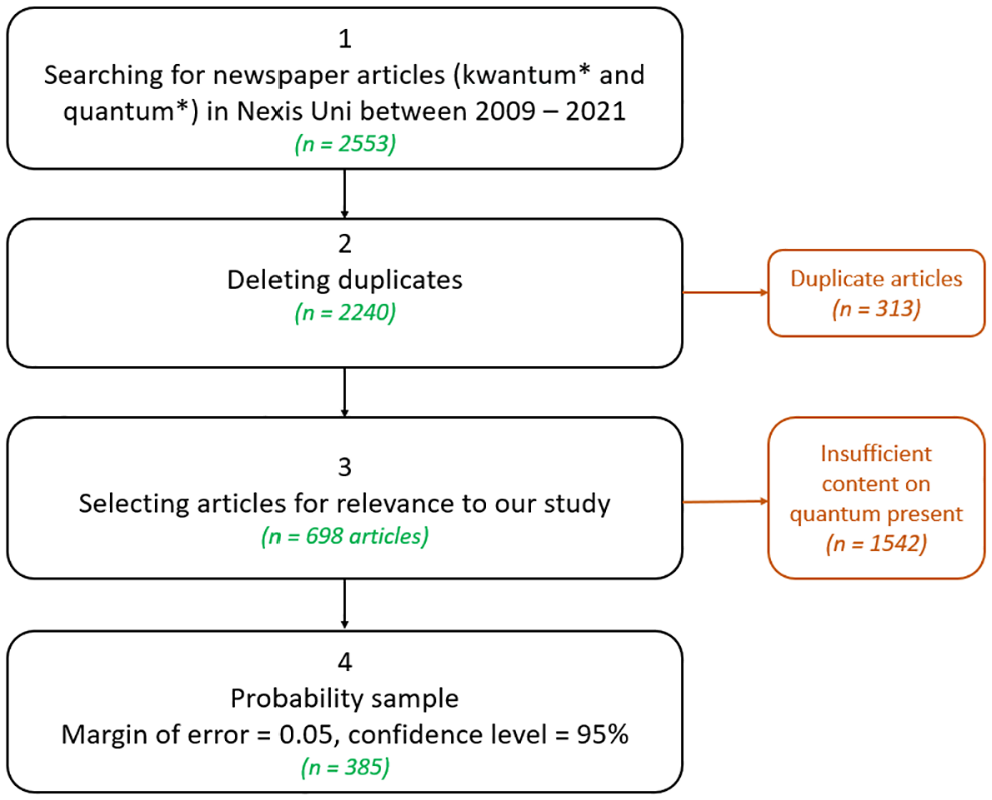
Data Collection Method.
In the second step, duplicate articles were deleted via a hybrid automatic-manual process. Details of this process can be found in Section A1 in the Supplemental Appendix and in the referenced source code. 3 It resulted in a total of 2,240 unique articles. Afterward, we selected the articles with sufficient quantum science and technology content for our study. The reasons for discarding an article are included in Table A1 in the Supplemental Appendix. The primary reason (n = 599) for excluding an article was due to using the search string in a company or product name, for example, references to the Dutch company “Kwantum” or the James Bond film “Quantum of Solace.” The two first authors of this article checked the article selection on a 20% random sample of the data set, which resulted in an acceptable level of agreement (α = 0.830,92.4%; Krippendorff, 2004). In total, we discarded 1,542 articles which left us with a data set of 698 articles. The metadata of all these articles were obtained through Nexis Uni (LexisNexis, Nexis Uni, n.d.), which included the newspaper brand, the section in which the article was published, the date of publication, the article headline, the name of the author, and the word count of the article.
Based on formulas for standard error and confidence intervals (Neuendorf, 2017), we drew a random sample of 385 articles for our analysis. We opted for a simple random sample due to limited coding resources, and sampling theory suggests that coding the entire data set is unnecessary as we can be 95% confident that the true population percentage is within 5% of the sample percentage. Descriptives of the sample are shown in Table A2 in the Supplemental Appendix.
Codebook
The complete codebook can be found in Supplemental Appendix B and was based on the codebook from Meinsma et al. (2023).
We coded the barriers to effective communication of quantum science and/or technology. If a theme was found, the sentence that reveals the theme was copied into the coding sheet. The spooky and enigmatic theme was identified when “quantum” was associated with “spooky” or “enigmatic” or a synonym of those terms. Second, the economic development/competitiveness theme was found when a news article made reference to the effect that quantum science and technology can have on the economy, and/or when the article highlights the competitive side on a local, national, or global level (see Nisbet, 2009). Third, we identified the presence of an explanation of three types of fundamental quantum concepts: superposition, entanglement, and contextuality in articles that make reference to quantum technology (i.e., articles with a quantum technology indicator). An explanation of superposition includes that a particle can be in multiple states at the same time; of entanglement that two particles share a quantum state, meaning that it does not make sense to discuss those particles as separate entities anymore; and finally, contextuality is considered a harder concept (see Jaeger, 2019), which we operationalized as that performing a measurement irreversibly affects a quantum state. Finally, the mystical viewpoint was identified when an article included ideas that do not adhere to established scientific paradigms of quantum, such as connections to spirituality, religion, and consciousness.
In addition, we coded the themes referring to a balanced perspective on quantum science and/or technology. The social progress theme was present when an article emphasized how quantum science and technology can solve problems or improve people’s lives (see Nisbet, 2009). The benefit theme was identified when either a positive evaluation of quantum science and technology was given, quantum science and technology was said to have advantages over something else (e.g., it was attributed to being faster, safer, and better), or when a specific reference was made to how quantum science and technology will benefit a particular field. Note that social progress is inherently a benefit, and therefore, the benefit theme was automatically identified when the social progress theme appeared in the article. The risk theme appeared when concerns about quantum science and technology were highlighted.
Finally, themes that were placed in the head, subhead, or lead were coded as prominent. We only included news reports and features in this part of the analysis, as these are the articles that typically have a structure with the most important information first, followed by less important information (Angler, 2017).
Coding Procedure and Reliability
To ensure reliable results, the first two authors conducted three independent coding rounds and discussed similarities and differences in their application of the codebook extensively. The first coding round was a pilot based on 36 articles from 2022. The second round involved drawing a random sample of n = 267 articles with n = 54 articles (20%) for intercoder reliability. Overall, the codebook was reliably applied. Only for certain codes, low occurrences affected reliability, as a slight difference in interpretation between the first and second coders was already detrimental for α. The coders, therefore, extensively discussed the differences and reached a consensus in all cases. With the discussion in mind, one of the coders proceeded with coding the entire sample of 267 articles. Because the coding process went smoother than anticipated, time allowed us to extend our initial sample of 267 articles to 385 articles of which an additional 24 articles were randomly selected for intercoder reliability testing (totaling n = 78 articles, 20% of 385 articles). As Table A2 in the Supplemental Appendix shows this procedure ensured overall the reliable application of the codebook and for any remaining disagreements, a consensus was reached between the two coders. The primary coder then proceeded to code the rest of the sample. The details of the analysis plan can be found in Table A4 in the Supplemental Appendix.
Results
Amount of Coverage
Of the 385 articles in our sample, most articles were published in 2014 and 2018 (in both years: n = 41, 10.6%), and the least in 2009 (n = 14, 3.6%). As can be seen in Figure 2, there are spikes in coverage. Figure A1 in the Supplemental Appendix shows that the curve of the total number of articles in the complete data set (N = 698 articles) resembles the curve in Figure 2. For an overview of the distribution of articles per year per newspaper in our sample, please see Figure A2 in the Supplemental Appendix.
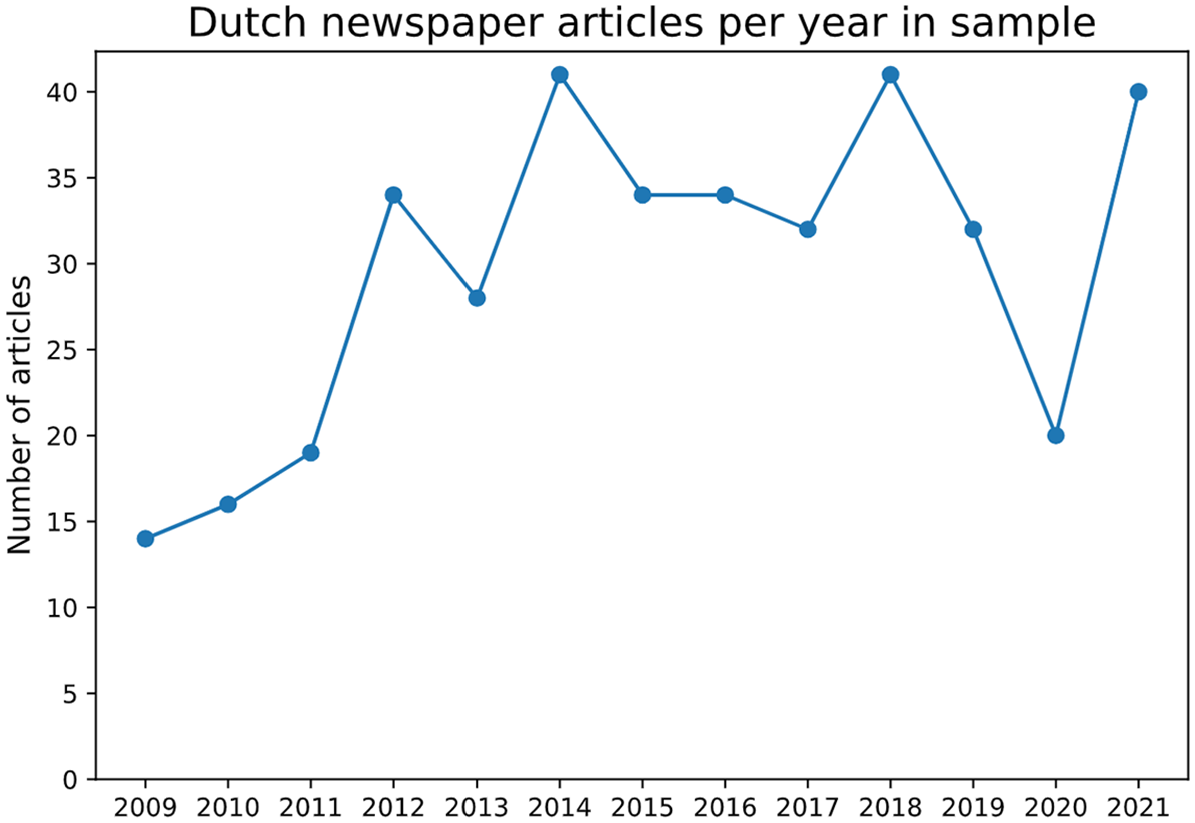
Frequency of Articles by Year of Publication (N = 385).
Quantum science and/or technology was the main focus in a little less than half of the articles (n = 170, 44.2%). The topic of quantum computing and simulation occurred most frequent (n = 153, 39.7%), followed by quantum communication (n = 33, 8.6%) and only two articles mentioned quantum sensing and metrology (0.5%).
Themes
Table 1 shows the prevalence of the themes that we analyzed. Below, we describe these findings in more detail and provide illustrative examples from our data set.
Frequency Table of the Newspaper Articles Comparing the Predefined Set of Themes.

Note. Multiple themes can occur in one article. aindicates the exact Clopper–Pearson confidence interval was calculated.
First of all, the spooky and enigmatic theme appeared in 24.2% of the articles in our sample (n = 93). An example is “The theory behind quantum mechanics is bizarre and counterintuitive. [. . .] There is nothing weirder than quantum mechanics” (Schenk, 2018). In this example, the terms “bizarre” and “weird” are indicative of the theme as they are semantically similar to the terms “spooky” and “enigmatic.”
Second, the economic development/competitiveness theme appeared in 8.6% of the articles in our sample (n = 33). An example is “NSA fears European lead in race for ‘qubits’” (Hond, 2014), where competitiveness is highlighted through the word “race.”
Third, to establish whether articles include an explanation of a quantum physics concept when referring to quantum technology, we analyzed the articles with a quantum technology indicator (n = 178) for including an explanation on superposition, entanglement, and/or contextuality. Results show that 50.6% of the articles with a quantum technology indicator (n = 90) explained at least one of these three concepts. Out of the three concepts, superposition is explained most often (see Figure A3 in the Supplemental Appendix). An example of a quantum concept explanation is as follows: If you apply the elusive properties of quantum physics to classical bits, you take the step to the qubit: an information carrier that can be not only zero or one, but also zero and one at the same time, something that physicists call superposition (Hal, 2017).
The mystical viewpoint was found in 10 articles (2.9%). An example appeared in an interview with a theologist, who pleads for connection and solidarity (Huttinga, 2017): I find it comforting and telling that quantum physics shows us the same thing: everything is completely intertwined and connected—already at the level of the electron. In the universe, everything is mysteriously connected to everything in every possible way. It is up to us to tune into that.
In only 13 articles (3.4%), reference was made to the fact that quantum would mean something good for society and should be developed and deployed in such a way. An example of the social progress theme is as follows: “According to her, quantum technology is going to revolutionize society. It can provide solutions to global issues in climate, energy, health care, and security” (Van onze correspondent, 2016). The example focuses on quantum technology as a solution to major problems that our society currently faces.
To examine the balanced perspective of quantum technology, we quantified the occurrence of the benefit theme and the risk theme. First of all, the benefit theme appeared in 33.2% of the articles in our sample (n = 128). An example is as follows (Wayenburg, 2014): The promises are great: with control of quantum information you could build quantum computers that calculate faster than all current computers, because they can analyse many billions of variants of the problem at the same time. Quantum information also offers the possibility to transmit information in an non-eavesdropping manner. And then there are probably even more applications that have not yet been thought of.
By stating that “the promises are great,” the author gives a positive evaluation of quantum computers. In addition, by using the word “faster” for comparing quantum computers to current computers, the author emphasizes an advantage of quantum computers.
Finally, the risk theme appeared in only 5.5% of the articles in our sample (n = 21). An example is as follows (Brugh, 2016): Imagine that everything you email, that you bank online, that you store on your computer, is no longer secure. [. . .] Peter Schwabe (35), cryptographer at Radboud University Nijmegen, is seriously concerned about that scenario. Because with the imminent arrival of quantum computers, which promise unprecedented computing power, this becomes a real danger.
The phrases “seriously concerned” and “a real danger” in relation to the arrival of quantum computers indicate risk. Furthermore, this example mentions a specific field that is being impacted: the digital security/privacy field. To gain more insight into these specific fields that are mentioned to be benefited or harmed by quantum technology, we carried out an additional analysis (see Figure A4 in the Supplemental Appendix). This showed that the digital security and privacy field were most often mentioned to be impacted by quantum science and technology, both in terms of causing benefits and causing risks to the field.
Table A4 in the Supplemental Appendix shows the number of times each theme was placed in a prominent location in news reports or features, and its percentage compared with the total number of prominent themes. The benefit theme was most often placed prominently (25×), followed by the spooky and enigmatic theme (15×). In addition, when comparing the number of times a theme appeared in a prominent location with its total occurrences, we found that themes were typically placed prominently in about a quarter of the news reports and features, with percentages ranging from 20% (mystical viewpoint) to 30% (risk), except for quantum concept explanations (15.5%) and social progress (8.3%).
Discussion
This study examined how quantum physics and technology were described in Dutch newspapers during the period 2009 to 2021. We quantified the occurrence of themes relevant to the setting of quantum science and technology.
First-Level Agenda Setting: How Often Is Quantum Technology Written About?
Both in the fully coded sample (385 articles) and in the total data set of 698 articles with quantum science and technology content, we find that the typical bell-shaped curve of salience for emergent technology is not (yet) visible (such as for nanotechnology in the American and Spanish news; Lewenstein et al., 2010; Veltri, 2013). Overall, we see an upward trend interrupted by several dips, including one in 2020 that may be related to COVID-19. As quantum technology is in an early stage of development, it is possible that we are currently at the start of the bell-shaped curve of salience.
Between 2009 and 2021, the six major Dutch newspapers wrote an average of around 50 articles per year with content about quantum science and technology. This number seems relatively small compared with the number of research outcomes in the Dutch media in general (Hijmans et al., 2003) and compared with the prevalence of other physics disciplines (Kristensen et al., 2021). It may thus be that the public has not yet been largely exposed to quantum science and technology and may not know much about it yet.
Second-Level Agenda Setting: How Is Quantum Science and Technology Written About?
We identified how quantum science and technology are described in Dutch newspaper articles, focusing on both potential barriers to, and potential facilitators of, effective science communication suggested in the literature. Contrary to claims from the literature, the economic development/competitiveness theme (Seskir et al., 2023) and mystical viewpoint (Bondani et al., 2024) were relatively uncommon (8.6% and 2.9%, respectively). This suggests that these potential barriers might not be very salient in the minds of Dutch newspaper readers and possibly less influential for the way people think about quantum science and technology. By contrast, quantum concept explanations (Grinbaum, 2017) were relatively frequent (50.6%), indicating that this barrier (i.e., lack of explanation) is not overly prominent in media coverage of quantum.
At the same time, however, the frequency of other themes aligns with concerns voiced in the literature. The spooky and enigmatic theme (Vermaas, 2017) appeared relatively often (24.2%), whereas the social progress theme (Roberson et al., 2021) was hardly present (3.4%). Furthermore, the frequency of the benefit frame (33.2%) largely exceeded that of the risk frame (5.5%), creating an unbalanced perspective (Roberson et al., 2021) on quantum in Dutch newspapers. In addition, the benefit theme and the spooky and enigmatic theme were often placed in prominent locations within news reports and features, potentially making them more influential than other themes. We, therefore, encourage journalists and science communicators to carefully consider the use and positioning of these themes in their public communication about quantum.
In comparing quantum technology coverage to that of other emerging technologies, it is surprising that the focus on economic benefits (Chuan et al., 2019; Lewenstein et al., 2010; Nisbet et al., 2003) and social progress (Chuan et al., 2019; Nisbet, 2009) is less clear. However, the tendency of news media to paint a positive picture while rarely mentioning the risks of quantum technology is consistent with other emergent technologies (Chuan et al., 2019; Lewenstein et al., 2010; Nisbet et al., 2003; Strekalova, 2015; Veltri, 2013). We know from previous research that a positive focus in news media can have a positive effect on the acceptance of emergent technologies (Scherrer, 2023; Scheufele & Lewenstein, 2005). Future research should investigate whether this is also the case in this context.
Limitations
A limitation of our study is that we used a predefined set of themes to code the data, which may overlook other interesting themes that a bottom-up approach could reveal. In addition, only a small number of authors contributed significantly to the coverage of quantum science and technology in Dutch newspaper articles, suggesting possible self-reinforcing effects as journalists look at each other’s articles or previous work. Since our study focused on a single country, the Netherlands, this may limit the generalizability of our findings. We, therefore, encourage replication in different contexts for the external validity of the study. Finally, although the concept is more nuanced, we operationalized contextuality as the idea that a measurement irreversibly affects a quantum state. We have limited our codings to only address this aspect of a measurement because of the concept’s complexity. Further qualitative research could examine which quantum concepts are all described and how deeply they are discussed in popular communication.
Practical Implications
News articles may influence perceptions and subsequent attitudes toward quantum technology. Therefore, we encourage journalists and science communicators to already consider the potential barriers and potential facilitators to effective science communication in literature. This way, communication about quantum might jump from a state of superposition—where it is effective and ineffective at the same time—to one of effectiveness.
Supplemental Material
sj-docx-1-scx-10.1177_10755470251318300 – Supplemental material for Quantum in the Media: A Content Analysis of Dutch Newspapers
Supplemental material, sj-docx-1-scx-10.1177_10755470251318300 for Quantum in the Media: A Content Analysis of Dutch Newspapers by Aletta Lucia Meinsma, Thomas Rothe, W. Gudrun Reijnierse, Ionica Smeets and Julia Cramer in Science Communication
Supplemental Material
sj-docx-2-scx-10.1177_10755470251318300 – Supplemental material for Quantum in the Media: A Content Analysis of Dutch Newspapers
Supplemental material, sj-docx-2-scx-10.1177_10755470251318300 for Quantum in the Media: A Content Analysis of Dutch Newspapers by Aletta Lucia Meinsma, Thomas Rothe, W. Gudrun Reijnierse, Ionica Smeets and Julia Cramer in Science Communication
Footnotes
Declaration of Conflicting Interests
The author(s) declared no potential conflicts of interest with respect to the research, authorship, and/or publication of this article.
Funding
The author(s) disclosed receipt of the following financial support for the research, authorship, and/or publication of this article: We acknowledge funding from the Dutch Research Council (NWO) through a Spinoza Grant awarded to R Hanson (Project Number SPI 63-264) and thank Ronald Hanson for this opportunity. This work was supported by the Dutch National Growth Fund (NGF), as part of the Quantum Delta NL programme.

Notes
Author Biographies
References
Supplementary Material
Please find the following supplemental material available below.
For Open Access articles published under a Creative Commons License, all supplemental material carries the same license as the article it is associated with.
For non-Open Access articles published, all supplemental material carries a non-exclusive license, and permission requests for re-use of supplemental material or any part of supplemental material shall be sent directly to the copyright owner as specified in the copyright notice associated with the article.
