




Abstract
This research examines how exposure to different motives of scientists affects the impact of scientific consensus on public attitudes toward cultured meat. While scientific consensus on the safety of cultured meat generally increased positive attitudes toward it, this effect depended on information about scientists’ motives. Exposure to information about scientists’ financial motives weakened the positive effect of scientific consensus because it undermined trust in scientists. Information about scientists’ prosocial motives did not influence the scientific consensus effect. These findings suggest that perceived motives can shift trust in experts, thereby affecting the influence of experts on public attitudes.
Introduction
Addressing many of today’s most pressing challenges to global sustainability (e.g., climate change and pandemics) requires significant, large-scale changes in people’s attitudes, behaviors, and lifestyles. As a major source of greenhouse gas emissions, food consumption is one area that requires a significant reform (Ivanovich et al., 2023). In particular, the current meat production system is extremely environmentally harmful; in 2015, livestock agriculture contributed to 6.2 billion tons of greenhouse gases—or 12% of all emissions (Food and Agriculture Organization, 2023). Much effort has been directed toward examining how meat production and consumption can be made more sustainable (e.g., Parlasca & Qaim, 2022), and a potential solution is to increase people’s consumption of alternative meats, such as cultured meat. Cultured meat (also known as cultivated meat, in vitro meat, or clean meat) refers to a type of meat produced by extracting muscle stem cells and cultivating them into muscle tissue in a laboratory setting (Post et al., 2020). Because its production does not involve animal farming, cultured meat is increasingly recognized as a sustainable and ethically responsible alternative protein source.
Yet, despite its potential to address substantial global issues, such as carbon emissions from meat production, animal welfare, and food security (Schaefer & Savulescu, 2014; Tuomisto & Teixeira de Mattos, 2011), consumers remain largely hesitant in their acceptance of this alternative meat source. Although there are many barriers to the acceptance of cultured meat—including its perceived artificiality, lack of nutrition, and anticipated taste (Bryant & Barnett, 2020)—concerns about the safety of food produced through novel technologies seem to be a key impediment (Siegrist & Hartmann, 2020; Verbeke et al., 2015; see the study by Onwezen et al., 2021 for a relevant review). Accordingly, understanding how and why people might perceive cultured meat as safe, thereby being more willing to consume, has significant implications. The present research addresses these questions by investigating the influence of information about opinions and motivations among experts (i.e., scientists).
Scientific Consensus Effect
While meaningful changes in sustainability-related attitudes and behaviors can be achieved through various approaches (Clayton et al., 2016; Constantino et al., 2022; Eom et al., 2019; Geiger & Brick, 2023; Pearson et al., 2016; Van Bavel et al., 2020), one effective way to promote positive change is to employ experts who can accurately and clearly communicate relevant information and advice (Cole et al., 2023; Flores et al., 2022; McGinnies & Ward, 1980). Given the novelty, complexity, and uncertainty inherent in the collective challenges today (e.g., whether and how climate change is happening and whether vaccines and mask-wearing are effective in protecting against COVID-19), scientists—many of whom are centrally involved in understanding and solving these challenges—are a key group of experts who can help persuade and promote positive change (Flores et al., 2022).
In particular, research has demonstrated that the expertise of scientists can be leveraged by communicating their consensus on an issue (van der Linden, 2021). People’s beliefs and attitudes about an issue seem to be significantly associated with their perceptions about the degree to which scientists agree on that issue (e.g., Ding et al., 2011; Hornsey et al., 2016; McCright et al., 2013). Experimental evidence confirms the causal role that scientists’ consensus plays. For example, information indicating a high percentage (e.g., 97%) of climate scientists agree that human activities cause global warming increased people’s beliefs about anthropogenic global warming and, consequently, their support for climate actions (van der Linden et al., 2019). Notably, scientific consensus messages have been shown to shape public attitudes effectively in other issue domains beyond climate change, such as vaccines (van der Linden et al., 2015) and genetically modified food (Dixon, 2016; Kerr & Wilson, 2018).
However, there may be good reasons to believe that scientific consensus effects are context-dependent (Bayes et al., 2023; cf. Kahan, 2016). For instance, messages of scientific consensus can backfire in some situations and negatively impact beliefs about an issue; such psychological reactance can occur when perceivers believe the message to be coercive and manipulative (Bayes et al., 2023; Ma et al., 2019). Moreover, the effectiveness of scientific consensus also depends on characteristics of the perceiver, such as people’s prior views and political orientations: Climate change skeptics (vs. believers) are more likely to strengthen their prior (dis)belief when presented with information of scientific consensus, and even more so if such skeptics strongly identify as Republicans (Ma et al., 2019). Affirming these arguments, recent meta-analytic evidence indicates that scientific consensus effects can be relatively heterogenous, suggesting the existence of moderator variables (van Stekelenburg et al., 2022). Given the mounting evidence for the context dependence of scientific consensus effects, scholars have increasingly recognized the need for more robust theorizing about and systematic tests of factors that modulate the effects of communicating scientific consensus (van der Linden, 2021).
The Moderating Roles of Perceived Motives and Trust in Scientists as an Underlying Mechanism
The present research responds to these recent calls by examining how exposure to different motives of scientists influences the scientific consensus effect in the domain of cultured meat. Making inferences about others’ motives behind an action is a common, spontaneous, and functional psychological reaction (Hassin et al., 2005; Moskowitz & Olcaysoy Okten, 2016). Importantly, such inferences about others’ motives can profoundly shape perceptions of actors and their actions (Menon et al., 1999; Ross et al., 1977). While there can be many motives that drive actions, they can be categorized into two broad categories: self-oriented (proself) motives and other-oriented (prosocial) motives (De Dreu & Nauta, 2009; Miller, 1999). For many actions, one motive is typically more prominent than the other, although the same action can be driven by both (Batson & Shaw, 1991; Cialdini, 1991; Miller, 1999). Regardless, people’s perceptions of these motives matter significantly in judgments of others and their actions (Carlson et al., 2022). Somewhat unsurprisingly, perceptions of proself (vs. prosocial) motives tend to elicit more negative evaluations (Carlson et al., 2022; Critchley, 2008). Carlson and Zaki (2018) showed that participants rated a target as less altruistic and more selfish when the target’s behavior (e.g., blood donation) was driven by proself motives (e.g., to get a gift card) compared to when the behavior was driven by prosocial motives (e.g., to help someone in need).
Likewise, the way people perceive motives of scientists (for conducting research) may have significant implications for their evaluations of scientists and susceptibility to scientists’ influence. In the present research, in examining people’s acceptance of cultured meat, we investigate how scientific consensus effects depend on the motives of scientists—who demonstrate consensus about the safety of cultured meat. In doing so, we expose people to information about distinct motives (proself vs. prosocial) of scientists. To the extent that this information changes perceptions of scientists’ motives, we posit that scientific consensus effects on increasing perceived safety of cultured meat and further willingness to consume it are attenuated when people are exposed to the information that scientists’ motives are self-oriented. Conversely, scientific consensus effects may be enhanced when people are exposed to the information that scientists’ motives are other-oriented.
Why might scientists’ motives moderate the scientific consensus effect? We suggest trust in scientists is a key factor. Specifically, information that scientists conduct research for self-oriented (vs. other-oriented) reasons diminishes (vs. enhances) trust in scientists. Evidence suggests that the inferences people make about scientists’ motives significantly influence outcomes such as people’s trust toward science and scientists (Eiser et al., 2009; Rabinovich et al., 2012). For instance, people report lower levels of trust in scientists who are perceived as trying to manipulate others (vs. inform others) through their communications (Rabinovich et al., 2012). In addition, Critchley (2008) found that people view publicly (vs. privately) funded scientists as more trustworthy because they perceived them as being more prosocially motivated.
Importantly, trust often functions as a heuristic that guides acceptance of experts’ advice and claims. Cummings (2014) argues, with a case involving health professionals, that trust plays a key role in the public risk perception when they process information from experts. When trust decreases (increases), people tend to evaluate information and assertions from experts more negatively (positively; Brewer & Ley, 2013; Hmielowski et al., 2014). Accordingly, trust in scientists or science has been suggested as a key factor upon which scientific consensus effects depend (van der Linden, 2021). Consistent with such reasoning, Chinn et al. (2018) showed that scientific consensus information did not increase perceptions of scientific certainty and personal agreement with the scientists’ position for people who reported lower trust in science. Taken together, we propose that scientists’ proself (vs. prosocial) motives decrease (increase) trust in scientists, thereby weakening (enhancing) the power of scientific consensus in persuading people to perceive cultured meat as safe, and therefore, they become more willing to consume it. Despite the implications of perceived motives for trust in scientists, no research has directly examined the moderating role of scientists’ motives on scientific consensus effects.
The Present Research
The present research examined how and why exposure to different scientists’ motives affects the influence of scientific agreement on attitudes about cultured meat. Specifically, we investigated how exposure to different motives of scientists modulates the effects of scientific consensus on safety perceptions of cultured meat and willingness to consume it. In doing so, we considered willingness to consume as a downstream outcome of safety perceptions, given prior research demonstrating the importance of safety perceptions in determining consumption intentions (Arvanitoyannis & Krystallis, 2005; Leung et al., 2023; Onwezen et al., 2021). Finally, we examined trust in scientists as a key factor that explains the hypothesized moderating effect of scientists’ motives.
Notably, the present research focused on scientists’ financial (doing science to make money) and prosocial (doing science to help others and society) motivations as forms of self-oriented and other-oriented motives, respectively. While various self-oriented motives exist (e.g., doing science to satisfy intellectual curiosity or gain fame), examining financial motives may be an appropriate contrast with prosocial motives as motives to gain material benefits are perceived to be more purely self-centered than other self-oriented motives (e.g., gaining emotional and social benefits; Carlson & Zaki, 2018).
Therefore, the main hypotheses tested in the present research are as follows:
Across two studies, we exposed participants to different motives of scientists to shift their perceived motives of scientists and examined how it affects scientific consensus effects. Study 1 provided an initial test of the hypothesized roles of scientists’ motives (testing H1, H2, and H3). While replicating the findings in Study 1 with a larger sample, Study 2 directly examined trust in scientists as a mediator that explains why exposure to different motives of scientists moderates scientific consensus effects (testing H1, H2, and H4). The materials, codes, and data from all the studies are available at the Open Science Framework: https://osf.io/eb3sa.
Study 1
Participants
There were three experimental conditions regarding scientists’ motives (control, financial motives, and prosocial motives). As we did not have data to accurately estimate sizes of the effects of interest, we assumed small-to-medium size differences (Cohen’s d = .30) in pre-post changes in dependent variables (by scientific consensus) between conditions. For such an effect size, an a priori power analysis using G*Power indicated that approximately 180 participants per condition would be sufficient to detect a significant group difference (.80 power, α = .05). Considering participants who might fail attention-check items, we opened a study to recruit 600 participants (~200 per condition) in the United States on MTurk, which 604 participants responded to. After excluding 10 participants who responded incorrectly to our attention-check items, 1 the final sample included 594 participants (253 males, 334 females, 7 others; Mage = 40.97, SDage = 13.60; 74.2% Caucasian-American).
Procedure
Figure 1 outlines the study procedure. After reading brief information about cultured meat, participants reported their perceptions about the safety of cultured meat and their willingness to consume it (i.e., baseline, pre-measures). Next, participants answered scales that were not relevant to the present study. Afterwards, participants were randomly assigned to read information about scientists’ motives for conducting science (no information for the control condition). Then, participants read a description of scientific consensus (i.e., a high level of scientific consensus) about the safety of culture meat and, finally, reported their safety perceptions about, and willingness to consume, cultured meat again (i.e., post-measures).

Study Procedure in Study 1.
Materials
Exposure to Different Motives of Scientists
Participants were assigned to one of three conditions: control, financial motive, or prosocial motive condition. Participants in the control condition were not provided with any information about scientists’ motives. Participants in the financial and prosocial motive conditions read a short passage describing reasons why scientists conduct research. The information to shift participants’ perceptions about scientists’ motives was fictitious. Depending on the condition, they read that (financial condition in parentheses): According to a recent survey from the National Science Foundation, 80% of scientists say that helping others and society (making money) is the most important reason why they work hard and do research. This percentage is significantly higher than those who say they do research for other reasons, such as to make money (help society), to gain social recognition, to have fun, etc.
Scientific Consensus About Safety of Cultured Meat
All participants read a short passage describing a high level of scientific consensus on the safety of culture meat (adapted from the studies by Dixon, 2016; van der Linden et al., 2019). Specifically, they read that: Cultured meat is an animal flesh product that has never been part of a living animal but is instead grown in a laboratory using muscle stem cells. With the increased interest in cultured meat, there has been much research on its safety. A recent survey from the National Academies of Sciences, Engineering and Medicine shows that the majority of scientists believe that cultured meat is safe to eat.
Safety Perceptions of Cultured Meat
Three items measured the perceived safety of cultured meat (e.g., “Cultured meat is safe to eat” adapted from the study by Dixon, 2016; 1 = strongly disagree to 7 = strongly disagree). The items showed high reliability (α pre = .919; α post = .907), and thus, we combined them into composites of the pre- and post-manipulation safety perceptions.
Willingness to Consume Cultured Meat
We employed two items to measure willingness to consume cultured meat (“Would you be willing to try cultured meat?” “Would you be willing to eat cultured meat regularly?” adapted from the study by Wilks et al., 2019; 1 = strongly disagree to 7 = strongly disagree). We averaged the two items to composites of the pre- and post-manipulation willingness to consume (Spearman-Brown ρpre = .94; Spearman-Brown ρpost = .94).
Results
Moderation of Scientists’ Motives on the Scientific Consensus Effect
To examine condition differences in the scientific consensus effect, we conducted repeated-measures mixed-model analyses, considering the nested structure of the data. Stata 18.0 was used for the analyses. Scientific consensus (pre and post; within-subject factor), motive condition (control, financial, and prosocial; between-subject factor), and the interaction between scientific consensus and motives were entered as predictors, with safety perceptions about cultured meat and willingness to consume it as the outcomes. We conducted separate analyses for each outcome.
For safety perceptions about cultured meat, there was a significant main effect of scientific consensus, F(1, 591) = 105.79, p < .001. Safety perceptions significantly increased after exposure to scientific consensus (Mpost = 4.83, SDpost = 1.42), compared to the pre-measure of safety perceptions (Mpre = 4.48, SDpre = 1.41; H1 supported). There was no main effect of motive condition, F(2, 591) = 1.86, p = .157. Importantly, there was a significant interaction between scientific consensus and motives, F(2, 591) = 3.48, p = .031. The positive effect of scientific consensus on safety perceptions was significantly smaller in the financial motive condition, relative to the control condition, b = −0.18, SE = 0.08, p = .037, 95% CI for b = [−0.34, −0.01] (H2a supported). In contrast, the scientific consensus effect did not differ between the prosocial motive condition and the control condition, b = 0.03, SE = 0.08, p = .704, 95% CI for b = [−0.13, 0.20] (H2b not supported). See Figure 2A.
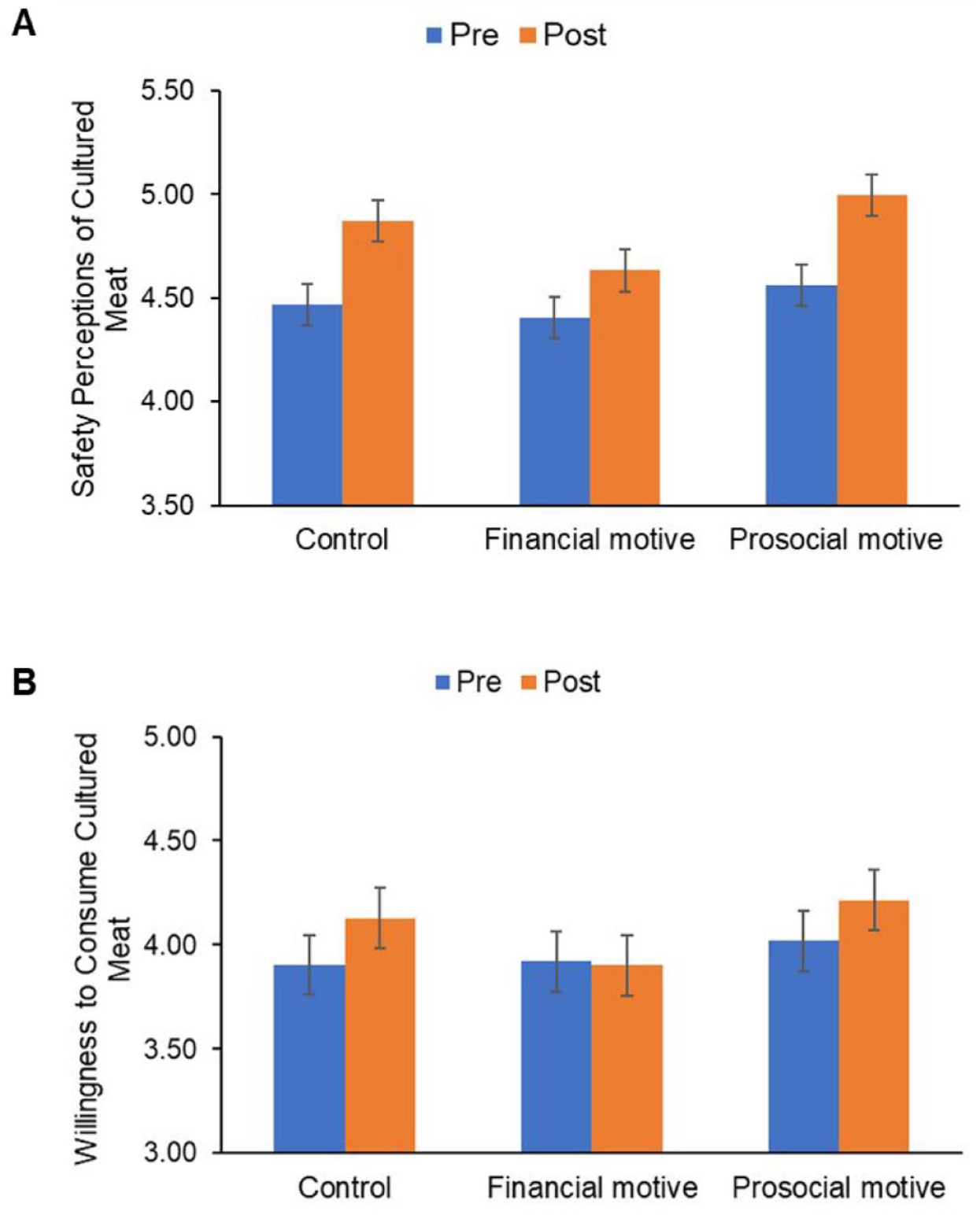
Pre- and Post-Measures of (A) Safety Perceptions of Cultured Meat and (B) Willingness to Consume Cultured Meat by Experimental Conditions in Study 1.
We found consistent results for willingness to consume cultured meat. There was a significant main effect of scientific consensus, F(1, 591) = 27.15, p < .001. Willingness to consume significantly increased by scientific consensus (Mpost = 4.08, SDpost = 2.04), compared to the pre-measure of willingness to consume (Mpre = 3.95, SDpre = 2.02; H1 supported). In contrast, there was no main effect of motive condition, F(2, 591) = 0.52, p = .593. Importantly, there was a significant interaction between scientific consensus and motives, F(2, 591) = 8.85, p < .001. Specifically, the positive effect of scientific consensus on willingness to consume was significantly smaller in the financial motive condition, relative to the control condition, b = −0.24, SE = 0.06, p < .001, 95% CI for b = [−0.36, −0.12] (H2a supported). In contrast, the scientific consensus effect on willingness to consume did not differ between the prosocial motive condition and the control condition, b = −0.03, SE = 0.06, p = .637, 95% CI for b = [−0.15, 0.09] (H2b not supported). See Figure 2B.
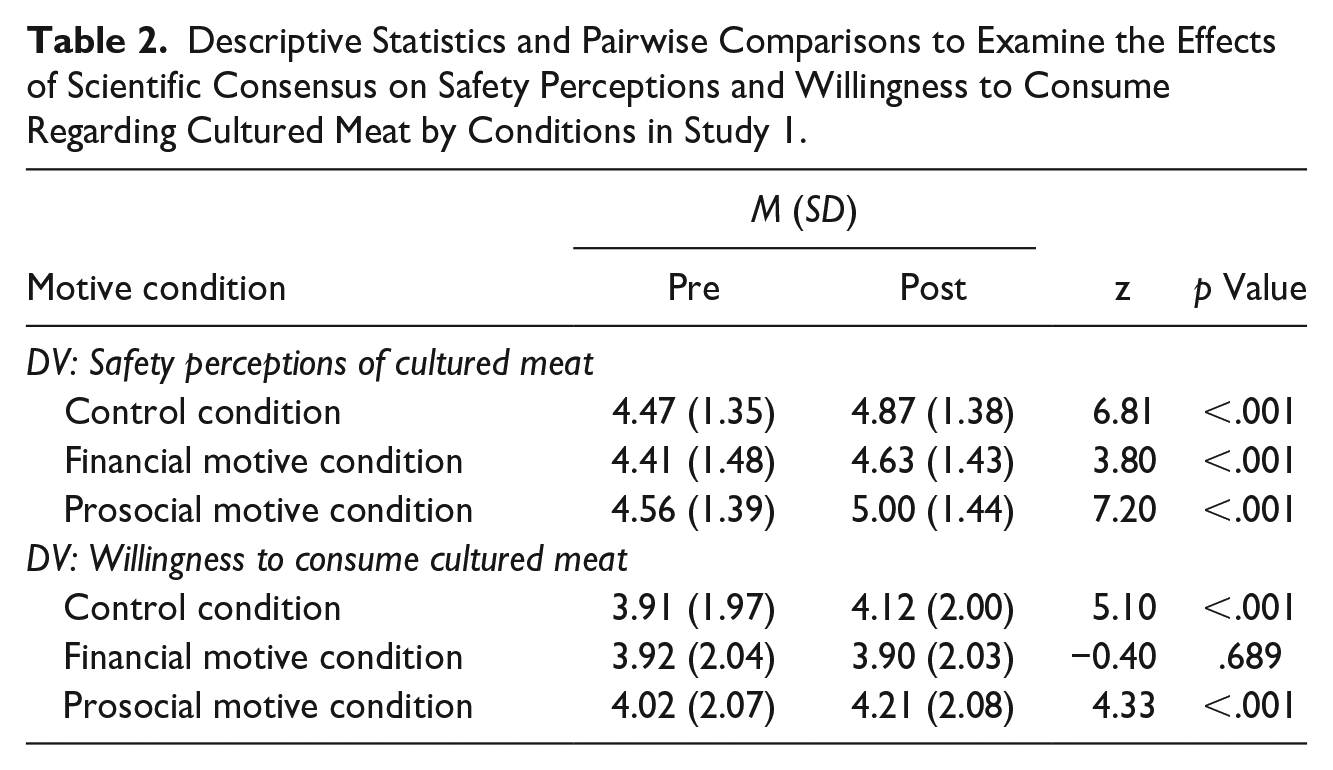
In sum, information that scientists were financially motivated (vs. control condition) decreased the positive effects of scientific consensus on safety perceptions and willingness to consume regarding cultured meat. In contrast, information that scientists possessed prosocial motives (vs. control condition) for doing science did not change the effects of scientific consensus. These key findings were consistent regardless of including or excluding demographic covariates (see Table 1 for more comprehensive results). Table 2 presents descriptive statistics and pairwise comparisons examining the scientific consensus effect by experimental conditions.
Mixed-Model Analyses to Examine Condition Differences in the Effects of Scientific Consensus on Safety Perceptions and Willingness to Consume Regarding Cultured Meat in Study 1.
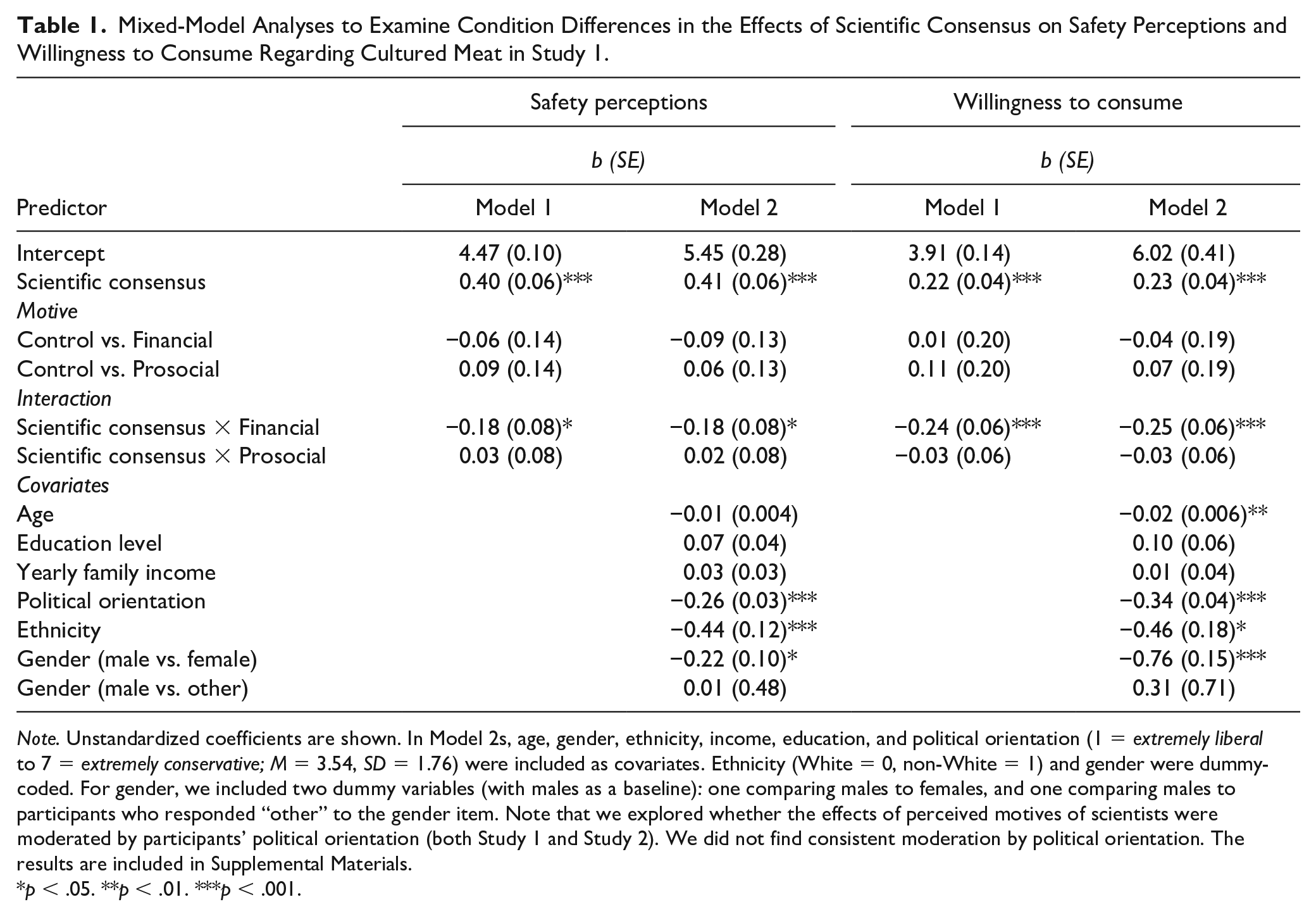
Note. Unstandardized coefficients are shown. In Model 2s, age, gender, ethnicity, income, education, and political orientation (1 = extremely liberal to 7 = extremely conservative; M = 3.54, SD = 1.76) were included as covariates. Ethnicity (White = 0, non-White = 1) and gender were dummy-coded. For gender, we included two dummy variables (with males as a baseline): one comparing males to females, and one comparing males to participants who responded “other” to the gender item. Note that we explored whether the effects of perceived motives of scientists were moderated by participants’ political orientation (both Study 1 and Study 2). We did not find consistent moderation by political orientation. The results are included in Supplemental Materials.
p < .05. **p < .01. ***p < .001.
Descriptive Statistics and Pairwise Comparisons to Examine the Effects of Scientific Consensus on Safety Perceptions and Willingness to Consume Regarding Cultured Meat by Conditions in Study 1.
Mediation
We found that the positive effects of scientific consensus (i.e., pre-post increase) on safety perceptions and willingness to consume depended on information about scientists’ motives. To further unpack the effects of scientists’ motives, we conducted a mediation analysis in which we examined willingness to consume cultured meat as a downstream outcome. Specifically, we investigated whether scientists’ motives (indirectly) predict the pre-post increase in willingness to consume cultured meat through their effect on the pre-post increase in safety perceptions.
To do this, we subtracted pre-measure scores of safety perceptions and willingness to consume from their corresponding post-measure scores and used the difference scores as the key variables. Thus, the mediator and the outcome represented changes due to scientific consensus (i.e., positive scores indicated increases in safety perceptions and willingness to consume after exposure to scientific consensus information; see the study by van der Linden et al., 2019 for a similar approach). In the analysis using the SPSS PROCESS macro version 3.4 (Model 4; Hayes, 2013), scientists’ motive condition (control, financial, and prosocial) was included as a multicategorical independent variable (dummy-coded with the control condition as the criterion group), change in safety perceptions as the mediator, and change in willingness to consume cultured meat as the dependent variable.
The results are shown in Figure 3. The indirect effect of financial motives (vs. control condition) through change in safety perceptions was significant, b = −0.05, SE = 0.03, 95% CI [−0.10, −0.003] (see Figure 3A). Specifically, information about scientists’ financial motives (vs. control condition) predicted a smaller pre-post increase in safety perceptions, b = −0.18, p = .038, which was positively associated with an increase in willingness to consume cultured meat, b = 0.28, p < .001 (H3a supported). This indicated that information about scientists’ financial motives (vs. control condition) reduced the increase in willingness to consume cultured meat by scientific consensus through a smaller increase in safety perceptions. In contrast, change in safety perceptions induced by scientific consensus did not mediate the effect of prosocial motives (vs. control condition) on the change in willingness to consume cultured meat (H3b not supported), mainly due to a non-significant a path (i.e., information about scientists’ prosocial motives (vs. control condition) did not change the effect of scientific consensus on safety perceptions, see Figure 3B). 2
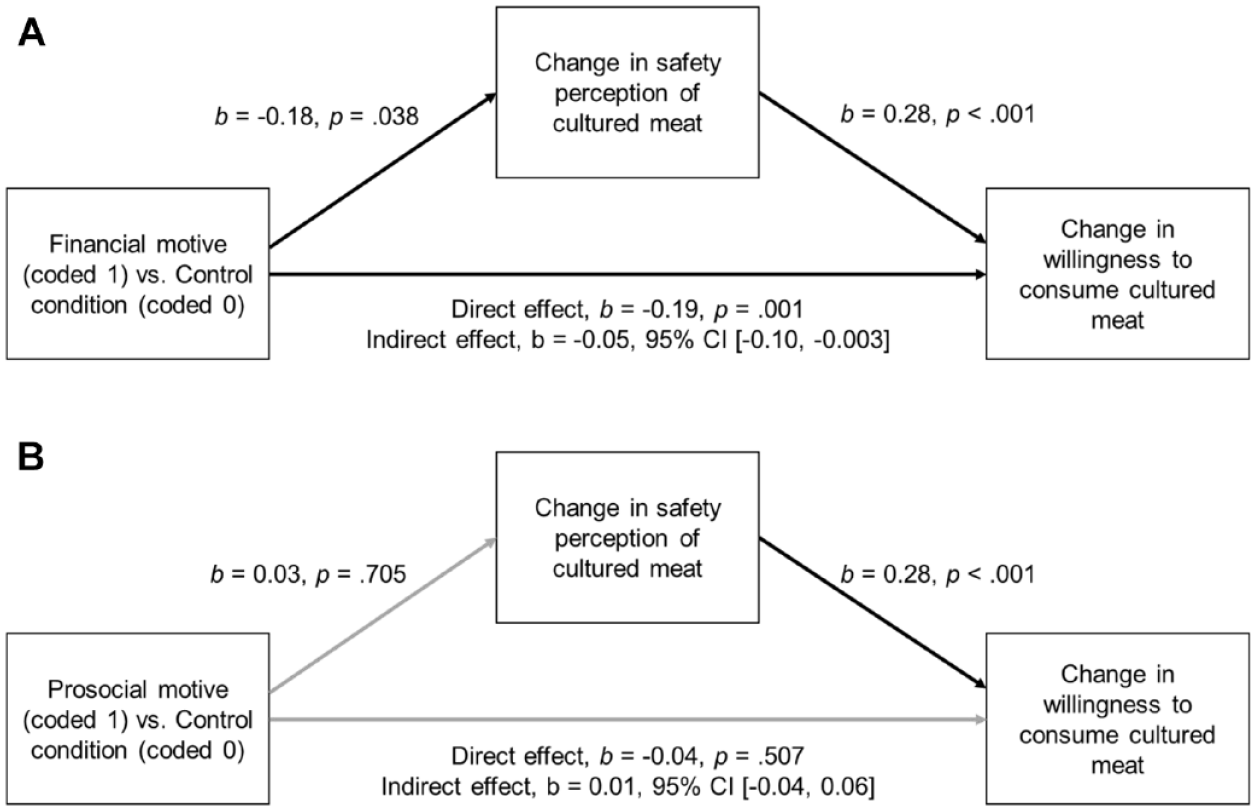
Effect of Scientists’ Motives on Change in Willingness to Consume Cultured Meat Through Change in Safety Perceptions, Comparing (A) Financial Motive vs. Control Condition and (B) Prosocial Motive vs. Control Condition.
Discussion
Providing supporting evidence for H1, Study 1 found that in general, the information that scientists mostly agreed that cultured meat was safe increased participants’ safety perceptions of, and willingness to consume, cultured meat. However, importantly, these positive effects were reduced when participants received the information that scientists conducted research mainly for financial motives (vs. control condition). Interestingly, information about scientists’ prosocial motives (vs. control condition) did not influence the effects of scientific consensus. Therefore, these results supported H2a, but not H2b. Study 1 also documented evidence for a mediation as hypothesized in H3a: Information about scientists’ financial motives (vs. control condition) decreased the positive effect of scientific consensus on perceived safety of cultured meat, which in turn led to a smaller increase in willingness to consume cultured meat (supporting H3a). In contrast, the hypothesized mediation effect in H3b was rejected due to a non-significant effect of prosocial motives (vs. control condition) on pre-post increase in safety perceptions.
Study 2
In Study 1, information about scientists’ financial motives decreased the positive effect of scientific consensus on attitudes toward cultured meat. In Study 2, we aimed to replicate these findings with a larger sample and, importantly, to directly examine trust in scientists as an underlying mechanism. Thus, Study 2 examined whether information that scientists were financially motivated lowers trust in scientists, and whether this lowered trust explains why financial motives attenuate the positive effects of scientific consensus on safety perceptions about cultured meat and further on willingness to consume it.
Participants
In Study 1, the effect sizes for safety perceptions were smaller than expected, and even more so when compared to effect sizes for willingness to consume. Therefore, in Study 2, we aimed to collect a sample large enough to detect the manipulation effect on safety perceptions with .80 power (specifically to detect the difference in change in safety perceptions between the control and financial conditions: r ~ .10). A power analysis indicated N ~ 800 to achieve .80 power (α = .05). To ensure high power, we opted to collect a larger sample size of 1,500. We opened a study for 1,500 participants in the United States on MTurk; 1,557 participants completed our study. After excluding 88 participants who responded incorrectly to our attention checks, the final sample included 1,469 participants (596 males, 856 females, 16 other, 1 missing; Mage = 40.34, SDage = 16.81; 1,081 Caucasian-American).
Procedure and Materials
The materials and procedure in Study 2 were largely similar to Study 1, with only one difference: After the manipulation (i.e., scientists’ motives) and before scientific consensus information about safety of cultured meat was provided (see Figure 1), we measured participants’ trust in scientists (3 items adapted from the study by Pechar et al., 2018; e.g., “Information from scientists is trustworthy”; 1 = completely false to 6 = completely true; α = .857). Using the same items as in Study 1, we measured participants’ pre- and post-safety perceptions of cultured meat (αpre = .903; αpost = .910) and pre- and post-willingness to consume cultured meat (Spearman-Brown ρpre = .94; Spearman-Brown ρpost = .94).
Results
Moderation of Scientists’ Motives on the Scientific Consensus Effect
As in Study 1, we conducted repeated-measures mixed-model analyses to examine condition differences in the scientific consensus effect (Stata 18.0 was used). Scientific consensus (pre and post; within-subject factor), scientists’ motive condition (control, financial, and prosocial; between-subject factor), and the interaction between scientific consensus and motives were entered as predictors. We ran the analyses for safety perceptions and willingness to consume as separate outcomes.
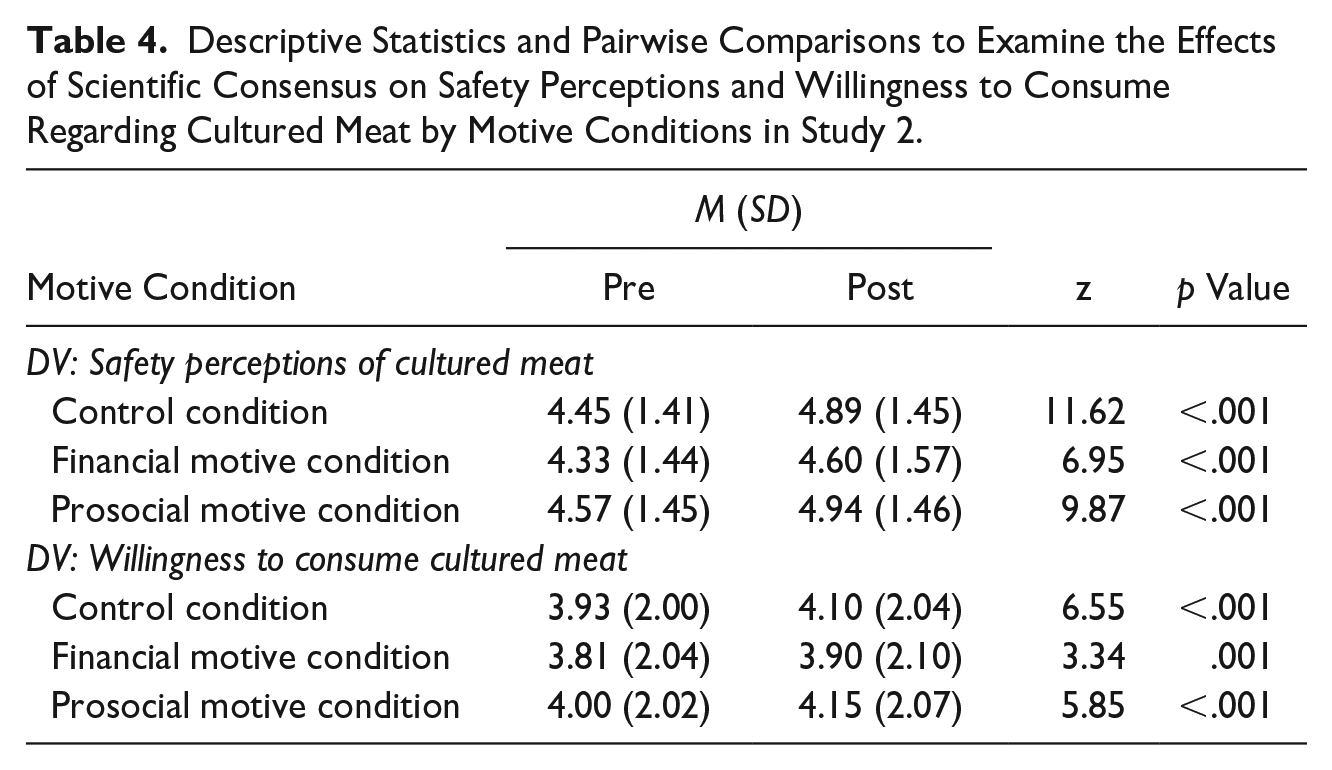
For safety perceptions about cultured meat, there was a significant main effect of scientific consensus, F(1, 1466) = 268.41, p < .001. Safety perceptions significantly increased by scientific consensus (Mpost = 4.81, SDpost = 1.50), compared to the pre-measure of safety perceptions (Mpre = 4.45, SDpre = 1.44; H1 supported). There was also a significant main effect of the motive condition, F(2, 1466) = 5.67, p = .004. Safety perceptions were significantly higher in the prosocial condition (M = 4.75, SD = 1.45), compared to those in the financial condition (M = 4.46, SD = 1.50), z = 2.57, p = .010. There were no other significant differences in safety perceptions either between the prosocial condition and the control condition (M = 4.67, SD = 1.43), p = .215, or between the financial condition and the control condition, p = .178. Importantly, there was a significant interaction between scientific consensus and motives, F(2, 1466) = 4.99, p = .007. The positive effect of scientific consensus on safety perceptions was significantly smaller in the financial motive condition, relative to the control condition, b = −0.17, SE = 0.05, p = .002, 95% CI for b = [−0.28, −0.06] (H2a supported). In contrast, the scientific consensus effect did not differ between the prosocial motive condition and the control condition, b = −0.07, SE = 0.05, p = .227, 95% CI for b = [−0.17, 0.04] (H2b not supported). See Figure 4A.
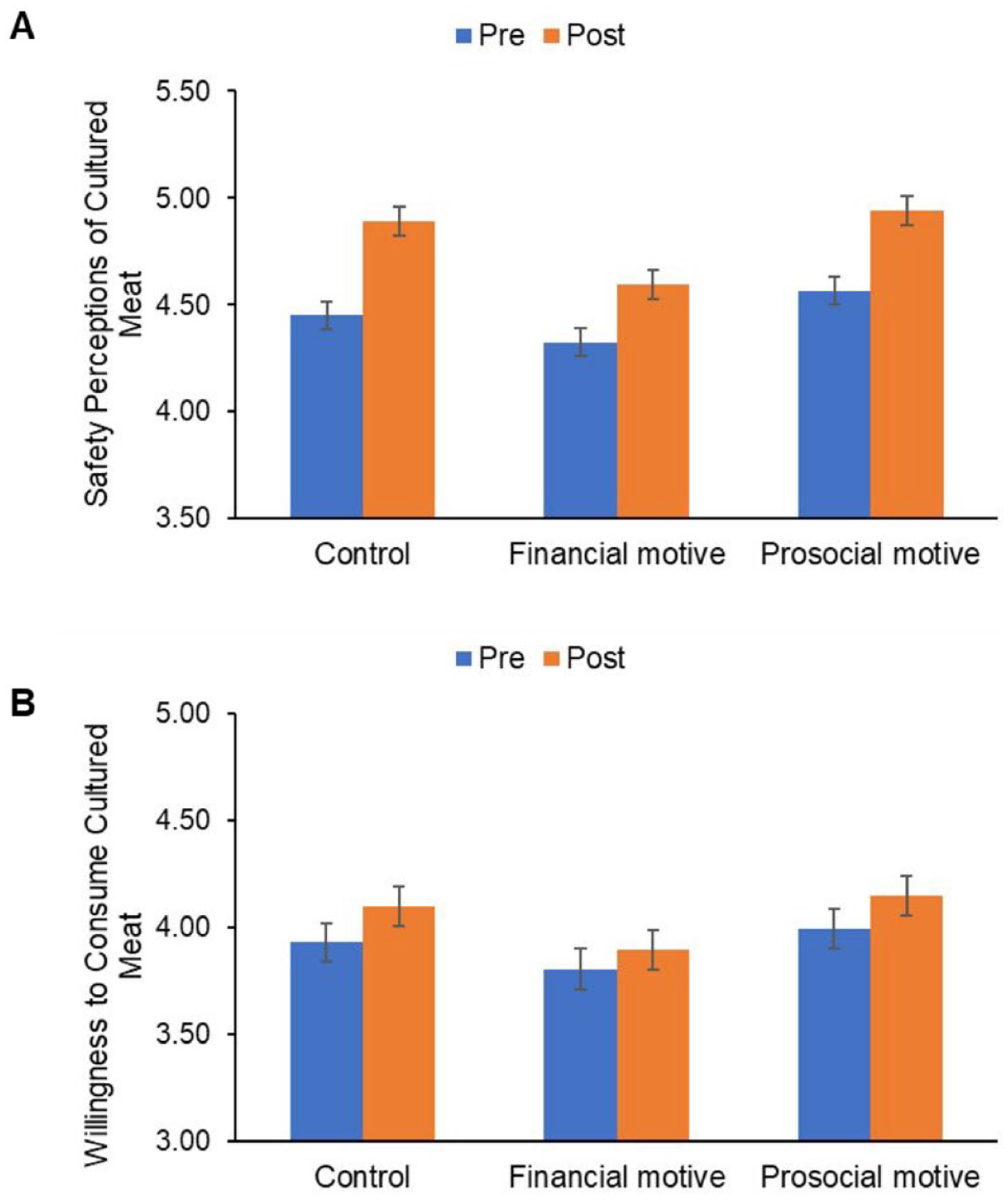
Pre- and Post-Measures of (A) Safety Perceptions of Cultured Meat and (B) Willingness to Consume Cultured Meat by Scientists’ Motive Conditions in Study 2.
For willingness to consume cultured meat, there was a significant main effect of scientific consensus, F(1, 1466) = 82.07, p < .001. Willingness to consume significantly increased after exposure to scientific consensus (Mpost = 4.05, SDpost = 2.07), compared to the pre-measure of willingness to consume (Mpre = 3.91, SDpre = 2.02; H1 supported). In contrast, there was no main effect of scientists’ motives, F(2, 1466) = 1.57, p = .209. We also found some suggestive evidence that the positive effects of scientific consensus depend on motives. Although the overall interaction effect between scientific consensus and motives was not significant, F(2, 1466) = 2.62, p = .073, the specific patterns were consistent with Study 1. The positive effect of scientific consensus on willingness to consume was significantly smaller in the financial motive condition, relative to the control condition, b = −0.08, SE = 0.04, p = .029, 95% CI for b = [−0.16, −0.01] (H2a supported). In contrast, the scientific consensus effect on willingness to consume did not differ between the prosocial motive condition and the control condition, b = −0.02, SE = 0.04, p = .631, 95% CI for b = [−0.09, 0.05] (H2b not supported). See Figure 4B.
These key results were consistent regardless of including or excluding demographic covariates (see Table 3 for more comprehensive results). Table 4 presents descriptive statistics and pairwise comparisons examining the scientific consensus effect by experimental conditions.
Mixed-Model Analyses to Examine Condition Differences in the Effects of Scientific Consensus on Safety Perceptions and Willingness to Consume Regarding Cultured Meat in Study 2.
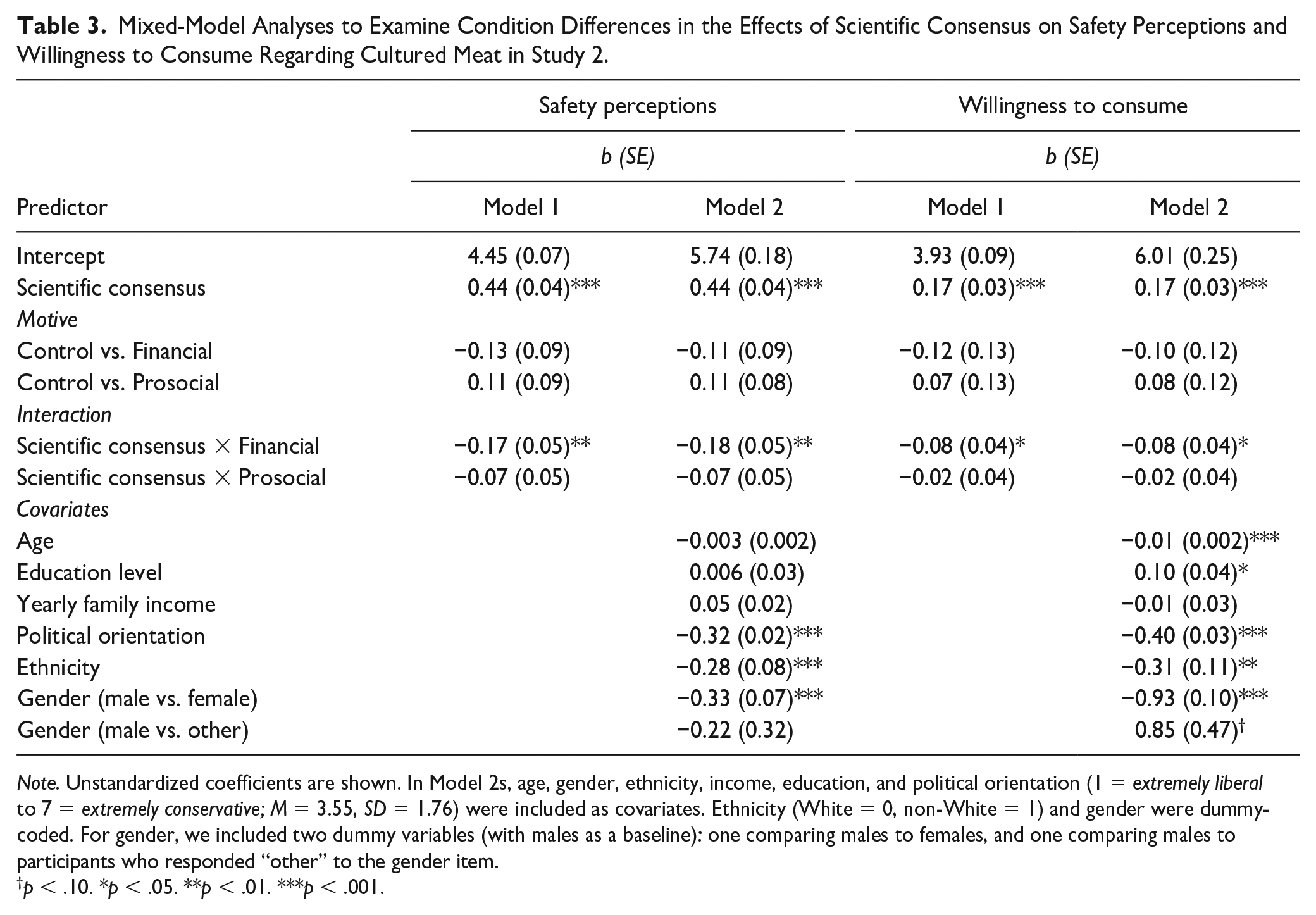
Note. Unstandardized coefficients are shown. In Model 2s, age, gender, ethnicity, income, education, and political orientation (1 = extremely liberal to 7 = extremely conservative; M = 3.55, SD = 1.76) were included as covariates. Ethnicity (White = 0, non-White = 1) and gender were dummy-coded. For gender, we included two dummy variables (with males as a baseline): one comparing males to females, and one comparing males to participants who responded “other” to the gender item.
p < .10. *p < .05. **p < .01. ***p < .001.
Descriptive Statistics and Pairwise Comparisons to Examine the Effects of Scientific Consensus on Safety Perceptions and Willingness to Consume Regarding Cultured Meat by Motive Conditions in Study 2.
Serial Mediation Including Trust in Scientists
Next, we investigated whether trust in scientists operated as a key factor explaining the effects of perceived motives of scientists. As in Study 1, we computed and used the difference scores between pre- and post-measures (i.e., post minus pre changes) for safety perceptions and willingness to consume. Again, positive scores represented increases in safety perceptions and willingness to consume after exposure to scientific consensus information. Notably, we extended the mediation model in Study 1 to include trust in scientists as the first mediator connecting the path from scientists’ motives to (the increase in) safety perceptions of cultured meat, which should in turn lead to (increases in) willingness to consume cultured meat. This model was tested using the SPSS PROCESS macro version 3.4 (Model 6; Hayes, 2013). In the model, we included scientists’ motives (experimental condition) as a multicategorical independent variable (dummy-coded with the control condition as the criterion group), trust in scientists as the first serial mediator, change in safety perceptions as the second serial mediator, and change in willingness to consume cultured meat as the dependent variable.
Figure 5 presents the results. The indirect effect of financial motives (vs. control condition) on the change in willingness to consume cultured meat through trust in scientists and change in safety perceptions was significant, b = −0.01, SE = 0.004, 95% CI [−0.02, −0.01]. Information about scientists’ financial motives (vs. control condition) decreased trust in scientists, b = −0.47, p < .001, which was positively associated with an increase in safety perceptions, b = 0.15, p < .001, which was also positively associated with an increase in willingness to consume, b = 0.21, p < .001 (H4a supported; see Figure 5A). In contrast, trust in scientists and change in safety perceptions did not mediate the effect of scientists’ prosocial motives (vs. control condition) on the change in willingness to consume cultured meat (H4b not supported), mainly because the first mediation pathway was non-significant (i.e., information about scientists’ prosocial motives (vs. control condition) did not influence trust in scientists, see Figure 5B). 3
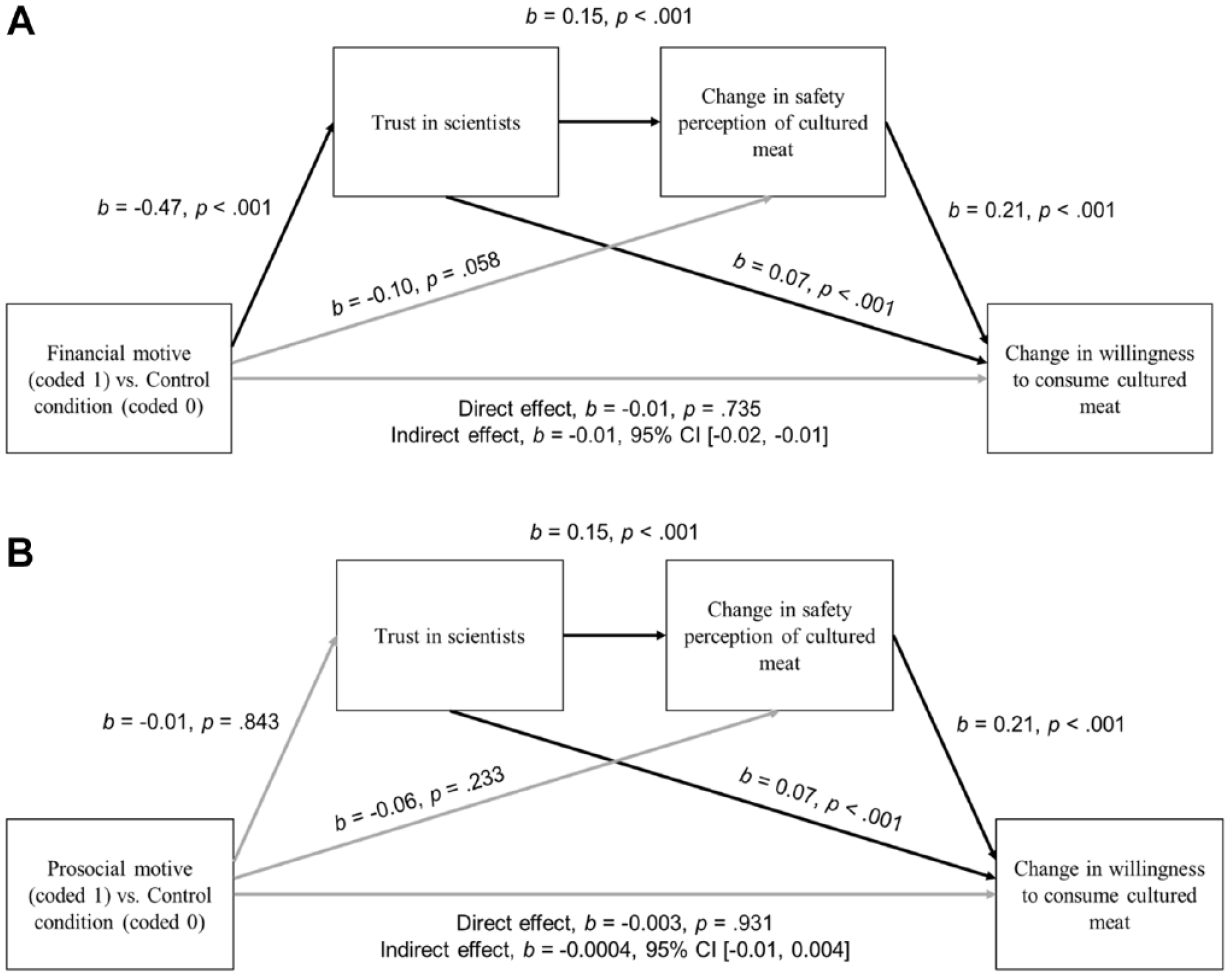
Effect of Scientists’ Motives on Change in Willingness to Consume Cultured Meat Through Trust in Scientists and Change in Safety Perceptions, Comparing (A) Financial Motive vs. Control Condition and (B) Prosocial Motive vs. Control Condition.
Discussion
Consistent with Study 1, Study 2 demonstrated that scientific consensus increased safety perceptions of cultured meat and willingness to consume it (H1 supported). Moreover, we found evidence that these effects depended on scientists’ motives. Information about scientists’ financial motives (vs. control condition) attenuated the positive effects of scientific consensus on safety perceptions of and willingness to consume cultured meat (H2a supported). In contrast, information about prosocial motives of scientists (vs. control condition) did not affect the positive effects of scientific consensus (H2b rejected).
It is important to note that the overall interaction between scientific consensus and motives was not significant on willingness to consume in Study 2, although the specific simple effects were consistent with Study 1. This suggests that the moderation effect of scientists’ motives may be more robust on safety perceptions, which were directly referred to in the scientific consensus message. This is in line with the literature suggesting scientific consensus has stronger effects on changing perceptions (e.g., climate change beliefs) directly associated with the consensus message compared to downstream outcomes (e.g., support for climate actions; van der Linden et al., 2019). The formation of consumption intentions may involve diverse factors that could suppress the effect through changes in safety perceptions (Rucker et al., 2011).
Finally, Study 2 identified trust in scientists as an explanation for the effects of scientists’ motives. Information that scientists were financially motivated reduced participants’ trust in scientists, and this reduced trust led to the attenuated positive effects of scientific consensus on safety perceptions of and willingness to consume cultured meat (H4a supported). The mediation effect hypothesized in H4b was rejected because trust in scientists did not differ between the prosocial and the control conditions.
General Discussion
Summary and Implications
The present research examined how exposure to different motives of scientists influences the effect of scientific consensus on people’s attitudes toward cultured meat. In our studies, generally, receiving information that most scientists endorsed the safety of cultured meat significantly increased people’s perceptions of safety about and willingness to consume cultured meat. This research is the first demonstration, to our best knowledge, of the significance of scientific consensus effects in the novel (and increasingly important) domain of cultured meat acceptance, beyond the domains previously examined, such as climate change (van der Linden et al., 2019), vaccines (van der Linden et al., 2015), and genetically modified food (Dixon, 2016; Kerr & Wilson, 2018).
Moreover, we found that the positive effects of scientific consensus depended on information about different motives of scientists. The positive effects of scientific consensus were attenuated when people were exposed to the information about scientists’ financial motives; that is, exposure to scientists’ financial motives suppressed the increases (by scientific consensus) in perceptions of safety about and, consequently, willingness to consume cultured meat. These findings significantly advance the literature on scientific consensus effects by responding to the recent calls for more systematic research on factors that modulate the effects of communicating scientific consensus (Bayes et al., 2023; van der Linden, 2021). Some research has already demonstrated that scientific consensus effects depend on factors, such as individuals’ prior beliefs (e.g., climate change skepticism) and political identification (Cook & Lewandowsky, 2016; Ma et al., 2019). The present research extends this emerging body of work by introducing a novel moderating effect by information about scientists’ motives (presumably through affecting perceived motives of scientists).
Importantly, we also found that the attenuation of the positive effects of scientific consensus by scientists’ financial motives occurred through a reduction in people’s trust in scientists. This finding adds to the existing evidence on the significant role of trust, affirming the view that trust in scientists is an important factor that modulates scientific consensus effects (Chinn et al., 2018; Suldovsky & Akin, 2023). The significant effects of trust also speak to the broad issue of how the public processes and responds to experts’ claims. Our findings are consistent with existing research that trust is a key determinant of acceptance of experts’ advice and opinions (Brewer & Ley, 2013; Cummings, 2014; Hmielowski et al., 2014). Our findings further suggest that how the public perceive experts’ motives importantly influences the persuasiveness of experts by affecting trust in experts.
In contrast to our hypothesis, information that scientists were prosocially motivated (vs. control) did not modulate scientific consensus effects. That is, information about scientists’ prosocial motives induced similar improvements in attitudes toward cultured meat as when no information was provided. There was no significant difference in trust in sciences between the prosocial and the control condition either. One possibility is that, in general, people already perceive scientists as conducting research for prosocial reasons (vs. financial reasons) by default. Such reasoning is consistent with research elsewhere documenting relatively high levels of trust in scientists (Funk et al., 2020). Nonetheless, such default perceptions may depend on various factors like participants’ sociocultural backgrounds (McPhetres et al., 2021) and types of scientists (Rutjens et al., 2022). Therefore, more systematic research is needed to examine how highlighting scientists’ prosocial motives affects scientific consensus effects.
Limitations and Future Questions
Finally, we note some limitations in the present research and highlight unanswered questions for future work. First, our studies examined only responses from Americans. Given the documented cultural variations in attitudes toward scientists (McPhetres et al., 2021) and cultured meat (Chong et al., 2022), the findings of the present research may not be applicable across different cultural contexts. Second, while this study contrasted financial motives with prosocial motives, self-oriented motives can be toward various self-interests, including emotional and social rewards (Carlson & Zaki, 2018). How these diverse types of self-oriented motives affect the effect of scientific consensus on public attitudes remains an unanswered question.
Third, we assume that the observed effects of information about scientists’ motives work by influencing people’s perceptions of those motives. However, we did not directly measure perceived motives. Future work should examine more directly the role of perceived motives in driving the effects observed in the present research. Nevertheless, we believe that our studies have significant real-world implications given the vast amount of information to which people are exposed every day (e.g., media reports on scientific fraud; Barnett, 2023), which may lead individuals to doubt scientists’ motives. Moreover, in the era of post-truth, there is the potential for the spread of mis/disinformation about scientists’ research and motives, which can undermine trust in scientists and weaken their credibility as experts. This is an important research area for further research.
Finally, the outcome variables in this study were attitudinal. Although attitudes are a key predictor of behavior (Ajzen, 1991), there is a considerable discrepancy between attitudes and behavior (Ajzen et al., 2019; Glasman & Albarracín, 2006), and this discrepancy often varies across different populations (Eom et al., 2016; Savani et al., 2008; Schüz et al., 2020). We encourage further research to address these important issues by examining behavioral outcomes among more diverse cultural groups.
Supplemental Material
sj-docx-1-scx-10.1177_10755470241277196 – Supplemental material for Exposure to Different Motives of Scientists Moderates Responses to Scientific Consensus: The Case of Cultured Meat
Supplemental material, sj-docx-1-scx-10.1177_10755470241277196 for Exposure to Different Motives of Scientists Moderates Responses to Scientific Consensus: The Case of Cultured Meat by Kimin Eom and Bryan K. C. Choy in Science Communication
Footnotes
Declaration of Conflicting Interests
The author(s) declared no potential conflicts of interest with respect to the research, authorship, and/or publication of this article.
Funding
The author(s) received no financial support for the research, authorship, and/or publication of this article.

Notes
Author Biographies
References
Supplementary Material
Please find the following supplemental material available below.
For Open Access articles published under a Creative Commons License, all supplemental material carries the same license as the article it is associated with.
For non-Open Access articles published, all supplemental material carries a non-exclusive license, and permission requests for re-use of supplemental material or any part of supplemental material shall be sent directly to the copyright owner as specified in the copyright notice associated with the article.
