




Abstract
Science communication spaces may provide an antidote to the hostility of graduate academic spaces. Using the conceptual lens of science identity, we interviewed North American-based STEM graduate students about their sense of belonging in these spaces. Our results suggest that many science communication spaces welcome a plurality of alternative science identities, while academic spaces require assimilation into a singular research science identity. These results suggest how science communication organizations might more intentionally cultivate spaces of belonging for scientists-in-training.
Introduction
Academic institutions rarely reward science communication activities by scientists directly (Edwards & Roy, 2017; Moran et al., 2020). Nevertheless, many scientists enthusiastically engage with the public about their research (Besley & Nisbet, 2013; Rainie et al., 2015). Furthermore, there is evidence that Science, Technology, Engineering, and Mathematics (STEM) graduate students approach social media channels and controversial topics more eagerly than their PhD-holding colleagues (Howell et al., 2019; Ritchie et al., 2022). This study investigates STEM graduate students’ identity-related motivations for participating in science communication.
As a whole, STEM academic spaces remain exclusionary, especially for students with one or more marginalized identities (McGee, 2021; Riegle-Crumb et al., 2019). Past scholarship, however, suggests that science communication activities—while devalued compared to research activities—may be places where marginalized students form alternative identities and places of belonging (Thiry et al., 2007). However, little research exists exploring how STEM graduate students make sense of their science communication activities and their sense of belonging in these spaces. To investigate the potential for science communication activities to be “pockets of belonging” for STEM graduate students, we interviewed 24 STEM graduate students currently enrolled at U.S. or Canadian universities who have participated in some form of public engagement.
STEM graduate student participants described how science communication spaces welcomed multiple science identities, whereas academic spaces required assimilation into a singular research science identity—or risk exclusion (Carlone & Johnson, 2007). We conclude the paper by discussing implications for science communication practice.
Literature Review
STEM Graduate Students’ Sense of Belonging
Many STEM graduate students—especially those with marginalized identities—do not feel a sense of belonging in academic spaces. Sense of belonging refers to “the extent to which an individual believes they are accepted, valued, and included in a community” (Stachl & Baranger, 2020, p. 1). A quantitative study exploring STEM researchers’ sense of belonging found that postdoctoral and senior graduate students were less likely to feel a sense of belonging than faculty, especially if they came from marginalized groups (Stachl & Baranger, 2020). Marginalized students in STEM often feel their identities are at odds with disciplinary norms. For example, Herzig (2010) found that women in mathematics felt they neither belonged to their discipline (due to masculine norms) nor their gender (because of their interest in mathematics).
A sense of belonging is associated with retention, and marginalized students often leave academic spaces before completing their degree program (Davis & Fry, 2019). At the same time, STEM graduate students have the potential to transform the cultures of both science communication and academic spaces to be more inclusive and empowering (Bankston & McDowell, 2018). Therefore, understanding their sense of belonging in these spaces may reveal factors that contribute to cultivating inclusion and belonging in both academic and science communication spaces.
There has been recent and growing attention to the graduate stage of the STEM career pathway (e.g., Bankston & McDowell, 2018; Johnson et al., 2017; Ong et al., 2011), as belonging and identity formation may operate uniquely at this level (Pascale, 2018; Strayhorn, 2018). Graduate students’ sense of belonging differs from undergraduates in several important ways, especially regarding how their social lives are less integrated into the university context. Previous studies have found four factors that contribute to graduate students’ sense of belonging: (a) balancing life demands, (b) investment in Graduate School, (c) relationships with peers, and (d) relationships with faculty (Pascale, 2018).
Early-career scientists, especially those with marginalized identities, may use select science communication spaces as an antidote to the disconnection and dehumanization of academia (Valdez-Ward et al., 2023). Science communication spaces may serve as what we name “pockets of belonging” for marginalized STEM graduate students. Many marginalized graduate students place a high value on using their education as a way of giving back and improving their communities, but these activities and definitions of success are usually afforded less respect and prestige in academic spaces (Spalter-Roth & Van Vooren, 2009; Thiry et al., 2007; Weatherton & Schussler, 2022). Underrepresented graduate students in STEM are often overrepresented in science communication spaces because these spaces allow for alternative outreach identities that allow for a strong sense of social justice and a desire to give back to the community (Thiry et al., 2007). Graduate students may seek out science communication spaces as an effective antidote to what they dislike about traditional academic spaces (e.g., impersonal, lacking professional development, out of touch with social issues, and culturally exclusive). With these considerations in mind, we posit the following research question:
Research Question 1: How do STEM graduate students describe their sense of belonging in both academic and science communication spaces?
Science Identity
The concept of science identity may shed light on how marginalized scientists navigate academic power structures while retaining their sense of agency in science communication activities. Science identity is thinking of oneself and being recognized by others as being a “science person” (Carlone & Johnson, 2007; Gee, 2000). Science identity is consistently linked to retention in STEM fields, especially for marginalized students (Diekman et al., 2015; Espinosa, 2011).
An interactionist approach to science identity considers how different contexts affect its development (Kim & Sinatra, 2018). Encouragingly, communication training spaces are associated with increased science identity for STEM students (Alderfer et al., 2023; Cameron et al., 2015; Linvill et al., 2019), particularly for marginalized scientists (Mackiewicz et al., 2022). Similarly, science communication training can serve as a counter space, decentering dominant norms and providing healing spaces for marginalized scientists to enact their identities fully (Valdez-Ward et al., 2023).
Likewise, STEM graduate students may redefine what it means to be a scientist to develop alternative science identities. In a study of successful Women of Color in STEM, Carlone and Johnson (2007) found three science identity trajectories: research scientist, altruistic scientist, and disrupted scientist. Both research and altruist scientist identities formed positive scientist identities for themselves with the help of supportive relationships, but they differed in whom they considered meaningful others (Carlone & Johnson, 2007). Disrupted scientist identities, on the contrary, were ultimately successful but failed to have their bids for recognition recognized due to a combination of gendered, ethnic, and racialized factors (Carlone & Johnson, 2007). Their work suggests multiple identity pathways into science, as identity formation largely depends on one’s perception of what science is for.
Relationships may be a critical factor in developing these alternative science identities. Science identity includes three dimensions (competence, performance, and recognition), but recognition by key others is critical to developing a positive science identity (Carlone & Johnson, 2007). Work demonstrating that mentorship and participation in science communication play a role in persistence in academia (Cameron et al., 2020) adds more evidence for the importance of recognition by meaningful others for belonging.
In this research, we examine the role of science communication activities in cultivating alternative science identities for STEM graduate students and how these identities interact with their sense of belonging in both academic and science communication spaces. We therefore explore the following research questions:
Research Question 2: How do STEM graduate students who participate in science communication describe how different contexts (e.g., academic and science communication) affect their science identity?
Research Question 2a: Which science identity trajectories do STEM graduate students describe?
Research Question 2b: How do STEM graduate students describe the dimensions of their science identities (competence, performance, and recognition)?
Method
Participants
Participants were recruited through snowball sampling. Emails were sent to our contacts in the science communication ecosystem (e.g., Science Communication Trainers Network, Ciencia PR, Reclaiming STEM) to recruit graduate students in STEM fields currently at U.S. or Canadian universities who have experience in public engagement (see Appendix A for the recruitment email template). We used the National Science Foundation’s definition of STEM fields, which includes mathematics, natural sciences, engineering, computer and information sciences, and the social and behavioral sciences—psychology, economics, sociology, and political science (Gonzalez & Kuenzi, 2012). Participants were limited to students who had participated in some form of public engagement with science, defined as “any information exchange which is designed to engage the targeted audience in STEMM” (Canfield & Menezes, 2020).
Seventy-six STEM graduate students responded to our email. We sent a presurvey to all qualifying graduate students to purposively sample a range of intersectional identities (both from marginalized and dominant groups). The presurvey consisted of an online informed consent form and a short set of demographic questions. We used this questionnaire to help maximize the diversity of our sample across ethnicity/race, gender expression, sexuality, scientific field, and university geography. From those who answered the survey (64), we selected 24 to interview. All participants chosen for the study were sent an introductory email that included a video the first author recorded that explained their positionalities and provided an overview of the study.
In terms of racial and ethnic identities, participants self-reported they were White/non-Hispanic (9), White/Iranian (1), White/Asian (1), White/Jewish (1), White/Hispanic/Latinx (3), Black/African (1), Ecuadorian (1), Afro-descendant/Puerto Rican (1), Brazilian (1), Middle-Eastern (1), Chinese (2), Asian (1), and South Asian (1). Participants reported they were cisgender men (7), cisgender women (15), genderfluid (1), and trans man (1). Participants self-reported their sexualities were heterosexual (17), asexual (2), bisexual/pansexual (3), and gay/queer/lesbian (2).
Participants varied widely in terms of scientific field because of the purposive sampling scheme. Participants represented (often overlapping) fields, including physics/astronomy, engineering, biological/medical sciences, geosciences, chemistry, mathematics, computer science, and social sciences. Participants’ universities were located in the midwest United States (3), southwest United States (4), southeast United States (1), northeast United States (5), West United States (1), Newfoundland-Canada (1), Ontario-Canada (3), and Québec-Canada (1).
Interview Procedure and Analysis
The first author conducted all interviews over Zoom with audio and video, as STEM graduate students were located across the United States and Canada. All interviews were recorded, transcribed, and reviewed by all authors. The average interview took 81 minutes to complete, spanning 61–107 minutes. All interviews were conducted between February 25, 2021, and April 26, 2021.
Interviews were conducted using a semi-structured interview protocol that included concepts discussed in the literature review (see Appendix B). We asked participants about (a) how the participant came to be an STEM graduate student, (b) how they got started in public engagement with science, (c) what types of public engagement they are involved in, (d) the best and worst parts of public engagement, (e) how public engagement affects other parts of their life, (f) which spaces they feel they belong or feel like an outsider, and (g) their plans for the future. This interview protocol was developed and tested in collaboration with STEM graduate students in a seminar taught by the first and second authors.
During data collection, we used Tracy’s (2019) phronetic iterative approach to ensure that the interview protocol functioned effectively. This meant that we conferred regularly throughout the interviewing process and agreed that the protocol was capturing salient data. The interview protocol is available as Supplemental Material.
The primary goal for data analysis was to explore the meaning participants attached to the experiences they described and how these meanings complemented extant literature. Data analysis, which was led by the first author in consultation with the coauthors, was guided by Tracy’s (2019) approach and included multiple phases of conferrals among the authors. Specifically, we iteratively developed a coding schema based on Carlone and Johnson’s (2007) model of science identities as well as themes that emerged from the interview data. Using the phronetic iterative approach enabled both deductive and inductive analyses of the data and reflected, more broadly, research consistent with a constructivist paradigm (Mills et al., 2006). Ultimately, the key themes discussed above were consistent with Carlone and Johnson’s (2007) taxonomy of alternative science identities (research, altruistic, and disrupted) and the factors that contribute to these identities (competence, performance, and recognition). Analysis was done using NVivo software, and the final sample size (N = 24) was based on the authors’ agreement that no new information was manifesting from interviews (i.e., that saturation had been reached, Guest et al., 2012). The first author led the coding process, conferring with the other authors at the conclusion of each round of coding. Three rounds of coding were conducted in total.
Results
RQ1: STEM Graduate Students’ Sense of Belonging in Academic and Science Communication Spaces
Interviews with STEM graduate students suggested that they experience academic spaces as othering and exclusionary but that they often experienced science communication spaces as “pockets of belonging.” Science communication spaces invited a plurality of science identities, whereas academic spaces only privileged research science identities. As one participant explained, I feel like a fish out of the water sometimes . . . I really like research, right? I just don’t like the environment. I think people competing the whole time and just having to publish . . . It’s very stressful. It’s bad for your mental health. (Interview 10)
STEM graduate students described academic spaces as othering and exclusionary because they asked them to assimilate into a narrow research science identity. In addition, participants also described how academia required them to assimilate into the “mythical norm” (Lorde, 1984) of academia (e.g., White, straight, cis, male, able-bodied, and affluent). STEM graduate students’ descriptions of academia’s hostile culture matched previous research (e.g., Edwards & Roy, 2017), including low psychological safety, intense competition, and isolation. The ongoing COVID-19 pandemic exacerbated these exclusionary conditions (Sverdlik et al., 2022).
In contrast, STEM graduate students described how science communication spaces were often spaces of belonging and offered an antidote to the hostility of academic spaces. One participant describes how they use science communication activities to escape academic culture: For me, I would say [science communication is] like more of an escape from those things [academia] . . . So then you come to this sort of point where you say, “Do I continue to fight in academia or do I bail?” . . . I’ve always done outreach as a way to have some sort of contact with the world outside of academia. (Interview 16)
More specifically, participants described how their science communication activities allowed them to enact both research science identities as well as altruistic science identities. For example, participants described how their science communication activities brought them back in contact with the bigger picture and the stakeholders of their research. They often described that talking to others about their research helped them connect their day-to-day research activities—which could often be mundane or rife with failures—to a greater sense of purpose and meaning. When asked about spaces in their life where they felt belonging, one participant answered, “I think [science communication] spaces . . . have given me self-confidence and awareness that I belong, that I don’t have to fit in” (Interview 13). Another participant, when asked if they only had their lab work, mentioned that they would have quit academia without science communication (Interview 10).
However, not all science communication contexts were “pockets of belonging.” Two participants described how more “visible” science communication activities asked them to fit the stereotypical image of a scientist. For example, a participant who had a large social media following described the racist and sexist comments they received on their posts. These (few) exceptions suggest that more “visible” science communication contexts may operate differently, cultivating a narrower set of science identities than those that are less visible.
RQ2a: STEM Graduate Student Science Identity Trajectories
While participants agreed that academia was a space of othering and science communication was (generally) a space of belonging, participants differed in the science identity trajectories they described. After characterizing participants according to Carlone and Johnson’s (2007) descriptions, we categorized 13 participants as having a Research Science Identity, 10 as having an Altruistic Science Identity, and one as having a Disrupted Science Identity.
Research Science Identity
Participants exhibiting the research science identity were characterized by (a) being passionate about science for “science’s sake” and (b) feeling recognized by science faculty as a “science person.” The research science identity was the only science identity described by participants as welcome in both academic and science communication contexts. These participants were characterized by wanting to remain in academia or industry for the love of scientific research. They described using their science communication activities to feed back into their love of science for science’s sake. For example, as one participant describes, The research is what drives me. [. . .] So my hope is that I would probably go to somewhere more research-focused, [. . .] before I went to something that was more like science communication, even though that’s something I really care about. (Interview 8)
Participants of the research science identity perceived a single- or best-path to becoming an academic scientist: a tenure-track position at a research-intensive university. They also described feelings of scarcity about the available positions. One participant describes the competition and pressure this creates when they said, “If there is only one path, it’s going to add so much pressure on everybody” (Interview 14).
All participants recognized that research science identities were the science identity most welcomed in academic spaces.
Altruistic Science Identity
Participants exhibiting the altruistic science identity were characterized by (a) seeing science as a vehicle for altruism, (b) creating innovative meanings of “science,” and (c) redefining who were meaningful others to be recognized as a “science person.” Ten of the participants were categorized as having altruistic science identities. When asked about their futures, participants with this identity described a variety of plans. These participants explained that they used their science communication activities to feel they were making a positive impact on society through their science. As one participant explained, Most humans want to contribute in a positive manner to society in a way that they feel capable and as though they are able to make a positive impact. And for me, the realm that works through is science communication and outreach. (Interview 16)
Some participants described how they plan to remain in academia but want to make sure their work has societal impact. Others participants explained that they want to become professional science communicators, work in science policy, or become entrepreneurs. These participants tended to reject the research science identity and many aspects of the academic cultural environment. For example, many were critical of the “publish or perish” mentality present among many of their colleagues.
Disrupted Science Identity
The participant exhibiting the disrupted science identity was characterized by seeking out but not receiving recognition from meaningful scientific others. They describe how the pandemic was a major tipping point for them: The major reason why I dropped out is still the pandemic. So, my life was not very happy during this year, I was pretty much depressed and isolated in my apartment . . . I was not very interested in the research, so the research couldn’t help. (Interview 14)
This quote suggests that a discrete event (the pandemic) may have exacerbated cultural, day-to-day aspects of doing science, driving them to quit STEM graduate school. Because this participant may represent a unique case, this article focuses on how science communication contexts affect dimensions of the positive science identities (research and altruistic science identities).
RQ2b: Dimensions of Science Identity
STEM graduate students with positive science identities described how the three dimensions of science identity—competence, performance, and recognition—contribute to either cultivating alternative meanings of being a scientist in science communication spaces (altruistic science identities) or reinforcing their love of science (research science identities). Echoing the findings of Carlone and Johnson (2007; see Figure 1), we also found that the dimension of recognition was most often associated with differentiation into different science identity trajectories.
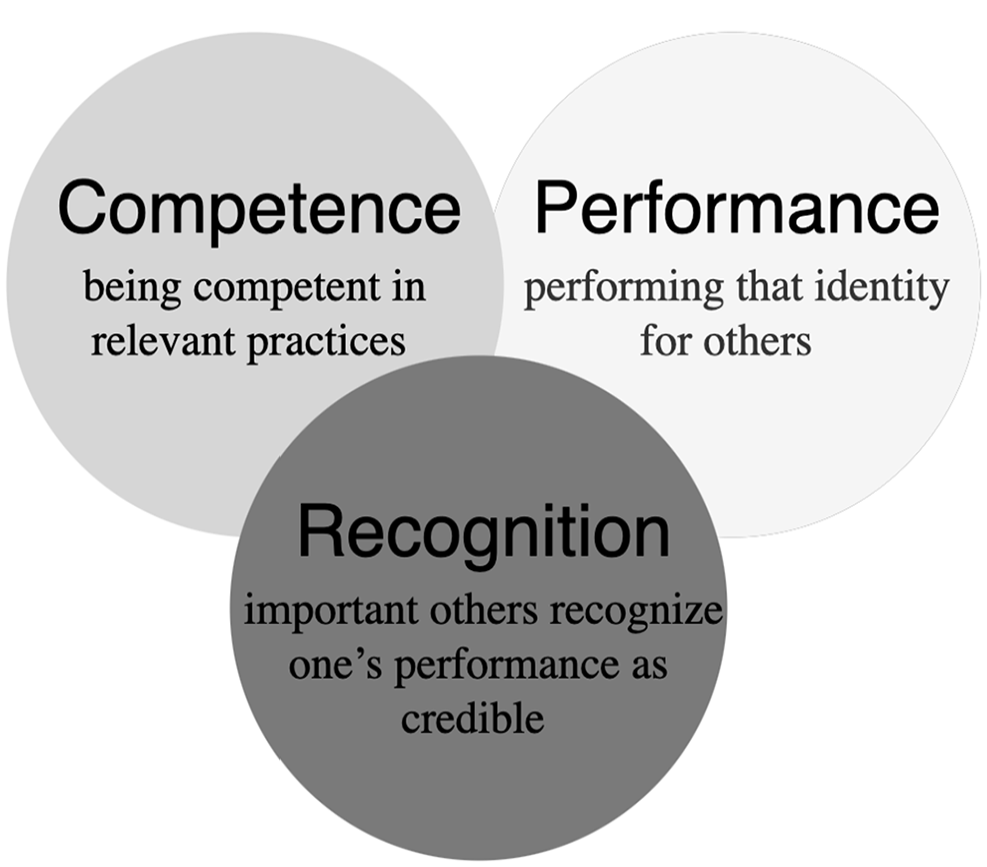
Science Identity Dimensions.
Competence
Our interviews suggest science communication activities may cultivate participants’ competence. They described how science communication bolstered their sense of skill and self-efficacy. For those individuals exhibiting the research science identity, science communication appeared to bolster their competence associated with research; for those categorized with the altruistic science identity, science communication seemed to boost their sense of competence for using science to make an impact on society.
For those with the research science identity, science communication helped reinforce their sense of research skills and self-efficacy. Participants explained that this had a mitigating effect on the negative aspects of STEM academic spaces, including their sense of isolation and lack of recognition. However, participants described how science communication activities often provided lower-stakes ways to gain skills and self-efficacy in comparison to academic spaces. For example, one participant described how science communication spaces helped them fight their imposter syndrome: [Y]ou might feel like an idiot in front of a bunch of like very egotistical scientists who like to feel superior, but you will never feel under-qualified in front of a bunch of fifth graders [. . .] it’s a positive reinforcement that you will not get anywhere else in the science field. (Interview 5)
Many participants felt that these feelings of competence could be brought back into their research spaces. For example, participants often described how the COVID-19 pandemic adversely impacted their feelings of competence because it stalled their research progress and ability to participate in face-to-face science communication activities. However, those who were able to pivot to virtual science communication activities described how doing so helped refill their feelings of competence and attenuate feelings of isolation associated with the pandemic.
Participants exhibiting the altruistic science identity described how science communication helped them expand how they personally defined competence. These individuals talked about how they came to increasingly view competence through their ability to connect with others and maximize their positive impacts on society. As one participant remarked, Since the beginning, I always knew I didn’t want to stay in academia, and I was very clear with my PI [advisor]. So that was nice that we were both on the same page, and I always tried to get training in science policy, science education in other areas that I was passionate about. The PhD is just a door. (Interview 12)
Performance
Participants described how science communication activities allowed them lower-stakes opportunities to perform their science identity. Participants described how academic spaces usually required performance of a research science identity, even if it was not the preferred identity of the participant. Doing science communication activities while pursuing a degree often means performing prioritizing research to maintain advisor or department approval. One participant described this performance after a conversation with their advisor about stopping their science communication activities to focus on research: [E]ven after having that conversation with her, I didn’t end up letting go of anything. I just kind of showed her that I was very interested in the research, even just showed her more interest in that regard. And I just kept what she said in mind but didn’t actively quit anything. (Interview 7)
Some participants with an altruistic science identity described switching to a research identity performance for academic spaces: So, I go to these spaces where I’m like, okay, this is specifically a science space, like an academic conference. [. . .] And I’m like, okay, I’m going to put away the scicommer part of myself. I’m not going to talk about it because I’m trying to be in the science space [. . .] And so I was really trying to train myself and be a scientist in the science spaces. (Interview 21)
Science communication spaces, on the contrary, welcomed both research and altruistic science identity performances. These participants described how science communication activities allowed them to redefine what counts as a meaningful performance. For example, science communication during the COVID-19 pandemic meant more opportunities for some to perform their altruistic science identity. As one participant expressed, “It [the pandemic] did give me a purpose because I felt like I was helping in some sort of way, sharing my knowledge of immunology” (Interview 12)
Recognition
Although participants named how science communication contexts catalyzed both the competence and performance dimensions of science identity, participants most often named the recognition dimension of science identity in science communication contexts. For research science identity participants, science communication activities allowed them (a) to receive recognition by scientific colleagues beyond their advisor and (b) to remember their love of science. For altruistic science identity participants, science communication activities allowed them (a) to connect to nonscientific others that recognized their altruistic science performances and (b) to redefine what science is for.
Recognition by Meaningful Others
Science identity development requires recognition from meaningful others as a science person (Carlone & Johnson, 2007). For participants with a research science identity, meaningful others are successful scientists. Specifically, STEM graduate students described their advisors as playing the largest role in their sense of recognition as a science person, and many participants described how precarious it felt to depend so much on one person.
Participants explained that science communication activities connected them with meaningful scientific others beyond their advisor (see Figure 2). For example, one participant described how recognition from staff at a nearby science museum granted this recognition: When I emailed, I said, “I don’t know if I count as an expert. I have a Master’s degree in microbiology, and I’m a PhD student, but I don’t know if I count as an expert to you guys.” And they were like, “Yeah, you’re an expert.” (Interview 23)
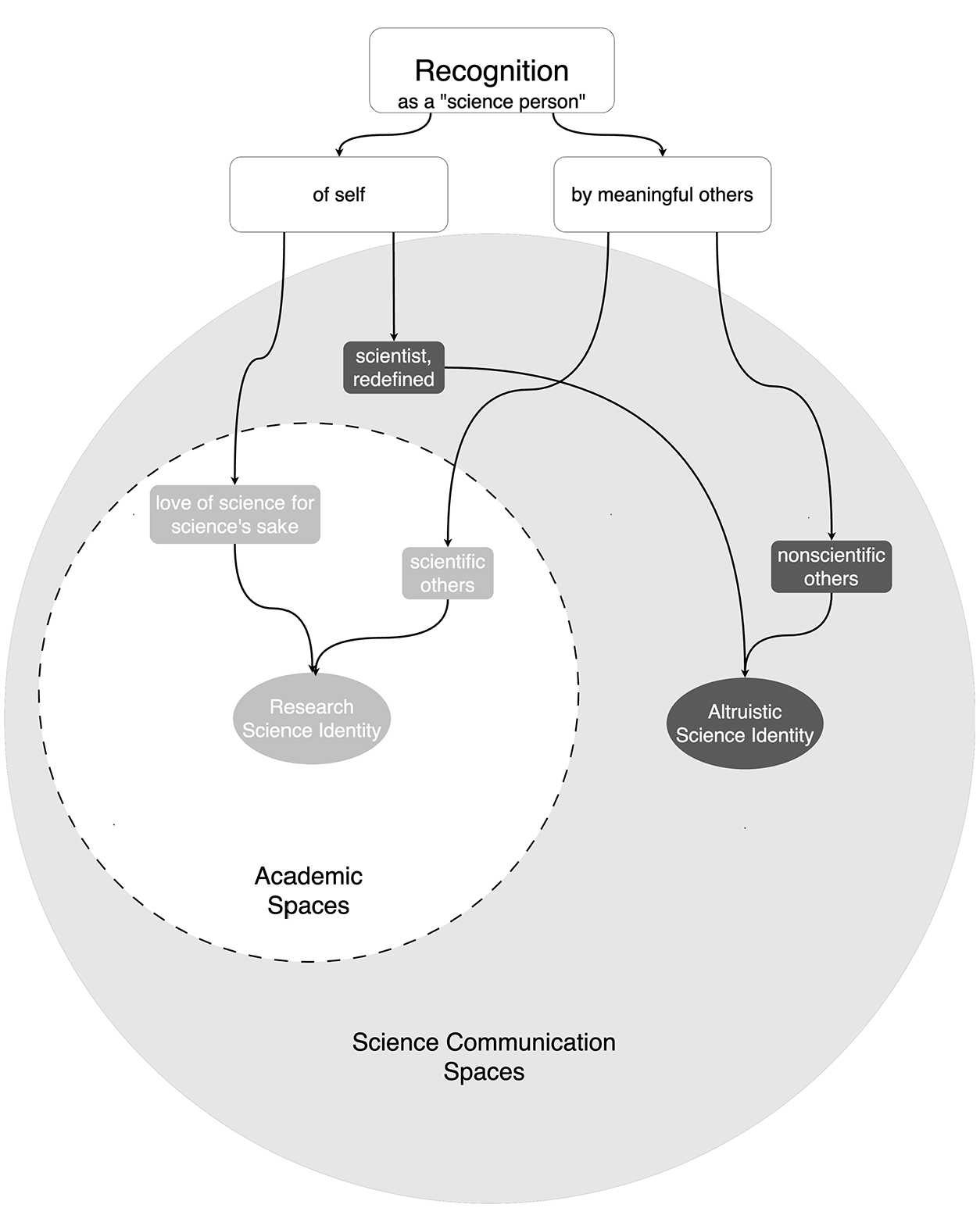
Science Communication Activities Facilitated Multiple Science Identities, Whereas Academic Spaces Only Welcomed Research Science Identities.
This participant went on to describe how this positive feedback helped curtail their feelings of imposter syndrome.
For participants with altruistic science identities, science communication activities allowed them to redefine who they regarded as meaningful (see Figure 2). Meaningful others named by participants included family, community members, and science communication audiences. For example, one participant shared how their family’s approval encouraged their altruistic science identity: I’ve always been really rewarded by my family’s approval, and they’ve always been super supportive, and so I haven’t had to seek out other approvals just, like, since forever. That’s kind of been like, “I don’t care what the world’s saying. My family says I’m awesome.” (Interview 15)
Participants commonly named science communication organizations (e.g., science communication training programs) as meaningful others. Many participants, especially those with marginalized identities, sought out science communication spaces to meet others like them and to connect with communities that are more diverse than those that typify academia.
Only a few participants characterized their advisors or peers as actively supporting their altruistic science identities, and a vast majority of participants said that they do not receive any sort of monetary compensation for their science communication efforts (e.g., departmental fellowships or grants).
Recognition of Self
In addition to recognition from others, development of science identity requires recognition of self as a “science person.” Participants commonly noted how science communication spaces enhance recognition of self for both research and altruistic science identities.
For participants with a research science identity, science communication activities reminded them of their love of science (see Figure 2). Participants with a research science identity often described that they pursue science communication activities to share their enthusiasm about their research. These participants also described how science communication activities brought them back in contact with the “bigger picture” and the stakeholders of their research. As one participant shared: [I]t was a time that my [chemical] reactions were all going wrong in the lab [. . .] and you feel like your world is ending. But [science communication] was also an eye opener for me because I was like, “Okay, this is the importance of what I’m doing.” (Interview 10)
A few of the participants with a research science identity described how their science communication fed back into their research—either through helping them more deeply understand their research or giving them new ideas for projects. One participant shared how this happened for them: I felt like in having to distill what I know down into very simplified terms, I realized what I did and did not know. [. . .] So, yeah, it definitely increases my general understanding because I have definitely gotten way too specific and forgotten a lot of things. (Interview 23)
For participants with an altruistic science identity, science communication activities were partly what enabled them to redefine how they saw themselves as a scientist (see Figure 2). Participants with the altruistic science identity described how science communication allowed them to connect their science to societal benefit, something they valued highly. As one participant explained, “[A]s scientists, we’re here to serve the community, the public. Like, there’s no reason to be doing science if it’s not benefiting the people, especially, like, public-funded science” (Interview 15). Altruistic science identity participants changed their definitions of success from research output to social impact. For example, one participant described how they came to reject the “publish or perish” mentality: I’m not like the people in my lab who publish whatever papers they publish. I started to talk to people that have similar [altruistic] thinking. And I started to see like, okay, they are successful. [. . .] And I think that’s starting to open my mind about the skills that I have. (Interview 10)
Some of the participants who held altruistic science identities named that science communication helped them feel they were contributing to increasing diversity, equity, inclusion, and belonging in STEM spaces. For example, one participant described how they saw their science communication as a form of activism: I think you can have different ways of being scientists, but the way that I’m doing it is a way that connects those things but also aligns with my values and also other truths like racism, structural violence, the vulnerability and acknowledging all of those components of our society and doing work that challenges them. (Interview 13)
Discussion
Our results suggest many science communication contexts are “pockets of belonging” for multiple science identities, while academic contexts privilege research science identities for STEM graduate students. However, more visible science communication contexts did not cultivate belonging, suggesting that science communication spaces require intentionality to become “pockets of belonging” (Canfield & Menezes, 2020).
This research extends work on science identity by considering the role of science communication spaces in developing alternative science identities, with implications for belonging in these spaces. Utilizing an interactionist approach, we considered how early-career scientists’ science identity and sense of belonging interact with both academic and science communication contexts. In addition to finding evidence of the alternative science identities theorized by Carlone and Johnson (2007), our results suggest how science communication activities may help develop positive alternative science identities like altruistic science identities. Altruistic science identities may be related to what Risien and Storksdieck (2018) describe as impact identities. They suggest that scientists with impact identities are “able to knit together disciplinary ties, personal relationships, intellectual contributions, and passion for science along with their other interests and strengths to achieve meaningful impacts” (p. 64).
This work helps demonstrate how science communication can help enrich the state of inclusion, equity, and belonging within the STEM culture. Specifically, our findings convey the potential ways that science communication can engender multiple, positive alternative science identities among its practitioners. By allowing multiple forms of science identity to thrive, science communication spaces are seen as “pockets of belonging” by STEM graduate students.
In contrast to science communication contexts, STEM graduate students experienced academic contexts as othering—requiring them to assimilate to research science identities. The stereotype that being a scientist is about pure dedication to research still remains a part of the experience of scientists-in-training (Risien & Nilson, 2018). Resisting this stereotype and inviting in multiple identities may attract and retain more students who are currently uninterested a single research identity. Marginalized students (e.g., students of color and women) have more difficulty thriving in STEM academic environments than white men (McGee, 2021) because they must negotiate cultures characterized by White, masculine values and behavioral norms, all of which are framed within a broader ideology of meritocracy (Eisenhart & Finkel, 1998; Seymour & Hewitt, 1997). Students of color also often bring values that are at odds with those expected by science departments (Seymour & Hewitt, 1997). Asking STEM graduate students from marginalized groups to assimilate into academic spaces stifles innovation and well-being (McGee, 2021).
This work allows us to move beyond “leaky pipeline” metaphors and calls for “broadening participation” to instead think about transforming systems and culture to cultivate multiple modes of belonging (Bevan et al., 2020). Bringing more marginalized people into STEM spaces will not automatically make these spaces more equitable because—as the research suggests—a graduate students’ sense of belonging derives from their social worlds (Herzig, 2010) and their ability to be their whole selves (Hanh, 1991; Somé, 1993). A key piece of cultivating cultures of belonging in science communication includes making space for a plurality of science identities that better support marginalized students’ aspirations and well-being (Bazyar, 2022; Carlone & Johnson, 2007).
Rather than asking STEM graduate students to assimilate (Halsey et al., 2020; Massey et al., 2022), science communication contexts might intentionally empower students to think about the assets they bring to scientific endeavor (Alderfer et al., 2023). Unfortunately, previous analyses of science communication trainings for STEM students suggest that most promote a more deficit-based (rather than asset-based) approach to science communication (Vickery et al., 2023). Instead, inclusive forms of science communication trainings include a focus on identifying and emphasizing the assets (e.g., cultural community wealth) that students carry with them into academic spaces (Alderfer et al., 2023).
Although academic spaces require assimilation from STEM graduate students, participants explained how they resist these oppressive structures through relationships and self-definition. This move echoes learnings from Black Feminist Thought, which helped demonstrate how marginalized students navigate oppressive structures while retaining their sense of agency through self-definition (Collins, 2022). Similarly, our findings on STEM graduate students using science communication as “pockets of belonging” suggest that multiple modes of belonging may be at play. Wenger (1998) describes three modes of belonging: engagement, imagination, and alignment as key roots of identity formation. Science communication spaces likely invite a plurality of positive science identities by helping scientists cultivate more awareness and agency related to their burgeoning science identities and helping ensure that these identities align with their core values.
We found that the role of recognition by meaningful others was key to an STEM graduate students’ sense of belonging, beyond feeling competent or performing their science identities (Carlone & Johnson, 2007). Other research on STEM graduate students’ sense of belonging also found relationships to be an important factor (Stachl & Baranger, 2020; Thiry et al., 2007). For example, getting to share struggles with peers and mentors contributed to an increased sense of belonging (Stachl & Baranger, 2020). In this study, STEM graduate students described the immense power their advisors had to create a space of belonging (or othering). Participants also described how science communication spaces expanded their social networks to include more “meaningful others” from which to receive recognition of their competent performances of “being a science person.” By providing supportive, extra-advisory relationships, science communication may cultivate alternative science identities.
In addition to recognition by others, STEM graduate student participants described how their recognition of self as a “science person” was facilitated by science communication because these activities offered a sense of purpose. Purpose—the intention to accomplish something meaningful to the self and impactful to the world—requires direction, meaning, and social support (Damon, 2008). Many schools of thought in psychology—including psychoanalytic theory, developmental psychology, logotherapy, social psychology, and positive psychology—all contend that a strong sense of purpose and meaning is key to well-being and life satisfaction (Baltes et al., 2006; Damon, 2008; Erikson, 1994; Frankl, 1985; Peterson & Seligman, 2003). Frameworks of science identity suggest that persistence in STEM fields derives not only from an individual’s success and abilities but also depends heavily on whether they can connect their STEM experiences with their sense of purpose (Carlone & Johnson, 2007). Purpose is also connected to a sense of resilience (Colby et al., 2001; Menon & Lachman, 2001). Many of the STEM graduate students we interviewed named science communication activities as providing this sense of purpose, even if they lacked it in their research. The sense of purpose provided by science communication activities may help early-career scientists be more resilient and avoid burnout, especially in times of crisis (e.g., the COVID-19 pandemic).
This research suggests a key role for science communication organizations in increasing early-career scientists’ sense of belonging. Most participants described how their academic mentors were ill-equipped to support science identities other than narrow research science identities, suggesting an essential role for science communication organizations to help cultivate belonging. To cultivate a plurality of science identities, these organizations should intentionally provide opportunities for early career scientists (1) to be recognized by meaningful others for their competent alternative science identity performances and (2) to self-define what it means to be a scientist.
Much of the previous emphasis on science communication training has been on content (e.g., Lewenstein & Baram-Tsabari, 2022), and most programs focus on skill-building rather than identity development (for an exception, see Rodrigues et al., 2023). Although training competencies remain important for science communication effectiveness, the relationships that trainees build may play key roles in their identity development.
What is counted as “success” in STEM academic spaces and science communication spaces matters for belonging. Success is often connected to a scientist’s publication record in STEM academic spaces. However, many graduate students are beginning to doubt the value of their advanced degrees for doing meaningful work (Woolston, 2022). Research on STEM graduate students’ definitions of success shows they hold a diversity of definitions but feel less belonging when their definitions do not echo the (often singular) definitions of success held by their advisor, department, or institution (Weatherton & Schussler, 2022). These mismatches occur more often for marginalized students and their advisors’ ideas of success (Brauer et al., 2022). Expanding inclusion and belonging in STEM spaces will require challenging publication quantity as the primary success metric. Allowing scientists to co-define success may better align with their diverse goals, cultivating plurality and belonging (Spalter-Roth & Van Vooren, 2009; Weatherton & Schussler, 2022).
To allow participants to self-define what it means to be a scientist, science communication trainers should reflect on what “success” means in trainees’ spaces. Broadening the definition of what science is “for” to include research- and altruistic-minded pursuits will more likely include a plurality of science identities.
Cultivating these “pockets of belonging” in science communication spaces may provide immediate benefits to STEM graduate students’ science identity development and sense of belonging. However, long-term change may require shifting norms and redistributing resources. STEM graduate students are keenly aware of how teaching and science communication activities are devalued compared to research activities (Thiry et al., 2007). Structural change will require science communication spaces to receive the same resources as more elite (and more oppressive) ones.
While we found that STEM graduate students may be cultivating “pockets of belonging” in science communication spaces, as long as these activities remain devalued within academic spaces, students who participate in them will have subordinate status (Thiry et al., 2007). Circumventing that subordinate status ultimately requires system-level change, such as redesigning institutional reward structures and resources to help normalize and prioritize impactful science communication activities (Hoffman, 2021). For example, some departments have expanded their promotion and tenure guidelines to include science communication activities (Risien & Nilson, 2018). This research also suggests that the training and socialization of graduate students must also prepare them for diverse career trajectories and life goals. In this way, expanding institutional conceptualizations of success and what science is for may make these spaces more inclusive for minoritized students. Long-term change will also involve improving STEM graduate students’ sense of belonging in academic spaces. Our results suggest that academic mentors may be a key intervention point, as they played an outsized role in participants’ sense of belonging in these spaces.
This study is based on qualitative interview data, which is context-dependent and should not extrapolated into generalizations. In addition, all the STEM graduate students we interviewed were based in the United States and Canada, so these data—and their implications—should be considered with that geography and the associated cultures in mind. We hope the results will compel other researchers to explore further how science communication spaces contribute to junior scientists’ identify formation and sense of belonging within STEM. There is a need for future qualitative research that replicates and extends this line of work. Likewise, we hope to see quantitative research that could help reveal the extent to which our findings exist more broadly among STEM graduate students.
Conclusion
As more attention is paid to inclusion and belonging among STEM graduate students (e.g., Bowman, 2023), we should go beyond broadening participation. Our study suggests that science communication spaces can potentially be “pockets of belonging” for STEM graduate students, offering them refuge and healing from oppressive academic spaces. This suggests that science communication might be envisioned as a space for identity development, not just professional development (Rodrigues et al., 2023). By shifting from a sole focus on skills acquisition to identity and belonging, these spaces can adopt an explicit goal of working toward equitable participation and liberation of marginalized groups in academic science spaces (Volpe et al., 2023). Our study reveals how STEM graduate students resist oppressive academic structures by building supportive relationships and cultivating self-definitions of success. Understanding the characteristics of these “pockets of belonging” will support efforts to build inclusive and empowering science communication spaces.
Supplemental Material
sj-pdf-1-scx-10.1177_10755470241268587 – Supplemental material for Science Communication Spaces as “Pockets of Belonging”: Inviting in a Plurality of Science Identities for Scientists-in-Training
Supplemental material, sj-pdf-1-scx-10.1177_10755470241268587 for Science Communication Spaces as “Pockets of Belonging”: Inviting in a Plurality of Science Identities for Scientists-in-Training by Nic Bennett, Anthony Dudo and John Besley in Science Communication
Footnotes
Declaration of Conflicting Interests
The author(s) declared no potential conflicts of interest with respect to the research, authorship, and/or publication of this article.
Funding
The author(s) disclosed receipt of the following financial support for the research, authorship, and/or publication of this article: This work is supported by a grant by The Rita Allen Foundation.

Author Biographies
References
Supplementary Material
Please find the following supplemental material available below.
For Open Access articles published under a Creative Commons License, all supplemental material carries the same license as the article it is associated with.
For non-Open Access articles published, all supplemental material carries a non-exclusive license, and permission requests for re-use of supplemental material or any part of supplemental material shall be sent directly to the copyright owner as specified in the copyright notice associated with the article.
