




Abstract
The search for extraterrestrial intelligent (SETI) and non-intelligent extraterrestrial life has recently received considerable attention in academia and international news media. Since media frames of scientific space exploration potentially influence public support and perceptions of science, the German news media’s coverage of extraterrestrial life was analyzed. The three dominant frames from 2009 to 2022 were beneficial space exploration, unidentified aerial phenomena (UAP)/extraterrestrial intelligence (ETI), and SETI risk. Two frames relied primarily on scientific sources, mainly universities/research centers, NASA, the SETI Institute, and Stephen Hawking. The European Space Agency (ESA), the German Aerospace Center (DLR), and astrobiology as a discipline were rarely cited. Implications for science and risk communication are discussed.
Scientists and scientific disciplines are increasingly required to demonstrate the broader societal impact of their research, beyond peer-reviewed journal articles and traditional bibliometric measures, to their employing institutions, funding agencies, and the broader (taxpaying) public. In particular, the importance of the mainstream news media in science communication is reflected in the expansion of measures of research excellence and the impact of the open science agenda (Jonker et al., 2022). Being present in the news media has been considered a major factor in bridging the gap between science and the public since most people as well as decision-makers acquire a great deal of science information from there (Schäfer, 2012). Researchers themselves were found to acknowledge that public engagement is generally part of scientific activity that is achieved mainly through media relations with traditional media, after education formats and events, and before social media communication (Fecher & Hebing, 2021). In this context, science communication is vital to “provide the public with information essential to forming opinions about public policy and about the costs and benefits of governmental expenditures on science” and to enable the publics to differentiate responsible science from irresponsible science and to better “discriminate the activities of scientists from those of ‘pseudo’ scientists” (Treise & Weigold, 2002, p. 311).
The need to legitimize expenditures, to emphasize societal benefits, and to improve the publics’ science literacy through mediated science communication especially applies to scientific disciplines involved in space exploration with the goal to search for extraterrestrial life (SETL). This is mainly due to the immense costs—the European Space Agency’s (ESA) budget for 2023 is 7.08 billion € (ESA, 2023)—as well as reputational problems that are believed to stem from the influence of non-scientific sources or conspiracy beliefs related to unidentified flying objects (UFO) (Bram, 2021; Shostak, 2004). While SETL, including the search for extraterrestrial intelligence (SETI), has been on the agenda of science, space exploration, as well as the mainstream media for a long time (Garber, 1999), more recent scientific observations and space exploration missions with explicit SETL goals have given the field new momentum including its public resonance (Mace & Schwalbe, 2020). Among them was the launch of the Kepler Space Telescope in 2009 which led to the discovery of most of the presently known planets outside of our solar system, called exoplanets, some of which are Earth-sized and orbit stars in the habitable zone (Lissauer et al., 2014). Further examples include the controversial debate in academia and the media about the observation of the interstellar object “Oumuamua” passing our solar system in 2017 that was interpreted by Harvard physicist Avi Loeb and others as a “fully operational probe sent intentionally to Earth vicinity by an alien civilization” (Bialy & Loeb, 2018, p. 4). The discovery of phosphine in the atmosphere of Venus in 2020 (Greaves et al., 2021) sparked a debate about the potential existence of life on the planet. In 2021, the James Webb Space Telescope was launched by ESA and NASA with one of its goals to investigate the potential for life in other solar systems. In the same year, the Perseverance Rover landed on Mars with the mission of seeking signs of ancient life. These projects and observations have presumably increased the international public attention to astrobiology including SETL and SETI as scientific disciplines. According to NASA’s roadmap, the multidisciplinary and interdisciplinary field of astrobiology addresses the questions of how life begins and evolves, whether life exists elsewhere in the universe, and what the future of terrestrial and extraterrestrial life is (Des Marais et al., 2008).
SETI, described by some scholars as a branch of astrobiology (Tarter, 2004), has long been a topic of science fiction but also the news media. Seth Shostak, astronomer at the SETI Institute, pointed to the ambivalent relations between SETI scientists and the media (Shostak, 2004). While they give beneficial attention to the field and generate interest among the broader public, they also contribute to the “pervasive conflation of SETI and the UFO phenomenon” (Shostak, 2004, p. 540) that is often regarded as damaging scientific credibility. Science communication scholars have pointed to a communication gap between scientists and the media, where scientists are concerned about the inaccuracies or misrepresentation in the news coverage of astrobiology and SETI (Oliver, 1997). Despite the efforts of scientists, the misrepresentation of SETI in the media and in public political statements may have contributed to the cancelation of U.S. Congressional funding of NASA’s SETI program in 1993, for instance (Garber, 1999).
There is consensus in science communication research that the way media frame science and scientists influences public perception and, as a consequence, funding, political support, career opportunities, as well as science literacy or trust in science (Nisbet et al., 2002; Schäfer, 2017), including SETL and space exploration (Bingaman et al., 2022; Kauffman, 2005; Oliver, 2008; Shostak, 2004). Thus, due to the revitalization of the SETL field and the significant growth of research output in astrobiology since the 2000s (Malaterre & Lareau, 2023), it is important to understand the characteristics of the media coverage of SETL, including public representations of the relevant scientific disciplines and institutions in recent years. However, research with that focus is rare. Most works focused on fiction and entertainment media (e.g., Brain & Rosen, 1983; Kaveney, 2005; Ruppersburg, 1987; Trushell, 2004). Research on news media and journalism usually addressed space flight, space exploration, space technology, or national security, with SETL playing a minor role, if any (Byrnes, 1994; Clark & Illman, 2003; Kauffman, 1994; Neal, 2007). A few more recent publications have looked at public perceptions or the media coverage of Mars exploration in the United States or the United Kingdom with some reference to SETL (Dittmer, 2007; Mace & Schwalbe, 2020; Slobodian, 2015) which may be an outcome of NASA’s and others’ revitalization of astrobiological questions in those missions in the 2000s.
Hence, the goal of this study is to analyze and identify dominant media representations of the role of science in SETL according to the news media. For that purpose, we took German news media as an example with Germany being the largest economy in Europe and, by 2023, the most important contributor to ESA including its astrobiology missions (ESA, 2023). Germany is an interesting case study in mediated science communication since astrobiology is a relatively young field in the country (Schröder, 2020) as exemplified by the formation of the German Astrobiology Society in 2016. Thus, media coverage can be particularly influential in engaging the public with SETL and astrobiology, facilitating informed judgments about it, attracting or discouraging young scientists, and potentially promoting or undermining public support for tax expenditures in the field in Germany, where most education and research programs are publicly funded.
A quantitative analysis of the mainstream media’s representation of SETL does not only have implications for modern science communication in fields such as astronomy, astrobiology, or SETI, but it may also reveal patterns of how the media assign risks and benefits to this research. Scholars have discussed the importance of risk communication and preparedness not only in the context of searching, but more importantly in scenarios of finding extraterrestrial life or even having contact with an extraterrestrial intelligence (ETI) (Korbitz, 2014; Neal, 2014). Such scenarios would trigger significant global media attention with serious consequences for how the public responds (Shostak, 2004). According to risk communication theory (Roberto et al., 2009), these reactions will also depend on risk and benefit attributions of searching for and/or finding extraterrestrial life in today’s media coverage and how it informs the public in terms of severity and susceptibility of the threats that may arise from space exploration, active SETI, or projects like the Messaging to Extraterrestrial Intelligence (METI).
In science communication and related research, the concept of news frames has been employed on a regular basis and was defined as a “central organizing idea or story line that provides meaning to an unfolding strip of events, weaving a connection among them” (Gamson & Modigliani, 1989, p. 143). Framing studies on media representations of science and technology or its effects were often focused on fields like nanotechnology, biotechnology, or artificial intelligence, very often with positive tendencies and more emphasis on benefits than risks (e.g., Cools et al., 2022; Donk et al., 2011; Marks et al., 2007; Metag & Marcinkowski, 2013; Nguyen & Hekman, 2022). Although framing is a rather broad field with diverse definitions and operationalizations (de Vreese, 2012), Entman’s (1993) understanding of frames, consisting of the four elements: problem definition, causal interpretation, moral evaluation, and treatment recommendation, is among the most used (Guenther et al., 2023). With their empirical application of this approach to the study of mediated biotechnology frames, Matthes and Kohring (2008) further defined that problem definitions consist of an issue (i.e., topics) and “relevant actors that discuss the problem” and that a “causal interpretation is an attribution of failure or success regarding a specific outcome” (e.g., those responsible for risks/benefits). Moral evaluations were understood as positive, negative, or neutral evaluations of different objects while treatment recommendations were defined as calls “for or against a certain action” (p. 264). Based on this approach, we posed the following research questions (RQ) to study SETL and the role of science in the German news media:
Research Question 1 (RQ1): What are the main topics, influential scientific actors, attributions of risks and benefits, evaluations, as well as recommended actions in SETL emphasized by the news media in Germany?
Research Question 2 (RQ2): Which sources (actors), science disciplines, and topic emphases influence the news media’s risk/benefit evaluations of SETL?
Research Question 3 (RQ3): Which dominant frames of the mediated SETL can be identified in mainstream news media?
Literature Review: Framing Science, Technology, and Space Exploration
Framing has been employed on a regular basis to study public representations of science and technology in the media (Guenther et al., 2023; Schäfer, 2012). Frequently studied topics included emerging technologies such as nanotechnology (Donk et al., 2011; Metag & Marcinkowski, 2013), biotechnology (Marks et al., 2007; Matthes & Kohring, 2008), or artificial intelligence (Cools et al., 2022; Nguyen & Hekman, 2022). A common finding was that technologies were framed positively more often than negatively with more emphasis on benefits than risks. Donk et al. (2011), for instance, found that scientists were often framed as responsible for the benefits of nanotechnology. Similarly, Metag and Marcinkowski (2013) found scientists to be the dominant actors in the coverage of that technology, often trying to promote their research in a positive way. Using a topic modeling approach, Cools et al. (2022) found science to be a less important topic that was more evenly related to positive and negative frames in the U.S. coverage of artificial intelligence. Using Entman’s (1993) frame elements, Matthes and Kohring (2008) identified a “research benefit” frame in the media coverage of biotechnology where science was the dominant topic and scientists were the main actors who were mainly attributed to be responsible for the technology’s benefits. However, the science-related frame was found less frequently than the frames of “economic prospect” and “genetic identity.” In summary, framing research on science and technology often found positive tendencies in the media coverage, with science and scientists having a moderate presence in content compared to business and politics. This was also found for the presence of science in media frames of climate change with (scientific) “uncertainty and hoax” being a more frequent sub-frame than (scientific) “consensus” (Guenther et al., 2023). In comparison to that body of research, our study will reveal the role of different science disciplines in the context of the media’s SETL reporting and verify whether and how prominently science is featured and how the topic as well as risks and benefits are evaluated.
Science or scientific disciplines specifically related to space exploration or SETL were rarely studied from a media framing perspective or in general (Schäfer, 2012). A few studies addressed space flight, space exploration, space technology, or national security (Byrnes, 1994; Clark & Illman, 2003; Kauffman, 1994; Neal, 2007). More recent publications have analyzed public perceptions or the coverage of Mars exploration (Dittmer, 2007; Mace & Schwalbe, 2020; Slobodian, 2015). If at all, SETL as a subject was of secondary interest, limited to aspects of Mars exploration, or surfaced in the findings by accident.
A study by Neal (2007) used a qualitative frame analysis of NASA’s press materials and New York Times editorials to identify social constructions of human space flight. The author found five “meaning frames”: a new era of routine transportation, business, scientific research, heroism, and exploration. None of the frames was related to SETL, SETI, or astrobiology. The scientific research frame mostly referred to NASA’s intent to emphasize on scientific collaboration and scientific benefits for humanity as a rationale for spaceflight and human presence in space. In the 1990s and early 2000s, space exploration became an important narrative, mostly referring to the exploration of Mars.
Dittmer (2007) used qualitative content analysis to study U.S. media coverage of the Mars Pathfinder mission between 1996 and 1998 without further grounding in theory. The author identified “rhetorical threads” which were described as “powerful language of colonialism that manifested itself in three specific ways in their effort to portray the mission in an exciting light: scientific advance and the search for life, construction of Martian toponymy, and the Earth analogy” (Dittmer, 2007, p. 120). Thus, the scientific search for life or the conditions for potential life (e.g., water) on Mars became an important narrative in the media, even though the Pathfinder mission itself was designed primarily as a geological mission. However, the study lacks quantification of that theme in the media and methodological details about how it was identified.
Mace and Schwalbe (2020) investigated the coverage of Mars exploration “in relation to scientific and cultural milestones” (p. 1914) in U.S. and U.K. news media between 2011 and 2016. They employed framing and tone analysis based on predefined frames that were derived from previous space-related studies. Out of the eight frames, mainly Exploration (journeys to Mars), Scientific Knowledge (justification of space exploration through scientific discovery), Life (speculation about life on Mars), and Business (economic benefits of space travel) were relevant. The Nationalism (patriotism based on space programs), Settlement (human colonies on Mars), Fear (do-or-die perspective of why humans should explore/colonize Mars), and the Legacy frame (new frontiers and independent pioneers willing to battle hostile environments) were less frequently found. It is noteworthy that while seven frames were derived from previous literature, the only SETL-related frame (Life) was identified during the pretest of this study. The Life frame was the third most frequent and emerged mainly between 2012 and 2013. It “highlighted the possibility of past or present life on Mars” and was interpreted by the authors as overly optimistic and “sensationalizing the science” since life has not been found yet (Mace & Schwalbe, 2020, p. 1925).
In conclusion, news research on space exploration is scarce and rarely focuses on science-related aspects of SETL, while SETI has been generally disregarded. SETL was usually limited to Mars-related exploration although a great deal of astrobiology is concerned with the study of exoplanets and/or the study of life on Earth. None of the studies measured or quantified the occurrence and evaluation of specific scientific actors/sources in the field (e.g., SETI Institute, NASA, and ESA). Our study will fill these gaps and add data on the subject for a country other than the United States and the United Kingdom.
Detecting SETL Frames in the Media
The field of media framing research was characterized by a vast variety of conceptual and operational notions and approaches (Guenther, 2023; de Vreese, 2012). Therefore, to specify our approach to detect mediated SETL frames, we first differentiate the most important of these understandings, then justify our selection of a framing approach, and finally explain that approach for this study.
At the conceptual level, issue-specific frames are distinguished from generic frames. Issue-specific frames “are pertinent only to specific topics or events,” whereas generic frames “transcend thematic limitations and can be identified in relation to different topics, some even over time and in different cultural contexts” (de Vreese, 2012, p. 368). Examples of generic frames include, for example, the framework by Semetko and Valkenburg (2000) with the five frames of conflict, attribution of responsibility, economic consequences, human interest and morality, or Iyengar’s (1991) differentiation of thematic and episodic frames. Since our goal was to understand the role of science in the media’s framing of SETL, only an issues-specific approach was feasible to capture specific scientific sources and SETL-specific aspects of the field.
At the operational level, manifold approaches of measuring frames are known (Matthes & Kohring, 2008). A simplified distinction often refers to inductive and deductive approaches to frame detection, although these terms are not always used consistently (Matthes & Kohring, 2004; Semetko & Valkenburg, 2000). Inductive usually refers to methods where frames emerge from the data analysis (qualitatively, quantitatively/variable-based, and/or computational) with the possibility of finding new frames. Deductive approaches mostly refer to the necessity to predefine frames and code for their presence or absence in the material. Hence, frames have to be known before data collection and new frames cannot be discovered. Due to the lack of studies on SETL frames that included SETI and aspects of astrobiology, a list of predefined frames was not available. Therefore, we decided to use an inductive variable-based approach to framing.
A widely adopted conceptual framework that meets our goals and, in addition, is well-developed at the operational level, is Entman’s (1993) frame definition according to which journalists frame certain subjects by selecting “some aspects of a perceived reality and make them more salient in a communicating text, in such a way as to promote a particular problem definition, causal interpretation, moral evaluation, and/or treatment recommendation” (p. 52). Based on this, Matthes and Kohring (2008) developed an operational approach that employs several indicators at the variable level to measure the four frame elements of problem definition, causal interpretation, and so on. In this framework, problem definitions consist of an issue (i.e., topics) and relevant actors. Causal interpretation is measured by attributions of failure or success regarding a specific issue. This refers, for instance, to the attribution of risks/benefits by specific senders to those responsible for risks/benefits. Moral evaluations were understood as positive/neutral/negative evaluations of different objects, while treatment recommendations were defined as calls “for or against a certain action” (Matthes & Kohring, 2008, p. 264). Treatment recommendations were also operationalized as prediction of future results that imply support or withdrawal of support for an issue (Matthes & Kohring, 2004; Taddicken et al., 2020). Each frame element was measured by several variables which subsequently were used to identify systematic groupings of texts (i.e., frames) using cluster analysis. Since frames were only detected through computer-assisted data analysis, the approach is inductive, while the literature-based development of measures for frame elements is deductive.
With this approach, we analyzed media reports about SETL according to (a) emphases of specific aspects of the topic as well as influential actors/sources or scientific disciplines (problem definition); (b) attributions of responsibility for risks and benefits of SETL by and to some of these actors (causal interpretation); (c) evaluations of the issue at hand as well as risks and benefits of SETL in general (moral evaluation); (d) and calls for certain actions to deal with the issue (treatment recommendation). Thus, for each of the four frame elements, we developed measures for content analysis that were adopted from previous framing research (Donk et al., 2011; Matthes & Kohring, 2004, 2008) and adjusted to SETL specifics. These indicators were subsequently used in a cluster analysis to detect statistically recurring patterns in the media coverage (i.e., frames). This method of frame detection has been shown to be valid and reliable compared to alternative approaches (Donk et al., 2011; Matthes & Kohring, 2008) and has been frequently used since then (Guenther et al., 2023).
Method and Materials
Sample
To analyze the way German news media frame SETL, we conducted a quantitative content analysis of the five online-based media outlets ARD news online (tagesschau.de), Spiegel online, t-online, Focus online, and Bild.de. According to Reuters’ Digital News Report in 2021, they are among the six most used news media platforms in Germany (Newman et al., 2021). We analyzed the online platforms of mainstream media outlets since together with TV news they are the most important news source above print media and social media in Germany. They represent a variety of political leanings (liberal/left-wing and conservative/right-wing) and reporting styles (tabloid-style and quality news) in the German media system.
All news media platforms were searched for relevant articles using keywords such as extraterrestrial life, SETI, astrobiology, or intelligent life (in German). In this way, we were able to assess the relative importance, characterization, or absence of science in the context of the SETL topic as opposed to exclusively preselecting articles that refer to science in the first place. The time frame for the analysis ranged from 2009, when the Kepler Space Telescope was launched, to August 2022, when the first images from the James Webb Space Telescope were released. Kepler’s launch was used as the starting point since it represents an important milestone for astrobiology. It was more successful than other telescopes and techniques in discovering (Earth-sized) exoplanets inside and outside the habitable zone (Lissauer et al., 2014) and led astrobiologists to conclude that rocky planets are much more common than expected (Hawkes, 2017).
In total, 350 articles were retrieved with the keyword search. After screening for articles that actually dealt with different non-fictional aspects of extraterrestrial life, a final sample of 272 articles was included and coded. With “non-fictional,” we refer to factual journalistic news reporting about SETL-related matters excluding, for example, reviews of movies, shows, or novels related to extraterrestrial life. The distinction fictional/non-fictional does not refer in any way to speculative parts of some news articles about the (none-)existence of ETI or its links to the occurrence of unidentified aerial phenomena (UAP), for example.
Instrument
The development of the codebook was guided by framing theory (Entman, 1993) and previous research (Donk et al., 2011; Matthes & Kohring, 2008) using the four frame elements of problem definition, causal interpretation, moral evaluation, and treatment recommendation (Table 1). For problem definition, we coded the main topics of each article, the main actors that were mentioned as well as the main academic discipline that was referenced. The dimension of causal interpretation included the actors responsible for benefits or risks as well as the senders of benefit or risk attributions in each article. The list of actors that was coded for each category included scientists, research institutions, specific organizations in the field (e.g., DLR, ESA, NASA, and SETI Institute), business actors, governments, journalists, and others. The frame element of moral evaluation included indicators of different aspects of SETL (e.g., search for non-intelligent extraterrestrial life, costs, potential result, etc.) and how they were evaluated on a 3-point scale (negative, balanced/neutral, positive). In addition, mentions of benefit and risk evaluations of SETL were coded for the domains of science, civil society, the economy, politics, and others. Mentions of treatment recommendations included several kinds of recommended actions such as regulating the risk, financial support, development of ethical standards, better information, or the withdrawal of support. In addition, we coded how the media reports and their sources predict the result of searching for intelligent or non-intelligent extraterrestrial life (unlikely, uncertain, and likely).
Codebook Categories (Selection of Main Indicators).
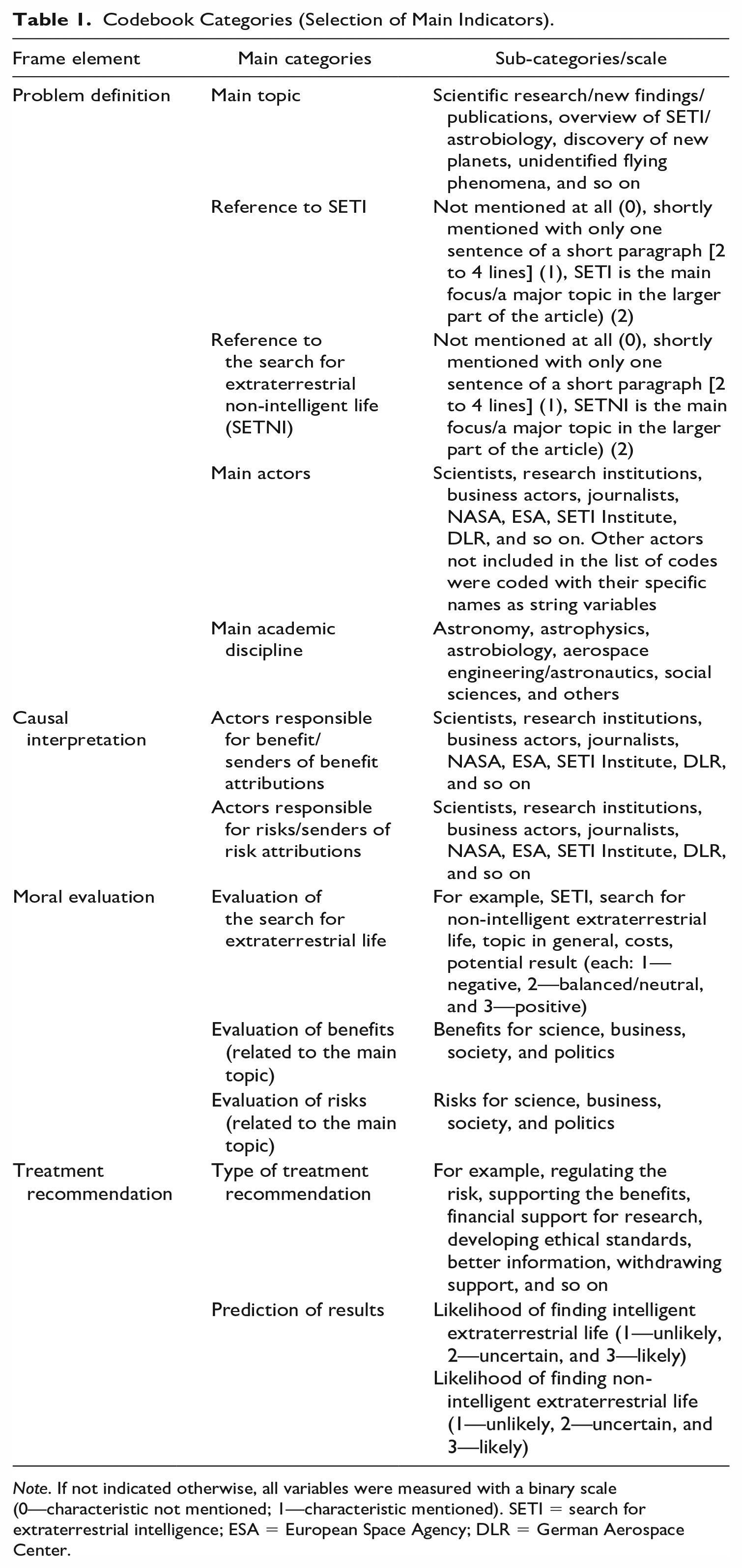
Note. If not indicated otherwise, all variables were measured with a binary scale (0—characteristic not mentioned; 1—characteristic mentioned). SETI = search for extraterrestrial intelligence; ESA = European Space Agency; DLR = German Aerospace Center.
To assess the codebook’s reliability, the main coder was assigned to a random sample of 32 articles out of the overall sample (12%) with at least 5 articles from each media outlet. These articles were coded twice with a 1-week delay to calculate intracoder agreement using Krippendorff’s alpha coefficient (KALPHA). The overall average reliability of the codebook resulted in a KALPHA score of .85 indicating sufficient consistency between coding decisions (Krippendorff, 2004).
Data Analysis
Besides descriptive statistics, chi-square tests, multiple linear regressions, and analysis of variance (ANOVA) were used to explore relationships between variables. Effect sizes were reported as Cramer’s V (chi-square tests), adjusted R-squared and standardized beta (regression), as well as eta-squared (ANOVA). The interpretation of effect sizes followed Cohen’s (1988) recommendations.
While previous framing research mainly used hierarchical cluster analysis (Matthes & Kohring, 2008), we applied two-step cluster analysis for frame detection. This technique has been reported to produce reliable and robust cluster solutions compared with other clustering methods such as latent class analysis or hierarchical cluster analysis (Kent et al., 2014). Two-step cluster analysis is a hybrid approach using distance measures to separate groups in the first step and subsequently applies a probabilistic approach to identify the optimal subgroup model. The procedure has several advantages such as the ability to include nominal and interval-scaled variables, being less sensitive to the violation of normal distribution assumptions, and, most importantly, determining the number of clusters based on statistical measures (Akaike information criterion [AIC] and Bayesian information criterion [BIC]) instead of arbitrary choices based on visualizations or other criteria (Everitt, 2011). Especially for specifying the number of media frames in data sets, the researcher’s previous assumptions may lead to subjective decisions. To detect news media frames in the news coverage of SETL, we aimed at including theoretically relevant indicators for each of the four frame elements (Entman, 1993) to identify a meaningful and interpretable frame structure. This trade-off between statistical robustness and theoretical and/or qualitative assessment has been practiced and addressed in previous framing research using an inductive approach to frame detection (Matthes & Kohring, 2008). For that purpose, we first excluded frame element indicators that did only appear with a frequency below 5% in the material. Second, we ran two-step cluster calculations and excluded predictors with the lowest or no contribution to building clusters until we achieved a stable cluster solution with a silhouette coefficient above zero (fair cluster solution).
Some of the follow-up analyses were conducted using ANOVA with the cluster solution as the factor and, in some cases, binary outcome variables. ANOVA has been shown to work well in such contexts although some of the classic statistical assumptions are not met (Glass et al., 1972).
Principal component analysis (PCA) was used as an exploratory dimensionality reduction method to reduce the number of variables and avoid multicollinearity in follow-up analyses with mediated evaluations of SETL including risk/benefit evaluations. The number of components was calculated with Eigenvalues > 1 as the criterion followed by a Kaiser-Varimax rotation. The Kaiser–Meyer–Olkin (KMO) measure (at least 0.5) as well as Bartlett’s test for sphericity (should be significant, p < .05) were used to assess sampling adequacy. Factor loadings > 0.3 were considered substantial for interpretation (Hair et al., 2019).
Results
Descriptive Results (RQ1)
The majority of the 272 news items dealing with SETL were published in the news magazine Focus Online (35%) followed by the tabloid-style media outlet Bild.de (25%). Spiegel online, which is a rather liberal/left-wing news platform with a significant impact on Germany’s media agenda, published 23% of all articles. The lowest share was found for ARD News/Tagesschau.de (2%) which is the online platform of Germany’s most influential TV news show. Most articles were published in the science or education section of the media outlets (60%). Article length ranged from short (up to 399 words) (42%), to medium (400–999 words) (48%), to long (>999 words) (10%). We found between 3% and 8% of coverage in most years, with the exception of 2015 (12%) and 2017 (15%), when media coverage peaked. In 2017, the anniversary of the so-called WOW signal (1977), the discovery of new exoplanets as well as the sending of a message to Luyten’s star by METI International received a lot of that attention.
The most frequent main topics were discussions of the potential existence of ETI (18%), new research or scientific publications (17%), the observation of extraterrestrial signals (17%), as well as the discovery of new planets (14%) (Figure 1). The sighting of UAPs or UFOs was the main topic in 10% of the articles. A rather high share of news items dealt with topics that were not part of the previously defined list (19%). For those topics, a qualitative description was coded in an open string variable. The analysis of these codes showed that some articles dealt with the topic of METI (3%) or potential contact scenarios with an ETI (3%). Only one or two articles were found, for instance, on Area 51, life on Mars, financial issues of SETI research, and the disappearance of a plane or a UFO fan.
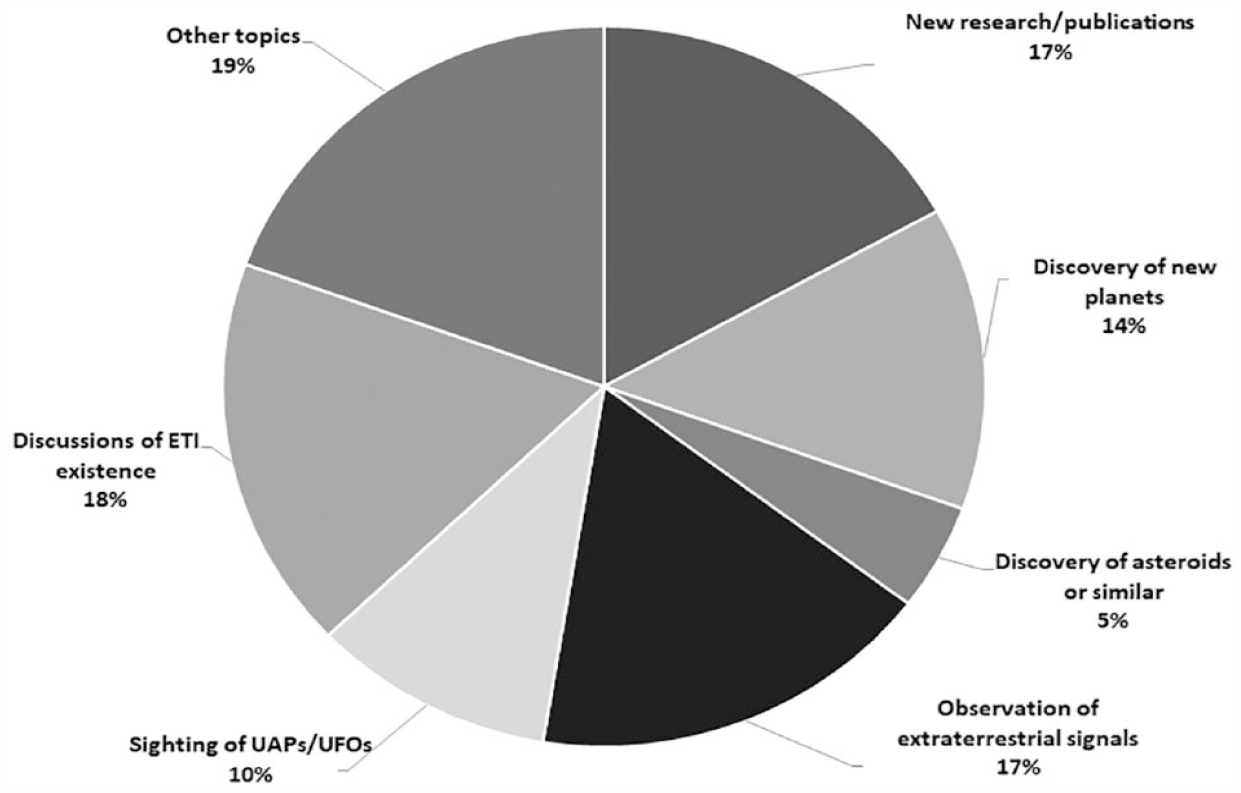
Main topics of the German news media coverage of the search for extraterrestrial life.
More in general, we coded to what extent an article refers to the SETI or non-intelligent life on a 3-point scale (0—not mentioned, 1—shortly mentioned, and 2—main focus). On average, the SETI topic was clearly more relevant (M = 1.2; SD = 0.8) compared to searching for non-intelligent life (M = 0.5; SD = 0.7). The main actors that were mentioned or cited in the news were predominantly scientists or scientific institutions with universities and research centers being the most frequent (60%) (Figure 2). Close to one-third of all articles referred to NASA, civil society, or the SETI Institute, respectively. ESA (8%) or its German equivalent (DLR) (2%) were rarely mentioned. Among political actors, mainly the U.S. government (13%) or the U.S. president (4%) were somewhat relevant. Stephen Hawking was frequently featured (10%) as one of the individual celebrity scientists. Other actors that were not part of the predefined codes were found rather often (35%) as part of the long tail. Among them were, for example, astronomers and astrophysicists such as Seth Shostak (2.2%), Frank Drake (1.8%), and Carl Sagan (1.5%). In addition, the German astronaut Alexander Gerst (1.5%), the German science journalist and astrophysicist Harald Lesch (1.5%), as well as the CEOs Elon Musk (1.5%) and Mark Zuckerberg (1.5%) were mentioned.
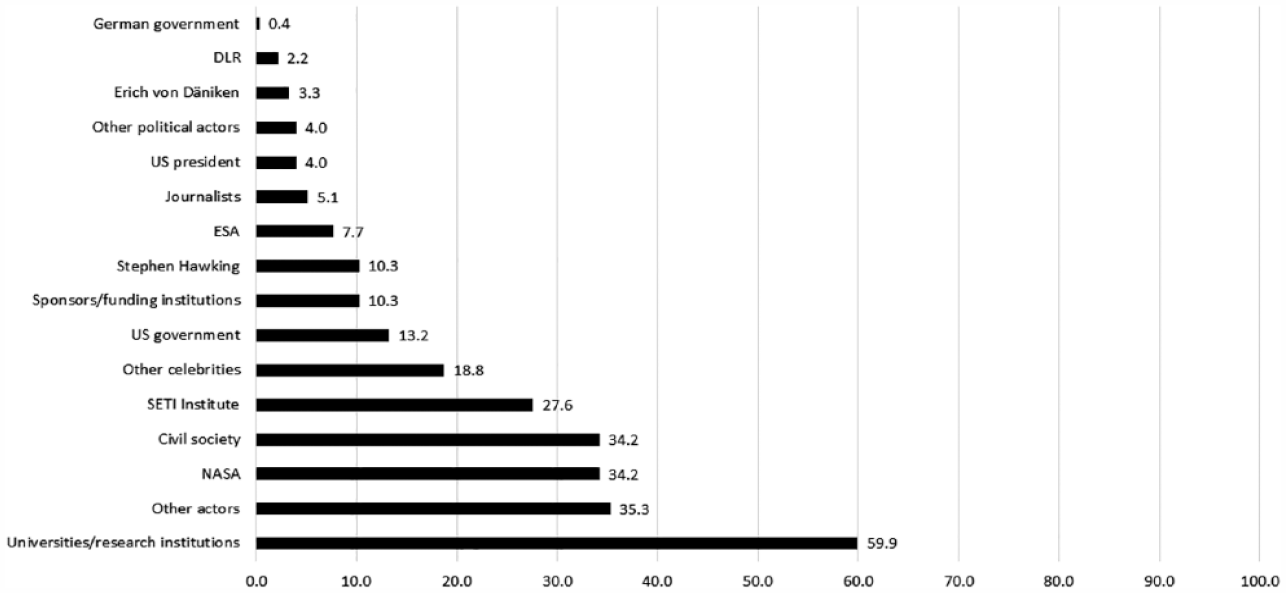
Main actors in the German news media coverage of the search for extraterrestrial life.
The explicitly mentioned science disciplines related to SETL were in descending order astronomy (46%), astrophysics (19%), astrobiology (9%), social sciences (5%), and aerospace engineering (0.7%). Among the openly coded category of “other disciplines,” we frequently found various subfields of physics (15%), biology (6%), and mathematics (3%). The term exobiology was mentioned three times.
In terms of risks and benefits, we found a prevalence of benefits over the risks of SETL. Scientific benefits were mentioned most often (52%) followed by societal benefits (18%). Economic (3%) or political benefits (2%) were almost irrelevant. Among the risks, societal risks (18%) and scientific risks (11%) were mentioned most frequently. Other risks were not relevant (<5%). General evaluations of different aspects of the topic were measured on a 3-point scale (1—negative, 2—balanced/neutral, and 3—positive). In general, positive or negative evaluations were rare. On average, the media coverage had a slight tendency toward positive evaluations of SETI research (M = 2.06; SD = 0.37), the search for non-intelligent life (M = 2.08; SD = 0.27), the main issue of the article (M = 2.06; SD = 0.32), and the potential result of search efforts (M = 2.06; SD = 0.33).
Treatment recommendations in the context of SETL were rarely mentioned in general. Most frequently, articles pointed to the need for regulating the implied risks (12%) and the further support of the potential benefits (17%). Only in a few news items, the withdrawal of support for SETL was mentioned (1.5%). Further recommendations included more financial support (2.6%), shifting the thematic focus of SETL (2.6%), the creation of ethical standards (2.9%), and better information (5.9%). The likelihood of finding extraterrestrial life was mostly rated as uncertain. Finding intelligent life was mentioned more often to be likely (24%) than unlikely (15%). This was even more pronounced for finding non-intelligent life (18% likely; 3% unlikely).
Explaining Mediated Risk/Benefit Evaluations of SETL (RQ2)
To find determinants of mediated risk/benefit evaluations of SETL, we first conducted a PCA of evaluation indicators. We included the summed-up number of mentioned risk categories (M = 0.35; SD = 0.51) and the number of mentioned benefit categories (M = 0.77; SD = 0.67). In addition, evaluation indicators of SETI research, the search for non-intelligent life, the main issue of the article, and the potential result of search efforts were entered into the PCA. This resulted in a satisfactory component solution (KMO = 0.63; Bartlett’s test p < .001). Further analysis yielded empirical justification for retaining 2 factors which accounted for 52.4% of the total variance. The varimax-rotated factor solution revealed two interpretable components of mediated evaluations of SETL, risk/benefit evaluations and SETI evaluation (Table 2). The risk/benefit evaluations component explained 27% of the total variance and refers to the overall number of benefit assessments of SETL along with its risks (negative loading). In addition, the component reflects the general evaluation of the SETL subject, and more specifically the evaluation of searching for non-intelligent life with higher values meaning more positive evaluations. Thus, the presence of benefit evaluations and the absence of risk attributions formed an underlying dimension with generally more positive evaluations of the SETL field. The component of SETI evaluation explained 25% of the total variance and reflects the evaluation of SETI research and its potential result with higher values meaning more positive evaluations. This dimension addresses the more explicit media evaluation of searching for intelligent life independently from risk/benefit considerations and different from the search for life in general.
Principal Component Analysis (PCA) With Evaluation and Risk/Benefit Indicators.
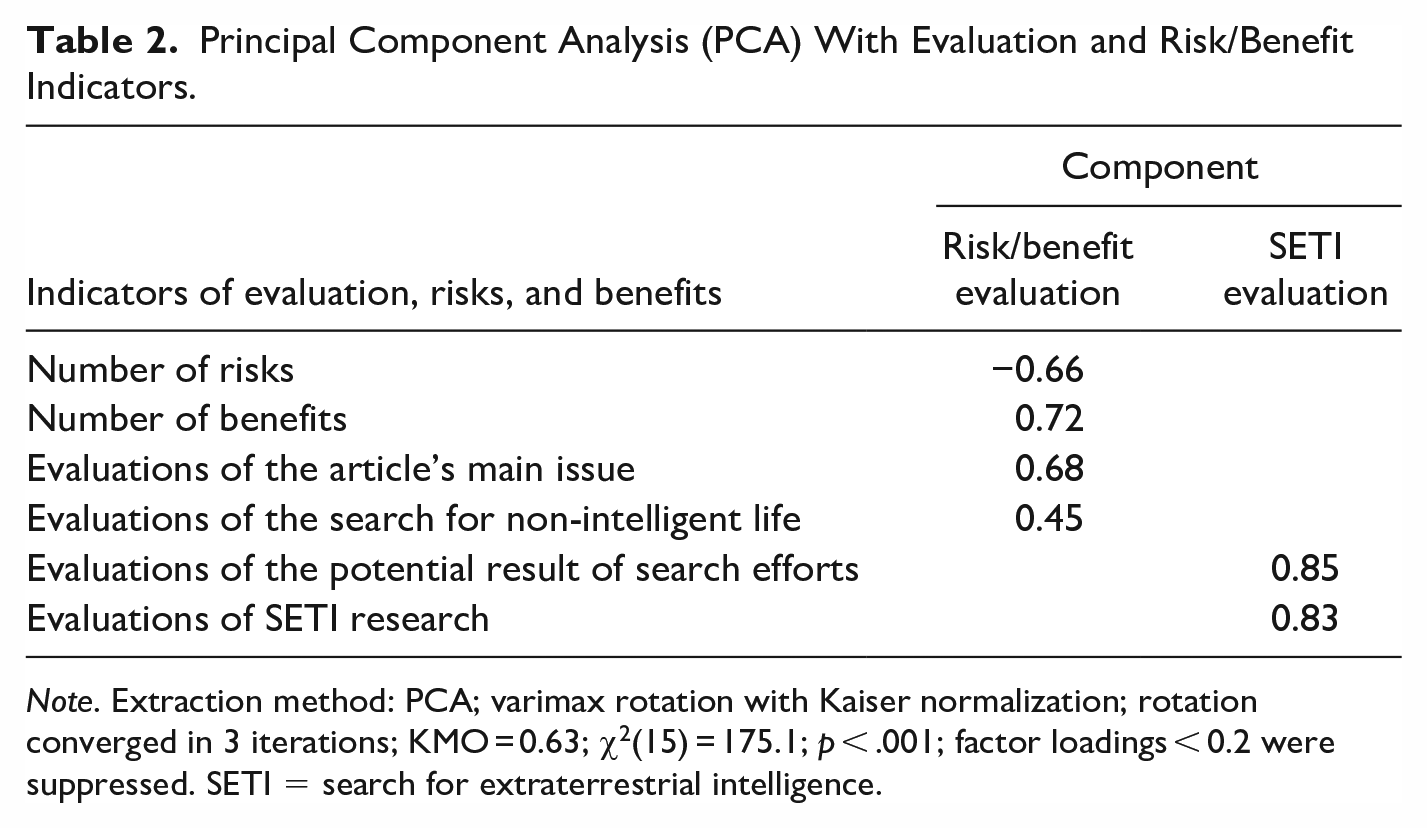
Note. Extraction method: PCA; varimax rotation with Kaiser normalization; rotation converged in 3 iterations; KMO = 0.63; χ2(15) = 175.1; p < .001; factor loadings < 0.2 were suppressed. SETI = search for extraterrestrial intelligence.
Multiple linear regression models were calculated to test the influence of referenced science disciplines, emphasis on SETI or the search for non-intelligent life, mention of actors, actors responsible for benefits/risks, and senders of benefit/risk attributions as predictors. Only predictors occurring more often than 5% in the sample were included (a total of 31 predictors). Risk/benefit evaluations (PCA factor score) was the dependent variable. The resulting model explained a substantial amount of variance (adj. R² = .36) (Table 3). The mention of astronomy was significantly (p < .05) related to more positive risk/benefit evaluations of the media coverage. In addition, several actors mentioned as the source of benefits (SETI Institute, NASA, universities, sponsors, and civil society) predicted favorable risk/benefit evaluations of SETL. A negative influence was found for the mention of social sciences, the SETI Institute as an actor, an article’s emphasis on SETI research as well as some actors responsible for risks (universities and civil society).
Multiple Linear Regression With Risk/Benefit Evaluations (PCA) as Dependent Variable.
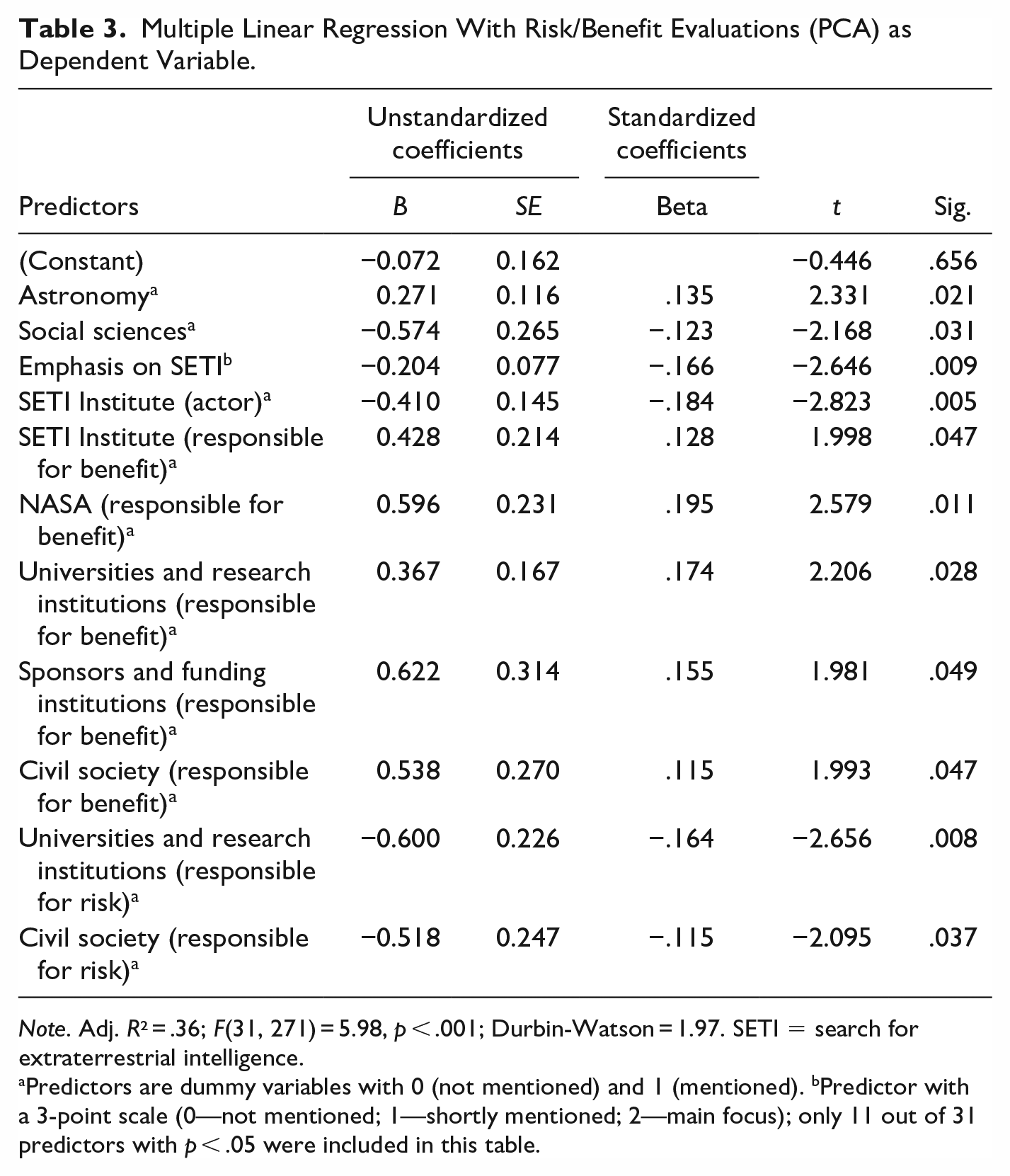
Note. Adj. R² = .36; F(31, 271) = 5.98, p < .001; Durbin-Watson = 1.97. SETI = search for extraterrestrial intelligence.
Predictors are dummy variables with 0 (not mentioned) and 1 (mentioned). bPredictor with a 3-point scale (0—not mentioned; 1—shortly mentioned; 2—main focus); only 11 out of 31 predictors with p < .05 were included in this table.
For SETI evaluation as the dependent variable (PCA factor score), the regression model explained only a small amount of variance (adj. R² = .07). The mention of aerospace engineering/astronautics (Beta = .14), the article’s emphasis on both SETI (Beta = .20) and non-intelligent life (Beta = .15) were significantly (p < .05) related to more positive SETI evaluations. Interestingly, the mention of Stephen Hawking as the sender of risk attributions negatively influenced SETI evaluations (Beta = −.28).
Media Frames of SETL (RQ3)
Based on the procedure of cluster analysis described before, for the frame element of problem definition, we entered the main topic, the reference to either SETI or the search for non-intelligent extraterrestrial life, and some of the frequently mentioned main actors (e.g., SETI Institute, NASA, universities/research institutions, sponsors/funding institutions, U.S. government). For the frame element of causal interpretation, we included many actors that were attributed to be responsible for benefits (e.g., SETI Institute, NASA, universities/research institutions, sponsors/funding institutions) and actors that were identified as senders of benefit attributions (SETI Institute, NASA, and universities/research institutions). Universities and research institutions were included as a source of risk as well as a sender of risk attributions together with Stephen Hawking. For the frame element of moral evaluation, scientific benefits, societal risks, and several evaluation indicators (evaluation of SETI, search for non-intelligent life, article’s main issue, and potential result of the search) were included. Treatment recommendations did not appear frequently in the media coverage in general. Therefore, only regulating the risks and supporting the benefits of SETL could be included.
Other variables were not included because of low predictor importance for differentiating clusters and/or because no satisfactory and robust cluster solution was produced (silhouette coefficients of zero or below). The best cluster solution containing indicators for all 4 frame elements comprised 29 variables and resulted in an acceptable cluster structure (silhouette coefficient = 0.2) of three clusters, which henceforth were interpreted as media frames. Since most variables were measured on a binary scale (0/1), we reported the means for the sake of better interpretability (Table 4 and Figure 3). The frequencies of the main topics are reported separately in Table 5.
Two-Step Cluster Analysis (BIC) With 29 Indicators of Four Frame Elements.
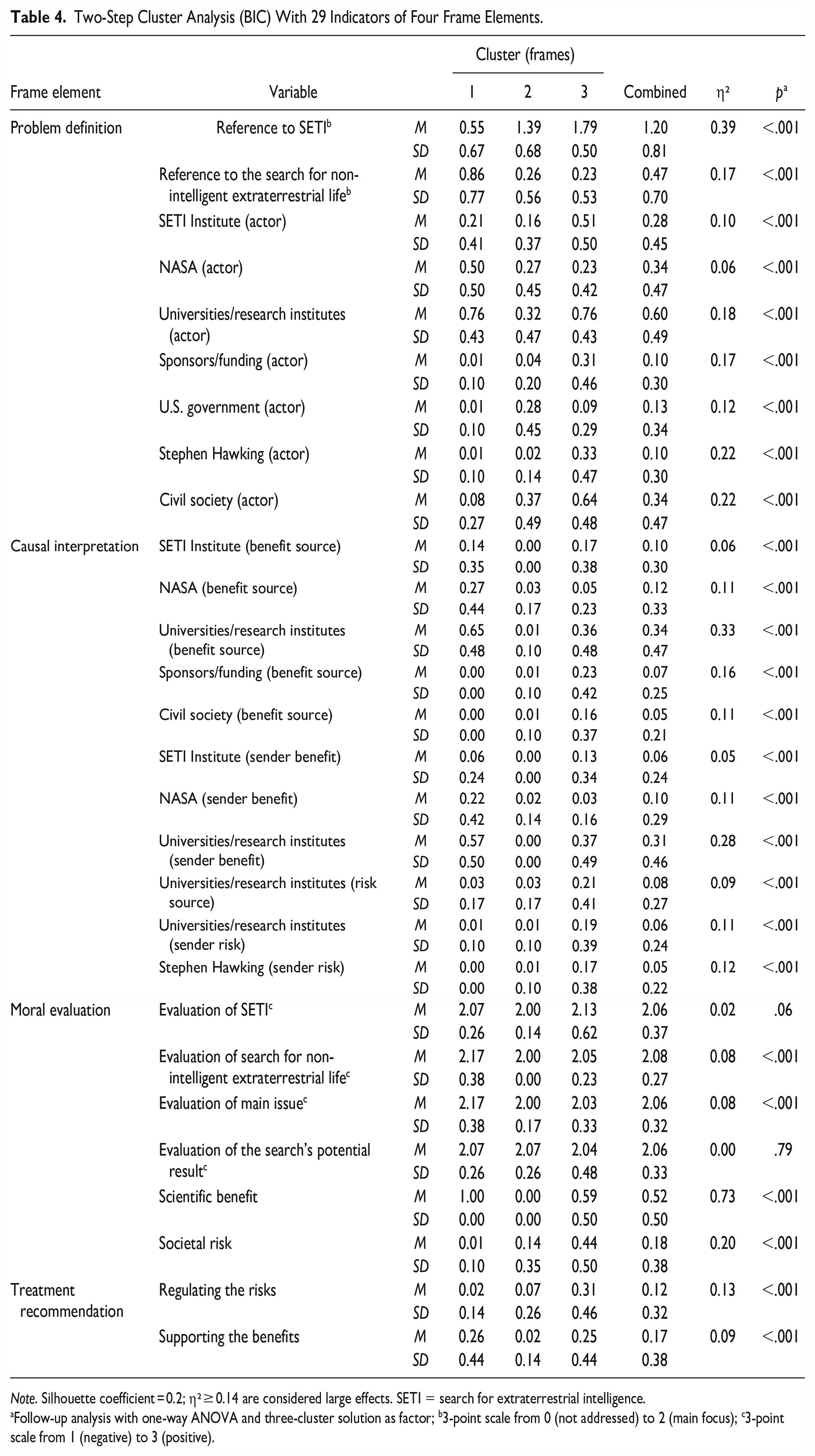
Note. Silhouette coefficient = 0.2; η² ≥ 0.14 are considered large effects. SETI = search for extraterrestrial intelligence.
Follow-up analysis with one-way ANOVA and three-cluster solution as factor; b3-point scale from 0 (not addressed) to 2 (main focus); c3-point scale from 1 (negative) to 3 (positive).
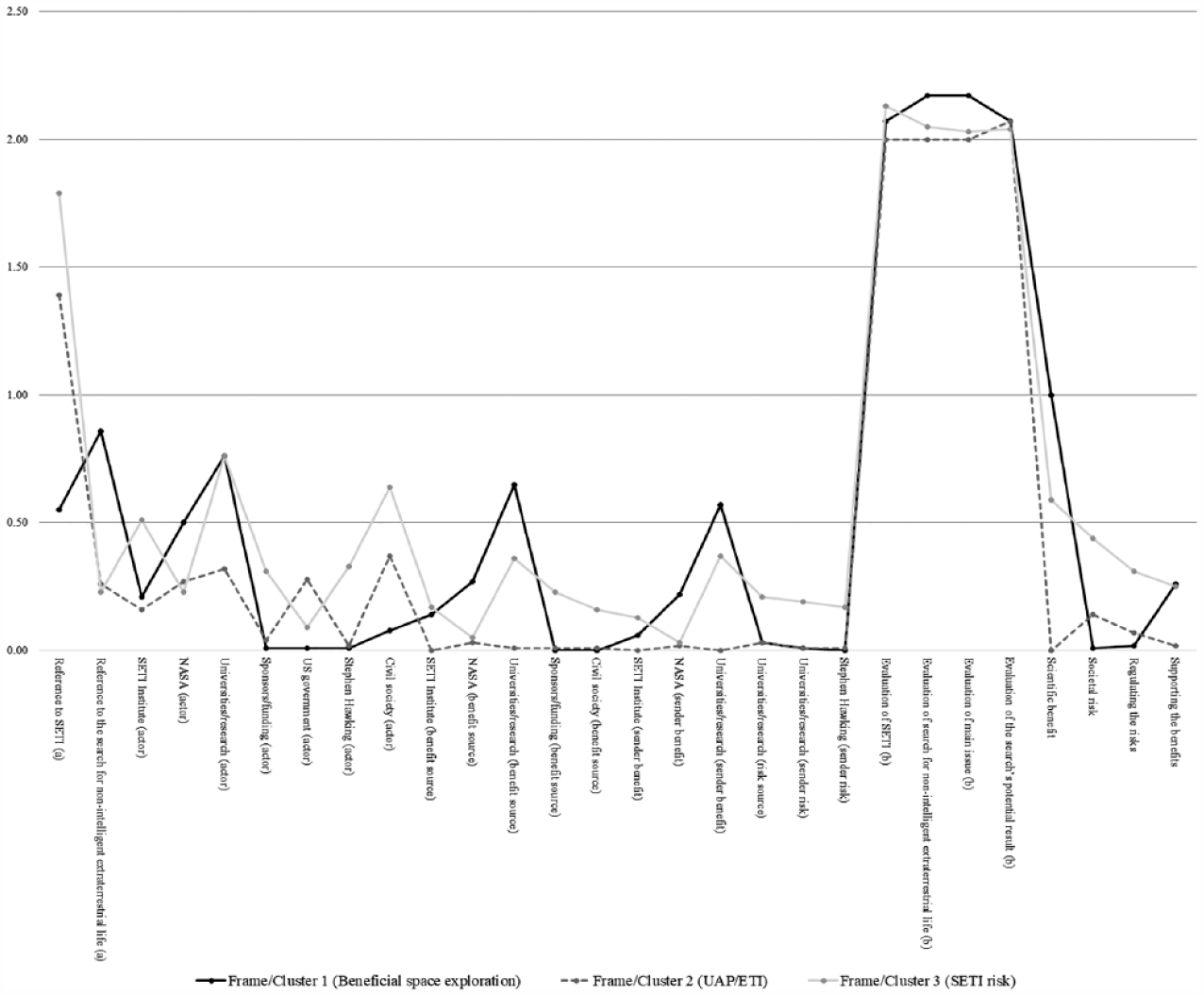
Visualization of Frame Element Indicators by Frame/Cluster (Means).
Main Topics of the SETL Media Coverage Across Three Frames.
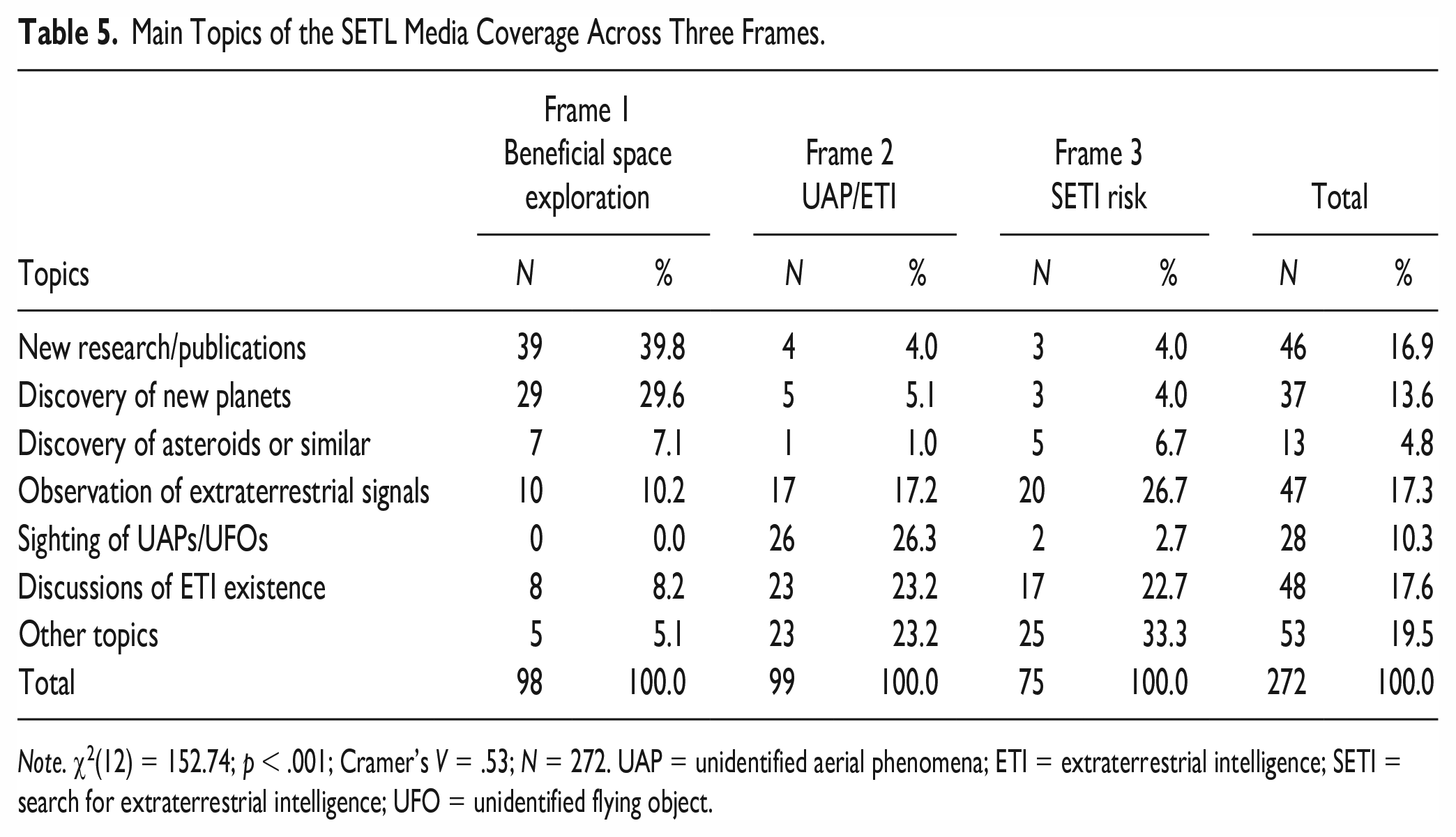
Note. χ2(12) = 152.74; p < .001; Cramer’s V = .53; N = 272. UAP = unidentified aerial phenomena; ETI = extraterrestrial intelligence; SETI = search for extraterrestrial intelligence; UFO = unidentified flying object.
A follow-up one-way ANOVA showed that most clustering variables with the exception of evaluations of SETI and evaluation of the potential results contributed significantly (p < .001) to separate clusters. The most important variables (large effects with η² ≥ 0.14) to differentiate clusters (i.e., frames) were, for instance, the evaluation of scientific benefits, the reference to SETI, universities/research institutions as benefit sources and senders, Stephen Hawking and civil society as actors, as well as the evaluation of societal risks. Hence, indicators of all four frame elements were statistically crucial for detecting and describing three media frames of SETL.
Because of the salient features of each cluster, we termed the frames beneficial space exploration (cluster1, 36%), UAP/ETI (cluster2, 36%), and SETI risk (cluster3, 28%). The beneficial space exploration frame strongly emphasized on the search for non-intelligent life as opposed to SETI and highlighted scientific sources as senders and sources of benefits with generally more positive evaluations. The UAP/ETI frame received more ambivalent evaluations, highlighted the U.S. government as opposed to scientific actors, and speculated more about the existence of an ETI and/or UAP. The SETI risk frame emphasized SETI in general and referred to the SETI Institute, universities, and civil society as main actors. Most importantly, scientific and societal risks and calls for more risk regulation were stressed.
The more detailed analysis of clusters showed that the main topic of an article was crucial for distinguishing the frames (Table 5). A chi-square test revealed a significant pattern of topics within frames with a large effect size, χ2(12) = 152.74, p < .001, Cramer’s V = 0.53. The beneficial space exploration frame mainly referred to new research/publications as well as the discovery of new exoplanets. The UAP/ETI frame dealt significantly more often than the two remaining frames with the sighting of UAPs (or UFOs) but also the potential existence of ETI. The SETI risk frame contained the topic of observing extraterrestrial signals more often than the other frames. In addition, the openly coded category of “other topics” frequently contained articles about METI and contact with aliens in this frame.
Based on the analysis of further frame element indicators, the beneficial space exploration frame is arguably the most scientific and positive media frame. The most salient features here are the reference to searching for non-intelligent extraterrestrial life, and NASA as well as universities as dominant actors, sources of benefits, and senders of benefits. Predominantly positive evaluations of the field and the topic and the emphasis of the scientific benefits stand out. The media also recommend further supporting those benefits.
The UAP/ETI frame mainly refers to SETI as the main focus and mentions the U.S. government as the most salient actor and, to some extent, civil society. On average, evaluations of SETI are slightly more negative compared to the other two frames. It is the frame where universities or research institutions are the least relevant in comparison. Besides the UAP topic (26%) and the potential existence of ETI (23%), we found additional articles in the openly coded “other topics” category, such as Area 51, the disappearance of a UFO fan or an airplane, that point to the underlying theme of “they might already be here.” This was also supported by the finding that eight out of nine mentions of Swiss bestselling author Erich von Däniken, who has written mainly about extraterrestrial visitors in ancient history, were found in this frame.
In the SETI risk frame, science is again more salient. Universities or research institutions, the SETI Institute, Stephen Hawking, sponsors of SETI research, as well as civil society are often cited as actors and/or benefit sources or senders. The causal discourse is more ambivalent, pointing to risks and benefits simultaneously. It is noteworthy that in addition to universities, Stephen Hawking was frequently quoted as a sender of risk attributions to SETI. While SETI is evaluated more positively, this frame also stresses its societal risks more than the two other frames. In terms of treatment recommendations, articles with that frame urge measures to either regulate the risks and/or support the benefits of SETI.
Exploratory follow-up analyses with variables that had to be excluded from the cluster analysis revealed further interesting features that were related to the three frames. In terms of explicitly referenced scientific disciplines, astronomy was most often found in the beneficial space exploration frame and the SETI risk frame, χ2(2) = 18.81, p < .001, Cramer’s V = 0.26. Similarly, this was true for astrophysics, χ2(2) = 19.13, p ≤ .001, Cramer’s V = 0.26. Astrobiology was most often mentioned in the beneficial space exploration frame, χ2(2) = 6.20, p = .04, Cramer’s V = 0.15, but not very frequently referenced in general (9%). Social sciences were also rarely mentioned (5%), but appeared most often in the SETI risk frame, χ2(2) = 10.65, p = .005, Cramer’s V = .20.
The predicted result of searching for intelligent extraterrestrial life (1—unlikely, 2—uncertain, and 3—likely) did not differ significantly between frames, F(2, 269) = 0.79, p = .45. The prediction of finding non-intelligent life was on average more likely in the beneficial space exploration frame (M = 2.24, SD = 0.50) than in the UAP/ETI frame (M = 2.07, SD = 0.41) or the SETI risk frame (M = 2.12, SD = 0.37), F(2, 269) = 4.18, p = .02, η² = 0.03.
The distribution of frames over time showed significant differences between the years of media coverage, χ2(26) = 49.45, p = .004, Cramer’s V = 0.30 (Figure 4). In 2011, 2013, 2014, 2017, and 2018, the beneficial space exploration frame clearly dominated. In 2012, 2015, and especially recently in 2021 and 2022, the UAP/ETI frame was more salient in German news media. The SETI risk frame was present in every year but only dominated over the other two frames in 2016. A relatively small effect was found for the distribution of frames across media outlets, χ2(8) = 16.44, p = .037, Cramer’s V = 0.17. Most online news media platforms emphasized the beneficial space exploration frame (ARD 60%, Spiegel 37%, t-online 42%, and Focus 44%) over the remaining frames. Only the tabloid-style Bild.de employed the UAP/ETI frame (51%) as well as the SETI risk frame (30%) more often than the beneficial space exploration frame (19%).
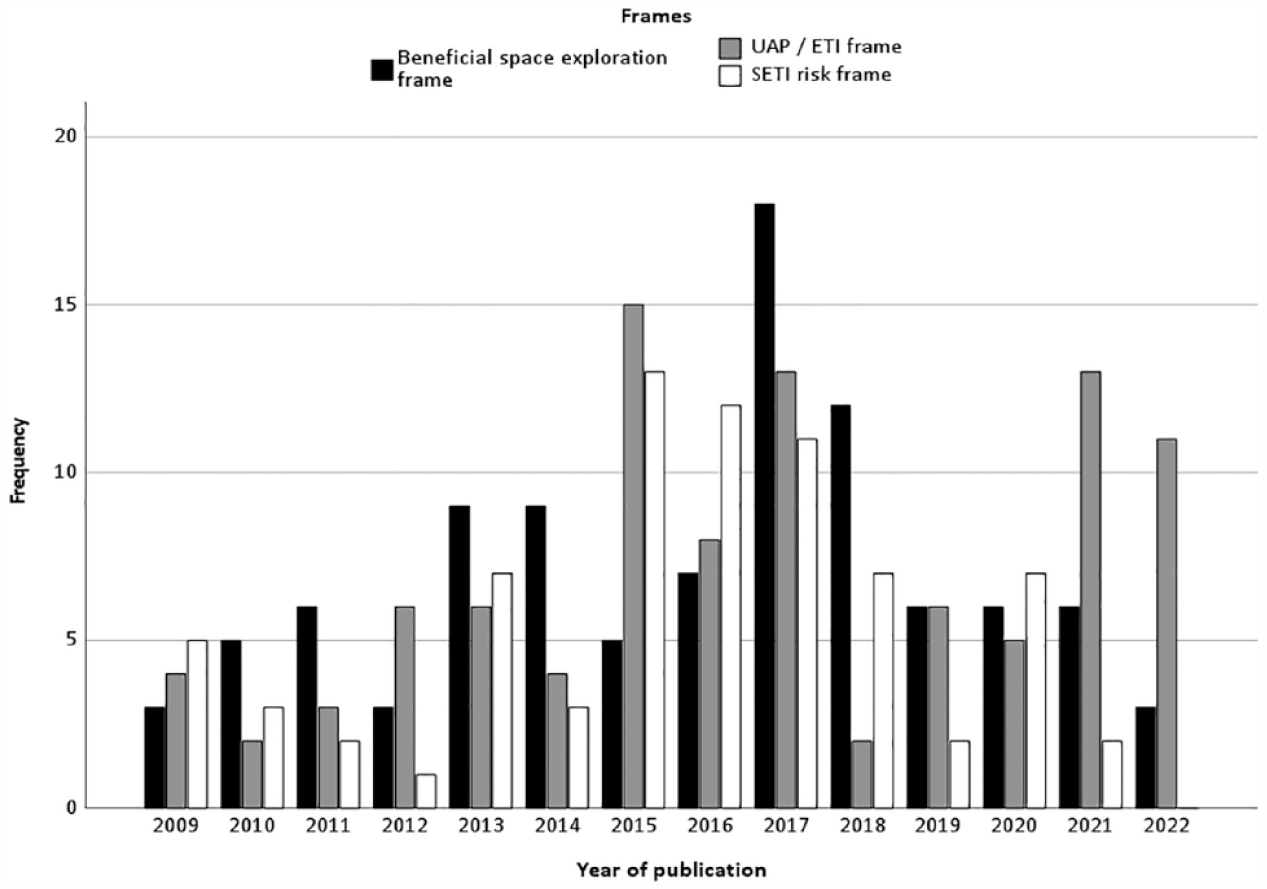
Distribution of frames by year of publication (absolute frequencies).
Discussion
From a science communication perspective, our analysis revealed mixed results. While the overall number of articles on SETL published in German news media each year was not overwhelming, the topic was regularly on the mainstream media agenda between 2009 and 2022, with occasional peaks (2015 and 2017). The media coverage addressed a relatively wide range of SETL topics and refrained from a narrow focus. In addition, the greater share of sources and actors were legitimate scientific institutions or individuals such as universities, NASA, or the SETI Institute. While the overall tendency of the media coverage was positive, it also addressed different kinds of risks and a few negative evaluations. Thus, some of the goals of science communication such as creating public awareness, interest, and understanding of science as well as supporting the formation of opinions (Burns et al., 2003) seem to be well supported by German news media coverage of scientific efforts to SETL.
From the perspective of science disciplines, the results might be disappointing for astrobiology which is at the heart of the SETL endeavor (Des Marais et al., 2008). The discipline was rarely mentioned whereas other fields like astronomy and astrophysics were referenced by journalists most frequently. In addition, the three dominant news frames we found seem to support what Billings (2012) described as a rhetorical boundary-work between SETI and astrobiology. The greater share of mentions of astrobiology was linked to the beneficial space exploration frame in which the search for non-intelligent life instead of SETI was most salient. In the SETI risk frame, astrobiology was rarely mentioned. Thus, while many SETI researchers describe their field as a branch of astrobiology (Shostak, 2004; Tarter, 2004), the media seem to follow the boundaries between SETI and astrobiology upheld by the broader scientific community (Billings, 2012). This also applies to institutions like NASA which was most prominent in the frame of beneficial space exploration, whereas the SETI Institute was more salient in the SETI risk frame. Nonetheless, both institutions have a substantial influence in the overall discourse on SETL. This was not confirmed for ESA or the German Aerospace Center (DLR) which were basically absent from German news about extraterrestrial life. Particularly given ESA’s strong involvement in major missions with accentuated astrobiology goals, such as Juice, ExoMars, or ESA’s support of Perseverance, the results of this study may be disappointing from a public relations and science communication perspective. Whether this is due to a lack of institutional communication or the editorial decisions of German science journalists (Schäfer, 2017) remains uncertain at this point and may be an interesting question for future research.
Although the SETL points to many questions of (potential) societal impact on psychological, institutional, political, societal, and cultural levels, the social sciences played a very minor role in German news media. They were never mentioned in the beneficial space exploration frame and were almost exclusively referenced in the SETI risk frame as senders of risk attributions. This points to the continued marginalization of the social sciences in the field of SETL, as has been observed in the past (Neal, 2014). For our analysis of news media frames, we can only speculate whether this marginalization stems from the lack of awareness among science journalists or the distance that social scientists themselves keep from the topic. While SETL has evolved as a serious scientific field in the natural/life sciences, the social sciences may still have to contend with greater fears of losing reputation or the often observed “giggle factor” (Garber, 1999; Shostak, 2004) when peers associate a scientific interest in SETL/SETI with UFO conspiracies or science-fiction fandom.
Despite the emphasis on science and scientific sources, our analysis also revealed a frame that seems to include many topics that German exosociologists described as “hot potatoes” in the SETL context (Schetsche & Anton, 2019). This refers, for example, to sightings of UAPs or UAP videos released by the Pentagon (especially in 2021/2022), alien abductions, and government conspiracies around Area 51. The frame also addressed the hypothetical existence of ETI on Earth or in the galaxy. While this frame is somewhat related to the SETI efforts, it rarely refers to more serious scientific sources or disciplines. Thus, the previously described “pervasive conflation” or “mix-up” between the SETI sciences and those hot potatoes in the media (Shostak, 2004) was also found in the recent German news. However, with the rare reference to scientific institutions in this context, the boundaries seem to be more or less established. Whether this frame and the ambivalent media evaluations actually have undesirable effects on SETL sciences and institutions or whether this can serve as a means to raise awareness and interest in SETL from a science communication perspective (Oliver, 2008; Shostak, 2004), is a question for follow-up research.
Our findings are also meaningful from a risk communication perspective. According to Renn (2009), risk communication should create an understanding of risks among different stakeholders in society, support the adaptation of behavior to minimize harm, strengthen trust toward responsible institutions, and enable participation or dialogue to contribute to conflict resolution and the further democratic regulation of risks. Although no evidence of extraterrestrial life has yet been found, academics have pointed out the need for risk management plans and preparedness for various contact scenarios with ETI (Korbitz, 2014; Neal, 2014). In democratically organized societies, this requires open communication and the participation of multiple stakeholders as well as civil society. Our findings indicate that the SETI risk frame in German news incorporates a dialectical discussion of societal as well as scientific risks and benefits. Although this is still a very hypothetical discourse, these media representations seem to offer a balanced basis to shape public perceptions without one-sided emphases on fear or utopian scenarios. It is noteworthy that this mediated risk discourse was not only based on some social science sources but was also strongly influenced by one individual scientific celebrity, Stephen Hawking. His warnings of the potentially negative consequences of encountering or contacting an ETI resonated repeatedly in the German news coverage with the SETI risk frame. This exemplifies the significance of reputation and prominence of certain scientists and their impact on the media agenda as well as public perceptions of SETI (Gazan, 2013). Future risk narratives may benefit from a more plural set of voices and scientists who are actively conducting research on questions of SETL. For science communicators in the SETI field, however, the risk discourse is a double-edged sword. On the one hand, it raises attention and is also reasonable from a risk communication perspective. On the other hand, accentuated risk attributions may trigger fear and public rejection of SETI or METI efforts, including their funding.
The beneficial space exploration frame seems to correspond very well to the PR or science communication goals of NASA and research institutions in the SETL field because of rather positive evaluations and the strong emphasis of benefits. From a risk communication perspective, however, the almost complete absence of risk in this frame is arguably problematic. Risks such as the introduction of extraterrestrial pathogens to Earth can be a realistic threat (Griffin, 2013; Shapshak, 2019). Although institutions like NASA and ESA run planetary protection programs that among other goals intend to prevent backward contamination of Earth by those pathogens, mainstream media coverage of SETL should inform the public about not only these potential risks but also the measures that are taken to minimize these risks. Risk communication research has shown that besides communicating the susceptibility and severity of a threat, it is important to inform the publics about prevention and/or response measures (efficacy) to avoid fear-induced maladaptive behavior among risk bearers (Roberto et al., 2009). Hence, even though the beneficial space exploration frame seems very favorable for institutions involved in space missions with astrobiology-related goals, PR and science communicators should inform the media and the public about the related risks and safety measures on a more regular basis. However, again, communicators may be hesitant to emphasize such topics because they fear this kind of discourse may erode public and political support for their research and its costs (Shapiro & Schulze-Makuch, 2009).
Conclusion
Quantitative research on the news media’s framing of the scientific SETL is rare in general and nonexistent in Germany. This study identified three main news frames in five of the most used German online news platforms: the beneficial space exploration frame, the UAP/ETI frame, and the SETI risk frame. The news media cover a broad range of topics, tend to evaluate SETL positively, and emphasize benefits over risks. Moreover, with the exception of the UAP/ETI frame, scientific institutions and individuals are the main sources. This points to rather effective PR and science communication efforts in the field and/or a somewhat high reliance of German journalists on scientific sources when it comes to SETL. The disciplinary and maybe strategic boundaries between SETI and astrobiology seem to play out in German news media as well. From a risk communication perspective, the media and their sources stress some societal risks of SETI but fail to sufficiently inform about risks and remedies related to searching for or finding non-intelligent life beyond our planet.
Future research should analyze further media sources such as science magazines, TV shows, blogs, social networks, or video platforms. In addition, more cross-national comparative research is needed to compare the public framing of SETL. As of now, space agencies in approximately 70 countries are planning more missions (Brukardt et al., 2022) which may raise the risks of SETL. It also underpins the global dimension of the field and its significance for civil society. Experimental or longitudinal studies are needed to investigate the framing effects of PR, science communication, and SETL-related media frames. More research guided by risk communication theory may help to better understand public responses and appropriate communication strategies for different future scenarios of detecting, contacting, or encountering extraterrestrial life (Gartrelle, 2015). The latter, according to German news media, is more likely than unlikely.
Footnotes
Acknowledgements
We want to thank the members of the Research Network Extraterrestrial Intelligence (Germany) including astrobiologists, aerospace engineers, physicists, psychologists, sociologists, and science journalists, who helped with background information on the latest developments in the SETL field. We would also like to thank the anonymous reviewers and the Science Communication editorial team for their support.
Data Availability Statement
Data, media articles, and additional materials are available upon request to the corresponding author.
Declaration of Conflicting Interests
The author(s) declared no potential conflicts of interest with respect to the research, authorship, and/or publication of this article.
Funding
The author(s) received no financial support for the research, authorship, and/or publication of this article.
