



Abstract
We study the marketing of radioactive products in Sweden from 1910 to 1940, using a dataset of newspaper and magazine advertisements. We use multimodal critical discourse analysis to show how marketers harnessed the meaning potentials of language and semiotic resources to embed radium in discourses of science and technological development, and thus convince consumers of its health benefits. We find that canny marketers continuously colonized, shaped, and remarketed radioactive products in response to greater scientific knowledge and growing safety concerns. These techniques highlight the challenges of distinguishing legitimate/illegitimate applications of discoveries when science and entrepreneurialism move at the same pace.
Introduction
“Regain your health with Miradium!”; “No modern person can do without Schéels!”; “Radiophor turns dreams into a reality!”
Advertising claims, such as those shown above, were commonplace in newspapers and magazines in early 20th-century Sweden, used to convince potential consumers of the health benefits of the newly discovered element radium. The mysterious properties of radium had quickly captured the public’s interest, leading to the rapid growth of a commercial market that offered everything from radioactive bread, chocolate, shampoo, and soap to radium-infused jewelry, cutlery, fishing gear, and condoms (Olausson, 2012). Through their advertisements, marketers promised that radium would bridge the gap between conventional medicine and popular therapies, providing a cure for all types of illnesses and offering consumers a modern lifestyle that was both “natural” and “rational” (Murdock, 2017, p. 21). This was highly attractive to the emergent middle class who was anxious to keep up with scientific advances and had a strong attraction to fashionable, rather than necessary, goods to improve their well-being (Gurney, 2017, p. 35).
Today, the use of science in marketing to promote healthy lifestyles is a crucial selling point (A. Chen & Eriksson, 2019, 2021). Research shows that this type of marketing is common and often successful in influencing the way that people think and act (J. Chen, 2015; Pitrelli et al., 2006). However, it is only in recent years that attention has started to be paid to the ways in which marketers make use of and construct ideas about science. Of these limited studies, most focus on a contemporary context, exploring such products as probiotic yogurts, skincare creams, margarine, and oat milk (Arroyo, 2013; Jovanovic, 2014; Koteyko, 2009; Ledin & Machin, 2020b). Furthermore, in many cases, these studies frame the relationship between marketing and science as a modern-day practice, ignoring its broader historical trajectory.
In this article, we therefore conduct a study of the marketing of radioactive products in early 20th-century Sweden with the aim of shining a historical spotlight on the relationship between science, healthy lifestyles, and food/cosmetics marketing. Using a large dataset of newspaper and magazine advertisements, we seek to demonstrate how marketers embedded radium in discourses of science and technological development, continuously adapting their strategies in response to greater scientific knowledge and growing safety concerns. We also aim to show how they made their claims about radium appear as true and credible—what we see as these claims’ modality (Kress & Van Leeuwen, 1996). These advertisements made such links not just through language but also through semiotic resources, such as images, color, and typography, which helped illustrate radium’s functions and efficacy. Therefore, our analysis draws on the tools of multimodal critical discourse analysis (MCDA), which is a method to reveal how meaning is created and conveyed (Ledin & Machin, 2018, 2020a). Discourse is a key concept for this approach. We see discourse as a set of socially constructed beliefs, a form of knowledge, which is significant for how we think and act in particular situations. In the advertisements we study, discourses are constructed through the interplay between language and semiotics. Thus, they offer a powerful illustration of how marketers can capitalize upon both public interest and gaps in public knowledge of a scientific discovery/invention, using this as a lucrative opportunity to launch new products and frame them in certain ways to maximize sales potential. We believe that situating seemingly contemporary marketing strategies in a broader trajectory of patterned practices and uses offers us critical distance from our current experiences of marketing and, thus, more room to reflect on the use of fuzzy references to science and make informed choices about products that are framed as healthy.
Previous Studies on the Commercialization of Radium
Historical research on the discovery of radium, the development of radiation therapy, and its early medical usage is extensive (cf. de la Peña, 2003; Lavine, 2013; Rentetzi, 2007; Weart, 1988). However, research on the commercialization and popular understanding of radium remains surprisingly scarce. To date, most publications have been anecdotal and limited to blog posts that view surviving radium products in museums as mere “curiosities” rather than objects worthy of scientific investigation. Of the scant academic publications on the topic, most focus on the changing perception and representation of radium in Italy (Candela & Mariotto, 2016), Germany (Murdock, 2017), and the United States (Lavine, 2014; Rentetzi, 2008). The most comprehensive account on the commercialization of radium is Half Lives, written by Lucy Jane Santos in 2020. While this book provides an excellent account of the rise and fall of radium as a marketable commodity in the early 20th century, it does not draw attention to Scandinavia, despite the fact that Sweden was one of the European leaders in the commercialization of radium products at this time. Although some Swedish-language texts exist (e.g., Lindeke, 2017; Olausson, 2011; Swedjemark, 1999), they tend to be short and descriptive rather than contributing new insights on the way that scientific discourses on radium were communicated to the lay public. Furthermore, despite the wealth of evidence left by advertisements in newspapers and magazines on how radium products were marketed to Swedish consumers, these data have thus far been widely overlooked by researchers. Therefore, this article will break new ground in its focus on Sweden, its large dataset of radium product advertisements, and its examination of how semiotic choices were used to embed radium in discourses of science and technological development and, thus, convince consumers of its health benefits.
“Radiumfeber”: The Discovery of Radium and Its Commercial Exploitation in Sweden
Marie and Pierre Curie’s discovery of radium in 1898 in a Bohemian pitchblende sample occurred at the same time as the development of mass consumption and modern advertising in Sweden. For centuries, Sweden had been a predominantly rural country, but by the end of the 19th century, it was transforming into an urban, industrialized, and modern nation (Magnusson, 2002, p. 302). This led to the emergence of a new middle class: a group with greater disposable income and highly conscious of keeping up with the latest trends (Gurney, 2017, p. 35). This middle class provided a ready-made consumer market for the newly launched commercial radium industry. Canny entrepreneurs immediately took advantage of the popular press to market their products, drawing upon the rhetoric of modernity, technology, and science to stimulate public interest (Stendahl, 2016). By the 1910s, Sweden was at the forefront of the European market for radioactive products and advertisements could be found on an almost daily basis in its national newspapers and magazines.
Swedish public interest in radioactivity had grown after the Curies were awarded the 1903 Nobel Prize in Physics, along with Henri Becquerel. Although the Curies did not travel to Stockholm for the awards ceremony, the event was widely reported in the Swedish press and articles abounded on the “mysterious” curative properties of radium and its “magical” phosphorescent nature. In an attempt to explain radium to the general public, the popular press described it as a brown powder that looked like snus (chewing tobacco), but took on a magical glow when placed in a dark room (Svenska Dagbladet, 1903). Just as Candela and Mariotto (2016) have found in an Italian context, at this time, the Swedish press focused more on the excitement of radium’s properties than its possible practical applications.
Public attention began to turn to the potential medical usages of radium after Radiumhemmet was established in Stockholm in 1910. Radiumhemmet was one of the first clinics in the world to offer radiation therapy as an effective way to treat skin cancer (Forssell, 1939, p. 5). At Radiumhemmet, patients were treated with radium salts, which were inhaled, ingested, or applied topically, or radon, which was pumped from a radium source, sealed into seeds, and injected directly into the site of a tumor (Kardamakis et al., 2010). The popular press responded quickly to these medical breakthroughs, now reframing radium as a highly beneficial treatment for cancer and also gout, rheumatism, and neurasthenia (Svenska Dagbladet, 1911). According to Murdock (2017, p. 24), the public was quick to accept radioactivity as a medical cure because they saw familiar patterns in previous scientific debates played out in newspapers on the curative properties of electricity and X-rays.
In tandem with the medical application of radium, the development of a cultural industry around radioactivity emerged in Sweden, which was essential in selling radium as a health aid. Shrewd owners of springs (particularly in Ångermanland Province) began obtaining analyses of their waters and, finding them to be radioactive, quickly tapped into popular convictions about the healing powers of natural springs using scientific rationale. Aggressive marketing campaigns took place across the local and national press, with rival spas trying to outdo each other by claiming that they were the “most radioactive in the country.” Advertisements also emphasized the presence of medical officers to create an illusion of safety and control (Gustafsson, 1969, p. 107). Many Swedish health spas also started producing radioactive water and soft drinks, which were bottled and advertised to consumers as indispensable for those who wanted to take the spa experience home with them.
It was amid this growing “radiumfeber” across Sweden that opportunistic entrepreneurs saw their chance, moving radium beyond the control of hospitals, spas, and institutes into an unregulated commercial market. Suddenly, radium soaps, shampoos, and salts, among other items, were sold on the high street, promoted as promising unprecedented health to consumers. And the public, caught up in the “hype” around radium, believed that these claims were scientifically sound (Murdock, 2017, p. 22). As radium was invisible, odorless, and tasteless, consumers had no way to verify sellers’ claims about its presence, much less its effects. This prompted the Nordisk Familjebok (1915, p. 890) to warn that the general public was “so gripped by the mystery and wonder of radium” that many dangerous or fraudulent products “marched forward under the protection of radium’s banner.” As we will see in this article, it was radium’s mysterious nature and the constant flux of scientific understanding on its properties and abilities that were key selling points for manufacturers and were crucial in convincing potential consumers to purchase radioactive products.
Data and Method
Our study draws upon a sample of 124 advertisements for the three biggest radium brands in Sweden—Miradium, Radiophor, and Schéels—dating from 1910 to 1940. Miradium sold radium salts to be dissolved in water and ingested, Radiophor specialized in radium hair tonic, and Schéels manufactured radium soap, creams, and medicinal patches. The sample was collected predominantly through a manual search of the Swedish National Library’s Digital Newspaper Archive (https://tidningar.kb.se/). Most of the advertisements come from Sweden’s two largest newspapers: Svenska Dagbladet and Dagens Nyheter. A small number was also gathered from digitized magazines held at Gothenburg University Library and Stockholm City Archives. Our analysis seeks to understand the strategies that each brand used to embed radium in discourses of science and technological development and promote it as essential for health and well-being, and how these strategies changed over time as scientific understandings of radium developed. Figure 1 shows the frequency of radium advertisements in our sample of Swedish newspapers and magazines from 1910 to 1940.
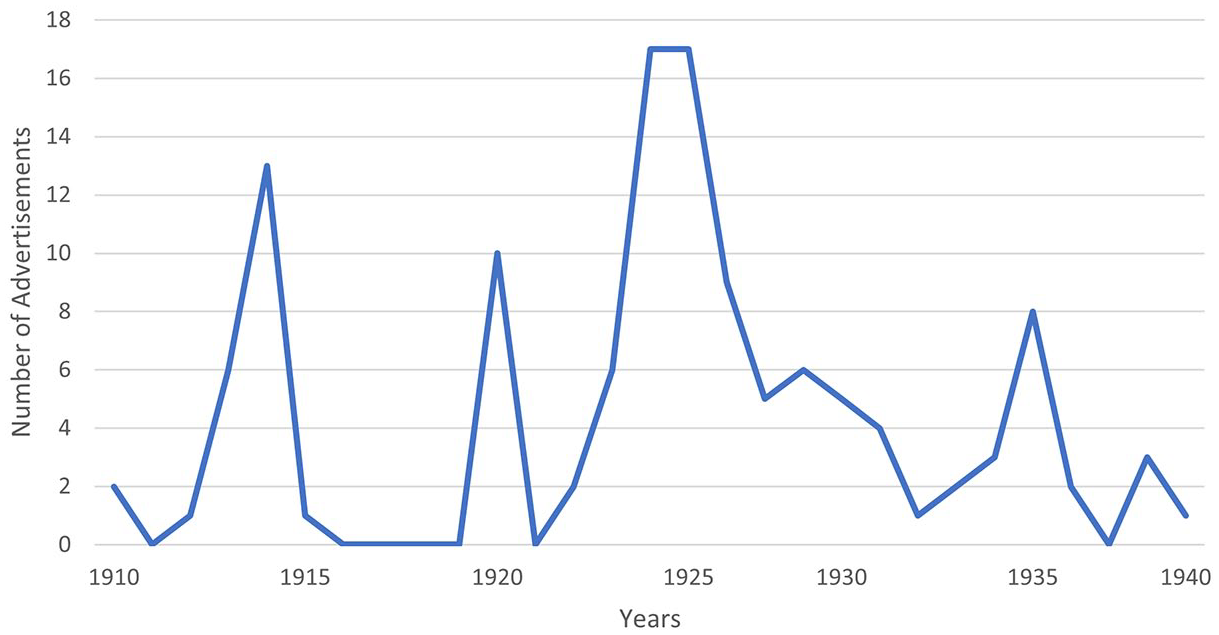
Frequency of radium advertisements in study sample of Swedish newspapers and magazines (1910–1940).
The qualitative approach of this study draws on MCDA, which views discourse in the broader sociocultural context in which it is situated (Ledin & Machin, 2020a; Machin & Mayr, 2012). MCDA derives from Social Semiotics, which sees elements used in communication as semiotic resources (Kress & Van Leeuwen, 1996, 2001; Van Leeuwen, 2005). In this analysis, we combine the study of language with the study of visual elements and look at how they work together to create meaning, linking certain ideas and values to what is represented. In our case, this means that we deconstruct the choices of language and other semiotic resources used to convey ideas about radium, and how they work to embed radium in discourses of science and technological development and make them appear as effective and credible for maintaining a healthy lifestyle.
A crucial concept for the analysis is modality (Fairclough, 1992, 2003; Hodge & Kress, 1979). From the perspective of Social Semiotics, modality is understood as “the status, authority and reliability of a message, to its ontological status, or its value as truth or fact” (Hodge & Kress, 1988, p. 124). It is a way to analyze what is constructed as true and to reveal the communicators’ commitment to that truth (Machin & Mayr, 2012; Van Leeuwen, 2005, p. 160). Modality is thus a way to find out how the validity/credibility of science is represented and to what extent marketers appear as aligned to the promises they put forward.
The analysis looks specifically at the lexical choices made to represent radium and the products’ beneficial effects. In particular, we consider the presence or absence of modal verbs (e.g., may, will, must) and expressions (e.g., possible, probable, likely) and how they can be used to appeal to emotions by indicating likelihood or obligation. We also examine the use of adverbial intensifiers (e.g., very, most, remarkably) and the degree to which they present something as certain or uncertain.
The analysis also pays attention to images, illustrations, symbols, and color, and how these resources can contribute to the reproduction of ideas about radium and references to science. For these purposes, the following analytical tools are used (Ledin & Machin, 2018, 2020a):
Causality, which entails how graphic elements are represented as having effects on each other, for instance, through arrows between elements.
Framing, which concerns how elements are separated on the ground of sameness and difference. Often this is done through frames or spaces.
Orientation, which considers how advertisements are organized in terms of spatial composition, such as center–margin, bottom–up, or left–right.
Symbolization, which relates to the meanings linked to the basic shapes of graphic elements, for instance, the purport of curvature or angularity, curved or straight lines.
As newspaper readers meet an advertisement as one coherent communicative artifact, the analysis particularly considers the interrelationship between language and semiotics, and how they are co-deployed to create meaning.
Social semiotic approaches have been criticized by some scholars for being too centered on the detailed analysis of texts without giving much consideration to the broader social practices and processes that underlie their production or reception (Aiello & Parry, 2019, p. 372). According to Machin (2013), this “tunnel vision” can result in non-critical, subjective, or anecdotal analyses. To address these concerns, we embed our analysis in the changing historical context and discourse about the medical effects of radiation in order to demonstrate how the advertisements work as part of a wider dialogue with the social world and help (re)produce culture and knowledge (O’Hagan, 2019). We also draw upon evidence on changing attitudes toward radium and the regulation of radium products from archival records, particularly the archives of the Museum of Pharmaceutical History (Stockholm), the Museum of Medical History (Uppsala), the Swedish Society of Radiation Physics (Uddevalla), and the Swedish Pharmaceutical Society (Stockholm). Together, these resources ensure that the advertisements are deconstructed in meaningful and predictive ways through empirical research rather than theoretical assumptions.
Given the importance of grounding social semiotic analysis in historical insights to gain a better understanding of how marketing strategies are shaped by socially situated knowledge, our analysis is organized chronologically into three parts that look at the techniques used by advertisers during the 1910s, 1920s, and 1930s, respectively. While we recognize that standard approaches to MCDA tend to organize findings around themes, our decision to use decades is guided by our own methodological perspective that blends MCDA with historical insights. Organizing by decade enabled three core themes to emerge holistically that clearly linked particular lexical and semiotic choices to a set period in time, reflective of then-understanding of radium: mystery of nature (1910), scientific authority (1920), and safety concerns (1930). Through this approach, we show clearly how the content of radium product advertisements changed over time in response to greater scientific and medical knowledge about the effects of radiation. The analysis draws on a wide range of lexical and semiotic examples that illustrate the typical marketing strategies that frequently reoccur across newspaper and magazine advertisements.
1910s: Channeling the Mystery of Nature
Radium entered the Swedish public’s awareness at a time when the professional boundaries between scientific and medical expertise were not firmly established. Therefore, it served as a “tabula rasa” on which traditional ideas about the connection between health and nature could be promoted (Lavine, 2014, p. 53). Drawing on the traditional belief that indigenous plants and minerals had medicinal properties, manufacturers immediately embedded their products in a broader historical rhetoric, harnessing the mystery of nature to promote radium as a health-giving resource (Murdock, 2017, p. 24).
At this early stage in the marketing of radium products, few advertisements refer to its physical properties; instead, they frame radioactivity in relation to naturopathy, emphasizing its restorative abilities. Radiophor hair tonic, for example, claims that its radioactivity “accelerates hair regrowth” and “cures itching and dandruff in no time at all,” while Schéels soap informs consumers that it has “a life-giving ability” to “revitalize skin and chase away pimples.” It also describes radium as “a wonderful, mysterious subject that has rendered humanity such priceless services.” From the outset, manufacturers use high modality to present the effects of their products as certain and leave readers little room to question the veracity of these statements (Ledin & Machin, 2018, p. 63). Manufacturers also regularly describe radium as a “nutrient” or “mineral” that is essential “for the maintenance of life” or even “a precious substance with wonderful properties” to give it an air of mystery. Depicting radium as a nutrient or mineral removes it from the realm of elite science and makes it more accessible to consumers. These types of buzzwords work because they allow interpretative flexibility, yet are recognizable enough to enable consumers to adapt them to their own purposes (Vincent, 2014, p. 246). Thus, here, they serve to present radium as a natural cure and generate consumer interest in products without fully understanding its properties or benefits (Vincent, 2014, p. 239). Manufacturers also take advantage of the meaning potentials of image, color, and typography to make active connections between radium and nature. This both creates a demand for their products and reinforces the notion of radium as a natural medicine. This is particularly apparent in the advertisement for Radiophor in Figure 2A. Here, the green color of the field and the trees is prominent, thereby making links to nature and growth and presenting Radiophor as a natural substance (Kress & Van Leeuwen, 2002, p. 354). In the trees, we see Radiophor bottles depicted as fruits, further strengthening this connection. Below the trees, “Radium hair tonic Radiophor” is written in white, bold capital letters. The white symbolizes purity and truth, while the uneven shapes and fluffy edges add a touch of playfulness and bring to mind clouds and sheep, thus further signaling links with nature and life (Ledin & Machin, 2018, p. 134). In the foreground is a gardener who is pouring a bottle of Radiophor over the letters, which suggests that Radiophor is responsible for triggering the growth and nourishing the greenery dominating this advertisement. When viewed together, the greenery, the gardener, the bottles, and the fleecy letters evoke a cyclical process of nature, emphasizing that Radiophor is key to this natural nourishment and growth.
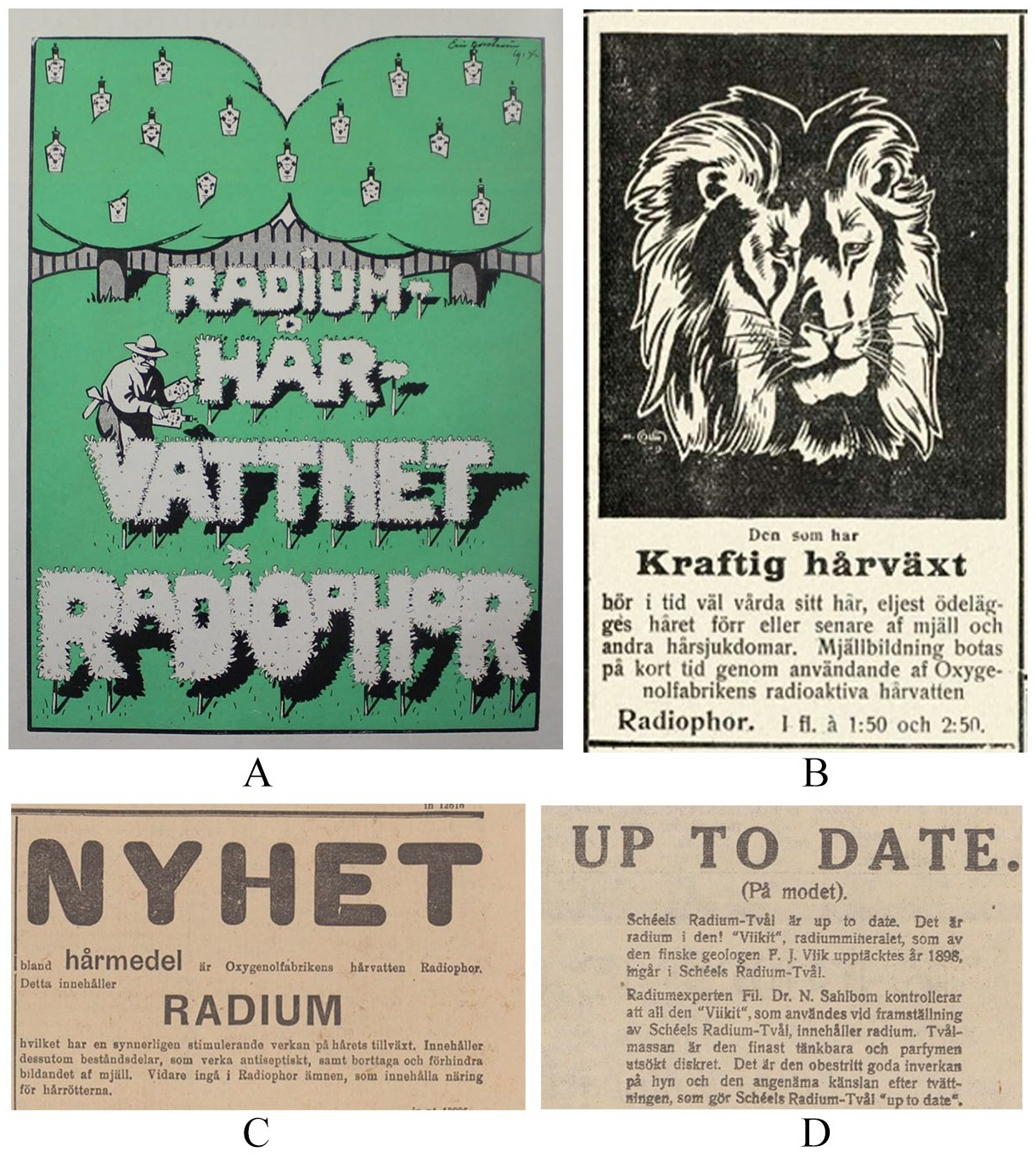
1910s radium advertisements in Sweden: (A) associations with nature (Source. Söndags-Nisse, Stockholm City Archives), (B) associations with animals (Source. July 5, 1914, Gothenburg University Library), (C) disguised as news article (Source. August 13, 1913, Swedish National Library), and (D) associations with modernity (Source. September 5, 1915, Swedish National Library.
Other advertisements make visual connections between radium and nature through images of animals. We see monkeys scratching their bald heads and lions with thick manes to emphasize Radiophor’s restorative properties, as in Figure 2B. The lion has a long historical association with heraldry and royalty where it is used to depict bravery and nobility. It is often referred to as the “king of the beasts,” a description which relates to its traits as a very powerful, strong, and wild animal; these associations are evoked by this advertisement, which frames Radiophor as a mighty product. Radiophor’s strength is further emphasized by the words “Strong hair growth” in big, bold letters below the picture. The use of a lion with a noticeable, flowing mane also links directly to the polysemy of the word mane in Swedish [man], which can be used to describe someone with long, thick, and flowing hair. The text then stresses the importance for people to take care of their hair and counter “dandruff and other hair illnesses” by using Radiophor. By using the familiar image of a lion and lion-related language, Radiophor becomes accessible to readers and fills the gaps in their knowledge about radium with meaningless puff (Santos, 2020, p. 127).
Manufacturers also link their products to nature by drawing parallels between radium’s “rays” and the weather. Radiophor compares the way that its product acts on the body to “rain for vegetation,” arguing that both are refreshing and essential for growth, while Schéels describes its U-Radium cream as bringing “new life in the same way that the rays of the spring sun cause the grass to sprout and trees and shrubs to grow.” Lavine (2014, p. 58) believes that linking radium’s “rays” with sunshine had two clear purposes: it called to mind other popular nature cures, such as heliotherapy, and invited consumers to compare the light of radium with other healing lights (e.g., heat lamps, Finsen lamps, X-rays). As these treatments and devices were expensive, technological, and associated with orthodox medicine, they could be intimidating for consumers. By contrast, radium was portrayed as a simple mineral that was cheap and easily accessible, thereby making it more appealing to consumers.
Another key technique used by manufacturers is to disguise their advertisements as informative articles. Placing advertisements alongside news articles rather than on a dedicated advertisement page means that they can easily be mistaken for factual content by readers. This structure makes textual and paratextual information fuse into one, thereby increasing the impact of the messages (Thornton, 2009, p. 65). The advertisements’ visual similarity to articles is also conveyed by the use of heavily compressed text and bold headings. A good example of such design is the advertisement in Figure 2C. The bold heading “Nyhet” is polysemic in Swedish and can refer to both a piece of news and something that is a novelty; therefore, it immediately captures the attention of potential consumers. Below, the words “hair tonic” appear in bigger, bold fonts, while “radium” is texted in a similar size but in capital letters. The following text states that radium has a “very stimulating effect” on hair growth, is “antiseptic,” and contains “nutrients for hair roots.” Although there are no explicit references to science or any information backing up these claims, the advertisement’s position among newspaper articles frames it as truthful and unbiased.
The association of radium with modernity and progress is also an essential component of early radium advertisements. As Santos (2020, pp. 62–64) notes, radium quickly became associated with modernity and was introduced into the English language as a metaphor for beauty (“her eyes were like radium”) and to describe the 70th wedding anniversary. Schéels’ capitalizes upon these associations, regularly using the strapline “the soap of the future” and describing its products as “epoch-defining,” “state-of-the-art,” and “stylish.” It also warns that “no modern person is alien to the wonderful results achieved with radium treatments.” Through these high modality statements, Schéels creates a dichotomy between “responsible” and “modern” consumers who are prepared to look after their bodies and “irresponsible” and “unmodern” consumers who are unwilling to adhere to the norms of healthiness (A. Chen & Eriksson, 2019, p. 425). A case in point is the advertisement in Figure 2D, which uses the English “up-to-date” in its headline to convey to readers that Schéels is forward-thinking and innovative. The advertisement goes on to tell readers that Schéels is up-to-date because it uses radium in its soap, which makes their product the “finest imaginable” with an “undeniably good effect on the skin.” Schéels also describes its soap as being part of a “rational skincare” regime—a phrase which sounds extremely modern in tone and implies that the product is based upon scientific knowledge of beauty and hygiene. Schéels’ advertisements also place heavy emphasis on “Viikit,” a mineral described as having a “rejuvenating and beautifying effect on the human body.” Viikit (now known as wiikite) was discovered by the Finnish mineralogist Fredrik Johan Wiik in 1898 and was relatively unknown among the Swedish lay public. Roy (2002) notes that buzzwords are often words that are new, different, euphonious, and loosely connected to science. By choosing a previously unknown word, Schéels creates an iconic idea to which consumers could attach special or even magical meanings, believing that Viikit has miraculous properties.
In sum, bringing together “mystery” and “nature” and linking it to “modernity” and “progress” were fundamental to the success of radium products in the 1910s. Advertisements revealed nothing about what radium was or how it acted on the body; instead, they promoted the idea that it was abundant in nature and could have miraculous outcomes on health and well-being.
1920s: Commercializing Scientific Authority and Expertise
The 1920s marked the peak period for the commercialization of radium in Sweden, with dozens of new brands and products flooding the market. During this decade, a marked shift in the tone of advertisements occurred to reflect growing public awareness of the scientific debates around radium. At first, these debates were not focused on radium’s safety, but rather on the risk of fraudulent products. Attention also shifted to the types of diseases that radium could treat and the best forms of treatment. It was only later in the decade that questions arose on safety measures regarding appropriate doses and treatment length. In all cases, we see Swedish manufacturers immediately responding to these debates through their advertisements. Suddenly, references to radium’s mysteriousness are omitted, and its strong connection with nature is played down. Instead, advertisements seek to legitimize radium products by associating them with fast-moving scientific knowledge and disseminating this to the public in a palatable way through pseudoscientific explanations and vivid imagery.
At this time, a widely debated subject in the European press was whether the actual amount of radium in commercial products matched the manufacturers’ claims and, if it did, whether there was enough to achieve the stated outcomes (Santos, 2020, p. 139). Arguments centered around the effectiveness of products that contained actual radium salts compared with those that were only exposed to radon gas. While radium has a half-life of 1,602 years, radon’s half-life is just 3.8 days; therefore, by the time products reached customers, most were no longer radioactive (Medvetenskap, 2008). Swedish manufacturers reacted quickly to these concerns. Miradium, launched onto the market in 1922, used the strapline “Contains genuine radium,” informing customers that its salts were “not something that has only been exposed to radiation” to distinguish the brand from other products. It also claimed that the amount of radium in its salts was “the same proportions as the world-famous natural radium sources,” implying that consumers could experience the benefits of a spa in the comfort of their own home. Schéels also began to emphasize the radium content in its products, reminding consumers that its soap “stored radium indefinitely without losing its power” and that its cream was “constantly radioactive” and, therefore, “very effective.” These textual cues are formulated as objective facts and produce shared truths that align readers with certain statements and distance them from others (Kress & Van Leeuwen, 1996, p. 155). Readers thus have few opportunities for circumspection and are more likely to trust the information they receive.
Another clear difference between 1910s and 1920s advertisements is the targeted focus on particular types of consumers. Whereas earlier advertisements used the excitement of radioactivity to cast a wide net over all Swedes who wanted to be modern and in harmony with nature, these advertisements pinpoint sufferers of particular diseases and claim that their products will provide a cure. This was in line with rapidly changing medical understanding about radium and its potential applications for not just skin diseases but also diabetes, anemia, rheumatoid issues, mental health complaints, stomach ailments, and, even, insomnia (Lindeke, 2017, p. 34). The advertisement for Miradium in Figure 3A immediately captures readers’ attention with its list of seven illnesses (gout, sciatica, anemia, rheumatism, nerve diseases, arteriosclerosis, and senility) written in bold and arranged into a pyramid shape. Pyramids are a common feature in early 20th-century advertising, often used to signal interconnections between consuming a product and acquiring a healthy lifestyle (O’Hagan, 2021). Here, the visual layout encourages readers to rely upon their limited knowledge of radium and make assumptions about Miradium’s effectiveness in treating these illnesses (Ledin & Machin, 2020a, p. 188). When viewed in conjunction with the text below, the pyramid takes on an arrow shape, moving in a directional flow upward that implies energy and vitality (Ledin & Machin, 2016, p. 333). Thus, without even having to read or fully understand the detailed text about Miradium’s properties, readers are covertly exposed to its supposed benefits.
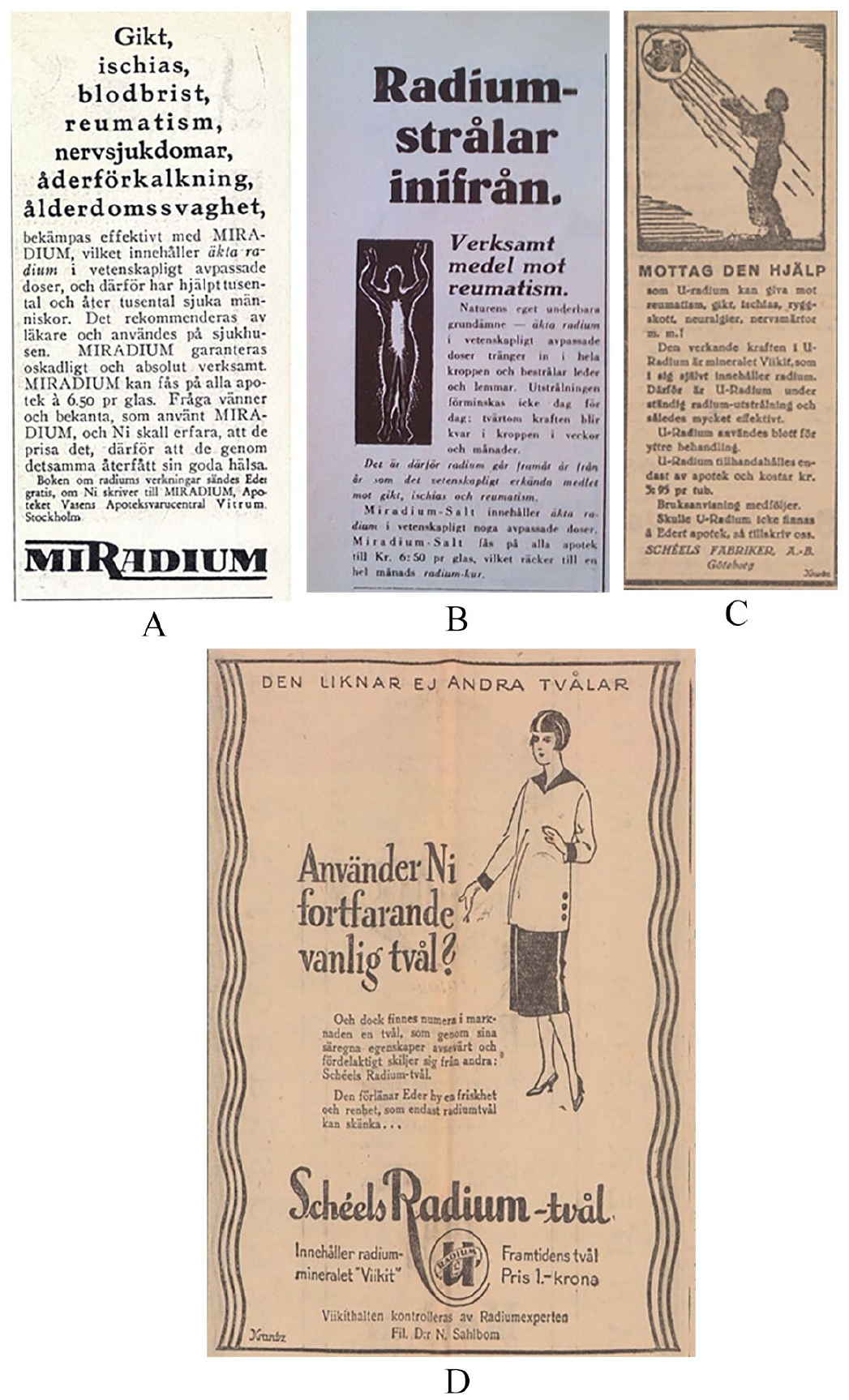
1920s radium advertisements in Sweden: (A) pyramid of health (Source. August 13, 1924, Swedish National Library), (B) internal radium treatment (Source. January 22, 1923, Swedish National Library), (C) external radium treatment (Source. September 10, 1924, Swedish National Library), and (D) figure of pharmacist (Source. December 15, 1927, Swedish National Library).
To support these targeted customer segments, advertisements also use increasingly scientific descriptions to explain the effects of radium on the body. No longer is radium portrayed as an element or nutrient; instead, it is reframed as “science’s most remarkable drug,” which is “life-giving, rejuvenating, strengthening, beautifying and invigorating” (Schéels). These descriptions are often preceded by low modality statements, such as “no one doubts that . . .” or “it is a known fact that . . . ,” which make it hard for readers to negotiate and form their own opinions. Here, we see how modality draws upon interpersonal, rather than ideational, meaning to convey truthfulness, serving to represent ideas that shape readers’ understanding of truths rather than express absolute truths (Kress & Van Leeuwen, 1996, p. 154). When describing its effects, Miradium explains that “countless millions of microscopic radium particles deposit in the organism for a long time and affect it with their invisible rays,” while Schéels describes its soap as “radiating continuous energy, which gives your skin and your blood a health renewal bath and forms new, healthy radioactive blood.” These statements are not qualified in any way or attributed to anybody; thus, they create an imaginary “we” that appears to represent a reasoned and objective argument, thereby giving readers little reason to question these claims (Kress & Van Leeuwen, 1996, p. 156).
Around 1923, physicians began to debate whether radium treatments were more effective internally or externally. As Santos (2020, p. 59) notes, the lack of consensus among medical professionals gave manufacturers free rein to shape public understanding to their own advantage. Miradium started to employ the headlines “The best cure is radium internally” and “Radium shines from within” to state its case. This was supported by an image of a black silhouette with its hands raised and a ball of flashing light in its torso spreading out across its body (Figure 3B). The use of a featureless silhouette associates the image with the biological field of anatomy, while the front angle and sharp contrast between black and white draw parallels with X-ray imaging, thereby foregrounding its scientific message and increasing the product’s credibility. A common nickname for radium was “liquid sunshine” in accordance with the (now debunked) medical belief that it acted as a bactericide, exposing the inside of the body to rays, which caused the whole interior of a patient to light up (Santos, 2020, p. 56). The image clearly presents this complex idea in a visually appealing way to consumers, also drawing on the associations of sunshine with health, happiness, and warmth to depict radium as a positive and harmless element.
Schéels, in contrast, emphasizes that radium externally is the most effective treatment. Frequent images in its advertisements show figures standing at sinks filled with water and rays actively rising from the soap and covering their skin, or silhouettes standing outside as rays beam down and penetrate their bodies (Figure 3C). In these latter images, the U-Radium logo is cleverly depicted in a circular frame, positioned at the top of the page, radiating light, thereby visually implying the sun. Although this image is misleading in its presentation of how radium acts, it clearly embeds radium within the construct of “liquid sunshine” and, like Miradium, associates it with positivity and well-being. Again, the use of an anatomical silhouette imbues it with scientific authority, while the side profile implies factual content (Ledin & Machin, 2020a, p. 82).
Toward the end of the 1920s, concerns were beginning to grow about the long-term impacts of radium exposure. This was largely triggered by the tragic case of the “Radium Girls” in the United States—a group of female factory workers who contracted radium poisoning from painting watch dials with self-luminous paint (Clark, 1997). The National Swedish Board of Health responded to these concerns by requiring all hospital radiological machines to be calibrated to ensure uniformity of doses, while the Union of Swedish radiologists called for the regulation of radiation for medical purposes (af Wåhlberg, 1997, p. 2). Sweden’s commercial radium market remained unregulated, however (Arvastson, 2008, p. 30). Aware that public anxieties were growing over the potential dangers of self-medicating with radium, manufacturers changed track and used their advertisements to assert the safety of their products.
Whereas earlier advertisements had focused on products containing genuine radium, emphasis was now placed on strict scientific measurements and analyses. Consumers were informed that Miradium had “scientifically measured doses” of radium, Schéels had “radium in a dose that is suitable for humans,” and Radiophor had “well-balanced radium content” in “exactly the properties required.” After the invention of the Geiger counter in 1928, manufacturers were able to state their radium content with even greater precision—“Holds 0.25 mg radium per kg” (Schéels compress)—which enabled them to make the bolder claim that their products were “guaranteed to be harmless and absolutely effective” (Radiophor). While these figures sound scientific, consumers were probably unaware of the exact quantity of radium in the products or what the recommended safe amount should be. Therefore, they symbolically communicate a discourse of safety, even though consumers have no pre-established knowledge or supporting evidence to determine whether this is actually the case (A. Chen & Eriksson, 2019).
Another way that manufacturers gave their products scientific credibility and a sense of safety was to associate them with medical authorities. Schéels informed customers that its products were endorsed by “a number of highly educated people” and “a prominent Swedish doctor,” Radiophor stated that all its ingredients were “tested and recognized by medical professionals” and Miradium claimed that it was “scientifically established in the world’s largest hospitals.” Leaving the testimonials deliberately vague forces consumers to “connect the dots” and make assumptions about who has endorsed the products. At times, the names of specific doctors or laboratories were stated in advertisements to build scientific integrity: “checked by radium expert Dr. N. Sahlbom” (Schéels) or “measured by the Curie laboratory in Paris” (Miradium). However, customers had few ways of checking whether these claims are true. This scientific integrity was also indicated visually through such images as women in white tunics (Figure 3D), which suggested that they were pharmacists and, therefore, had medical expertise to guide customers. In these images, the women often stand assertively with their hand gesturing toward the product or a rhetorical question like “Are you still using your usual soap?” These images capitalized on the success of Helena Rubinstein in Australia who described herself as a “beauty scientist” and wore a white lab coat in publicity photographs (Santos, 2020, p. 170). They also specifically targeted “new” women in Sweden who had been given the right to vote in 1921 and were particularly susceptible to the scientific management of beauty and hygiene (Stendahl, 2016).
Overall, manufacturers responded quickly to the fast-paced changes in scientific understanding and public perceptions of radium throughout the 1920s, drawing upon a variety of resources to convey scientific authority and expertise. By learning to adapt their advertisements to the needs and desires of the general public, they ensured that their products remained popular despite growing concerns over their effectiveness and safety.
1930s: Balancing Safety With Sustainability
By the 1930s, Swedish public attitudes toward radium were beginning to rapidly change as more and more cases of radiation poisoning were reported in the national press (Olausson, 2012, p. 66). A story that attracted the most attention was that of Eben Byers, an American socialite who drank several doses of Radithor (a radioactive drink) a day over a 2-year period to treat an arm injury. Byers’s body started to slowly decompose; by the time he died in 1932, he has lost his jaw, holes had formed in his skull, and his bone tissue had disintegrated (Santos, 2020, p. 201). Byers’s death prompted immediate action from public authorities across the world, with the United Kingdom and the United States calling for the ban of all radioactive preparations (Carleton, 1933; Colwell & Russ, 1932). In Sweden, an official government report was commissioned, part of which scrutinized the health claims of radium products (Statens Offentliga Utredningar [SOU], 1932). In the wake of this report, radium brands and product lines began to gradually disappear from the Swedish market; only Miradium remained popular throughout the decade. While Miradium continued to stress that its products contained “genuine radium in carefully controlled amounts,” there was a marked change in its marketing strategy: now, focus reverted to the “mystery” of radium once again to disassociate it from negative medical and scientific associations. This was achieved largely through two techniques: consumer testimonials that provided personal and beneficial experiences of long-term radium intake and metaphoric depictions of illnesses as monsters, which played down the focus on radium.
One way of presenting the personal experiences of using Miradium was through the first-person biography, as seen in Figure 4A. Although this is obviously an advertisement, its design with a close-up photo of an older man and a bold heading containing the statement “I do not feel rheumatism, gout, nor sciatica” is reminiscent of a regular newspaper item. Underneath, in smaller font, “A man writes” is written, deliberately left anonymous. In fact, the only identification of the man are the initials “K.S” at the end of the statement. By this time, newspaper items were often anonymous or signed with initials, which lends credibility to this advertisement as an authentic news story. As readers, we will link the statement to the photo and assume that it is the man who is speaking. This photo is what Kress and Van Leeuwen (1996, p. 118) describe as a “demand image”; it establishes an imaginary relationship with readers and asks them for some kind of acknowledgment in a similar way to a face-to-face interaction. This design frames the following statement as honest and authentic, which makes the truth hard to question.
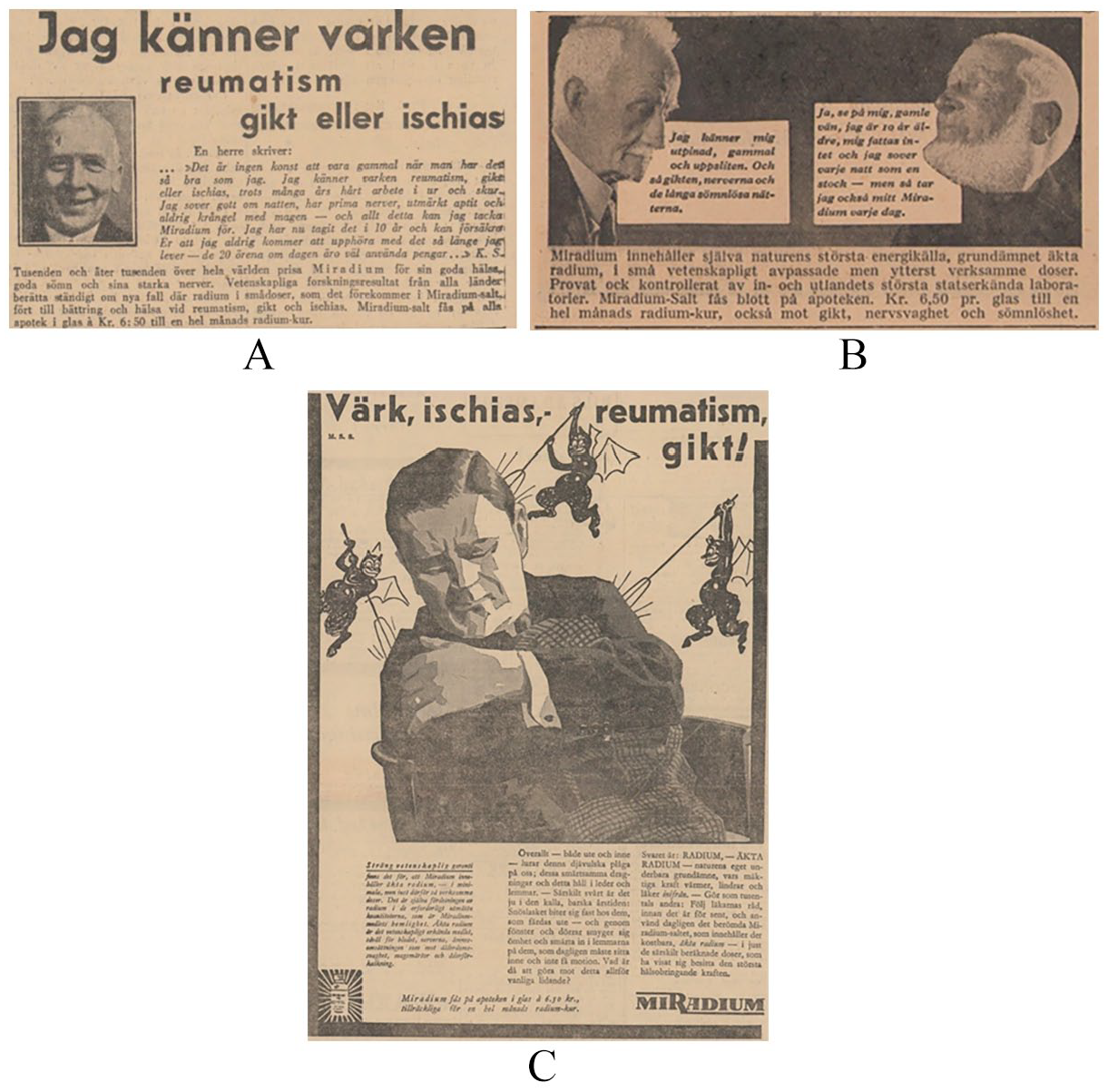
1930s radium advertisements in Sweden: (A) first-person biography (Source. April 11, 1934, Swedish National Library), (B) vignette (Source. July 1, 1935, Swedish National Library), and (C) visual metaphor of illness (Source. April 29, 1931, Swedish National Library.
The text goes on to recognize Miradium as a miraculous product that facilitates healthy and trouble-free aging. The man says: “It’s not difficult to age when you feel as good as I do,” followed by a sentence repeating the statement in the heading. By using intensifiers, he then stresses the clear benefits of Miradium when he explains, “I sleep well at night, have first-rate nerves, an excellent appetite and never any stomach complaints.” This is followed by a sentence in which he confirms that he has been taking Miradium for 10 years and that he will do so as long as he lives; no other potential reasons for his well-being are accounted for. All Miradium customer testimonials from this period emphasize this long-term, harmless use of radium in a deliberate nod to the Eben Byers’s case, thus justifying that their products are safe. Presented as a good example, the man’s account provides “role model authority” (Van Leeuwen, 2008, p. 107). This is the type of authority that plays a crucial role today in lifestyle media and advertising, and is important for so-called influencers on social media.
Below this statement, the font changes from italics to roman, thereby marking a “footing shift” (Goffman, 1981, p. 128) from customer testimonial to Miradium’s “expert authority” (Van Leeuwen, 2008) and establishing a new referential point for the reader. The text begins by informing readers that “thousands and thousands all over the world praise Miradium for their good health, good sleep and strong nerves,” although Miradium was only sold in Northern Europe. However, the way in which the man’s testimony is framed as one of many potential acknowledgments, coupled with the use of the value-laden “praise,” stresses Miradium’s legitimacy and intensifies its claim. This legitimacy is further emphasized by the sentence that follows, which reads: “Scientific results of research from all countries constantly tell of new cases where radium in small doses, as is found in Miradium salts, have led to improvement of health in cases of rheumatism, gout and sciatica.” Although “research from all countries” is an abstract form of expertise, not mentioning any particular study or scientist, its scientific affirmation imbues Miradium with credibility. Overall, the absence of hedging statements and references to science, role models, and expert authority give the advertisement high modality, therefore persuading consumers of Miradium’s health benefits.
Another popular form of consumer testimonial that provided role model authority was a short vignette with speech bubbles, featuring two people involved in an interaction. As seen in Figure 4B, the vignette contains images of two faces—one on the left looking down and one on the right with the gaze directed upward—and two text boxes containing what appear as statements from these people. In this case, the readers are positioned as onlookers, as they are just observing or eavesdropping on the ongoing conversation. This is what Kress and Van Leeuwen (1996, p. 119) describe as an “offer” image because it “offers” the represented participants to the readers as a piece of information. Again, these two men are anonymous, but the images of their faces grant authenticity to their statements. The overall design of the image mimics a comic format and follows a left–right orientation, which is very common in Western culture (Kress & Van Leeuwen, 1996). In such a composition, the left side represents “given” information, while the right side represents “new” information to which “the viewer must pay special attention” (Kress & Van Leeuwen, 1996, p. 181). Thus, it depicts a certain causality between the two men, suggesting a development over time (Ledin & Machin, 2020a).
The texted statements are in line with this causality, suggesting that Miradium is causing the change to “the new.” The man on the left says that he “feels worn-out, old and broken” and complains of his “gout, nerves and long sleepless nights.” His downward gaze and troubled expression give the impression that he is carrying the weight of the world on his shoulders, thereby accentuating the breadth of his problems. The man on the right replies: “Look at me, old friend. I’m ten years older than you, I’m not short of anything, and I sleep like a log every night—but I also take my Miradium every day.” He is gazing upward, providing a feeling of hope and an optimistic view of the future. Interpreted together, the image evokes the idea that the man on the left could become the man on the right—his future self—if only he starts taking Miradium immediately. This advertisement thus become a story about change, bearing obvious similarities to the kind of makeovers that take place on many contemporary reality TV shows.
A third important category of advertisements in the 1930s contains illustrations of men or women being attacked by demon-looking figures. In marked contrast to the advertisements of the 1920s, these images serve to illustrate the effect of illness on the body, rather than the effect of radium. Figure 4C shows a good example of such advertisement which, under the heading “Pain, sciatica, rheumatism, gout,” is a drawing of a man who appears to be suffering from severe pain, squeezing a pillow as he winces. His left arm grips his right shoulder, while his face—with eyes closed and wrinkled forehead—is turned downward and directed toward his shoulder in an expression of suffering. He is surrounded by three, small figures with pitchforks in their hands and bat-style wings on their backs, which associate them with the devil and evil. These figures act as visual metaphors for the illnesses listed in the heading, symbolizing them as very concrete threats.
Under this image, we find two text blocks, the one on the left signaling science and providing an abstract form of expert authority (Van Leeuwen, 2008). Its small, italicized font links it to modern-day disclaimers found at the bottom of advertisements, used by companies to specify the scope of their rights and obligations to consumers. The underlined first sentence states, “Strict scientific guarantee,” and goes on to inform readers that “Miradium contains actual radium in minimal doses,” which is why it is “so efficient.” While the first statement aims to legitimize Miradium, what follows appears to be a contradiction: It is the minimal doses that makes it so effective, thus implying that larger doses would be less so. This is clearly an active attempt by Miradium to counter the growing public awareness of the harm that radium could cause to humans. Although the “strict scientific guarantee” is about Miradium containing actual radium in minimal doses, it could easily be read as a scientific guarantee of Miradium in general. Next, the text explains that Miradium’s secret is the “distribution” of these “measured quantities,” which connotes precise scientific measurement, but these measurements are not accounted for. The final sentence informs readers that “actual radium is the scientifically approved medicine for the blood, the nerves, the metabolism as well as age-related weakness, stomach pain and arteriosclerosis.” Although this statement does not refer specifically to Miradium and its abilities, it clearly connects Miradium to science and scientific approval. Therefore, while the content of this text block simply guarantees that Miradium contains radium in minimal doses, it performs the work of associating the product with scientific control and authority.
The text block on the right is more closely related to the image, using value-laden language to inform readers that a “diabolical torment is lurking on us” and that suffering is “all-pervading,” particularly when “the sleet bites” those outside and pain “creeps into the limbs” of those inside. The column ends with the question of what can be done about this. The answer is, of course, “RADIUM, GENUINE RADIUM,” given salience through the use of capital letters. Here, Radium is described as ”nature’s own wonder element” whose “forceful powers heats, mitigates and cures from the inside.” This return to nature in advertisements makes Miradium more innocent and distances it from the growing negative associations of radium. The final sentence again provides expert authority, recommending readers to follow the example of “thousands of others” and “follow the doctor’s advice before it’s too late,” thus supporting the visual impression of the lurking painful threats and that the product has been medically approved.
In conclusion, the rapidly growing critique and questioning of radium products altered the way that they were marketed in the 1930s. Customer testimonials of long-term intake were increasingly used to demonstrate radium’s harmlessness, while monsters as visual metaphors of illness were employed to make radium appear as a natural part of everyday life necessary to keep fit and healthy.
Conclusion
The analysis of the marketing of radioactive products in early 20th-century Sweden shows that marketing strategies were designed—and transformed—to naturalize ideas and values about radium that could create and maintain demands of radioactive products at a profitable level, even as the awareness of the products’ health risks increased. In its early years, radium was framed as a mysterious nutrient or mineral, rather than a chemical or element. Advertisements show images associated with the natural world, such as lions, monkeys, gardens and forests, green and white colors, fluffy fonts and weather metaphors, as well as references to modernity and progress. All these techniques served to democratize its appeal by associating it with the familiar domain of nature and emphasizing its “life-giving” properties deliberately disguised as informative articles. In the 1920s, as questions arose on the effectiveness and safety of radium products, marketing altered to embed radium in scientific authority and expertise. Advertisements from this period focus on forms of treatment, appropriate doses, and treatment length, using images of pyramids, anatomical silhouettes, and people in lab coats to promote scientific integrity. Vague testimonials create a sense that products are endorsed by doctors, while unqualified statements about health benefits are often presented as facts. By the 1930s, newspapers were filled with stories of radiation poisoning, leading marketers to employ consumer testimonials in the form of firsthand biographies and comic vignettes to act as role models, as well as metaphorical images of monsters to play down radium’s dangers. Here, focus centered on the effect of illness rather than the effect of radium, with emphasis on the safety of its long-term use and its transformative health effects. In 1939 and 1941, the National Swedish Board of Health put forward requests to ban radium products, arguing that they were “humbug medicines” (Farmacevtisk & Revy, 1939, 1941), but little changed. It took the atomic bombings of the Japanese cities of Hiroshima and Nagasaki in 1945 to bring an abrupt end to the commercial radium industry in Sweden. Almost overnight, radium advertisements disappeared from newspapers and products vanished from the market, as the public were finally made aware of the dangers of radiation, thus concluding more than 30 years of its lucrative commercialization.
From our analysis, some important insights regarding the use of science in marketing that are relevant for this strand of research emerge. On a general level, we have found that marketers’ use of references to science and scientific innovations is not a recent phenomenon. While ongoing research in this area has treated it as a contemporary practice (cf. J. Chen, 2015; Dodds et al., 2008), our study shows that it has a much longer history and roots in newspaper advertising at the end of the 19th/early 20th century (cf. O’Hagan, 2021). On a more specific level, we have found historical evidence of shifts in marketing that paralleled shifts in scientific understanding of radium. In the case of our research, this meant rapid responses to the growing public awareness of the harmful effects of radium that were widely publicized in the popular press. In order to maintain sales, advertisements were subtly and carefully redesigned to evade criticisms, yet they were often misleading or contradictory, revealing nothing about the potential risks of radium consumption. These findings, therefore, show the importance of studying marketing in a broader societal perspective and exploring how it is shaped by discourses that circulate in a society at a given time. We find the MCDA approach to be particularly useful in this respect; it provides a theoretical and methodological platform which makes it possible to relate changes within marketing to other key institutions and discourses in society, not just historically but also today. It also fosters critical reflections on the way different semiotic resources can be exploited to serve commercial interests, which further underlines how important it is to study advertising multimodally.
In light of what we know today about radium, the marketing of radium products may appear bizarre. However, gaining an awareness of the fuzzy references to science in early 20th-century advertisements can, in fact, remind us of the many challenges that still exist today in distinguishing legitimate and illegitimate applications of discoveries when both scientific knowledge and entrepreneurial opportunities are moving at the same pace. The still rather scant research on contemporary uses of science in food and cosmetic marketing has shown that references to science are effective in shaping consumers’ beliefs and purchasing behavior (J. Chen, 2015; Pitrelli et al., 2006), even when these claims are pseudoscientific and implausible, unrealistic and confusing (A. Chen & Eriksson, 2021; Dodds et al., 2008). The knowledge gained through investigating historical data, thus, offers us distance from our current experiences of marketing, thereby giving us more room to develop a critical stance and reflect on contemporary, “science-based” commercial products, such as collagen supplements, nootropic drinks, or activated charcoal, and the hope and promises that come with them. Moreover, these insights invite us as researchers to assess and further study how current legislation works to help consumers navigate consumer culture. Although current regulations stipulate that they operate so as to ensure that consumers make healthy choices, 1 we still find marketing, just as in the early 20th century, that does not seem to guarantee consumers all necessary information. Thus, greater attention to historical uses of marketing may fundamentally transform the way we understand health discourses and help develop more effective legislation that ensures consumers are not misled into purchasing products that offer no real additional benefits to their health.
Footnotes
Declaration of Conflicting Interests
The author(s) declared no potential conflicts of interest with respect to the research, authorship, and/or publication of this article.
Funding
The author(s) received no financial support for the research, authorship, and/or publication of this article.
