




Abstract
Research on exemplification suggests that celebrity health exemplars can exert a greater influence on public risk perceptions than exemplars featuring noncelebrities. In the aftermath of actor Tom Hanks’s announcement that he tested positive for COVID-19, an online experiment compared the effects of his exemplar to an identical noncelebrity exemplar. Hanks’s disclosure increased perceptions of susceptibility to the virus. The celebrity exemplar also increased anxiety, which increased intentions to engage in preventive behavior. These findings suggest that the mere presence of celebrity might function as a cognitive and affective heuristic that guides risk-related assessment and decision making.
On March 11, 2020, actor Tom Hanks, considered by some to be the third most popular American actor at the time (Czajkowski, 2018), announced on Instagram that he and his celebrity wife, Rita Wilson, had tested positive for the COVID-19 virus. When Hanks made his announcement, the United States was in a preliminary stage of pandemic crisis management, in which public attention was focused on understanding the health risk of the virus (Pan & Meng, 2016). At the time, there were only a little over 500 confirmed cases in the United States (Muccari et al., 2020) and few people had any firsthand experience with the virus.
For this reason, Hanks’s experience with COVID-19 was likely a touchstone moment for those trying to orient themselves to the risks the virus posed.
Decades of research on celebrity health–related media events 1 has documented a variety of effects that announcements such as Hanks’s can have on public health (see Myrick, 2017), such as increased issue awareness, health-related communication, engagement in prevention and treatment, and reduced disease stigmatization (e.g., Cohen et al., 2020; Hoffner & Cohen, 2018; Myrick et al., 2013; Rahmani et al., 2018). The mechanisms most often considered responsible for these effects typically fall under two categories: visibility-related factors tied to message reach and involvement-related factors tied to message influence. In terms of visibility, celebrities function as media agenda setters (Nownes, 2019), publicizing public health issues. But beyond what the public thinks about, celebrities also shape how people perceive public health issues. Traditionally, scholarship has attributed this influence to media figure involvement, a term that can refer to a variety of (generally positive) sentiments people feel for a celebrity (Brown & Basil, 2010). Although there are exceptions (e.g., Drizin et al., 2018), a consistent finding in the research on celebrity health effects is that stronger personal involvement, such as parasocial engagement or wishful identification, leads to attitudes and behaviors consistent with the celebrity’s example (e.g., Bond & Drogos, 2014).
Yet involvement-related explanations for celebrity effects suggests that the same things that make celebrity health events influential are the things that make noncelebrity health events influential. They do not speak to whether there are unique attributes of celebrities that make them more influential than ordinary people. After all, involvement and interpersonal attractiveness is associated with personal influence (Cialdini & Sagarin, 2005), regardless of celebrity status. One question this study sought to answer is whether there might be something unique about the quality of celebrities—beyond personal involvement—that can make their health experiences more psychologically impactful than noncelebrity experiences?
Tom Hanks was not first person to be diagnosed with COVID-19, and at the time of his announcement, descriptions of ordinary people’s experiences with the virus were increasingly common. According to exemplification theory, any mediated exemplar of a health crisis could potentially increase public perception of risk (e.g., Spence et al., 2017). But if celebrities such as Tom Hanks possess a unique ability to influence others, then his account of a COVID-19 experience should be more influential than an identical exemplar featuring an ordinary person, even when involvement is accounted for. An online experiment examined this possibility. Perceptions of COVID-19 susceptibility, severity, and anxiety were examined as mediators of the effect of Hanks’s celebrity on people’s willingness to engage virus prevention behaviors.
Exemplars and Risk Perceptions
The term exemplar refers to any sort of individual case report in interpersonal or mediated communication that is intended to illustrate and simplify complex ideas (Zillmann, 2006), such eye-witness accounts and personal stories (e.g., celebrity announcements) and product reviews. According to exemplification theory, not only do people tend to generalize individual exemplars in order to comprehend broader experiences, but these exemplars tend to leave a more influential and longer-lasting impression than statistical information related to the phenomenon, even if the statistics are more accurate (Krämer & Peter, 2020; Zillmann, 2006).
Studies have shown that exposure to exemplars about threats magnifies people’s estimates of risk (e.g., Spence et al., 2017; Westerman et al., 2009), a key determinant of health-related behavior (see Paek & Hove, 2017). Theories of health psychology typically draw a distinction between two distinct and negatively related cognitive risk estimates of risk: perceptions of personal susceptibility and severity of the hazard (El-Toukhy, 2015). Exemplification research shows that exposure to exemplars can increase both types of risk perceptions related to a range of threats including severe weather (Westerman et al., 2009), food-borne illness (Aust & Zillmann, 1996), unhealthy snacks (Ahn, 2018), terrorism, bed bugs, and pink slime (Spence et al., 2017).
According to exemplification theory, the reason that exemplars tend to have a strong and enduring influence on people’s risk perception is, in part, because they appeal to availability and representativeness heuristics (Zillmann, 2006). The availability heuristic refers to people’s tendency for people to equate an event’s likelihood with how memorable it is and how easily it comes to mind, and the representative heuristic refers to people’s tendency to stereotype and generalize the characteristics of a single event to understand other similar occurrences. Ahn (2018) observed that the effects of exemplars on susceptibility and severity can be explained by the availability and the representativeness heuristics, respectively. Specifically, she reasoned that the more cognitively accessible information about an exemplified risk is in a person’s mind, the more it should shape estimates of susceptibility. By this logic, features of an exemplar depicting a health risk that make it more memorable should increase people’s estimates of how likely they are to encounter the hazard. And in terms of the representativeness heuristic, Ahn argued that people should be inclined to infer that a single exemplar of a threat is typical of the threat more broadly, and therefore base their perceptions severity on the exemplar’s illustration.
Celebrity Exemplars and Risk-Related Perceptions
Building on this logic, celebrity exemplars should play a particularly influential role in people’s susceptibility and severity perceptions because they appeal to both availability and representativeness heuristics. In terms of the availability heuristic, celebrities’ prestige and position in people’s collective consciousness makes them inherently more memorable (Yoo, 2016). Furthermore, because celebrities are inherently newsworthy and the public is exposed to them repeatedly, people are better able to recall celebrity-related information. This cognitive availability should increase the likelihood that a celebrity exemplar is used to inform people’s assessments of their personal susceptibility to a risk (Ahn, 2018), and higher perceptions of susceptibility should lead to an increased willingness to engage in risk prevention behaviors. This logic lead to the first hypothesis:
The public may also rely on celebrity exemplars as heuristic cue for representativeness. Because they are high-profile, celebrity health problems may seem particularly serious. Yoo (2016) suggested that by virtue of their status and popularity, celebrity health experiences are perceived as a benchmark that people use to evaluate the severity of similar experiences. However, this possibility is premised on the assumption that celebrity experiences are deemed representative. Alternatively, people might heuristically regard a celebrity exemplar as less typical of the common experience. Celebrities are usually exceptional in some way, perhaps with regard to their talent, beauty, or experience. Celebrities also enjoy privileges that ordinary people do not, such as greater economic, social, and cultural capital. Compared then with a health exemplar featuring an ordinary person, a celebrity exemplar may be regarded as more atypical (not appealing to the representativeness heuristic), and therefore not have as great an impact on perceptions of severity. On the contrary, it stands to reason that because they are arguably more similar to members of the public, an exemplar featuring an ordinary person could exert a greater influence on people’s perceptions of risk severity than identical, celebrity exemplars. Because the relative influence that two types of exemplars will exert on perceptions of risk severity is unclear, a research question was posed:
Celebrity Exemplars and Risk-Related Emotion
Research on exemplification effects has mostly focused on how exemplars affect cognitive outcomes, such as risk assessments, but exemplification is also an emotional process. In fact, studies have often manipulated exemplar details and images with the expressed purpose of making them more vivid, or “emotionally interesting” and “emotion-arousing,” in order to demonstrate exemplification effects (Aust & Zillmann, 1996; Nisbett & Ross, 1980; Yoo, 2016). However, as Dixon (2016) pointed out, most exemplification research has not examined emotion as an exemplar outcome. To begin filling this gap, he confirmed that increased risk perceptions in response to a news exemplar of a vaccination controversy were the result of negative emotion elicited by the exemplar.
Yet while emotions often do inform the assessments people make decisions, they can also exert an independent influence on behavior that can even be at odds with their cognitive assessments (Loewenstein et al., 2001). From this risk-as-feelings perspective, risk perception is conceptualized as the sum of people’s affective and cognitive evaluation of a threat. In other words, emotion—specifically affective responses to threats such anxiety, worry, and fear—is viewed as a dimension of risk perception that is capable of exerting its own discrete and direct influence on behavior.
Although there has been some scholarly speculation that, compared with everyday people, celebrities are associated with more intense emotional responses (Knoll & Matthes, 2017), no direct evidence to support this contention could be located. Nonetheless, there remains good reason to expect that a celebrity health event will enhance people’s risk-related emotional responses. Celebrities, after all, are symbols (see Wohlfeil et al., 2019). They represent of the values in the culture that give them celebrity status, and they convey meanings that, in many cases, may evade conscious processing, much like a brand. Eisend and Langer (2010) argued that celebrities are infused with affect, such that when people are exposed to a celebrity in a message, they have a spontaneously generated emotional response. Celebrities, in other words, function as heuristic affective cues (Slovic et al., 2002). For this reason, relative to accounts of ordinary people, celebrity experiences were expected to stir more feelings which should boost risk-related affect in response to a threat. This prediction is proposed in a second hypothesis:
Method
Participants
On March 13, 2020, two days after Tom Hanks announced that he had tested positive for COVID-19, workers on Mechanical Turk (MTurk) were invited to complete an online survey of “opinions about the Coronavirus.” Because a U.S. actor was used as a stimulus, only workers who residing in the United States were invited to participate. 2 Recruitment was restricted to workers who had at least a 98% approval rating on at least 100 tasks. Although 223 surveys were submitted, 10 cases in which a respondent entered seemingly random responses to open-ended questions or in which there was evidence that a single respondent accessed the survey twice were omitted from analysis, leaving a final sample of 213. Most participants were male (55.2%), and White (79.4%). Their ages ranged from 18 to 73 years (M = 37.99, SD = 14.94). Every U.S. state was represented in the sample. The largest proportion of participants (18.5%) resided California. Most respondents identified as Democrats (46.4%), over a quarter of the sample identified as Republicans (27.8%), a fifth identified as Independents (20.2%), and 5.5% affiliated with another party or did not report a political affiliation. Only 8.5% of the sample had less education than “some college.”
Procedure
After consenting to complete the online survey, participants were randomly assigned to read one of two exemplars about a person who was infected with COVID-19, either a celebrity exemplar or a noncelebrity exemplar. Following exposure to the exemplar, participants were asked a series of questions about their COVID-19 risk perceptions. After reporting their perceptions of the virus, a separate page of the survey informed all participants (even those assigned to the noncelebrity condition) that Tom Hanks recently tested positive for COVID-19. All participants were then asked to indicate whether they were aware of his diagnosis and they were asked report on their parasocial attachment and wishful identification to Tom Hanks before providing demographic information.
Exemplar Conditions
On the first page of the survey, participants read one of two short passages that were identical except for whether they described a celebrity, Tom Hanks, or a noncelebrity. In the celebrity condition, participants read that “this week, among many other people, actor Tom Hanks tested positive for COVID-19, the coronavirus. He is currently in social isolation to prevent the virus spreading. Tom Hanks is 63 years old.” In the noncelebrity condition, participants read a passage that was identical except for that instead of actor Tom Hanks, “business man, Ben Jenkins,” was the subject. In total, 109 participants were assigned to read the celebrity exemplar and 104 were assigned to the noncelebrity condition. Immediately after reading these passages, participants were required to spend 60 seconds explaining what they knew about this case. This activity was intended to prime celebrity effects (Cohen et al., 2019) and ensure that participants took a moment to consider the exemplar before proceeding the survey.
Measures
All survey items were measured on 7-point scales ranging from 1 (Not at All Likely or Disagree Strongly) to 7 (Extremely Likely or Agree Strongly). All indexes were calculated by calculating the average of participants’ responses to each item in each respective scale.
Perceived Personal Susceptibility to COVID-19
A single item was used to measure participants’ estimates of personal susceptibility to COVID-19. Participants were asked to indicate how likely it was that “you personally will catch the COVID-19 virus (the coronavirus).”
Perceived Severity of COVID-19
In order to tap into respondents’ perceptions about the gravity of the COVID-19 virus, they were asked indicate the extent to which they agreed with three statements about how serious, dangerous, and consequential it is to have COVID-19.
Perceived Severity of COVID-19 for the Celebrity and Noncelebrity
Respondents were asked to use three items to estimate how serious, dangerous, and consequential the virus is for Tom Hanks/Ben Jenkins. This variable was measured in order to establish that the risk of COVID-19 for the celebrity and noncelebrity was perceived as being equal (see the preliminary analyses section).
Anxiety
Three items were also used to gauge emotional responses to the risk of COVID-19, and participants were asked to indicate how anxious, worried, and afraid they feel when thinking about COVID-19.
Preventative Behavioral Intentions
Participants were asked to estimate the likelihood they would engage in 11 behaviors over the next several months: increase the amount you clean and disinfect things you touch, wash your hands with soap and water more often than usual, avoid touching your face with unwashed hands, cover your mouth with your arm instead of your hand when coughing and sneezing, avoid shaking other people’s hands, avoid crowds and public gatherings, avoid leaving my home, avoid traveling, stay home from work or school, wear a face mask, and wear gloves.
Personal Impact of COVID-19
To determine the extent that respondents felt personally affected by COVID-19, they were asked to indicate their agreement with five statements that asked about the virus had already negatively affected you personally or your immediate family, your friends and acquaintances, people in your community, people in your state, and people in your country, in terms of both health and lifestyle effects of the crisis.
Parasocial Relationship Strength
Bocarnea and Brown’s (2007) Celebrity-Persona Parasocial Interaction Scale was used as an indicator of involvement with Tom Hanks. The scale included items about interest in and knowledge about Hanks, cognitive and empathetic engagement with him, and how likeable they find him. One item from the scale was excluded because it appeared to share too much conceptual overlap with parasocial interaction (a distinct type of involvement). This variable was used as a control variable.
Wishful Identification
To determine the extent that participants wished they could be like Tom Hanks, Hoffner’s (1996) three-item wishful identification scale was employed. This second indicator of involvement with Hanks also served as a control variable.
Results
Preliminary Analyses
Table 1 displays the means, standard deviations, scale reliabilities (Cronbach’s alphas), and zero-order correlations among the variables in the predicted model, including covariates.
Means, Standard Deviations, Scale Reliabilities, and Zero-Order Correlations for Variables of Interest and Control Variables.
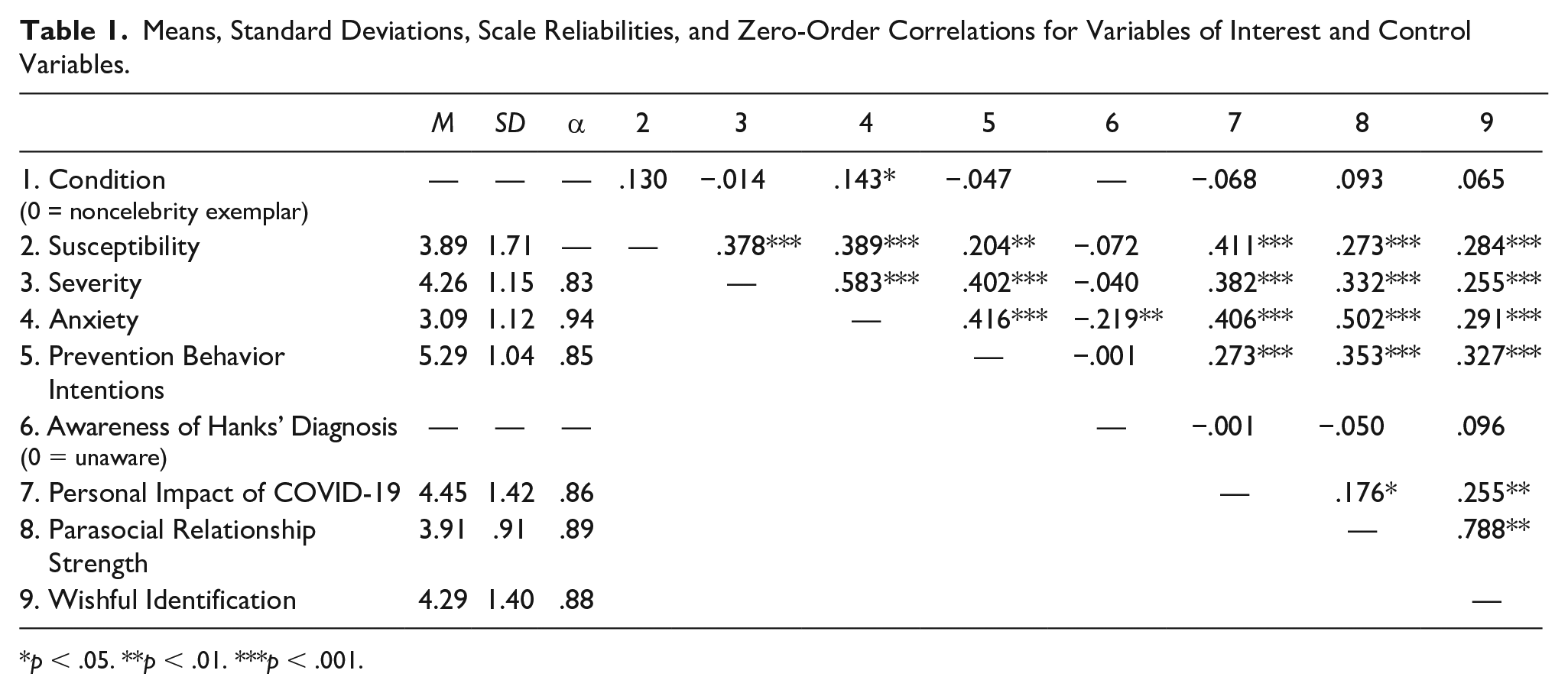
p < .05. **p < .01. ***p < .001.
The only variable that was intended to be manipulated experimentally was the celebrity status of the person featured in the exemplar, but there was a chance that in doing so, perceptions of the severity of COVID-19 could have also been inadvertently manipulated. A t test showed that perceptions of how severe COVID-19 was for Tom Hanks (M = 4.31, SD = 0.91), did not differ from perceptions of severity for Ben Jenkins (M = 4.23, SD = 2.38), t(212)= −.327, p = .744. This demonstrated that even though different people were in the exemplar, the virus was seen as equally dangerous for both.
Parallel Mediation Analysis
A parallel mediation analysis was conducted with PROCESS version 3.4 for SPSS. In this model, the experimental condition (noncelebrity exemplar = 0) was entered as the independent variable, risk-prevention behavior was entered as the dependent variable, and susceptibility, severity, and emotion were entered as mediators. Several control variables that might be related to perceptions of Tom Hanks or responses to COVID-19 were included in initial versions of the model (e.g., biological sex, age, political ideology, and education). However, for the sake of parsimony, only four variables that shared significant relationships with variables in the model were retained in the analysis reported here: awareness of Hanks’s announcement prior to this study, personal impact of COVID-19, and the strength of their parasocial relationship and wishful identification with Hanks. The model was run with 10,000 bootstrapped samples for percentile bootstrap confidence intervals.
The first hypothesis, which predicted that perceived susceptibility would mediate the relationship between celebrity and preventative behavioral intentions, was not supported, a1b1 = −.006, BootSE = .029, BootCI = [−.055, .194]. Notably, however, although susceptibility estimates were unrelated to behavioral intentions, the celebrity exemplar did increase people’s perceptions of personal susceptibility to COVID-19, a1 = .458, SE = .121, p = .006, CI = [.032, .885]. There was also not a significant indirect effect of celebrity on behavioral intentions through severity perceptions, a2b2 = −.004, BootSE = .028, BootCI = [−.066, .056]. Regarding Research Question 1, although severity perceptions were positively associated with preventative measures as expected, b2 = .166, SE = .075, p = .028, CI = [.018, .314], the celebrity exemplar had no bearing on severity perceptions. Finally, in support of Hypothesis 2, anxiety mediated the relationship of celebrity on behavior, a3b3 = .073, BootSE = .042, BootCI = [.005, .166]. Participants exposed to the celebrity exemplar had greater anxiety when thinking about COVID-19, and in turn they reported being more likely to engage in preventive behaviors. The results are displayed in Figure 1.
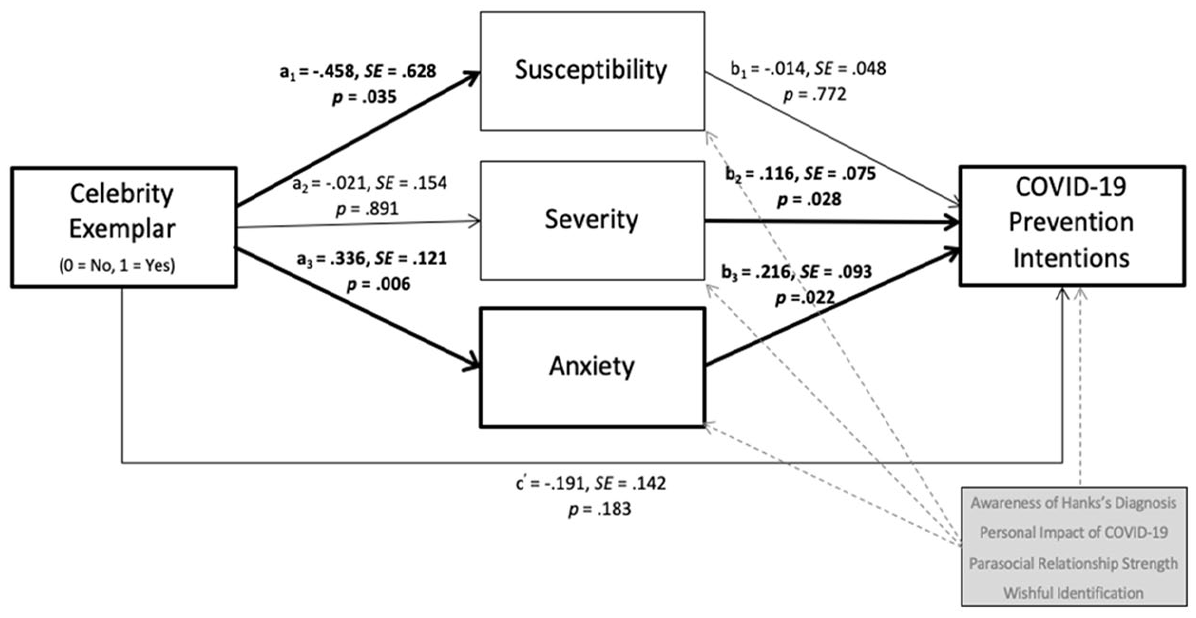
Parallel mediation model.
Discussion
It follows from past research on celebrity health events that, compared with a noncelebrity exemplar, Hanks’s announcement should have increased COVID-19-related risk perceptions because people were more involved with him (e.g., Brown & Basil, 2010). They may have been parasocially involved with Hanks, regarding him as a friend and empathizing with him. Or they wishfully identified with him, aspiring to be more like him. Although beyond the scope of this study and not formally tested, a cursory look at some of the data collected for this research bears that possibility out. The two involvement variables, parasocial attachment and wishful identification with Hanks, were positively correlated with all three indicators of risk perception as well as intentions to engage in behaviors to prevent the spread of the virus. Those more involved with Hanks were probably more influenced by his exemplar.
However, the more interesting story that emerges from this research is that even when involvement variables were held constant, a celebrity exemplar still had a more positive influence on certain dimensions of risk perceptions, compared with an exemplar featuring an ordinary person. Even though the noncelebrity exemplar featured the experience of a person who was arguably more relatable to the participants in this study (most of whom it is presumed are not celebrities), they appear to have relied on the celebrity’s experience as benchmark with which to estimate their own susceptibility. Exposure to the celebrity exemplar also increased participants’ felt anxiety about COVID-19.
Because the only factor that varied between the two experimental exemplars was the person—either an unknown person with an ordinary job or a famous celebrity—these findings suggest that there could be something unique about the celebrity exemplars that are able to shape public health attitudes and behaviors, above and beyond whether people feel personally involved with the celebrity. Recall that past knowledge of Hanks’ diagnosis was entered as a covariate in the analyses, as were two influential forms of involvement with Hanks. Thus, it seems unlikely that these effects are purely the product of publicity or even caring for Hanks’s health and personal welfare.
Instead, consistent with exemplification theory (Zillmann, 2006), Hanks’ celebrity might have acted as a heuristic—a symbol that provided both a cognitive and affective shortcut on which people could base assessments of COVID-19’s risk. As Yoo (2016) suggested, because celebrities are iconic and familiar, they should also be more cognitively available. Thus, compared with exemplars about the experience of ordinary people, celebrity examples should be more readily accessible during decision-making processes. A noncelebrity exemplar is not only more abstract, but presumably more forgettable. Hanks’s diagnosis likely lingered in respondents’ the top-of-mind awareness longer, making them more likely to consider his susceptibility to the virus when judging their own (Ahn, 2018).
Exposure to the celebrity exemplar also resulted in increased COVID-related anxiety. And consistent with the risk-as-feelings approach (Loewenstein et al., 2001), this emotional response exerted a direct effect on intentions to engage in virus prevention behavior, independent from cognitive risk perceptions. Notably, emotion was the only risk perception variable to mediate the effect of Hanks’s experience on behavior. The celebrity exemplar did not have any indirect effect on behavior through the two cognitive dimensions of risk perception. This finding hints that celebrities’ greatest power of influence lies in their ability to move people’s emotions. It bears repeating, once again, because two personal involvement variables were entered as covariates, this suggests that the reason the reason for this effect was not simply because respondents were feeling for Hanks. Rather than reporting on their feelings of anxiety in response to the exemplar or even general anxiety, respondents were specifically asked to indicate the emotions they feel when they consider the COVID-19 virus. Thus, it seems reasonable to conclude that exposure the celebrity exemplar resulted in greater anxiety directed at the virus.
This finding suggests that one reason celebrity health exemplars, such as announcements about celebrity diagnoses or even accounts of celebrity deaths, have a relatively greater impact on public health is because they function an affective cue (Slovic et al., 2002). By virtue of their status, their cultural relevance, and their symbolism, celebrities are imbued with affect, and they are therefore capable of stimulating emotion in those who are familiar with their celebrity involuntarily (Eisend & Langer, 2010). This automatic transfer of emotion can color people’s decisions, including how they should respond to risk.
Given the relatively higher susceptibility perceptions and anxiety in response to the celebrity exemplar, it is somewhat surprising that there was no difference between the exemplars in terms of perceived severity. Yoo (2016) suggested that when celebrities face health challenges, these struggles are perceived as being more severe by virtue of their association with prominent person. Celebrity experiences may be more likely to appeal to the representative heuristic. Alternatively, it also seems plausible that celebrity health events could downplay the severity of a health issue because they tend to be in a more privileged position to deal with these issues. In other words, celebrities’ exceptionality may make all of their experiences seem less representative of ordinary people’s experiences. In this case, Tom Hanks’ COVID-19 exemplar did not have any discernable effect on perceptions of how serious the virus is as a health threat compared with an ordinary person’s example. However, while this null result suggests that celebrity status has no bearing on severity perceptions, it should be interpreted cautiously and with careful consideration for this study’s limitations, particularly with regard to the stimuli.
Limitations and Future Research
The stimulus for this study was remarkably artificial and simplistic, consisting of only brief description of a person and their COVID-19 test results. They were not embedded in a news articles or other formats where exemplars are typically encountered; thus, the generalizability of these findings to people’s responses to actual coverage or conversations about celebrity health events is severely limited. Furthermore, the passage did not include other types of more complex information that media consumers might typically encounter when they are exposed to exemplars. The passage described somebody catching COVID-19, but it did not describe the virus itself or what implications of testing positive for the virus are. In this way, the stimulus may have primed readers to consider susceptibility but not how serious it is, and plausibly, this is why the celebrity and noncelebrity exemplars did not differentially affect perceptions of severity. In future research, a stimulus that includes more information about the risk itself may be better equipped to determine if or how a celebrity exemplar affects risk severity assessments.
This study’s scope is also narrowly limited to the relative effects of a celebrity health exemplar compared with a noncelebrity exemplar. The findings cannot, for instance, speak to if and how either exemplar affected people’s baseline risk perceptions and behavior because no control group was included in the experiment. Relatedly, although this research builds on exemplification theory to explain why celebrity health exemplars should, psychologically speaking, be more impactful than exemplars featuring noncelebrities, the study does not actually demonstrate exemplification effects. A comparison of the relative effects of a noncelebrity exemplar, a celebrity exemplar, and base-rate information about the risk will be needed to gauge whether celebrity’s health examples truly exemplify the risks they are associated with.
Finally, the extraordinarily unique circumstances surrounding Hanks’s celebrity health event highlight a major limitation of this study and a path for future research. Tom Hanks’s health event was a fortuitous research opportunity, because it permitted observation of public response to a naturally occurring celebrity health event, involving one of the most famous U.S. celebrities, concerning a risk that could potentially affect anyone, during a formative time in the public’s understanding of the risk. Yet the uniqueness of this moment—the celebrities involved, the nature of the risk, and the timing of his announcement—is precisely why the results of this study cannot be easily generalized to other celebrity heath events. For instance, even among other celebrities, Tom Hanks is exceptional in many ways. A key question that arises from this study is whether he is exceptional in any particular ways that explain could explain the findings. Affectionately known as “Hollywood’s Everyman” (Sperling, 2020), it is possible, for example, that his seeming similarity to others is why one reason that his COVID-19 experience had a relatively greater impact on people’s perceptions of their own vulnerability to the virus (Rimal & Morrison, 2006). Because only one celebrity’s experience was sampled for this research, this study is unable to speak to how and whether his unique relationship with the public factored into his influence on people’s risk perceptions. The findings here are theoretically promising because they hint that the process of celebrity influence on public health might have mechanisms that are unique from the process of interpersonal influence. However, this is only a case study. In order to establish more definitively that the quality of celebrity has a unique and direct effect on health-related perception, emotion, and behavior, it is necessary to replicate these findings across different celebrity stimuli, different health risks, and different stages of crisis.
Footnotes
Declaration of Conflicting Interests
The author declared no potential conflicts of interest with respect to the research, authorship, and/or publication of this article.
Funding
The author received no financial support for the research, authorship, and/or publication of this article.
