




Abstract
While increasingly more is known about how to reframe the relevance of climate change, much less is known about how people deal with situations in which they are confronted with frames that are incompatible with their own frames. The current research conducts an interactional framing analysis to investigate how users in climate change blog comments interactively construct the meaning of issues, identities and relationships, and their interactions. Results show that most framing differences start with issue framing but thereafter shift to identity and relationship or process framing. Finally, users mostly deploy polarizing interaction strategies to deal with these framing differences.
Introduction
The scientific evidence for human influence on the climate system is growing (Intergovernmental Panel on Climate Change [IPCC] 2014). Most studies find at least 97% scientific consensus that humans are responsible for climate change (Anderegg et al., 2010; Cook et al., 2013). Nonetheless, skepticism about the reality and severity of climate change is still persistent in some Western societies (Whitmarsh & Capstick, 2018), resulting in a polarized climate change debate. McCright and Dunlap (2011b) discuss that there are those “identifying the negative environmental consequences of industrial capitalism,” and “those defending the economic system from such changes” (p. 156), which shows that there is a strong ideological component underpinning the polarization. The persistent polarization around climate change has led to political inaction in industrialized countries such as the United States (Ladd & York, 2017).
Labels commonly appearing in conversations about climate change reflect and even sustain the polarized camps (Howarth & Sharman, 2015). Howarth and Sharman (2015) explain that “those who express ‘ambivalence,’ ‘attitudinal uncertainty,’ ‘dissonance,’ or ‘cynicism’ about mainstream climate science and/or the need for mitigation or adaptation climate policy are most commonly referred to as sceptics, deniers, or contrarians” (p. 241), whereas those that support the mainstream scientific position are often referred to as “alarmist, warmist, believer, or catastrophist” (p. 244).
Next to the labels, the deployed frames also reflect the antagonistic debate. For example, supporters of the mainstream scientific position deploy frames that stress the benefits of different climate change policies, while others deploy frames that stress the costs (Bernauer & McGrath, 2016). One explanation for why people support one frame and reject another can be found in the identity-protective cognition thesis. This thesis suggests that people selectively credit and dismiss asserted dangers in a way that protects their in-group’s cultural identity. More specifically, White males display skepticism towards risks when activities central to their cultural identity are under threat by this risk (White male effect; Kahan et al., 2007). Drawing on this thesis, McCright and Dunlap (2011a) show that conservative White males are more likely to deny climate change compared to the rest of the U.S. population, because they consider conservative White male elites that challenge the reality of climate change to be their in-group. More generally, people support climate change frames that credit their cultural identity and dismiss frames that challenge this identity.
Therefore, communication scholars often suggest reframing the relevance of climate change in ways that resonate with audiences’ cultural identities (i.e., their worldviews and values), in order to depolarize the debate and create public engagement with climate change (Corner et al., 2014; Nisbet, 2009; Nisbet & Mooney, 2007). However, Bernauer and McGrath (2016) find that simply reframing climate policy is unlikely to increase public support. They explain that people are exposed to many competing frames and tend to selectively accept frames that confirm their existing views. Thus, if people do not easily accept incompatible frames, the question is how people respond to situations in which they are confronted with incompatible frames. The climate change communication literature is scarce with respect to how people deal with situations in which differences in framing emerge. Such research is crucial, however, as it provides insight into whether and how people use polarizing interaction strategies when framing differences emerge.
In the current research, we specifically focus on user comments in the climate change blogosphere, as previous research pointed out that this online venue is polarized to the extent of communities, hyperlinks, topics, and discourses (Brüggeman et al., 2020; Elgesem, 2019; Elgesem et al., 2015). Climate change blogs are “websites that primarily and frequently produce content about climate change with dated entries in a reverse chronological order and possibly a comment section” (Van Eck et al., 2019, p. 2). Comments on climate change blogs provide a rich source of data (Matthews, 2015). User comments represent the viewpoints of only a small portion of media users and are not necessarily representative of public opinion. However, comment threads provide users with a public space for debate, which in turn can influence public opinion on climate change and further scientific discussion (Schäfer, 2012; Walter et al., 2018).
Generally, on the one hand research on climate change comment threads reveals demonstrations of incivility, echo chamber effects, and the presence of climate–skeptical views (Collins & Nerlich, 2015; De Kraker et al., 2014; Walter et al., 2018). On the other hand, it shows how comment threads offer the potential for a naturally occurring discursive space for dialogue, deliberation, and mobilization around climate change (Collins & Nerlich, 2015; Cooper et al., 2012; Graham & Wright, 2015; Uldam & Askanius, 2007). To the best of our knowledge, only Matthews (2015) investigated climate change blog comments, by analyzing the backgrounds of users and how they became interested in climate science. Hence, the current research aims to contribute to understanding processes of climate change polarization in climate change blog comments. In this article, we investigate whether and how users deploy strategies to deal with framing differences that either align the incompatible frames or rather further polarize the difference.
Theoretical Framework
In the current research, we will apply interactional framing theory. The following section explains this theory and the section “Overview of Theoretical Focus” will provide an overview of the theoretical focus of the current research.
Interactional Framing Theory
The interactional perspective on framing focuses on the dynamic enactment of frames in ongoing interactions. Central to this thesis is that the primary focus is on how alignments, disjunctions, or turning points emerge through the framing process. The theory contributes to our understanding of how meaning is coconstructed in interactions (Dewulf, 2006; Pearce & Cronen, 1980). This perspective is ontologically, theoretically, and methodologically different from the cognitive perspective on framing, in which the emphasis is on how the frames are stored and represented in memory (Dewulf, 2006). Thus, both theories differ to the extent that the cognitive perspective focuses on structures of expectations, while the interactional perspective focuses on the alignments negotiated in interaction (Aarts & van Woerkum, 2006; Dewulf et al., 2009). Henceforth, we will refer to the latter perspective as “framing” instead of “frames,” as the term framing captures the dynamic process more appropriately (Dewulf et al., 2009).
Beside conceptualizing these two different theoretical perspectives, we also need to consider “what is it that gets framed?” in interactional framing theory. Dewulf et al. (2009) identify three general categories: issues, identities and relationships, and interaction processes. In the current research, we define “framing category strategy” as the user’s choice to deploy issue frames, identity and relationship frames, and/or process frames. Accordingly, in this research we will focus not only on how users interactively construct the meaning of issues in comment threads of climate change blogs but also on how users interactively construct the meaning of self, other, and relationships, as well as the ongoing interaction process between them.
Moreover, a “framing difference” emerges when issue frames, identity and relationship frames, or process frames of two different actors are incompatible. The first interactional move by actor A is called the Act. The reaction to the initial act by actor B is called the Interact. After a minimum of these two interactional steps, a difference in framing can emerge (Dewulf & Bouwen, 2012). For example, if actor A argues, “Climate change is caused by humans” and actor B reacts to that statement by arguing, “That’s not true, the climate has changed before,” a difference in issue framing emerges about the causes of climate change. In the current research, each singular comment is understood as an interactional step.
How actors deal with differences in framing arises in the subsequent interaction between the two actors (Lems et al., 2013). Hence, the double interact is introduced, which defines the reaction of actor A on the reaction of actor B to the initial action of actor A (Weick, 1979). Thus, if the analysis focuses on how differences in framing emerge, Steps 1 and 2 need to be minimally completed. But if the analysis focuses on how actors actually deal with differences in framing, this minimal sequence of three interactional steps needs to be completed with a double interact. All the interactional steps that follow after the first double interact are named double interacts as well (Dewulf & Bouwen, 2012).
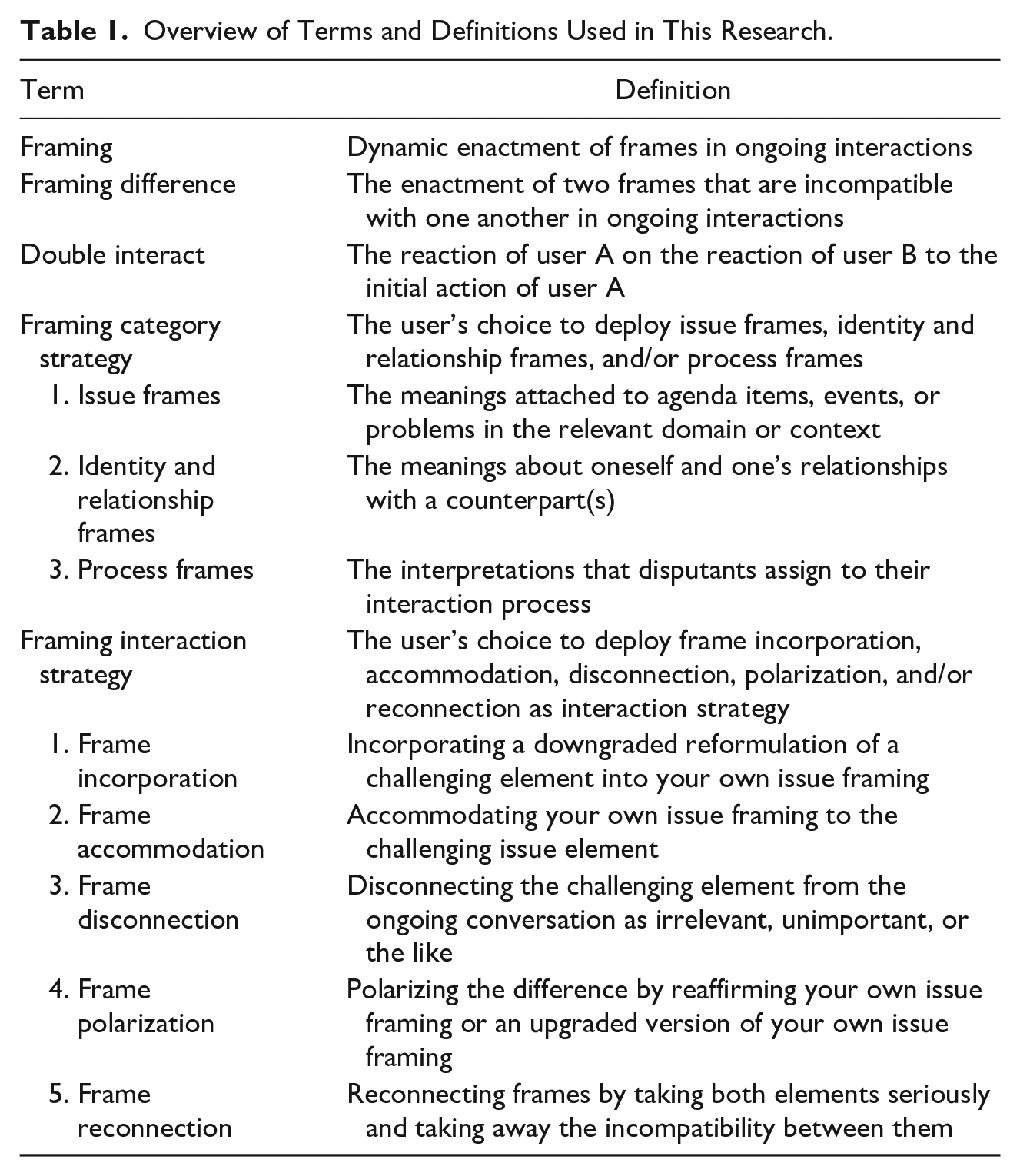
On the basis of this concept of double interact, Dewulf and Bouwen (2012) identified five interaction strategies for “doing differences” that explain how actors deal with differences in issue framing in real-life conversations. They identified frame incorporation, accommodation, disconnection, polarization, and reconnection as the respective interaction strategies (see Table 1 for definitions of the strategies). In the current research, we will adopt this framework and use “framing interaction strategy” to refer to the user’s choice to deploy one of these strategies. We will analyze how users deal with framing differences in climate change blog comments. Additionally, we will investigate whether at the end of an interaction sequence, framing differences are often left unresolved or whether the actors aligned their framings.
Overview of Terms and Definitions Used in This Research.
Last, interactional framing theory has been applied to different fields, mostly complex issue settings in which differences in issue framing are bound to emerge (Aarts & van Woerkum, 2006; Dewulf & Bouwen, 2012). Yet research that builds on this theory is relatively scarce, especially in climate change communication literature, as most researchers follow the cognitive perspective on framing. The current research will apply interactional framing theory, as we are interested in how polarization is enacted in climate change blog comments.
Overview of Theoretical Focus
Table 1 presents an overview of the terms and their definitions that we use in this research (Dewulf & Bouwen, 2012; Dewulf et al., 2009). In sum, we will focus our analysis on the following three aspects:
How many double interacts are present in user threads of climate change blogs?
What kind of framing category strategies do users deploy when framing differences emerge and continue?
What kind of framing interaction strategies do users deploy when they deal with differences in framing?
Method
This research applied discourse analysis to investigate framing in interactions (Dewulf & Bouwen, 2012; Lems et al., 2013). Our approach draws from a social constructionist approach in the tradition of discursive psychology and conversation analysis, in which the focus is on how the turn-by-turn sequences of interaction plays out in various types of reciprocal action (Sacks et al., 1974). Our approach, however, does not utilize traditional conversation analysis. We apply interactional framing theory and draw from the sequential turn-by-turn focus associated with traditional conversation analysis. In the current research, we want to analyze what framing category and interaction strategies users deploy and what they achieve by deploying these strategies (Potter & Wetherell, 1987; Wood & Kroger, 2000).
Our approach was (a) deductive because we rely on existing framing category strategies and framing interaction strategies, (b) inductive because in the analysis we are open to finding new framing interaction strategies that emerge directly from the data, and (c) abductive because we are open to discovering new dimensions of interactional framing theory for which there is no appropriate explanation or rule yet (Reichertz, 2007). This integral approach addresses concerns of discourse analysis that it overemphasizes the inductive character of qualitative research, without dismissing its value (Dewulf & Bouwen, 2012).
Data Collection
Comment threads of the popular, award-winning climate change blogs Watts Up With That and RealClimate were selected (“Top Five Science Blogs,” 2006; The Weblog Awards, 2011). Watts Up With That is generally characterized as a blog that does not support the mainstream scientific position on climate change. The tagline of this blog is, “The world’s most viewed site on global warming and climate change” (https://wattsupwiththat.com/). RealClimate is generally characterized as a blog that endorses the mainstream scientific position on climate change. The tagline of this blog is, “Climate science from climate scientists” (http://www.realclimate.org/). The comment threads of both blogs are moderated.
Both blogs played a significant role when emails were stolen from the server of the University of East Anglia. A hacker uploaded the emails on RealClimate (Schmidt, 2010). A blogger from Watts Up With That first broke the story. Soon after that, the event was dubbed climategate in the blog’s comment threads, a term that caught on in mainstream news stories (Nerlich, 2010; Norton, 2010). Skeptics suggested that these emails written by climate scientists were proof that climate change was just a conspiracy. RealClimate received a great deal of comments with questions and actively blogged to counter all the misinterpretations (Schmidt, 2010). The event generated considerable press attention and had a significant effect on public beliefs in climate change and trust in scientists (Leiserowitz et al., 2013).
The last five published blog posts on each blog that received more than 25 and less than 250 comments were selected since April 30, 2019. Thus, a total of 10 blog posts with corresponding comments was collected on the May 6 between 10.00 a.m. and 11:00 a.m. GMT + 2. This time frame was selected, because it was at that stage of the research the latest point in time and would therefore deliver a fresh data set. Around the blog publication dates, there were no critical discourse moments marked by relevant events (e.g., Conference of Parties or IPCC report releases; Carvalho & Burgess, 2005), which is reflected in the content of the selected blogs. The selected blog posts of RealClimate were about the (a) Nenana Ice Classic, (b) a successful model simulation, (c) writing about worst case scenarios, and (d) and (e) two open threads on climate science issues. The selected blog posts of Watts Up With That were about (a) the Climate Action Now Act, (b) a study about climate change friendly air conditioners, (c) analysis of new NASA AIRS study, (d) climate change costs for businesses, and (e) China building coal plants. In addition, only blog posts with 25 to 250 comments were selected, in order to ensure that the thread included double interacts but prevent the data set being dominated by one single extensive user thread. The five selected blog posts of Watts Up With That received a total of 436 comments, and the five selected blog posts of RealClimate received a total of 531 comments, that is, the entire sample included 10 blog posts and 967 comments.
Data Analysis
First, per blog post, a corpus was created that contained all the different interaction sequences. Interaction sequences were demarcated by selecting a sequence of comments in which previous users were explicitly addressed. For example, the comment was published as a reply comment, or the previous comment number or the name of the previous user was explicitly mentioned. Each singular blog post was also considered as an interactional step.
Importantly, as we draw on interactional framing theory, we were primarily interested in how meaning is created in the interactions between users. For example, framing differences were identified on the basis of the users’ construction of reality rather than the researchers’ perception. Accordingly, earlier research focusing on real-life conversations showed that differences in issue framing were signaled by disagreements, opposing questions, and signs of surprise or confusion (Dewulf & Bouwen, 2012). Hence, we focused on such signs but were also open to identifying new signs of framing differences. Subsequently, only the interaction sequences that contained at least one double interact were selected.
The final data set was analyzed in ATLAS.ti (Version 8.3.20). Separate codes were created for the three framing category strategies and five framing interaction strategies, that is, a total of eight codes. Each interactional step in the interaction sequences was closely analyzed by applying the appropriate codes. The unit of analysis was the entire comment and not individual sentences. Thus, all sentences were understood in context. Moreover, separate memos were created, in which potential new findings were noted down. Subsequently, the first author engaged in an iterative process of data analysis, in order to acquire a deeper understanding of the data. Special attention was given to understanding how framing category strategies, framing interaction strategies, and the (non)resolution of framing differences interacted with one another.
Intermediate rounds were organized with all authors to discuss theoretical and methodological challenges and ambiguous interaction sequences. Prior to these meetings, all authors coded the ambiguous interaction sequences independently, after which the dissimilarities were discussed. These rounds guaranteed that the codes were reliable and applied consistently. For example, during the analysis, we identified an issue with the application of the “identity and relationship framing” code. It was unclear whether the code should be applied only when it concerned the users of the respective interaction sequence or also when it concerned external actors. After discussion, we decided to apply the code when only it concerned the users of the respective interaction sequence itself (i.e., actors A and B). Similarly, we decided that process frames could be applied only when it concerned the ongoing interaction of the users itself, instead of references to interactions that other users were having. This latter theoretical decision implied by definition that a “process framing” code could never be applied in the Act. Users cannot refer to the interpretations that disputants assign to their interaction process when there is no interaction yet.
Results
The following section presents our findings on how many and what kind of double interacts we identified in the user threads of RealClimate and Watts Up With That. Subsequently, we discuss the framing category strategies that users deployed when framing differences emerged and continued. Last, the section “Unresolved Framing Differences” discusses our findings on the framing interaction strategies that users deployed when they dealt with differences in framing. The findings are accompanied with extracts of the interaction sequences, which were selected because they clearly illustrate the results.
Frequency of Double Interacts
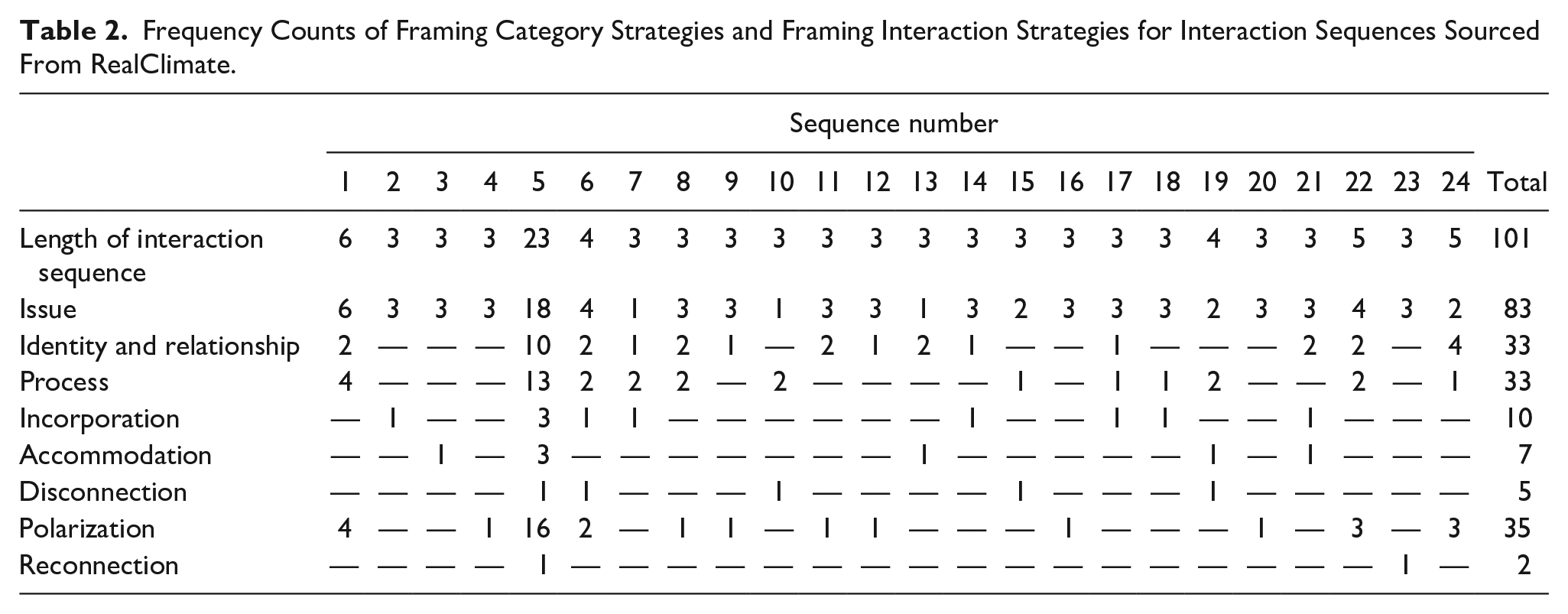
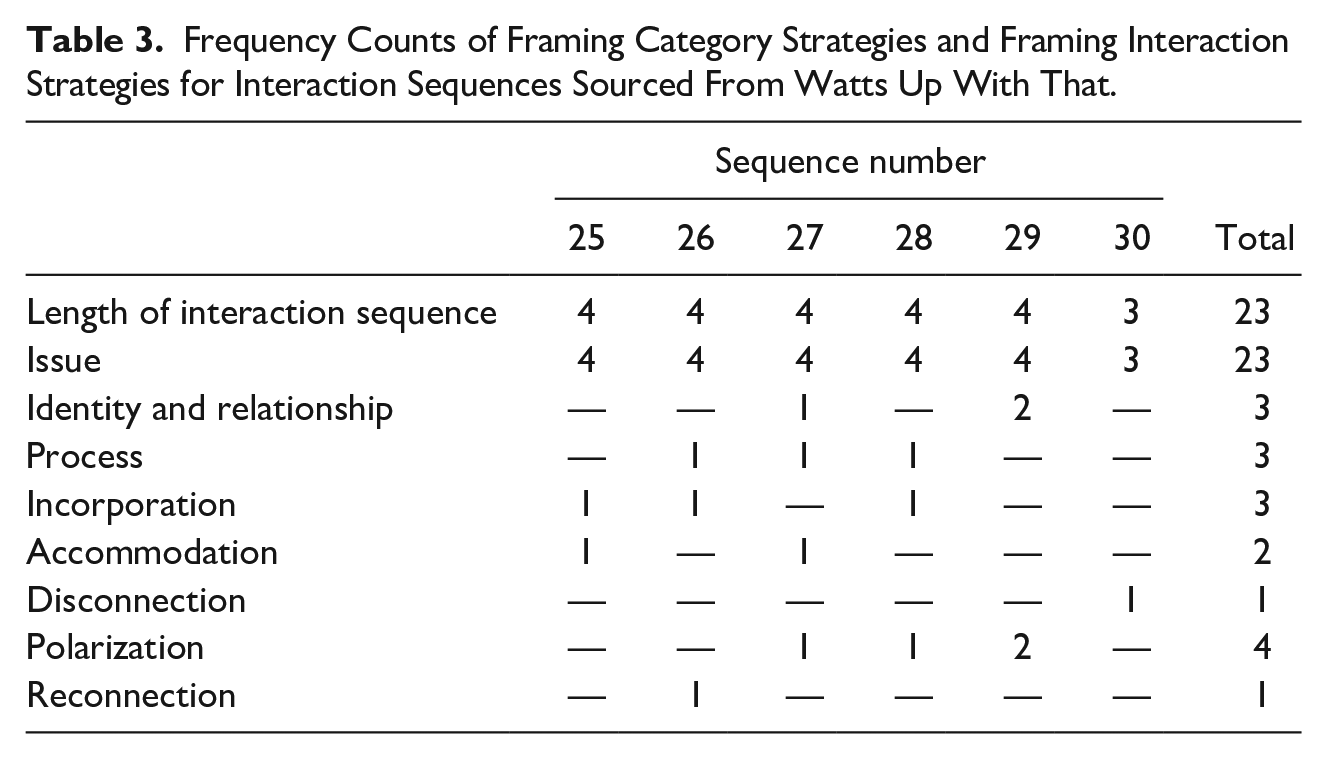
The final data set contained 30 interaction sequences. The sequences ranged in length from three to six interactional steps, except one long interaction sequence comprising 23 steps. Only six interaction sequences were identified in the sample of comments of Watts Up With That. In fact, they were all identified in the user thread of one blog post. The other 24 interaction sequences were identified in user threads of all five blog posts of RealClimate. More framing differences are apparent in the sample of comments of RealClimate. Thus, there is more deliberation on this blog, since users engage with more alternative viewpoints. Tables 2 and 3 present an overview of the results of the entire analysis on the basis of the length of the interaction sequences and the frequencies of the various framing category strategies and framing interaction strategies per blog. Please see the online supplemental material for an overview of the entire analysis.
Frequency Counts of Framing Category Strategies and Framing Interaction Strategies for Interaction Sequences Sourced From RealClimate.
Frequency Counts of Framing Category Strategies and Framing Interaction Strategies for Interaction Sequences Sourced From Watts Up With That.
Framing Category Strategies
The next section discusses how framing differences emerge. The subsequent section presents how actors can also shift their framing category strategy during a framing difference.
Emergence of Framing Differences
All interaction sequences started with issue framing. In two instances, the sequence also started with identity framing. We find that the majority of framing differences (20/30) that emerge in the interact are differences in issue framing. The majority of these differences in issue framing concerns climate science analyses and results. Some differences also relate to good scientific conduct, effective action to address climate change, science communication, and the moderation policy of RealClimate. Extract 1 is an example of a part of an interaction sequence sourced from RealClimate. The example shows how a difference in issue framing emerges that concerns climate science analyses and results.
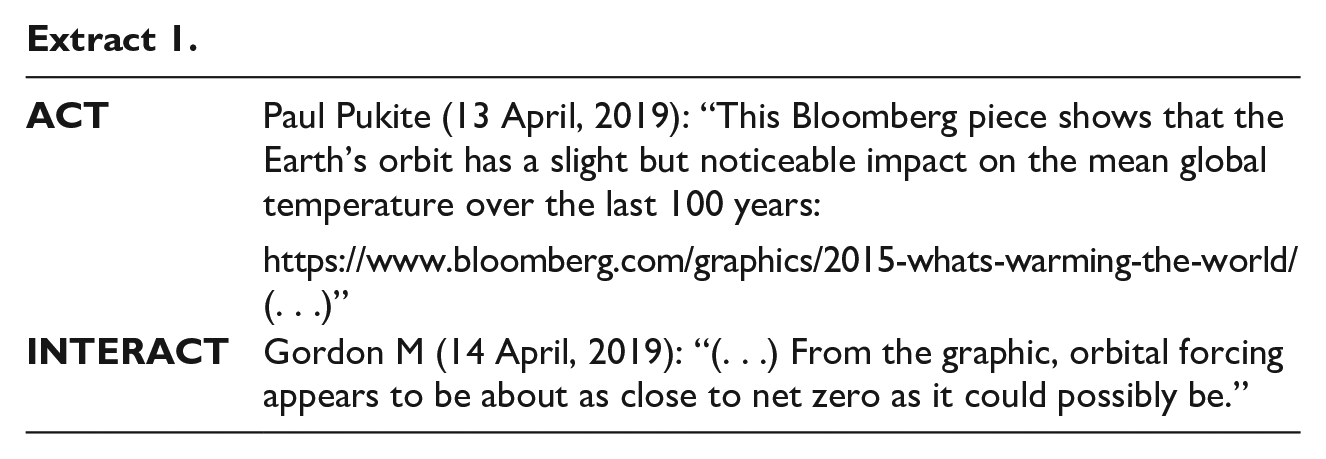
In Extract 1, a difference in issue framing emerges that is signaled by disagreement. Paul Pukite argues that the Earth’s orbit has a slight but noticeable impact on the mean global temperature over the past 100 years. Gordon M disagrees with Paul Pukite by arguing that the orbital forcing appears to be about as close to net zero as it could be, meaning that is does not have an impact. Thus, Gordon M challenges Paul Pukite’s framing by drawing on a piece of scientific data, rather than explicitly or overtly challenging the original issue framing. In this way, the extract shows how a framing difference can emerge subtly and without direct and overt disagreement.
Shifts in Framing Category Strategies
Out of 30 interacts, 27 consisted of issue framing. However, in nine out of the 30 instances actor B responds in the interact also or exclusively with an identity and relationship or process framing (see Tables 2 and 3). Thus, we find that framing differences can emerge and continue while actors shift their framing category strategy. This finding adds to earlier research, where it was found that framing differences emerge when frames are incompatible within a framing category. In fact, in 22 of the 30 interaction sequences actors shift their framing category strategy during the sequence. See Table 4 for an example of an interaction sequence that shows how actors continuously shift their framing category strategy. In only eight of the 30 interaction sequences the actors maintain their initial issue-framing strategy for the entire sequence.
Framing Category Strategies of Interaction Sequence 5.
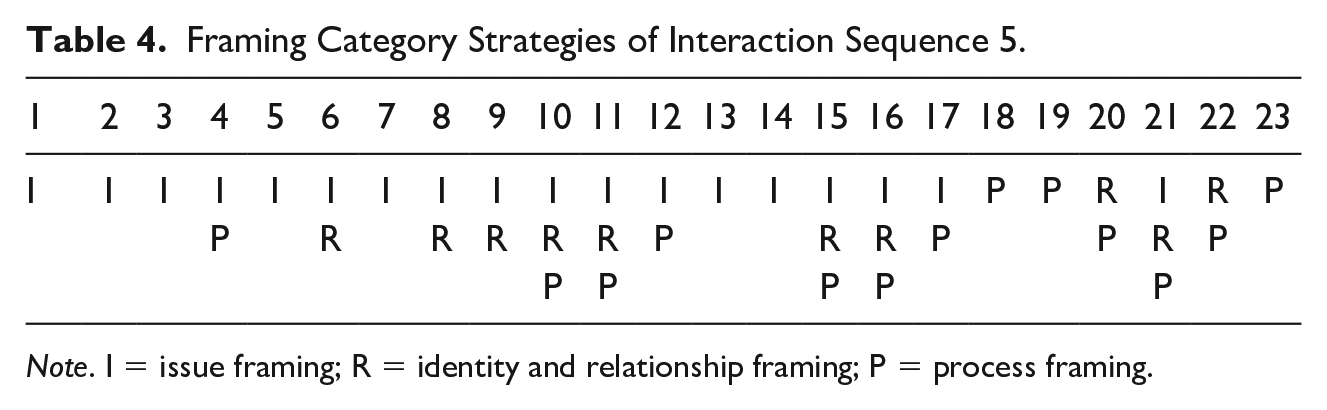
Note. I = issue framing; R = identity and relationship framing; P = process framing.
If actors introduce identity and relationship framing, they most frequently do so in two contexts. First, the actor attributes expertise or a lack of expertise to oneself or the other. Second, the actor accuses the other of being either a denialist or an alarmist. In general, the actors attribute more frequently meaning to the other actor than oneself or their mutual relationship. Moreover, these meanings are mostly negative denotations. This finding helps to understand why in 10 of the 15 instances that identity and relationship framing was introduced at a certain point, the interaction sequence was in the end left unresolved. Extract 2 is an interaction sequence sourced from RealClimate. The extract shows how actors shift from issue to identity and relationship framing during a framing difference and consequently how the framing difference is left unresolved.
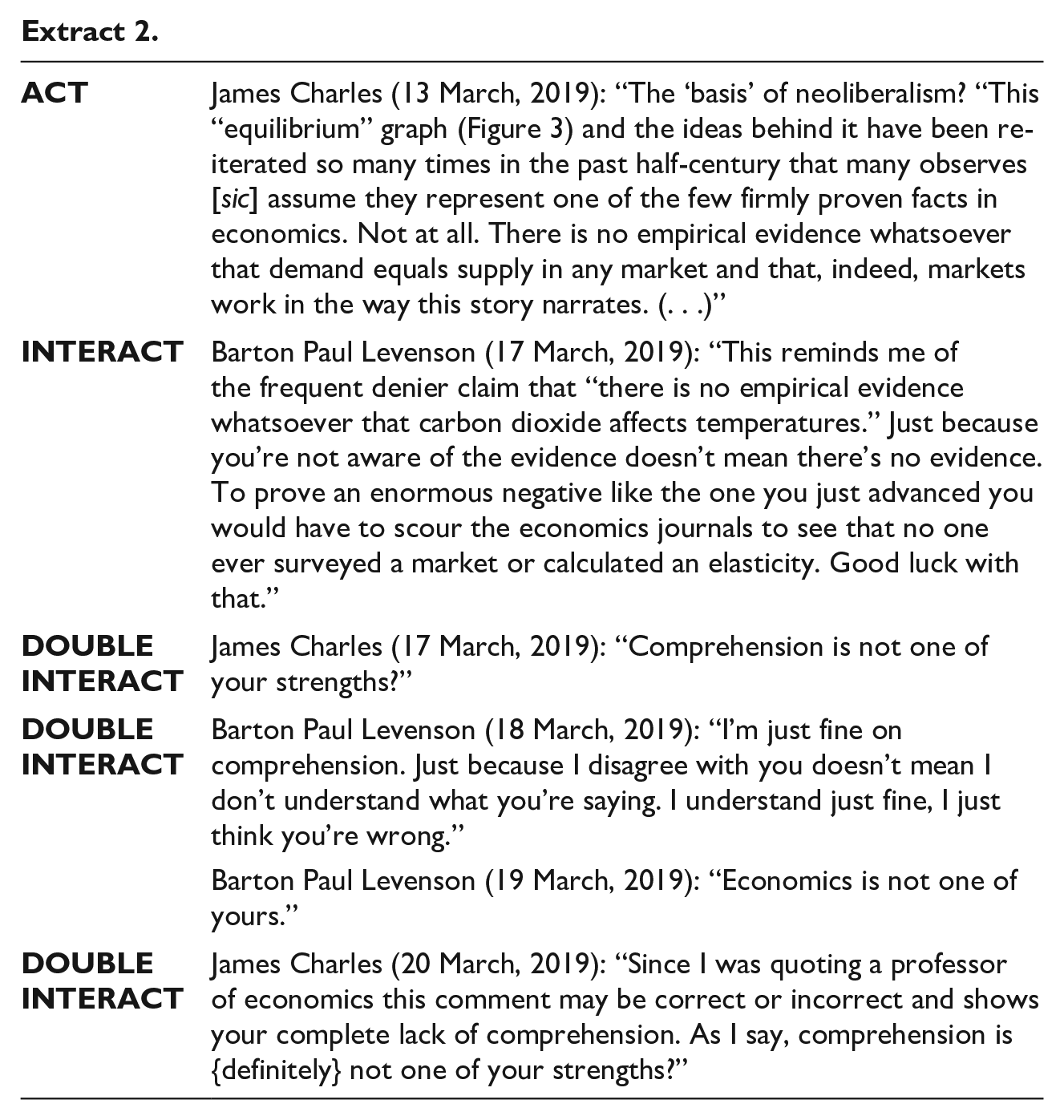
Extract 2 shows that a difference in framing emerges, which is signaled by disagreement. James Charles argues that there is no empirical evidence whatsoever that demand equals supply in any market. Barton Paul Levenson disagrees with James Charles’s framing and argues that he cannot make that claim. Barton Paul Levenson argues that not being aware of the evidence does not mean there is no evidence. Thus, a difference in issue framing emerges about whether there is empirical evidence for the claim that demand equals supply in any market.
Moreover, Barton Paul Levenson also introduces identity and relationship framing as a category strategy. He argues that James Charles’s claim is a “denier” claim. As a result, the framing difference continues, and James Charles now also shifts from issue framing to identity framing by suggesting that comprehension is not one of the strengths of Barton Paul Levenson. Thus, while the framing difference started with a difference in issue framing, both actors shifted their framing category strategy to identity and relationship framing.
The shift in framing did not resolve the framing difference, as subsequently, Barton Paul Levenson responds with identity and relationship framing by arguing that he is fine on comprehension and James Charles’s strength is not economics. Moreover, Barton Paul Levenson also introduces process framing. He refers to the interaction of James Charles and him by arguing that James Charles’s interpretation of their interaction is not correct. Barton Paul Levenson discusses that the correct interpretation of their interaction is that he understands what James Charles is saying, yet does not agree with him. Last, James Charles responds again with identity and relationship framing, upgrading his previous statement that comprehension is “definitely” not one of Barton Paul Levenson’s strengths. Thus, while the sequence started with a difference in issue framing, Barton Paul Levenson and James Charles get caught in a difference in identity and relationship and process framing. The fact that both users attribute a lack of expertise to the other and accuse the other of being a denialist renders the framing difference unresolved. More specifically, after four double interacts including identity and relationship framing the framing difference is left unresolved.
If actors introduce process framing, they most frequently do so in two contexts. First, the actor accuses the other actor of solely criticizing other actors. Second, the actor argues that their words are misunderstood by the other. These findings help to explain why process framing was introduced after identity and relationship framing in six of the 13 instances that we identified. More specifically, the interactional sequences in which process framing is deployed subsequently to identity and relationship framing allow the actors to redirect the interaction away from personal attacks, thereby avoiding further potentially uncivil discourse (also see, e.g., Table 4). Extract 3 shows the first three interactional steps of a sequence of six steps sourced from RealClimate. It illustrates how actors shift from issue to identity and relationship to process framing during a framing difference.
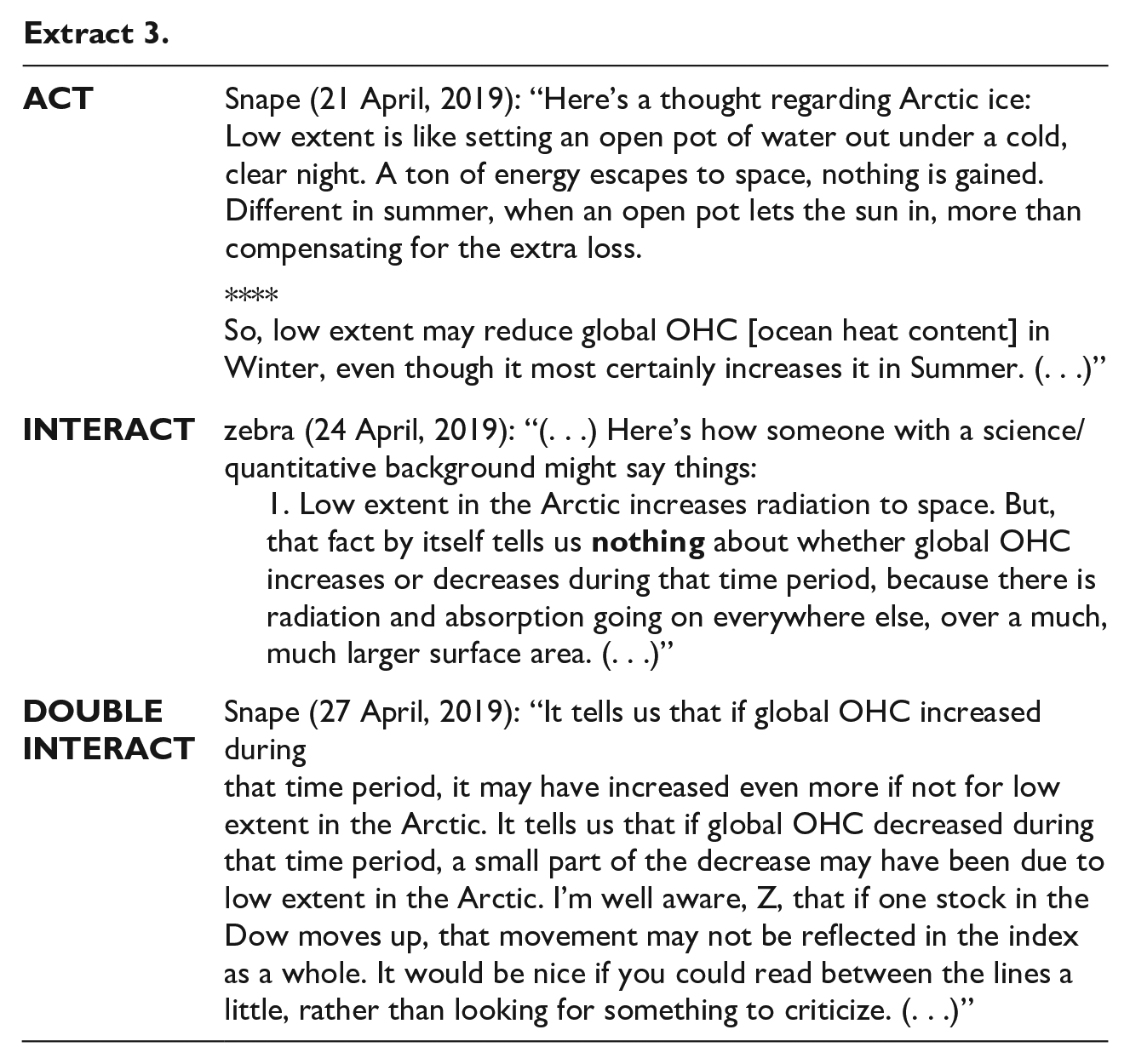
Extract 3 shows that a difference in framing emerges, which is signaled by disagreement. In the interact, zebra disqualifies Snape’s issue framing that the ow extent of Arctic ice increases radiation to space and increases or decreases ocean heat content. Thus, a difference in issue framing emerges about whether there is a link between low extent of Arctic ice and increases in radiation to space and increases or decreases in ocean heat content. Zebra also introduces identity and relationship framing. He conveys that his own issue framing is how someone with a scientific/quantitative background might say things. Zebra herewith attempts to establish a “scientist” identity, someone who has a background in science/quantitative research and should therefore be qualified to make accurate statements on the topic. However, Snape does not attend to this identity but responds with issue framing again. He puts his initial argument about low extent in the Arctic back on the table. On top of that, he also introduces process framing, by arguing that zebra could read between the lines a little, rather than looking for something to criticize. In this way, Snape redirects the interaction away from personal attacks, thereby avoiding further potentially uncivil discourse.
Finally, in contrast with the double interact data set of RealClimate, all interactional steps from the double interact data set of Watts Up With That included issue framing. Only six of the 23 interactional steps included identity and relationship or process framing.
Interaction Strategies to Deal With Framing Differences
Our results show that users’ framing interaction strategies for dealing with framing differences are consistent with the strategies that Dewulf and Bouwen (2012) identified in their research. In general, users deployed most frequently interaction strategies that left the framing differences unresolved (45 instances). In contrast, 25 instances were documented in which the incompatible framings were aligned. The first section discusses the interaction strategies that were deployed and did not resolve the framing differences. The following section presents our findings on the interaction strategies that were deployed to align the incompatible framings.
Unresolved Framing Differences
In 45 out of 70 instances users deployed frame polarization and disconnection. Overall, frame polarization was the most frequently deployed framing interaction strategy (39 out of 70 instances).
In 23 out of 39 instances, climate science analyses and results were topic of discussion when users deployed frame polarization to reaffirm or upgrade their own issue framing. Yet frame polarization was also frequently deployed in combination with identity and relationship and/or process framing. Accordingly, like these framing category strategies, frame polarization was mostly deployed in a context in which users attribute a lack of expertise to the other user, accuse the other of being either a denialist or alarmist, or blame the other user of solely criticizing others. Moreover, in all sequences in which frame polarization was introduced at a certain point, the last interactional step also included frame polarization. The double interacts of Extracts 2 and 3 are illustrative examples of interaction sequences in which frame polarization was the deployed framing interaction strategy. Extract 4 shows an interaction sequence sourced from RealClimate that illustrates how an actor deploys frame polarization as his framing interaction strategy.
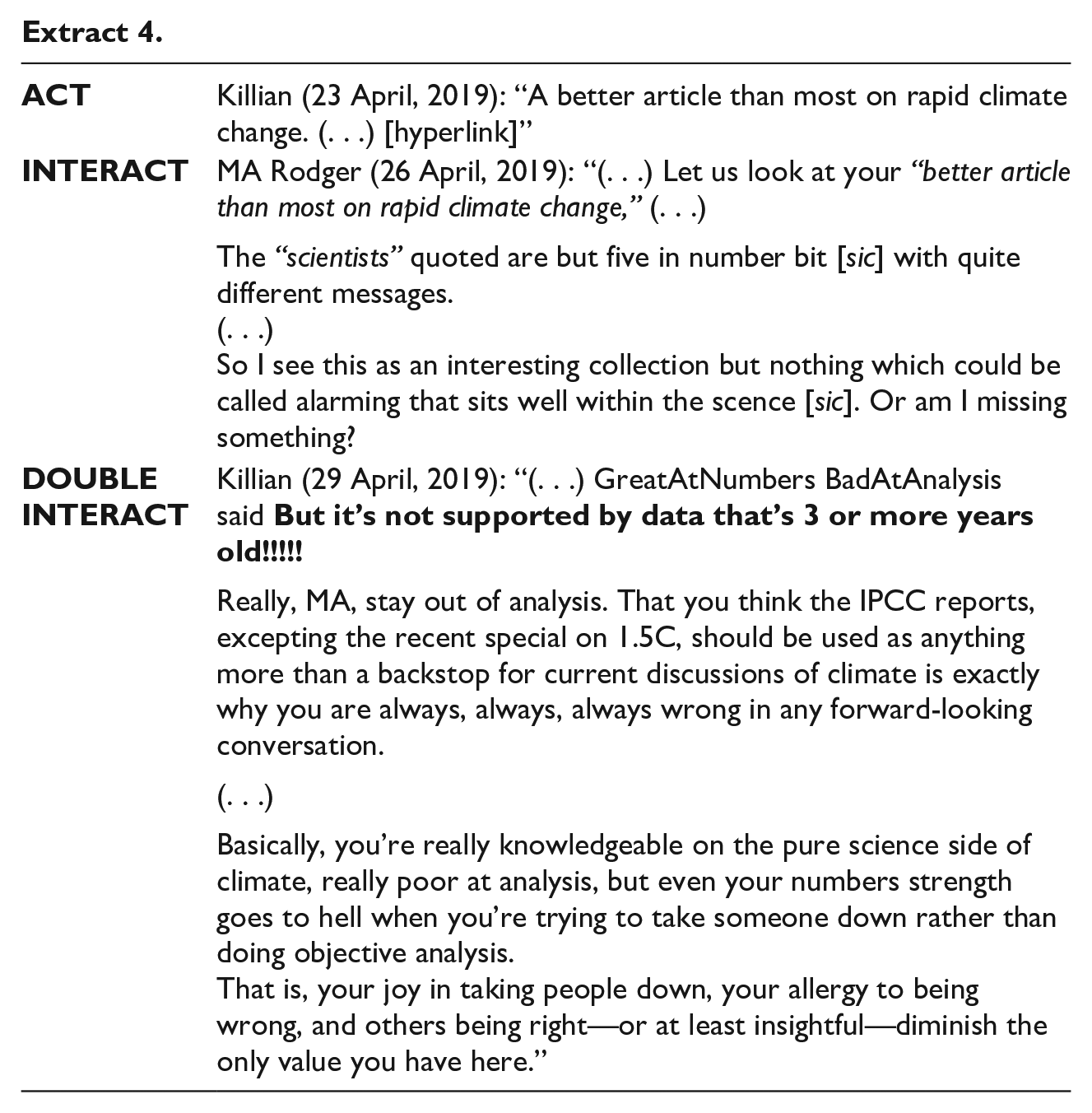
Extract 4 shows that a difference in framing emerges, which is signaled by disagreement. MA Rodger disqualifies Killian’s issue framing that his article is a “better article than most on rapid climate change.” MA Rodger argues that the article’s findings could not be named alarming that sit well within science. Thus, a difference in issue framing emerges about whether the article shows that the climate is rapidly changing based on scientific facts. Consequently, Killian responds with issue framing to MA Rodger’s issue framing. He disqualifies MA Rodger’s framing that the article’s findings are not sitting well within science by arguing that the IPCC reports serve as more than a backstop for current discussions of climate. Moreover, Killian also introduces identity and relationship framing, by (a) referring to MA Rodger as “GreatAtNumbersBadAtAnalysis,” (b) attributing a lack of expertise to MA Rodger by discussing how he is poor at analysis, and (c) portraying MA Rodger as someone who enjoys taking people down, is allergic to being wrong, and last, does not have any value in user threads of RealClimate. Thus, Killian polarizes the initial framing difference between him and MA Rodger by upgrading his own issue framing about the article. Additionally, Killian further polarizes the difference by introducing identity and relationship framing that attributes negative denotations to MA Rodger. Consequently, the framing difference is left unresolved.
In four of the six instances that frame disconnection was deployed as the framing interaction strategy, the user also deployed process framing as framing category strategy. Accordingly, like process framing, frame disconnection was mostly deployed in a context in which users argue that oneself did not mean or say that in their previous ongoing interaction.
Frame Alignments
The framing interaction strategies incorporation, accommodation, and reconnection were deployed to align the different framings. Overall, frame incorporation was the most frequent deployed strategy to align framing differences (13 instances), followed by frame accommodation (9 instances), and lastly frame reconnection (3 instances).
In nine of the 13 instances in which users deployed frame incorporation, climate science analyses and results were topic of discussion. Similarly, in five out of nine instances in which users deployed frame accommodation, climate science analyses and results were topic of discussion. In line with this finding, in 12 of the 13 instances that frame incorporation was deployed and six of the nine instances that frame accommodation was deployed, these framings were accompanied by issue framing. Moreover, in eight of the 13 instances that frame incorporation was deployed and five of the nine instances that frame accommodation was deployed, the interaction sequence ended with a resolved framing difference. Extract 5 provides an example of an interaction sequence sourced from Watts Up With That. The example illustrates how user A deploys frame incorporation and how user B subsequently deploys frame accommodation.
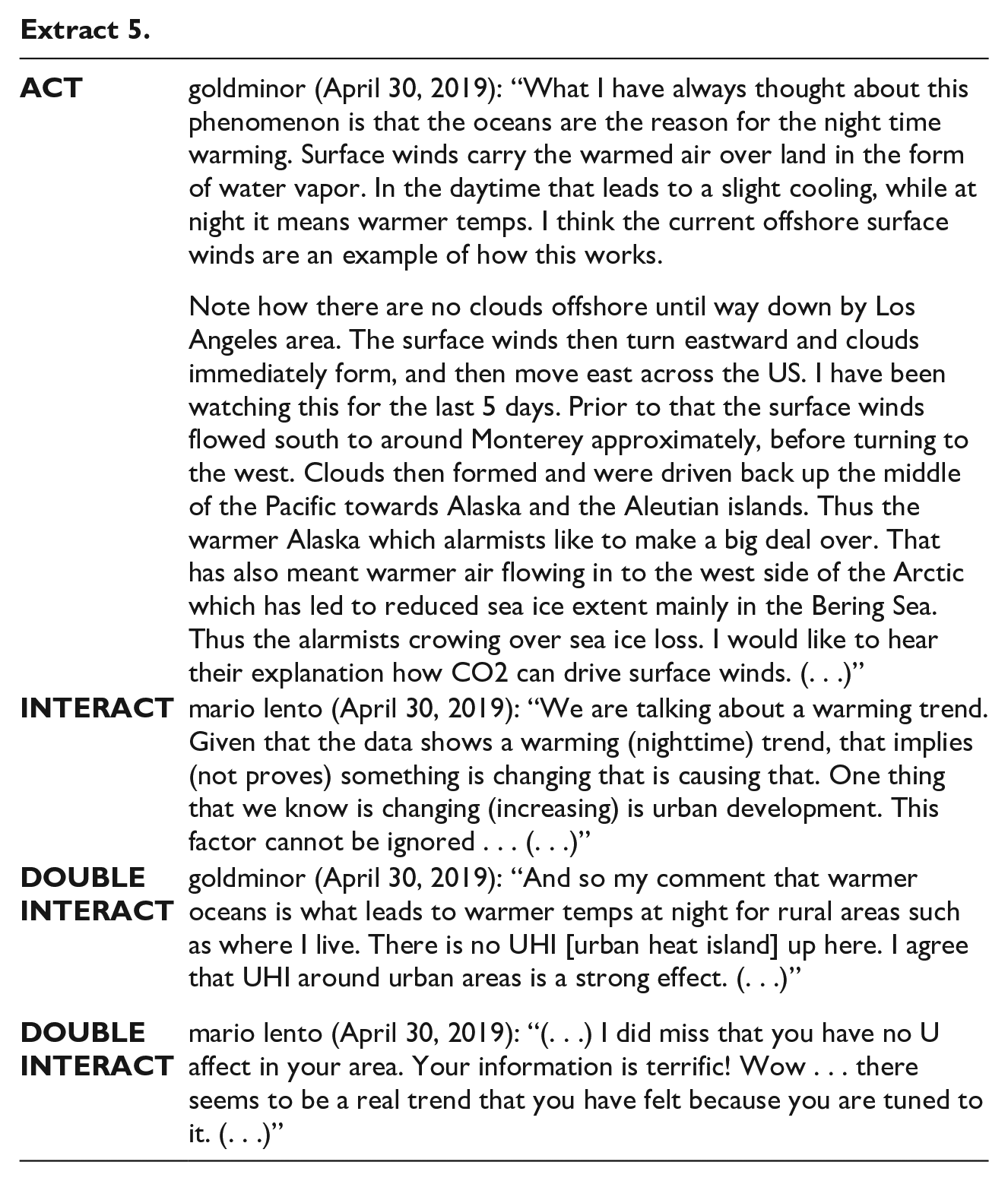
Extract 5 shows that a difference in issue framing emerges, which is signaled by disagreement. Mario lento points out that goldminor should not forget about urban development as a factor that causes the nighttime warming trend that provides an explanation for sea ice loss in the Arctic. Thus, a difference in issue framing emerges about whether warmer oceans could lead to warmer temperatures at Alaska. Subsequently, goldminor deploys issue framing and frame incorporation. Goldminor agrees that the urban heat island effect around urban areas has a strong effect on nighttime warming trends and uses this challenging issue framing to reaffirm the framing that warmer oceans lead to nighttime warming trends in rural areas. Goldminor argues that there is no urban heat island effect in the rural area where goldminor is living. As a result, mario lento deploys frame accommodation, by accommodating his own issue framing about urban heat island effect as a factor to the challenging issue element of goldminor, in which urban heat island effect does not play a role. Thus, mario lento and goldminor resolved the framing difference through clarifying the facts without the need to resort to personal attacks.
Users rarely reconnected frames by taking both elements seriously and taking away the incompatibility between them. The three instances in which users deployed this framing interaction strategy varied in terms of framing category strategy and context. Two times frame reconnection was deployed accompanied by issue framing and one time accompanied by process framing.
Finally, no remarkable differences were identified in both double interact data sets when comparing the framing interaction strategies of users at RealClimate or Watts Up With That.
Discussion and Conclusion
The purpose of this research was to provide insight into whether and how people use polarizing interaction strategies when framing differences emerge. This article focused on climate change blog comments. Overall, most users deployed issue framing as their framing category strategy, which as expected frequently concerned climate science analyses and results. We find that users can shift their framing category strategy while the framing difference continues. This result provides a novel perspective on interactional framing theory.
Frame polarization was the most common interaction strategy of users. Thus, most framing differences were further polarized as users reaffirmed or even upgraded their own framing. This finding adds to our understanding of polarization in the climate change blogosphere (Brüggeman et al., 2020; Elgesem, 2019; Elgesem et al., 2015; Van Eck et al., 2019). The risk of frame polarization is that users keep reinforcing their own framing and are therefore unable to resolve framing differences (Dewulf & Bouwen, 2012). Indeed, in all interaction sequences in which frame polarization was introduced, the interaction sequence also ended with frame polarization. Overall, our results demonstrate that meaning about climate change is coconstructed in interactions. This result is critical for future climate change communications, as groups with opposing views might only drift further apart. Therefore, we suggest that scholars and practitioners should widen their scope on frames by developing and testing framing guidelines that seek to foster collective action on climate change (e.g., see Webster & Marshall, 2019).
Frame polarization was frequently deployed in combination with identity and relationship and/or process framing. When users shifted to identity and relationship framing, they predominantly attributed a negative denotation to the other’s identity. In addition, when users shifted to process framing, they frequently assigned interpretations to their ongoing interaction that the other user was solely criticizing others or that their own words were misunderstood. Thus, these findings suggest that if users deploy these types of identity and relationship and process framings, they are more likely to further polarize the framing difference. In line with this finding, frame incorporation and frame accommodation were mostly deployed in combination with issue framing. This finding suggests that if users maintain issue framing throughout the entire interaction sequence, they are more likely to solve the framing difference. These two suggestions provide a starting point for developing effective framing guidelines.
A possible explanation for why users decide to use polarizing interaction strategies could be that users try to protect their cultural identity (Kahan et al., 2007), as the other users’ framing challenges their cultures’ posture on climate change (McCright & Dunlap, 2011a). This thesis would also explain why our results deviate from Collins and Nerlich’s (2015) finding that user comments in The Guardian demonstrate incivility but mostly show potential for deliberation. In contrast, our research shows that interaction sequences with well-reasoned argumentation and deliberation (issue framing) often engendered uncivil conversations (negative identity and relationship framing). Since audiences in the climate change blogosphere are known to be highly engaged (Lewandowsky et al., 2013), critical comments could potentially form more easily a threat to climate change blog users’ cultural identity, resulting in dismissal of conflicting frames (Kahan et al., 2007; McCright & Dunlap, 2011a).
Substantially more double interacts were identified in the user comments of RealClimate than Watts Up With That. This finding suggests that there is more deliberation in user threads of RealClimate as users engage with more alternative viewpoints (Collins & Nerlich, 2015). In contrast, Watts Up With That functions more as an echo chamber, as users tend to agree with comments of previous users. We need to be cautious with comparing both data sets in terms of the deployed framing strategies, as the RealClimate data set included more double interacts. Yet the fact that users of Watts Up With That always deployed issue framing and were less inclined to use identity and process framing with negative denotations supports our argument: Watts Up With That functions more as an echo chamber in which users feel safe and perceive comments less as a threat to their cultural identities. Overall, these observations are consistent with literature on one hand showing that user comments offer potential for deliberation and mobilization around climate change (Collins & Nerlich, 2015; Cooper et al., 2012; Graham & Wright, 2015; Uldam & Askanius, 2007), and on the other pointing to concerns about echo chamber effects creating niches of denial and demonstrations of incivility (Collins & Nerlich, 2015; Walter et al., 2018).
For the first time, the interaction strategy framework of Dewulf and Bouwen (2012) was successfully applied to analyze identity and relationship and process framing differences, beside differences in issue framing. The interaction strategies of the current research were consistent with their framework, and we did not identify any additional strategies. Also for the first time, interactional framing theory was successfully applied to the online realm. However, sometimes it proved difficult to correctly identify sarcastic intent with the absence of intonation and nonverbal cues. Moreover, moderation policies and anonymity of users most likely affected the results (e.g., presence of uncivility), which are in this research not accounted for. Hence, conducting interactive framing analyses on other online and off-line media platforms to understand processes of climate change polarization is a critical future research direction. Another interesting future research direction would be analyzing whether framing interaction strategies are user-dependent (personal communication strategies) instead of, or, in addition to, context-dependent, as this analysis revealed clues that this might be the case. Last, we recommend conducting a sequential analysis to examine patterns in the framing category and interaction strategies in more detail.
Supplemental Material
Supplementary_Material_-_Table_overview_of_entire_analysis – Supplemental material for Online Climate Change Polarization: Interactional Framing Analysis of Climate Change Blog Comments
Supplemental material, Supplementary_Material_-_Table_overview_of_entire_analysis for Online Climate Change Polarization: Interactional Framing Analysis of Climate Change Blog Comments by Christel W. van Eck, Bob C. Mulder and Art Dewulf in Science Communication
Footnotes
Declaration of conflicting interests
The author(s) declared no potential conflicts of interest with respect to the research, authorship and/or publication of this article.
Funding
The author(s) disclosed receipt of the following financial support for the research, authorship, and/or publication of this article: This work was supported by the Dutch Research Council (NWO) [406.17.527, 2017].

Author Biographies
References
Supplementary Material
Please find the following supplemental material available below.
For Open Access articles published under a Creative Commons License, all supplemental material carries the same license as the article it is associated with.
For non-Open Access articles published, all supplemental material carries a non-exclusive license, and permission requests for re-use of supplemental material or any part of supplemental material shall be sent directly to the copyright owner as specified in the copyright notice associated with the article.
