




Abstract
This article explores how readers of UK newspapers construct expertise around climate change. It draws on 300 online readers’ comments on news items in The Guardian, Daily Mail and The Telegraph, concerning the release of the International Panel on Climate Change report calling for immediate action on climate change. Comments were analysed using discursive psychology. We identified a series of discursive strategies that commenters adopted to present themselves as experts in their commentary. The (mostly indirect) use of category entitlements (implicitly claiming themselves as expert) and the presentation of one’s argument as factual (based on direct or indirect technical knowledge or common sense) emerged as common ways in which readers made claims to expertise, both among the supporters and among the sceptics of climate change science. Our findings indicate that expertise is a fluid concept, constructed in diverse ways, with important implications for public engagement with climate change science.
Introduction
At a time that is often identified as the ‘post-truth’ era, it becomes important to understand how people represent reality and their entitlement to claiming what is real and what isn’t. When it comes to understanding and orienting our behaviour in a novel unknown area, we often rely on experts, that is, people with higher levels of knowledge, skill and experience in the subject (Hertzum, 2014). The literature on expertise is vast, and a recent review demonstrates that expertise has been approached and defined in a variety of ways, depending on the particular area of research (Farrington-Darby and Wilson, 2006). Recently, however, traditional accounts of expertise – defined as the possession of specific abilities and knowledge which sets some people apart from others in specific areas – have been undermined by what appears to be acritical rejection of existing knowledge, leading to what Nichols (2017) calls the ‘death of expertise’. We therefore ask, ‘How do people manage and claim expertise in a context in which expertise itself is under threat?’ This question becomes particularly important when talking about climate change (CC), a complex issue involving numerous scientific disciplines, including chemistry and physics (e.g. Seinfeld and Pandis, 2016), meteorology (e.g. Westervelt et al., 2016), and biology and health sciences (e.g. Epstein, 2001).
Climate change and the politics of doubt
The scientific community has been vocal in recent decades about the anthropogenic causes of, and substantial dangers posed by, CC and the urgent need for action (Union of Concerned Scientists, 1997). Indeed, in a series of reports, the International Panel on Climate Change (IPCC) has repeatedly called for significant action aimed at reducing emissions and preparing for the impact of inevitable changes in global climate. However, scientists’ warnings have not been easily accepted by politicians or the public. In the past three decades, the political debate on whether and how governments should tackle CC has been the theatre of intense conflicts, resulting in the formation of two polarised camps, ‘sceptics’ and ‘pro-science’, usually aligned with right-wing and left-wing political ideologies, respectively (Bolsen and Shapiro, 2017; Brewer, 2012; Hornsey et al., 2016). This polarisation persists in some countries (such as the United Kingdom, United States, Australia and Norway), with substantial numbers of the public sceptical of the existence of CC and/or its anthropogenic origin (Santos and Feygina, 2017; Smith and Mayer, 2019).
In the United Kingdom, while outright denial of the existence of CC is rare, only 36% of the population believe that CC is mainly or entirely due to human activity and over half consider human and natural causes equally responsible (Phillips et al., 2018). Thus, despite scientific consensus, some degree of scepticism regarding CC’s anthropogenic nature appears to be pervasive in the UK. One likely contributor to this scepticism is the way in which CC is represented in the media (Boykoff, 2007b). As with most political and social issues faced by modern countries, the media plays an important role in informing citizens about the current debates on sustainability and environment (Boykoff and Roberts, 2007). The mass media have proven to be very influential tools for raising public awareness of environmental issues (Schoenfeld et al., 1979; Slovic, 2000). However, they can also contribute to polarisation and resistance. For example, Boykoff (2007b) argues that the US media representation of CC fostered a move from (scientific) convergence to (political) contention.
As the political debate intensified, and the coverage of the CC debate increased, communication and social researchers started questioning whether and how media (and news media in particular) were influencing the public’s understanding of this complex and multifaceted phenomenon. Attention has particularly been given to issues concerning the journalistic style in which mass media (and press in particular) covered the communication concerning the scientific debate on CC (e.g. Antilla, 2005; Carvalho, 2007; Grundmann and Scott, 2014). Research has shown how British newspapers dramatised the issue of CC and challenged its scientific bases in various ways. First, tabloids, particularly the Daily Mail, have misrepresented scientific consensus on the anthropogenic causes of CC (Boykoff and Mansfield, 2008). Second, conservative newspapers, particularly The Times and The Telegraph, have framed CC in discourses that emphasise scientific uncertainty, given space to sceptics, privileged the perspective of industry, and/or downplayed the need for the United Kingdom to reduce greenhouse gas (GHG) emissions (Carvalho, 2007; Carvalho and Burgess, 2005; Doulton and Brown, 2009; Painter and Gavin, 2016). Finally, metaphors derived from the religious domain have been deployed by part of the press to undermine the scientific basis of anthropogenic CC (Woods et al., 2012; Nerlich, 2010), thus leaving room for conspiracy-like interest-based arguments challenging CC science. Moreover, political voices (usually the main sources in the news; cf. Tiffen et al., 2014) are divided along ideological lines in their support of CC science (Brewer, 2012), thus allowing further opportunities to undermine it.
While not all British newspaper articles challenge the scientific consensus (Boykoff, 2007a), nevertheless, in various ways, and to various degrees, UK newspapers have employed a range of strategies to undermine climate scientists and their findings. These strategies may have contributed to the ongoing public scepticism of CC science evident in recent research (Phillips et al., 2018). The domain of CC, then, appears to suffer from the ‘death of expertise’ identified by Nichols (2017), in that traditionally valued scientific expertise (Livingstone and Lunt, 1994) is widely contested.
If scientific credentials are no longer sufficient to confer expertise on CC, then what is? Critical to answering this question is Eriksson and Thornborrow’s (2016) definition of expertise not as a property of the individual but as a social practice, ‘consisting of an asymmetrical, hierarchical relationship between at least two participants: the knowledgeable expert and the less knowledgeable advisee’ (p. 1). This definition of expertise as constructed in social interaction points to the need to explore the discursive strategies that laypersons themselves adopt to construct expertise in the CC debate.
Eriksson and Thornborrow (2016) document how experts and advice-givers are widespread in current media programming, where expert opinion is sought on every aspect of life – from diet to child rearing, to fashion and cooking. So, expertise is ordinary in the sense that it is applied to everyday issues. But there is a second way in which expertise is presented as ordinary: taken together, the papers in Eriksson and Thornborrow’s (2016) special issue highlight the fluidity of the concept of expertise and how this is constructed and de-constructed in the media, not only by ‘traditional’ invited experts but also by the public within the programmes. In this sense, contemporary media provide opportunities for ordinary people to present themselves as experts.
Another forum in which such bids to expertise might be made is online comments on news articles. Readers’ comments represent a valuable resource for those seeking to understand public perceptions and constructions of CC (Koteyko et al., 2013). Existing studies document how online commentary on British newspapers denigrates CC scientists, for instance, through claims that they have an agenda which distorts their scientific practice (Jaspal et al., 2013; Koteyko et al., 2013; Woods et al., 2018). What these studies reveal is that in recent years, readers’ comments have regularly challenged the expertise of CC scientists. Moreover, research shows how online comments affect both the behaviour and beliefs of readers (Lee and Jang, 2010; Park and Lee, 2007). What we do not yet know is how readers are claiming expertise themselves in practice. The current study begins to fill this gap through an inductive analysis of constructions of expertise in comments made by readers of left- and right-wing online newspapers in the United Kingdom.
Method
Comment selection
The comments selected for this article are the first 100 first-level comments to British newspaper articles concerning the release of the fifth report by the IPCC, in 2014, which focused on the likely impacts of CC. A search of the Lexis Nexis database was carried out, including all UK national newspapers in the period 12 February to 12 May 2014, which covered the release of the second and third parts of the fifth IPCC report (IPCC, n.d.). The search terms used were (climate change OR global warming) AND (IPCC OR Intergovernmental Panel on Climate Change), all as ‘major mentions’. Once duplicates were removed, 82 articles remained, of which 31 were available online and had at least 100 comments each. This was narrowed down to five articles, all of which were news articles on the overall content of the IPCC report; the remainder either focused only on specific aspects of the IPCC or the report or were opinion pieces. These five articles appeared in The Telegraph (2), The Guardian, The Independent, and Daily Mail. We had hoped to select four articles, representing all format (broadsheet vs tabloid) and ideology (left- vs right-wing) combinations. The Guardian article (Goldenberg, 2014) was selected as the left-wing broadsheet, being widely regarded as more left wing than The Independent. The Telegraph article with the most comments (Demetrio, 2014) was selected as the right-wing broadsheet and the Daily Mail article (Zolfagharifard, 2014) as the right-wing tabloid. Unfortunately, there was no left-wing tabloid article meeting these criteria.
The three selected articles were very similar in terms of content, outlining the main points of the report and contextualising it within the scope of IPCC activities. All three included appeals from experts and signatories of the report for action to address foreseeable negative outcomes of CC. All articles included statements arguing that coordinated action could address negative consequences and noted the potentially devastating consequences of inaction. Although all three articles stressed the general consensus in the scientific community on anthropogenic CC, each quoted dissenting voices (in particular, that of Professor Richard Tol) and reminded readers of past and present controversies. However, only the Daily Mail described governments as ‘lobbying’ for a change in the wording of the report, thus implying the influence of political interests on the report.
For each article, we extracted the first 100 first-level comments (i.e. comments that were not replies to preceding comments) for analysis. Based on usernames, 97 different people commented on the Daily Mail (94 wrote one comment each, three wrote two comments each). For The Telegraph, 71 commenters wrote one comment each, six wrote two comments each, four wrote three comments each, and five comments were written by guests (no username), so between 82 and 87 different people contributed to the data set. For The Guardian, 90 different people commented (83 wrote one comment each, four wrote two comments each, three wrote three comments each).
These first-level comments can be understood as ‘inherently interactional’ in that posts online are ‘constructed or designed in ways which display an orientation and sensitivity to the particular or more general other(s) who are receiving or co-participating in this electronic communication’ (Meredith and Potter, 2014: 372). We can consider that, for these first-level posts, the recipients are potentially overhearing, or lurking, readers, that is, the general readership of those newspapers. We can also understand the first-level comments as being responsive to the content of the newspaper articles.
In line with the British Psychological Society’s (2017) guidelines on Internet-mediated research, we deemed it unnecessary to obtain informed consent, given that the comments were freely available in the public domain (at the time, no subscription or registration was required to access them). In addition, the fact that commenters regularly interacted with each other on the platform was an indicator in our view that they were aware that these comments were public and open to scrutiny. In order to guarantee confidentiality, we analysed only the comment, with no mention of the contributors’ usernames, and any identifying information (if present) is removed from the illustrative comments here reported.
Analytical procedure
Discursive psychology
Discursive psychology (DP) is a constructionist approach to studying psychological features (Edwards and Potter, 1992; Potter, 2010). It focuses on how descriptions, claims, allegations, identities and so on are made relevant in talk (Potter and Hepburn, 2008). Its interest is in discourse as the primary way through which human life is conducted. However, discourse is not treated as a way to access inner thoughts or feelings. Rather, DP analyses discourses and discursive practices as social action. It therefore treats discourse as being action-oriented, in that descriptions can be inspected for what actions they may be doing (e.g. blaming, accounting, denying). It also treats discourse as constructive, first, in the sense that any description is constructed from particular words, phrases, sentences and so on, which are also all treated as doing some action. Second, it treats discourses as constructing a particular version of the world (Potter and Edwards, 2001). Finally, it understands discourses as being situated within a specific rhetorical and interactional context.
DP, therefore, allows us to explore the ways in which descriptions and accounts are used in newspaper comments to construct notions of ‘lay’ expertise. Edwards (1998) notes that descriptions can be built to reflect the topic or object of that description (e.g. CC), but in doing so, speakers also manage how they may be viewed or the subject-side of the description. We can explore how descriptions or accounts of CC may be written in ways that construct some knowledge on CC and also present the writer as an expert. We are, therefore, showing how they construct their own expert knowledge through the different discursive strategies they use, which may do different actions depending upon the context. We make no claims about whether the commenters are right or wrong or whether they are experts or not. Instead, we are interested in the discursive strategies or practices used to demonstrate competence, knowledge or expertise in the topic at hand.
Analytic process
We analysed instances in which commenters made their own expertise or expert knowledge relevant through the language they used. After familiarising themselves with the material, the first two authors independently and inductively identified social and discursive actions and practices through which commenters claimed expertise. Once the authors had identified a list of practices, these were discussed in relation to the overall aims of the research (Wiggins, 2016). Previous DP literature was examined to explore our list of discursive devices identified in the newspaper data, compared with descriptions and accounts in other relevant literature (e.g. Potter, 1996). Wiggins (2016) notes that ‘there are no hard-and-fast rules for which analytical issue to focus on’ (p. 130), so we were guided by the aims of the research and by previous literature within the field of DP. We use this literature in the analysis to highlight the similarities and differences between the practices used in this context and in others.
Once we had agreed on a list of devices, both authors then returned to the data set to ensure that all instances of these practices had been collected (Wiggins, 2016). Once the collection had been built, the authors went through each instance and described the practices which were used to construct notions of expertise, and what social actions these descriptions were doing. Extracts used in the analysis presented below were chosen to demonstrate the most typical uses of these practices, although it has, of course, not been possible to include examples of every variation of every practice.
Analysis
We identified a number of discursive strategies which individuals used in order to present themselves as experts. We consider these strategies ‘discursive’ in the sense that they are action-oriented and recipient designed. The practices employed for constructing the author as an expert are often used in conjunction with one another, with more than one strategy often present in a single comment. As indicated in Figure 1, these discursive practices fell into two main categories: presenting oneself as an expert and constructing an argument as factual. There were several distinct strategies within each of these categories, as explained below.
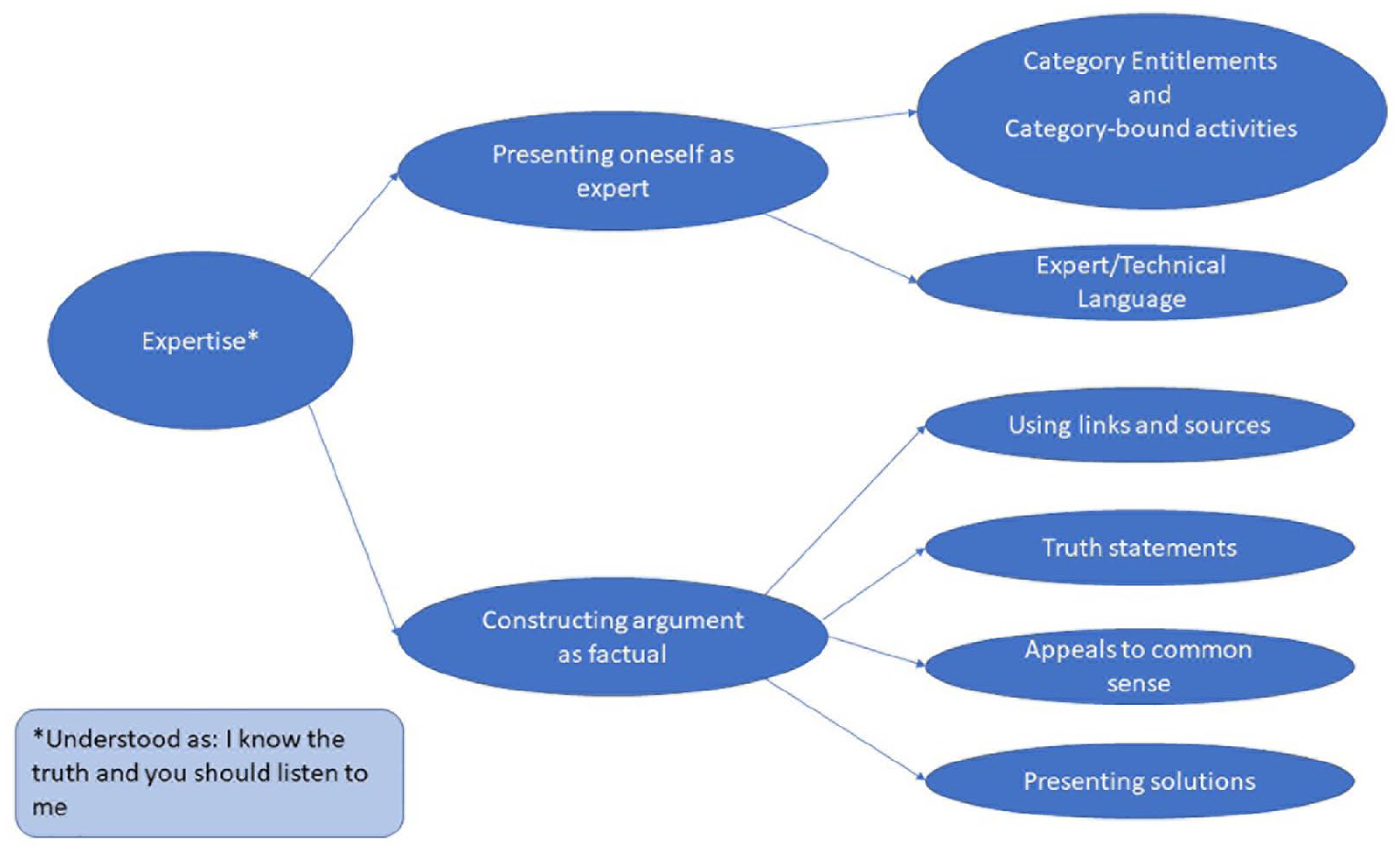
Discursive strategies aimed at conveying expertise.
Presenting oneself as expert
In this first section, we explore the discursive strategies adopted to present oneself as an expert. We identified two strategies here: the use of category entitlements or category-bound activities and using expert/technical language. In each section, we will show how these strategies are used to perform different actions related to presenting themselves as an expert.
Category entitlements and category-bound activities
One key point emerging from the analysis is that individuals very rarely explicitly claim expertise, by stating, for example, ‘I am a climate scientist’. Using such category-based claims to expertise provides the author with an ‘entitlement’ to particular knowledge related to that category (Potter, 1996). However, the use of this category does not reflect some fixed identity for any individual, but is rather an interactional resource for claiming entitlement to have knowledge or expertise on a particular topic (Potter, 1996; Rapley et al., 2003). In the rare instances in which posters did claim expertise through category entitlement, it referred to an area of expertise which was not directly related to climate science:
1 When I was an undergrad Astrophycist astronomers were just starting to be able to pick up 2 near earth asteroids in enough time to calculate the chance of them hitting the earth long 3 enough in advance to do something about it. . . . 4 What nobody expected was that if we put out a warning saying there was a 90% chance of a 5 catastrophic meteorite hit nobody would do anything. But that is exactly what has happened 6 with these IPCC reports. Amazing. (The Guardian, post 37)
In the above extract, the participant is using their qualification of ‘astrophysicist undergraduate’ to present themselves as entitled to make a claim about CC by virtue of having this qualification. The entitlement draws on an implicit category-bound predicate or characteristic (Stokoe, 2012) of someone with a degree in astrophysics, that is, that they understand science. It is this ‘expertise’ around science that gives the author the entitlement to comment on the response to the IPCC reports.
Commenters also sometimes implicitly claimed membership of the category of expert through carrying out category-bound activities which are associated with that category (Sacks, 1992). The viewer’s maxim proposed by Sacks (1992) states ‘if a member sees a category-bound activity being done, then, if one sees it being done by a member of a category to which the activity is bound, see it that way’ (p. 259). Thus, if a commenter shows that they have carried out activities that are associated with the category of ‘expert’, then they can be seen as being part of that category:
1 I have performed some simple annual algebraic calculations that prove global warming using 2 a thermal model as opposed to the greenhouse theory. This simple approach becomes 3 significant when combined with classic atmospheric weather patterns because it shows why 4 the arctic is melting and antarctic not which has been the thorn in the side for the 5 greenhouse theory. Why is this theory critical to the planet? Simply reducing CO2 6 concentration in the atmosphere in the short time frame is nearly impossible, thus the 7 greenhouse theory identifies a problem that cannot be resolved in the time frame necessary. 8 Simply stated, the thermal theory hypothesis: the planet is warming primarily due to the 9 combustion effect of fossil fuels as opposed to the greenhouse effect . . . (The Guardian, post 54)
Here, the commenter presents the category-bound activity of carrying out ‘algebraic calculations’, which can be read as an activity that belongs to a particular category: an expert. Chovanec (2016, p. 12) states, when talking about documentaries, that expertise is to ‘name and explain diverse phenomena’. While the commenter does not, then, explicitly state that they are an ‘expert’ in the area, they position themselves as someone who carries out ‘expert-based’ activities. In the rest of the post, the commenter positions themselves as someone who has the expertise to be able to explain the subject to other readers and positions the potential recipients and respondents of the post as needing this explaining to them ‘simply’.
The use of expert/technical language
The use of technical or scientific language may also mark a commenter as an expert even if they do not explicitly claim to be one. In the example below, the commenter is explaining their scepticism of human-made CC:
1 . . . In thermodynamic terms it is a ‘perpetual motion machine of the second kind’, the lower 2 atmosphere using its own internal energy to cause itself to heat and expand, imaginary 3 ‘positive feedback’. To create this fantasy, the models use 3x exaggerated GHE, a bad 4 mistake by Hansen’s group in 1981, not picked up in peer review. The final part of the fraud is 5 c. 25% extra cloud albedo in ‘hind casting’ to offset imaginary temperature rise. 6 In reality, there is no significant CO2-AGW. There was AGW from a different cause, but it 7 saturated about 2000. The World is starting to cool as we enter the new Little Ice Age. Pray 8 for cheap gas reserves to keep us warm for the next 50 years . . . (The Telegraph, post 60)
Throughout this extract, the commenter draws on technical language and subject-specific knowledge, such as ‘3x exaggerated GHE’ (line 3) and the reference to ‘Hansen’s group’, with a specific date used to provide further evidence of their subject-based knowledge (line 4). The use of such technical language can function to persuade potential recipients of the commenter’s knowledge, and as such, the author is implicitly claiming expertise. We can see how this subject-specific language is often accompanied by value-laden qualifiers ‘imaginary’, ‘fantasy’, and ‘fraud’ (which, in turn, suggest ulterior motives). At line 6, there is a truth statement (‘In reality, there is no significant CO2-AGW’) and a series of further statements that are all constructed as factual. There are no hedges or mitigation. Having established authority by adopting technical language and suggested the existence of specific stake or bias (Edwards and Potter, 1992) driving other experts’ assessments of CC, the commenter presents their interpretation as factual and truthful, thus demonstrating their own expertise.
We see, then, that authors very rarely make explicit claims to expertise. However, they do make implicit claims by presenting themselves as doing activities that place them in the category ‘expert’. As we saw with the final extract, there are ways in which authors can display expertise without explicitly claiming it. One way of doing this is through constructing their argument as factual, which we explore next.
Constructing an argument as factual
A key focus of discursive psychology is in examining how descriptions, statements or claims are constructed as factual (Potter, 1996). In a field like CC where the topic is disputed and discussed by commenters, presenting a claim as factual becomes important for the possibility of persuading recipients of the validity of the claim. We would also argue that in presenting a statement as factual, commenters are also implicitly claiming some expertise in that area. We have identified several strategies which are used by commenters to present claims as factual: (a) using links and sources, (b) truth statements, (c) appeals to common sense, and (d) presenting solutions.
Using links and sources
While individuals can present knowledge as their own and therefore present themselves as experts, another strategy identified was for commenters to use links to other sources providing information which is presented as credible. As such, the authors do not necessarily construct themselves as experts, but rather align their opinion to that of recognised experts. This group of strategies parallels the use of notes in Patrona’s (2016) work: while, in the context of TV debates, people rely on notes to support and better organise their claims, when commenting on news online, they have access to the Internet and can provide quotes and links that can complement and expand their argument. In doing so, commenters construct consensus while also implicitly stating their own expertise (i.e. their knowledge of the topic and their familiarity with other authoritative backers of their position).
This practice of claiming expertise can allow for recipients to see that there is some consensus around the arguments being made, from those who have a higher category entitlement to make such arguments. This type of strategy for demonstrating consensus is particularly important when considering the scale of debates around whether there is a scientific consensus about anthropogenic CC (Boykoff and Roberts, 2007). In the following extract, the commenter draws on a quote by an organisation to present their argument as credible:
1 GeolSoc - many members work in fossil fuels, so no agenda here. 2 This rate of increase of CO2 is unprecedented, 3 even in comparison with the massive injection of carbon into the atmosphere 55 million years 4 ago that led to the major PETM warming event, 5 and is likely to lead to a similar rise in both temperature and sea level. (The Guardian, post 4)
In this post, arguing in favour of the science and call to action in the IPCC report, the commenter uses GeolSoc (Geological Society) as a source of information, thus using a group which has a category-based entitlement to knowledge or expertise about CC. Moreover, the comment features reported speech, which offers the reader direct access to the claims, rather than a paraphrased claim, so that they can make their own judgement about its accuracy (Stokoe and Edwards, 2007). In this way, expertise is not claimed based on the commenter’s expertise but on their recourse to another group’s expertise. This also functions to demonstrate a level of consensus around CC. It is also noteworthy in this case that they present a stake inoculation at line 1 (cf. Edwards and Potter, 2005) ‘many members work in fossil fuels, so no agenda here’ in order to refute the potential that this group could be deemed as biased in some way.
A similar strategy, which can also function as a way of either supporting or undermining the claims about scientific consensus on CC, is to back up arguments with links to ‘official’ authoritative sources:
1 Carbon dioxide, considered the main vector for human-caused global warming, is some 2 0.038% of the atmosphere[1]- a trace gas. . . . 3 [1] Fundamentals of Physical Geography, 2nd Edition 4 by Michael Pidwirny Concentration varies slightly with the growing season in the northern 5 hemisphere. HYPERLINK 6 ‘http://www.physicalgeography.n. . .’ http://www.physicalgeography.n. . . (The Telegraph, post 15)
The author of this (originally extremely long) comment, which argues against anthropogenic CC, displays familiarity with the academic style of communication: they use references and endnotes to provide sources backing up their statements. This is an identity statement in itself, as this familiarity is likely to come from training (and therefore ‘expertise’). The use of other sources to back up their statement is also a way to build the idea that there is scientific support or consensus about their claim (Potter, 1996).
Truth statements
In previous extracts, we have seen that alongside claims to expertise in the form of technical language and the use of other sources, some comments also employed matter-of-fact statements to convey expertise. While these types of statements can be used in combination with other strategies, in this section, we will focus on these types of ‘truth statements’. Gilbert and Mulkay (1984) identified what they called an empiricist repertoire, which gives the impression that the comments ‘follow unproblematically and inescapably from the empirical characteristics of an impersonal natural world’ (p. 56). We see this empiricist repertoire in the following extract:
1 the inconvenient truth is the medieval warm period was warmer than today - and the roman 2 warm period even warmer than that. many of the temps we are being compared to were as 3 we were coming off an established ‘cold’ period following a mini-ice age. (Daily Mail, post 67)
The commenter draws on the title of the Al Gore documentary ‘An Inconvenient Truth’ (line 1) which is considered one of the main ways in which CC was initially bought into the public eye. In using the title of the documentary, the author places their comments and assertions on a par with those in the documentary: the commenter is now presenting their own ‘inconvenient truth’. Potter (1996) notes that if too much detail is provided in an explanation, it can be inspected for contradictions or confusions. In order to avoid this, individuals can be systematically ‘vague’, presenting few details which could be contested. We see this in the above comment, where the author provides fairly vague time periods (line 1–2) ‘medieval’ and ‘roman’ warm periods rather than specific dates. They do not provide definite temperatures, but rather simply say that the temperature was ‘warmer’ (line 2). In this way, they present their argument as being the real ‘inconvenient truth’ but equally do not offer any specific details which potential recipients could challenge.
Appeals to common sense
In this section, we explore how common knowledge is evoked as a source of expertise by the commenters. In her analysis of the way Greek citizens presented their expertise in the context of a political discussion programme, Patrona (2016) identifies ‘Appealing to common sense’ as a discursive strategy. This is a way to affirm one’s expertise by downplaying that of others. In Moscovici’s terms, this might be seen as a form of anchoring an unknown phenomenon (CC and its science) to something that is well known (Moscovici, 1981). Indeed, Farr (1993) identifies in social representations an important theoretical tool in understanding how the public makes sense of science:
1 ANYONE who does anytime travelling will have noticed that seasons all over are getting 2 messed up. It’s not just the UK but EVERYWHERE. That’s what climate change is doing. (The Telegraph, post 53)
Here, the participant is restricting the category of people who have this commonly held knowledge to ‘anyone who does anytime travelling’ (line 1). In this sense, it claims expertise based on the practice of travelling and it is not exclusive to a select group of qualified individuals (as indicated by the employment of block capitals in ANYONE). This experience-based expertise will lead to the common-sense conclusion that ‘seasons all over are getting messed up’. In other words, there is consensus among people who travel – the ‘experts’ – that climate is changing. The use of the term ‘EVERYWHERE’ (line 2) implies that this is generally known and easily detectable. This claim of practice-based expertise functions to set up an oppositional category. Individuals who do not recognise what is happening are either lacking common sense or do not have expertise (they do not travel). In other words, CC should be recognised if you have the requisite expertise or common sense.
In the following comment, the commenter also claims expertise through common-sense knowledge:
1 Warmism \ climatism is so yesterday. We all know it’s a complete load of rubbish, there is 2 no more mileage in it, give it a break permanently. No one in their right mind believes in 3 that nonsense. It’s not science. It’s fairy tale and a giant scam. (The Telegraph, post 68)
The commenter draws on the idea that it is well known that CC is ‘a complete load of rubbish’ (line 1), through stating that ‘we all know’ (line 2), which indicates that there is a consensus around this argument (Potter, 1996). They also set up two opposing categories: those who do not believe in CC and those who do – who are not in their right minds. It is also implied that those who believe in CC are not scientists but have instead been duped by a ‘giant scam’. In this way, they set up the idea that CC deniers or sceptics are scientists and experts, while those who believe in CC are gullible and not in their right mind.
Presenting solutions
In this final section, we show how commenters present solutions to CC as a way of claiming expertise:
1 When will we stop funding these charlatans. They now have as much credibility as FIFA. 2 Dredge the rivers, stop building on flood plains. rebuild the sea walls & get on with life (The Telegraph, comment 44)
This comment uses ‘truth statements’, but in this case, they are presented as ‘solutions’ to the issue of CC. The author offers three examples for how to manage CC, all of which are presented as obvious. However, they are also fairly vague – there is little explanation of what parts of CC this would solve, or any specifics about which rivers would be dredged for example. As such, although implicit expertise is claimed through presenting solutions (which by implication the IPCC have not thought of), there is a systematic vagueness (Potter, 1996) which means that they are less likely to be challenged by potential recipients.
Discussion
At a time when scientific credentials are no longer unanimously accepted as vouches for expertise, it becomes important to understand how expertise is constructed by the public. In the case of CC, the issue becomes particularly complicated: the phenomenon itself is very complex and a deep understanding requires the combination of competences derived from a series of highly specialised disciplines. Moreover, research shows how sections of the British media may have further muddied the waters, using a variety of strategies to undermine the scientific consensus and the expertise of climate scientists (e.g. Woods et al., 2012; Boykoff and Mansfield, 2008; Nerlich, 2010). We argue that by implication, readers might be left with the impression that expertise in this area is ‘up-for-grabs’. This article showed that expertise was very rarely explicitly claimed; more subtle strategies were employed that can seem very convincing but are hard to challenge or question.
One type of strategy was to construct oneself as having a category entitlement to expertise on CC. Commenters rarely employed straightforward category entitlements – rather, they tended to signal their belonging to an ‘entitled’ category implicitly, for example, by carrying out category-bound activities. These implicit constructions of expertise are perhaps harder to challenge than explicit constructions. Moreover, if people rely upon such implicit indicators of expertise, they may pay less attention to other credentials, such as scientific training and peer review, in public debates and news reports.
Another common strategy was to present arguments as factual. This was achieved in several ways. Commenters claimed expertise by adopting technical language, backing up their statements with relevant links or quoting what they deemed to be authoritative sources. Interestingly, these included politicians and scientists. The factuality of the comment was also claimed by making what we called ‘truth statements’, that is, by presenting opinion as ‘matter-of-fact’, without even attempting to argue in favour of it or justify the position taken. In some ways, these strategies mirror media presentations of CC. For instance, the media sometimes present politicians as CC experts (see Boykoff and Roberts, 2007; for similar discursive strategies in another political area, see Coen et al., 2017) and present experts’ contributions in the form of soundbites, where the expert gives a statement, rather than an argument (Kruvand, 2012).
Finally, commenters often presented their expertise by appealing to people’s awareness of generally known facts. Either by appealing to people’s direct experiences or by offering ‘simple’ solutions to the complex issue of CC, commenters seemed to construct themselves as more knowledgeable and competent than others who do not have the same experience or who make competing claims. Unlike many of the other strategies, truth claims and appeals to common sense do not emulate scientific discourse. Indeed, in some cases, these strategies may work to challenge scientific expertise on the grounds that it contradicts one’s own lived experience and knowledge. There are parallels here with the use of the idiom ‘listen to your body’ in online forums to challenge scientific knowledge about health (Versteeg et al., 2018). It may be, then, that there are tensions and synergies between specific strategies in the construction of expertise. For instance, perhaps strategies that assume an underlying confidence in sound science (such as category entitlements and technical language) tend to be deployed together by commenters to work up a more convincing account. Future work could usefully explore this possibility.
While a comparison between competing perspectives on CC was not the focus of this article and frequency of different strategies was not counted, it is noteworthy that all the strategies reported were represented across the spectrum (i.e. by people arguing both for and against the existence of anthropogenic CC). The presence of the same strategies in both ‘camps’ offers an interesting insight into the potential difficulty faced by a reader in determining others’ expertise. If both supporters and deniers of CC use the same discursive strategies to claim expertise, readers are perhaps forced to rely upon their existing political and moral allegiances in order to evaluate them.
Many of the strategies identified are common ways in which people construct reality in conversational terms (Potter, 1996) and in which ‘ordinary expertise’ (Eriksson and Thornborrow, 2016) is presented in mainstream media. Our commenters seemed to converge on an idea of expertise similar to ‘entitlement to speak the truth and be listened to’, reflecting the social, relational definition of expertise offered by Eriksson and Thornborrow (2016). While we agree that it is important to recognise and assign expertise to people on the basis of their own experiences and on the ways in which they use and make sense of mediated messages (e.g. Couldry et al., 2016), at the same time, we argue that there needs to be a shift in the way we think about – and indeed talk about – expertise. This is not to replicate an ‘elitist’ view of democracy, rather, to avoid the risks associated with claims to expertise in areas in which one has none. In other words, we should redefine what we mean by knowledge and who are the important actors whose voices we need to hear from. All citizens are impacted by whether governments decide to uptake the IPCC recommendations, so they have every right to be heard, both on and offline. Thus, when it comes to news media, it is important that everyone is given a voice so as to provide a wide representation of perspectives in a political debate (cf. Curran et al., 2014). Yet, it is important that citizens are empowered to represent their own expertise as intrinsically valid and not to claim expertise elsewhere.
People are indeed experts in their own life, and some may be scientifically trained and able to argue adopting scientific terminologies or to evaluate the soundness of scientific arguments. It is important to note that we are not making claims about the actual expertise of commenters on one or the other ‘side’ of the debate: Kahan et al. (2012) show how having expertise in science literacy and numeracy does not mean holding one or the other position in the CC debate. At the same time, however, the easy access to information online makes it easier for people to construct an ‘expert-sounding’ argument (cf. Nichols, 2017) but this does not mean that anyone can claim expertise in CC science. It is important therefore to disentangle political identity and ideology from science-based knowledge and evidence (see, for example, Kahan, 2014).
There were some limitations to the current study. The lack of a suitable left-wing tabloid article means that a particular section of the media-commenting public was not represented in our research. Media articles can be accessed across the globe, so caution is required in interpreting the strategies identified as typical of the British public in particular. Our focus was on identifying and unpacking key strategies used to construct expertise and it was beyond the scope of the study to compare their frequency among supporters versus deniers and across media outlets. Our typology of key strategies would provide a useful starting point for future research to conduct more content-analysis-based research examining whether and how they are associated with particular ideological positions with respect to CC. Finally, the current study focuses on the strategies readers used to construct their own expertise. It was beyond the article’s scope to also examine how commenters challenged the expertise of others. Studies have already shown that in online comments on British newspaper articles (particularly those published by right-wing newspapers such as the Daily Mail and The Telegraph), readers challenge scientific expertise on CC (Jaspal et al., 2013; Koteyko et al., 2013; Woods et al., 2018). Future research might usefully explore whether and how discursive devices promoting one’s own expertise are used in conjunction with strategies to undermine that of others.
In conclusion, readers commenting on CC news claimed expertise by presenting themselves as comfortable with the subject and style of communication attributed to experts in the media or by challenging this type of knowledge and proposing instead a more ‘common sensical’ understanding of reality, thus appealing to a different form of expertise, borne out of direct experience and understanding. This diversity indicates that the very idea of expertise is a fluid concept that is not captured satisfactorily by ‘traditional’ definitions such as the one provided by Hoffman (1998). Furthermore, claims to expertise were often indirect. This combination of fluidity and indirectness could make it difficult to challenge such claims. As such, the lay strategies identified in this article should be seen as a force to be reckoned with in public engagement with CC science.
Footnotes
Funding
The author(s) received no financial support for the research, authorship, and/or publication of this article.
