




Abstract
Undergraduate special education teacher preparation is only effective if graduates persist in the profession, yet many face early career burnout, especially when working with children with challenging behavior. In this article, we discuss how higher education faculty can embed high-impact practices that help develop autonomy and relatedness and inoculate preservice candidates against early burnout. We highlight protective measures and offer resources for higher education faculty and preservice teachers considering ways to prevent burnout along the preparation pathway.
To support positive educational outcomes for students with emotional and behavioral disorders (EBD), the field of special education depends on the ongoing development and sustainability of new generations of special education teachers (SETs). In that way, outcomes for students with EBD are deeply tied to education professionals’ own mental and physical health and persistence in the field. When educators themselves are healthy, they have more capacity to identify student strengths and needs and implement instruction and related services accordingly. But when teachers experience burnout, their instructional quality decreases (Madigan & Kim, 2021a), and they are more likely to leave the field (Madigan & Kim, 2021b).
Unfortunately, research shows that SETs often experience stress and burnout associated with their work (Bettini et al., 2017; Cancio et al., 2018; Park & Shin, 2020). Teachers of students with EBD are at a particularly high risk of experiencing these negative psychological experiences due to the high emotional demands of the job and the inadequacy and/or imbalance of associated resources (Brunsting et al., 2021). At the same time, many college students entering educator preparation programs are already experiencing poor mental health (Eisenberg et al., 2025).
As a team of teacher educators in a predominantly rural state with a high proportion of students identified with EBD (i.e., 15%; U.S. Department of Education, 2023), we are concerned about the professional sustainability of the passionate students whom we shepherd into the special education workforce each year. We want to help them avoid the burnout and associated attrition that too often occurs among special educators, leaving many schools’ special education departments consistently understaffed (National Center for Education Statistics, 2023).
To this end, we have continually reflected on two questions: (1) what would it take for SETs to experience their work as joyful, manageable, and sustainable? And (2) what can we do within teacher preparation to plant the seeds that facilitate this type of career? Our hypothesis is that while teacher preparation programs writ large are heavily focused on the licensure competencies and standards they must address to fully prepare educators to enter the field, there are other important dimensions of high-quality SET preparation that can prevent the seeds of early burnout.
Over the past several years, we have redesigned our undergraduate SET preparation programming (Kervick et al., 2025) to deliberately embed a variety of high-impact practices (HIPs; Kuh, 2008a) that may serve as protective factors, supporting students’ likelihood of navigating threats to their well-being and health as they begin their careers. These include strategies to build choice into the professional pathway, orient students into the profession, and encourage opportunities for students to pursue interests and passions (e.g., first-year seminar, service learning, global learning, undergraduate research) as protective measures to support their well-being. Through intentional implementation of these HIPs embedded within our teacher preparation program, we aim to “inoculate” our special education teacher candidates against early career burnout, especially when working with children with behaviors that adults perceive as challenging.
We use the term inoculate to signal that teacher preparation programs can play a role in embedding protective factors that will help prevent preservice SETs from experiencing early seeds of burnout as they develop the skills, dispositions, and competencies to become fully prepared SETs. While the term may seem clinical, we intend it to signal proactive and intentional actions that undergraduate teacher preparation programs can take to integrate HIPs to equip preservice SETs to experience their jobs as sustainable, even when they are challenging. Such efforts do not replace core learning outcomes in the program of study that support preservice SETs in developing skills and competency for the responsibilities of the job (e.g., teaching social-emotional skills, responding effectively to challenging behavior, providing evidence-based specialized instruction, collaborative teaming). Instead, these embedded strategies help preservice SETs explore their own behavior and development toward wellness and self-determination. While we recognize that no single preparation strategy can solve or eliminate burnout risk, we hypothesize that building these skills during preparation may offer some protection as graduates enter the workforce. These are protective factors, not definitive solutions. We hope that this article sparks a conversation among faculty engaged in SET preparation to explore other ways we may collectively and proactively reduce the burnout threat as preservice SETs enter the field, especially when working with children with EBD.
Addressing Three Basic Needs: Promoting Preservice SETs’ Autonomy, Competence, and Relatedness
To reduce the risk of burnout, faculty and leaders in educator preparation programs must consider how to bolster new special educators’ intrinsic motivation and well-being, as protective factors, before they enter the field. In Deci and Ryan’s (2008) Self-Determination Theory (SDT), they assert that the fulfillment of three basic needs contributes to human well-being across cultures: autonomy, competence, and relatedness. Research has shown that the absence of autonomy, competence, and relatedness influences teachers’ intentions to leave the profession (Bettini et al., 2023). In addition to the call for a better understanding of what types of working conditions may support SETs in meeting their basic needs for autonomy, competence, and relatedness, we believe that educator preparation program faculty and leaders must engage in ongoing reflection regarding the extent to which we are addressing these needs during future teachers’ preservice years, as a proactive way that may help reduce the risk of early burnout and support novice teachers in persisting in the teaching profession. As Brunsting and colleagues (2023) point out, “. . . teacher preparation programs may be a high leverage opportunity to support SET’s well-being and promote their affective engagement throughout their careers” (p. 309). We assert that faculty and leaders in teacher preparation programs must impart not only knowledge and skills (i.e., increase preservice SETs’ competence by attending to practice-based standards for special educators, see Berlinghoff & McLaughlin, 2022), but also intentionally create learning environments that foster their own sense of autonomy and relatedness. Autonomy, as defined by Deci and Ryan (2008), is when individuals feel a sense of volition and choice in their actions (e.g., a sense of agency and ability to determine their pathway). Deci and Ryan (2008) define relatedness as when individuals feel connected and have meaningful relationships with others (e.g., form a community or experience a sense of belonging).
These three needs are universal and align with many strategies that SETs themselves will use when teaching students with EBD. For example, choice-making (an element of autonomy) is a widely practiced positive behavior intervention strategy that teachers of students with EBD can employ to reduce instances of challenging behavior and foster self-determination (Shogren et al., 2004). Likewise, relationship building has been found to be effective in supporting students with EBD and has the added benefit of diminishing burnout (Van Loan & Garwood, 2020). By strengthening preservice SETs’ own autonomy and relatedness through our pedagogy, we believe their experiences will generalize into their work with their future students with EBD. In other words, fostering preservice SETs’ autonomy and relatedness while in college also boosts preservice SETs’ competence to teach their future students these skills.
We acknowledge that there is already important emphasis on the basic need of competence in teacher preparation to develop a highly prepared special education workforce, as program faculty and leaders recognize that strong preparation increases the likelihood that SETs will persist in the field (Miller et al., 1999). Teacher preparation should continue to attend to the ways in which coursework can integrate skill-building to ensure SETs feel competent to navigate the working conditions that await them when they enter the workforce. Feeling competent is an important element of self-determination. However, the basic needs of autonomy and relatedness do not necessarily receive the same intentional attention in educator training programs. In the following sections, we introduce the idea that HIPs for undergraduate education may bolster the development of the other components of self-determination, autonomy and relatedness, along the preparation pathway.
HIPs for Addressing College Students’ Self-Determination
In 2007, the Association of American Colleges and Universities developed a list of evidence-based HIPs for college learners (Kuh, 2008a). Four HIPs that can be embedded in undergraduate education to promote preservice SETs’ self-determination are (a) first-year seminars and experiences, (b) service learning (SL), (c) global learning/study abroad, and (d) undergraduate research (Kilgo et al., 2015; Kuh, 2008b). First, seminars and experiences for students in their first-year can have a positive impact on engagement and promote substantive interactions with peers and faculty (Keup & Young, 2018). For example, first-year seminars enhance students’ sense of relatedness when they orient students to campus resources (Al-Sheeb et al., 2018). Second, participation in SL can be particularly impactful in teacher education, helping preservice teachers to connect theory to practice (Resch & Schrittesser, 2023) and engage in their communities (Piestrzynski & Williams, 2024). It enhances both students’ sense of competence and their relatedness to their communities.
Third, studying abroad builds intercultural competence (Huang et al., 2023). Moreover, students who participate in study abroad are more likely to voluntarily participate in other HIPs (Di Maggio, 2019). It can therefore enhance students’ sense of autonomy, competence, and relatedness. Finally, participation in undergraduate research has significant positive effects on learning outcomes (Kilgo et al., 2015) and student engagement (Lanning & Brown, 2019). Within the field of special education, it is important for practitioners to be confident in using evidence-based practices, particularly when working with students with EBD (Gable et al., 2012). Being able to engage with new research literature enhances preservice candidates’ sense of autonomy and choice over their own professional decision making. Figure 1 conceptualizes our theory of change leveraging HIPs in undergraduate education as the protective measures which may inoculate preservice SETs against early career burnout. Our program design embeds HIPs into our undergraduate special education teacher preparation, to help preservice SETs develop their sense of autonomy, competency, and relatedness. These seeds of well-being and self-determination may help protect preservice SETs against burnout as they enter the field and begin working with students with disabilities including EBD.
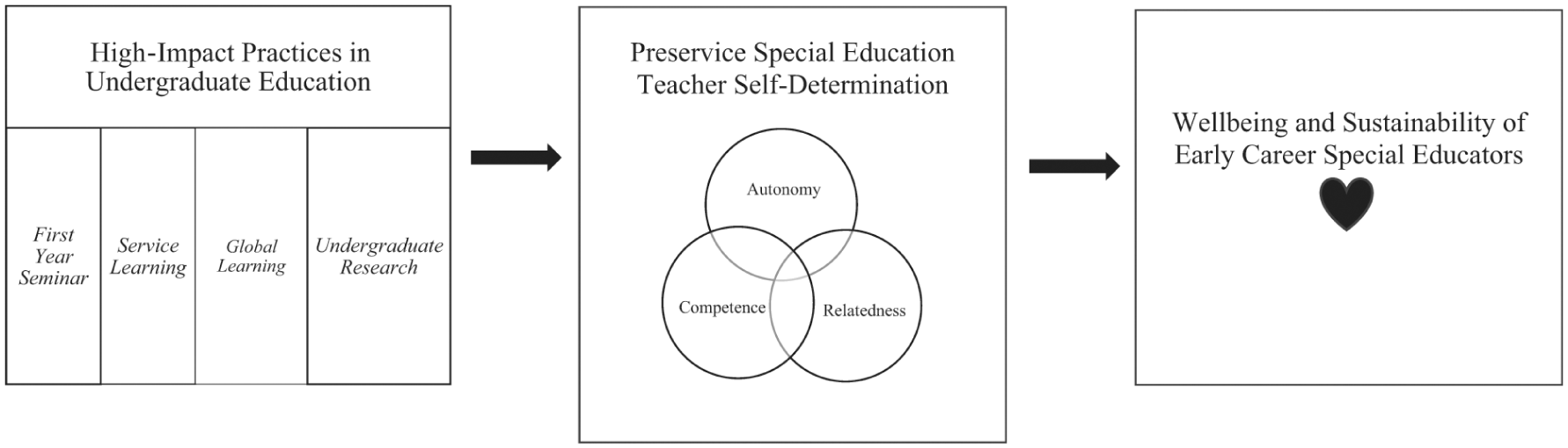
High-impact practices to develop self-determination to prevent early career special education teacher burnout.
Before describing the specific HIPs named in Figure 1, we acknowledge an important limitation, which is that no teacher preparation approach can eliminate or solve burnout. Research shows that burnout is primarily driven by working conditions in schools (Brunsting et al., 2024). Our goal is to potentially reduce vulnerability to burnout by strengthening protective factors during teacher preparation. We view these HIPs as one piece of a larger solution that must ultimately include systemic improvements to working conditions for special educators. The strategies we describe are intended to serve as protective factors that may increase resilience, not as guarantees against burnout. In the narrative descriptions of the HIP strategies that follow, we weave examples of how Maya, a composite representation of our current students, is inoculated against early career burnout by building up her self-determination and wellness through these experiences throughout her teacher preparation program journey.
First-Year Seminar and Multiple Plan “A’s”
Maya entered our program as a first-year student from a small rural community. She grew up in a household with a younger brother who struggled with behavioral outbursts. Initially diagnosed with a developmental delay, later Maya’s brother qualified for special education services under the category of Emotional Disturbance and experienced challenges with making and sustaining friendships. As an adolescent, Maya’s brother had difficulty with bouts of depression. Maya and her brother are close, and she is a key ally of his. She is nervous about starting college, yet excited about her chosen program – Special Education – as she hopes to learn more about working with children who exhibit behaviors others find challenging. Maya does not know much about what the special education major will entail, so she is relieved to find out that she will be enrolled in a seminar with other first-year special education majors that will help her begin to plan her teaching journey.
Brunsting and colleagues (2023) urge teacher educators to contemplate how their programs prepare teacher candidates with skills that will support their work with students (e.g., skills for supporting children with complex disabilities) as well as general skills related more specifically to the role of a special educator (e.g., collaboration with others, advocacy). To help teacher candidates develop role-oriented skills, a range and variety of field experiences and an early orientation to the diversity of roles within the profession are critical.
Maya’s first memories of “being a teacher” are when her brother’s behavior therapist would visit their home and include her in his weekly play therapy sessions. It was these memories, and the feelings they provoked, that inspired Maya to see herself as a special educator someday, specifically an early childhood special educator. As they grew older, Maya enjoyed spending time with her brother at her aunt’s horse barn. They loved riding together. She also loved participating as a member of her brother’s individualized education program team and supporting him to achieve his goal of independently living with a roommate in his own apartment after transitioning to college. Maya could see herself in the role of a high school special educator as well! How would she discover which career path would be the right one for her?
In our program, preservice SETs enroll in coursework that spans the birth-age 21 spectrum and they elect to engage in field experiences that will support them in determining the age bands they want to work within and ultimately earn their licensure and endorsement. State endorsement and licensure areas in special education in our state include birth–age 6, Grades K–8, Grades 7–age 21, or some combination of those age bands. Field experiences include a variety of spaces where future special educators could apply their skills such as traditional public-school settings, therapeutic settings for children with EBD, and community-based settings. Students have the autonomy to explore different settings and age groups and ultimately make their own decision about their preferred age band.
Instead of having a lock-step curriculum devoid of choice, our program offers multiple pathways and possibilities for candidates to individually tailor their preparation as a future SET. As a program, and aligning with SDT, we believe that having this level of autonomy is essential to fostering candidates’ internal motivation to work within varied special education contexts, with unique students and families, and may empower them to persist and sustain in the field despite challenges they might experience as novices. However, providing candidates with the freedom to choose their own pathways, without targeted supports, may be counterproductive.
Recent research suggests that adolescents’ sense of personal agency is diminishing (Anderson et al., 2019). Agency is defined as the capacity “to influence intentionally one’s functioning and life circumstances” (Bandura, 2006, p. 164). This means that preservice SETs may need a supportive undergraduate learning environment that encourages them to both decide what they want to do for themselves (autonomy) and have the capacity to act on their choices (agency). Offering a broad curriculum that speaks to preservice SETs’ passions, cultural backgrounds, and talents may help to develop students’ personal autonomy and agency. To this end, when considering their future preparation and entry into the teaching profession, they enroll in a 1-credit required seminar during the second semester of their first year that aims to familiarize them with the field of special education and the wide-range of career paths for special education majors’ post-college. Throughout the class sessions, candidates’ learning intersects with self-reflection of their values, passions, goals, and environmental, social, and cultural influences on the development of special educators’ identity. As part of the seminar, candidates are presented with the idea of creating three “Plan A’s” for their next 5 years (i.e., 4 years of undergraduate study and 1 year post), an idea borrowed from a Burnett and Evans (2016) book on how to think and plan like a designer. Each Plan A that candidates create represents a different approach to their goals for life related to working in the field of special education. Candidates are encouraged to not view these as “Plan A, Plan B, and Plan C,” but rather three possible “Plan A” scenarios with each plan feeling like a real choice (Burnett & Evans, 2016).
As seasoned academic advisors, we have noticed an increase in the mental health needs of first-year college students (Wyatt et al., 2017) and witnessed students unravel when an unexpected life event wreaks havoc on their plan of study. In the past, when preservice SETs were expected to have only one plan of study, we saw them interpret their program plan as their only plan. Candidates viewed any differentiation from the original plan as failure, and it was sometimes difficult to visualize alternate paths forward. This was one of the reasons for creating an undergraduate degree program that would allow for maximum flexibility, encouraging autonomy and reflection to try out various opportunities, experience multiple age bands, and follow their interests. We want candidates to reframe the belief that there is only one singular plan for earning a special education degree at our university into the idea that “there are multiple great lives (and plans) within me, and I get to choose which one to build my way forward to next” (Burnett & Evans, 2016, p. 90).
We hope that by supporting preservice SETs to imagine many possibilities for their undergraduate years, they get the opportunity to exercise autonomy, make choices, and exert more control over their programs of study than are traditionally available in teacher preparation programs. This includes exploring a range of academic minors, campus jobs, and extracurricular clubs that can enrich their minds and fuel their passions, supporting their holistic development across their college experience.
Furthermore, strengthening their sense of relatedness, their plans are not meant to be developed in isolation. Rather, candidates are encouraged to create their plans in community with others who know them well and can offer insights into their strengths and skills not readily seen by themselves. We encourage undergraduate students to share their ideas with a group of friends, referring to them as their “life design team.” We encourage them to invite people to this team who will ask good questions but not offer critiques or unwanted advice. We believe that designing three “Plan A’s” and building a network of supports through communicating professional goals with friends, family, and faculty is an important inoculation strategy in not only building these strategic relationships but also supporting candidates in becoming autonomous in charting their professional pathways.
Maya is thrilled that she does not have to choose, before even attending college classes, whether she most wants to work with young children or young adults with disabilities. As Maya begins mapping out possibilities for her time as an undergraduate, she created a “life design team” of individuals she knows will offer her great ideas to ponder. For example, at a campus event, an informal social gathering for students to drink tea and be in community with one another, Maya meets Victor who is a social work major and a double minor in French and equine studies. Maya is thrilled to learn that there is a minor that focuses on horses! Victor shares that he will be doing a practicum in the spring semester at a therapeutic school for children with EBD. She makes a note that she would like to make sure one of her practicums focuses on that population of students as well. In one seminar class session she also learns about different professional organizations, including the Council for Exceptional Children’s Division for Emotional and Behavioral Health, and is curious to discover any resources on supporting children with mental health challenges. It sparks her interest in research. She recalls on her college admissions tour that the guide emphasized undergraduate research opportunities at the University. Now Maya is hard at work to figure out three possible “Plan A’s” for her undergraduate years that incorporate different field experiences, adding a minor, and working with faculty to conduct research. She is also feeling less anxious about the next four years, knowing that there is room in her degree plan to pivot as she discovers more about herself, the profession, and her interests.
Service Learning
Service learning is a HIP (Kuh, 2008a) grounded in service, reciprocity, and critical reflection (Tinkler et al., 2014). Service learning requires a strong partnership between the university and the community entity, and the goals for each partner must be explicit and honored. Inherent in SL is students’ deep reflections on their experiences while serving the community partner, and these reflections often result in significantly shifted dispositions and improved confidence (Tinkler et al., 2014).
In the fall semester of her second year, Maya declares a minor in equine studies and finds her time at the university’s horse barn to be extremely relaxing. She recalls the ways in which being with horses was a calming influence on her brother and makes a note to do some research on careers in special education that may also include work with horses. An additional benefit of spending time in the barn is that she has met a broader circle of friends including Anna who is studying to become a speech-language pathologist. Anna mentions to Maya that there is a speech-language pathology certificate that could complement her major. Maya makes a note to investigate this option further because in her first field placement in an alternative program for middle school students with EBD, she’s noticing a connection between language development and some of the behaviors she’s witnessing. She’s been feeling a bit anxious about how to respond to the behaviors she’s been seeing in her practicum and makes a note to reach out to Victor and see if he has any strategies to share from his previous placement. Maya’s also feeling a bit nervous because this semester she is learning about the importance of family partnership through an SL course. She is anxious about scheduling the SL component into her busy schedule and lacks confidence in skills she has to offer, particularly when she learns she will be interacting with families with refugee backgrounds newly arrived in the country. Having grown up in a rural predominantly white community, Maya worries that she will have a hard time building connections and juggling the SL hours on top of such a busy schedule.
Fostering family and community partnership is a critical part of being an effective SET, yet novice SETs are often unprepared for taking on this responsibility and face low confidence in their abilities to partner with families (Kyzar et al., 2019). Being expected to forge family partnerships with limited skills and when there are tense relationships can lead to feelings of inadequacy and stress and contribute to teacher burnout (Fox et al., 2020). To boost confidence and the desire to embrace family partnerships, we designed a required SL class that brings undergraduate students into the community to learn from families and agencies that support a variety of family needs. Through this class, preservice candidates understand the benefit of teachers being “connectors” (i.e., learning about student and family needs as well as community resources and making connections between them; McKnight & Block, 2010). The classes also emphasizes asset-based partnership and the joy of engaging in relationships.
Choice is an important aspect of the SL component of this course. As the semester begins, we invite community partners to our class to share information about potential SL opportunities for students. Students are required to complete 15 hours of service in the community across the course of the semester, and they exercise self-determination and autonomy by choosing their activities according to their interests and schedules.
This is a scaffolded experience. In class each week, the professor dedicates consistent time to debriefing community-engaged experiences. Candidates keep a journal to process their own thoughts, and they talk about what they are doing and seeing in whole-class and small-group discussions. Candidates raise questions and learn to problem-solve and debrief together. By design, the community-based experiences are ambiguous and difficult for many candidates at first. Candidates build confidence, comfort, and excitement as they continue. Engaging in this potentially ambiguous work is part of the inoculation strategy. That is, family and community partnerships are organic and should be experienced while in preservice training, so students persevere through the messiness to develop partnership-oriented dispositions while in a reflective and supervised setting. We believe that all these experiences help candidates understand the joy that authentically engaging with families and community partners can bring.
Maya decides to sign up for cooking with families as part of bi-weekly family dinners at a local community organization. The families come from different countries of origin and many individuals are beginning to learn English. Across the semester, Maya becomes more confident initiating conversation and learning about family members’ lives and family member children’s needs. One mom shares that her child’s been exhibiting challenging behavior at school. Maya is feeling more confident in the relationship through having cooked with the mom over the past two months and shares some ideas of strategies that may be helpful (e.g., a choice menu) that she learned about in her practicum placement, which the mom appreciates. She even hires Maya to help care for her son over the weekends. Maya reflects in class to her peers that although she was nervous to work with families, the SL experience helped her build confidence and see the importance of getting to know family’s interests, strengths, and needs as well as the importance of building positive relationships with families. She even learned some new recipes!
Global Learning
Global learning is a HIP that involves problem-solving, engaging diverse perspectives, collaboration, and supporting collective well-being (Landorf & Doscher, 2023). Cross-cultural and linguistically diverse experiences are enriching and build self-efficacy and autonomy, essential for navigating unfamiliar contexts (Huang et al., 2023).
In developing her three plan A’s, Maya contemplates whether she wants to do a traditional semester study abroad or take advantage of other global learning opportunities offered by the university. When she entered college, she was adamant that she would study abroad in New Zealand during her junior year. However, over the past two years, she added a minor in equine studies, and a certificate in speech-language pathology assistant. Maya becomes involved in mentoring with the university’s postsecondary education program for young adults with intellectual disabilities and through that work had connected college students with intellectual disabilities to programming at the horse barn, a program that she initiated and hoped to continue to offer. She also makes some friends who love snowshoeing, and they develop a weekend routine where they explore a new trail and have brunch.
Maya discovers that getting out into the woods in the winter with a group of friends is a great way to destress and she starts to feel concerned about taking a full semester away. Maya initiates a conversation with program faculty to revisit her plan to see whether a shorter term experience would be the right fit. However, she wants to make sure it is not just a tourist style experience, as she has been learning about culturally responsive practice and wants a global learning experience that continues to help her develop those skills. Maya decides to enroll in a travel study course offered by special education program faculty during the spring semester of her junior year that facilitates a SL experience in Costa Rica focused on community and family partnership over the spring break. She is excited to be able to still have a global learning experience while being able to sustain the other passions and hobbies that are emerging as important for her well-being. She is especially looking forward to learning about the experiences of children with disability and their families in the Costa Rican communities they will be visiting.
We have developed two travel study courses, one in Costa Rica and one in the Azores islands, that align with the learning outcomes for the special education major but also attract students from a variety of disciplines on campus. In a 10-day intensive travel experience, undergraduate students explore local schools and communities, learning about various education systems. Through digital storytelling, candidates compare cultures, fostering joyful connections among families, children, and peers. This course also encourages our preservice SETs and their peers to step back from their own cultures, gaining deeper insights and appreciation while promoting asset-based thinking that supports their roles as future SETs.
Weekend adventure activities designed to stretch comfort zones empower students by allowing them to choose their pursuits, whether white-water rafting, jungle hiking, or swimming in hot springs. These experiences foster curiosity, resilience, and autonomy while strengthening community among students. We believe that the therapeutic benefits of nature, such as hiking and wildlife observation, rejuvenate our students’ spirits and inspire fresh perspectives upon returning.
Teachers frequently face behavioral challenges without clear solutions. The travel experiences provide opportunities to navigate ambiguity, such as adapting to unexpected situations while staying with host families (Haines et al., 2021). This process cultivates essential flexibility and emotional regulation skills crucial for classroom dynamics. Moreover, we believe that the shared experiences create strong friendships and collaborative learning, forming supportive social networks among future educators. By sharing strategies and offering mutual support, candidates enhance their ability to navigate classroom challenges.
Offering travel study opportunities as part of a teacher preparation program equips undergraduates with vital skills to face professional challenges. Travel studies are an inoculation strategy that can serve as a robust foundation for preparing future teachers, nurturing their autonomy and relatedness while equipping them with essential skills to embrace ambiguity, support their well-being, and experience adventure. Exposure to cross-cultural experiences enhances their capacity to become effective, empathetic, and innovative educators, fostering a lifelong passion for teaching.
In her final journal reflection, Maya describes her time in Costa Rica as life changing. She learns a lot about herself, particularly her capacity to be flexible and patient in unfamiliar situations and endure challenging circumstances. Over the course of the week at one point Maya contracts food borne illness along with several of her peers which fuels a lot of stress in the group. In managing that anxiety and supporting her peers, Maya draws upon strategies she had learned from coursework, recent field experiences, and supporting her brother, which reinforces a sense of confidence and an emerging sense of “expertise” that she can draw upon in a novel setting and unexpected circumstance. She is grateful for her SL experience of cooking with families, which provides skill building opportunities that support her while engaging with children and families in Costa Rica. Even though at times the experience is challenging, Maya has fun, and the experience reinforces that cooking with others is a passion! She is excited to share new foods and recipes with her roommates when she returns.
Undergraduate Research
In the first-year seminar, preservice SETs are introduced to the scholarship and passions of special education program faculty. Advisors assist these undergraduate students in knowing about opportunities to get involved in research, especially as it aligns with student interests. Currently, there is not much research on the benefits for preservice SETs engaging in research. However, undergraduate research can be impactful for college students in a variety of ways. The benefits of undergraduate research include the development of career readiness skills, experiencing personal and professional growth such as identity development and articulating career goals, experiencing a practical application of knowledge learned through coursework, engaging with diverse perspectives, opportunities to develop leadership skills, and developing an understanding of how the skills honed through involvement in research can be applied to their future careers (Mekolichick, 2023).
Maya has reached her senior year. She cannot believe it is her final year of college. In revisiting her three Plan A’s, she realizes that she ended up pursuing a mash-up of the three plans as her goals and interests continued to evolve over her undergraduate experience. She also notices some ideas that she had to let go of when circumstances changed and she had to be mindful of her own needs and well-being. Although she had at one point considered minoring in Spanish, she ended up not being able to fit it in. However, she is feeling confident that there will be opportunities post-college to brush up on her language skills. She reflects upon the freedom she has had to carve her own path and the ways in which it has led to discovering new things to study that complement her major, as well as hobbies and wellness activities that she hopes to maintain beyond college. The variety of field experiences has prepared Maya for her culminating student teaching experience in the spring semester where she has decided to focus on elementary-aged students. However, first, she can finally check off one of her goals that she flagged during her first-year seminar! Maya is excited to take an independent study to participate in a community-engaged research opportunity with a local public school inclusive early childhood special education classroom. Specifically, Maya’s role will be assisting the school teaching team to implement evidence-based, classroom-wide practices to support children’s social-emotional growth and prevent challenging behaviors. Maya is one of five other undergraduates, representing education and psychological sciences majors, involved in implementing this pilot program.
High-quality research on evidence-based interventions for young children with behaviors adults perceive as challenging is limited (McKenna et al., 2021). Gaps between research and practice have been noted, along with the importance of teachers being able to translate research to practice when working with children with EBD (Cook et al., 2003). Practitioners need to be able to evaluate the conditions under which selected practices will be effective and acknowledge that while there are several evidence-based practices available for practitioners to implement, more research is needed that focuses on children with EBD (Riden et al., 2022). For undergraduate teacher preparation, the opportunity to engage in research that establishes evidence for practices preservice SETs might use in their teaching careers may enhance their awareness of evidence-based practices (Greenwood & Mabeady, 2001) and their implementation of these practices as novice teachers (Jones, 2009). Furthermore, community-engaged research in local schools may increase preservice teachers’ opportunities for exploring classroom life, strengthening their practical teaching skills, and reducing the dissonance they may feel from their preconceived notions of teaching and reality, all of which may sustain them and their well-being into their future careers (Brunsting et al., 2023).
As part of the research team, Maya collects data on student behaviors using antecedent-behavior-consequence or ABC analysis. Team members analyze the behavior together and then suggest evidence-based strategies to the preschool teachers on proactive and responsive strategies to intervene. The experience energizes Maya. She begins to see that teachers do not have to “go it alone.” Not only can they partner with special educators, but they can think about other community resources such as university students and faculty to help them in intervening with students with EBD. Moreover, through consulting with teachers and her peers, Maya has added additional tools and evidence-based strategies to her toolbox, which she knows will be instrumental as she transitions into full-time student teaching. Maya feels a growing sense of self-efficacy in connecting research to practice and experiences firsthand the importance of relationship building across a team to address challenging behavior. All this reinforces for Maya the idea that undergraduate research experiences may be an effective inoculation strategy.
Integrating High-Impact Practices for Self-Determination Into Educator Preparation Programs: Guidance for Teacher Educators
While research begins to emerge on the role of teacher preparation in preventing burnout, teacher preparation programs can begin to act. Specifically, as programs are revising or updating curricula, thinking intentionally about the moments and places in the curriculum where there might be opportunities to engage in different HIPs is critically important. Program faculty might consider the following questions as they reflect on their preparation programs:
Is our SET preparation pathway designed to cultivate dimensions of well-being through focus on autonomy and relatedness, in addition to competency development?
How might SET preparation leverage HIPs (Kuh, 2008a) as a vehicle for developing autonomy and sowing the seeds of relationship building for preservice SETs?
How might the HIPs be intentionally incorporated into the preparation pathway to prevent early career burnout and foster self-determination and wellness as graduates enter the workforce to serve children with EBD?
Table 1 offers a series of reflection questions to spark undergraduate teacher preparation faculty and preservice SETs to engage in contemplation on the ways in which candidates can determine their path into the profession and the important resources, supports, and relationships that can elevate their sense of autonomy and well-being along the journey. Table 1 includes questions for both faculty and preservice candidates recognizing that it is not solely the responsibility of faculty members to hold all the answers and “possibilities.” We believe that it is a mutual responsibility. That is, it is critically important for preservice SETs to develop the initiative and ability to explore, critically evaluate, and make decisions, because those skills will be needed throughout their professional careers.
Reflection Questions and Resources for Embedding High-Impact Practices Into Undergraduate Special Education Teacher Preparation.
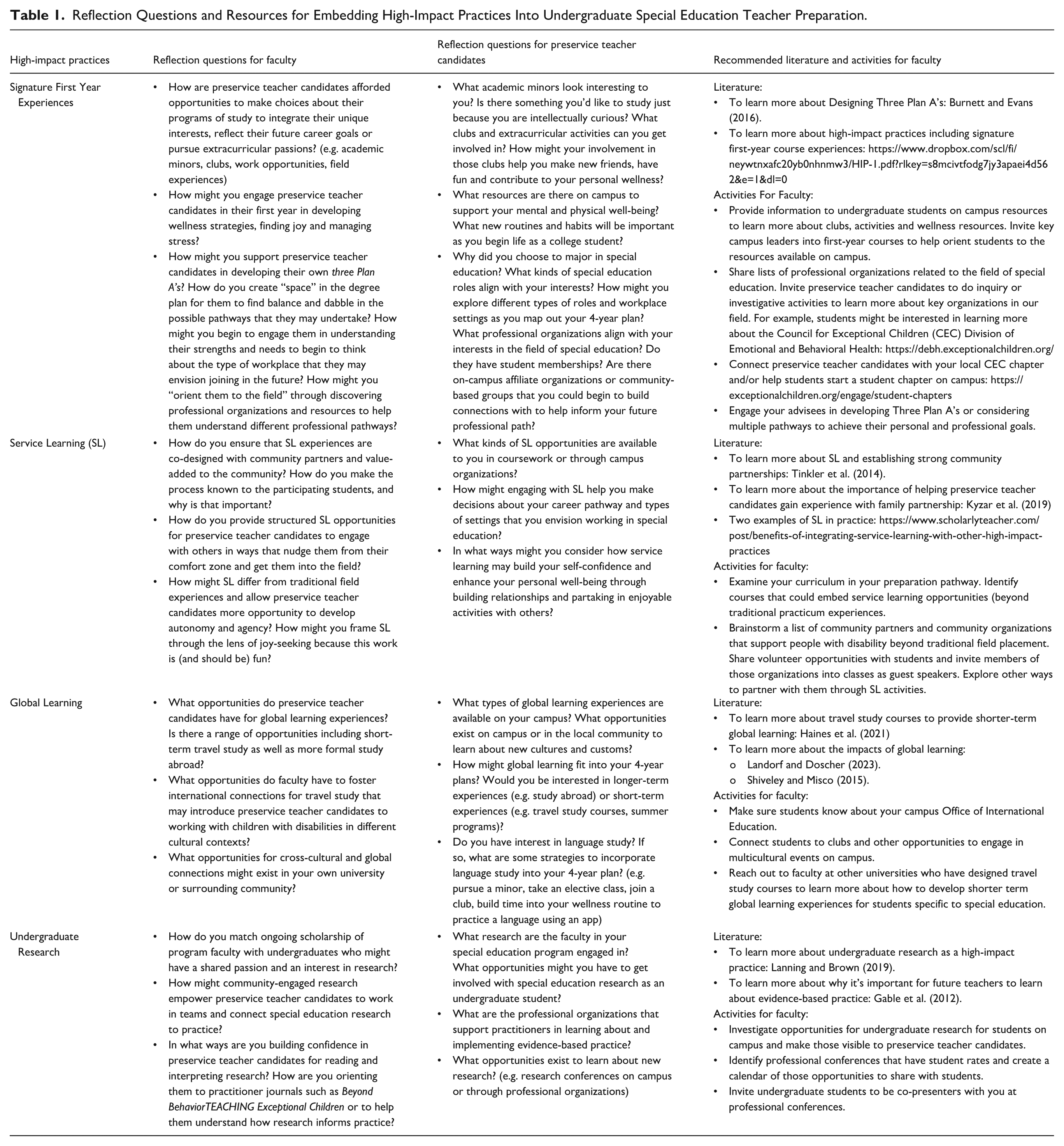
Table 1 also includes resources and literature to learn more about the practices highlighted. For example, faculty and candidates can examine the first-year experience as candidates matriculate into their degree programs and consider how they might envision their college experience including extracurricular activities, academic minors they might discover, and relationship-building opportunities. Additionally, faculty and candidates can examine how to embed opportunities for SL or global learning that foster opportunities for candidates to build self-confidence, experience fun adventures, navigate unfamiliar situations, and develop meaningful cross-cultural relationships. Faculty and candidates may also choose to reflect on the ways in which candidates become confident in connecting research to practice and seek opportunities to learn about faculty research to participate in during their college experience. The ideas and reflective questions captured in Table 1 provide a roadmap for special education teacher preparation programs to begin the process of aligning HIPs to foster autonomy and relatedness as protective measures against early burnout. Table 1 also includes relevant literature and helpful resources where faculty and preservice SETs can learn more information related to the practices outlined, as well as suggested activities to embed into their program design.
While this article focuses on a conceptual framework and practical strategies for embedding HIPs into preservice special education teacher preparation to inoculate candidates from early career burnout, we acknowledge the importance of empirical evidence to evaluate the impact of these approaches on candidate well-being, autonomy, and relatedness. Our team is currently developing a comprehensive evaluation plan to examine outcomes such as autonomy, competence, relatedness, and indicators of mental health and burnout risk. Planned measures may include brief validated scales to assess perceived stress and qualitative reflections collected at multiple points across the program. These data will allow us to assess whether the HIPs described here function as protective factors against burnout and contribute to candidates’ resilience and persistence. We encourage other teacher educators to consider similar evaluation strategies that use both quantitative and qualitative approaches to build a shared evidence base for practices that promote sustainability in the profession.
Collecting evidence for continuous improvement is essential for all teacher preparation programs. Teacher educators seeking to evaluate the impact of HIPs on candidate well-being might consider several methods. First, brief surveys can be used at program entry and exit to measure key program outcomes (e.g., autonomy, relatedness, stress). Second, faculty can systematically embed reflection prompts throughout coursework to capture qualitative insights. Third, faculty can track students’ participation in HIPs, including the number of SL hours, global learning experiences, and engagement with undergraduate research. Lastly, to protect confidentiality, faculty can aggregate collected data at the cohort level to inform program design. Collectively, these strategies may provide actionable feedback without requiring large-scale research infrastructure.
Conclusion
Suppose novice teachers need to experience autonomy, competence, and relatedness to sustain their roles in the field of special education. In that case, teacher preparation programs do not have the luxury of simply attending to students’ development of competence alone. It is also essential to bolster their autonomy and relationship skills. One way to accomplish that is through teacher education program faculty providing repeated opportunities to students to practice exercising students’ own volition and forming relationships with others during their preservice years. This is critical, particularly given the fact that burnout is something that is frequently experienced by special educators working with children with EBD (Garwood et al., 2018) and that teachers who are less emotionally exhausted may be more optimistic about their work (Brunsting et al.,2024). The job of a special educator requires that they utilize relationship-based approaches (Van Loan & Garwood, 2020), support choice-making as a fundamental right (Bannerman et al., 1990), and not only respond to challenging behavior but increase self-determination and quality of life for the students they are serving (Shogren et al., 2004). Future SETs need to develop these skills within teacher preparation through curated opportunities to strengthen their own sense of autonomy and network of relationships. The protective strategies offered herein are examples of ways in which undergraduate teacher preparation can leverage HIPs that may reduce the risk of early career burnout and strengthen the self-efficacy and well-being of SETs as they enter the workforce, potentially increasing the likelihood that SETs may find a sense of joy and accomplishment in the work.
In her final semester student teaching seminar, Maya is thinking about her post-graduation plans. Her faculty engage her and her peers in thinking about the working conditions and types of settings they feel most align with their own interests and professional goals. Maya values the varied experiences she has had in her undergraduate program and the important relationships she has created both within the university and the broader community. Maya has written down key questions she hopes to ask future employers, including the degree to which there is a commitment to collaboration and mentoring early career SETs.
Maya reviews her three Plan A’s and decides she is really interested in working in a location within driving distance of a community horse barn. She wonders if she can start a middle school club to connect children with mental health challenges with horseback riding. Teaching in a community with racial and ethnic diversity is also important to Maya, informed by her SL and travel study experiences. She hopes to get a job as a SET working with students who have challenging behaviors as her experience conducting community-engaged research on social-emotional learning strategies sparked a passion for working with a team on evidence-based behavior intervention planning. A bonus for Maya might be landing a job in a college town with proximity to winter recreation so she can stay connected to university resources and continue to destress by snowshoeing in the winter. Regardless of where she lands, Maya feels gratitude for having charted out a road map that is unique to her strengths, passions, and interests. Maya realizes the ways in which that autonomy has led each of her graduating peers to map out a different entry point into the profession, while building a lifelong network of colleagues that can support each other in their different trajectories.
Footnotes

Funding
The authors received no financial support for the research, authorship, and/or publication of this article.
Declaration of Conflicting Interests
The authors declared no potential conflicts of interest with respect to the research, authorship, and/or publication of this article.