




Abstract
Special education teachers (SETs) working with students with emotional and behavioral disorders (EBD) often experience high stress and feel underprepared to meet the complex needs of their students. Research shows that strong student–teacher relationships are critical for both SETs and students, yet preservice programs rarely provide explicit instruction in relational skills. Drawing on Torey Hayden’s autobiographical narratives, along with related research, this article presents a vision for reconceptualizing preservice training to prioritize relationship-centered, process-oriented teaching.
Special education teachers (SETs) working with students with emotional and behavioral disorders (EBD) are struggling in the classroom. This group of educators reports elevated levels of stress (Hester et al., 2020) and faces a heightened risk of burnout (Jeon et al., 2022). Many enter classrooms without adequate training to address the complex social, emotional, and behavioral needs of their students due to insufficient training in teacher preparation programs coupled with meager professional development opportunities in schools (Haines et al., 2017). Teacher shortages compound the problem. These SETs are serving students with EBD regardless of certification, experience, or preparedness (Brunsting et al., 2023). As a result, many SETs feel overwhelmed, underprepared, and unable to provide the consistent support their students need (Brunsting et al., 2023).
This gap in preparation has real consequences for students. Students with EBD often require strong, trusting relationships with their teachers to succeed academically and socially. Fox et al. (2020) found that relationships are one of the most powerful factors supporting both teacher well-being and student success. Relationship-building skills are rarely taught explicitly in teacher training programs, though.
This article proposes a vision for closing that gap. It first examines the challenges faced by students with EBD and the limitations of current teacher preparation programs. It then introduces a process-oriented, relationship-based approach inspired by the work of Torey Hayden. Finally, it outlines a preservice course model, grounded in Hayden’s narratives and supported by existing research, that loads future SETs with the relationship-building skills necessary to thrive in tomorrow’s classrooms.
Challenges Faced by Teachers of Students With EBD
Students with EBD are among the most challenging populations to teach (Billingsley et al., 2006). They face elevated risks for poor academic outcomes, social skill deficits, and mental health concerns (Kauffman & Landrum, 2018; Leggio & Terras, 2019). Vulnerably, many contend with both externalizing behaviors (e.g., aggression, defiance) and internalizing struggles (e.g., anxiety, withdrawal), which can disrupt learning and hinder peer relationships. Dropout rates are higher for students with EBD than almost any other disability category, and long-term improvements in academic or behavioral outcomes are practically undetectable over time (Leggio & Terras, 2019; State et al., 2019). Clearly, students with EBD present intensive needs that demand the leadership of well-trained teachers who can combine academic instruction with intensive social-emotional support (Cumming et al., 2021).
Gently stated, SETs do not always enter the field well-trained to meet the needs of their students. Up to 32% of SETs in some states lack full certification (U.S. Government Accountability Office [GAO], 2024), and researchers found teachers working with students with EBD are less experienced, less qualified, and more likely to be certified through alternate certification programs compared with other educators (Billingsley & Bettini, 2019). As teacher shortages intensify, districts are assigning SETs to challenging roles regardless of certification or experience. Thus, it may come as no surprise that special educators are feeling underprepared to lead students with EBD. This mismatch between student needs and teacher preparation has SETs feeling underqualified and overwhelmed. More importantly, this leaves students without the consistent, skilled support they require.
Research points to the power of strong student–teacher relationships in changing this dynamic. Positive student–teacher relationships are important for the successful academic, social, and emotional development of students (Capern & Hammond, 2014). Students with EBD value teachers that display warmth, understanding, and patience (Capern & Hammond, 2014). Moreover, students admit that a meaningful relationship with their teacher is essential to their success in school (Sellman, 2009).
Strong, stable teacher–student relationships improve academic motivation, students’ sense of belonging, and school climate and act as a protective factor from increased internalizing and externalizing symptoms for students (Longobardi et al., 2019; Scales et al., 2020). For teachers, strong classroom management stems from positive teacher–student relationships (Marzano & Marzano, 2003). Breathing life into this concept of relational skills is tough, though. Most teacher preparation programs do not provide explicit, structured guidance in relationship-building, leaving new teachers to learn through trial and error, often in high-pressure conditions.
Addressing this training gap is essential. Preparing SETs to work with students with EBD must go beyond the basics and include a deliberate, evidence-based approach to forming authentic connections. One way is to reconceptualize preservice support for SETs. This challenge presents a great opportunity for colleges and universities to teach preservice SETs how to build the skills needed to form relationships with students with EBD. The next section explores one promising framework: shifting teacher preparation toward a process-oriented, relationship-centered mindset (M. J. Marlowe & Hayden, 2013).
A Shift Toward a Process-Oriented Mindset
The dynamics of goal versus process orientation are discussed by M. J. Marlowe and Hayden (2013). Goal orientation is focused on a product or result. Behavior is motivated by the desire to achieve a goal, and motivation is largely extrinsic (M. J. Marlowe & Hayden, 2013). M. J. Marlowe and Hayden (2013) call goal orientation doing mode because it burns cognitive, analytical, and intellectual thoughts as its methodological oil. Process orientation hangs on the other side of the spectrum. It is focused on growth, relationships, and development. M. J. Marlowe and Hayden (2013) say process-oriented behavior is motivated by the meaning and fulfillment found within the experience or process itself rather than the outcome, and motivation is typically intrinsic. Process orientation is being mode because its methodology is built from awareness and receptiveness. Importantly, M. J. Marlowe and Hayden (2013) emphasize that one orientation is not better than the other and, as such, both orientations are necessary for a healthy and balanced way of life.
We believe that with a heavy focus on standardized testing, K–12 schools are generally goal-oriented. They are pressure cookers for meeting test score targets, covering required curriculum, and producing measurable results. In a goal-driven system, teachers can feel pressured to “get through” content rather than engage with the process of growth and relationship-building. It is our belief that standardized testing and data-driven mandates have taken the reigns. Students have become data points. On top of that, teachers are stuck in the product-focused mud as schools lose sight of the beauty in the process of student growth and development. By hyper-focusing on benchmarks, schools lose sight of the child. While accountability has its place, we believe that an overemphasis on outcomes can sideline the connections that fuel learning, especially for students with EBD. A relationship-based mindset gets back to the basics of why teachers teach.
We believe that a process-oriented approach offers a counterbalance. Rather than centering on end results, such as standardized tests, process orientation values the experiences, interactions, and personal growth that occur along the way (M. J. Marlowe & Hayden, 2013). We believe that motivation in this mode is primarily grounded in meaning, curiosity, and connection. Process-oriented SETs can prioritize flexibility, responsiveness, and empathy, recognizing that trust and rapport are often prerequisites to academic success, particularly for students with EBD. Currently, most teacher preparation programming regarding students with EBD leans heavily on goal-oriented skill sets (e.g., responding to misbehavior) while giving less space to the “being” skills that foster trust, empathy, and authentic connection (Oliver & Reschly, 2017). For SETs to thrive, we believe that they need explicit practice in process-oriented thinking and relationship-building.
We believe that Torey Hayden’s work offers a vivid entry point for this shift. Hayden is a special educator and child psychologist specializing in working with students with severe social, emotional, and behavioral challenges. She is also a successful author. Her books are true stories based on her classroom experiences. While today’s teachers are feeling overwhelmed with dizzying intervention options, Torey Hayden’s books suggest that a better approach to working with students is by building healthy relationships. Her autobiographical books, such as One Child (1980) and Somebody Else’s Kids (1982), invite readers into her classroom, showing how patience, flexibility, and trust can support students with EBD.
Hayden’s autobiographies do not sugarcoat anything. In fact, they portray the job as challenging yet rewarding, with an aura that small victories are hard to come by but deeply meaningful. In a course for preservice SETs, it might be difficult to communicate the realities of a class of students with EBD. Torey Hayden’s stories fill this gap and provide a front-row seat to the successes and challenges of serving this unique population of students. In the next section of this article we examine three research-based methods for integrating Hayden’s literature into preservice programs, offering a practical path for embedding relationship skills into teacher preparation.
Fusing Narrative Literature With a Relationship-Based Preservice Approach
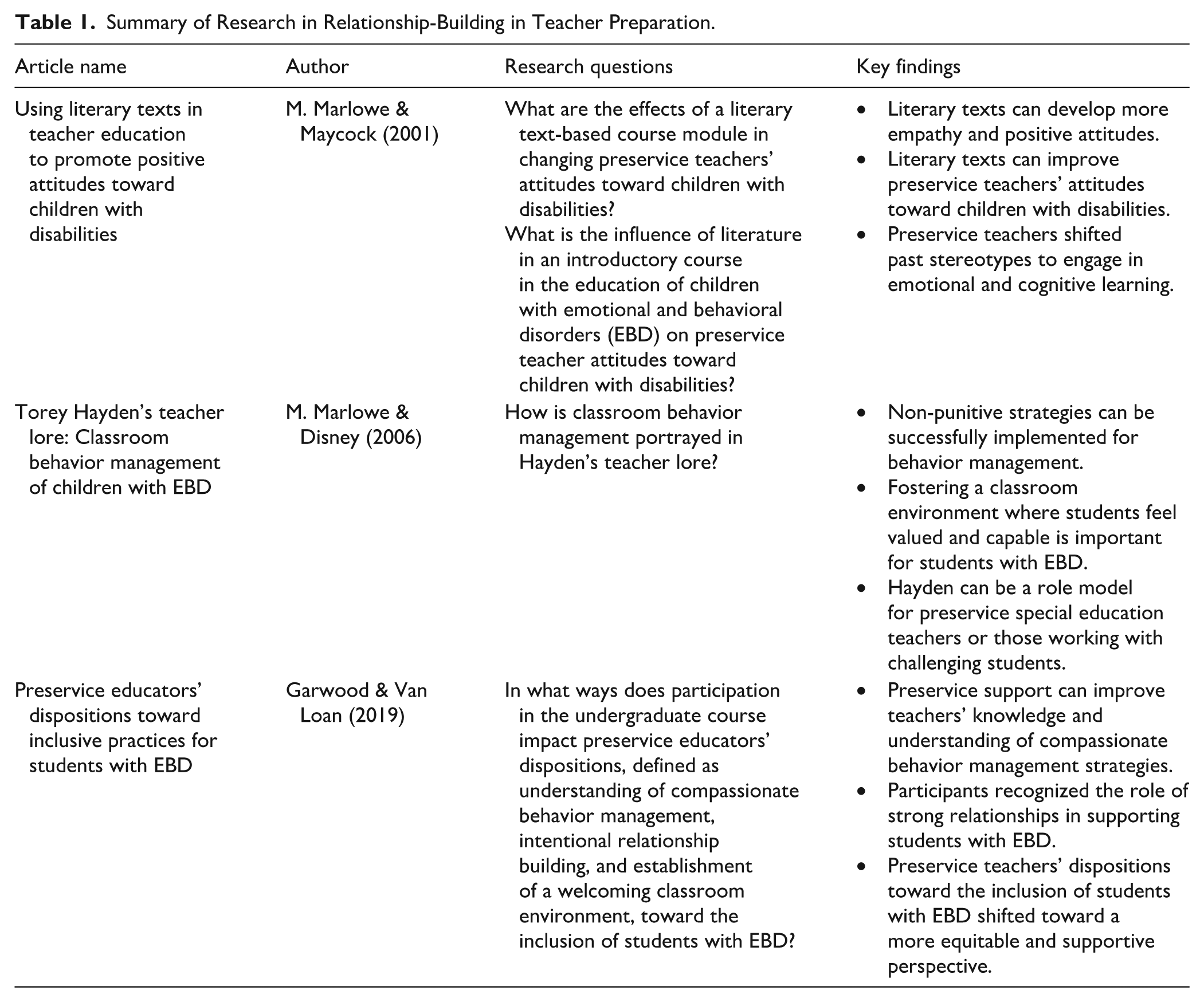
Research shows that Torey Hayden’s autobiographical books can be more than inspiring stories. That is, they can be structured tools for building relationship-focused skills in preservice SETs. As shown in Table 1, several studies demonstrate practical ways to integrate her narratives into coursework, helping future SETs engage with the emotional, behavioral, and instructional complexities of teaching students with EBD.
Summary of Research in Relationship-Building in Teacher Preparation.
Guided Literary Analysis for Reflection and Empathy
M. Marlowe and Maycock (2001) conducted a study of 29 students enrolled in a teacher education course. Researchers leaned on five of Hayden’s stories as the primary source for class lectures, discussions, and assignments. Written assignments leaned on specific prompts around the complex nature of Hayden’s experiences in a particular book (M. Marlowe & Maycock, 2001).
M. Marlowe and Maycock (2001) followed a six-step procedure for class discussions and response papers that included (1) retelling the story parts with a focus on feelings, characters, and situations relevant to the problem, (2) probing events from the story to facilitate a shift in feelings and relationships, (3) stimulating the class to identify similar situations in real life or from other media to lend validity to the idea that books can extend actual experiences, (4) providing an opportunity for the class to explore the consequences of certain behaviors or feelings in the book, (5) fostering the drawing of conclusions or generalizations about whether certain actions in the book had positive or negative effects, and (6) allowing classmates to determine the desirability or effectiveness of several actions in a specific situation in the book (p. 329). This structured approach prompted preservice teachers to think critically about the relational and behavioral decisions depicted in Hayden’s classrooms while also reflecting on their own potential responses in similar situations.
Linking Narratives to Behavior Management
M. Marlowe and Disney (2006) extended this work by connecting Hayden’s storytelling to Fritz Redl’s (1966) influential theory of managing behavior problems. Redl introduced techniques that remain cutting-edge today such as accommodating classroom environments to students’ emotional needs, limiting negative consequences, and preventing aggressive, self-injurious, or disruptive behavior in non-punitive ways (M. Marlowe & Disney, 2006). He is also recognized for developing life space interviewing, a therapeutic, verbal strategy for intervention with students in crisis that continues to be used by therapists and counselors today (Redl, 1959).
Redl’s theory on managing behavior problems identified five strategies that educators can use to address student behavior problems: changing, managing, tolerating, preventing, and accommodating (Redl, 1966). M. Marlowe and Disney (2006) examined how classroom management is portrayed in Hayden’s books through Redl’s theoretical lens. Their article detailed each of Redl’s five strategies that teachers use to address problem behaviors by operationalizing them and connecting multiple quotes from Hayden’s books that directly reflect a specific strategy. Hayden often used “managing” strategies to de-escalate situations in ways that preserved student dignity or “changing” strategies to reshape classroom routines for better emotional safety. We believe that pairing narrative examples with components of a recognized theoretical framework can provide preservice teachers with concrete response strategies that are grounded in authentic classroom contexts.
Enhancing Dispositions Toward Students With EBD
Garwood and Van Loan (2019) conducted research focused on the impact of Hayden’s literature on preservice teachers’ attitudes. They conducted a mixed-methods study of 41 preservice educators in an undergraduate course. Participants were provided focused instruction to support students with EBD using Torey Hayden’s autobiographies. Research results unveiled improved preservice educator dispositions toward the inclusion of students with EBD (Garwood & Van Loan, 2019). Furthermore, through Hayden’s books, themes emerged from participant voices such as the power of authentic learning, caring for children, and separating students from their behavior.
No known standardized measure is available to gauge proficiency in teacher–student relationship skills. However, faculty can lean on surveys used by Garwood and Van Loan (2019) to collect data on teacher–student relationships, classroom ecology, and behavior management. Garwood and Van Loan’s (2019) research can be included in collegiate classrooms to emphasize the value of building relationships to enhance classroom management.
Together, these studies offer a replicable model for embedding relationship-building into teacher preparation programs. Hayden’s books provide meaningful, emotionally rich scenarios to include in coursework. Structured discussions like that described in M. Marlowe and Maycock (2001) can facilitate deep reflection. Theoretical connections like Redl’s (1966) framework can translate insights into actionable strategies. Intentional instruction, found in Garwood and Van Loan’s (2019) research, can help shift teacher dispositions in ways that support effective classroom management. In the next section of the article we build on these foundations, proposing a preservice course design that places relationship-building at the center of teacher preparation for future teachers of students with EBD.
A Vision for Preservice Education
We believe that a clear, explicit roadmap for teaching relationship skills to preservice teachers might effectively support both SETs and students with EBD. This approach is consistent with Council for the Accreditation of Educator Preparation (CAEP, 2022) and Council for Exceptional Children (CEC, 2020) standards, which highlight reflective practice and relational understanding as essential outcomes of excellent SET preparation. Educators and researchers have already utilized Torey Hayden’s stories in preservice classrooms with positive student outcomes (e.g., Garwood & Van Loan, 2019). A loose model has already been developed by multiple research teams (see Table 1). The model will act as the canvas for this conceptualized preservice course that is focused on teaching future SETs to build strong relationships with students with EBD.
Course Purpose
This suggested course can be designed to provide preservice SETs with the knowledge, mindset, and skills necessary to form authentic, trusting relationships with students with EBD. The course can include Torey Hayden’s autobiographical narratives as core texts and blends reflection, theory, and application in a process-oriented framework.
Course Texts
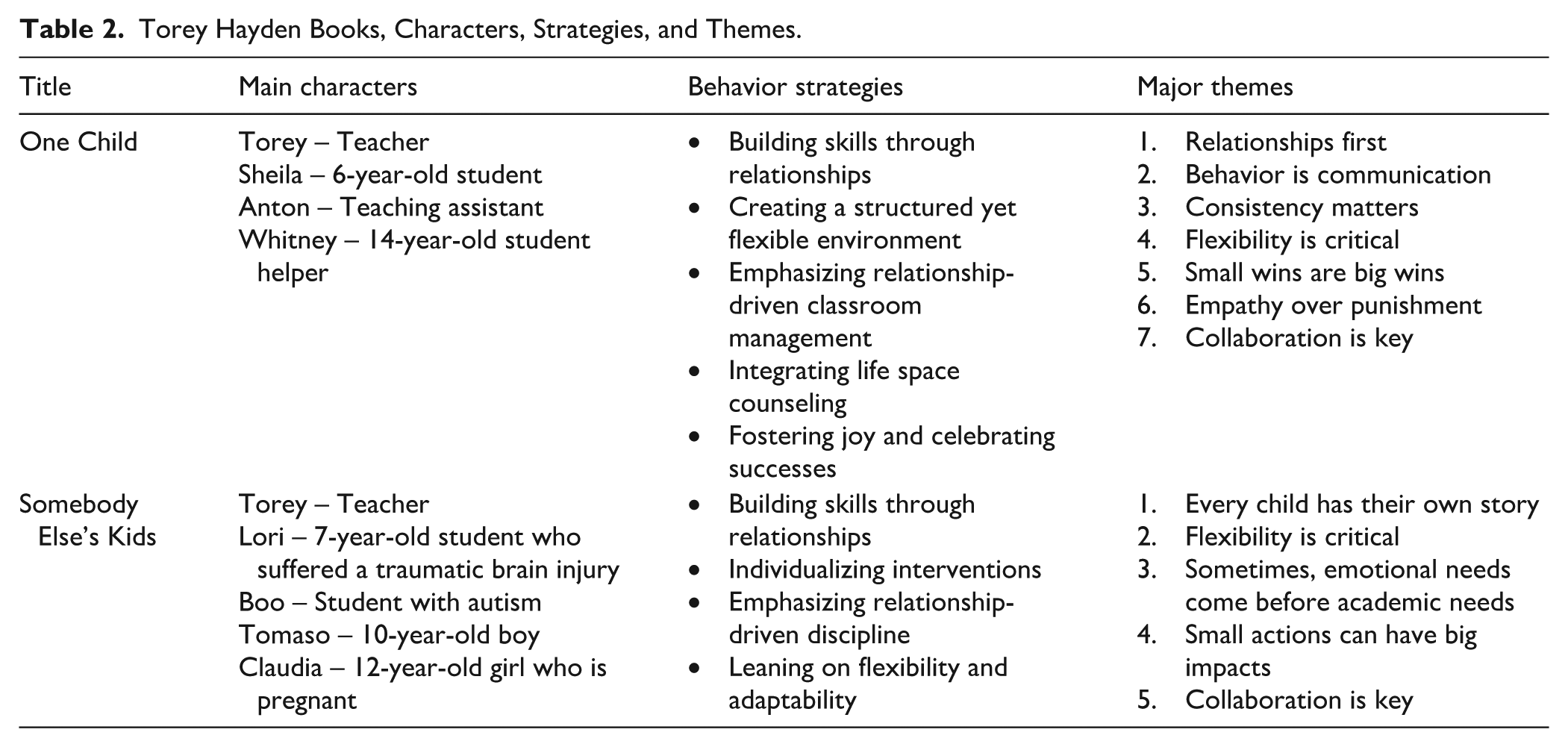
Primary readings can be drawn from Hayden’s autobiographies, offering distinct classroom contexts and relationship-building examples. Hayden’s books may help preservice SETs explore trauma-informed teaching, relationship-building skills, empathy, trust, and more. We suggest a starting point for preservice teachers be One Child (Hayden, 1980). The narrative centers around Torey leading her students with social, emotional, and behavioral challenges. A main student in the book, Sheila, is a 6-year-old girl who has suffered severe abuse and neglect. Before transferring into Hayden’s class, Sheila conducted a disturbing act of violence that severely burned a younger child. Sheila’s IQ is high, which adds a unique layer for Hayden to consider. The story expresses how Hayden supported Sheila, and her classmates, through the school year.
Somebody Else’s Kids (Hayden, 1982) is the second recommended text. In this book, Hayden’s students have unique needs. Lori has a traumatic brain injury, Boo is a nonverbal child with autism, and Claudia is pregnant. The narrative models how individualized support, empathy, and trust help meet the needs of each child. Hayden’s other books can supplement the course or be considered as alternatives. Table 2 provides a quick reference guide to Hayden’s literature.
Torey Hayden Books, Characters, Strategies, and Themes.
Course Objectives
Learning objectives for this course can consider the full spectrum of relationship-building skills necessary for preservice SETs in the classroom coupled with Hayden’s texts. Objectives can be flexible starting points and, leaning into a process-oriented mindset, can be adjusted throughout the course. For example, by the end of this course, preservice SETs should be able to: 1. Identify and apply trauma-informed, relationship-centered teaching strategies drawn from Hayden’s narratives; 2. Analyze classroom interactions to determine how teacher actions influence student behavior and trust; 3. Develop strategies for building rapport in diverse classroom contexts; 4. Reflect critically on personal attitudes, biases, and approaches to relationship-building; and 5. Demonstrate the ability to integrate process-oriented thinking into classroom decision-making.
Course Assignments
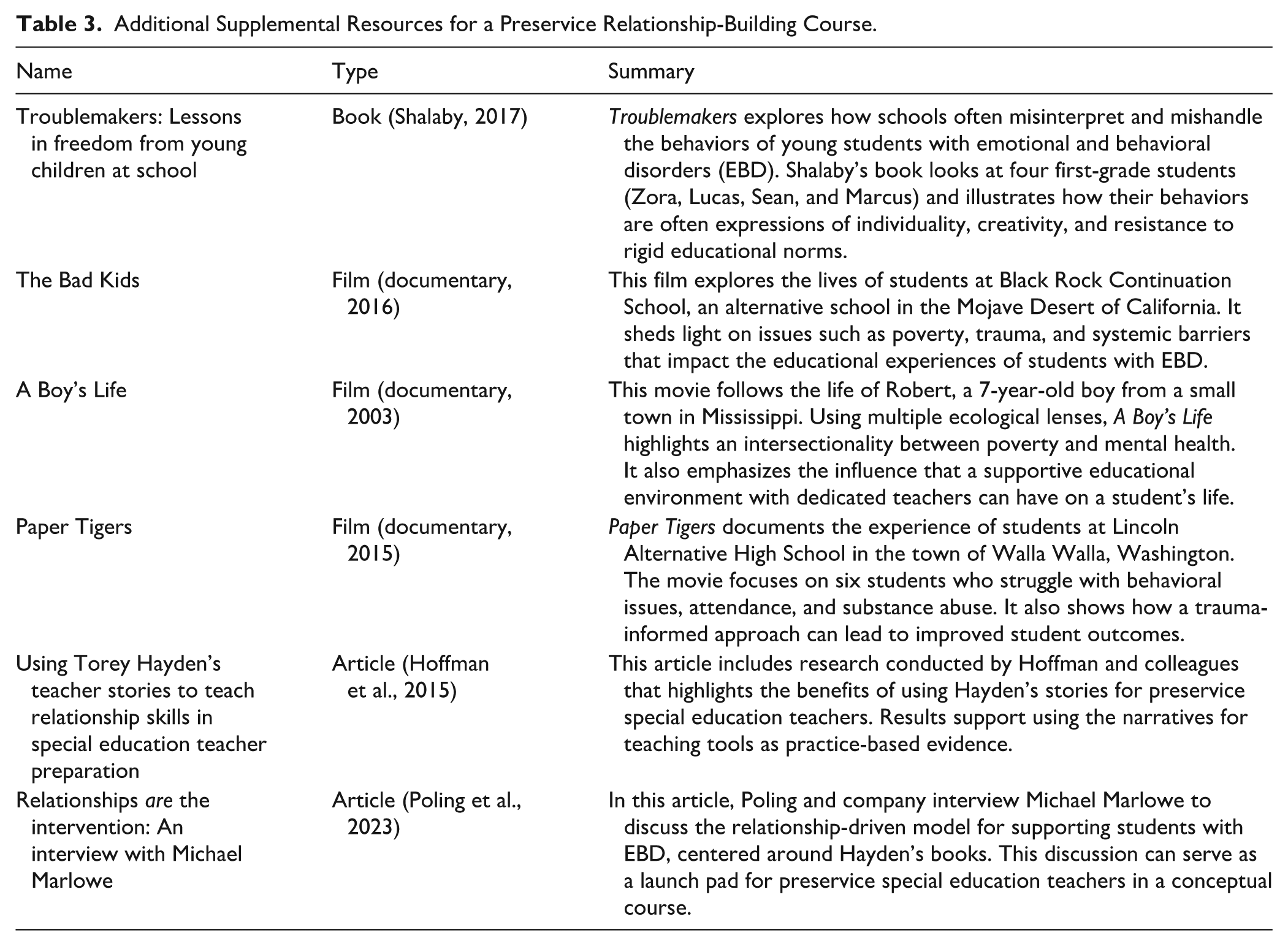
Assignments can be designed to give preservice SETs opportunities to reflect, collaborate, and apply relationship-building strategies in realistic contexts. Each task can be designed to build on the course’s process-oriented focus, encouraging students to critically assess their own perspectives, practice empathy-based communication, and translate lessons from Hayden’s narratives into actionable skills for working with students with EBD. These assignments can aim to develop the relational mindset that we believe is essential for long-term success in the classroom. Finally, supplemental resources can be valuable to offer choices and strengthen retention for preservice SETs. Table 3 provides additional supplemental options.
Additional Supplemental Resources for a Preservice Relationship-Building Course.
A list of potential assignments to be included in the course follows:
1. Weekly reflection journals (see Lama, 2023) – Respond to guided prompts on themes from assigned readings, connecting them to personal beliefs and classroom implications.
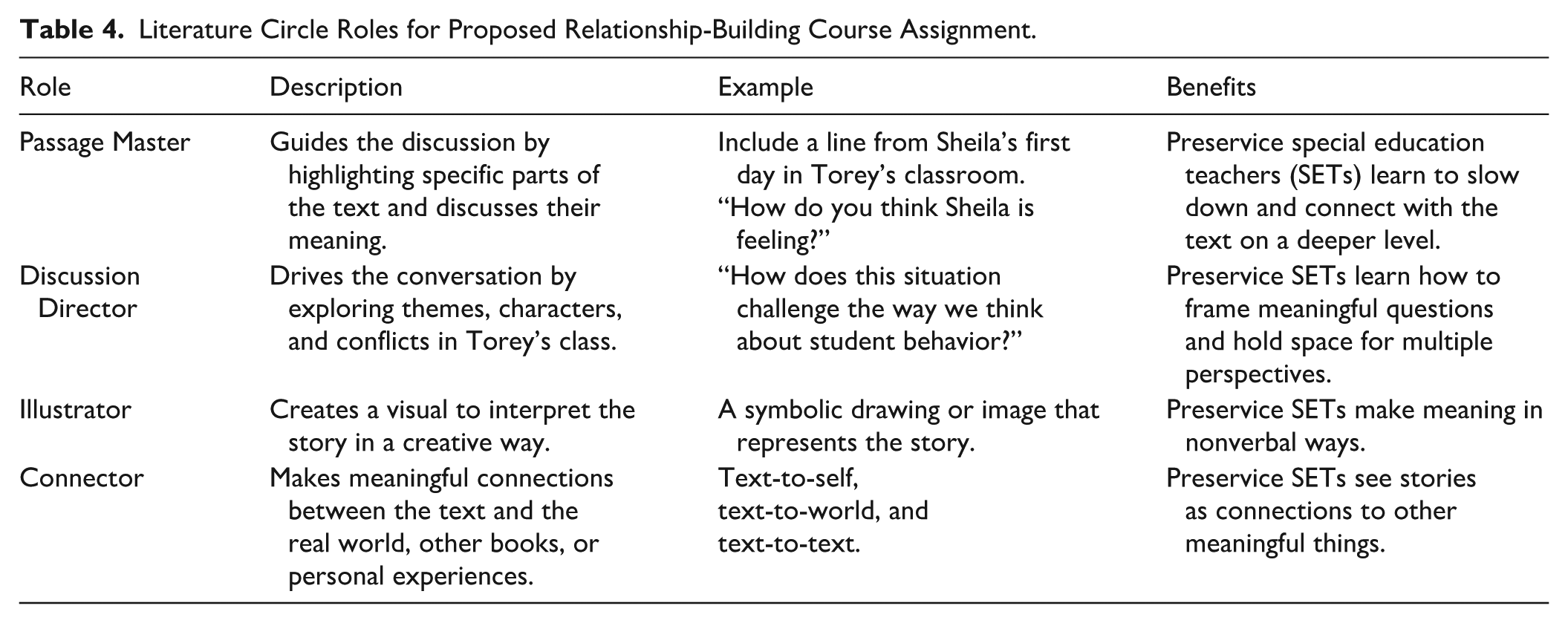
2. Literature circles (see Soares, 2016) – Small groups with rotating roles (e.g., passage master, discussion director, connector, illustrator) to discuss major texts (see Table 4 for more details).
3. Role-play scenarios (see Fu & Li, 2025) – Practice de-escalation, active listening, and empathy-based communication.
4. Classroom management plan (see Turner, 2023) – Design a relationship-centered classroom management approach inspired by Hayden’s methods.
Literature Circle Roles for Proposed Relationship-Building Course Assignment.
Conclusion
Research indicates that SETs of students with EBD are feeling overwhelmed, burned out, and struggling to find solutions that are easily accessible. From a macro level, we believe that a dynamic shift is required to reorient the structure in schools so that the process of learning, and building relationships, is front and center. Yet, too often, we believe that preservice preparation emphasizes lesson planning, assessment, and curriculum over the deeper, process-oriented skills required to connect with students whose trust has been fractured by trauma, insecurity, or past negative school experiences. We propose that teacher preparers emphasize building meaningful relationships with students.
We believe that infusing relationship-building into SET preparation should not be considered an optional upgrade. We view it as a necessity. Integrating narrative literature, such as Torey Hayden’s autobiographies, offers a model with research support. Hayden’s stories create an emotional bridge between preservice teachers and the lived experiences of students with EBD. These stories, coupled with a strong instructional framework and theoretical connections, can translate preservice SET learning into actionable skills.
We believe that olleges and universities have the opportunity, and the responsibility, to ensure that preservice SETs are ready to foster trust, safety, and authentic engagement in their classrooms. By adopting process-oriented training, teacher preparation programs can prepare SETs to lead with relationships when supporting students with EBD.
Footnotes

Funding
The authors received no financial support for the research, authorship, and/or publication of this article.
Declaration of Conflicting Interests
The authors declared no potential conflicts of interest with respect to the research, authorship, and/or publication of this article.