




Abstract
Background
APOBEC-1 complementation factor (A1CF) and Apolipoprotein B mRNA editing enzyme, catalytic polypeptide-1 (APOBEC-1) constitute the minimal proteins necessary for the editing of apolipoprotein B (apoB) mRNA in vitro. Unlike APOBEC-1 and apoB mRNA, the ubiquitous expression of A1CF in human tissues suggests its unique biological significance, with various factors such as protein kinase C, thyroid hormones, and insulin regulating the activity and expression of A1CF. Nevertheless, few studies have provided an overview of this topic.
Objective
We conducted a literature review to describe the molecular mechanisms of A1CF and its relevance to human diseases.
Method
In the PubMed database, we used the keywords ‘A1CF’ and ‘APOBEC-1 complementation factor’ to collect peer-reviewed articles published in English from 2000 to 2023. Two authors independently reviewed the articles and reached the consensus.
Result
After reviewing 127 articles, a total of 61 articles that met the inclusion criteria were included in the present review. Studies revealed that A1CF is involved in epigenetic regulation of reproductive cells affecting embryonic development, and that it is closely associated with the occurrence of gout due to its editing properties on apoB. A1CF can also affect the process of epithelial-mesenchymal transition in renal tubular epithelial cells and promote liver regeneration by controlling the stability of IL-6 mRNA, but no influence on cardiac function was found. Furthermore, increasing evidence suggests that A1CF may promote the occurrence and development of breast cancer, lung cancer, renal cell carcinoma, hepatocellular carcinoma, endometrial cancer, and glioma.
Conclusion
This review clarifies the association between A1CF and other complementary factors and their impact on the development of human diseases, aiming to provide guidance for further research on A1CF, which can help treat human diseases and promote health.
Keywords
Introduction
RNA editing is the modification of specific nucleotide sequences in the genome template, resulting in different nucleotide sequences in the transcript. Due to its ability to allow a single gene to produce different protein products and thereby enhance genetic plasticity, RNA editing is an important genetic regulatory mechanism. There are 2 common types of RNA editing in the nucleus involving enzymatic deamination from C to U or from A to I. Among them, the best-characterized example of C-to-U RNA editing is apolipoprotein B (apoB). apoB is one of the largest proteins in nature and plays a central role in lipid metabolism. 1 C-to-U editing of apoB RNA can produce 2 different isoforms - apoB 100 and apoB 48. When C-to-U RNA editing changes codon 2153 of the apoB genomic template transcript from CAA to UAA (C6666 to U), resulting in translation termination, truncated protein apoB 48 is produced. In contrast, unedited apoB mRNA encodes the full-length protein apoB 100. Both apoB 48 and apoB 100 are important regulators of lipid transport and metabolism but have different functions in lipid metabolism and susceptibility to atherosclerosis. apoB 100 is the sole apolipoprotein present in low-density lipoprotein (LDL), which transports two-thirds of the cholesterol in human plasma. High levels of LDL cholesterol are a major risk factor for coronary heart disease. In contrast, lipoproteins containing apoB 48 are cleared more rapidly and do not metabolize into LDL particles, making them not a major risk factor for coronary heart disease. 2 Changes in apoB mRNA editing reflect cellular lipid balance and are also the result of integrated adaptation to development, hormones, nutrition, or other factors.
In humans, rodents and all placental mammals, C-to-U RNA editing of apoB occurs in the small intestine. In certain species, such as rats and mice, apoB mRNA editing also occurs in the liver. 3 In many other mammals, including humans, the liver only synthesizes and secretes apoB 100. From a functional perspective, apoB is essential for lipid transport in both intestinal cells and hepatocytes, 4 but apoB 48 is preferred in terms of output.5,6 There is evidence that 2 gene products play essential roles in apoB RNA C-to-U editing, namely the RNA-specific cytidine deaminase APOBEC-1 (apoB mRNA editing catalytic subunit 1) and the RNA binding and targeting subunit A1CF (APOBEC-1 complementation factor).7-9 APOBEC-1 cannot edit apoB mRNA alone and is expressed only in the gastrointestinal tract in humans. In contrast, the accessory protein A1CF is more widely distributed in humans, with A1CF cDNA detected in many human tissues besides the small intestine, with significant levels in the kidneys, liver, and small intestine.9,10 The widespread expression of A1CF in human tissues lacking APOBEC-1 and apoB mRNA suggests that A1CF may be involved in other RNA editing or RNA processing events. 9
Mechanisms of Action
APOBEC-1 is a zinc-dependent cytidine deaminase that requires additional proteins or accessory factors to edit apoB mRNA. Consequently, the APOBEC-1 complementation factor A1CF was discovered. Interestingly, Anuradha et al 11 found that specific and efficient editing of apoB mRNA could be reconstituted in vitro using only A1CF and APOBEC-1. Thus, the simplest model of the apoB mRNA editing enzyme consists of an APOBEC-1 dimer (54 kDa) and an A1CF monomer (65 kDa). This model is consistent with the minimum size of the native holoenzyme, which is 120 to 125 kDa, suggesting that A1CF and APOBEC-1 constitute the minimal protein requirements for specific and efficient editing of apoB mRNA in vitro. In the rat intestinal epithelial crypt cell line IEC-6, increased levels of A1CF resulted in a more than 10-fold increase in apoB mRNA editing. 12 This experimental result also demonstrates the essential role of A1CF as a component of the apoB mRNA editing complex.
The full-length A1CF gene is 80 kb and contains 15 exons, of which 3 are non-coding exons. It is a 64.3 kDa RNA binding protein localized in the nucleus, capable of binding to apoB mRNA both in vitro and in vivo.
13
Based on cDNA sequence analysis, the N-terminal region of A1CF contains 3 distinct RRM (RNA recognition motif) domains, which function in RNA binding, making them necessary for the binding of A1CF to apoB mRNA.
14
The RRM domain consists of 80-90 amino acids and contains 2 short conserved sequences, an RNP2 (ribonucleoprotein 2) hexamer and an RNP1 octamer. The C-terminal region of A1CF, spanning residues 304 to 586, is not absolutely required for the functional activity of A1CF. However, further deletion of the region rich in arginine glycine (rg) from the accessory domain will disrupt complementary activity, RNA binding, and interaction with APOBEC-1.
14
The amino acid sequences and the corresponding diagram of the 3 RRM motifs in A1CF are shown in Figure 1. Amino acid sequence of the human a1cf gene. (A) A diagram of the 3 RNA recognition motifs (RRM) in the human a1cf gene. (B) The amino acid sequence of the a1cf. The amino acid sequences of RRM1, RRM2, and RRM3 are displayed in different colors.
As an RNA-binding subunit, A1CF can bind to a mooring sequence consisting of 11 nucleotides (UGAUCAGUAUA) on apoB mRNA and dock with the catalytic subunit APOBEC-1, facilitating upstream cytidine deamination to complete apoB mRNA editing.7,15,16 The editing process is shown in Figure 2. The editing activity of A1CF and APOBEC-1 on apoB mRNA is specific to C6666, and triple-mutations in the mooring sequence (GGAUGAGAAUA) or the point mutation at U6678-G (UGAUCAGGAUA) can affect apoB mRNA editing.
17
Mehta et al
14
found that A1CF has a higher affinity for single-stranded rather than double-stranded apoB mRNA. Additionally, amino acids in the pre-RRM region are necessary for complementation activity and RNA binding. While all 3 RRM domains of A1CF are necessary for complementary activity and interaction with APOBEC-1, individual domains contribute differently to RNA binding. Point mutations in RRM1 or RRM2 resulted in a two-order of magnitude decrease in the Kd of apoB mRNA, while mutation in RRM3 reduced binding affinity by 13-fold. Co-expression of RRM1 with RRM2 or RRM3 yielded moderate affinity binding. Furthermore, researchers
18
found that the mutant A1CF (G398S) could increase the expression of genes responsible for cellular transport processes, thus alleviating the triglyceride accumulation induced by wild-type A1CF. Conversely, wild-type A1CF affected the expression of mitochondrial matrix proteins, increasing cellular oxygen consumption. Therefore, A1CF may play a broader role in regulating gene expression. The schematic diagram of A1CF and APOBEC-1 participating in apoB mRNA editing. Complementation factor A1CF binds to the mooring sequence of apoB mRNA and docks with the cytidine deaminase APOBEC-1, causing the CAA codon at position 2153 on apoB mRNA to be changed to UAA, resulting in translation termination and the production of apoB 48.
Regulatory Factors
Protein Kinase C
Multiple factors affect the editing of apoB mRNA by A1CF. The literature reports 19 that protein kinase C (PKC) can stimulate apoB mRNA editing in primary rat hepatocytes and enhance the phosphorylation of A1CF, while protein kinase A (PKA) has no effect on editing. It is speculated that the phosphorylation of A1CF by PKC may be a key regulatory mechanism for apoB mRNA editing in rat hepatocytes. Conversely, treatment with proteasome inhibitors can decrease A1CF levels, resulting in decreased levels of apoB protein editing and production. 20
Related Hormones
In addition to protein kinases, certain hormones can also affect the expression of A1CF and the editing of apoB mRNA. Thyroid hormones regulate the expression of many genes, which in turn regulate lipid metabolism in our body. One study found that mice lacking thyroid hormones have significantly increased liver triglyceride levels, mainly due to decreased thyroid hormone-dependent apoB mRNA editing. Furthermore, supplementation with A1CF alone can improve thyroid function. This result suggests that thyroid hormones can regulate hepatic lipid metabolism in mice by altering the gene expression of A1CF, 21 which is also the first evidence of the physiological metabolic regulation of this gene in mammalian species. A1CF can shuttle between the cytoplasm and nucleus. When serum insulin levels are elevated, it is retained in the nucleus, supporting the editing of apoB mRNA. In obese mice with hyperinsulinemia, decreased nuclear retention of A1CF and apoB mRNA editing in the liver were observed, along with increased cytoplasmic retrieval of A1CF and increased mRNA recovery of total cellular lipoproteins in the cytoplasmic extract. Leptin, on the other hand, can inhibit the expression of A1CF. This suggests that the loss of insulin-regulated A1CF shuttle and leptin-regulated A1CF expression may be early causes of the overall pathology related to very low-density lipoprotein secretion in the liver of obese individuals. 22
Clinical Significance of A1CF
Impact on Embryonic Development
Using homologous recombination technology to knock out A1CF, it was found that heterozygous a1cf+/- mice were healthy and fertile. 10 Mutant a1cf-/- embryos could be detected at embryonic day 3.5. No blastocysts were detected after embryonic day 4.5 and therefore no surviving a1cf-/- mice were found. Meanwhile, small interfering RNA knockdown of A1CF in either rat (apobec-1-expressing) or human (apobec-1-deficient) hepatoma cells decreased A1CF protein expression and induced a commensurate increase in apoptosis. These data suggest that A1CF plays a crucial role in early embryonic development. Whether APOBEC-1 plays a synergistic role in this process still needs further verification. 10
Testicular germ cell tumors (TGCTs) are the third most common heritable cancer, 23 and their risk involves epigenetic mechanisms. 24 Various testicular abnormalities, such as cryptorchism and testicular atrophy, are also associated with TGCT, 25 suggesting that TGCT and urogenital developmental abnormalities share common genetic and environmental origins. 26
Males of the 129/Sv family of mouse strains have strong genetic predisposition to spontaneous TGCT, 27 and APOBEC1 cytidine deaminase is one of the effective epigenetic modification factors that contribute to the susceptibility of TGCT in 129/Sv inbred mice. 28 Carouge et al 29 used the related 129-derived targeted ES cell lines to generate a1cfKO/+ mutant mice and then backcrossed them with inbred 129/Sv control mice. Conventional (Mendelian) inheritance infers that the genetic effects of the maternal and paternal are similar in offspring phenotypes. If the offspring phenotype is more dependent on the parental sex and genotype, it can be inferred that there is a parent-of-origin (PofO) effect. The result showed that maternal a1cfKO/+ heterozygosity reduces the TGCT occurrence in wild-type male offspring. However, the paternal heterozygosity results in conventional effects. In terms of testicular abnormalities, a strong paternal effect was found in the a1cfKO/+ backcrosses, and the risk of testicular atrophy in the heterozygous male offspring was significantly reduced. The transmission of alternative alleles from heterozygotes is generally Mendelian, but in a1cfKO/+ intercrosses, the number of heterozygotes was found to be 5 times greater than expected. Furthermore, the genotypic bias was stronger for females, which may be related to the sex chromosomes. A1cfKO/+ adult males produced fewer mature sperm than 129/Sv adult males. This suggests that the RNA-binding protein A1CF is involved in the epigenetic control of reproductive cell fate, urogenital development, and gamete function. Similarly, in vitro fertilization studies using a1cf gene mutations and wild-type alleles showed that non-random combinations of fertilization were caused by intrinsic genetic factors of both oocytes and sperm, primarily due to functional differences between germ cells in A1CF mutant heterozygotes unable to isolate mRNA targets. 30
Impact on Gout
Elevated serum uric acid concentration can lead to gout, a common and painful inflammatory arthritis. Elevated serum apoB levels are associated with primary gout. 31 Interestingly, there is an association between uric acid levels and the risk of gout with A1CF.32,33 Researchers combined data from over 140,000 individuals of European descent in the Global Urate Genetics Consortium (GUGC) to identify and replicate 28 genome-wide significant loci associated with serum uric acid concentration, including A1CF.32,34
Dong et al also found an association between A1CF and gout in the Chinese population, 35 and the A1CF gene may be a potential genetic marker for hyperuricemia risk associated with antihypertensive drug treatment in Chinese hypertensive patients. 36 A study of 1411 clinically defined Japanese gout patients showed that single nucleotide polymorphisms (SNPs) of A1CF were associated with clinically defined gout cases in Japan. 37 Additionally, a genotyping study of 2792 NZ Europeans and NZ Polynesians with or without gout supported the fact that alcohol can affect the risk of gout through glucose and lipoprotein metabolism. In the absence of alcohol exposure, genetic variations in the A1CF gene play a greater role in gout. 38
Impact on Kidney
A1CF-mediated post-transcriptional editing of apoB mRNA in the small intestine is necessary for lipid absorption. In addition to the intestines, A1CF mRNA has also been reported to be highly expressed in the kidneys. Huang et al 39 found that A1CF was weakly expressed in embryonic kidneys of C57BL/6 mice at E15.5dpc but strongly expressed in mature kidneys after birth, and mainly in the endothelial cortical tubules. Furthermore, A1CF negatively regulates the epithelial-mesenchymal transition (EMT) process in renal tubular epithelial cells. Ectopic expression of A1CF could upregulate the epithelial marker E-cadherin and downregulate the mesenchymal markers vimentin and α-smooth muscle actin (α-SMA) in NRK52e cells. Moreover, knockdown of A1CF enhances EMT, contrary to the overexpression effect. The above results suggest that A1CF may act as an antagonist of the EMT process in renal tubular epithelial cells. A multi-ethnic genome-wide association study of 413 Cameroonian patients with sickle cell disease (SCD) found that A1CF variations were closely associated with renal insufficiency. 40
Impact on Liver
It has been reported that heterozygous a1cf+/- mice exhibit reduced cell proliferation and impaired liver mass restitution after partial hepatectomy. 41 When exploring the mechanism of impaired liver regeneration, it was found that the level of IL-6 decreased, which proved that A1CF regulates liver regeneration after hepatectomy by controlling the stability of IL-6 mRNA to a certain extent.
Impact on Heart
In transgenic mice that express tamoxifen-inducible Cre recombinase specifically in cardiomyocytes, there are a large number of rearrangements/duplications of transgene elements, and transgene integration is accompanied by the deletion of 19 500 bp genomic DNA fragment, which contains the promoter, exon 1 and part of intron 1 of a1cf gene and some elements predicted to regulate chromosome architecture. Therefore, the protein expression of A1CF in homozygous mice was completely lost, but the result that homozygous mice survived contradicted to that reported by Blanc et al (10). In addition, the expression of A1CF protein was difficult to detect in the hearts of the 3 mice analyzed, suggesting that this protein may not play a major role in cardiac function. 42
Impact on Cancer
The minimal protein complex required for apoB mRNA editing has been identified and consists of APOBEC-1 and A1CF. The mRNA levels of APOBEC-1 and its alternatively spliced peptide apobec-t were identified by RNase protection experiments, and both were found to be overexpressed in human colon cancer. 43 As an RNA specific cytidine deaminase, overexpression of APOBEC-1 in transgenic animals is associated with liver carcinogenesis, suggesting that RNA editing may be another mechanism of tumorigenesis. Porter et al 44 applied easyclip, a UV crosslinking immunoprecipitation sequencing method, to 33 of the most common recurrent cancer mutations in 28 RNA binding proteins (RBPs) and found that the RNA binding capacity of each RBP molecule in A1CF e34k mutation increased. It is suggested that A1CF may be related to tumorigenesis and development.
Breast Cancer
Zhou et al 45 found that EIYMNVPV motif is crucial for the nuclear localization of A1CF, and A1CF (-8aa) lacking EIYMNVPV motif exhibits cytoplasmic distribution. Importantly, A1CF (-8aa) can promote the proliferation of breast cancer cell line MDA-MB-231 while the IL-6 mRNA level increases. Silencing IL-6 could attenuate the proliferation of MDA-MB-231 cells induced by A1CF (-8aa). In another breast cancer cell line, MCF7, A1CF was found to play a crucial role in cell migration and survival by affecting the 3' untranslated region of Dickkopf1 to upregulate its expression. 46
Lung Adenocarcinoma
Based on chromatin regulators analysis, 6 chromatin regulators, including A1CF, was found to constitute the prognostic features of lung adenocarcinoma and proved to be effective survival predictors in multiple independent datasets. It has also been demonstrated to be an indicator of tumor microenvironment and sensitivity to immunotherapy and chemotherapy. 47
Renal Cancer
Ni et al 48 found that RNA editing complementary protein A1CF affects the proliferation and colony formation of renal cell carcinoma (RCC) cells. Reduced A1CF expression inhibits the proliferation and colony formation of 786-O cells. Further screening pathway indicated that A1CF increases ERK activation. Inhibition of MEK1/2 phosphorylation by U0126 also reduces A1CF-induced ERK activation. These results indicated that A1CF activates ERK and promoted the proliferation and colony formation of renal cancer cells. Xia et al also found that A1CF promotes the migration of renal cancer cells by promoting the nuclear translocation of the transcription factor Smad3. 49 A1CF negatively regulates the epithelial-mesenchymal transition of tubular epithelial cells. However, it promotes invasion and aggressiveness of renal cancer. These differences might explain the differences in the effects of A1CF on normal renal tubular cells and renal carcinoma cells.
Hepatocellular Cancer
It has been demonstrated that APOBEC-1 overexpression in the liver can effectively reduce the levels of apoB 100. However, hypermutated transgenic animals may be associated with the formation of liver tumors. A1CF increases non-specific hypermutation and specific editing with variable site sensitivity by APOBEC-1 in a dose-dependent manner. In human liver HepG2 cells, overexpression of APOBEC-1 and A1CF results in 20%-65% hypermutation of apoB mRNA at positions 6639, 6648, 6655, 6762, 6802 and 6845, while the normal editing rate at position 6666 is 90%. 50 Blanc et al 51 found that hepatocyte specific A1CF transgenic (a1cf+/Tg) mice exhibited increased liver proliferation and steatosis, and increased expression of lipogenesis related genes using RNA-seq, RNA CLIP-Seq and tissue microarrays. Aged a1cf+/Tg mice developed spontaneous fibrosis, dysplasia, and hepatocellular carcinoma, which were accelerated by a high-fat/high-fructose diet and independent of Apobec1. Meanwhile, A1CF was overexpressed in some patients with hepatocellular carcinoma. In summary, liver-specific A1CF overexpression selectively alters polysomal distribution and mRNA expression, promoting lipogenesis, proliferation, and inflammation pathways leading to hepatocellular carcinoma. Moreover, chromatin interaction analysis (CHIA-PET) and high-throughput chromosome conformation capture combined with chromatin immunoprecipitation (HiChIP) also confirmed the regulation of A1CF by enhancers of cancer genes in hepatocellular carcinoma. 52
Endometrial Cancer
Liu et al 53 collected 552 tumor tissues and 35 normal tissues from the Cancer Genome Atlas (TCGA, https://cancergenome.nih.gov/) database and identified differentially expressed gene A1CF as highly expressed in endometrial cancer tissues. Upregulated A1CF is enriched in the P53/P21 signaling pathway and closely associated with patient age, stage, and mortality. Moreover, high expression of A1CF leads to shorter overall survival and worse prognosis in endometrial cancer patients. Overexpression of A1CF decreased P21 and P53, promoted the proliferation, invasion, and migration of endometrial cancer cells, while loss of A1CF inhibits these processes. This suggests that A1CF is closely associated with the prognosis and progression of endometrial cancer through regulation of the P53/P21 signaling pathway.
Glioma
As the most common and fatal malignant brain tumor, glioma has a poor prognosis. 54 Song et al 55 found that A1CF can act as an oncogene by stabilizing and increasing the expression of FAM224A. FAM224A serves as a molecular sponge for miR-590-3p and is located in the RNA-induced silencing complex. The discovery of this signaling pathway provides a new molecular target for the treatment of glioma.
Role of A1CF in Human Malignancies.
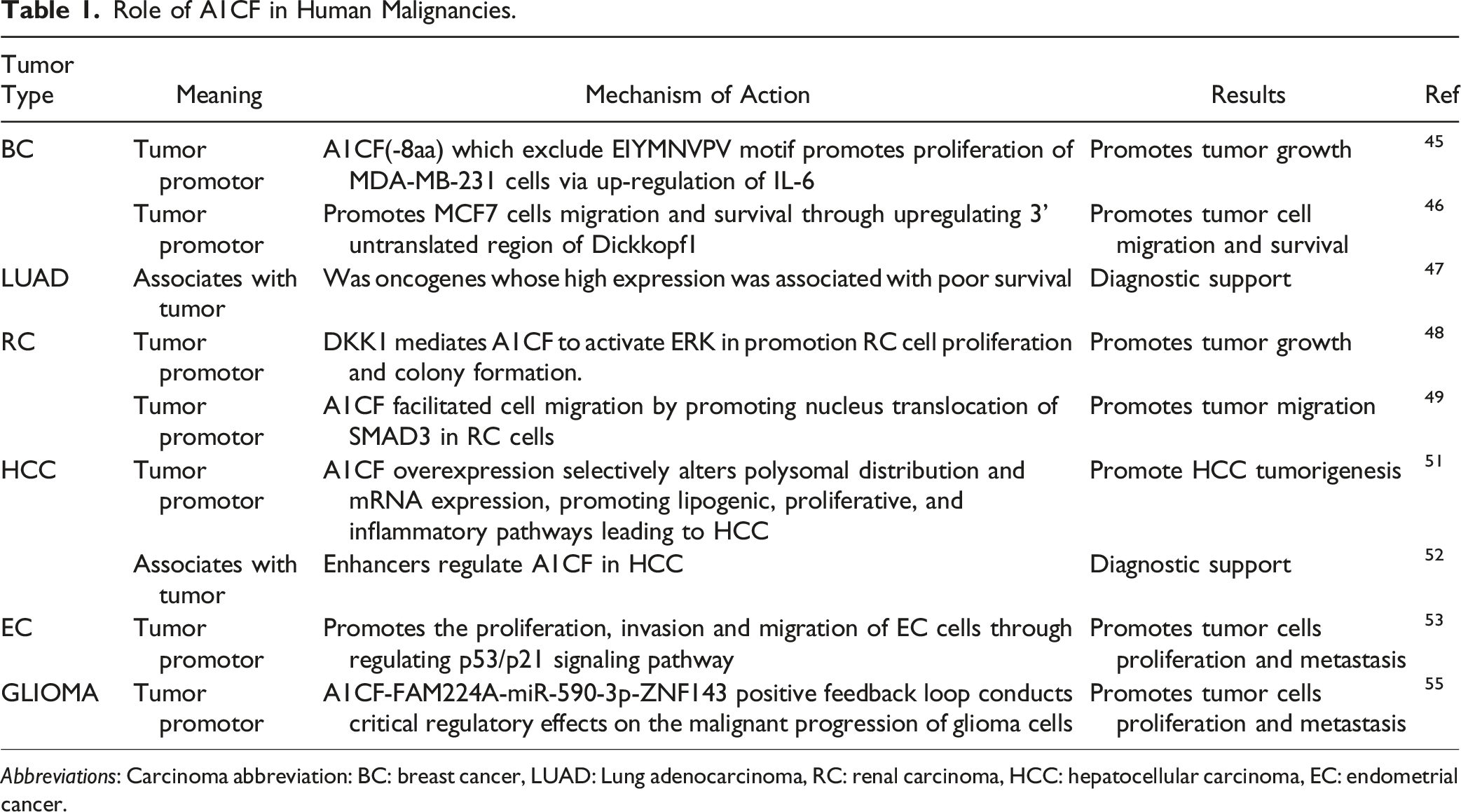
Abbreviations: Carcinoma abbreviation: BC: breast cancer, LUAD: Lung adenocarcinoma, RC: renal carcinoma, HCC: hepatocellular carcinoma, EC: endometrial cancer.
Other Complementation Factors and Their Function
Other candidate accessory proteins, such as RBM47, GRY-RBP, and CUGBP2, have been identified through their affinity for apobec1 or apoB RNA. 56
RBM47
Fossat et al discovered a novel RNA-binding protein RBM47, which interacts with APOBEC1 and A1CF, and is expressed in tissues undergoing C to U RNA editing. It can substitute for A1CF and is necessary and sufficient condition for apobec1-mediated in vitro editing. 57 Moreover, the predicted protein structure diagram of RBM47 is most closely related to that of A1CF (45% overall identity). 58 Comprehensive analysis of clinical breast cancer gene expression databases, breast cancer progression cell line models, and mutation data from cancer genome resequencing studies revealed that RNA binding motif protein 47 (RBM47) acts as a suppressor of breast cancer progression and metastasis. RBM47 inhibits the initiation and growth of breast cancer in experimental models. Analysis of HITS-CLIP showed that RBM47 can alter the splicing and abundance of its target mRNA subset. RBM47 inhibits tumor progression by stabilizing some mRNA, such as dickkopf WNT signaling pathway inhibitor 1. Therefore, the deletion of multifunctional RNA binding motif protein RBM47 is a selective pathway for breast cancer metastasis. 59 Subsequent studies have reported a correlation between dysregulation of RBM47 and poor prognosis in other tumor types such as colon cancer, melanoma, renal clear cell carcinoma, and lung cancer.60-63 The spontaneous development of intestinal and colonic polyps in intestinal-specific RBM47 knockout mouse models further confirms the importance of RBM47 in maintaining cell growth and homeostasis in other mammalian species. Recently, RBM47 has been identified as a novel post-transcriptional regulator of epithelial cell-specific alternative splicing events and as a key regulator of the stability of Wnt/β-catenin signaling antagonists, partially exerting its tumor suppressor function.64,65
GRY-RBP
A RNA-binding protein GRY-RBP with 50% homology to A1CF was discovered in 2000. 66 GRY-RBP isolated from chicken intestine cDNA can bind to A1CF, APOBEC-1, and also can bind to apoB RNA. Experiments have shown that GRY-RBP binding to A1CF can inhibit the binding of A1CF to apoB RNA and C to U RNA editing. GRY-RBP and A1CF co-localize in the nucleus of transfected cells, with predominant distribution in the nucleus. Overall, the results suggest that GRY-RBP is a member of the A1CF gene family and may regulate C to U RNA editing by binding to A1CF or APOBEC-1 or by binding to the target RNA itself.
CUGBP2
Anant et al 67 discovered a 54 kDa RNA-binding protein CUGBP2 in bovine liver S-100 extracts. CUGBP2 co-localizes with A1CF in the nuclei of transfected cells, suggesting their interaction in vivo. CUGBP2 binds to apoB RNA, particularly sequences rich in AU located upstream of the editing cytosine. ApoB RNA bound by McA cell CUGBP2 is more extensively edited than the unbound portion. Overall, their data suggest that CUGBP2 acts in apoB mRNA editing by forming regulatory complexes with the 3 components of the minimal editing enzyme apobec1, A1CF, and apoB RNA.
Conclusions and Future Directions
Elevated serum uric acid is regarded as a risk factor for hyperlipidemia and kidney disease. 68 Metabolic syndrome, characterized by multiple organ damage centered on the liver, is accompanied by increased levels of uric acid, inflammation, and higher concentrations of triglycerides in the blood and liver. 69 A1CF, as a complementation factor, involves in the editing of apoB mRNA, generating 2 different subtypes of apoB products that affect lipid metabolism. Therefore, it is not difficult to understand that A1CF is associated with gout and abnormal renal function, and that thyroid hormones and insulin can regulate A1CF.
PKC is a family of serine-threonine kinases that plays an essential role in regulating important signaling pathways in mammalian cells. Regulated by various molecules, PKC is translocated to the plasma membrane to conduct various other signal transduction pathways. PKC has been implicated in a variety of human diseases, such as neurological disorders, cardiovascular diseases, and infections. 70 It is important to note that PKC is involved in numerous enzymes and transcription factors that affect oncogenic signaling, and plays a crucial role in regulating tumor proliferation and apoptosis. Therefore, PKC has emerged as an attractive target for the development of anti-cancer agents. 71 Lehmann et al 19 found that PKC can enhance the phosphorylation of A1CF in rat hepatocytes, which allows the proposal of a functional link between A1CF and tumorigenesis. Due to the extensive expression of A1CF cDNA in human tissues, it has been found that various tumors such as breast cancer, lung adenocarcinoma, renal carcinoma are associated with abnormal expression of A1CF. The APOBEC family closely related to A1CF can contribute to development of multiple types of cancer through abnormal DNA editing mechanisms. 72 The 11 types of APOBEC cytidine deaminase in humans are encoded by genes such as AID, APOBEC1, APOBEC3, etc. AID, the evolutionarily founding family member, has been found in lymphoid tumors. 73 Subsequently, TC-specific APOBECs may contribute to colorectal cancer mutagenesis. 74 APOBEC induced switching of the strand-coordinated mutations at sites of chromosomal rearrangements has been found in multiple myeloma, prostate, and head and neck cancer. 75 Furthermore, the APOBEC3 gene plays a potential oncogenic role in virus-infected cancers, particularly in cervical cancer.76,77
However, there are still many functions beyond oncogenesis that need to be revealed about A1CF. For example, PKC can activate A1CF in rat hepatocytes. Is there such similar phenomenon in other places where lipoprotein editing occurs, such as the small intestine? PKC is unique in activating A1CF phosphorylation, while another type of protein kinase PKA cannot activate A1CF. What is the difference in their mechanisms of action? Why does A1CF have different effects on epithelial mesenchymal transition between normal renal tubular cells and renal cancer cells?
In addition, there are controversial results in the literature about the function of A1CF in terms of embryo survival. Blanc et al 10 found that A1CF-/- embryos could only survive for 3 days, but the experimental observations of Harkins et al appear to argue against this theory. 42 Is this related to transgenic mouse expressing a tamoxifen-inducible Cre recombinase specifically in cardiomyocytes? Moreover, cardiac dysfunction has not been observed in homozygous mice with the deletion of the A1CF protein expression, and the mechanism remains unclear.
Among the other complementation factors closely related to A1CF function retrieved, RBM47 has been found to function as a tumor and metastasis suppressor. RBM47 can replace A1CF in the process of C-to-U RNA editing, and its predicted protein structure is most similar to that of A1CF. Interestingly, 2 proteins with such similar structures have 2 diametrically opposite effects in tumor development. The other 2 auxiliary proteins, GRY-RBP and CUGBP2, are also closely related to A1CF, but there are no relevant literature reports on their association with tumors. With the development of medical technology and the deepening of scientific research, more and more functions and mechanisms of A1CF and other complementary factors may be revealed. These findings will provide a theoretical basis for future research on the treatment of related diseases.
Footnotes
Declaration of Conflicting Interests
The author(s) declared no potential conflicts of interest with respect to the research, authorship, and/or publication of this article.
Funding
The author(s) disclosed receipt of the following financial support for the research, authorship, and/or publication of this article: The present study was supported by Science and Technology Development Project of Henan Province (242102520051).
