




Abstract
Conversational large language model (LLM)-based chatbots utilize neural networks to process natural language. By generating highly sophisticated outputs from contextual input text, they revolutionize the access to further learning, leading to the development of new skills and personalized interactions. Although they are not developed to provide healthcare, their potential to address biomedical issues is rather unexplored. Healthcare digitalization and documentation of electronic health records is now developing into a standard practice. Developing tools to facilitate clinical review of unstructured data such as LLMs can derive clinical meaningful insights for ovarian cancer, a heterogeneous but devastating disease. Compared to standard approaches, they can host capacity to condense results and optimize analysis time. To help accelerate research in biomedical language processing and improve the validity of scientific writing, task-specific and domain-specific language models may be required. In turn, we propose a bespoke, proprietary ovarian cancer-specific natural language using solely in-domain text, whereas transfer learning drifts away from the pretrained language models to fine-tune task-specific models for all possible downstream applications. This venture will be fueled by the abundance of unstructured text information in the electronic health records resulting in ovarian cancer research ultimately reaching its linguistic home.
“Any sufficiently advanced technology is indistinguishable from magic.” Artificial Intelligence (AI) has been an extremely broad discipline resulting in concrete real-world applications. Centered on the creation of “intelligent” systems with a long tradition in computer science, it primarily owes its popularity to Deep Learning (DL), its distinct subfield, which used neural networks to analyze large amounts of data, such as images (DALL-E2) or text (ChatGPT). 1 Being a conventional surgical oncologist but also a technology enthusiast, I have been mesmerized by the researching capabilities of the newly launched ChatGPT. This conversational large language model (LLM)-based chatbot utilizes a neural network to process natural language, thus generating highly sophisticated output based on advanced modeling of the contextual input text. 2 Indeed, testing GPT-4 on certain speculative tasks renders well-written and human-like prompted responses, if proper constructs are to develop; how meta-human! Although I did not ask GPT-4 to write the cover letter for this manuscript, I still wonder why it is now becoming the virtual assistant—and not necessarily the ghost writer, as many claim—in scientific publishing? Check for yourself…
[AL: Summarize the history of artificial intelligence in ovarian cancer research]
Artificial intelligence (AI) has been applied to ovarian cancer (OC) research for several years, with a growing body of research exploring its potential applications. One of the earliest applications of AI in OC research was the use of machine learning algorithms to examine medical imaging data. For example, in 2011, researchers used machine learning (ML) algorithms to distinguish between benign and malignant ovarian masses based on ultrasound images. Since then, AI has been implemented in a range of tasks in OC research, including diagnosis, prognosis, and personalized treatment planning. In 2016, researchers developed an AI system that was able to predict OC survival rates based on gene expression data. Other studies have explored the use of AI in identifying biomarkers for early detection, treatment response, and predicting treatment outcomes.
Despite these promising early results, there are still certain challenges to overcome in the application of AI to OC research. One major obstacle is the need for copious amounts of high-quality data to train ML algorithms. In addition, there are ethical considerations around the use of AI in healthcare, including issues of privacy and bias. Nevertheless, the potential of AI continues to be significant. Continued research and development in this area will improve our understanding of the disease and improve outcomes for patients.
[AL: Speculate on the future potential of artificial intelligence in ovarian cancer]
Ovarian cancer is a complex and heterogeneous disease that presents a significant challenge to diagnosis and treatment. However, AI has the potential to significantly improve our ability to detect, diagnose, and treat OC in the future. One potential application of AI in OC management is in the analysis of medical images, such as ultrasounds, CT scans, and MRI scans. Machine learning algorithms could be trained to identify patterns in these images that may be indicative of OC, allowing for earlier detection and more accurate diagnoses. In addition, AI can help to differentiate between malignant and benign ovarian masses, which can be difficult to distinguish using traditional imaging methods. Another potential application of AI in OC is in the development of personalized treatment plans. By analyzing copious amounts of patient data, including genetic information and treatment histories, ML algorithms can help to identify the most effective treatment options for individual patients. This can improve patient outcomes and reduce the risk of side effects associated with ineffective treatments. AI can also be employed for monitoring patients for signs of disease progression and to predict the likelihood of recurrence after treatment. Interrogating an exhaustive list of patient medical records and imaging studies, AI can help to identify patients who are at higher risk for recurrence, allowing for more frequent monitoring and earlier intervention.
Overall, the potential for AI in the field of OC research is significant (Figure 1). While there are still many challenges to overcome, including the need for large amounts of high-quality data and the development of robust machine learning algorithms, the continued advancement of AI technology holds promise for improving the detection, diagnosis, and treatment of OC in the future. Illustration of (A, B) the future of AI in ovarian cancer, (C, D) AI in ovarian cancer surgery, (E) the future of AI in oncology as envisioned by the AI-powered DALL-E 2 image generator (OpenAI).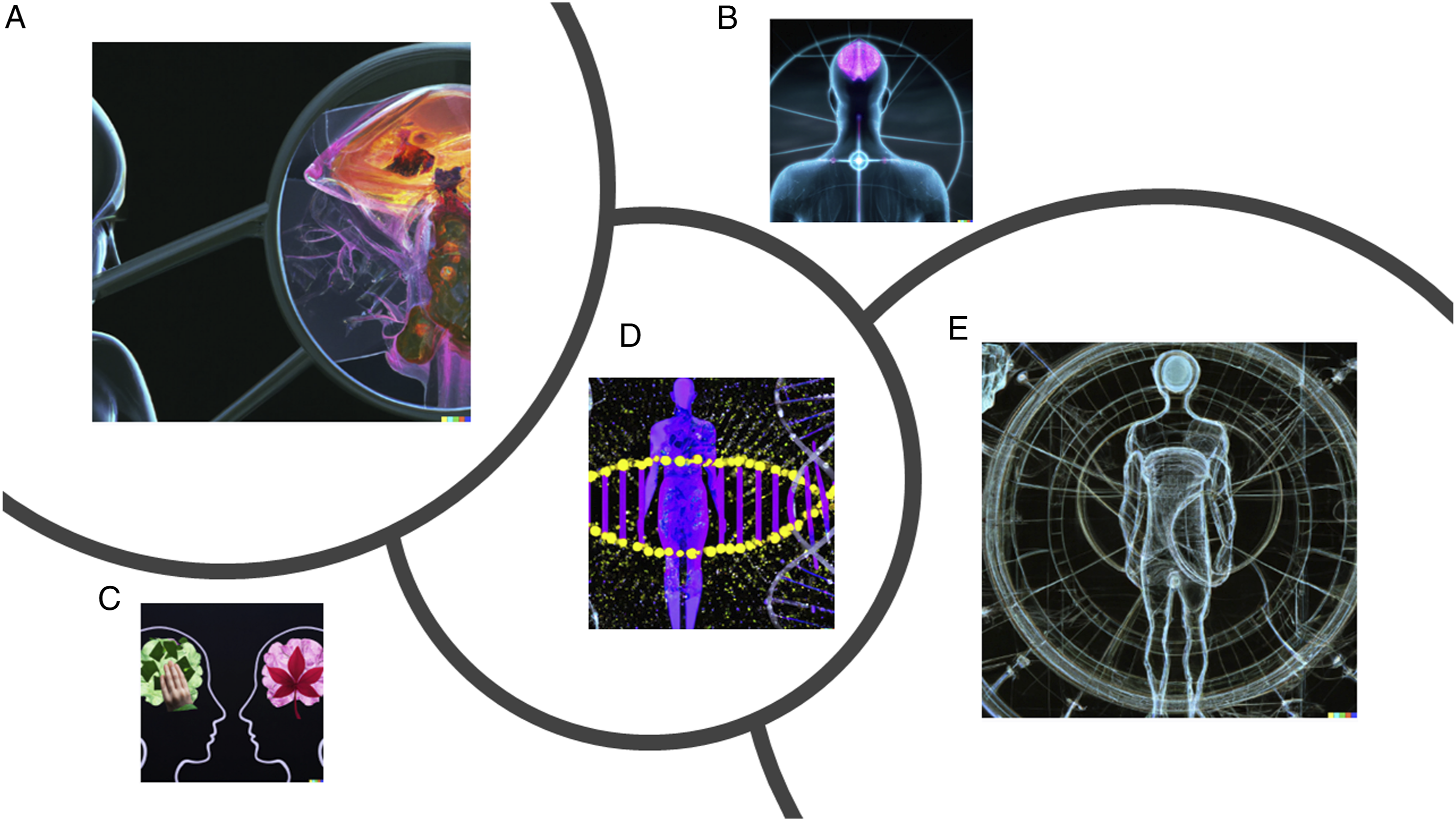
For the fastest growing consumer application to date, I embrace the immense interest in LLM-based chatbots, a captivating technological opportunity for further growth. In the grand scheme of things, this AI-based technology is now more than ever democratized; it is affordable and accessible; it gives flexibility and access to talent diversity because innovation can create from anywhere and succeed everywhere. It promotes equity by overcoming language barriers. Access to further learning, leading to the development of new skills and personalized interactions is becoming easier than ever. I am not surprised by the innate resistance of the human mind that has instantaneously triggered mixed feelings in the scientific community. A SWOT examination of the ChatGPT in the context of healthcare practice and research has been summarized elsewhere. 3 Indeed, ChatGPT was not developed to provide healthcare, and the ability to address healthcare issues is rather unexplored.
Instead of arguing on the benefits and concerns, the cautious excitement needs to be simply cited with rigorously evaluating the content of LLMs in the healthcare setting for accuracy and potential false or fabricated information. In OC research, it is critical to improve the validity of the scientific writing process. As with all language models, GPT-4 capacity is unlimited owing to its ability to generate text from pretrained patterns. To avoid “hallucinating” writing, there is an urgent need to share raw data, and encourage external data validation; standardize training in research ethics and scientific integrity; reduce scientific misconduct by developing novel tools to match the specific goal. To help accelerate research in biomedical NLP, task-specific and domain specific language models may be required.
4
In turn, a bespoke, proprietary OC-specific natural language using solely in-domain text, is required, whereas transfer learning drifts away from the pretrained language models to fine-tune task-specific models for all possible downstream applications (Figure 2). Such venture will be fueled by the abundance of unstructured text information in the electronic health records. It will offer the golden opportunity for textual data transformation into embedded linguistic biomarkers and their matching with discrete clinical variables to enhance human decision-making and improve prediction of critical outcomes.
5
Examples of basic Sankey diagram snapshots displaying flows from prevalent nodes as described on operative notes for ovarian cancer surgery (Data not shown). The width is proportional to the importance of the flow. The x-axes represent consecutive transitions (steps) or time points. This source-to-end descriptive data visualization emphasizes the major flows during surgical cytoreduction.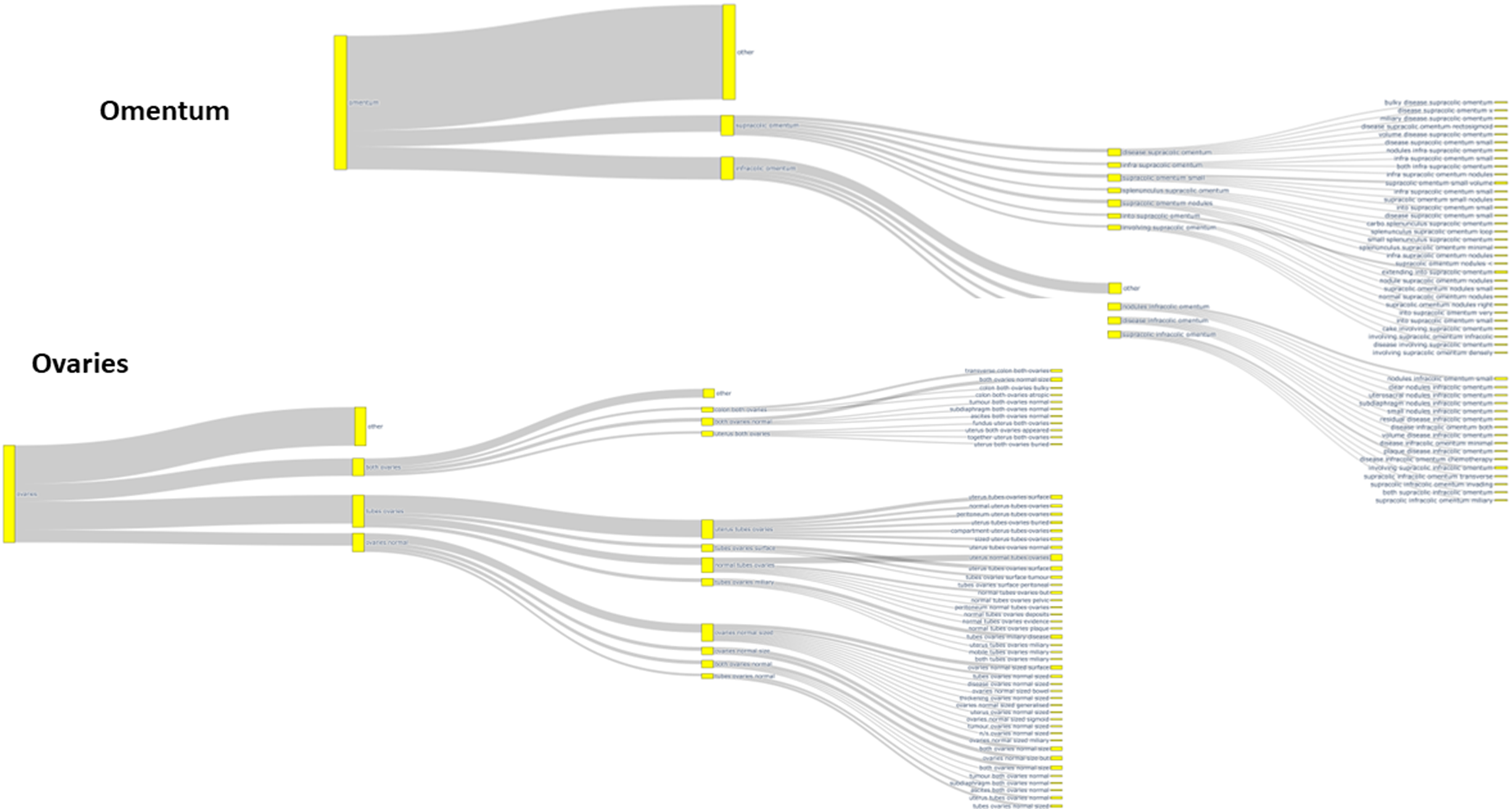
Artificial Intelligence-based chatbots will soon revolutionize how cancer patients access information owing to their potential to formulate interpretable responses to complex questions and conversations. 6 As we speak, there is no single answer to a single question. The anticipated concerns from the extensive use of LLMs have been expressed by other medical disciplines.6,7 Blockchain technology can be helpful towards this direction. 8 Explainability AI may unveil the—open—Pandora’s black box of AI-driven LLM.9,10 This could hopefully drive “imperfect users” towards more critical and reflective decisions using this AI methodology. 11
Footnotes
Declaration of Conflicting Interests
The author(s) declared no potential conflicts of interest with respect to the research, authorship, and/or publication of this article.
Funding
The author(s) received no financial support for the research, authorship, and/or publication of this article.
