




Abstract
Distant metastasis (DM) is the dominant negative prognosis for thyroid carcinoma. Radioactive iodine (RAI) therapy serves as an effective treatment for thyroid carcinoma. However, resistance to RAI occurs in patients with DMs. The present study aims to discriminate patients who may benefit from RAI. We extracted patients with thyroid cancer in the Surveillance, Epidemiology, and End Results program and analyzed thyroid cancer–specific survival after radiotherapy based on age and grade subgroups. A total of 1608 patients having DMs were eligible, including 521 (32.4%) cases with bone metastasis, 90 (5.6%) cases with brain metastasis, 158 (9.8%) cases with liver metastasis, 995 (61.9%) cases with lung metastasis, and 50 (3.1%) cases with other metastases. Advanced age, poor differentiation, follicular carcinoma, lymphatic metastasis, tumor size >10 mm, and extracapsular invasion are associated with pulmonary metastases. With respect to patients with DM, RAI therapy improved the survival in the age <45 years group and the well-/moderately differentiated group. For patients with pulmonary metastasis, RAI improved the survival in the higher grade group but did not have a strong effect in the better grade group. Our data indicate that the disparity of metastatic sites has different risk factors. Similarly, this finding indicates that RAI should be precisely applied to patients who undergo DM but are young and have well-/moderately differentiated tumors and may improve survival in pulmonary metastasis patients with poor grade tumors.
Introduction
Thyroid cancer (TC) is the most common endocrine neoplasm but has a relatively good prognosis, exhibiting incidence rates of 3.1% and death rates of 0.7%. 1 Distant metastases (DMs) from TC were rare and were only diagnosed in 1% to 4% of patients. However, the outcome of these patients was poor, which was the leading cause of TC-related death. 2 Given the potential impact of all available treatment strategies, precise assessment at the time of diagnosis is a pivotal element of clinic decision-making regarding the timing and type of initial therapy, including local therapy or systemic treatment.
Generally, the most common site of metastases is the lung. 3 Metastasis to the lung was reported to occur in 7% to 30% of pediatric patients with differentiated TC (DTC) and ∼4% of pediatric patients with DTC in the adult group. 4 The metastatic sites of TC are mainly distributed in the lung, bone, liver, and brain. Among these sites, the long-term overall survival of patients with pulmonary metastases (PMs) ranges from 25% to 75%. 5 The incidence of bone metastases, the second most common site, was reported to be in the range of 1% to 20%. 6 According to the 2018 National Comprehensive Cancer Network guidelines, conventional treatments for DM include radioactive iodine (RAI), external beam radiation therapy (EBRT), and chemotherapy. Excluding central nervous system being recommended to neurosurgical resection, all soft tissue metastases were recommended to RAI. After iodine diagnostic imaging, confirmed radioiodine-avid tumors will be subjected to RAI. On the other hand, metastatic disease not amenable to RAI therapy will be treated by EBRT. External beam radiation therapy was found to improve disease-free survival at 10 years. 7 According to a meta-analysis, EBRT also decreased locoregional recurrence from 25% to 8%. 8 However, it was still debated whether EBRT could benefit metastatic patients. Although the indications for RAI and EBRT might explain the survival difference, some study suggested that RAI inherently conferred better prognosis, while EBRT conferred worse prognosis. 9 The present tumor classifications cannot identify the patients who bear RAI-refractory tumors. Predicting the success of this therapeutic is difficult.
Generally, RAI is recommended for patients with such clinical indications as tumor size ≥20 mm, high-risk histology, extrathyroidal extension (EE), lymph node metastases, multifocality, and unstimulated serum thyroglobulin (Tg). 10,11 As strongly recommended in the 2015 American Thyroid Association Management Guidelines, RAI should be applied to treat patients with TC undergoing PM. The efficacy rate of RAI therapy has been proven to be 58% in cases with PM. 12 It is reported that patients with PM after RAI are more likely to have a better prognosis by the presence of young patients, low serum Tg level, nonextrapulmonary DM, 131I-avid lung nodules, and pulmonary lesion size <1 cm. 12 -15 However, to date, the detailed indication of RAI in patients with TC having DM has not been assessed for its ability to predict survival nor has it been tested among patients undergoing other treatments.
The purpose of our investigation was to evaluate survival trends and differences in a large cohort of patients with TC with DMs treated with RAI or EBRT.
Materials and Methods
From the Surveillance, Epidemiology, and End Results (SEER) program, we identified patients with TC diagnosed from 2010 to 2016 and excluded those who were diagnosed with more than 1 primary tumor. We chose 2010 as the start point for the information of DM that was available from 2010. The demographic characteristics included age at diagnosis (≤45 years and >45 years) and sex (male and female). The patient characteristics included grade (well-differentiated, moderately differentiated, poorly differentiated, undifferentiated, and unknown), histology (according to the International Classification of Diseases for Oncology, Third Edition, codes 8050/3, 8052/3, 8130/3, 8260/3, 8341/3, 8342/3, 8343/3, 8344/3, 8347/3, 8408/3, 8450/3, 8452/3, 8460/3, and 8507/3 were defined as papillary histology; code 8340/3 was defined as papillary with follicular variant histology; codes 8345/3, 8346/3, 8347/3, and 8510/3 were defined as follicular histology; and codes 8020/3 and 8805/3 were defined as undifferentiated histology), lymphatic metastases (LMs; absent, present), tumor size (≤10, 11-20, 21-40, >40 mm), EE (absent, present), and DMs (absent, present). Based on surgical treatments, patients were categorized as receiving total thyroidectomy (surgery of primary site variable values of 50), receiving other surgery (surgery of primary site variable values of 10-40), refusing surgery (surgery of primary site variable values of 00), and unknown (surgery of primary site variable values of 80-99). Based on radiotherapy, patients were categorized as receiving radioiodine (radiation recode variants of radioisotopes), receiving beam radiation, refusing radiotherapy, and others.
Statistical Analysis
Clinical characteristics were compared using the χ2 test or Fisher exact test as appropriate. Logistic regression and Cox regression analysis were used to model the risk factors of DMs and prognostic factors of patients with DM and PM. Odds ratios (ORs) or hazard ratios (HRs) and 95% confidence intervals (CIs) were calculated for the corresponding model. All variants selected into the multivariate models were calculated to be significant at the <.05 level in advance. Analyses were performed with SPSS version 22.0 (IBM Corporation, Armonk, New York), and all charts were performed with GraphPad Prism 8.0. Thyroid cancer–specific survival (TCSS) only analyzed the percentage of people who died from TC. Patients who died from causes other than TC were not counted. A 2-side P value <.05 was considered to be statistically significant.
Results
Clinical Characteristics and Risk Factors for Patients With DM
During the 2010 to 2016 period, a total of 75 419 patients were enrolled in the study. Among these patients, DM was found in 1608 cases. The patients with DM were divided into 5 main groups according to metastatic sites: 521 (32.4%) cases with bone metastasis, 90 (5.6%) cases with brain metastasis, 158 (9.8%) cases with liver metastasis, 995 (61.9%) cases with lung metastasis, and 50 (3.1%) cases with other metastases. Of these patients with DM, 759 (47.2%) died of TC. The mean follow-up at the time of death was 36.07 months, and the median follow-up was 34.00 months.
The characteristics of the patients with TC with DM are provided in Table 1. DM was more common in patients aged >45 years (3.8%) and male (4.9%) compared to the non-DM group. A total of 52.9% of undifferentiated patients had DM. In advance, DTC, smaller tumor size, less lymph node involvement, and EE were less diagnosed with DM. A total of 32.4% of patients who refused the surgery had DM, while almost none of the patients who underwent thyroidectomy (total thyroidectomy 1.5%, others 1.3%) had DM. A total of 40.9% patients who underwent EBRT had DM, while only 1.6% patients who underwent RAI had DM.
Clinical Characteristics of the Patients With TC With DM.

Abbreviations: DM, distant metastasis; EBRT, external beam radiation therapy; RAI, radioactive iodine; TC, thyroid cancer.
Multivariate logistic regression analysis was applied to assess the various risks stratified by DM status (Figure 1). Compared with patients aged ≤45 years, the cases aged >45 years (adjusted OR [aOR]: 2765; 95% CI: 1.959-3.903] had an increased risk of DM. Referred to patients in well-differentiated tumors, patients in higher grades (moderately, aOR: 1.685; 95% CI: 1.138-2.495, poorly, aOR: 6.398; 95% CI: 4.333-9.448, undifferentiated, aOR: 12.861; 95% CI: 8.175-20.235) showed an uptrend in the possibility of DM. In addition, DM was less frequently associated with females (aOR: 0.754; 95% CI: 0.584-0.972), significantly associated with papillary with follicular variant histology (vs papillary, aOR: 1.711; 95% CI: 1.182-2.476), follicular histology (vs papillary, aOR: 4.849; 95% CI: 3.085-7.622), LM (vs without LM, aOR: 3.435, 95% CI: 2.588-4.559), tumor size >20 mm (21-40 mm vs ≤10 mm, aOR: 2.068; 95% CI: 1.176-3.639; >40 mm vs ≤10 mm, aOR: 4.647; 95% CI: 2.649-8.152), and EE (vs intrathyroidal extension, aOR: 2.179; 95% CI: 1.612-2.946). Ultimately, multivariate analysis revealed that age 46 to 85, male, higher grades, papillary with follicular variant histology, follicular histology, tumor size >20 mm, LM, and EE all significantly increased DM hazard compared with the counterpart.

Multivariable logistic regression for analyzing the risk factors for DM in patients diagnosed with TC. *P values significant at the <.05 level. aOR indicates adjusted odds ratio (adjusted for age, sex, grade, histology, LM, tumor size, and EE); CI, confidence interval; DM, distant metastasis; EE, extrathyroidal extension; IE, intrathyroidal extension; LM, lymphatic metastases; TC, thyroid cancer; y, years.
Clinical Characteristics and Risk Factors for Different Metastatic Sites
As shown in Table 2, multiple characteristics as the variables were significantly associated with all 4 common sites of relapse. To further delineate the potential relationship between characteristics and the sites of distant relapse, each of these organs was analyzed separately (Figure 2).
Clinical Characteristics of Different Metastatic Sites in Patients With TC.

Abbreviations: EBRT, external beam radiation therapy; RAI, radioactive iodine; TC, thyroid cancer.

Multivariable logistic regression for analyzing the risk factors for bone metastases (A), brain metastases (B), liver metastases (C), and lung metastases (D). *P values significant at the <.05 level. aOR indicates adjusted odds ratio [(A), (C) and (D) are adjusted for age, sex, grade, histology, LM, tumor size and EE. (B) is adjusted for sex, grade, histology, LM, tumor size and EE]; CI, confidence interval; EE, extrathyroidal extension; IE, intrathyroidal extension; LM, lymphatic metastases; y, years.
Bone metastases were significantly associated with >45 years of age, poorly differentiated and undifferentiated, papillary with follicular variant histology, follicular histology, LM, tumor size >10 mm, and EE, which were less associated with females. Brain metastases were only associated with follicular histology. Liver metastases were significantly associated with poorly differentiated and undifferentiated tumors, medullary histology, and LM. Lung metastases were significantly associated with >45 years of age, higher grades, follicular histology, LM, tumor size >10 mm, and EE.
It is worth noting that there was statistical significance among different histology types for all 4 metastatic sites, and 3 of them, including bone, brain, and lung, were associated with follicular histology. Tumor grade was divided into 2 groups: one group consisted of well-differentiated and moderately differentiated tumors. The other group consisted of poorly differentiated and undifferentiated tumors. The latter was significantly associated with DM and excluded brain metastases. Finally, the presence of LM, tumor size >10 mm, and EE was common risk factors for bone and lung metastases.
Radioactive Iodine Improves TCSS in the Age ≤45 Years Subgroup in Patients With DM
It is worth noting that age and grade were highlighted as common risk factors in usual metastatic sites. Whether radiotherapy can relieve the tumor burden in these high-risk groups is demonstrated below. Figure 3 illustrates the multivariate Cox regression analysis of TCSS in patients with DM and PM based on age. In patients with DM (Figure 3A and B), among those ≤45 years of age, patients who underwent RAI had a 5-year rate of TCSS of 91.7%, whereas those who underwent EBRT had a rate of 45.5%, which was significantly lower than RAI (EBRT vs RAI, adjusted hazard ratio [aHR]: 5.499, 95% CI: 1.672-18.804, P = .005). Among patients older than 45 years, those who underwent RAI had a 5-year rate of TCSS of 69.1% compared with 20.0% among those who underwent EBRT. However, no statistically significance was shown in this subgroup (EBRT vs RAI, aHR: 1.801, 95% CI: 0.855-3.796, P = .122). For lung metastases (Figure 3C and D), in the age <45 years subgroup, those who underwent RAI had significantly higher TCSS (5 years, 94.7%) than those who underwent EBRT (5 years, 44.4%; EBRT vs RAI, aHR: 5.386, 95% CI: 1.092-26.552, P = .039). In the age >45 years subgroup, those who underwent RAI had a 5-year rate of TCSS of 59.8%, when EBRT had a rate of 11.8%; however, it was not significantly different (EBRT vs RAI, aHR: 1.399, 95% CI: 0.555-3.522, P = .477). In general, the effect of RAI in patients with PM corresponded with that in patients with DM. Radioactive iodine was superior to EBRT in those who were younger than 45 years. In advance, we further analyzed the survival in bone metastases (Supplementary Figure 1), but no significance was observed.

Multivariate Cox regression analysis survival curves of TCSS based on age subgroup. A, Age ≤45 years in patients with DM. Adjusted for histology and surgical treatments. B, Age >45 years in patients with DM. Adjusted for grade, histology, surgical treatments, LM, tumor size, and EE. C, Age ≤45 years in patients with PM. Adjusted for histology and surgical treatments. D, Age>45 years in patients with PM. Adjusted for grade, histology, and surgical treatments. DM indicates distant metastasis; EE, extrathyroidal extension; LM, lymphatic metastasis; PM, pulmonary metastasis; TCSS, thyroid cancer–specific survival.
Radioactive Iodine Improves TCSS in the Well-Differentiated and Moderately Differentiated Grade Subgroup in Patients With DM
Among patients with DM in well- and moderately differentiated tumor grade, those who received RAI had a 5-year rate of TCSS of 78.9%, compared with a rate of 64.8% among those who underwent EBRT (EBRT vs RAI, aHR: 2.975, 95% CI: 1.044-8.476, P = .041; Figure 4A). However, among patients with poor or undifferenced grade, there was no significant difference between the RAI (5 years, 38.9%) and EBRT (5 years, 6.4%) groups with respect to TCSS (Figure 4B; EBRT vs RAI, aHR: 1.678, 95% CI: 0.757-3.721, P = .203). Conversely, among patients with PM (Figure 4C and D), no statistically significant difference was observed in the better differentiated group (EBRT vs RAI, aHR: 2.472, 95% CI: 0.504-12.131, P = .265) when RAI increased TCSS compared with EBRT in the higher grade group (EBRT vs RAI, aHR: 3.413, 95% CI: 1.707-6.821, P = .001). This finding does not demonstrate any advantage of RAI therapy on the basis of grade classification among patients with DM at high grade since these patients have no benefit from the use of adjuvant RAI, but RAI improves the TCSS of patients with PM in poor grade tumors. Furthermore, we analyzed the survival in bone metastases (Supplementary Figure 2), but no significance was observed in the survival rate between different groups.
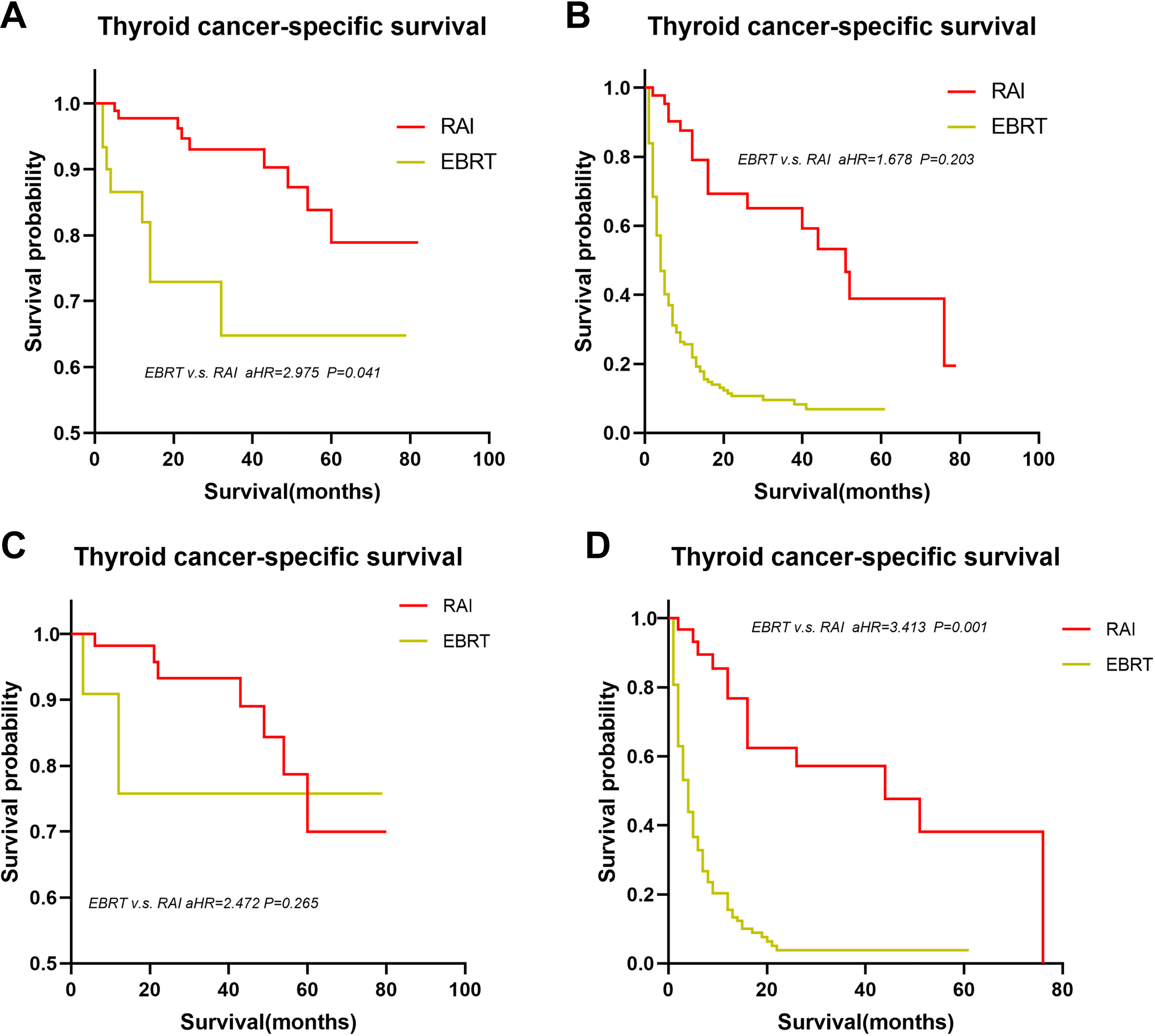
Multivariate Cox regression analysis survival curves of TCSS based on grade subgroup. A, Well- and moderately differentiated tumors in patients with DM. Adjusted for age and surgical treatments. B, Poorly differentiated and undifferentiated tumors in patients with DM. Adjusted for age, histology, surgical treatments, LM, and EE. C, Well- and moderately differentiated tumors in patients with PM. Adjusted for surgical treatments. D, Poorly differentiated and undifferentiated tumors in patients with PM. Adjusted for age, histology, and surgical treatments. DM indicates distant metastasis; EE, extrathyroidal extension; LM, lymphatic metastasis; PM, pulmonary metastasis; TCSS, thyroid cancer–specific survival.
Discussion
Using a large population of patients with advanced TC, this study illustrated that age >45, higher grades, papillary with follicular variant histology, follicular histology, LM, tumor size >20 mm, and EE were risk factors for DM independent of other clinicopathological factors. Furthermore, these observations illuminate the significant impact of age >45 years and higher grades on metastatic spread and thus reinforce further their clinically relevant implications. Our findings on the association between RAI and survival indicated that RAI could significantly improve survival in age ≤45 years and well-/moderately differentiated grade subgroups in patients with DM, as well as in patients with PM who are younger than 45 years or with poor grade tumors.
Risk factors for DM have been discussed in some studies. A previous study indicated that patients >65 years of age and follicular and medullary TC were risk factors for bone metastases. 16 Patients with papillary TC who were older, male, with larger tumor size and higher Tg level had a higher risk of PM. 17 For other metastatic sites, little information was published. As the supplement, our study provided evidence that worse grade, tumor size >10 mm, LM, and EE were also associated with bone metastasis development. Poor grade, follicular histology, LM, and EE were correlated with lung metastases. In addition, risk factors for liver and brain metastases are listed. Apart from these clinical characteristics, gene mutations also take part in DM. Undifferentiated tumors had a greater mutation burden, including TP53, TERT promoter, PI3K/AKT/mTOR pathway, SWI/SNF subunits, and histone methyltransferases. BRAF and RAS were predominantly mutated genes, which dictated distinct metastatic sites. The BRAF mutation led to regional nodal metastases, and the RAS mutation tended to DMs. 18
Age >45 years was a negative prognostic factor for the survival of patients with DM and PM undergoing RAI. Because EBRT was regularly recommended to radioiodine-refractory patients, we compared the survival of these 2 radiotherapy treatments to explore the clinical characteristics of RAI-refractory population. Existing studies have suggested that RAI could improve the survival of patients with TC with PM. 5,19,20 The younger patients showed stronger RAI avidity 1,21 for the more active expression of the sodium iodide symporter. 12 In addition, the decline of the immune system and the more aggressive histological subtype also accounted for the poor effect of RAI in the older patients. 15,22 Moreover, the possible hypofunction of the hypothalamic/pituitary system resulted in a decreased response to the low level of serum T4, which gave rise to insufficient serum thyroid-stimulating hormone (TSH), 23 subsequently impairing RAI uptake. Relevant evidence about the correlation between the effect of RAI and serum thyrotropin (TSH) level in young group and aged group was insufficient, so this hypofunction should be further discussed.
Regarding the other risk and negative prognostic factors of patients with DM, poor tumor grade results in RAI-refractory tumors in most cases. Based on our study, RAI significantly improved the survival of patients with DM in the better grade subgroup but failed in the higher grade subgroup. In theory, poorly differentiated or undifferentiated thyroid tumors rarely concentrate iodine, 24 which represents the low efficacy of RAI. The conventional therapy of radiosensitizing combined with adjuvant chemotherapy seemed to be ineffective in metastatic anaplastic TC. 25,26 Thus, we compromised EBRT in progressive or symptomatic disease. However, we obtained contradictory results in patients with PM. The BRAF V600E mutation might explain this phenomenon. BRAF V600E knockdown in mice resulted in fewer lung metastases from primary tumors, 27 which proved that BRAF activation was associated with lung metastases. The BRAF V600E mutation could activate the MAP kinase pathway, which resulted in a decreased expression of sodium iodide symporter. 28 A new study suggested that MAPK pathway inhibition or BRAF inhibitor could inverse RAI-refractory TC. 29 On the other hand, the effect of RAI in poorly differentiated patients with PM might be explained by the well-differentiated variant of metastatic lesions, which need further study and more evidence. Furthermore, the dose of radioiodine could make difference. Generally, lymph node metastases may be treated with about 100 to 175 mCi of 131I. Patients with DMs are usually treated with 100 to 200 mCi of 131I, when diffuse PMs are recommended less to avoid lung injury. We further analyzed survival difference in patients with PM based on lymph node status (Supplementary Figure 3), but no statistical significance was observed. According to our results, careful selection was required for patients with PM with lower grades.
The study has several limitations. Distant metastases and nondifferentiated thyroid carcinoma in TC are sufficiently rare that the sample size of this study was small. Due to the insufficient number of cases of some subgroups, bias was unavoidable, and further study was not performed. Also, some follow-up data, such as the level of serum Tg and recurrence, are not available in the SEER program.
Conclusions
In conclusion, age and grade not only suggest a high risk of DM but are also significantly different regarding the effect of radiotherapy on tumors. These observations could potentially be used in determining the appropriate regimen for patients with TC with DM.
Supplemental Material
Supplemental Material, s1 - Radioactive Iodine Therapy in Patients With Thyroid Carcinoma With Distant Metastases: A SEER-Based Study
Supplemental Material, s1 for Radioactive Iodine Therapy in Patients With Thyroid Carcinoma With Distant Metastases: A SEER-Based Study by Chenyuan Li, Qi Wu and Shengrong Sun in Cancer Control
Supplemental Material
Supplemental Material, s2 - Radioactive Iodine Therapy in Patients With Thyroid Carcinoma With Distant Metastases: A SEER-Based Study
Supplemental Material, s2 for Radioactive Iodine Therapy in Patients With Thyroid Carcinoma With Distant Metastases: A SEER-Based Study by Chenyuan Li, Qi Wu and Shengrong Sun in Cancer Control
Supplemental Material
Supplemental Material, s3 - Radioactive Iodine Therapy in Patients With Thyroid Carcinoma With Distant Metastases: A SEER-Based Study
Supplemental Material, s3 for Radioactive Iodine Therapy in Patients With Thyroid Carcinoma With Distant Metastases: A SEER-Based Study by Chenyuan Li, Qi Wu and Shengrong Sun in Cancer Control
Footnotes
Authors’ Note
C.L. and Q.W. contributed equally to this work. Institutional review board approval was not required for this study, for the SEER program is an unlinkable anonymized database open to the public.
Declaration of Conflicting Interests
The author(s) declared no potential conflicts of interest with respect to the research, authorship, and/or publication of this article.
Funding
The author(s) received no financial support for the research, authorship, and/or publication of this article.

Supplemental Material
Supplemental material for this article is available online.
References
Supplementary Material
Please find the following supplemental material available below.
For Open Access articles published under a Creative Commons License, all supplemental material carries the same license as the article it is associated with.
For non-Open Access articles published, all supplemental material carries a non-exclusive license, and permission requests for re-use of supplemental material or any part of supplemental material shall be sent directly to the copyright owner as specified in the copyright notice associated with the article.
