



Abstract
Cervical cancer is the fourth most commonly diagnosed cancer and the fourth leading cause of cancer deaths in women worldwide. Few single-nucleotide polymorphisms associated with risk of cervical cancer have been identified, yet genetic predisposition contributes significantly to this malignancy. Long noncoding RNA LINC00673 has been widely explored for its role in the development and prognosis of many tumors, and 2 genome-wide association studies identified that LINC00673 rs11655237 was associated with susceptibility to pancreatic cancer. In the current study, using a case–control study design, we found rs11655237 significantly increased susceptibility of cervical cancer in a Chinese population (odds ratio = 1.27; 95% confidence interval = 1.08-1.50; P = .005). Expression of LINC00673 was significantly higher in adjacent normal tissues than in paired cancer tissues (P < .01) and significantly lower in the cancer or paired adjacent normal tissues of patients with cervical cancer having rs11655237 allele A than in those having rs11655237 allele G (P < .001). Our results indicate that LINC00673 rs11655237 is associated with increased risk of cervical cancer, possibly by downregulating LINC00673 expression in cervical tissues.
Introduction
Cervical cancer, the fourth most commonly diagnosed cancer and also the fourth leading cause of cancer deaths in women worldwide, is a serious public health concern. 1 It is the second most commonly diagnosed cancer and the third leading cause of cancer death among females in less developed countries. 1 Despite the screening opportunities offered in the last few decades, cervical cancer still remains one of the most common types among women. 2 –4 According to the report of National Office for Cancer Prevention and Control of China, 98.9 thousands of estimated new cases and 30.5 estimated deaths of cervical cancer occurred in 2015. 1
Persistent infection with oncogenic human papilloma virus (HPV) and chronic inflammation are well-established causes of cervical cancer. 5 -8 However, the study indicated that only a small percentage of infected women would finally develop into cervical cancer. 9 In this regard, several reports documented that tumor angiogenesis of cervical cancer is controlled by numerous factors, including the regulation of many long noncoding RNAs (lncRNAs). Long noncoding RNA LINC00673 has been widely explored for its role in the development and prognosis of many tumors, including pancreatic cancer, gastric cancer, non-small cell lung cancer, and tongue squamous cell carcinoma. 10 –13 Recently, considerable efforts have been made to investigate the effect of genetic variations in the lncRNA genes on the susceptibility of various tumors. LINC00673 rs11655237 was first identified to be associated with susceptibility to pancreatic cancer by a genome-wide association study (GWAS) on 9925 pancreatic cancer cases and 11 569 controls, including 4164 newly genotyped cases and 3792 controls in 9 studies from North America, Central Europe, and Australia. 14 Furthermore, another GWAS by Zheng et al 13 replicated the findings in Chinese population and found that rs11655237 created an miR-1231 binding site and interferes with PTPN11 degradation. However, to our knowledge, the role of lncRNA LINC00673 and its polymorphism rs11655237 within the context of cervical cancer had not been reported. Recently, functional single-nucleotide polymorphism (SNP)-based study strategy has been widely used in the genetic association studies. 15 –17 Given the important role of LINC00673 in carcinogenesis, we hypothesized that the LINC00673 rs11655237 could influence the susceptibility of cervical cancer.
Methods
Ethics Statement
The study was approved by the First Affiliated Hospital of Chongqing Medical University and the Affiliated Hospital of Inner Mongolia Medical University review board (IRB-0231), and each participant signed an informed consent. The whole research was conducted in accordance with the approved guidelines.
Study Population
Totally included in this study were 1000 cervical cancer cases and 1000 healthy controls, who were recruited between February 2007 and December 2015. All the patients were histologically confirmed and the metastasized cancer cases from other origin were excluded. The histology for each case was reconfirmed by at least 2 pathologists. The healthy controls were enrolled from people seeking for health care in the same hospitals. They were genetically unrelated to the cases and had no history of gynecologic tumors. Demographic information was collected using standard questionnaire by checking their medical records, and peripheral blood samples, tumor tissues, and paired adjacent cervical tissues were also collected.
Genotyping
Genomic DNA extraction was carried out from 200 μL of EDTA-anticoagulated whole blood using a QIAamp DNA Blood Mini Kit (Qiagen GmbH, Hilden, Germany) according to the manufacturer’s protocol. The genotypes of SNP rs11655237 were determined by TaqMan allelic discrimination methods. The random 10% of samples were repeatedly genotyped and the results were 100% concordant.
Quantitative Realtime Polymerase Chain Reaction
The cancer tissues and adjacent normal tissues of 100 cervical cancer cases were involved in this assay. Total RNAs were isolated using TRIzol method and reverse transcribed to complementary DNA and subjected to quantitative Realtime polymerase chain reaction. The primers of LINC00673 were sense TCCACCCTGGTCTTCTCCTGTAAC and reverse GGTTCAAAGCACCCACCGAGT. The primers of GAPDH were sense TGACTTCAACAGCGACACCCA and reverse CACCCTGTTGCTGTAGCCAAA. The relative normalized quantity of LINC00673 expression was calculated using the 2−ΔΔCT algorithm.
Statistical Analysis
Demographic characteristics between cases and controls were analyzed using χ2 test, and differences in continuous variables were tested by Student t test. Hardy-Weinberg equilibrium (HWE) for the SNP rs11655237 among the controls was tested using a goodness-of-fit χ2 test. Unconditional logistic regression model was conducted to calculate odds ratios (ORs) and their 95% confidence intervals (CIs) of the association between the SNP and cervical cancer risk, adjusting for age, menopausal status, body mass index (BMI), waist–hip ratio (WHR), family history of cancer, and oral contraceptive users. Nonparametric analyses of Spearman correlation test was used to assess the correlation of LINC00673 rs11655237 genotypes with LINC00673 expression. All statistical tests were 2 sided and conducted using Statistical Program for Social Sciences (SPSS 19.0, Chicago, Illinois). A 2-side P value of <.05 was considered as statistically significant.
Results
Characteristics of Study Population
A total of 100 cervical cancer cases and 1000 healthy controls were enrolled in this study. As shown in Table 1, there were no statistically significant differences in age, menopausal status, and WHR. However, we found the case group has bigger BMI, more family history of cancer, and more HPV infection rate and oral contraceptive users (P < .05), compared to the control group. The majority of the histological types identified were squamous cell carcinoma, 801 (80.1%).
Distributions of Selected Variables in Cervical Cancer Cases and Healthy Controls.

Abbreviations: BMI, body mass index; HPV, human papilloma virus; WHR, waist–hip ratio. The bold indicates the comparison is statistically significant.
Association Studies of rs11655237 Alleles and Genotypes
The allelic and the genotype frequencies for LINC00673 rs11655237 in the case and control group are summarized in Table 2. The genotype frequencies of rs11655237 among the controls and the cases were all in accordance with HWE (P = .949 and .802, respectively). The difference in allele distribution of rs7958904 between the case and controls was of statistical significance (OR = 1.27; 95% CI = 1.08-1.50; P = .005). The AG genotype was associated with a 1.26-fold increased risk (95% CI = 1.02-1.56; P = .033) of cervical cancer as compared to the GG genotype, while the AA genotype conferred 1.58-fold increased risk of cervical cancer compared to the GG genotype (95% CI = 1.05-2.37; P = .028). When a dominant model was employed, the AG and AA genotypes were associated with a 1.30-fold increased risk (95% CI = 1.06-1.59; P = .010) of cervical cancer as compared with the GG genotype. However, no statistically significant association was observed for the recessive model (OR = 1.46; 95% CI = 0.97-2.21; P = .066).
Associations Between LINC00673 rs11655237 and Cervical Cancer Susceptibility.

Abbreviations: CI, confidence interval; OR, odds ratio.
aAdjusted for age, menopausal status, body mass index, waist–hip ratio, family history of cancer, and oral contraceptive users. The bold indicates the comparison is statistically significant.
Stratified Analyses
Further stratified analyses by BMI, family history of cancer, oral contraceptive users, and HPV infection were conducted to evaluate the potential effect modification for risk of cervical cancer. As shown in Table 3, allele A of SNP rs11655237 was still significantly associated with increased risk of cervical cancer in women with BMI ≤25, no family history of cancer, no oral contraceptive use, and no HPV infection. This may be caused by the relatively small sample size in subgroup.
Associations Between LINC00673 rs11655237 and Cervical Cancer Susceptibility by Menopausal Status.

Abbreviations: BMI, body mass index; CI, confidence interval; HPV, human papilloma virus; OR, odds ratio. The bold indicates the comparison is statistically significant.
Relative Expression of LINC00673
We also examined the expression level of LINC00673 and the potential effect of rs11655237 in cervical cancer tissues and adjacent normal tissues of 100 cases (Figure 1). Among all the pairs of patients with cervical cancer, the expression levels of lncRNA LINC00673 in cervical cancer tissues were significantly lower than those in the corresponding normal tissues (P < .01). And allele A was significantly associated with decreased expression level of lncRNA LINC00673 (P < .001), which may further increase the susceptibility of cervical cancer.
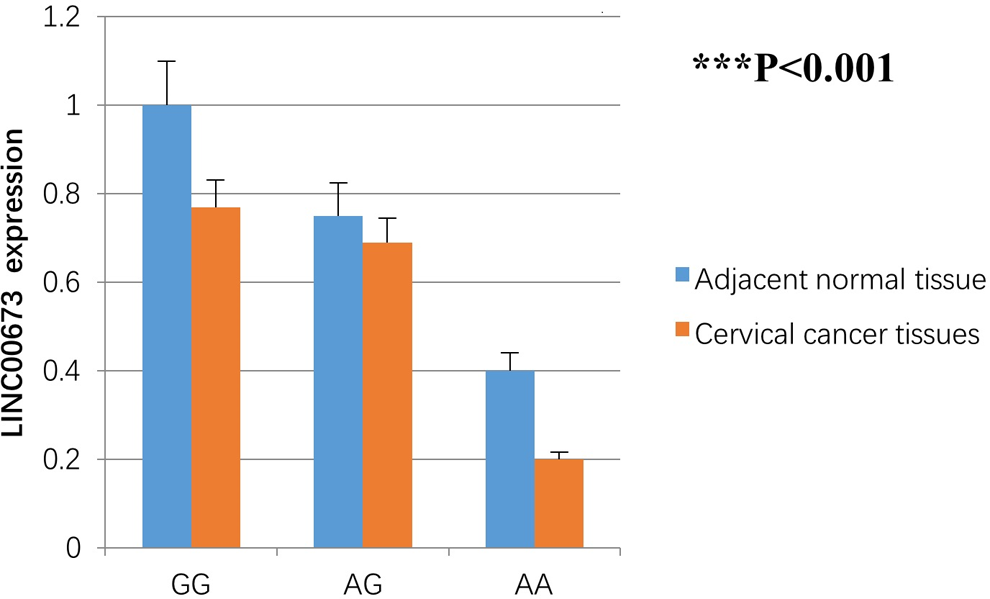
Relative expression of LINC00673. LINC00673 levels determined by quantitative realtime polymerase chain reaction (RT-PCR) in normal tissues adjacent to cervical cancer in participants with the AA, AG, or GG genotype at rs11655237. Results are shown as means ± standard error of the mean (SEM) relative to glyceraldehyde-3-phosphate dehydrogenase (GAPDH) levels, and all P values are from 2-sided t tests. ***Statistical significance apply to all the results.
Discussion
The aim of our study was to evaluate the potential contribution of LINC00673 rs11655237 to the susceptibility of cervical cancer. We found that cervical cancer risks were significantly higher in carriers of A allele and genotype AA/AG of rs11655237 polymorphism than those with G allele and GG genotype. We also found that lncRNA LINC00673 was downregulated in cervical cancer tissues, and allele A of rs11655237 could significantly decrease the expression level of LINC00673, which may further increase the susceptibility of cervical cancer. To the best of our knowledge, this is first study aiming to evaluate the function of lncRNA LINC00673 and its variant-rs11655237 in the carcinogenesis of cervical cancer.
Long noncoding RNAs have been identified to be involved in multiple biological functions and play a vital role in cervical carcinogenesis. 8,18 –28 Long noncoding RNA LINC00673 was first identified for its role in maintaining cell homeostasis and its germline variation might confer susceptibility to pancreatic cancer by Zheng et al. 13 Then, Huang et al 10 reported that LINC00673 was activated by SP1 and exerts oncogenic properties by interacting with LSD1 and EZH2 in gastric cancer, and Lu et al 25 found that LINC00673 regulated non-small cell lung cancer proliferation, migration, invasion, and epithelial mesenchymal transition by sponging miR-150-5p. Yu et al 12 also showed that LINC00673 was associated with poor prognosis and promoted invasion and metastasis in tongue squamous cell carcinoma. In the current study, we found the expression levels of lncRNA LINC00673 in cervical cancer tissues were significantly lower than those in the corresponding normal tissues, which means that LINC00673 may be involved the carcinogenesis of cervical cancer. All studies above provide solid evidence that lncRNALINC00673 plays an essential role in the development and metastasis process of multiple cancers.
Using HaploReg, we found SNP rs11655237, a noncoding transcript variant in lncRNA LINC00673, showed significant DNase hypersensitivity in multiple cancer cell lines and binds transcription factors including P300, FOXA1, FOXA2, and the DNA repair protein RAD21. 29,30 To elucidate the mechanisms by which the rs11655237 genotype predisposed the susceptibility of cervical cancer, we investigated the association of the rs11655237 genotype with LINC00673 expression in cancer and adjacent normal tissues. We found allele A of rs11655237 could significantly decrease the expression level of LINC00673. These results indicate that LINC00673 might be a tumor suppressor in cervical cancer, while rs11655237 A allele suppresses the transcription of lncRNA LINC00673. This may be caused by the G > A change at rs11655237 and creates a target site for miR-1231 binding, which diminishes the effect of LINC00673. 13 The G > A mutation at rs11655237 was predicted to change the local folding structures and free energy of lncRNA LINC00673. 13,31
The current study has strengths and weaknesses. The assessment of LINC00673 rs11655237 with susceptibility of cervical cancer in a relatively large Chinese population is a major asset as is the application of the same epidemiological and testing protocols to different populations (the power was 89.4% for such an association). 32 Weaknesses of the present study include, however, the restriction to selection of a priori interesting SNP, the relatively low statistical power in the subgroup analysis, and the impossibility to assess jointly the influence of genetic characteristics of the host and other demographic factors, and the design of a hospital-based study. 33 However, these limitations could not cover up the progressiveness of the current study.
In conclusion, the present study investigated the association of LINC00673 rs11655237 with cervical cancer risk and identified LINC00673 rs11655237 significantly increased susceptibility of cervical cancer in Chinese population. Expression of LINC00673 was significantly higher in adjacent normal tissues than in paired cancer tissues and significantly lower in the cancer or paired adjacent normal tissues of patients having cervical cancer with rs11655237 allele A than in those with rs11655237 allele G. Further large-scale, well-designed, different racial population-based studies are warranted to elucidate the impact of rs11655237 on occurrence and development of cervical cancer.
Footnotes
Authors’ Note
The scheme was authorized by ethics committee of the First Affiliated Hospital of Chongqing Medical University and the Affiliated Hospital of Inner Mongolia Medical University (IRB-0231). The verbal consent for this study was obtained from the patients.
Declaration of Conflicting Interests
The author(s) declared no potential conflicts of interest with respect to the research, authorship, and/or publication of this article.
Funding
The author(s) received no financial support for the research, authorship, and/or publication of this article.