



Abstract
Growing research suggests that clinical psychological traits are contiguous with normal personality and can be located within the same psychometric frameworks. In this article, we examined whether autism-related traits (ARTs) can plausibly be located within the Five Factor Model (FFM) of personality. Across two studies (Ns = 408 and 423), participants completed measures of ARTs, broad FFM domains, and narrower FFM facets. We used empirically derived criteria to evaluate whether ARTs overlapped (i.e., shared variance) with the FFM domains to a degree that was comparable to FFM facets. Results suggested that most socially oriented ARTs could be represented as facets of the extraversion domain, whereas behaviorally oriented ARTs were more peripheral to the FFM. Cognitively oriented ARTs were less consistently linked with the FFM. These findings highlight the value of the FFM as an organizing framework for ARTs, marking an important step toward synthesis across the personality and autism literatures.
Keywords
Autism is a lifelong neurodevelopmental condition that emerges in early childhood and affects various social and quality-of-life outcomes (American Psychiatric Association [APA], 2022; Drmic et al., 2017). The core features of autism comprise a multifaceted, dimensional structure that spans both general and clinical populations—those without and with a formal diagnosis, respectively—across specific social, cognitive, and behavioral features (Fletcher-Watson & Happé, 2019; Happé & Frith, 2020). Recent shifts toward a dimensional understanding of autism align with broader literature demonstrating that clinically relevant individual differences generally vary by degree, rather than by kind (Conway et al., 2021; Haslam et al., 2020). Following this dimensional conception, there is a rising interest in autism-related traits (ARTs). These describe non-clinical analogues of features typically characteristic of people diagnosed with autism spectrum disorder (ASD) and may resemble basic personality traits (Chown, 2019). Yet, the degree to which ARTs can be incorporated within broad personality trait taxonomies—developed precisely as organizing frameworks for such trait-like characteristics—is currently unknown.
The most influential trait framework in personality psychology is the Five Factor Model (FFM), also known as the Big Five 1 —an empirically derived, hierarchically arranged model for describing personality trait characteristics at an overarching level of abstraction (Costa & McCrae, 1992; Goldberg, 1990; John et al., 2008). Many clinically relevant trait characteristics (e.g., anxiety) can be subsumed within the FFM framework (e.g., Kaplan et al., 2015; Kotov et al., 2010; Lyon et al., 2020), but such research remains scarce in the context of autism. Given the similarities ARTs have with features of ASD, evaluating whether ARTs can be located within the FFM structure may help synthesize findings across the personality and autism literatures (Wright & Hopwood, 2022). Thus, our aim in this article is to shed light on the utility of the FFM as an organizing framework for ARTs.
Autism-Related Traits
The Diagnostic and Statistical Manual of Mental Disorders (DSM-5-TR) defines ASD as a neurodevelopmental condition characterized by social, communication, and interaction impairments, together with restricted and repetitive behaviors and interests (APA, 2022). Although the DSM-5-TR and other diagnostic systems still categorize people according to their functional “deficits” (Bottema-Beutel et al., 2021; Broderick & Ne’eman, 2008), mounting evidence favors a continuous, multidimensional conception of autism (Fletcher-Watson & Happé, 2019; Happé & Frith, 2020; Uljarević et al., 2023). Such a dimensional approach has been proposed for the future of psychiatric nosology, given the evidence against psychiatric categories that have accumulated over the past few decades (see First, 2016; Haslam et al., 2020; Kotov et al., 2010; Krueger et al., 2014). Moreover, this conception aligns with advocacy by autistic community members for a social model of autism, which appreciates natural variations in human neurodevelopment (Pellicano & den Houting, 2022). Thus, both the empirical record and lived experience accounts of the autistic community increasingly favor a multidimensional conception of autistic traits.
The emergence of a multidimensional conception of autistic features has prompted the development of scales to assess ARTs in the general population. Of these, the most well-known and widely used is the Autism-Spectrum Quotient (AQ; Baron-Cohen et al., 2001; >7,500 citations on Google Scholar). The AQ comprises five dimensions labeled Social Skill, Attention Switching, Attention to Detail, Communication, and Imagination (see Table 1 for brief descriptions). Research using the AQ supports the relevance of ARTs for characterizing both clinical and community samples. For example, Abu-Akel et al. (2019) employed mixture modeling on a combined sample comprising participants with and without ASD diagnoses and found evidence for the dimensional distribution of ARTs, albeit with two complementary categorical components that reflected the two groups of participants based on diagnostic status (see also Leth-Steensen et al., 2021). Overall, this research further substantiates the dimensional nature of ARTs.
Overview of Traits Examined in This Research
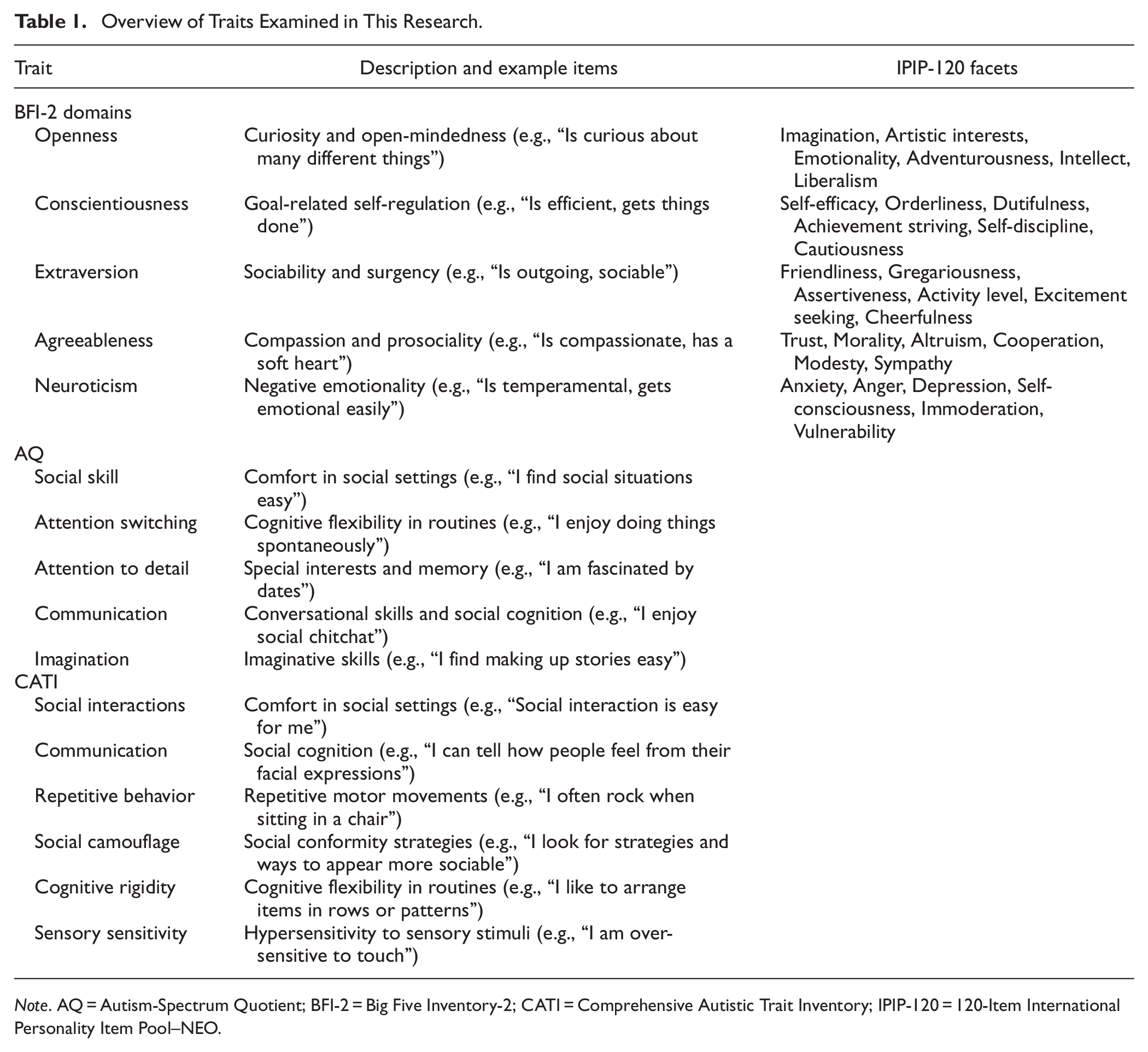
Note. AQ = Autism-Spectrum Quotient; BFI-2 = Big Five Inventory-2; CATI = Comprehensive Autistic Trait Inventory; IPIP-120 = 120-Item International Personality Item Pool–NEO.
Importantly, findings regarding the factor structure of the AQ have been very mixed, with studies favoring alternative structures comprising two (e.g., Hoekstra et al., 2008), three (e.g., Hurst et al., 2007), four (e.g., Freeth et al., 2013), or five (e.g., Kloosterman et al., 2011) factors. More recently, a comprehensive psychometric analysis comparing different factor structures of the AQ found that a three-factor model (Social Skill, Details/Patterns, and Communication/Mindreading; cf. the original five factors noted above) best fit the data, although this parsimonious solution did not fully capture the breadth of autistic features (English et al., 2020). Subsequently, Zhu et al. (2022) proposed an alternative theory-driven AQ structure that provided more comprehensive coverage of six autistic features and exhibited comparable (if not better) fit compared to other factor structures. The dimensions within this representation are Social Anhedonia, Interest in Details/Patterns, Social Cognition, Social Discourse Convention, Imagination Ability, and Desire for Predictability/Routine.
Another more recent effort to improve on the psychometric limitations of the AQ yielded an alternative measure, the Comprehensive Autistic Trait Inventory (CATI; English et al., 2021). The six ARTs specified within the CATI are Social Interactions, Communication, Repetitive Behavior, Social Camouflage, Cognitive Rigidity, and Sensory Sensitivity (see Table 1 for brief descriptions). Although the AQ’s factor structure was mostly informed by the scale authors’ contemporary views and perspectives on autism (Baron-Cohen et al., 2001), the item content of the CATI aligns more closely with clinical diagnostic criteria for ASD. The ARTs captured by this questionnaire may therefore better reflect features of autism as seen in the clinical population. Indeed, the CATI was found to have incremental validity over the AQ when predicting autism diagnosis (English et al., 2021). That said, the CATI (like the AQ) was not intended as a diagnostic tool but as a measure of ARTs in the general population. Despite its recent introduction to the literature, its promising psychometric properties have been confirmed within several community samples, including a Chinese sample using a translated version of the CATI (Meng & Xuan, 2023).
Can ARTs Be Accommodated Within the FFM Framework?
The FFM captures individual differences in personality trait characteristics across five broad dimensions (Openness to Experience [hereafter, Openness], Conscientiousness, Extraversion, Agreeableness, and Neuroticism; Goldberg, 1990; John et al., 2008; see Table 1 for brief descriptions). The FFM dimensions describe the structure of personality at a broad level of abstraction, with the five domains subsuming “a large number of distinct, more specific personality characteristics” (John et al., 2008, p. 119) lying at a lower facet level. The FFM provides a robust organizing framework for psychological trait constructs (Bainbridge et al., 2022), including clinical trait constructs and broader psychopathology (see, e.g., Kotov et al., 2010; Markon et al., 2005; Wright & Hopwood, 2022). Indeed, the Hierarchical Taxonomy of Psychopathology (HiTOP), recently proposed as an improvement on categorical diagnostic systems such as the DSM (Kotov et al., 2017; Widiger et al., 2019), is based closely on the FFM structure.
Given the utility of the FFM as a broad organizing framework for both general population and clinically relevant personality traits, it seems plausible that the FFM may also accommodate ARTs within this framework. However, only one study (to our knowledge) has examined whether ARTs can be accommodated within the FFM’s factor structure. Using exploratory factor analysis (EFA), Wakabayashi et al. (2006) examined five- and six-factor solutions in which the FFM facets and the AQ scales were specified as variables for inclusion. In each of these solutions, one factor corresponded to the AQ scales and the remaining factors to each of the FFM domains 2 ; thus, both solutions seemed to suggest that ARTs are distinct from the FFM domains. In addition, Wakabayashi et al. (2006, p. 876) found that the FFM domains typically yielded “small”R2 values (ranging from .09 to .34) when entered as predictors of each of the AQ scales within multiple regression analyses, again concluding that ARTs are independent from the FFM domains.
However, we see two problems that may undermine the conclusions drawn by Wakabayashi et al. (2006). First, EFA solutions are strongly dependent on the variables included within a particular analysis (Saucier, 1997). Consequently, they are likely to produce factor solutions that closely reflect the underlying structure of the included scales, and thus may not indicate whether the FFM can accommodate other trait constructs (Bainbridge et al., 2022; Trninić et al., 2013). Indeed, factor analyses combining FFM traits with other scales often yield ambiguous results, whereby different factor solutions seem similarly interpretable (e.g., Ashton et al., 2012, p. 653). Importantly, the ostensibly independent ART factor in Wakabayashi et al.’s (2006) EFA solutions nevertheless had strong loadings from some of the extraversion facets, indicating these were not completely distinct from FFM traits.
Second, Wakabayashi et al. (2006) did not specify any a priori criteria to determine whether AQ scales could be reasonably described by the FFM domains. Rather, they arbitrarily labeled R2 values as “small,” without specifying in advance what R2 value could be taken to indicate that a scale is well described by the FFM. Granted, it is difficult to specify such criteria in a non-arbitrary manner, as exemplified in a debate between Saucier and Goldberg (1998) and Paunonen and Jackson (2000): although Saucier and Goldberg (1998) reported that the FFM domains predicted many trait characteristics reasonably well, specifying a multiple R of .30, Paunonen and Jackson (2000) pointed out that this entailed an R2 of .09 which they regarded as trivial. Thus, the two author teams drew starkly different conclusions from the same data, and their disagreement could not be resolved owing to the arbitrary nature of the criteria advocated by each team. Similarly, whereas some researchers might agree with Wakabayashi et al.’s (2006) description of R2 values of up to .34 as “small,” others might regard these as relatively large (see Gignac & Szodorai, 2016). Importantly, this ambiguity persists despite more recent efforts to thoroughly estimate the relation between ARTs and the FFM—namely, a comprehensive meta-analysis of these association (Lodi-Smith et al., 2019). Again, this is because a priori criteria are needed to determine whether those associations are sufficiently strong to indicate that ARTs can be incorporated within the FFM.
Given these interpretive ambiguities, further investigation is warranted to determine whether ARTs can plausibly be located within the FFM framework. To provide an a priori and non-arbitrary criterion for making this assessment, we will follow the approach recently proposed by Bainbridge et al. (2022). In brief, we will compare the variance in individual ARTs as described by the FFM domains, relative to the variance in FFM facets as described by the FFM domains. The logic here is that the FFM facets correspond to the FFM domains conceptually and empirically, having been validated as narrower traits lying within the space described by the FFM (Costa & McCrae, 1995; Goldberg, 1993). Thus, the degree to which the FFM domains are similarly (or even superiorly) related to ARTs, relative to the FFM facets, would suggest that ARTs can plausibly be accommodated within the FFM structure as facets themselves. This empirically derived a priori criterion circumvents the subjective interpretations of R2 values evident in Wakabayashi et al. (2006), and in previous debates surrounding the utility of the FFM as a broad organizing framework (i.e., Paunonen & Jackson, 2000; Saucier & Goldberg, 1998).
Supposing that ARTs can be accommodated within the FFM structure, the next question concerns where they might be located within this framework. The aforementioned meta-analysis by Lodi-Smith et al. (2019) revealed that ARTs had significant correlations with all FFM domains, with the most pronounced correlate being (low) extraversion (Fisher’s z = −.50). These patterns of association may indicate the domains with which ARTs are most closely aligned, presuming that they can indeed be incorporated within the space defined by the FFM. Also adopting the analytical approach of Bainbridge et al. (2022), we will examine regression parameters from analyses in which each ART is predicted by all of the FFM domains simultaneously. This will indicate the relationship of each ART to the multidimensional structure of the FFM without influencing factor rotations, as is the case when using EFA (cf. Wakabayashi et al., 2006).
The Present Research
In sum, there is growing interest in traits describing features of ASD within the general population, and it seems plausible that these ARTs might be accommodated within broad personality taxonomies such as the FFM. Given the limitations of the few studies to examine this possibility, the question at hand remains largely open. Thus, in Study 1, we will explore whether ARTs can be reasonably located as facets within the FFM structure (Research Question 1 [RQ1]) and where individual ARTs can be located across the FFM domains (RQ2). In Study 2, we then attempt to confirm key findings of Study 1. We report how we determined our sample size as well as all data exclusions, manipulations, and measures in the study. All data, analysis code, and Supplemental Material can be found on the Open Science Framework (https://osf.io/zwja2/?view_only=1ff66dbb93d44f988072b4eff5fcf482).
Study 1
Method
Participants
Undergraduate psychology students in Australia participated for course credit. Our inclusion criteria specified a minimum age of 18 and proficiency in English. We set a target sample of 300 participants to provide (a) >80% power to detect a medium effect size in the context of individual differences research (i.e., r = .20; Gignac & Szodorai, 2016; N > 193; Brydges, 2019); (b) stable estimates of correlations of this magnitude (i.e., N > 250; Schönbrodt & Perugini, 2013); and (c) a satisfactory sample size for conducting structural equation modeling (i.e., N = 200–300; e.g., Barrett, 2007; Comrey & Lee, 1992). We oversampled beyond this target to remedy likely exclusions based on our rigorous quality control protocol, described below. Thus, after launching our study in early April 2023, we collected as much data as possible until the end of semester 1 of the 2023 university calendar (i.e., late June). Study 1 was granted ethical approval by the Office of Research Ethics and Integrity at The University of Melbourne.
Of the 689 participants who started the study, 137 participants exited immediately (thus omitting responses to all variables). A further 144 cases were excluded based on a series of quality control checks partly informed by Wood et al. (2017). Specifically, participants were excluded if they provided (a) unreasonably fast (<1 s) and/or slow (>12 s) average responses to the 60 items of the Big Five Inventory-2 (BFI-2; described below); (b) highly invariant responses across items of the BFI-2 (i.e., “straight-lining”, indicated by SD < 0.5 within any of 3 blocks of 20 items); (c) an average score of less than 4 (out of 7) on a 7-item scale assessing self-reported data quality (e.g., “I exerted sufficient effort on this survey”; Wood et al., 2017); and/or (d) empty responses on an open-ended question asking participants to indicate their current hobbies or interests. Additionally, cases were excluded if they were identified to be (e) duplicate responses from the same participant; and/or (f) participants aged younger than 18 years. The final sample (N = 408) 3 was aged 18 to 52 (M = 19.22, SD = 2.84), comprising 328 female (80.39%), 74 male (18.14%), and 5 non-binary (1.23%) participants who identified as Asian (53.43%), Caucasian (38.24%), or other ethnicities (8.33%). Three participants declined to describe either their age, gender, or ethnicity.
Measures and Procedure
We measured the FFM domains using the 60-item BFI-2 (Soto & John, 2017), the FFM facets using the 120-Item International Personality Item Pool–NEO (IPIP-120; Maples et al., 2014), 4 and ARTs using the AQ (Baron-Cohen et al., 2001) along with the CATI (English et al., 2021). Table 1 provides brief descriptions of these scales, whereas Supplemental Table S7 presents means, standard deviations, and McDonald’s omega (ω) reliability coefficients. To aid interpretation, CATI Social Interactions and CATI Communication were reverse-scored to mirror the comparable scales in the AQ. For succinctness, in the following sections, we often refer to ARTs that appear socially oriented (i.e., AQ Social Skill and Communication; CATI Social Interactions, Communication, and Social Camouflage), cognitively oriented (i.e., AQ Attention Switching, Attention to Detail, and Imagination; CATI Cognitive Rigidity), and behaviorally oriented (i.e., CATI Repetitive Behavior and Sensory Sensitivity). All questionnaires asked participants to rate the extent to which they agreed with statements that characterize them, using a 5-point Likert scale (1 = strongly disagree, 5 = strongly agree). All questionnaires were presented online via Qualtrics™, along with demographic questions and some additional questionnaires that were not relevant to this project. The survey took less than 1 hr to complete.
Statistical Analysis
Data cleaning procedures were conducted using SPSS Statistics (Version 29; IBM Corp., 2022), and descriptive statistics were examined using JASP (Version 0.17.3; JASP Team, 2023). All other analyses were conducted using R (Version 4.2.2; R Core Team, 2022) within RStudio (Version 2022.12.0.353; Posit Team, 2022). Specifically, we used the lavaan package (Rosseel, 2012) to run a series of latent variable regression models adapted from Bainbridge et al. (2022). Latent variable modeling better captures unobservable psychological constructs (i.e., by computing the common variance among observed variables) and adjusts for measurement error beyond the scope of traditional multiple regressions (Borsboom & Mellenbergh, 2002; Cai, 2012), alleviating potentially underestimated R2 values (cf. Wakabayashi et al., 2006). Nonetheless, we also ran the latter analyses, based on observed mean scores, for comparative purposes (see Supplemental Tables S1–S3). The basic configuration of our models is presented in Figure 1.
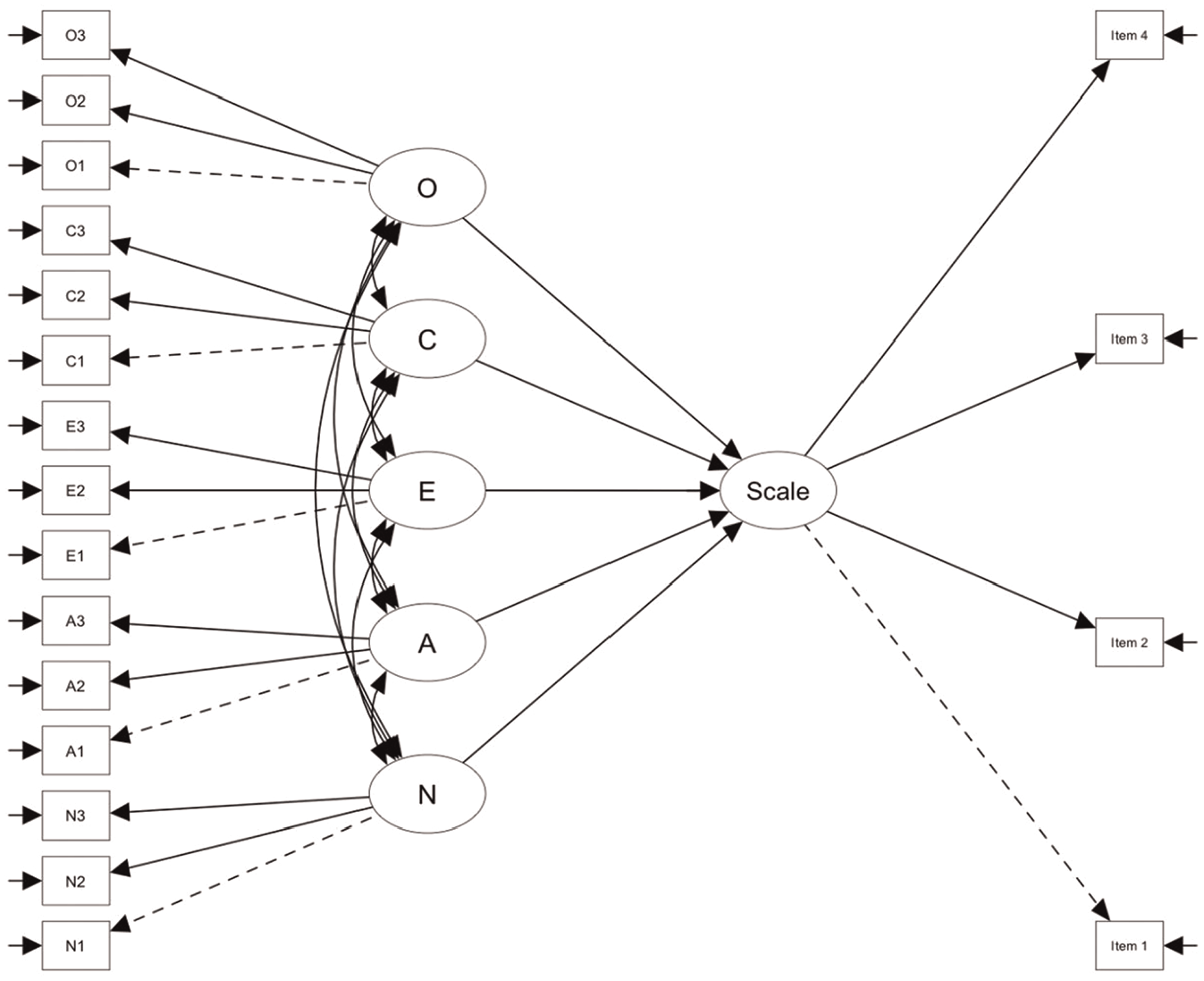
Structure of the latent regression models.
As shown in Figure 1, we modeled the FFM domains as latent factors predicting an unspecified latent factor (i.e., “Scale”), which may be substituted with an FFM facet or an ART. This amounted to 41 separate models corresponding to 30 FFM facets from the IPIP-120, as well as 11 ARTs from the AQ and the CATI. Each latent factor (e.g., Openness) was specified using their corresponding observed variables (e.g., the BFI-2 Openness items). Oblique rotation (i.e., allowing correlated factors) with maximum likelihood estimation was employed given that the FFM domains are not orthogonal (see DeYoung, 2006).
To answer RQ1, we extracted the R2 values generated from our models in indicating the share of variance of each ART or FFM facet described by the FFM domains. We rank-ordered the R2 values of the FFM facets to apply Bainbridge et al.’s (2022) criteria outlined in Table 2, then evaluated the R2 values of the ARTs according to these criteria. This allowed us to determine the degree of overlap between ARTs and the FFM domains, relative to that between the FFM facets and domains. These criteria provide a strict threshold for determining whether an ART may be considered locatable within the FFM, given their implication that 10% of the FFM facets themselves are considered peripheral to the FFM. To answer RQ2, we then examined the standardized regression coefficients generated from our models with the ARTs in determining the location of these traits across the FFM domains.
Criteria for Assessing Degree of Overlap with the FFM.

Note. Adopted from Bainbridge et al. (2022). FFM = Five Factor Model; IPIP-120 = 120-Item International Personality Item Pool–NEO.
Results
Preliminary Analyses
As shown in Supplemental Table S7, all scales had sufficiently high reliability (ω ≥ .70; McNeish, 2018) apart from three AQ scales that did not surpass this threshold (Attention Switching, Attention to Detail, and Imagination). Pearson’s and Spearman’s intercorrelations between the FFM domains and ARTs are also presented in Supplemental Table S9. Parametric correlations were broadly consistent with their non-parametric counterparts, suggesting that minor violations of distributional assumptions (see Supplemental Material, p. 11) were unlikely to have influenced our results.
Main Analyses
RQ1: The Degree of Overlap Between ARTs and the FFM
As detailed in Table 3, at least 25% of the variance in an ART ought to be described by the FFM domains for that trait to be considered locatable as a facet within the FFM structure (i.e., surpassing the 27th facet or Peripheral criterion). The R2 values from our latent variable regression models, with the FFM domains predicting ARTs, are presented in Figure 2 (see Supplemental Table S12 for a numerical version of this figure). In all, 8 out of 11 (i.e., 72.7%) traits surpassed the Peripheral criterion, indicating that most ARTs examined in our study overlapped sufficiently with the FFM domains to be plausibly located within the FFM facet structure.
Criteria for Classifying Degree of Overlap with the FFM Domains in Study 1.

Note. FFM = Five Factor Model; IPIP-120 = 120-item International Personality Item Pool–NEO.
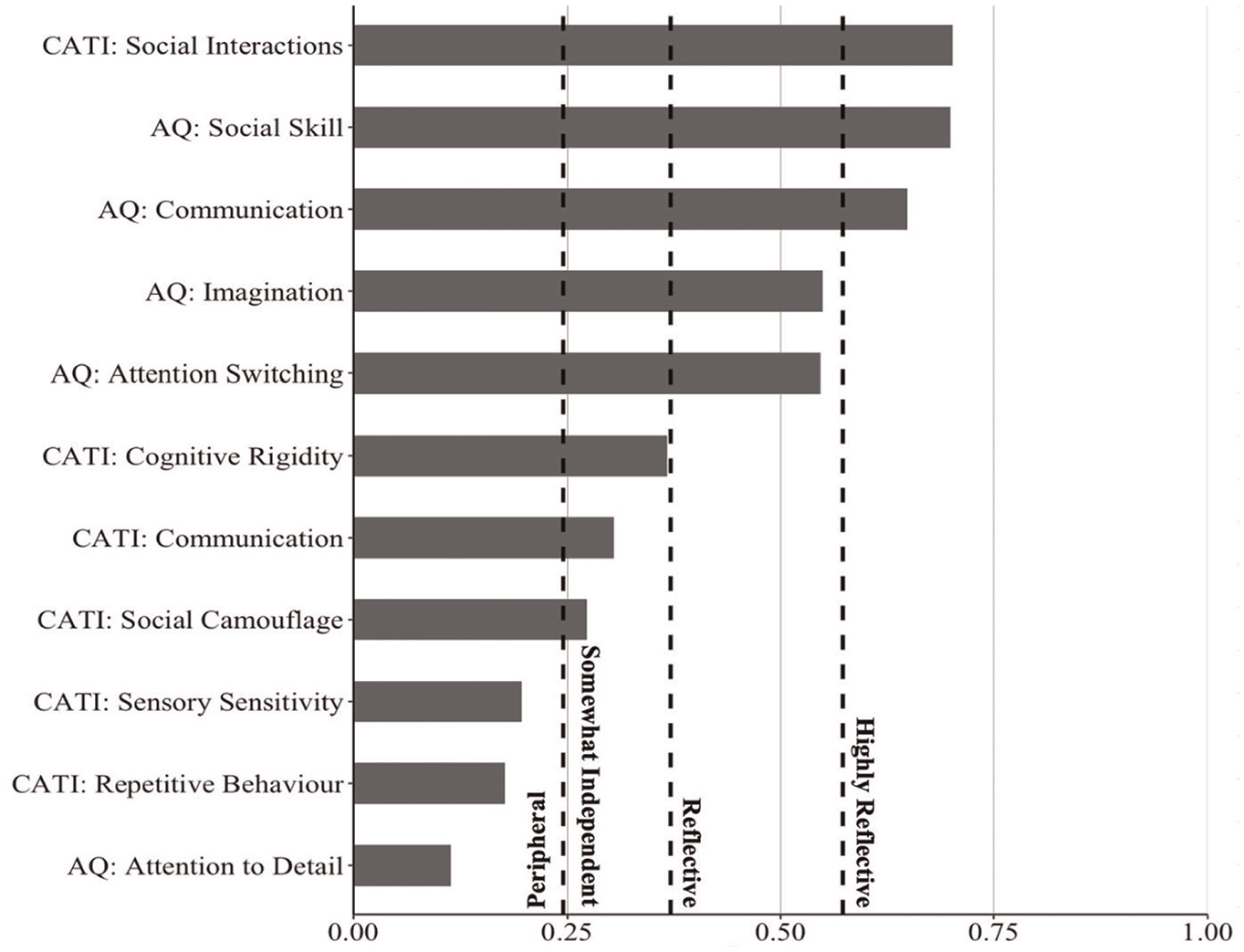
Variance in each ART described by the FFM domains in Study 1.
Some salient patterns evident in Figure 2 are as follows: First, the ARTs that were best captured by the FFM all assessed social features of ASD (i.e., CATI Social Interactions, AQ Social Skill, and AQ Communication). Other socially oriented ARTs (i.e., CATI Communication and CATI Social Camouflage) were also well described by the FFM, albeit to a lesser degree. Next, ARTs that correspond to the non-social features of ASD revealed relatively more mixed patterns of correspondence with the FFM. The more cognitive aspects of these features (i.e., AQ Imagination, AQ Attention Switching, and CATI Cognitive Rigidity) were readily captured by the FFM (except for AQ Attention to Detail), whereas the more distinctively behavioral aspects (i.e., CATI Sensory Sensitivity and CATI Repetitive Behavior) were largely independent from the FFM. Finally, AQ scales overlapped more strongly with the FFM domains compared to the CATI scales.
As noted earlier, we also ran traditional multiple regressions based on observed mean-score variables, using the same basic configuration in Figure 1. In these models, some R2 values were considerably lower relative to those of the latent models, especially for the AQ scales (see Supplemental Table S12). Given that latent variable models adjust for measurement error and unreliability, this inconsistency in results for observed versus latent variables is indicative of problems with psychometric structure, which aligns with previous criticisms surrounding the AQ’s psychometric properties (e.g., English et al., 2020). Thus, we repeated our analyses using the theory-driven six-factor AQ structure recently developed by Zhu et al. (2022). Overall, findings based on this alternative AQ structure were broadly consistent with those reported above. Specifically, in both cases, socially oriented and cognitively oriented ARTs were readily captured by the FFM, whereas the behaviorally oriented ART was not (see Supplemental Material, pp. 15–16).
RQ2: The Location of ARTs in the FFM
Figure 3 presents a heat map of the standardized regression coefficients from our latent variable regression models, with the FFM domains predicting ARTs. It shows that the three socially oriented ARTs (i.e., CATI Social Interactions, AQ Social Skill, and AQ Communication) were principally aligned with Extraversion. Among the remaining socially oriented ARTs, CATI Communication was most closely aligned with Agreeableness and more moderately with Openness, whereas Social Camouflage corresponded relatively evenly to Extraversion, Agreeableness, and Neuroticism. Next, for the cognitively oriented ARTs: AQ Imagination was principally aligned with Openness; AQ Attention Switching was most closely linked with lower Neuroticism and somewhat higher Extraversion; and CATI Cognitive Rigidity was most closely aligned with Conscientiousness, as well as more moderately with lower Agreeableness and higher Neuroticism. The remaining ARTs—mostly describing behaviorally oriented features—were peripheral to the FFM, and accordingly had relatively weak links with the FFM domains (although CATI Repetitive Behavior and Sensory Sensitivity nevertheless had moderate associations with Neuroticism).
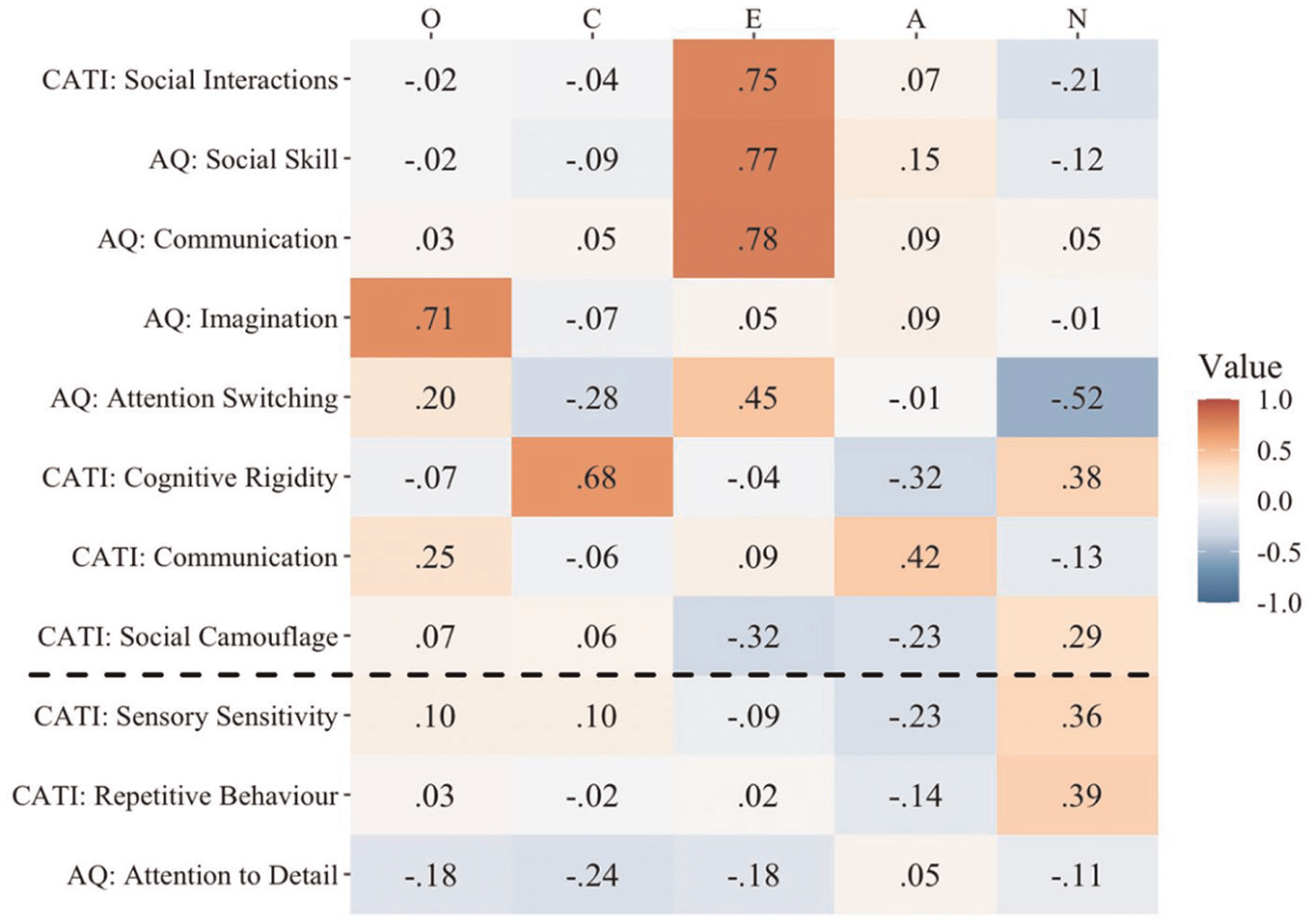
Heatmap depiction of multiple regression coefficients indicating locations of ARTs within the FFM in Study 1.
Exploratory Analyses
Building on the observation that some ARTs were strongly aligned with one FFM domain (RQ2), we subsequently ran exploratory analyses using latent variable correlations to investigate whether some of these traits may be considered closely related to (or even redundant with) existing FFM facets. Exploring the correlations between each ART and each FFM facet would require 330 separate analyses, so we restricted our focus to traits predicting any FFM domain with a standardized regression coefficient exceeding ±.50, as depicted in Figure 3. Accordingly, we computed 36 latent variable correlations, each between one ART and one FFM facet (see Supplemental Figure S5 for the configuration of these models and Supplemental Table S17 for the full results, as well as Supplemental Tables S23 and S24 for an equivalent set of analyses using the BFI-2 subscales in place of the IPIP-120 facets). Table 4 depicts the 10 largest latent variable correlations between ARTs and FFM facets.
Top 10 Latent Variable Correlations Between ARTs and FFM Facets in Study 1.

Note. Values inside brackets represent 95% confidence intervals. AQ = Autism-Spectrum Quotient; ART = autism-related trait; CATI = Comprehensive Autistic Trait Inventory; E = extraversion; FFM = Five Factor Model; IPIP-120 = 120-Item International Personality Item Pool–NEO; N = neuroticism; O = openness.
As shown in Table 4, very strong correlations (i.e., r > .80) emerged between two socially oriented ARTs, AQ Social Skill and CATI Social Interactions, and the Friendliness facet of Extraversion. These were closely followed by a third socially oriented ART, AQ Communicationr = .75. 5 Such strong correlations are often indicative of “twin constructs” (Lawson & Robins, 2021), or potential redundancy between scales. Therefore, we additionally compared the confirmatory factor analysis (CFA) fit indices between two latent variable correlation models with (a) one latent construct representing either AQ Social Skill or CATI Social Interactionswith IPIP-120 Friendliness; and (b) two latent constructs representing each construct separately, as employed earlier to generate the correlations in Table 4. Results from these analyses are presented in Table 5. To determine whether the two-factor models exhibited significantly better fit than the one-factor models (p < .05), the difference in chi-squared values between the two models must exceed a critical value of 3.84 with df = 1 (i.e., the difference between the number of parameters estimated in the two models). Table 5 reveals that the two-factor models performed significantly better in terms of the difference in chi-squared values, suggesting that, although AQ Social Skill and CATI Social Interactions overlap very closely with IPIP-120 Friendliness, these scales may not be entirely redundant with this FFM facet. Importantly, it should be noted that none of the models examined in Table 5 achieved optimal fit, particularly those involving the AQ scales. This again may reflect structural problems of the AQ that have been raised in prior research, a point we return to in the General Discussion.
Fit Statistics for One-Factor and Two-Factor Models with IPIP-120 Friendliness in Study 1.

Note. Values inside brackets represent 90% confidence intervals. AQ = Autism-Spectrum Quotient; CATI = Comprehensive Autistic Trait Inventory; CFI = comparative fit index; IPIP-120 = 120-Item International Personality Item Pool–NEO; RMSEA = root mean square error of approximation; SRMR = standardized root mean square residual.
p < .001.
The remaining correlations in Table 4 were indicative of moderate-to-strong effect sizes (i.e., .50 ≤ r ≤ .80), suggesting that these ARTs may not approach redundancy with the FFM facets, but might instead be regarded as “sibling constructs” (Lawson & Robins, 2021). That is, they may be measuring constructs within the same nomological network and potentially share underlying mechanisms—as will be considered further in the General Discussion.
Study 2
In Study 2, we attempted to confirm findings from Study 1 via a pre-registered direct replication. All methods for this study were identical to those from Study 1 unless specified below. The main difference between Study 1 and Study 2 is that the former recruited a university student sample, whereas the latter recruited a community sample. Confirming the locatability of ARTs within the FFM framework in this different sample would thus provide encouragement for both the replicability and generalisability of our Study 1 findings.
For Study 2, we pre-registered the methodological approach adopted in Study 1, along with two exploratory RQs and two confirmatory hypotheses. Specifically, we examined how many and which ART scales, from the AQ and CATI, are well explained by the FFM (RQ1) and approach redundancy with existing FFM facets (RQ2). We also predicted that three socially oriented ARTs—CATI Social Interactions, AQ Social Skill, and AQ Communication—would overlap with the FFM (in terms of R2 values) to a higher degree than do 20 of a set of 30 existing FFM facet scales (i.e., surpassing the Reflective criterion; H1). Finally, we predicted that the same three ART scales would correlate with one existing FFM facet (IPIP-120 Friendliness) to such a high degree as to suggest redundancy with that facet (i.e., r ≥ .80; H2). 6 The full pre-registration, together with all data, analysis code, and Supplemental Material, is available on the Open Science Framework (https://osf.io/zwja2/?view_only=1ff66dbb93d44f988072b4eff5fcf482).
Method
Participants
Australian residents recruited through Prolific (https://www.prolific.com) participated for payment (∼$8.50 AUD). Mirroring Study 1, our inclusion criteria specified a minimum age of 18 and fluency in English. We set a target sample of 400 based on the same considerations detailed in Study 1, and to secure a comparable sample size to that of Study 1 (i.e., N = 408). We therefore planned to recruit an initial sample of 500 participants to remedy likely exclusions based on our rigorous quality control protocol (see Study 1). In fact, only 460 participants were recruited because of a technical error, but this proved sufficient for meeting our sample size target. Specifically, we excluded 37 cases for unreasonably fast or slow responding, straight-lining, low self-reported data quality, and/or empty responses to an open-ended question (see “Study 1—Method” section). The final sample (N = 423) was aged 18 to 86 (M = 34.71, SD = 11.69), comprising 231 females (54.61%), 184 males (43.50%), and 8 who were either non-binary or non-disclosed (1.90%). Participants identified as Caucasian (66.90%), Asian (21.99%), or other ethnicities (11.11%). Thus, compared to Study 1, the final sample for Study 2 was older, more balanced with respect to gender, and more ethnically representative of the Australian population (i.e., 57.2% European ancestry and 17.4% Asian ancestry, according to the 2021 census; Australian Bureau of Statistics, 2022). Ethical approval was granted by the Office of Research Ethics and Integrity at The University of Melbourne.
Measures and Procedure
Participants completed a Qualtrics survey which included the same questionnaires employed in Study 1. Thus, the BFI-2 was again used to measure the FFM domains; the IPIP-120 was used to measure the FFM facets; and the AQ and the CATI were used to measure ARTs (see Supplemental Table S8 for means, standard deviations, and McDonald’s omega [ω] reliability coefficients). Additional questionnaires included in the survey were not relevant to this project. The survey took approximately 30 min to complete and was conducted in the third week of December 2023.
Statistical Analysis
Analytical procedures for Study 2 were identical to those described in Study 1. In brief, we ran 41 latent variable regression models (see Figure 1) in which oblique rotation and maximum likelihood estimation were employed. Analogous multiple regression analyses based on mean-scored variables were also deployed (see Supplemental Tables S4–S6). To answer RQ1 and H1, we compared the variance in individual ARTs explained by the FFM domains (i.e., R2 values), relative to the variance in FFM facets explained by the FFM domains, according to the criteria detailed earlier (see Table 2). Subsequently, we examined the standardized regression coefficients whereby the FFM domains predicted ARTs. To answer RQ2 and H2, we then examined latent variable correlations and CFA fit indices, mirroring our additional exploratory analyses in Study 1 (as described further below).
Results
Preliminary Analyses
As shown in Supplemental Table S8, all scales had sufficiently high reliability (ω ≥ .70; McNeish, 2018). Pearson’s and Spearman’s inter correlations between the FFM domains and ARTs are also presented in Supplemental Table S10. Mirroring Study 1, the pairs of correlations were broadly consistent, indicating that analyses are likely robust to minor violations of distributional assumptions (see Supplemental Material, p. 11).
Main Analyses
RQ1: The Degree of Overlap Between ARTs and the FFM
The criteria for classifying the degree of overlap with the FFM domains in Study 2 is presented in Table 6. These values are very similar to those of Study 1 (see Table 3). Next, the R2 values from our latent variable regression models are presented in Figure 4 (see Supplemental Table S13 for the numerical version of this figure). In all, 6 out of 11 (i.e., 54.5%) traits surpassed the Peripheral criterion, which is a smaller proportion of scales compared to Study 1. Yet, the same three socially oriented ARTs—AQ Social Skill, CATI Social Interactions, and AQ Communication—were again best captured by the FFM (i.e., surpassing the Reflective criterion). Thus, pre-registered hypothesis H1 was confirmed.
Criteria for Classifying Degree of Overlap with the FFM Domains in Study 2.

Note. FFM = Five Factor Model; IPIP-120 = 120-item International Personality Item Pool–NEO.
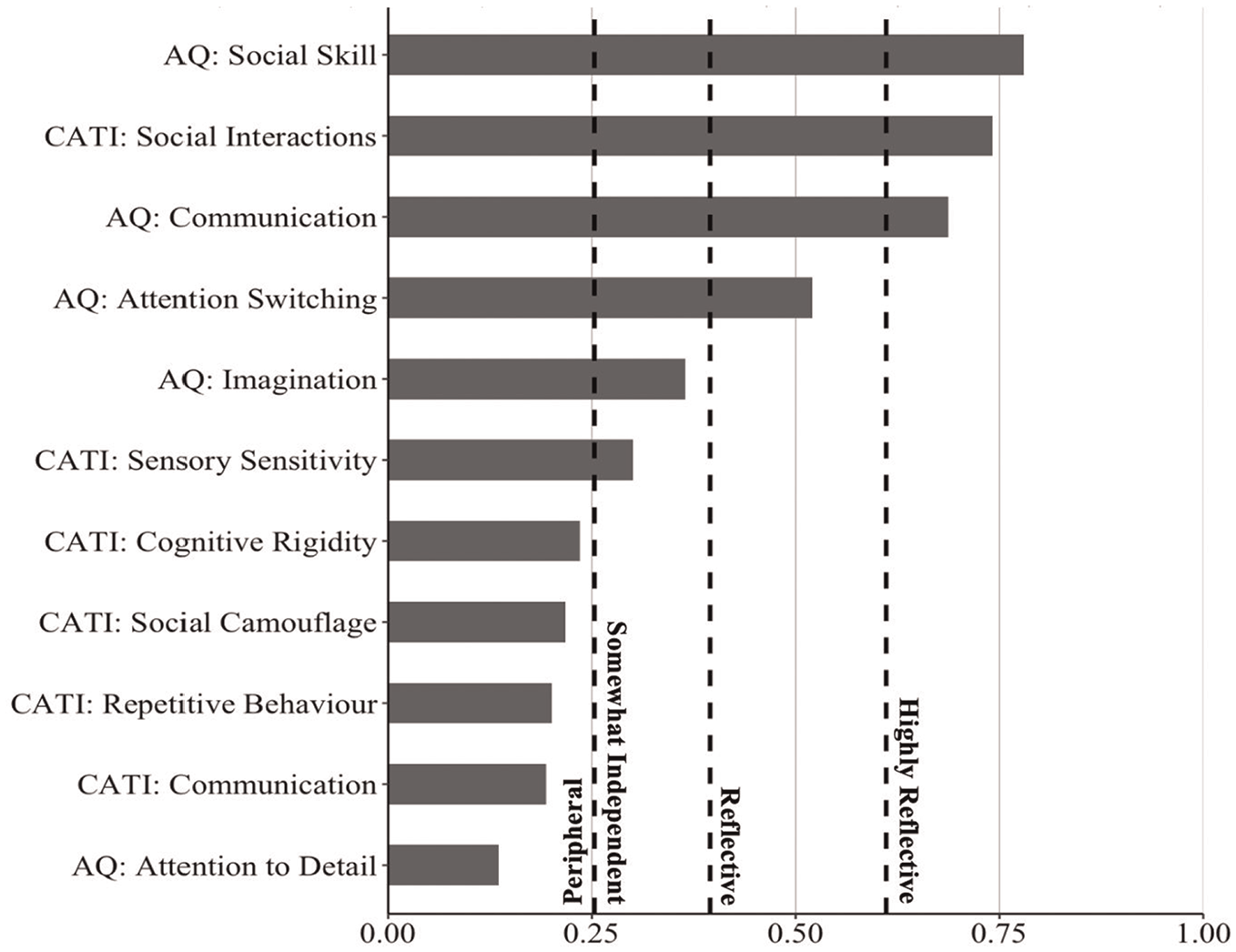
Variance in each ART described by the FFM domains in Study 2.
As in Study 1, both AQ Imagination and Attention Switching showed sufficient overlap to be regarded as potential FFM facets despite minor differences in the degree of overlap. In contrast to Study 1, CATI Sensory Sensitivity now surpassed the Peripheral criterion, whereas Cognitive Rigidity, Social Camouflage, and Communication did not. The remaining scales exhibited minor differences in terms of R2 values from Study 1. We again found that some R2 values in the regression models based on observed variables were considerably lower than those in the latent models, indicating problems with psychometric structure. As in Study 1, we thus deployed an alternative set of analyses based on the six-factor AQ structure developed by Zhu et al. (2022). Despite some differences compared to the results depicted in Figure 4, this supplementary analysis showed that socially oriented and cognitively oriented ARTs remained broadly captured by the FFM, whereas the behaviorally oriented ART was not (see Supplemental Material, pp. 17–18).
RQ1: The Location of ARTs in the FFM
Figure 5 depicts a heat map of the standardized regression coefficients from our latent variable regression models in Study 2, with the FFM domains predicting ARTs. Similar to Study 1, three socially oriented ARTs (i.e., AQ Social Skill, CATI Social Interactions, and AQ Communication) were principally aligned with Extraversion. In addition, AQ Imagination was again strongly aligned with Openness, whereas AQ Attention Switching again corresponded to lower Neuroticism and somewhat higher Extraversion. Although CATI Sensory Sensitivity had not surpassed the Peripheral criterion in Study 1, but did surpass this threshold in Study 2, it was nevertheless primarily aligned with Neuroticism in both studies. Meanwhile, in contrast to Study 1, CATI Cognitive Rigidity, Social Camouflage, and Communication were no longer moderately aligned with Agreeableness, although these scales retained similar degrees of overlap with the other FFM domains as in Study 1. The remaining ARTs, all peripheral to the FFM, showed relatively weaker links with the FFM domains, as was the case in Study 1.
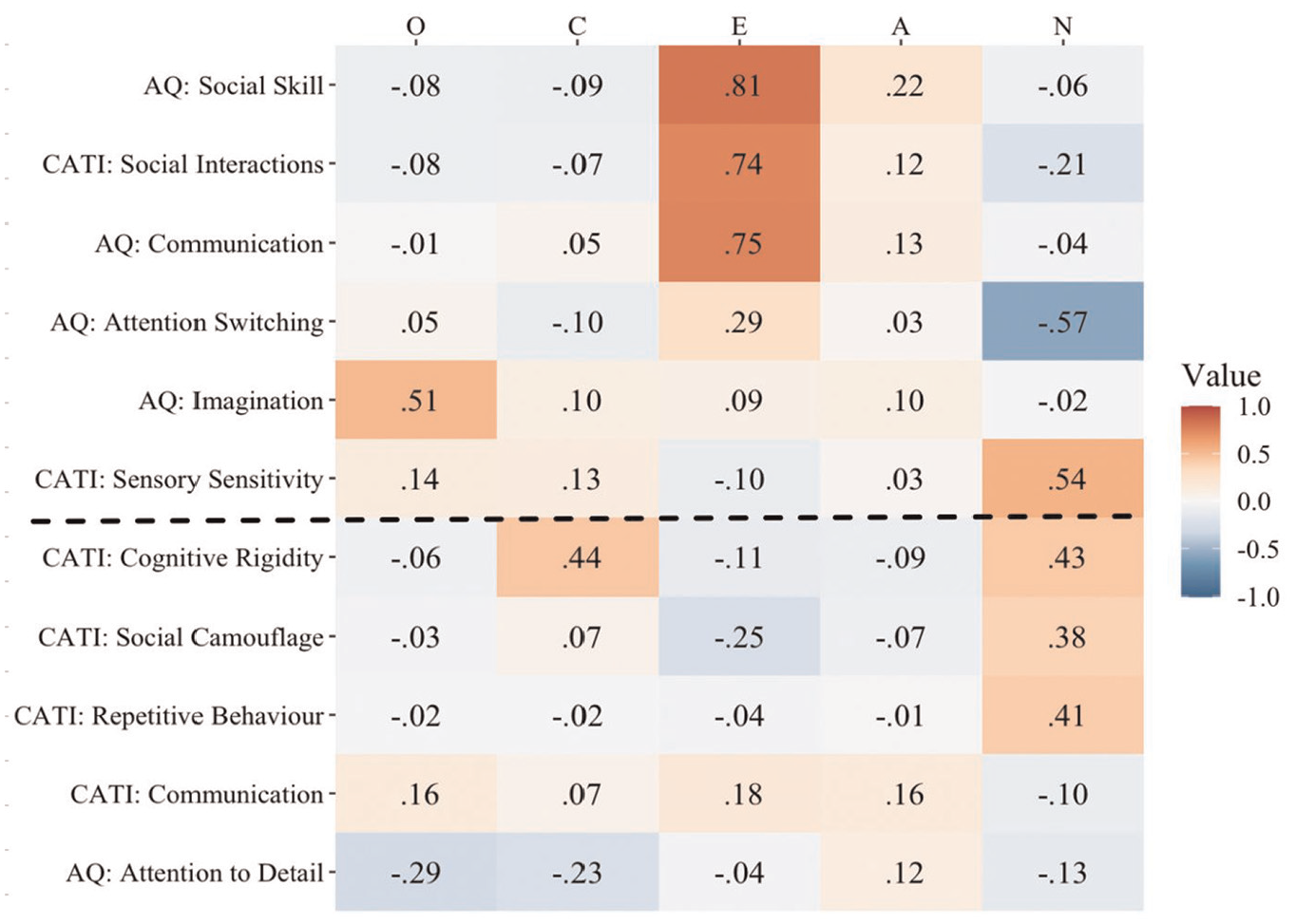
Heatmap depiction of multiple regression coefficients indicating locations of ARTs within the FFM in Study 2.
RQ2: Redundancies Between ARTs and Existing FFM Facets
As in Study 1, we again examined latent variable correlations between traits with standardized regression coefficients greater than an absolute value of .50 on any FFM domain, as depicted in Figure 5, and existing FFM facets corresponding to that domain. We thus computed 36 latent variable correlations, each between one ART and one FFM facet (see Supplemental Table S18 for the full results, as well as Supplemental Tables S25 and S26 for an equivalent set of analyses using the BFI-2 subscales in place of the IPIP-120 facets). The 10 largest latent variable correlations from this analysis are reported in Table 7.
Top 10 Latent Variable Correlations Between ARTs and FFM Facets in Study 2.

Note. Values inside brackets represent 95% confidence intervals. AQ = Autism-Spectrum Quotient; ART = autism-related trait; CATI = Comprehensive Autistic Trait Inventory; E = extraversion; FFM = Five Factor Model; IPIP-120 = 120-Item International Personality Item Pool–NEO; N = neuroticism; O = openness.
Closely matching Study 1, and confirming pre-registered hypothesis H2, we found very strong correlations (i.e., r > .80; Lawson & Robins, 2021) between three socially oriented ARTs—AQ Social Skill, CATI Social interactions, and AQ Communication—and the Friendliness facet of Extraversion. AQ Social Skill was also very strongly correlated (i.e., r > .80) with the Gregariousness facet of Extraversion, affirming the similarly strong association (r = .70) observed in Study 1. 7 As in Study 1, we again compared the CFA fit indices between one- and two-factor latent variable models using these ARTs. Bearing in mind the critical value of 3.84 (df = 1) with respect to the difference in chi-squared values between the two models, Table 8 reveals that the two-factor models performed significantly better than the one-factor models, suggesting that these socially oriented ARTs are close proxies for IPIP-120 Friendliness and Gregariousness, but are not entirely redundant with those scales. As we observed in Study 1, none of the models examined in Table 8 achieved optimal fit, and again the models involving the AQ scales fit least well. We comment further on this issue in the General Discussion.
Fit Statistics for One-Factor and Two-Factor Models with IPIP-120 Extraversion Facets in Study 2.

Note. Values inside brackets represent 90% confidence intervals. AQ = Autism-Spectrum Quotient; CATI = Comprehensive Autistic Trait Inventory; CFI = comparative fit index; IPIP-120 = 120-Item International Personality Item Pool–NEO; RMSEA = root mean square error of approximation; SRMR = standardized root mean square residual.
p < .001.
General Discussion
The present research aimed to examine whether (RQ1) and where (RQ2) ARTs may be located within the FFM structure across an initial exploratory and a subsequent confirmatory study. For RQ1, we observed that the variance in more than half of ART scales analyzed across Studies 1 and 2 were well-described by the FFM domains. These scales overlapped with the FFM domains to a degree that was comparable to at least 10% of FFM facets, suggesting that they too could plausibly be accommodated as facets within the FFM structure. In Study 1, three socially oriented ARTs (CATI Social Interactions, AQ Social Skill, and AQ Communication) were best captured by the FFM—being as related to the FFM domains as at least two thirds of FFM facets—and this finding was replicated in Study 2 (H1). These three socially oriented ARTs were principally aligned with extraversion, whereas the cognitively oriented ARTs (and other socially oriented ones) were more diffusely aligned with several FFM domains. By contrast, behaviorally oriented ARTs corresponded relatively weakly with all FFM domains. The three aforementioned socially oriented ARTs were subsequently found to approach empirical redundancy with existing extraversion facets (H2), whereas most of the remaining ART scales analyzed in our two studies did not reach such a degree of redundancy with existing FFM facets.
Traits Principally Aligned with One FFM Domain
Findings from both of our studies revealed that CATI Social Interactions, AQ Social Skill, and AQ Communication were best described by the FFM and principally aligned with extraversion. This finding aligns with a meta-analysis revealing extraversion to be the strongest FFM correlate of ARTs (Lodi-Smith et al., 2019) and is unsurprising given that these scales describe enjoying (cf. being skilled at) social interactions, which is conceptually central to extraversion (Smillie et al., 2019). These scales approached redundancy with existing extraversion facets, although we caution that further research is required to firmly establish this, given that we did not exhaust the 10 criteria comprehensively outlined by Lawson and Robins (2021) for distinguishing between “twin” and “sibling” constructs. (This, after all, was not our goal in the present research, which aimed to examine whether and where ARTs may be located within the FFM structure, following the methods of Bainbridge et al., 2022). We also found that AQ Imagination was somewhat consistently well-described by the FFM and principally aligned with openness. Similarly, this is unsurprising given that concepts relating to imagination are central to trait openness (Sassenberg et al., 2023), as reflected by the existence of an “Imagination” facet in IPIP-120 Openness, which was strongly correlated with AQ Imagination in both of our studies.
Bearing in mind that the AQ and the CATI were intended to measure ASD-derived trait constructs, putatively distinct from personality trait descriptors (Baron-Cohen et al., 2001; English et al., 2021), our findings suggest two possibilities: On the one hand, if these ART scales faithfully capture their intended constructs, then non-clinical analogues of certain social features of ASD may be largely homologous with personality facets relating to introversion and close-mindedness (i.e., low extraversion and openness). This broadly aligns with the emerging view that many clinically relevant traits are contiguous with “normal” personality traits and can be subsumed within models of personality structure such as the FFM (see, e.g., DeYoung & Kruger, 2018; Kotov et al., 2010; Krueger & Markon, 2014). On the other hand, our findings could also indicate that the scales we used to assess ARTs in this research partly failed to capture their intended constructs. For instance, whereas one defining feature of autism comprises challenges in social imagination or “imaginative play” (APA, 2022), AQ Imagination focuses more abstractly on imagination per se and was aligned principally with FFM openness. In this case, our findings may reveal a jangle fallacy, whereby the labels of ART scales reference autistic features such as those described within the DSM, yet the content of those scales overlaps with that of normal personality traits within the FFM. Bainbridge et al. (2022) offered similar suggestions for a multitude of psychological trait scales that were believed to be distinct from the FFM but could nevertheless be located as facets within the FFM.
Traits Aligned with Multiple FFM Domains
Across Studies 1 and 2, we found that several cognitively oriented ARTs, along with some socially oriented ones, corresponded moderately with two or more FFM domains, suggesting that they might be represented as interstitial facets located between several FFM domains in a multidimensional trait space (see Krueger & Markon, 2014). Given that these traits do not neatly align with one FFM domain, evaluating whether and how they can be meaningfully interpreted in the FFM context is critical. On the one hand, these apparently interstitial patterns may be artifactual. For instance, the AQ’s poor psychometric structure, as observed in Supplemental Tables S19 and S20, and elsewhere (e.g., English et al., 2020), may have resulted from problematic item pooling, producing scales with heterogenous, internally inconsistent content. Indeed, items from AQ Attention Switching appear to blend CATI Cognitive Rigidity and Repetitive Behavior with additional interpersonal features. This may have resulted in a less clear mapping to any one FFM domain, despite considerable multivariate overlap. Conversely, in the absence of psychometric concerns, interstitial traits are more likely to reflect constructs that are genuinely psychologically complex. For example, in both of our studies, nearly all CATI scales exhibited a weak-to-moderate link with neuroticism—a trait that is generally elevated across clinical populations (see, e.g., Ormel et al., 2013; Widiger & Oltmanns, 2017).
Importantly, we did not find consistent evidence that all of these scales could be readily accommodated in the FFM structure to begin with (i.e., RQ1). Specifically, CATI Communication, Social Camouflage, and Cognitive Rigidity were sufficiently described by the FFM in Study 1 only. These scales had weak-to-moderate links with agreeableness in Study 1 that did not emerge in Study 2, potentially explaining why they were not readily accommodated by the FFM in our second study. These inconsistencies may simply reflect sampling error, or perhaps a failure to generalize across demographically different samples. For instance, participants in Study 1 were much younger on average than those in Study 2, which may be pertinent given the well-documented changes in agreeableness across the lifespan (Roberts et al., 2006). Future research might therefore explore whether links between agreeableness and clinically-oriented ARTs (i.e., such as measured by the CATI) emerge only within certain samples or populations, varying as a function of age, or other demographic factors.
Traits Peripheral to the FFM Domains
CATI Sensory Sensitivity and Repetitive Behavior, alongside AQ Attention to Detail, were found to be largely independent of the FFM. These scales describe distinctive behavioral and cognitive features of ASD, such as having restricted interests and displaying repetitive patterns of behavior (Leekam et al., 2011). Prior research suggests that these features of ASD may be underpinned by visual and sensory-motor processing systems that are distinct from, yet potentially predictive of, the neurocircuitry alterations underpinning social cognition challenges in ASD (McCarty & Brumback, 2022; Robertson & Baron-Cohen, 2017). It is plausible that, compared to other ARTs examined in our studies, these three scales assess a much narrower set of idiosyncratic tendencies concerned with responses to incoming visual or sensory input in the immediate environment (i.e., highly contextualized; DeYoung et al., 2022; McCarty & Brumback, 2022). This could explain why these ARTs were found to be relatively distinct from the FFM domains, which describe broad and relatively decontextualized tendencies that vary widely in the general population.
Implications for the Field
Our finding that most ARTs examined can be plausibly located within the FFM structure contrasts sharply with Wakabayashi et al.’s (2006) conclusion that ARTs and FFM traits are distinct. This difference partly reflects the fact that although those authors arbitrarily described R2 values as high as .34 in their study as “small,” we derived a set of a priori criteria for determining what strength of overlap between ARTs and the FFM domains should be considered meaningful. In addition, the associations Wakabayashi et al. (2006) observed between the FFM domains and ARTs assessed by the AQ (R2 ≤ .34, as summarized on their p. 876) were far smaller than what we observed here (R2 ≤ .78, as summarized in our Figures 2 and 4). This potentially reflects a greater influence of measurement error on their results, which were based on mean scores rather than latent variables. Finally, Wakabayashi et al. (2006) based their conclusions primarily on results of EFA, which likely produced ambiguous results owing to the impact of variable inclusion on factor structure (Saucier, 1997). Overall, our methodological approach provided a clearer means to determine whether ARTs could be incorporated within the FFM, leading to our conclusion that many ARTs can plausibly be represented as FFM facets. Our study also provided novel insights into which ART corresponded with which FFM domain by examining individual ART constructs, where prior research had largely considered ARTs in terms of an aggregated trait severity score (e.g., total-scale AQ score; English et al., 2020; Lodi-Smith et al., 2019). Finally, our study demonstrated which individual ARTs may be more meaningfully distributed across the FFM domains (RQ2), after determining which of these traits were sufficiently accommodated within the FFM structure (RQ1).
A further contribution of our studies lies in our examination of two measures of ARTs offering somewhat distinct representations of ASD features in the general population. We found that our broad conclusions regarding the plausible representation of ARTs as FFM facets generalized, at least to some degree, across these different measurement instruments. Importantly, despite the differences between these ART questionnaires, our findings relating to the AQ should not be treated as independent from those relating to the CATI (or vice versa). This is because both questionaries were designed to assess the same construct space, as is reflected in their high intercorrelations (see Supplemental Tables S21 and S22). Indeed, the correlation between CATI Social Interactions and AQ Social Skill was indicative of empirical redundancy (i.e., r ∼ .80). Thus, we caution readers not to regard our observations for the AQ and CATI as cumulative sets of findings, but rather as an indication of the likely generalisability of our findings across different representations of ARTs.
Our findings have theoretical implications for the utility of the FFM as an organizing framework for ARTs and clinically relevant traits more broadly. At a broad level, we found that most socially oriented ARTs were consistently accommodated as facets within the FFM structure, whereas this was not the case for behaviorally oriented ARTs—comprising a much narrower cluster of idiosyncratic traits. Here, it is interesting to note that the FFM structure was informed by natural language semantics (John et al., 2008), based on the lexical hypothesis, which posits that human characteristics deemed most socially salient are more likely to be encoded in human language as trait descriptors (Cattell, 1943). Because the FFM captures socially salient personality differences (Srivastava, 2010), our findings may suggest that the degree to which clinically relevant traits can be accommodated by the FFM depends on whether these traits are socially salient in the general population. This could partly explain why “common mental disorders” (i.e., anxiety, depressive, and substance use disorders) show particularly strong overlap with “normal” personality trait constructs (see, e.g., Kaplan et al., 2015; Kotov et al., 2010; Lyon et al., 2020).
Limitations and Future Directions
One set of limitations concerns some of the measures used in our studies. Chiefly, our latent AQ measurement models weighted scale items somewhat differently to the original AQ measurement models (i.e., purely based on observed variables), which may make it difficult to integrate our results with previous research. As noted earlier, a recent analysis of different factor structures for the AQ found that a three-factor model exhibited the best fit (English et al., 2020), although this model failed to fully capture the breadth of autistic features. This is why we also explored results based on a more recent six-factor representation of the AQ structure (Zhu et al., 2022). Some of our findings amplify concerns that have been raised about the psychometric properties of the AQ, such as the poor fit we observed for CFAs involving AQ scales (see Tables 5 and 8). Although this is ancillary to our present aims (i.e., to evaluate the utility of the FFM as an organizing framework for existing measures of ARTs), an important goal for future research is to further address evident psychometric problems with the AQ—hitherto the most widely used ART questionnaire in the literature. Developing a comprehensive taxonomy of ARTs (e.g., combining the AQ, CATI, and other ART scales) may also yield a more psychometrically robust structure for ARTs. Next, we also acknowledge that the IPIP-120 may have failed to capture the breadth of FFM facets. Although the 30 facets within this questionnaire have been widely accepted in the personality literature for several decades (Costa & McCrae, 1992), recent research suggests there may be as many as 70 non-redundant personality facets (Irwing et al., 2024). It is plausible that the inclusion of a more comprehensive set of facets in our study would have resulted in even more ARTs being accommodated by the FFM, owing to a broader sampling of trait characteristics. Thus, future research may consider using other major personality taxonomies, in conjunction with the 70-facet measure developed by Irwing et al. (2024), to explore this possibility.
We also acknowledge that a high degree of overlap between the FFM domains and ARTs (as compared between the FFM domains and facets) suggests that ARTs can plausibly be accommodated as facets within the FFM structure, but does not provide definitive support for this claim. Such an overlap could be interpreted in other ways—for instance, in terms of a predictive or causal impact of ARTs on personality development, or vice versa—which are not possible to disambiguate in our cross-sectional, descriptive data. In the absence of causal evidence, the most conservative interpretation of our findings is that the measures of ARTs and personality traits examined in our studies assess very similar phenomena (see Tables 4 and 7). Future research employing longitudinal data collection, behavior genetic methods, or drawing upon knowledge on the neural underpinnings of personality may help to build on the present descriptive research by identifying predictive relations and developmental dependencies between personality and ARTs.
We also note that our labeling of ART scales as socially, cognitively, and behaviorally oriented features was based heuristically on the item content of the scales rather than any empirical validation of such labels. Our labels are likely to be simplifications, given that we expect many ART scales to reflect some subtle combination of social, cognitive, and behavioral processes. We accept that such simplifications could lead to misunderstandings, and that researchers might disagree with our choice of label for some ART scales. For instance, given that diagnostic criteria for ASD refers to imagination only in the context of social processes (i.e., imaginative play; APA, 2022), it may seem more appropriate to label AQ Imagination as a socially rather than cognitively oriented ART, even though the items of AQ Imagination scale do not refer clearly to social processes. Nevertheless, provided our labels are understood only as a convenient means to discuss the 11 ARTs examined in this paper, such disagreements may be moot points.
Finally, we reiterate that our goal in the present research was to examine whether ARTs, as they are studied in the general population, can be located within the space described by a major framework for personality, the FFM. Given the measures and samples used in our two studies, our findings may not have clear implications for ASD itself nor readily generalize to clinical samples. Applying the methods used in these studies to a clinical context—perhaps employing a clinical analogue of the FFM (e.g., the Personality Inventory for DSM-5; Krueger et al., 2012) and recruiting a sample of individuals with a formal ASD diagnosis—may therefore be a valuable extension of the present work.
Conclusion
In closing, we have shown across two studies that a majority of scales designed to measure ARTs in the general population can plausibly be located within the space described by the FFM, and that some of these scales approach redundancy with existing FFM facets. These findings suggest that at least some ARTs may be contiguous with “normal” personality traits (or potential “sibling constructs”), as has previously been demonstrated for other clinically relevant traits. One key insight from our findings is that social salience in the general population may be a key determinant of whether clinically relevant traits can be accommodated within the FFM. A pressing goal for future research concerns further understanding the predictive or causal relations between ARTs and FFM facets, which may be explored using longitudinal-experimental studies. The accumulation of this line of research would ultimately contribute to a deeper understanding of connections between personality and psychopathology in the autism context.
Supplemental Material
sj-docx-1-asm-10.1177_10731911251326395 – Supplemental material for The Utility of the Five Factor Model of Personality as an Organizing Framework for Autism-Related Traits
Supplemental material, sj-docx-1-asm-10.1177_10731911251326395 for The Utility of the Five Factor Model of Personality as an Organizing Framework for Autism-Related Traits by Edric S. Widjaja, Emily K. Spackman, Timothy F. Bainbridge, Steven G. Ludeke, Mirko Uljarevic, Kristelle Hudry and Luke D. Smillie in Assessment
Footnotes
Declaration of Conflicting Interests
The author(s) declared no potential conflicts of interest with respect to the research, authorship, and/or publication of this article.
Funding
The author(s) disclosed receipt of the following financial support for the research, authorship, and/or publication of this article: Funding was provided by the Melbourne School of Psychological Sciences.
Ethical Approval and Informed Consent Statement
Ethical approval for this research was granted by the Office of Research Ethics and Integrity at The University of Melbourne. All participants in this research provided informed consent.

Data Availability Statement
Supplemental Material
Supplemental material for this article is available online.
Notes
References
Supplementary Material
Please find the following supplemental material available below.
For Open Access articles published under a Creative Commons License, all supplemental material carries the same license as the article it is associated with.
For non-Open Access articles published, all supplemental material carries a non-exclusive license, and permission requests for re-use of supplemental material or any part of supplemental material shall be sent directly to the copyright owner as specified in the copyright notice associated with the article.
