



Abstract
Confronted by waves of isolation due to COVID-19, it is understandable how current and prospective interior architecture/design students could languish, socially and creatively. In their final studio in the Bachelor of Interior Architecture program at the University of South Australia, students were tasked to create a highly convivial space, a place to joyously interact with strangers—a challenge to recent experiences. The studio projects presented in this essay offer commentary and invite speculation on how conviviality could be manifest through interior forms, typologies, and design maneuvers.
Background
The term conviviality represents a body of urban design discourse concerning how urban spaces can encourage sociability, particularly between strangers. Creating spaces that elicit such social interactions, however passive or fleeting, is crucial for our community cohesion and are therefore considered in urban discourse as arenas of democratic living. 1 This is because they provide opportunities to observe, listen to, and mingle with others in our community that we might not typically interact with. 2 Convivial spaces are heterogeneous both in terms of use and users, allowing differences and commonalities to coexist. 3 The Highline in New York is often cited as a precedent of convivial space, for example, the 10th street amphitheater facilitates people watching, and the 23rd street lawns promote relaxed lingering with the idea that the more time spent, the greater the possibility for interactions. Such spaces have been essential components to human settlements from ancient Greece, Africa, the Far East, and the Roman Empire. 4 Essentially, convivial space reflects and facilitates our innate need for casual socialization and connection with others in the larger community. 5 Considering the periods of isolation and separation from others in communities across the world during the COVID-19 pandemic (perhaps especially here in Australia, which intermittently closed international, state, and intra-state borders for years 6 ), it seemed timely to challenge our final year studio students to conceptualize convivial design principles from urban discourse into an imagined interior design project.
A series of convivial design principles drawing on the work of Henry Shaftoe and the A + T Research Group informed student’s translation of conviviality into the interior realm. The convivial principle of diversity of use/hybridity was considered paramount to producing a convivial interior as to invite a diversity of user groups. Thus, the studio offered resistance to socially isolating experiences and typological homogeneity. While the students selected the typologies to hybridize and assist in creating a convivial space, they were provided a site with which to commence their speculation. The site for this convivial assemblage was the AMP building at 21 King William Street, Adelaide, specifically, the main insurance and banking hall. The 400 m2 hall (including a mezzanine level) is a local 1930s exemplar of classically derived interior architecture. The students designed within this existing fabric using adaptive reuse principles, making decisions to contrast, complement, install, insert, or intervene.
Conviviality
Convivial urban discourse was prompted by discussions in the 1970s about the loss of public spaces for community interaction, and the proliferation of sprawling suburbs with freeways connecting them was cited as the principal cause. Convivial space was conceptualized as an antidote 7 for reduced contact within communities and monotonous socio-spatial environments. Half a century later, current discussions around conviviality are almost wholly limited to the urban scale with public squares, parks, parklets, and streets as a central focus. Convivial design interventions are often considered and outlined in this vein, for example, the use of landscape design to provide views and vantage points, the provision of benches for sitting, eating, and meeting, and the use of managerial interventions such as planned social activities. Yet, the fundamental principles of convivial space are not necessarily limited to urban spaces. Spaces to support lingering, celebration, and play are attributes argued to catalyze potential social interaction; however, casual or fleeting and can arguably be promoted at any scale of the built environment. These principles were conceptualized into the interior realm for students to experiment with
diversity of use/hybridity to encourage cross-pollination of user groups;
opportunities to sit, encouraging lingering and thereby inviting interactions;
robust design and materiality for longevity and attraction;
adaptability of space to allow for separate or parallel use;
asymmetry to align with existing topography (the existing interior in this instance);
variety and intrigue through color and texture to attract users;
central location to siphon foot traffic (such as the site provided);
clusters and sequences of space to provoke discovery, new moments, and gathering throughout;
appropriate consideration of light to enhance the social context;
animation of space by promoting views and vantage points between activities;
appropriate scale to balance encapsulation and intimidation; and
promotion of feelings of safety through passive surveillance. 8
Hybridity
With rapidly increasing land prices in cities and the consequent proliferation of multistory buildings throughout the 20th century, hybrid uses became a method to promote the economic viability of buildings, essentially packaging what was available in the city grid under one roof. Post-structuralist thought further catalyzed the notion of hybridity by creating a context for architects and designers to question previous structures and typologies, and their seemingly iterative nature, inviting new spatial concepts to emerge. 9 Thus, it is argued that hybridity is an evolution of mixed use in that the typologies of hybridity are not simply adjacent but rather relate to one another and share intensities—a cross-pollination. Hybridity is valued within architectural and urban discourse as a social condenser—as a resistance to urban segregation. 10 The fundamental principles of hybridity are not necessarily limited to these scales or disciplines; hybrid spaces are unique creations that are often unexpected and unpredictable. At their core, they encourage coexistence and interdependence, which is foreseeably why hybridity is a tenant of convivial space. 11 This is Hybrid (2014) provides several large-scale examples of hybridity, both speculative and realized, as a primer for readers to frame hybrid dialogue. These include Starret and van Vleck’s Downtown Athletic Club, New York (1930) which featured 35 stories of mixed leisure, cultural, commercial, and residential areas; Le Corbusier’s Plan Obus (1933) which proposed to package a city within a miles-long continuous horizontal mid-rise; Cesar Pelli’s Sunset Mountain Park (1966) which proposed to slot varying functions into the existing topography of a mountain; Andrea Branzi’s No-stop City (1969) which offered to create large stacked empty containers for occupants to furnish and use as required; MVRDV’s Market Hall (2014) Rotterdam, which features a large market canopied by residential and commercial units.
Several broad modes of hybridizing typologies were introduced:
Mixing uses across vertical and horizontal planes throughout the existing building indeterminately hybridizing in favor of maximizing occupant choice.
Internally hybridizing where uses were intermittently dispersed throughout a space.
Monumentally hybridizing where focus was on a series of (re)moveable installations 12
Projects
Four projects were selected from the final studio work for this visual essay. They form a reflection on recent socially isolating experiences offering a translation of convivial (and consequently hybrid) discussion into the interior realm, as well as stimulating reflexive consideration of how the genesis typologies could become more joyous and sociable.
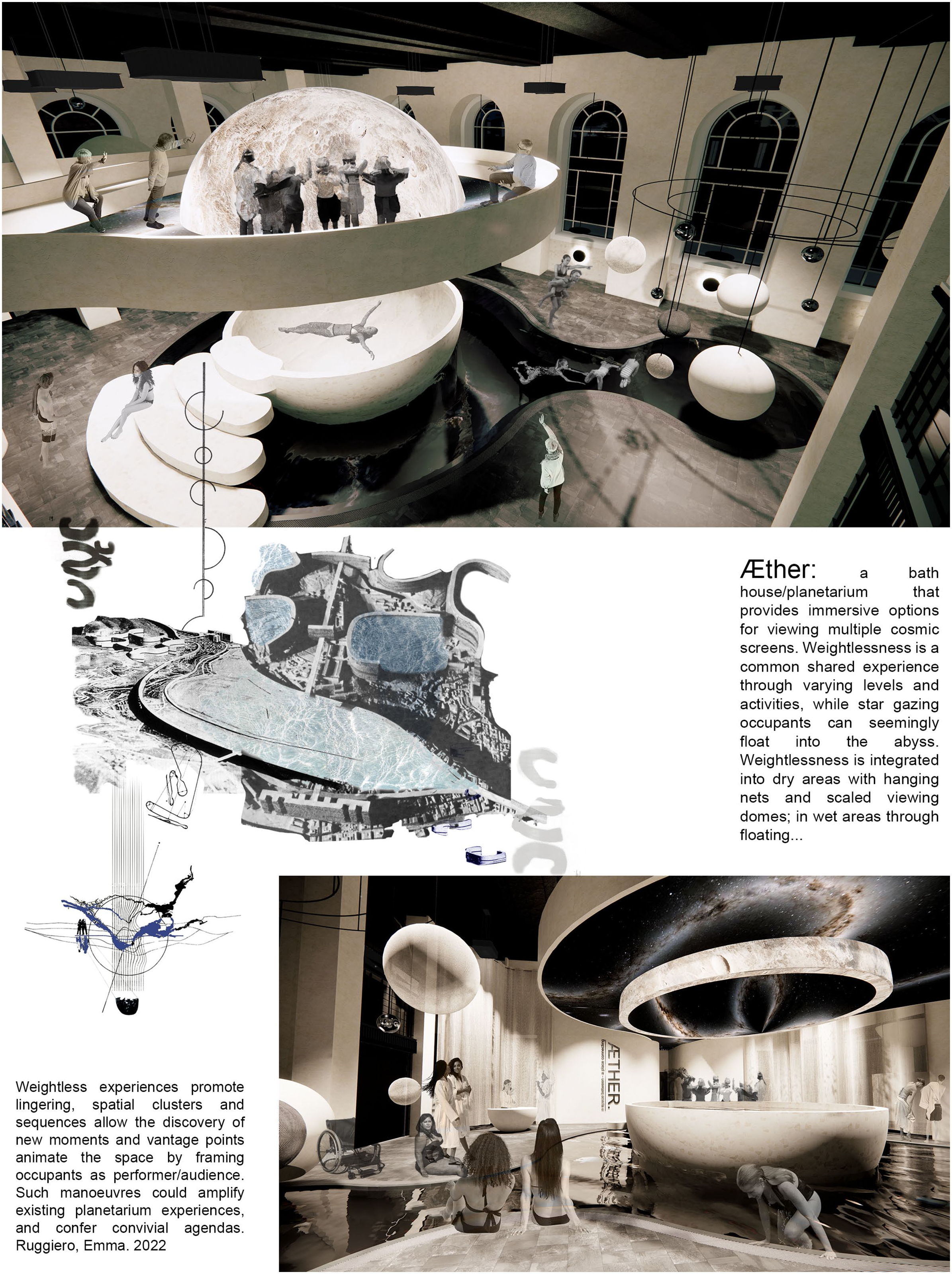
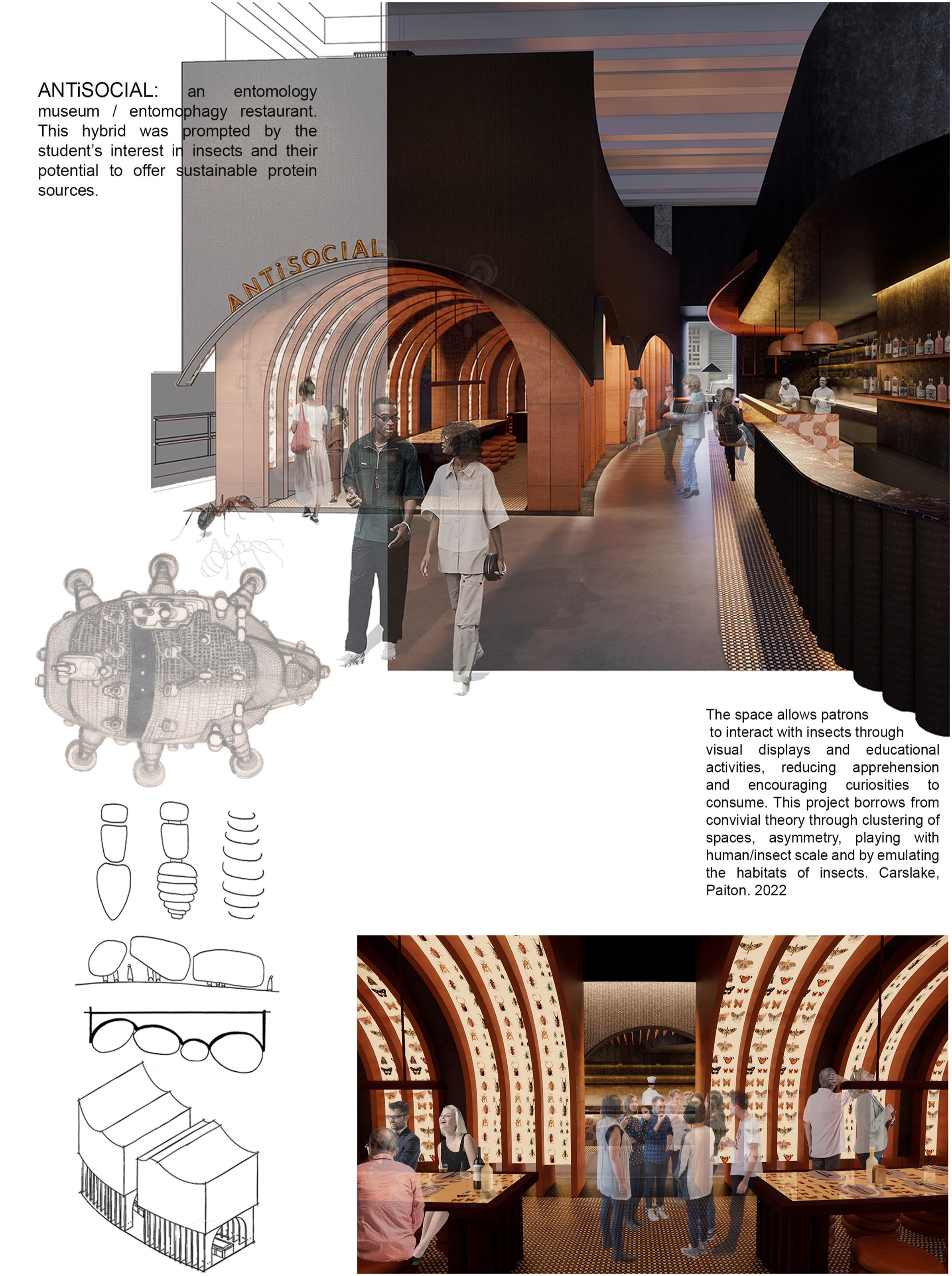
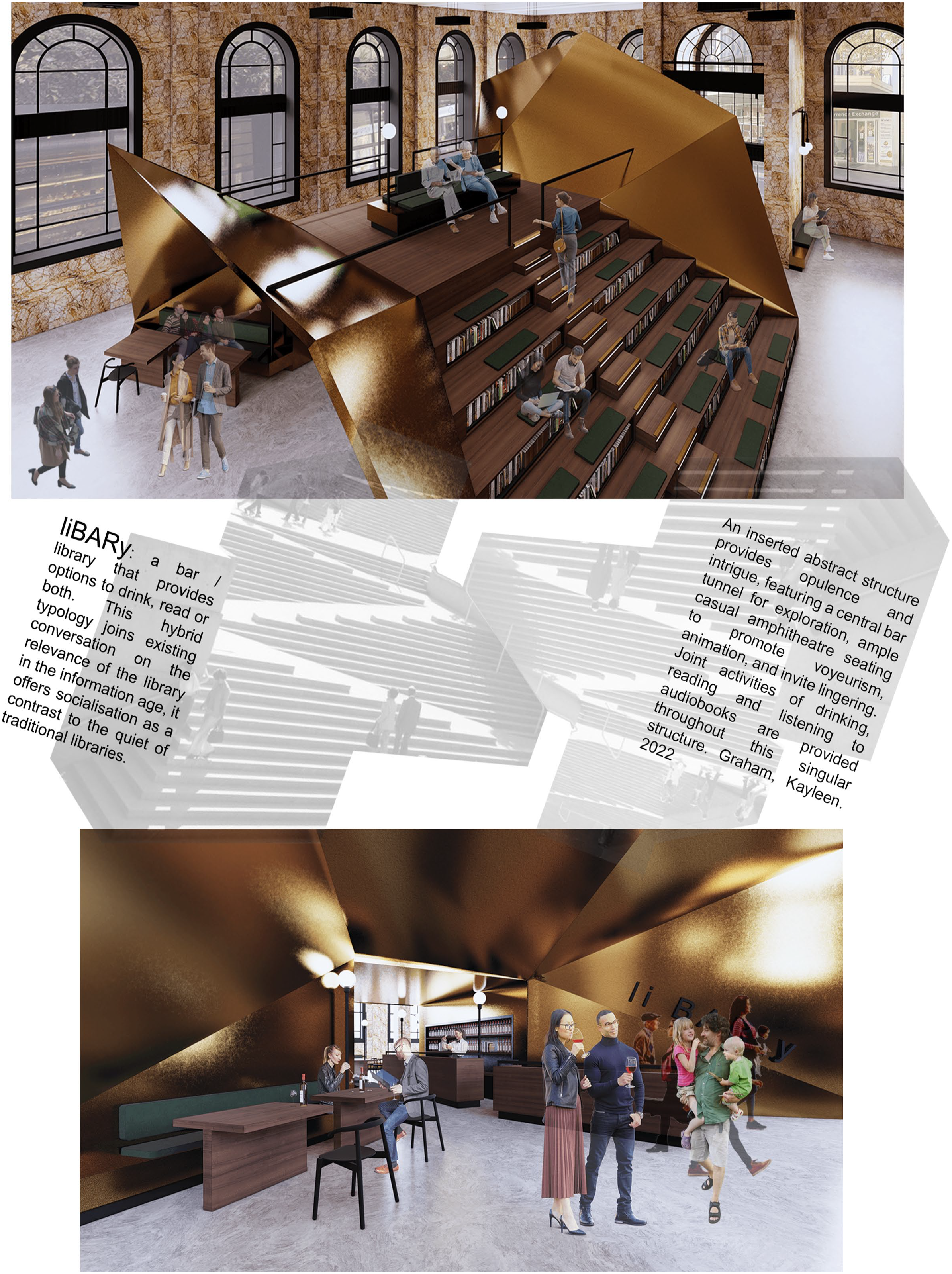
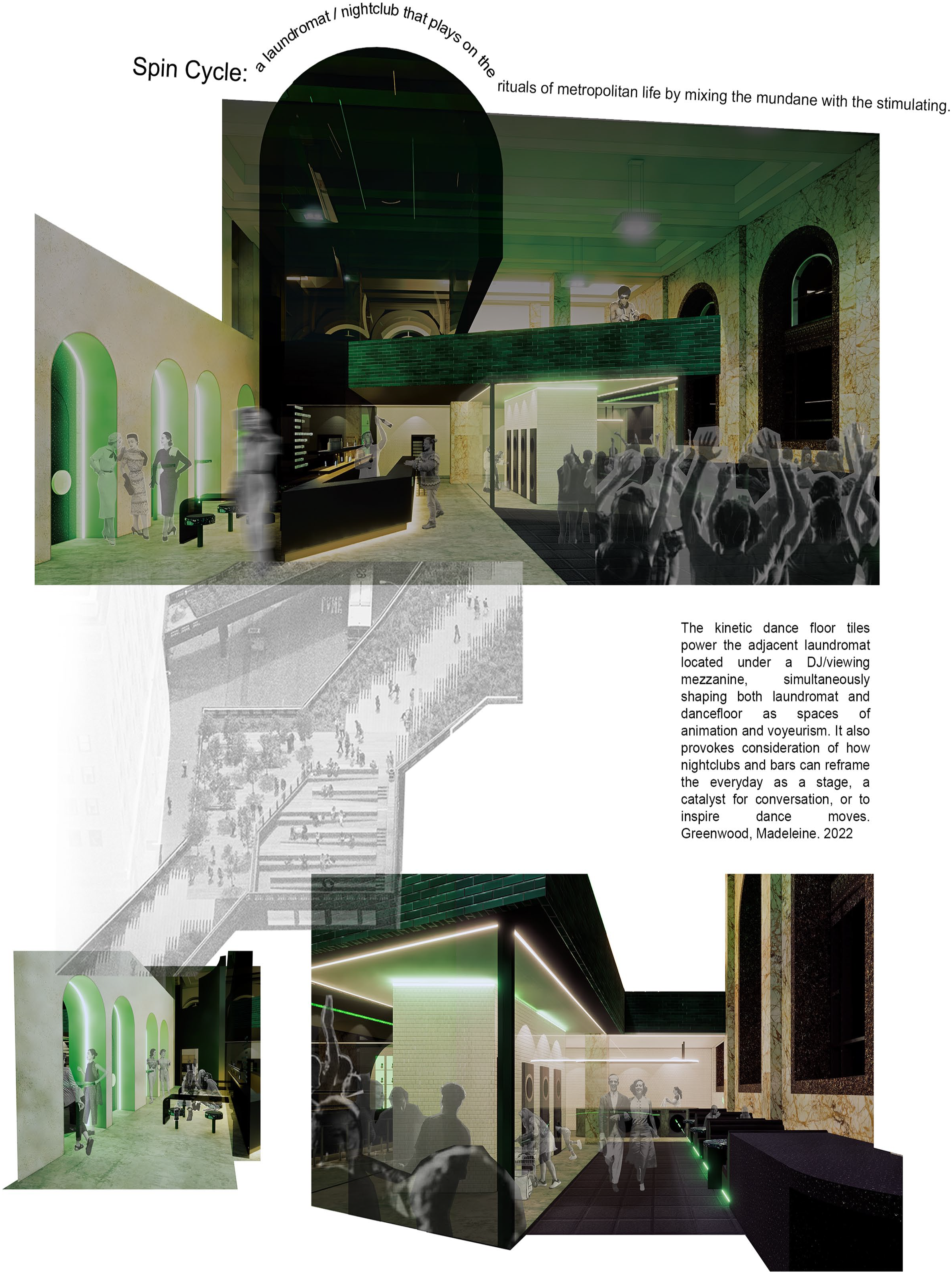
Each interweaves speculative and realized urban-scale convivial and hybrid spaces alongside the project examples which include a planetarium/bathhouse, a library/bar, an entomology museum/entomophagy restaurant, and a launderette/nightclub. This interweaving stimulates readers to draw homo/heterogeneities philosophically, ergonomically, and aesthetically between the scale of the urban and the interior. The images invite readers to speculate on what a convivial interior might be and how designers might set out to create them, they contrast common tropes and stereotypes of interior friendliness such as being soft, comfortable, or familiar. 13 Instead, they may appear as stars of the show—performative spaces with distinctive and unique characters.
Footnotes
Declaration of Conflicting Interests
The author declared no potential conflicts of interest with respect to the research, authorship, and/or publication of this article.
Funding
The author received no financial support for the research, authorship, and/or publication of this article.
