



Abstract
An experiment was conducted using a simulation software similar to the radar system with a new feature that makes the aircraft flight number blink on the radar display each time a pilot presses the radio button to talk. Eighteen participants volunteered. In the first scenario, the flashing feature was turned “OFF.” In the second scenario, the flashing feature was turned “ON.” Each participant was tested on three occasions. The first occasion was the “stuck-microphone” situation, the second was similarity in call-sign situation, the third was simultaneous transmission of voice communication from two or more flights on the radio that distorted the modulation. Participants identified significantly more aircraft when the flashing feature was active compared to when it was inactive. Consequently, it is anticipated that this flashing feature will likely reduce verbal communication between pilots and controllers, thereby improving overall controller performance and maintaining safe airspace operation.
The continual growth in the number of passengers and cargo transported daily necessitates a proportional increase in the presence of air carriers around the world. As air traffic becomes more congested, there is a greater demand for radio communication between pilots and air traffic controllers, resulting in increased workload and fatigue for both parties. Enhancing the performance and situational awareness (SA) of controllers becomes crucial for maintaining safe airspace operations. SA is to have the “mental picture” and understanding of what is occurring in a fast-paced environment (Durso & Dattel, 2004). Controllers need to be able to predict potential separation issues in advance (Endsley & Jones, 2012).
Radio communication between pilots and controllers can give rise to common scenarios impacting air traffic flow and airspace safety, placing a substantial burden on controllers’ time, energy, and impeding SA. Three notable scenarios are often experienced in this context. First, the unintentional obstruction of the radio frequency by a pilot, commonly referred to as a “stuck-microphone” situation. For example, if a pilot mistakenly doesn’t release the microphone button after communicating on the radio, a temporary block in any communication between pilots and the controller occurs. Second, confusion can arise during target identification if aircraft have similar call-signs. For example, if American 3568 and American 3658 are in the same sector, confusion can occur during communication between controller and the intended aircraft. Finally, the simultaneous transmission of voice communication from two or more flights on the radio can distort the modulation.
A controller’s radar display usually has several aircraft targets identified by their call signs. Reducing the time to respond to a targeted aircraft one is controlling will reduce workload and maintain safe operations. There is a linear increase in time to select or respond as the number of targets increases (Hicks, 1952).
To mitigate these identification and response time issues and to enhance communication efficiency we propose the incorporation of a new software into the radar system. One of the features of this software is to flash the callsign of the targeted flight on the controller’s radar display when the pilot activates the microphone. This salient feature dramatically reduces the number of targets the controller needs to survey by directing the attention toward the intended aircraft. Even if two or more aircraft make an announcement simultaneously, the controller is able to parse which aircraft are actively communicating, reducing workload, and enhancing the controller’s SA and performance (Terelak & Pinska, 2010).
The current study tested the effects of the flight number flash feature on participants’ SA and response time to recognize and identify the communicating aircraft. Several off-nominal events were introduced (e.g., call sign confusion, stuck-microphone) into the scenario. By implementing this technology, conducting systematic performance assessments, and promoting research initiatives, the Air Traffic Control community can continually improve controllers’ and pilots’ performance and SA while ensuring the utmost safety of airspace operations.
Method
Participants
Eighteen (15 m, 3 f) students at an aeronautical university participated in this study. Mean age of the participants was 24.06, (SD = 6.90). Each participant received $10 for about 30 min of participation. The 18 participants completed a scenario with the new software that included the Flight Number Flashing Feature (FFF) and a scenario where the Flashing Feature was not activated (NFF). Half of the participants received the FFF scenario first and half received the NFF first.
Materials and Procedure
The new software was developed to simulate En-route Radar Control Centers (See Figure 1).
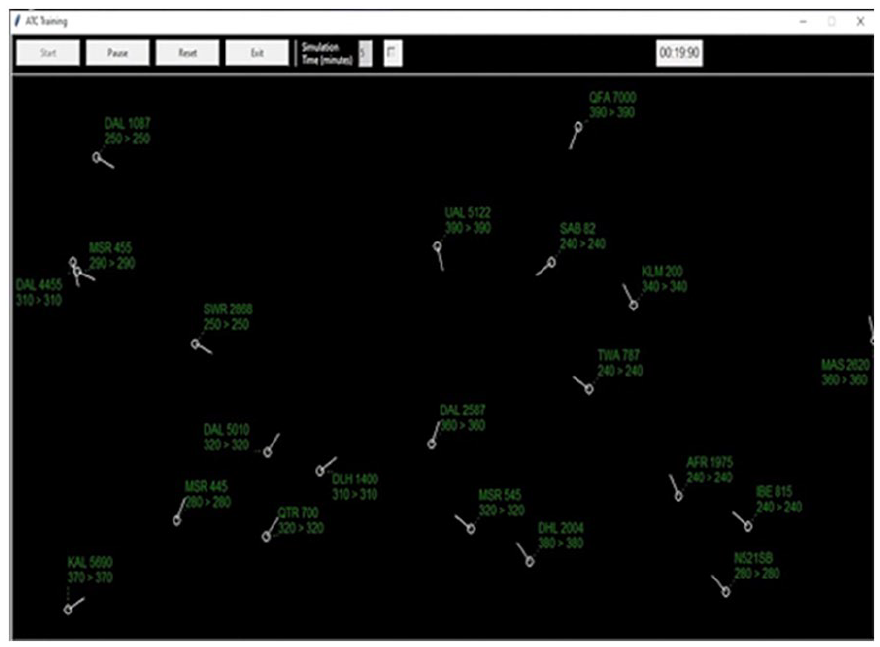
The FFF simulation software that designed by the researchers.
Each of the three scenarios that was created included 56 aircraft in the sector with aircraft entering and exiting the sector during the scenario. Call-signs of the aircraft were prerecorded in a variety of voices and inflections. Continuously throughout the scenario, an aircraft would announce their call sign. Participants were instructed to click on the displayed aircraft. Immediately after the participant correctly clicked on the displayed aircraft, another aircraft announced its call-sign. The program was designed to instigate a stuck microphone twice during the scenario. At one point in the scenario, two flights made an announcement simultaneously.
Performance was measured by accuracy of identifying the aircraft communicating. Participants had 15 s to identify the aircraft before the next aircraft made an announcement. Two SA questions were also asked during the scenario (e.g., How many DAL airplanes are currently in your sector?). After completing both scenarios, participants completed a 20-item questionnaire about the benefits of the FFF feature.
Results
A t-test was conducted on the number of correctly identified aircraft during the scenario. The FFF group identified significantly more (M = 89.39, SD = 18.69) aircraft t(17) = 14.15, p < .001, Cohen’s d = 3.334 (See Figure 2) during the scenario than the NFF group (M = 18.50, SD = 6.40).
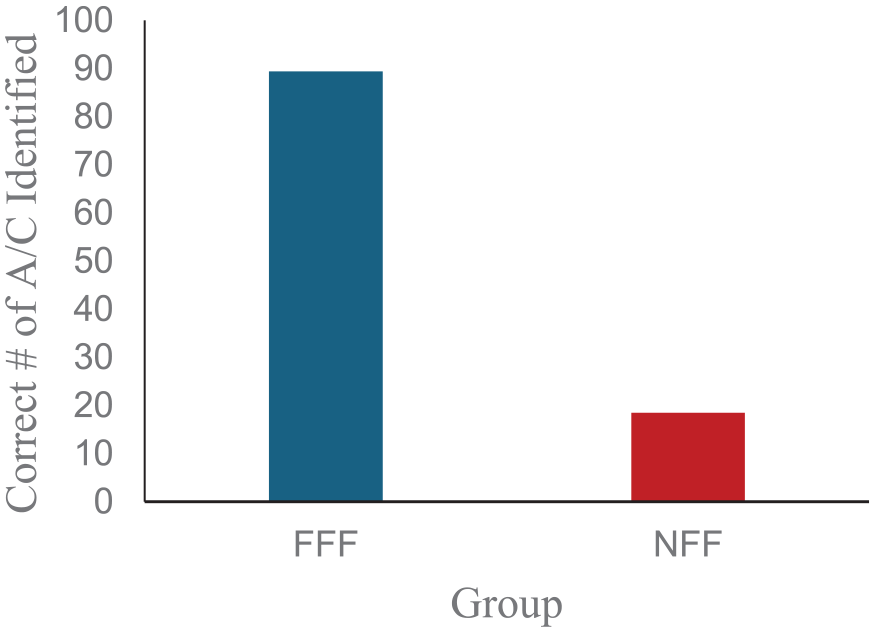
Number of aircraft correctly identified when flash feature was active and inactive.
A t-test of idle time also was conducted between the two groups. Idle time is the time the participant is searching for the announced aircraft. A significant difference t(17) = 15.339, p < .001, Cohen’s d = 3.616 was found (See Figure 3) with the NFF group spending more time (M = 160.42 s, SD = 38.75) searching for the announced aircraft than the FFF group (M = 15.21 s, SD = 6.26).
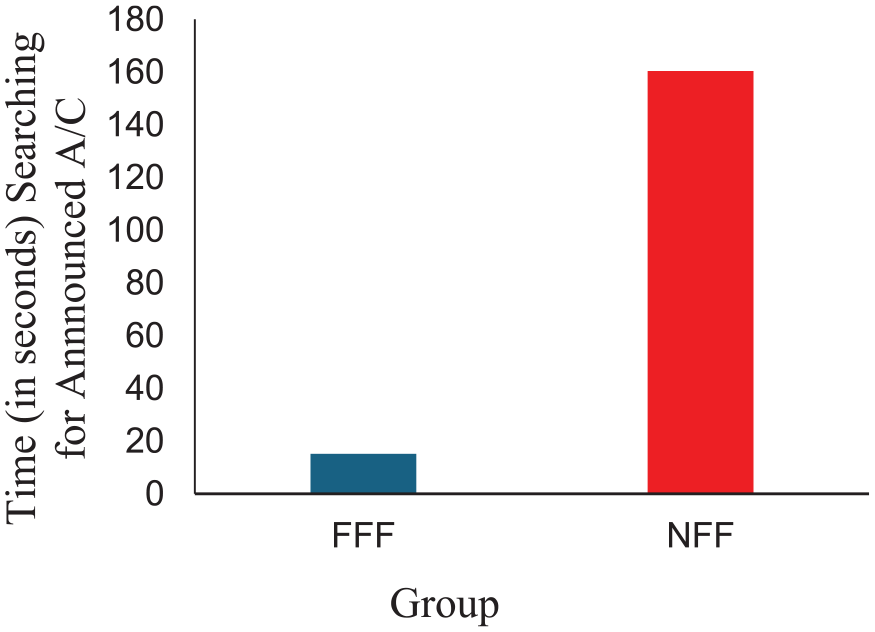
Idle time participants saved by using FFF.
At two different times in each scenario, Egypt 445 or Egypt 455 called in with a request of the controllers. The FFF group never misidentified which aircraft was calling, but the NFF group misidentified the aircraft 59% of the time (See Table 1).
Participants Confusion in Identifying Flight Numbers During the NFF Sessions due to Similarity in Call-signs.

No differences between groups were found in the response time to answer SA questions. An overwhelming response was found in participant’s reaction to the benefits of the FFF feature. The questions were reduced to eight factors, with 1 to 7 questions loading on each factor. As can be seen in Figure 4, mean scores for each factor were quite high (from 8.5 to 10.0) out of a rating that ranged from 1 (Strongly Disagree) to 10 (Strongly Agree).
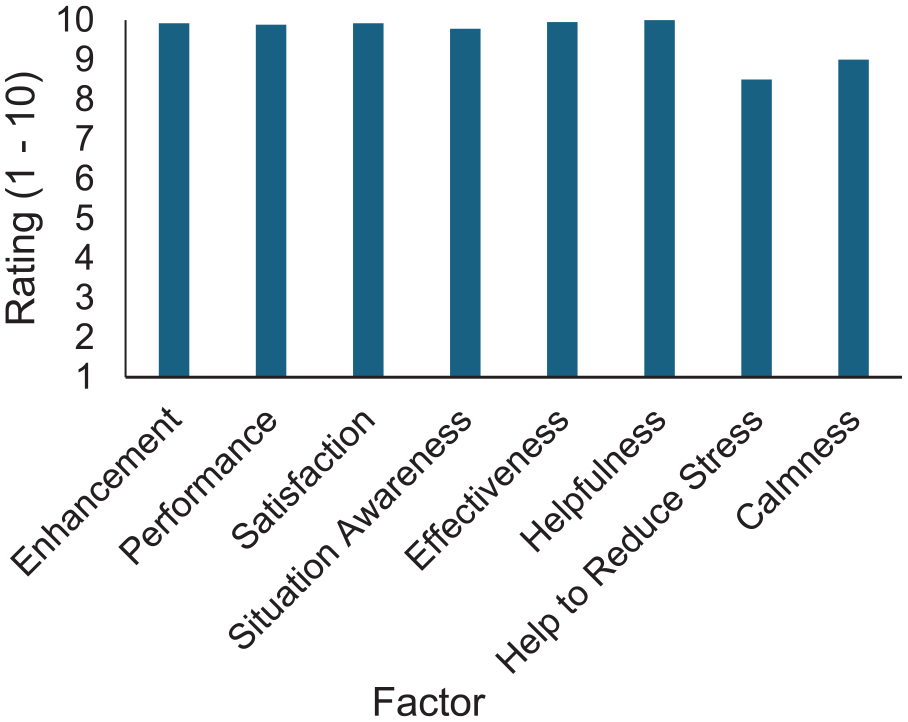
Self-report ratings of participants attitudes of flash feature.
Discussion
The flash feature showed overwhelming success as analyzed both objectively and subjectively. Participants identified significantly more aircraft when the flash feature was active compared to when it was inactive. Moreover, the effect size between the groups was extremely large, showing how much of an impact a treatment (i.e., the flash feature) has on participants’ performance.
Of possible greater importance is the significant differences and extremely large effect the flash feature had on the idle time measurement. When the flash feature was inactive, participants took over 10 times longer searching for aircraft compared to when the flash feature was active.
Participants saw the advantages and benefits of the flash feature. They were aware of their superior performance when the flash feature was active. However, the flash feature’s effect for SA was inconclusive. First, there were only two SA questions provided for each scenario. Second, many participants did not attempt to answer SA questions because the scenarios were frequently consumed by aircraft calling controllers. In retrospect, we feel that the SA questions were more obtrusive than originally anticipated.
Despite text-based communication systems possibly on the horizon (i.e., NextGen), voice communications will always be required in many situations. Outfitting air traffic control facilities with a flash feature for Radar Displays will greatly decrease workload and the amount of time required to search aircraft, Thus, controllers will be able to process information more efficiently and effectively, contributing to overall aviation safety.
Footnotes
Declaration of Conflicting Interests
The author(s) declared no potential conflicts of interest with respect to the research, authorship, and/or publication of this article.
Funding
The author(s) received no financial support for the research, authorship, and/or publication of this article.