




Abstract
Two separate cases with two deaf individuals filed a claim against a trucking company alleging that their applications for employment had been rejected due to their hearing impairment. The defendants argued that their company could not reasonably accommodate deaf drivers during their required internal training and thus could not hire the individuals for a commercial motor vehicle (CMV) driver position. In the subject cases, we reviewed the communication methods and channels available for CMV employers to safely employ hard-of-hearing/deaf employees during the on-the-road training program. After a review of relevant standards, regulations, and literature we recommended multiple methods for communication including simple graphical symbols used in roadway signage presented through handheld signs or electronically. Advances in current technology provide simpler and more familiar presentation methods for trainers and students, which would make the analysis and presentation of convincing arguments for matters like this easier if similar foundational steps are taken.
Introduction
Hearing loss is the second most prevalent health issue around the world (Stiles, 2017). In the United States, standard hearing examinations have determined one in eight people aged 12 years or older has hearing loss in both ears (NIDCD, 2024).In 2005, NHTSA reported that roughly 8.6% of the US population above the age of three, or roughly 28 million people, are hard-of-hearing (HOH).
Although a prevalent part of the population, there are few research papers regarding driving behavior for this subgroup of people. With this case study, we hope to demonstrate how an employer can adequately explore reasonable accommodations so that they may properly and safely assess the skills and qualifications of deaf drivers.
Regulation of HOH and Deaf Drivers
The majority of states, if not all, impose few restrictions on the licensing of persons with hearing impairments for private automobile driving. However, until recently, the Federal Highway Regulatory System excluded deaf and HOH drivers from interstate truck driving based on “sparse, preliminary data.” Since 1971, the hearing standard for interstate commercial motor vehicle (CMV) drivers has restricted drivers based on hearing levels (49 CFR 391.41(b)(11)).
While this is the current standard for interstate CMV drivers, each state can establish its own standards for intrastate CMV driving. After the Federal Motor Carrier Safety Administration’s (FMCSA, 2008) Executive Study demonstrated that crash risk is not increased for hearing impaired drivers, the FMCSA began granting two-year exemptions from the hearing requirement to specific drivers who do not pose a risk to public safety in 2013.
Capabilities of HOH and Deaf Drivers
There may be multiple reasons why deaf or HOH drivers do not have an increased crash risk relative to hearing drivers. First, driving is a primarily visual task. Available research suggests that the visual capacity of deaf and HOH people is increased relative to hearing people. Many studies have addressed this process and how deafness has a differential influence on both the structure and behavior of the visual system given that the visual system has a high capacity to adapt to changing physiological, environmental, or experiential stimuli or limitations. This was noted especially in peripheral vision as various studies have found evidence that deaf drivers develop effectively better vision or an enhancement of their useful field of view (Codina et al., 2017; Dye et al., 2016) and react more quickly to objects at the edge of their visual field (Bavelier et al., 2000). Secondly, driving can become a repetitive, habitual task. Deaf and HOH individuals may rely on experiences and previous knowledge to adapt and employ compensatory strategies for such impairment (Codina et al., 2011, 2017; Dye et al., 2016; Thorslund, 2014).
Devices and Accommodations, Available in 2014–2016, That Compensate for Lack of Auditory Perception
Employees with disabilities have the right to reasonable accommodations—modification, adjustment, or changes to their work environment—and these reasonable accommodations must be task-specific and must be determined on a case-by-case basis to be effective (78 Fed. Reg. 7479, 7480; February 1, 2013). To examine the reasonable accommodations that a company could have used to address its concerns regarding safely performing over-the-road training for a deaf driver, a review of available resources, potential assistive technologies, and reasonable accommodations that were available in the subject timeframe were evaluated. Technologies that could specifically apply during the driving portion of over-the-road training included:
Assistive mirrors, most often, two side mirrors and a rearview mirror.
An enhanced visual turn indicator.
Haptic alerting device that provides a warning when it detects sirens, horns, and other loud road noises (i.e., vibrating watches).
Voice Mail Transcription.
Written lists and instructions which otherwise would have been provided verbally.
Encouraging hearing employees to learn and use basic sign language.
Hiring a qualified sign language interpreter on an as-needed basis (e.g., during a job interview, orientation, benefits seminar, or training).
Providing disability awareness training when integrating employees who are deaf or HOH into the work environment.
Providing a vibrating text pager that may be triggered by the emergency alerting system or establishing a web-based text alert system.
Modifying equipment by adding a visual or tactile cue to the sound source.
The cases involved situations that developed around 2015, and even though the research, testing, and testimony occurred between 2019 and 2023, due to the restrictions in these specific legal cases, technology that was allowed to be discussed as reasonable accommodation had to be limited to what was available in 2015. There are far better communication methods available today.
Legal Case Study
Despite the ability for deaf and HOH individuals to drive safely, there are still potential barriers making communication difficult during training if proper pre-planning is not performed. In the subject case studies, two deaf individuals were denied employment as CMV drivers due to their disability. The company’s training program consisted of two parts: driving simulator training and over-the-road training. The focus of the subject case study is on over-the-road training.
Over-the-road training is a hands-on drive conducted on public roadways and was required by this employer for evaluating a driver on their ability to follow the trainer’s directions and adherence to internal practices as well as regulations and laws of the road. With a hearing trainer and hearing trainee, the trainer would verbally indicate exits to take, directions for turns, or requests to stop the truck. Trainees are then assessed on how adequately they follow directions while obeying the rules of the road and driving in a safe manner.
In this case, the employer asserted that the deaf trainees could not safely complete the driver training program because it required trainers to communicate with student drivers, including during hands-on over-the-road testing. The company’s position was that a HOH or deaf driver could not safely drive and simultaneously communicate with the trainer.
We conducted a naturalistic observational study in which a trainer and the two deaf trainees in these lawsuits were requested to choose a communication style that best suited them, prepare a pre-test plan, and perform the over-the-road portion of their training programs. Following the observational study, we reviewed and compared the communication methods and channels employed with the communication methods and channels available for CMV employers to safely employ HOH/deaf employees during the over-the-road portion of their training programs. The purpose of this paper is to demonstrate a research and presentation method that was found to be successful in presenting information to overcome potential “common sense” biases that existed in these matters.
Methods
Observational studies were conducted with the two deaf CMV trainees, articulate in American Sign Language (ASL) and who had exempt CMV licenses from certified CMV driving schools. Each deaf trainee participated in over-the-road training with different trainers while a video camera situated in the cab of the vehicle captured the interactions (Figure 1). Both deaf trainees were unfamiliar with the route, the gear system on the subject truck, and their trainer’s communication style prior to the over-the-road training.
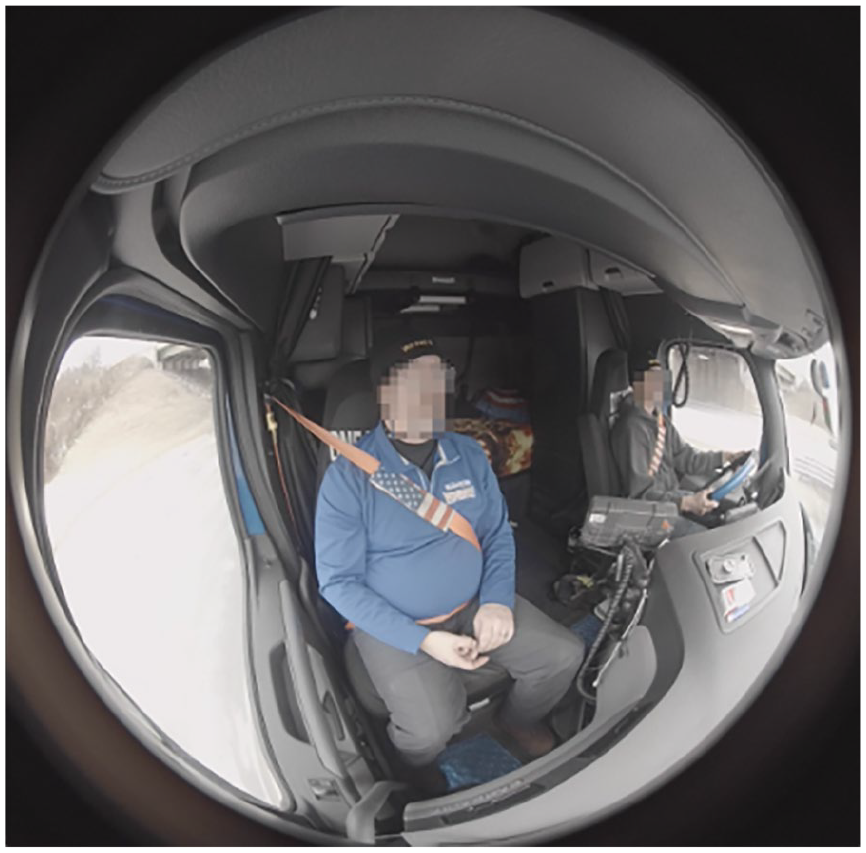
Annotated still of in-cab video taken during over-the-road driver training.
For the deaf CMV trainees, the first drive was conducted with a hearing trainer able to communicate in ASL, and the second drive was conducted with a hearing trainer with no ASL knowledge. The trip started around 9:00 AM and ended around 6:30 PM. During the drive the weather and road conditions ranged from dry to snowstorm with icy roads. A hearing trainee and hearing trainer were also observed to understand how over-the-road training was performed when neither trainer nor trainee were HOH or deaf.
The communication approach chosen was entirely decided upon by the trainer. The research team did not provide any instructions or suggestions to the trainers, trainees, or other personnel of the company. An individual from the research team was present in the back of the cab and shadowed the instructions being provided pre- and post-driving task but did not provide any instructions to the trainees or trainer.
Findings
Observed Communication Approaches
Deaf Trainee with Hearing ASL Trainer
When a deaf trainee was training with a hearing trainer with ASL knowledge, the hearing trainer provided hand gestures in ASL that would cover the needs of the training and the pre-determined route given the trainer’s experience with CMV driving. The hearing trainer did not provide pre-determined signs for every potential situation.
Deaf Trainee with Hearing Non-ASL Trainer
When a deaf trainee was training with a hearing trainer unable to communicate in ASL, the hearing trainer opted to use a simple note pad and pen to establish instructions prior to the trip. Although, the hearing trainer did not provide pre-determined hand gestures for every potential situation, he provided hand signals that given the trainer’s experience would cover the needs of the training and his pre-determined route. The trainer’s written instructions included: “Turns—I will hold up # of fingers for blocks till turn and will point direction of turn,” “Continue straight unless I give other direction,” and “Stop I will make a fist. Slow down I will make palm down motion.” The trainer also provided a specific, simple and clear hand gesture (“point to the right and then make a fist”) in the event of an emergency situation, for which the driver would be asked to stop immediately and get on the side of the road, in a safe manner.
Hearing Trainee with Hearing Non-ASL Trainer
Observations in this training also noted the hearing trainer used many hand gestures to direct the hearing student driver to signs, to locations within parking lots, and for route confirmations. The student driver was able to accomplish the task of detection, recognition and interpretation in a reasonable amount of time just as the deaf trainees were able to accomplish.
Observed Impact of Hand Signals on Driving
When the trainer and trainee established pre-determined hand signals prior to the drive, it was found that there was no need for the deaf driver to take much time to interpret these while driving. Additionally, glances to detect gross hand signals that have been trained and practiced will not take any longer to accomplish than normal driver scans to the mirrors, gauges and road signs.
Hand gestures at the deaf driver’s peripheral view did not introduce a distraction and were observed by the deaf trainees while they were monitoring the passenger side mirror or while waiting on a red light. In general, hand gestures at the deaf driver’s peripheral view did not impair driving performance, as both trainees did not miss any directions from the trainers and successfully completed the over-the-road training program. Communication occurred at the discretion of the trainer with attention towards not creating distraction or eyes-off-the-road conditions.
Recommended Alternate Communication Methods
After an extensive review of the appropriate standards and regulations, as well as the available scientific literature (discussed above), we recommended simple graphical symbols could be used with roadway signage presented either via physical handheld signs or electronic displays to supplement hand signals if a trainer felt they were needed. Viewing graphical displays complies with federal regulations and drivers are constantly monitoring images and short groups of words while driving (e.g., speed signs, exit numbers, changeable electronic message boards, signs along the roads, etc.).
Electronic devices such as smartphones, tablets, or iPads could be used to exclusively show pre-determined visual commands. Employing such devices would allow the trainer, while in the passenger seat, to link a device to a phone or tablet mounted within view of the trainee but not blocking the line of sight, like many GPS devices already installed in commercial vehicles (see Figure 1). This link would allow for real time display of graphical information and direction. We recommended these devices would not be used in any other form than just to show the pre-determined visual commands. Thus, the driver would not violate CMV rules which restricts a CMV driver from reaching for or holding a mobile phone to conduct a voice communication, send or read text messages or dialing a phone by pressing more than a single button.
Available standards, such as the Manual on Uniform Traffic Control Devices (MUTCD), can be used to determine acceptable pre-determined visual cues. The MUTCD is approved as the national standard for designing, applying, and planning traffic control devices, and is published by the Federal Highway Administration (FHWA) under 23 Code of Federal Regulations (CFR), Part 655, Subpart F. Using commonly seen signs as graphical communication tools would reduce the time needed to learn a particular graphical vocabulary and would be applicable immediately to over-the-road training (Figure 2).
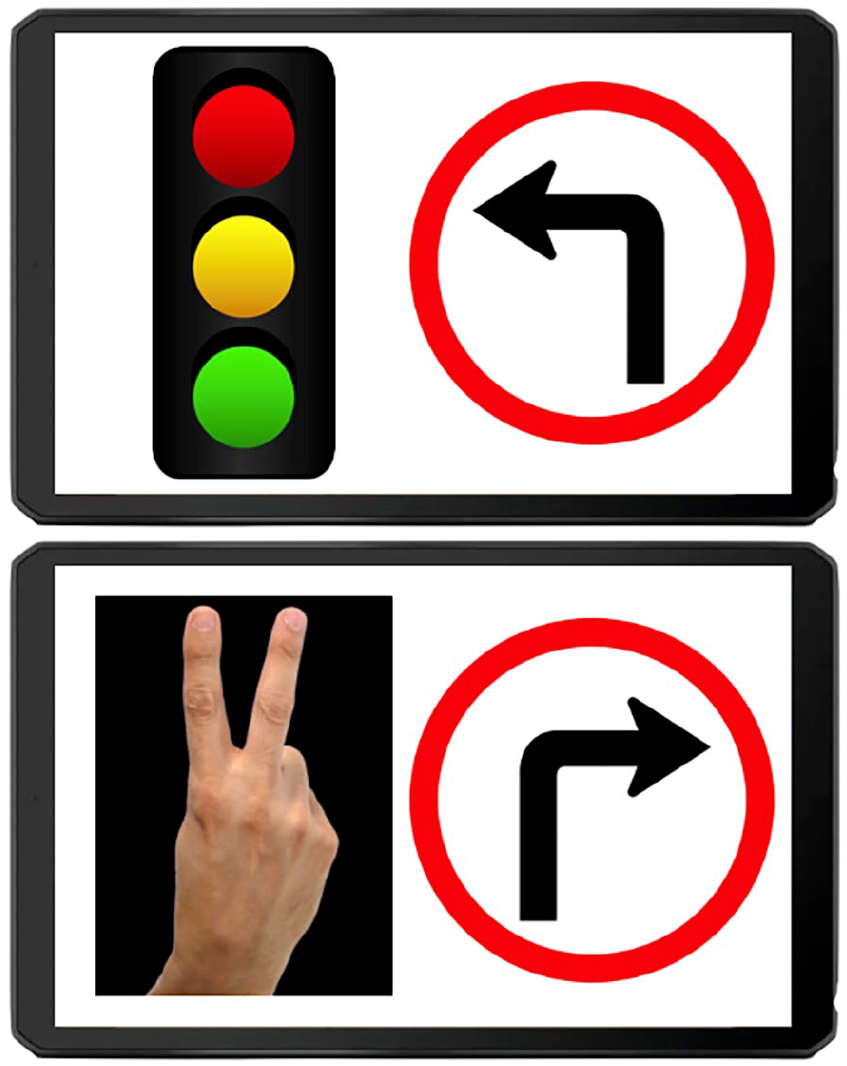
Visual cues presented on mounted devices representing “next light, turn left” (top) and “second intersection, turn right” (bottom).
Conclusion
We observed during the over-the-road training sessions in these legal cases that hearing trainers and HOH/deaf CMV trainees can find innovative and effective ways of ensuring crucial information is communicated in a safe manner. The foundational concern voiced in these cases was that a trainer could not provide reasonably timely feedback to trainees under real world driving situations. However, given that driving is a primarily visual task, that the drivers at issue are already licensed to drive commerical motor vehicles, and with the advances in current graphical and text to speech technology, alternate methods of communication are readily available to reasonably accommodate training in a safe manner.
There is no reliable, conclusive evidence that hearing loss or deafness results in a reduction of safety for commercial truck drivers (Federal Register, Qualification of Drivers; Application for Exemptions; National Association of the Deaf, FMCSA, 2013, 2016; Thorslund, 2014). In fact, high levels of ambient noise often mask environmental or task-specific sounds and age-related hearing loss can reduce the efficacy of sound as an alerting source of information (Kryter, 1970; Songer et al., 1993). In addition, noise can have adverse effects on human performance; however, the potential adverse effects are not present or are reduced in those with hearing loss or deafness.
Although the hand gestures were defined at the pre-trip plan in these case studies, these gestures could also be pre-determined as a company-wide protocol, instead of a per ride basis, so that the written standard operating procedure between a deaf driver and a hearing trainer is in place. While hearing trainers and deaf/HOH CMV trainees can find innovative ways of ensuring crucial information is communicated, these methods lack the speed and language specificity that two hearing drivers use. To address this, companies can also develop pre-determined visuals that represent the commands and situations likely to be encountered and to be displayed either on communication boards or through electronic information display devices.
NHTSA has published very detailed guidance on the development and implementation of display technology for use in motor vehicles (Campbell et al., 2016). The research includes information regarding where displays should be mounted and the types of messages and graphics that should be used depending on workload, urgency and how the information will be used. By utilizing the information from NHTSA, the development and implementation of an electronic information display device would not create any additional risks beyond what NHTSA has determined to be acceptable for all motor vehicles.
The pre-determined visual cues can also be implemented using a Heads-Up Display (HUD), which allows driver to see the information displayed as well as continue to see through the display to the road and mirror. HUDs can typically be mounted anywhere on the dash and connected to a device controlled by the trainer, who can display any number of messages or graphics in real time as well as pre-programmed reminders for things such as mirror checks, speed checks, and routine operations. Given the multitude of communication methodologies that can be established, especially as technology continues to advance, future research should investigate the performance in speed and reaction times of HOH/deaf trainees to theses alternative communication cues and methods.
In the first of the two cases involved in this matter the finding of the jury was that there were other factors besides the driver being deaf that may have sufficient reason for the defendant not to hire that individual and therefore found for the defendant. In the second case the jury made the determination that plaintiff’s claim had merit.
Footnotes
Declaration of Conflicting Interests
The author(s) declared no potential conflicts of interest with respect to the research, authorship, and/or publication of this article.
Funding
The author(s) received no financial support for the research, authorship, and/or publication of this article.