




Abstract
This study looks at the effects of the recognition rather than recall heuristic on a user’s cognitive load, particularly measuring the impact of the level of information provided and cognitive load and whether it impacts their decisions to seek medical care from the site with three conditions (minimal, neutral and overload level of information). Implications of this research include designing reliable medical websites requiring user’s cognitive engagement. Future research is needed to better understand and validate these findings.
Introduction
Medical and Healthcare websites have become a powerful tool and a vital platform for healthcare professionals and consumers to exchange information across diverse healthcare domains (Tieman & Bradley, 2013). The usability of healthcare websites can greatly impact users, and it is a key factor in affecting users’ satisfaction and the possibilities of continuing visits to these sites (Saad et al., 2022; Venkatesh et al., 2017). Researchers have evaluated the usability of various healthcare or medical websites using different measurement methods (e.g., Tieman & Bradley, 2013; Venkatesh et al., 2017).
Usability heuristics, such as “Recognition Rather than Recall” to minimize memory load, are generally followed by designers and engineers to improve user interactions (Nielsen, 1994). Due to the limitations of human cognitive resources and short-term memory (Cowan, 2008; Tracy & Albers, 2006), websites should be designed in a manner that minimizes memory and cognitive load so that users can complete tasks successfully.
Cognitive load refers to the amount of information that needs to be maintained in a user’s memory or the mental activity exerted while processing the information (Sweller & Chandler, 1991). In the healthcare domain, cognitive load has been extensively studied from the perspective of healthcare providers (Workman et al., 2007). Nonetheless, there has been less research on cognitive load from the perspective of the patient (Clarke et al., 2020). Patients are more likely to be users of medical websites when it comes to finding the services they need. However, users must navigate through a plethora of information on these websites in search of their desired product or service, which can lead to cognitive overload with too much information presented in a limited time (Malhotra, 1984; Schmitt et al., 2018).
Cognitive overload can result in increased error rates and frustration, as well as the inability to select useful information (Albers, 2011; Bawden & Robinson, 2009; Malhotra, 1984; Schmitt et al., 2018). Goswami (2015) found that when purchasing a product or service, consumers need to make various decisions relating to the information they are presented with. The concept of “intrinsic cognitive load” refers to the “intrinsic complexity of the material” in cognitive load theory (CLT; Sweller, 2010; Sweller & Chandler, 1991), suggesting that the quality and quantity of information presented are crucial. However, the quantity of the information, closely related to “Minimizing Memory Load,” has not been examined closely to explore how users’ perceptions and behavior change when these heuristics are followed.
Multiple subjective rating measurements are frequently used for measuring cognitive load, such as NASA task load index (TLX), Paas’s nine-point mental effort rating scale, and Workload Profile (WP) (Hart & Staveland, 1988; Paas, 1992; Tsang & Velazquez, 1996). These subjective methods have been evaluated in multiple studies (Rubio et al., 2004; Sun & Liu, 2013) and showed different strengths in measuring cognitive load depending on the goals. Other than the subjective self-reported cognitive load from the users, several other objective measurements might reflect users’ cognitive load. Performance metrics, including the time duration of completing the tasks, have been used to reflect users’ cognitive load (Chen et al., 2011; Ferreira et al., 2014; Haapalainen et al., 2010).
This research investigates the impact of a medical website’s text quantity on users’ cognitive load, their perception of the website, and their willingness to continue to seek medical care from the site. The study utilized several variations of the same medical webpage, manipulating the amount of text presented over three conditions, and measured participants’ cognitive load during a pre-test and post-test survey, task performance, including accuracy and time, and self-rated confidence and reliability of the webpage after each task. Additionally, participants were asked whether they would consider using this website in the future. The research and respective findings address a gap in the existing literature on patient-focused cognitive load studies and help define a path forward for future studies in this area.
Methods
One hundred fifty-three participants located in the U.S. were recruited via Amazon Mechanical Turk. All participants were randomly divided into three groups in a Qualtrics survey, following a randomized treatment design (Cook et al., 2002). We applied several filtering criteria to the responses collected through Qualtrics to ensure data quality. We excluded responses that did not show 100% completion, had a Recaptcha score above 0.5, or contained incorrect answers to the screening question. Ninety-eight responses remained.
The task involved identifying available services using screenshots of a local clinic’s webpages, which were edited by the experimenters into three conditions: (1) Minimal text (n = 41), retaining the same amount of text as the original website. Content included more generalized categories, such as “Family Medicine” and “Dental”. (2) Neutral text (n = 23), with slight text additions (Figure 1). The provided information included sub-categories, such as “Dental: Crowns; Dental Hygiene.” (3) Overload text (n = 34), adding much more text to the website. The information provided in this condition included a detailed explanation of each sub-category. For example: “Dental: Crowns (Dental cap that restores a tooth’s shape, size, and strength); Dental Hygiene (Routine Checkup).” All webpages maintained consistent design elements, including color, font, and layout, regardless of the amount of text.
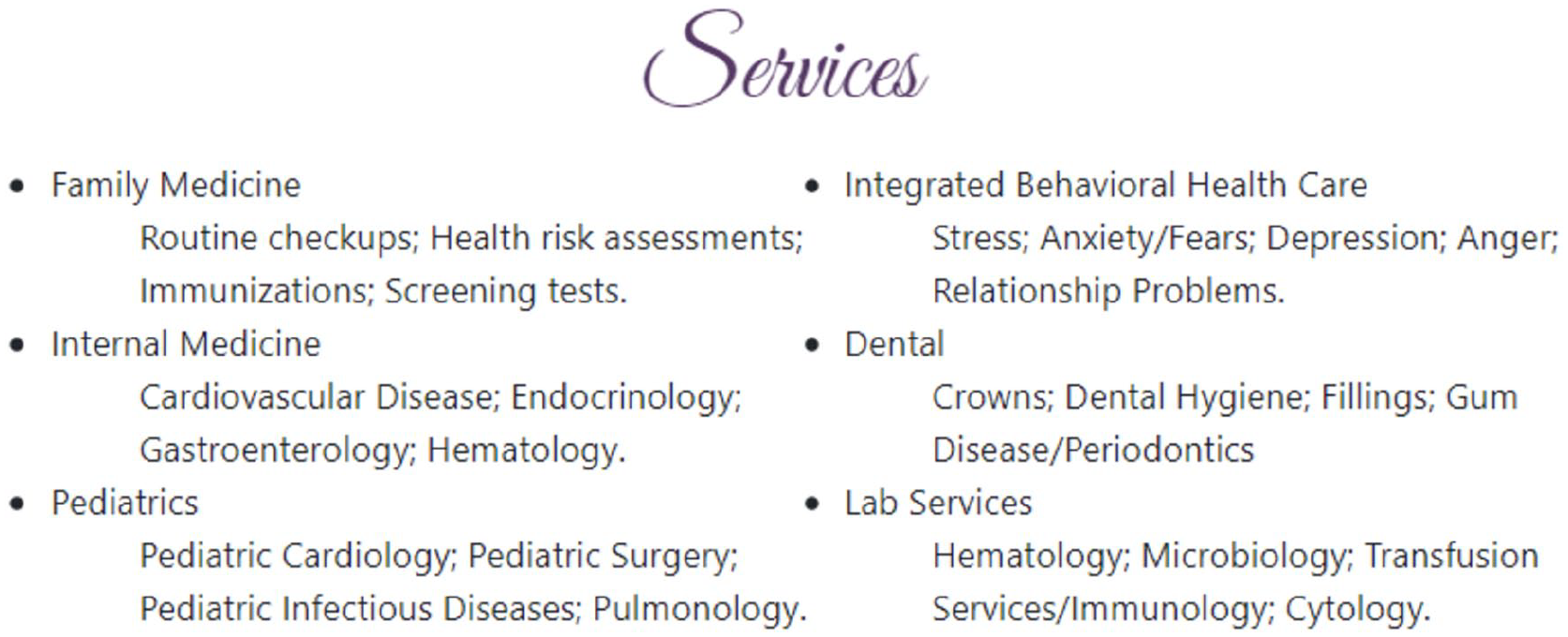
Example of the edited webpage in the neutral condition.
Before beginning the main tasks, all participants completed an initial task designed to assess their pretest cognitive load. This task was very similar to the main tasks in the Minimal text condition. After the pre-test, participants completed three similar tasks, answering if certain services were provided based on the website description based on the assigned condition. They were also asked to select the area on the screen that contained the necessary information that made them believe the service was provided. After completing the tasks, participants were asked to self-report cognitive load, self-rated level of confidence in their performance, level of willingness to continue to use the webpage, and perceived reliability of the webpage.
Seven measures were collected during this study: (1) Pre-test and Post-test Cognitive Load were measured using the Paas mental effort scale (a 9-point scale to measure cognitive load using one question; Paas, 1992). Paas’s scale is easy to answer and has relatively high sensitivity (Sun & Liu, 2013). (2) The participants’ performance accuracy in identifying whether a service was offered based on the information shown on the webpages. (3) The duration from the time when the webpage loaded to when the participant clicked to proceed to the next page. (4) Self-rated confidence in the accuracy of participants’ answers (Ackerman et al., 2016; Liu & Li, 2011). (5) Participants’ willingness to continue using the webpage. (6) Self-rated perceived reliability of the webpages. (7) Demographic information, including gender and age.
Results
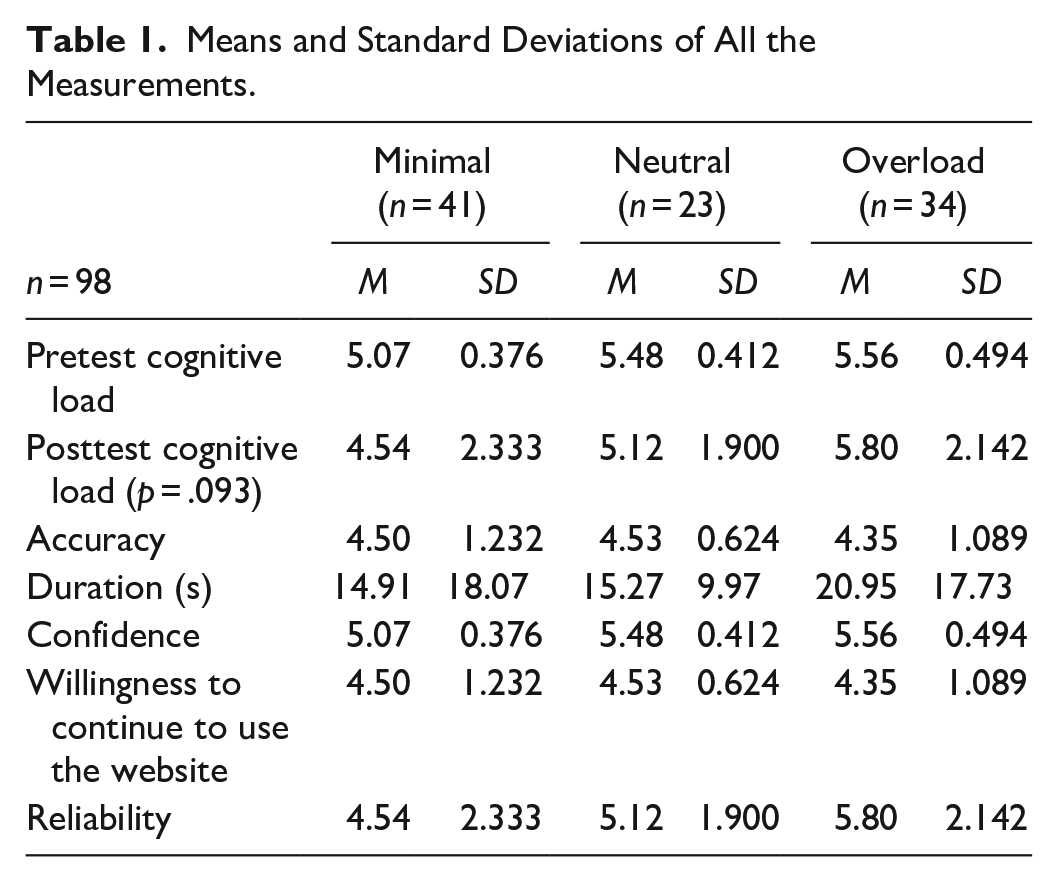
Bivariate correlational analysis, MANOVA, and pairwise comparisons were conducted on the information conditions and the measurements. Table 1 lists the means and standard deviations of all the measurements.
Means and Standard Deviations of All the Measurements.
Bivariate correlational analysis revealed that (1) Pre-test cognitive load was correlated with post-test cognitive load (r = .736, p < .001), willingness to continue to use the webpage (r = .392, p < .001), and perceived reliability of the webpage (r = .403, p < .001). (2) Post-test cognitive load was correlated with participants’ willingness to continue to use the webpage (r = .470, p < .001) and perceived reliability (r = .281, p = .005). (3) Participants’ willingness to continue to use the webpage was correlated with their perceived reliability of the webpage (r = .540, p < .001). (4) Participants’ level of confidence in task performance was negatively correlated with perceived reliability (r = −.199, p < .049). (5) Task performance accuracy was negatively correlated with the average time spent on each task (r = −.449, p < .001).
MANOVA results and pairwise comparisons showed a significant difference between the posttest cognitive load of the minimal and the overload condition (p = .042).
The strong positive correlation between pre-test and post-test cognitive load suggests that participants perceived mental effort remained relatively consistent throughout the experiment. MANOVA results showed the different cognitive loads required for Minimal and Overload conditions. This suggests that initial impressions may persist, rather than all conditions maintaining a similar level of cognitive demand throughout the study.
Both pre-test and post-test cognitive load were positively correlated with willingness to continue using the webpage and perceived reliability. This suggests that a higher cognitive load does not necessarily stop users from using the webpage. The correlation between willingness to continue to use and perceived reliability indicates users might be more inclined to use the webpage if they think it’s more reliable.
The weak negative correlation between participants’ confidence in task performance and perceived reliability could suggest that when users become more confident in their abilities, they may rely less on the webpage. Alternatively, webpages perceived as less reliable might prompt users to be more confident in their own judgment.
The relationship between task performance accuracy and average time spent on each task indicates that participants who took longer to complete tasks tended to be less accurate. This could suggest that individual capabilities or spending too much time on a task can potentially reduce accuracy.
Discussion
While traditional usability heuristics advocate for minimizing memory load (often through reduced information on a page), the current research shows that the relationship between cognitive load, user engagement, reliability, and confidence with medical websites is more nuanced than previously understood.
From the findings, we suggest that designers should be aware that initial impressions of cognitive load may persist throughout the user experience; similar results have been found about perceived aesthetics for websites and memory performance (Douneva et al., 2016; Lindgaard & Dudek, 2002).
The significant positive correlation between higher cognitive load and increased willingness to continue using a medical website suggests that users experiencing greater cognitive demand may not be discouraged. Instead, they might be more motivated to engage with the site, possibly because they perceive the information as valuable and the website as reliable. This finding has practical implications for the design of medical websites. It suggests that while it is important to avoid cognitive overload, a certain level of cognitive engagement is necessary to foster user investment and reliability. Designers might consider how to present information in a way that appeals to users as reliable and informational without overwhelming them, thereby increasing both the perceived reliability of the site and the likelihood of continued use to find medical care.
The study also has theoretical implications in designing different kinds of websites, challenging the assumption that ease of use is always the best design principle, especially in contexts where the quality and quantity of information presented are crucial, like in healthcare. It underscores the need for a balance between usability and the provision of comprehensive, reliable information that may require more cognitive effort to process but ultimately leads to greater user satisfaction with the website.
One limitation of this work is that the participants were recruited online, and these participants might have different motivations than the real users. Another limitation is that the participants experienced an interactive picture of webpages instead of interacting with real websites. This experience was relatively shorter than the typical experience of interacting with a medical website. Due to the consideration of minimizing the differences in physical workload and extraneous cognitive load (Sweller, 2010) among the conditions, all participants went through a single page without a second page available for more information. Many medical websites allow users to go to different pages to obtain more desired information. The reduction of this experience in the study can minimize the influences from the pages before reaching the desired page.
Footnotes
Declaration of Conflicting Interests
The author(s) declared no potential conflicts of interest with respect to the research, authorship, and/or publication of this article.
Funding
The author(s) received no financial support for the research, authorship, and/or publication of this article.
