



Abstract
Industrial exoskeletons have the potential to reduce injury risk and enhance productivity among manual labor workers. Despite the expected benefits, there is limited understanding of workers’ attitudes and perceptions toward this novel technology. This study examined manual labor workers’ multi-dimensional perception of exoskeletons compared to general populations using the newly developed Wearable Robot Perception (WeaR-P) Questionnaire. Sixty-two workers with physically demanding jobs and 59 university students completed the questionnaire after reading information on industrial exoskeletons. Results indicated that the overall perception of exoskeletons among manual labor workers was more favorable than that of the healthy, young students who are unlikely to perform everyday tasks involving high physical demands. Prior experience with exoskeletons among workers did not impact their perception of the technology. The findings suggest that an individual’s perception of exoskeletons may vary depending on their daily tasks and goals; however, hands-on experience may not change their overall perceptions.
Keywords
Introduction
Exoskeletons can help enhance users’ physical strength and endurance, assisting individuals with physical activities (de Looze et al., 2015; Pons, 2008). With an anticipated wide range of benefits, exoskeletons have been increasingly used in broad domains and for various applications, including military, healthcare, manufacturing, construction, and warehouses (de Looze et al., 2015; Gopura & Kiguchi, 2009). Exoskeletons in industrial settings are commonly used to provide vital lifting support for manual laborers in physically demanding workplaces, potentially reducing injury risk and fostering healthy work habits. Prior studies suggest that exoskeletons can reduce workers’ physical fatigue, muscle activity, strain on local muscle areas, and work-related back pain and help support body posture (Bosch et al., 2016; Spada et al., 2017a, 2017b; Theurel et al., 2018; Zhu et al., 2021).
Despite the continuous advancements and increasing use, exoskeletons remain relatively new to society, resulting in a limited understanding of perceptions and attitudes toward this emerging technology among industrial workers who may greatly benefit from using exoskeletons. Previous research indicates that individuals with negative attitudes toward a novel technology are more likely to exhibit unfavorable behaviors (Nomura et al., 2008). For example, users with more negative attitudes toward robots were more prone to displaying communicative avoidance behaviors with robots (de Graaf & Allouch, 2013; Nomura et al., 2008). Furthermore, prior research suggests that users who perceive a system as useful tend to have greater acceptance and willingness to use the device (Davis, 1989; Venkatesh & Bala, 2008) A similar trend may emerge with exoskeletons, leading workers with negative perceptions to resist or inefficiently use this potentially beneficial technology, while workers with positive perceptions are more willing to accept it.
Given the expected beneficial effects of exoskeletons on manual labor workers’ work demands, injury risks, and health, they may harbor distinctive, potentially more favorable, perceptions concerning this technology, recognizing its value in enhancing their daily work life and well-being. Understanding manual labor workers’ perceptions of exoskeletons is critical to help implement exoskeletons in broader workplaces and facilitate safer and more effective use among workers (Elprama et al., 2020). Prior research suggests that when users have no prior experience with novel technology, such as exoskeletons, they may have unwarranted, inflated positive attitudes toward it (Valentin & Choi, 2022). Workers with no prior experience with exoskeletons may form a more positive perception of the technology, possibly due to being biased toward their benefits; then, with more hands-on experience, they may develop more realistic, possibly less positive perceptions, especially if they experienced discomfort or pain associated with exoskeleton use (Baltrusch et al., 2020).
A general perception of a particular technology may be formed based on multiple distinct aspects and can vary across users. For instance, those with current health concerns or prior injuries may have a distinctive perception of exoskeletons relating to the health and safety impact exoskeletons may bring. Also, perceptions concerning how their social circle views and supports the use of technology could be particularly critical for a certain group of people, such as older adults, and may determine their overall perception of the technology. Investigating workers’ perceptions of exoskeletons in various dimensions will enable a comprehensive understating of the factors influencing their overall positive or negative perception.
The present study examined the multi-dimensional perception of exoskeletons among workers with physically demanding, manual labor jobs compared to the general healthy, non-worker population using the Wearable Robot Perception (WeaR-P) questionnaire (Valentin & Choi, 2023). Given that exoskeletons are still relatively new to most industry workers, we investigated how manual labor workers view exoskeletons in various aspects that may contribute to their general attitude toward this technology. Furthermore, we examined whether the WeaR-P questionnaire effectively captures differences in perception between two distinct groups of workers and a general population. This assessment can contribute to validating the questionnaire’s efficacy in discerning differences in perception of wearable robots, such as exoskeletons. Finally, we included a measure of intention to use as an outcome variable to examine the relationship between users’ overall perception of exoskeletons and their intention to use them.
Methods
Participants
A total of 121 respondents completed the online survey, with 62 recruited from Amazon Mechanical Turk (age: M = 27.35 SD = 5.18) and 59 from a university student pool (age: M = 19.12, SD = 1.49). Participants included 32 men, 87 women, and 2 non-binary. Participants from Amazon Mechanical Turk self-identified as having worked in the manufacturing, construction, or warehouse sectors. Only those who self-reported that their current jobs involved some form and degree of manual labor were eligible to participate in the survey.
Materials and Measures
WeaR-P. The WeaR-P questionnaire (Valentin & Choi, 2023) consists of 40 questions measuring user perception of exoskeletons in ten dimensions, including: (a) perceived usefulness (e.g., exoskeletons would help perform physically demanding tasks), (b) perceived ease of use (e.g., using an exoskeleton would require effort), (c) affective attitude (e.g., I find wearable robots intimidating), (d) safety and health impact (e.g., exoskeletons would help perform my work safely), (e) social influence (e.g., I would feel nervous operating an exoskeleton in front of other people), (f) embodiment (e.g., when wearing an exoskeleton, I would see it as an external tool), (g) perceived reliability (e.g., exoskeletons are reliable), (h) perceived adaptability (e.g., exoskeletons would be able to adapt to assist with what I need at a particular moment), (i) perceived cost (e.g., the maintenance of an exoskeleton would be difficult), and (j) perceived aesthetics (e.g., exoskeletons are visually appealing).
Exoskeleton Infographic
An infographic on industrial exoskeletons was designed to provide information on what exoskeletons are, available types with specific support functions (e.g., standing and crouching), and their benefits, including injury reduction, enhanced productivity, and expanded job opportunities for workers with age or physical limitations. Animated graphics adopted from online material (Stannard, 2023) demonstrated how exoskeletons assist human movement, complemented by images of individuals wearing exoskeletons.
Procedure
The participants completed the survey administered via Qualtrics. Subsequently, participants completed the Wear-P questionnaire and answered a question about their intention to use them. For each respondent, we computed the overall score of WeaR-P by summing up the score for all ten dimensions, as well as for each dimension. A higher score represents a more positive perception of exoskeletons. Respondents also reported their prior experience with exoskeletons. Participants were also asked to indicate their intention to use exoskeletons on a 5-point scale from strongly disagree to strongly agree to the statement, “I think I would use the exoskeleton during the next few days if I had the opportunity to use it.”
Results
Perceptions of Exoskeletons
Exoskeleton perceptions between manual labor workers and the general population were compared. The overall perception score of workers (M = 152.39, SD = 14.22) was significantly higher than that of the general population (M = 117.31, SD = 18.60, t(108.56) = 11.61, p < .001, d = 2.13). Furthermore, the manual labor workers’ perceptions were significantly more positive than the general population in the seven dimensions, including perceived usefulness, ease of use, social influence, embodiment, reliability, adaptability, and aesthetics, with t ranging from 5.01 to 17.81, all p < .001. There was no difference in the cost perception between workers (M = 11.89, SD = 2.14) and the general population (M = 11.90, SD = 2.27, t(119) = −0.03, p = .49). Affective attitudes were also not different between workers (M = 23.77, SD = 2.75) and the general population (M = 18.08, SD = 4.05, t(101.74) = 1.55 p = .061). Lastly, there was no difference in safety and health impact perception between workers (M = 16.17, SD = 2.02) and the general population (M = 14.36, SD = 3.29, t(92.58) = .553 p = .291).
Impact of Prior Exoskeleton Use on Perception
Unexpectedly, a majority of our worker sample (50 out of 62) had prior experience with exoskeletons. Participants reported the total usage hours ranging from 1 to 1,890 hours (M = 77.24, SD = 282.69), indicating a widely ranged length of prior exoskeleton experiences. None of the general population had experience using exoskeletons. A one-way ANOVA was conducted to compare the perceptions of exoskeletons between workers with prior experience vs. workers without prior experience vs. the general population to examine the effect of having prior experience using exoskeletons on the perceptions. The results indicated that there are significant differences in the overall perception score between groups, F(2, 118) = 68.02, p < . 001, η² = .54. However, the post-hoc analysis showed that there was no difference in exoskeleton perception between workers with prior experience (M = 152.90, SD = 11.17) and those without (M = 150.25, SD = 23.67, p = 1.00). As also shown in the previous analysis, the results indicated that the general population group, none of whom had prior exoskeleton experience, had a less positive perception of exoskeletons than workers with or without prior exoskeleton experience, p < .001 (Figure 1).
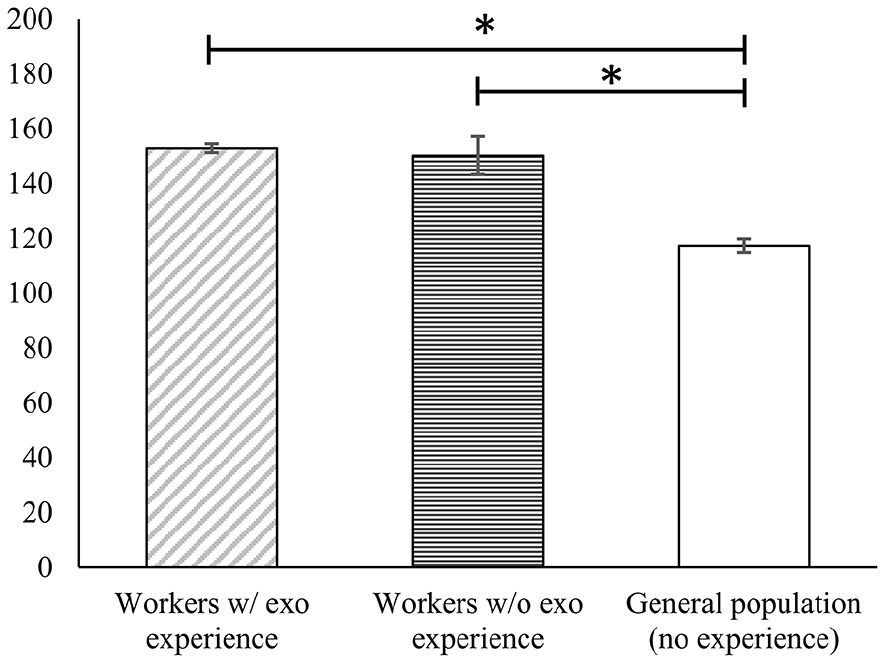
Comparisons of the overall exoskeleton perception scores between manual labor workers with vs. without prior exoskeleton experience and the general, non-worker population.
Correlations Between Exoskeleton Perception and Intention to Use
Workers reported a stronger intention to use exoskeletons (M = 4.24, SD = .670) compared to the general population (M = 3.10, SD = 1.41), t(81.98) = 5.634, p< .001, d = 1.10, indicating workers were more inclined to consider using exoskeletons compared to the general population. The correlational analysis showed that the overall perception score was significantly correlated with intention to use, r(121) = .721, p < .001, indicating that individuals with more positive general perceptions of exoskeletons are more likely to use exoskeletons if available. The correlations between the overall perception and intention to use were significant in both groups: workers, r(62) = .781, p < .001; and the general population, r(59) = .594, p < .001.
Discussion
This study showed that workers working in physically demanding workplaces viewed exoskeletons more favorably than the general population, who may not expect to benefit from the technology immediately. This finding suggests that an individual’s perception of exoskeletons may vary depending on their daily tasks or goals. Given that the general healthy young adult population is unlikely to have everyday tasks involving physically challenging postures or repetitive motions, their perceptions of exoskeletons might be less favorable due to a lack of immediate need. In contrast, workers who engage in manual labor tasks may perceive exoskeletons more positively due to their direct need for physical support. This finding coincides with prior research suggesting that users tend to form more positive perceptions of technologies that directly address their practical needs and challenges (Davis, 1989; Venkatesh & Bala, 2008). Furthermore, workers’ perceptions of exoskeletons differed from those of the general population in many dimensions, including ease of use, social influence, and adaptability, suggesting that the factors determining the manual labor workers’ general perception of exoskeletons could be distinct. The current findings also support that the Wear-P Questionnaire can differentiate between different users’ perceptions effectively. Future studies should employ the Wear-P questionnaire across various occupational groups to explore how different work settings may influence different aspects of the perception of exoskeletons.
In this study, few perception dimensions did not show significant differences between the two groups, including cost, safety and health, and affective attitude. Users of exoskeletons may perceive the device as costly and challenging to maintain, regardless of their jobs or exoskeleton needs. Surprisingly, the perceived safety and health impact of exoskeletons did not differ between workers and students, despite expectations that workers would perceive more substantial health benefits from exoskeletons. This could be attributed to the fact that both groups perceive the technology as offering safety and health benefits that could be advantageous for everyone involved. While the affective attitude did not show significant differences, it tended to be higher for workers compared to the general population. With a larger sample size, we may observe a clearer distinction between the two groups, which may then suggest that workers have a more positive emotional response to exoskeletons.
The current study did not show that workers with prior experience with exoskeletons had different perceptions than those without experience. A previous study examining the older worker population suggests that individuals who are familiar with exoskeletons are more likely to have realistic expectations of exoskeletons, leading to a less positive perception compared to those who are unfamiliar (Valentin & Choi, 2022). It is possible that the workers of the current study had more substantial, extended hands-on experiences with exoskeletons that were positive, resulting in realistic yet favorable perceptions. A previous study investigating the long-term use of exoskeletons in the workplace demonstrated that the device alleviated physical strain during automotive assembly tasks (Kim et al., 2021). This reduction in physical demands allowed workers to sustain longer working hours with less effort, potentially enhancing perceived job performance. Consequently, exoskeletons hold promise as they can mitigate workload, suggesting a potentially positive outcome for those accustomed to using them. The findings of this field study imply that workers with prior positive experiences with exoskeletons may exhibit greater receptiveness to these devices compared to those without such experiences. However, the effectiveness of exoskeletons may vary depending on specific models or work environments being evaluated (Siedl & Mara, 2021). Further research is warranted to investigate changes in users’ perceptions with varying experiences of extended use of exoskeletons.
Lastly, there was a significant correlation between the overall perception and intention to use exoskeletons in both worker and general population groups, suggesting that a more favorable perception of a system may predict the willingness to use the exoskeleton. This validates the importance of users’ perceptions in shaping their readiness to embrace innovative technologies like exoskeletons.
Footnotes
Declaration of Conflicting Interests
The author(s) declared no potential conflicts of interest with respect to the research, authorship, and/or publication of this article.
Funding
The author(s) disclosed receipt of the following financial support for the research, authorship, and/or publication of this article: This research was supported by the Human Factors and Ergonomics Society (HFES) Aging Technical Group.
