



Abstract
Healthcare teams often work in complex systems where soundscapes include numerous noise sources and levels which could impact teamwork. While studies have analyzed the impact of sound on patients, articles describing clinician and clinical team experience are relatively sparse. The purpose of this literature review was to determine what is currently known about soundscapes and their impact on teamwork and team performance in hospital-based healthcare settings. Eleven studies met the inclusion criteria. The Input-Process-Output framework and SEIPS 2.0 model guided our review and categorization of the included studies. The work environments studied included the operating room (OR), perioperative area, and a simulation. Noise input was grouped by existing noise, music or controlled sound conditions, and communication wearables during clinical or simulated tasks. Nine of the 11 articles studied the impact sound environment on team communication and three articles measured other team processes. The findings from this review assessed both existing and experimental noise conditions discovering associations with team performance processes and outcomes. Overall, previous studies have found that noise can impact individuals and elements of teamwork, especially communication. Future research is needed to develop best practices and innovative solutions supporting a positive soundscape for teamwork.
Introduction
Healthcare is increasingly delivered in teams (Mitchell et al., 2012), and effective teamwork in healthcare teams is associated with better team performance (Schmutz et al., 2019). Aspects of teamwork aspects commonly explored in relation to team performance include leadership; communication skills such as using closed-loop communication, asking clarifying questions, and information sharing; and coordination skills such as developing shared mental models, mutual trust, and mutual performance monitoring and backup behavior (Greilich et al., 2023; Salas et al., 2005).
The science of teams is shifting its focus to studying teams as dynamic systems that work in dynamic environments (Mathieu et al., 2018). The Input-Process-Outcome framework, a common unifying framework for research on teams, indicates that environmental factors can serve as inputs that affect team actions and interactions and, subsequently, outcomes (Hackman & Morris, 1975; McGrath, 1964). A dynamic environmental factor that may be of interest to the study of healthcare team processes and outcomes is the soundscape in which the team works.
Hospital soundscapes are complex and challenging environments filled with numerous noise sources and critical conversations. While several studies have analyzed the impact of sound on patients—including physiological and psychological reactions—staff experience and the soundscape work is relatively sparse and largely focuses on personal perception, stress, job performance, and health (Busch-Vishniac & Ryherd, 2023). Overall, literature is focused on the impact of healthcare soundscapes and sounds on individuals rather than the impact on teams.
The field of human factors describes the complex system in which teams work to provide care. Through the Systems Engineering Initiative for Patient Safety (SEIPS) Model, we evaluate these system inputs and their impact on both work process and outcomes (Carayon, 2006). Similarly, the SEIPS model follows the Input-Process-Output framework where the work system (tools and technology, tasks, person, internal environment, organizational constraints, and external environment) serves as the input. In the SEIPS 2.0 model (Holden et al., 2013), the model recognizes people (not just a person) at the center of the work system. This model guides our work in assessing teamwork in the literature while we explore the work system and impact of sound in the environment on patient and clinician outcomes.
The goal of this literature review was to determine what is currently known about soundscapes and their impact on teamwork and team performance in hospital-based care settings.
Methodology
PubMed and CINAHL were searched for literature utilizing the following search topics: sound/acoustics/soundscapes/noise/music and teams/teamwork performance in the healthcare environment. Study titles and abstracts were then screened based on the following initial screening criteria: (a) an aspect of the soundscape (defined as the acoustic environment as perceived, experienced, and/or understood by people in context; ISO 12913-1, 2014) was measured, (b) participants in the study were working as a part of a team (defined as two or more people were working together interdependently and adaptively to achieve a common goal; Salas et al., 2005), and, (c) at least one or more aspects of teamwork (defined as the knowledge, skills, and attitudes that team members need to interact interdependently with one another in an effective way that will lead to positive outcomes for the team; Salas et al., 2005) and/or team performance outcomes were evaluated in the study. Figure 1 highlights the screening process from an adapted version of the PRISMA flow diagram (Page et al., 2021).
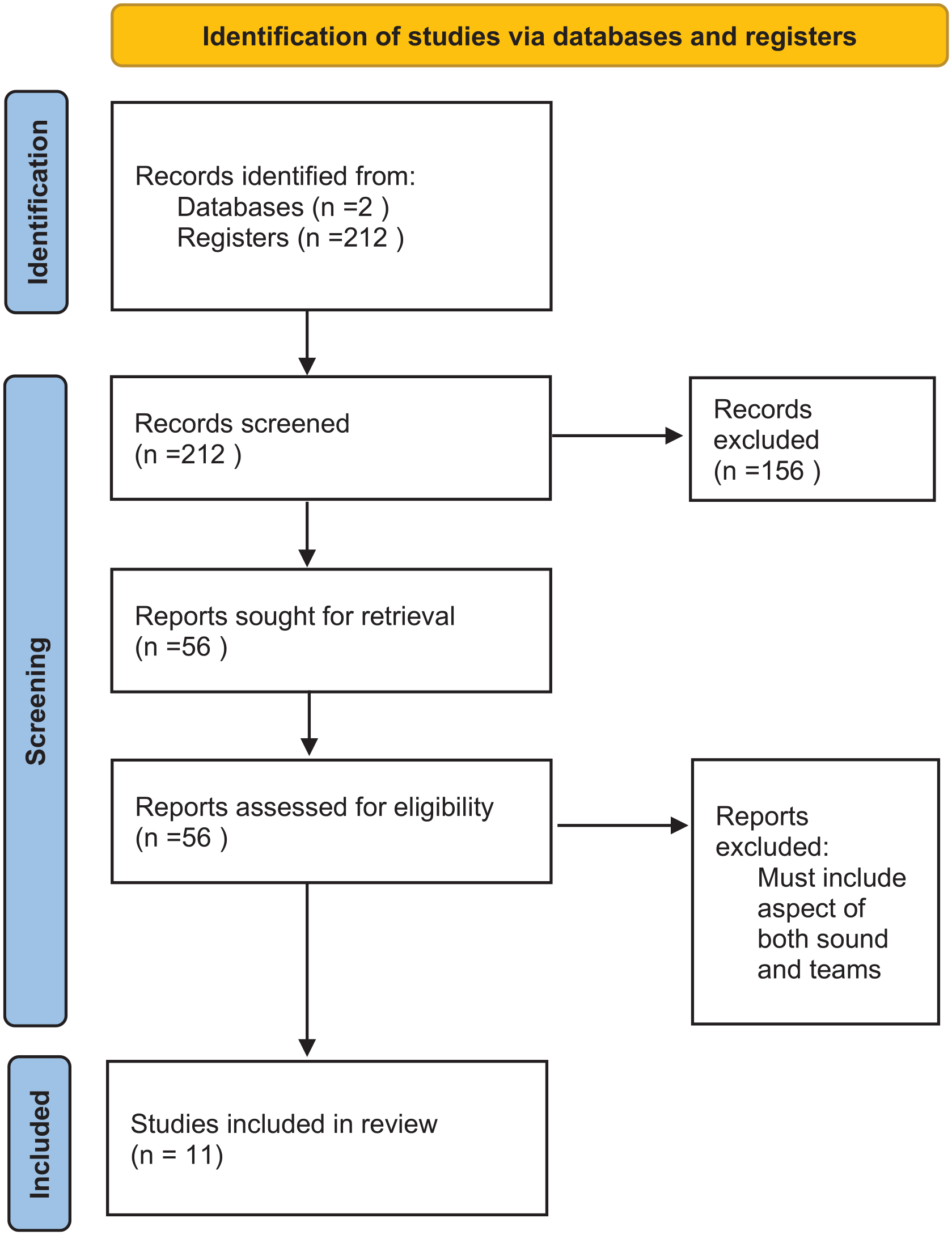
Literature search for teams and soundscapes.
Data were then extracted from the included studies, organized, and then subcategorized utilizing the following elements of the SEIPS 2.0 framework: inputs (clinical setting in the hospital, team composition, and aspects of the soundscape), processes (teamwork processes) and outcomes (impacts of the soundscape on teamwork processes and performance). To further define the work system, we included the different components as subcategories of our input (people, tasks, tools and technology, environment).
Results
Eleven empirical articles were identified that examined aspects of hospital soundscapes and their impact on teamwork and/or team performance. The literature identification strategy is detailed in Figure 1. The findings from the literature as categorized and subcategorized are summarized in Table 1. Most of the studies included in the review were conducted in operating room settings, with one (Friend et al., 2017) in a peri-operative environment and two (Cheriyan et al., 2016; Krage et al., 2017) in a clinical simulation setting.
Literature Results for Sound and Teamwork in Healthcare.
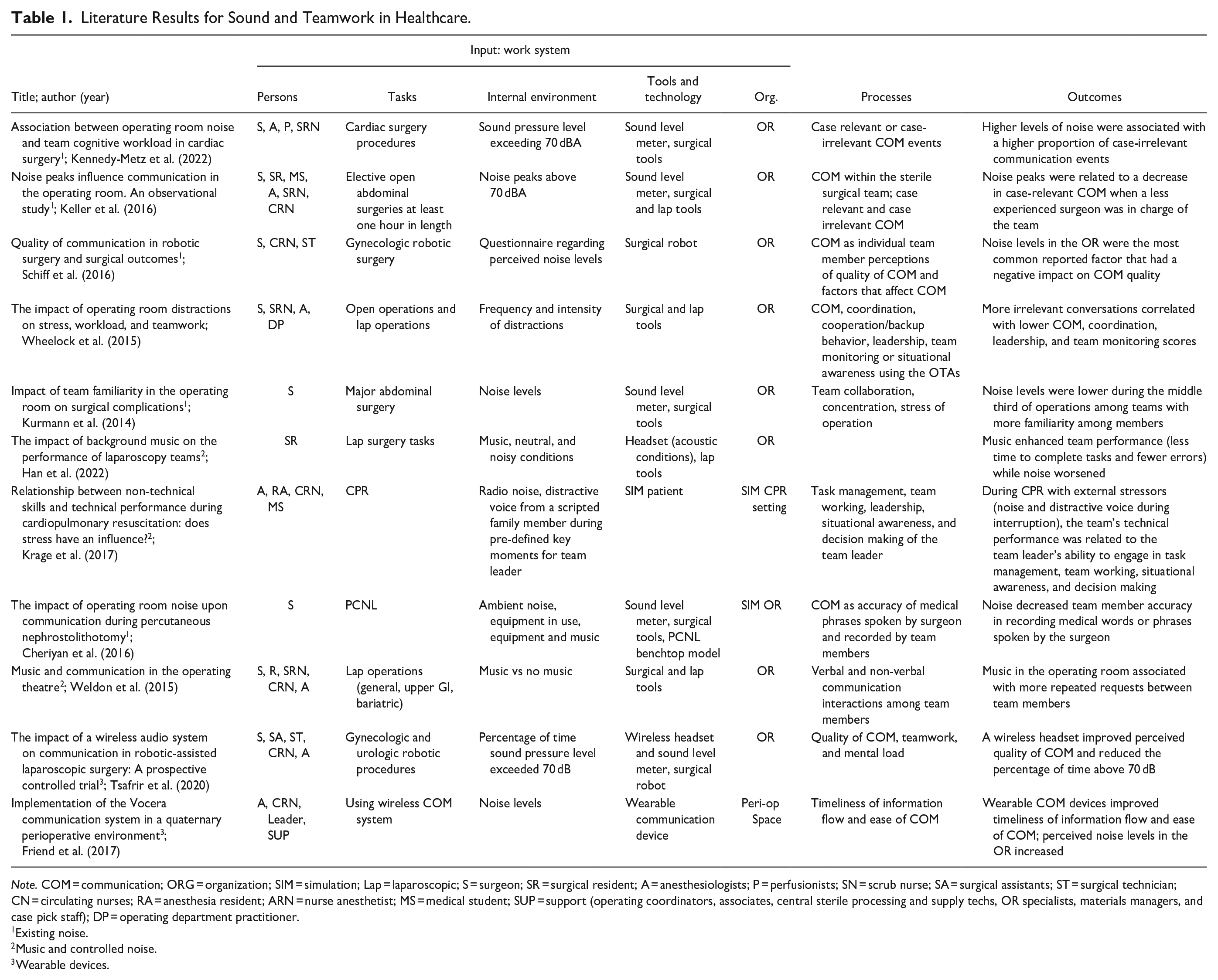
Note. COM = communication; ORG = organization; SIM = simulation; Lap = laparoscopic; S = surgeon; SR = surgical resident; A = anesthesiologists; P = perfusionists; SN = scrub nurse; SA = surgical assistants; ST = surgical technician; CN = circulating nurses; RA = anesthesia resident; ARN = nurse anesthetist; MS = medical student; SUP = support (operating coordinators, associates, central sterile processing and supply techs, OR specialists, materials managers, and case pick staff); DP = operating department practitioner.
1Existing noise.
2Music and controlled noise.
3Wearable devices.
Sound Environment
We identified three clear noise categories within the studies included in this review: (1) existing noise, (2) music or controlled sound conditions, and, (3) communication wearables. The articles included in this review were organized into groups based on these three categories to facilitate review of their effects (Table 1). Three of the articles utilized noise exceeding 70 dB/dBA as the characterization of the sound environment (Keller et al., 2016; Kennedy-Metz et al., 2022; Tsafrir et al., 2020), while three articles used different noise conditions (Han et al., 2022; Krage et al., 2017; Weldon et al., 2015).
Teams
Teams in eight of the articles were interprofessional in composition; the remaining three were composed of surgeons or surgical residents only (Cheriyan et al., 2016; Han et al., 2022; Kurmann et al., 2014). In Cheriyan et al. (2016) the people were surgeons who assumed roles of other clinical team members during simulation. Reports of team size varied from dyads (Han et al., 2022; Kurmann et al., 2014) to upwards of 10 members on each team (Tsafrir et al., 2020).
Nine of the 11 articles explored the effect of the sound environment on team communication. Communication was operationalized as perceived quality, timeliness of information flow, ease, accuracy, and relevance to the case. Three articles measured other team processes including task management (Krage et al., 2017), team leadership (Krage et al., 2017; Wheelock et al., 2015), situational awareness (Krage et al., 2017; Wheelock et al., 2015), leader decision making (Krage et al., 2017), coordination (Wheelock et al., 2015), and collaboration and concentration (Kurmann et al., 2014).
Team outcomes were operationalized in a variety of ways, including “outcomes” related to team processes, as mentioned above, or either clinical or simulated task completion and performance.
Effects of Sound on Team Processes and Performance
Literature covering existing noise and general types of noise in the hospital environment consisted of two subcategories: communication case relevancy and noise levels. Keller et al. (2016) noted a reduction in case-relevant communication during noise peaks when the team was led by a less experienced lead surgeon. Case-irrelevant conversations were related to increased team workload (Kennedy-Metz et al., 2022) and a decrease in communication, coordination, leadership, and team monitoring (Wheelock et al., 2015). Noise levels in the OR were lower during the middle of procedures with familiar teams (Kurmann et al., 2014) and were most frequently reported as negatively impacting communication quality (Schiff et al., 2016).
The studies identified that examined music or controlled noise conditions tried to either improve noise conditions or intentionally create distracting conditions. Of note, two articles looked specifically at music’s impact on communication in the operating room finding mixed results. Han et al. (2022) found that in a simulated laparoscopic surgery setting music enhanced team performance while a noise condition worsened team performance. Weldon et al. (2015) documented whether music was playing or not during surgery and tracked interactions of nurses, surgeons, anesthetists finding that music was associated with more repeated requests. Cheriyan et al. (2016) reported a decrease in team member accuracy in recording statements made by the team surgeon. During CPR with imposed noise stressors, the team’s technical performance was related to the leader’s ability to engage in teamwork skills (Krage et al., 2017).
Two studies examined the impact of wearable communication devices on team communication. One study observed improved perceived quality of communication and reduced exposure to high noise levels (Tsafrir et al., 2020). The other found wearable communication devices improved the timeliness of information flow and ease of COM; however, it also increased perceived noise levels (Friend et al., 2017).
Discussion
The impact of soundscapes on teamwork is an important element to consider in the healthcare environment. This review found that noise can impact individuals and elements of teamwork (primarily communication). Additional work is required to better understand appropriate soundscape metrics and how to design a healthcare soundscape conducive to effective teamwork.
The OR was the primary setting studied within the literature included in this review. Healthcare environments beyond the OR, such as emergency departments, intensive care units, and mother baby units could benefit from this type of soundscape and team analysis.
Only two of the 11 articles in this review specifically studied technology (wearables) as a factor to improve team interactions. Investigations of the impacts of a wider range of acoustic interventions including wearable devices, sensing and feedback to providers, lowered noise levels, architectural layouts or material selections, and potentially supportive sound elements such as music is warranted. While technology to measure sound might not routinely be considered part of the work system, there is an opportunity for continuous monitoring and improving feedback loops on teamwork. The studies that indicated higher noise levels were related to poorer teamwork pose opportunities for sound monitoring technology as a work system input for improved outcomes.
Most of the studies in this review explored the impact of elements of the soundscape on various aspects of team action processes—activities that take place as teams work to complete tasks—and among teams of varying sizes, many of which were interdisciplinary in nature. Communication was naturally a focal process of interest and future research can further explore how soundscapes help and hinder effective communication among healthcare teams. The effects of the soundscape on additional team action processes, such as situation awareness, performance monitoring, and adaptability are also worth further exploration. A dialogue with practitioners, researchers, and industry would be beneficial to identify what elements are important and what is not of interest. Specifically, how do the interactions among technology, team composition, and soundscape influence team processes and outcomes?
Limitations of this study include a lack of details on the organizational constraints in these different institutions and areas of study. This is a factor influencing the work system and should be studied. Additionally, with diverse applications this research did not focus on the clinical/simulation tasks and details of performance related to these tasks. Additional analysis of these measures across studies could further shed light on ideal soundscapes for teamwork.
Conclusion
The findings from this review assessed both existing and experimental noise conditions and their associations with team processes and outcomes. The soundscape design is an important element of the healthcare work system. Future research will benefit human factors and clinical practitioners in the healthcare industry by developing best practices and innovative solutions to support a positive soundscape for effective teamwork.
Footnotes
Declaration of Conflicting Interests
The author(s) declared no potential conflicts of interest with respect to the research, authorship, and/or publication of this article.
Funding
The author(s) received no financial support for the research, authorship, and/or publication of this article.
