




Abstract
In this study, a comparative analysis of virtual reality (VR) and desktop conditions was used to investigate how levels of immersion influence spatial ability. The study revealed significant differences in participants’ spatial environmental ability, with VR users displaying enhanced spatial ability as compared to desktop users. These findings support previous studies regarding the efficacy of immersive versus non-immersive technologies in spatial learning. This study contributes valuable insights for spatial ability training and educational methodologies, and points to the need for further research on this topic.
Introduction
Effective learning techniques vary greatly among students, depending on individual strengths and weaknesses. Especially in engineering topics, the barrier to entry is often more difficult for women over men (Sorby, 2009). One of the largest barriers to teaching more technical subjects such as engineering is students’ individual spatial ability (Harle & Towns, 2011; Yu et al., 2018). Spatial ability are the skills in “representing, transforming, generating, and recalling symbolic, non-linguistic information” (Linn & Petersen, 1985, p. 1482), which are important in comprehending technical subjects. Spatial ability is complex and includes many different skills (Carroll, 1993). To fully understand the different dimensions of spatial ability, it is crucial to deconstruct it into distinct factors. Among these factors: environmental ability, spatial orientation, and spatial relations (Yilmaz, 2009) are critical for learning engineering concepts. Environmental ability involves integrating information about objects with information of the object’s surroundings. Spatial orientation is the ability to imagine an object from a different perspective. Spatial relation is distinguishing whether a second stimulus is a rotated or reflected version of the first stimulus. Yilmaz argues that these three factors plus five others (closure speed, flexibility of closure, spatial visualization, spatiotemporal ability, and perceptual speed), makes up spatial ability.
Effective spatial ability correlates with improved performance in engineering-related tasks (Asriadi et al., 2023; Sippel & Blum, 2022). While various methods exist to enhance spatial ability, many require extensive practice, which is often impractical within classroom settings (Terlecki et al., 2009; Yu et al., 2018). However, leveraging highly immersive technologies like virtual reality (VR) presents promising avenues for real-time spatial ability enhancement without the need for extensive practice (Sippel & Blum, 2022; Zhao et al., 2020). VR can facilitate a deeper understanding of complex engineering concepts by reducing cognitive load (Lee & Wong, 2014), fostering practical applications (Sun et al., 2019), and enhancing student engagement (Sorby, 2009).
Although desktop monitors provide a level of immersion, because participants can still see the outside world, desktop monitors are less immersive than VR headsets and potentially impact the enhancement of spatial ability. VR offers a level of immersion that surpasses standard desktop computer use primarily due to its ability to fully engage the visual field and create a sense of presence in a virtual environment. VR creates a sense of “presence” by surrounding the users with a virtual environment that responds to their actions and movements. This feeling of being present in another world can be incredibly immersive and captivating. Also, VR headsets typically use stereoscopic displays to create a 3D effect, giving users a sense of depth and perspective that mimics real-world vision. This adds to the feeling of immersion by making the virtual environment appear more lifelike. VR systems also track the movement of the user’s head, allowing them to look around and explore the virtual environment naturally. This real-time tracking enhances immersion by making the virtual world respond to the user’s movements in a way that feels intuitive.
Some studies have begun to assess various levels of immersion and their impacts on spatial relations (Molina-Carmona et al., 2018), but do not investigate other facets of spatial ability. In addition, a tool’s level of immersion is complex and influenced by many different factors (Nilsson et al., 2016), indicating different levels of immersion (i.e., desktop vs. VR) may be more advantageous for different facets of spatial ability.
With the potential benefits of VR, it seems likely that this level of immersion could improve spatial ability skills. If VR and its deep level of immersion are helpful in improving spatial ability skills, VR could be a beneficial tool in lowering the barrier to enter engineering. Therefore, this study aimed at assessing the impact of two different computer setups (desktop vs. VR) on different aspects of spatial ability, including environmental ability, spatial orientation, and spatial relations. By addressing these objectives, we seek to provide insights into the effectiveness of different immersion levels for enhancing spatial ability in engineering education.
Method
Thirty-nine participants were recruited from an introductory engineering research pool; ages ranged from 18 to 25 (M = 19.2, SD = 1.9). See Figure 1.
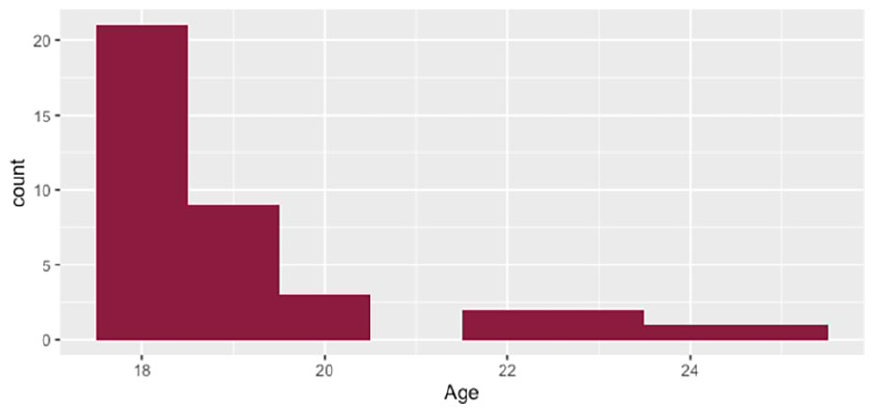
Age distributions of participants.
Most participants identified as men (31% or 79%), followed by women (7% or 18%), and non-binary/third gender (1% or 3%) See Figure 2.
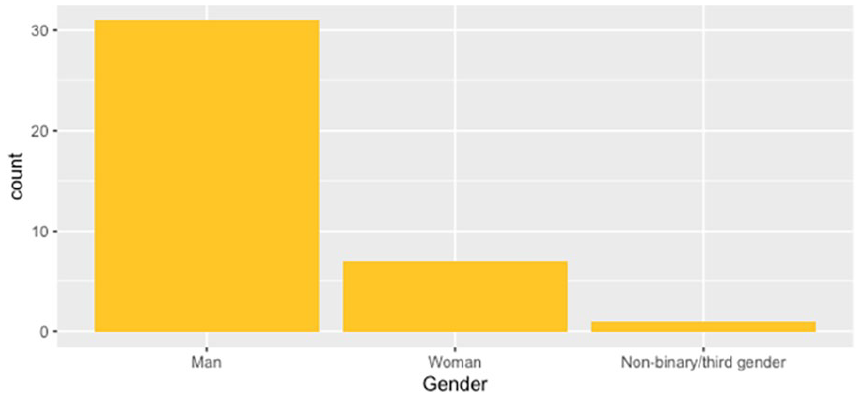
Gender distributions of participants.
Six participants identified with more than one race/ethnicity. Participants identified as White (19% or 48%), Hispanic or Latino (13% or 33%), Asian/Pacific Islander (7% or 18%), Native American or American Indian (4% or 10%), and Black or African American (3% or 8%).
Procedure
Participants were randomly assigned to one of two groups: Google Earth VR or Google Earth desktop. In the Google Earth VR condition, participants used a VR headset to explore and complete the tasks. Alternatively, those in the desktop condition performed the tasks using the standard desktop computer. Each participant received a condition-dependent tutorial to gain familiarity with their navigation tool before proceeding to the primary exploration task. More specifically, participants who were assigned to the Google Earth VR condition would receive a tutorial that teaches them how to navigate and interact with the virtual environment using the VR headset and controllers. On the other hand, participants assigned to the Google Earth desktop condition would receive a tutorial tailored to using the standard desktop computer interface. The goal of a condition-dependent tutorial is to ensure that participants are well prepared to use the technology assigned to them in the study, maximizing their ability to engage with the tasks and minimizing potential sources of confusion or bias due to unfamiliarity with the technology.
During the primary exploration task, participants explored an unfamiliar town in Montana. Participants in both conditions were asked to verbally identify the notable buildings and landmarks they encountered during this exploration task. Researchers provided guidance to ensure participants saw the required five key stimuli landmarks located within the town. See Figure 3 above for an example of the Google Earth view of the town that the participants virtually walked through. The researchers predetermined these landmarks and served as participant’s focal points for participants during the exploration task. See Figure 4 for an example of the virtual reality setup.
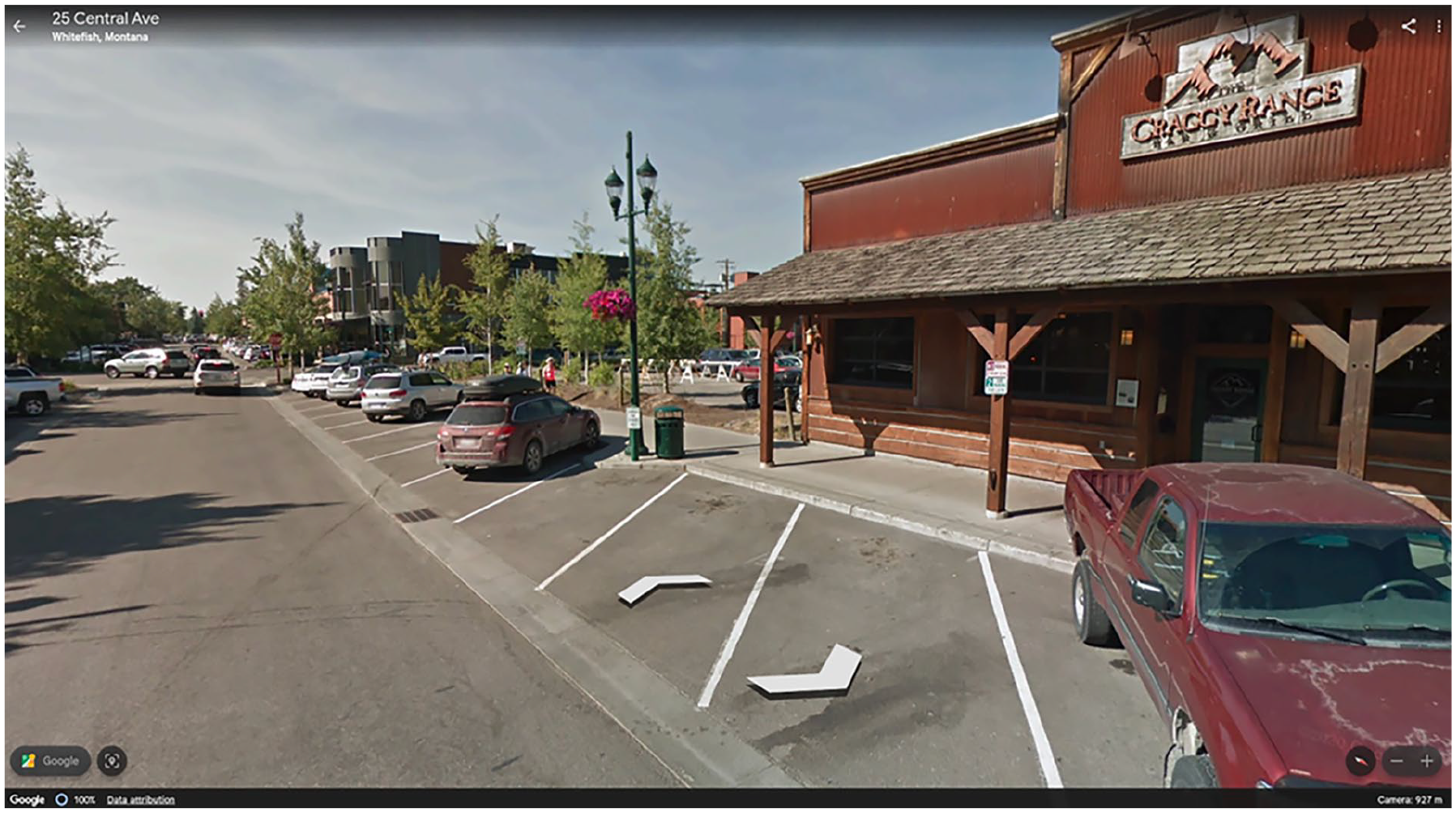
Google earth desktop view of Whitefish, MT.
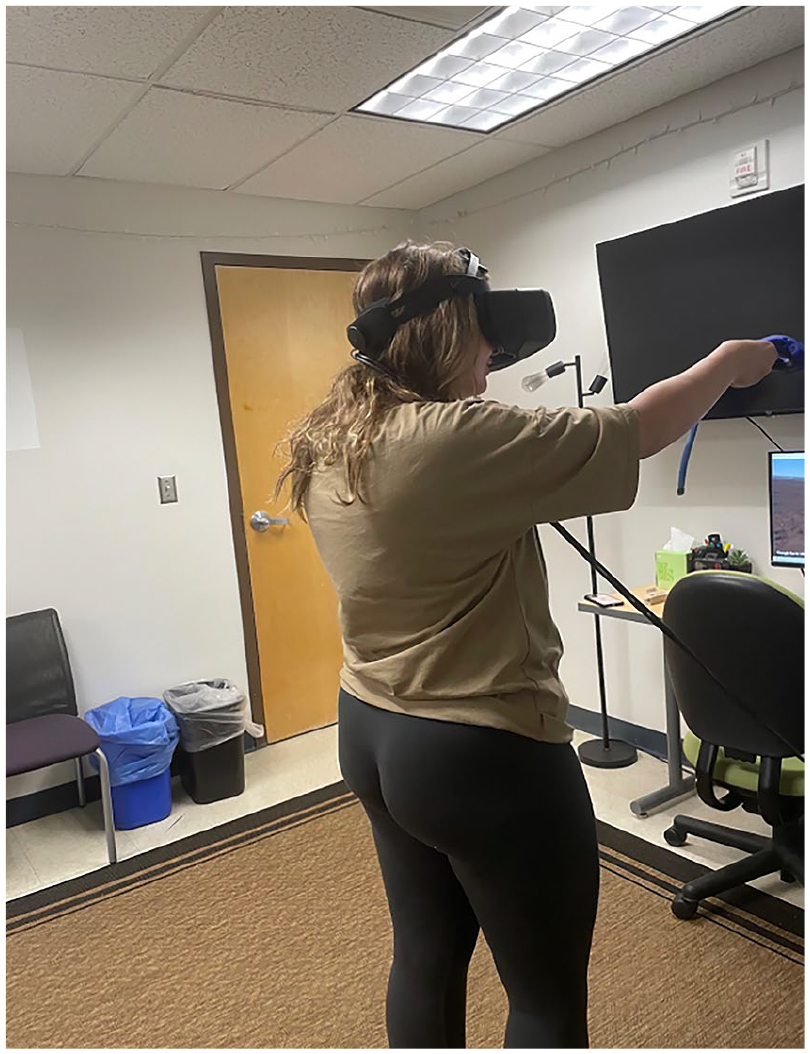
Participant reenacting the VR exploration task.
After completing the exploration task, participants were tasked to draw routes from their starting point to the five key stimuli on an electronic map, which served as an estimation of their environmental ability (see Figure 5). Both the time taken to draw the route to each stimulus and the route accuracy were recorded. Participants were not allowed to refer to the Google Earth and had to draw the routes from memory.
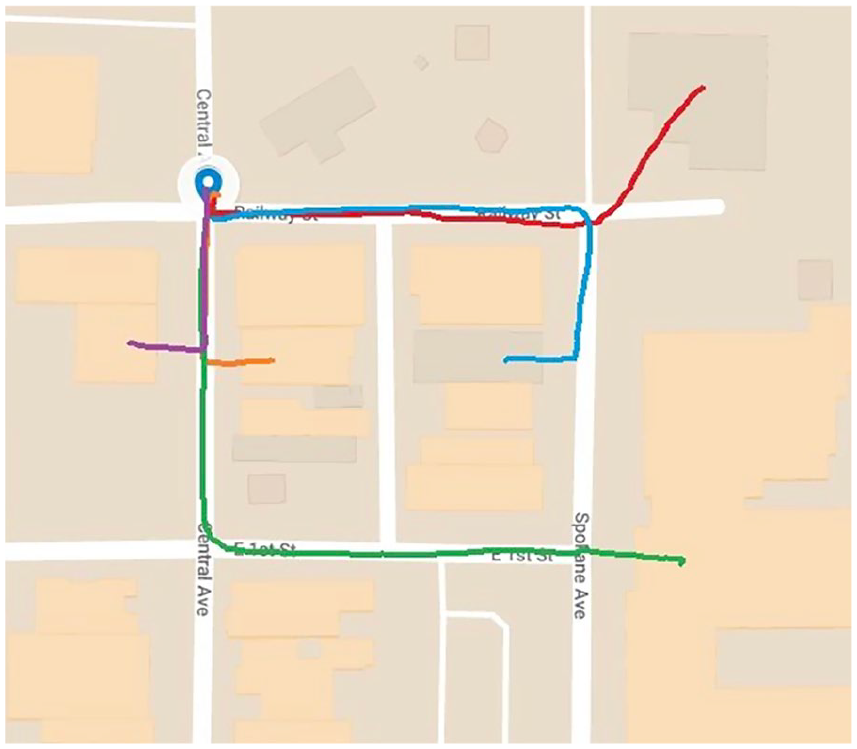
Example route drawing.
Next, participants’ spatial orientation was assessed through a Perspective Taking Test (Hegarty & Waller, 2004), where participants were required to adopt alternative perspectives in a separate, 2-dimensional environment. See Figure 6 for an example of that task. Finally, participants’ spatial relations ability was evaluated by using 14 trials of the Mental Rotation Test (Vandenberg & Kuse, 1978) where participants had to identify if two objects were the same but in different orientations.

Perspective taking test (Hegarty & Waller, 2004).
The study concluded with participants completing surveys on technology usage and proficiency, perceived spatial ability, geographical knowledge, and demographic information. It took approximately 30 min to complete the study.
Results
Data on navigation efficiency and route drawing precision were collected and analyzed. An Analysis of Variance was conducted to assess the impact of the different condition types on route accuracy. The results revealed a significant effect, F (1, 38) = 5.542, p = .024, suggesting that participants in the VR condition (M = 2.30, SD = 1.081) demonstrated better spatial environmental ability than those in the desktop condition (M = 1.92, SD = 1.085). See Figure 7 for a graphic of these results.
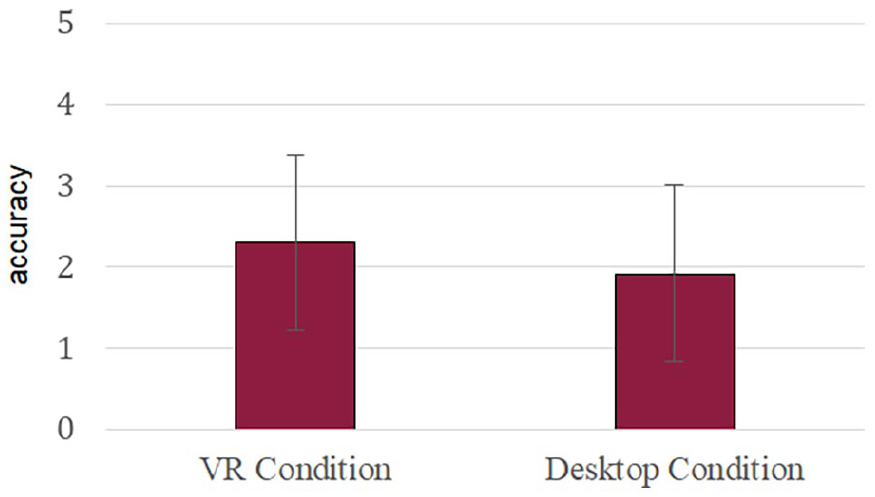
Spatial ability results by condition.
Results indicated a positive difference in spatial environmental ability when a person was able to virtually walk around in their environment, compared with a traditional desktop drag-and-click method of navigation.
Discussion
This study showed a significant difference in spatial ability between participants immersed in VR and those using a desktop. These findings contradict Zhao et al. (2020) study, which show no spatial learning difference between desktop and VR conditions. However, our results support Molina-Carmona et al. (2018) finding that VR immersion improves spatial orientation more than desktop immersion. This comparative approach between VR and desktop conditions revealed significant insights into the role of immersive technologies in spatial ability, offering valuable contributions to the fields of spatial ability training and educational methodologies.
One study limitation was our imbalance in participant gender. While the original study design aimed to compare the results based on gender, the pool of participants lacked the gender diversity required for meaningful analysis. Additionally, as noted by Zhao et al. (2020), first-time VR users may experience an “awe effect” where VR’s novelty in a lab setting could influence their behaviors. The “awe effect” may limit the generalizability of our findings in spaces like the classroom.
Further analyses will focus on the remaining spatial ability tasks (Perspective Taking and Mental Rotation Tests) and their potential mediating effects on spatial ability across the two conditions. Investigating the remaining factors of spatial ability not addressed in this study could produce greater insight into the participants’ baseline spatial abilities and its role. Future studies could also employ alternative methods of collecting spatial ability, spatial orientation, and spatial relations instead of route drawing, the Perspective Taking Task, and the Mental Rotation Test, respectively.
Although our analysis suggests potential spatial ability enhancements from VR, these results would benefit from further studies that clarify the complexity of this relationship and further investigate factors that influence spatial ability. Future research in fields such as spatial ability training and educational methodologies that address the identified limitations could provide a more comprehensive understanding of the relationship between immersive technologies and spatial ability.
Virtual reality can be an effective tool to enhance spatial ability because it can provide interactive simulations that require users to navigate and interact within virtual environments. These experiences can help users develop spatial awareness, including understanding the layout of spaces, distances between objects, and the ability to mentally manipulate objects in 3-dimensional space. VR offers a more immersive learning experience compared to traditional methods. Users can engage with spatial concepts in a hands-on way, which can lead to a deeper understanding and retention of spatial information. VR simulations can replicate real-world environments, such as architectural spaces, urban landscapes, or scientific models, allowing users to explore and interact with these spaces as if they were physically present. This enables users to develop practical spatial skills that are directly applicable to real-world scenarios. It is also important to note that VR experiences can present users with spatial puzzles and challenges that require them to use their spatial reasoning skills to solve. These activities can help users develop their ability to mentally rotate objects, visualize spatial relationships, and strategize effective solutions. VR is increasingly being used for professional training in fields such as architecture, engineering, medicine, and aviation, where spatial skills are essential. VR simulations can provide trainees with realistic scenarios to practice spatial tasks and procedures in a safe and controlled environment. Overall, VR offers a powerful tool for developing spatial ability by providing immersive, interactive, and multisensory experiences that engage users in spatial learning and problem-solving activities.
Footnotes
Declaration of Conflicting Interests
The author(s) declared no potential conflicts of interest with respect to the research, authorship, and/or publication of this article.
Funding
The author(s) received no financial support for the research, authorship, and/or publication of this article.
