



Abstract
This study sought to find a polarized risk shift between individual risk decisions and team risk decisions in an operational task. Risk shift theory has been explored in behavioral psychology and teamwork literature and is defined as the propensity of teams to make riskier decisions when compared to individuals. However, the findings from previous work were based on participant responses to hypothetical, abstract thought problems. These previous tasks lacked attributes present in an operational domain, including complexity, accountability, realism, and measurable risk. This study sought to bridge this gap by investigating whether this risk shift phenomena occurs in an operational task. Humans often work in teams in these domains, and increasingly, humans are also working with agents. Thus, an evaluation was done to first establish the existence of risk shift in human-only teams in an operational setting. The study had one independent variable: decision-maker with two levels, individual and team. The task design involved an aviation dispatch task, where participants simulated the role of a flight dispatcher. Participants were responsible to make dispatch decisions on whether to divert, hold, or send 25 airplanes, while weighing the potential consequences of incurring policy violations based on the possibility of an approaching storm. Results from the study showed the absolute value of the shift was significantly different than zero. Additionally, a thematic analysis found that groups varied in their decision-making strategies, using approaches like deferring to an influential teammate, averaging decisions amongst teammates, and collaborating to come to a new team decision. Establishing operational HHT risk shift in a realistic scenario provides the foundation for future experiments to examine how humans and autonomous agents perform teaming tasks in dynamic contexts involving risk.
Keywords
Introduction
The notion of risk involves the chance of loss, reward, and uncertainty (Yates, 1992). Risk shift theory has been explored in behavioral psychology and teamwork literature and is defined as the propensity of teams to make riskier decisions when compared to individuals (Levine & Moreland, 1998). There are varying theories around why teams behave differently with risk than individuals, including diffusion of responsibility (Bandura, 1991). Additionally, there has been work exploring team behavior in decision tasks (Rousseau et al., 2006; Wittenbaum et al., 2004).
Both individuals and teams face daily decisions that involve varying levels of risk. These decisions may have operational, financial, and safety implications when not appropriately calibrated to the risk, particularly in complex and highly technical domains (Grote, 2012; Zhu et al., 2021). Individual risk-taking versus group risk-taking has been studied across a variety of disciplines, including the decision sciences, economics, organizational psychology, small group research, and social psychology (Bougheas, 2013; Pruitt, 1971; Rousseau et al., 2006; Teger, 1967, Wallach et al., 1962). Additionally, the application of individual risk perception to their actual risk behavior in real-world settings has been explored (Hogarth & Kunreuther, 1995; Orasanu et al., 2002; Parmar & Thomas, 2020). Existing research has found evidence of many risk-taking theories playing out in group settings, including risky shift, where groups move toward risker decisions than individuals (Wallach et al., 1964), cautious shift, where groups move toward less risky decisions than individuals (Fraser et al., 1971), and group polarization, where groups make more extreme decisions than their individual average (Moscovici & Zavalloni, 1969). For a thorough review of these theories, see Melesse (2023). However, these theories have not been tested within an applied, operational domain.
Previous tasks required participants to reflect on forced choice, hypothetical scenarios (Kogan & Wallach, 1967; Wallach et al., 1962; Wallach & Kogan, 1965), limiting the application of the findings. These previous tasks lacked attributes present in an operational domain, including complexity, accountability, realism, and true risk, rather than just uncertainty. While the terms uncertainty and risk are often used interchangeably, there are distinctions. Risk is objective, while uncertainty is subjective (De Groot & Thurik, 2018). In true risk scenarios, the outcome is unknown but the probability distribution governing that outcome is known.
Understanding this distinction between uncertainty and risk is meaningful when seeking to create a decision task that is representative of a realistic, complex environment. Previous work only accounted for uncertainty, which is a subjective measure, as people cannot quantify the consequences. Decision-makers in complex domains can often identify probabilistic outcomes, marking these scenarios as risky, rather than just uncertain. Decision-makers in environments that possess both risk and uncertainty may still disagree about the perceived severity of consequences, but there are concrete measurements for those consequences. Therefore, creating an applied, operational task to test team risk theories requires a decision-making task grounded in quantifiable outcomes.
It is beneficial to understand risk behavior of teams in applied and complex situations to improve team function, particularly in mission-critical scenarios. Additionally, establishing the existence of a risk shift in operational settings creates further opportunities to explore team optimization around risk in practical domains, both for human teams and for humans teaming with autonomous agents or robots (Groom & Nass, 2007; Hanoch et al., 2021; Lyons et al., 2021).
This study aims to operationalize previous research by placing individuals and teams in a dynamic, realistic scenario requiring them to act as aviation flight dispatchers making risk-related decisions. The primary research question is to investigate if there is a polarized risk shift between individual risk decisions and team risk decisions in an operational task. Additionally, we seek to show the impact of individual responsibility, individual confidence, and teaming strategies when completing the task than in a team setting.
Method
Participants
Forty-five participants (19 male, 25 female, 1 transgender male) participated in the study. Participants averaged 30.5 years (range: 20–59). The study included 15 teams with team size averaging 3.0 people (range 2–5).
Task and Procedure
Airline dispatch operations represents a highly constrained domain where the specific situation greatly impacts the optimal strategy (Dorneich et al., 2002). Participants were instructed they would be acting as a flight dispatcher with 25 airplanes under their responsibility. They were informed that radar had spotted an approaching storm with a 40% probability of impacting the airplanes’ flight paths, such that they may have to divert to an alternative airport. While the bank of aircraft were in route to their final destinations, participants were asked to decide how many planes to divert, hold, or send through to the airport, based on their assessment of the developing weather situation (Huang et al., 2019). Table 1 provides the violations of policy associated with each possible outcome. Policies are statements of outcomes that are sought or avoided in the domain (Dorneich et al., 2001). Participants were informed that all decisions were safe, so their job performance would be assessed according to the decisions they made impacted operations. While safety is the most important goal in airline operations, secondary goals such as those in Table 1 can be considerations when choosing between alternatives (Dorneich et al., 2004).
Penalty Table With Policies Based on Dorneich et al. (2002).
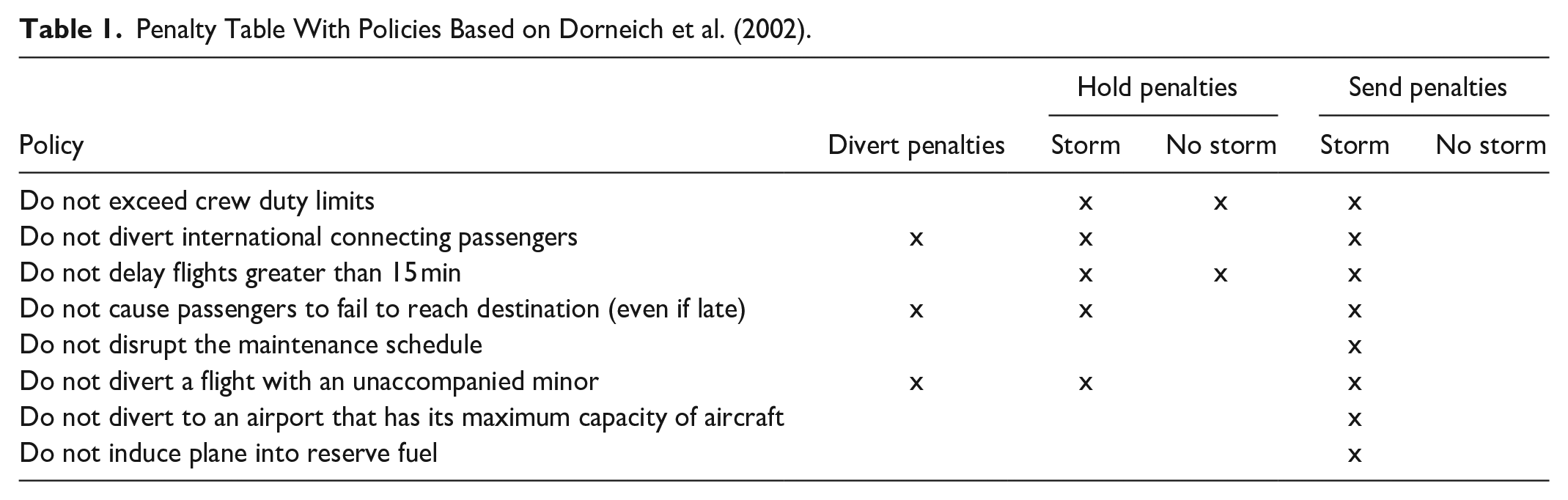
In this task, risk is quantified as the difference between potential outcomes for each decision, depending on whether the storm weather pattern impacts arrivals at the airport. For instance, if they decide to divert an airplane now, they will incur three penalties. However, if they decided to send the plane through to the airport, and the weather ends up forcing the plane to divert after all, they would then incur eight penalties. Holding, or delaying, an airplane means they would incur three penalties; this would rise to five if the airplane must later divert rather than continuing to land at the airport.
For this task to be operational, it included attributes of complexity, accountability, realism, and risk. In developing the task parameters, these four attributes were considered. To increase complexity, participants were asked to distribute 25 planes over three choices, rather than providing them a binary yes/no forced choice option. Additionally, participants were warned there was a 40% likelihood of approaching thunderstorms. This extra level of uncertainty (distinguished from risk) added further complexity to the task. To increase accountability, participants were informed their job performance would be assessed based upon their decisions. To increase realism, the aviation operations-based task required participants to be trained on the potential outcomes of different decisions. To increase risk, policy violations differed depending on a future, uncertain event, and the difference in policy violations between each decision point was objective. These numerical figures can create probabilistic outcomes, identifying this is a risk-based task.
Independent Variable
The study had one independent variable: decision-maker with two levels, individual and team. In the individual condition, the participants made their divert/hold/send decisions independently. In the team condition, a group of two or more individuals make decisions as a group. The team was required to reach consensus and were informed they were co-responsible for the final decisions.
Dependent Variables
Table 2 lists the dependent variables in the study.
Dependent Variables.
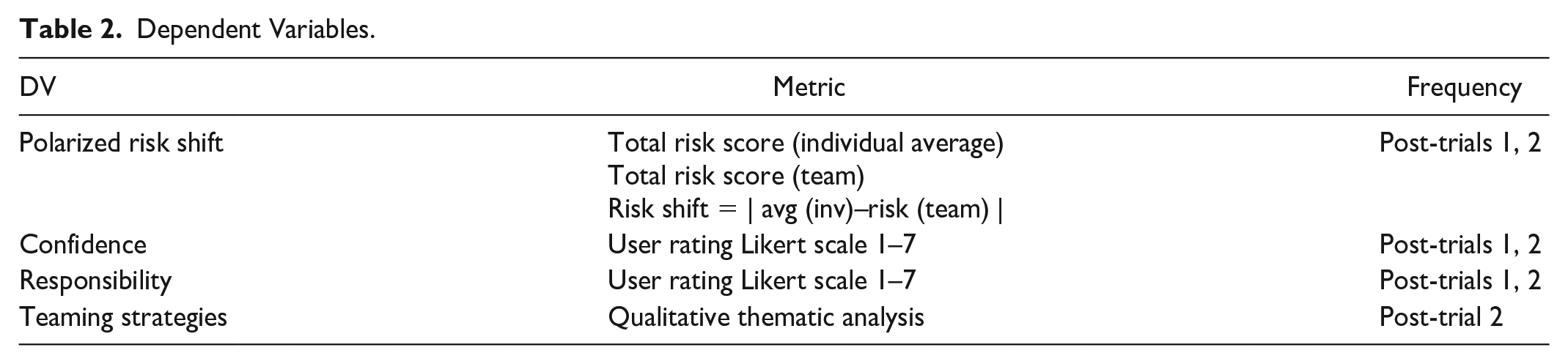
Risk is quantified as the difference between outcomes for each decision, depending on whether the uncertain weather condition occurs. For the divert decision, the incurred penalties are known, and there is no impact from the uncertain weather condition on the outcome. Therefore, the difference here is zero. For the hold/delay decision, the potential incurred penalties range from five to two, with a risk difference of three. For the send decision, the potential incurred penalties range from eight to zero, with a risk difference of eight. The measurement of risk is articulated in Equation 1:

Polarized risk shift was measured as the absolute value of the difference between the average of the scores in the individual conditions (of the team members) and the single score from the team condition. The measurement of polarized risk shift is articulated in Equation 2:

Level of confidence and level of responsibility were both measured on a 7-point Likert scale. The team conversations were recorded in the team condition, and a thematic analysis was performed to evaluate teaming strategies.
Procedure
The participants underwent brief task training before the experiment to familiarize themselves with the typical skills and knowledge required to successfully complete a dispatch task. The training included reading through an instructional printout and watching an informative video focused on the role and responsibilities of aviation dispatchers. There was a training knowledge check that was reviewed between participants and moderator prior to beginning the first trial to ensure participants understood the parameters of the task.
In Trial 1, participants completed the decision task individually. Participants answered the confidence and responsibility questions post-trial. Participants were then grouped into a team with the other participants in their research session. In Trial 2, participants were co-responsible for successfully completing the task and had to come to a unanimous team decision. Each participants answered the confidence and responsibility questions post-trial. After the full experiment, participants answered a prompt asking them to reflect on differences between their team decision and individual decision. Then participants were debriefed.
Experiment Design
This was a 1 × 2 within-subjects experiment where participants experienced both the individual and group condition of the decision-making tasks. Because of the nature of the experiment, the individual condition always occurred first to avoid exposing subjects to other group members’ points of view prior to the individual decision trial. This allows the individual to make their initial decisions based on their own judgment alone. Additionally, this follows experimental protocols of previous research (e.g., Wallach et al., 1962, Wallach et al., 1964).
This experiment could be run in two test environments, in-person or online via Zoom. During Trial 1, participants worked separately from the other participants either in the physical room or on the Zoom call but did not interact. Once Trial 2 began, participants were informed that they were being grouped into teams with the other people in their physical room or Zoom room to perform Trial 2 as teammates.
Data Analysis
Normality assumptions were assessed with Levene’s test of equality of variances and the Shapiro-Wilk test for normality. When normality assumptions were violated, Wilcoxon signed-ranks test to compare participants’ perceptions, otherwise a simple t-test was conducted for all comparisons. A p-value below .05 was categorized as significant. Cohen’s d was used for assessing effect size, where 0.2 < |d| < 0.5 is considered small effect size, medium effect size when 0.5 < |d|< 0.8, and large effect size for |d| > 0.8. A thematic analysis was performed on the recorded team conversations and qualitative individual versus team reflection data with the assistance of the transcription and AI software tool, Sonix.
Results
Polarized Risk Shift
The absolute value of the risk shift (M = 16.1, SD = 17.5) was significantly different than zero, W(14) = 59.5, p < .001. The effect size was large, with a Cohen’s d of 0.92. This represents a 13.9% shift in risk polarization from individual decisions to team decisions in a complex, operational task. Seven teams shifted toward risk, seven teams shifted toward caution, and one team remained neutral.
Responsibility
There was a significant decrease in the level of responsibility when moving from Trial 1 (individual decision) (M = 5.8, SD = 1.1) to Trial 2 (team decision) (M = 5.2, SD = 1.3), t(44) = 12.1, p = .001 (see Figure 1). The effect size was medium, with a Cohen’s d of 0.50.
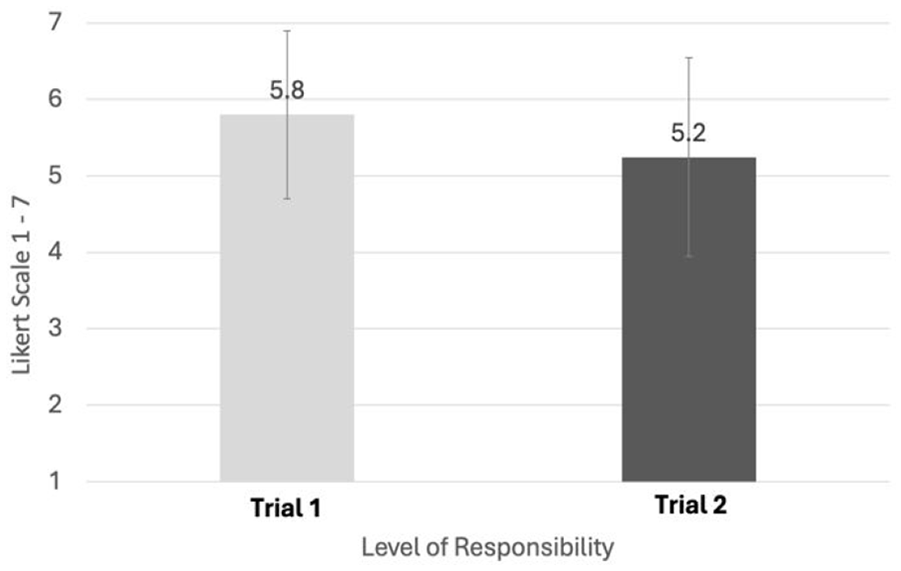
Level of responsibility: Trial 1 versus Trial 2.
Confidence
There was a significant increase in the level of confidence when moving from Trial 1 (individual decision) (M = 4.8, SD = 1.4) to Trial 2 (team decision) (M = 5.7, SD = 1.0), t(44) = 16.0, p < .001 (see Figure 2). The effect size was medium, with a Cohen’s d of −0.74.
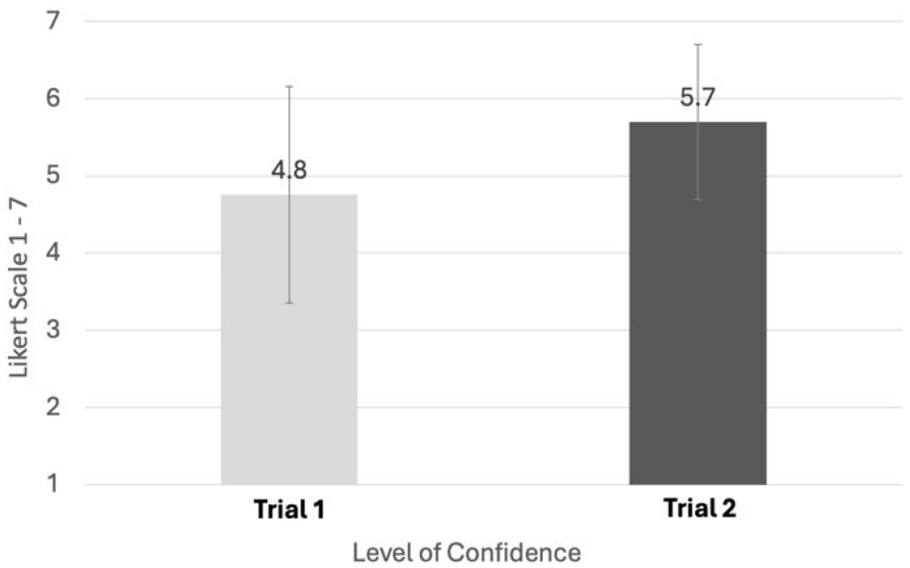
Level of confidence: Trial 1 versus Trial 2.
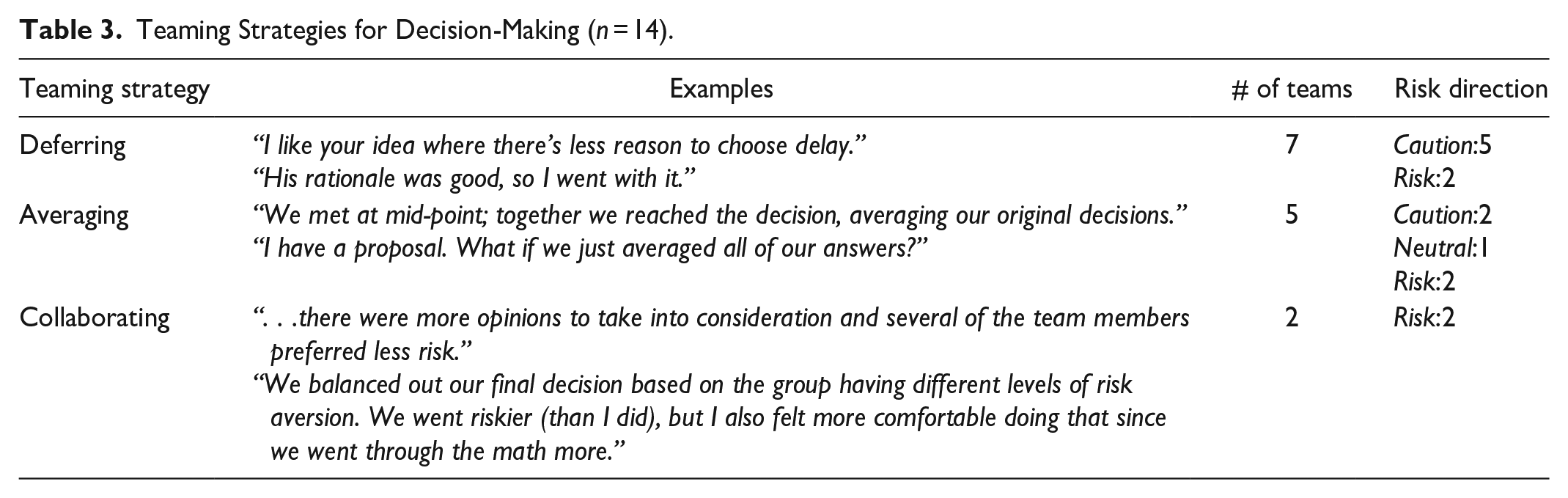
One additional focus of this experiment is the relationship between team decision-making dynamics and risk-taking behavior (Rousseau et al., 2006; Wittenbaum et al., 2004). A thematic analysis was performed on the recorded team conversations and qualitative individual vs. team reflection data to develop a taxonomy of teaming strategies (see Table 3). Teams used three primary resolution strategies for their decision-making: deferring to a primary teammate, opting to average amongst the team, and collaboration, where teams debated and developed a new decision proposal that was not aligned with any one team member’s preference or an even split of the original teammates’ decisions. Examples of phrases indicating different teaming strategies are listed in Table 3.
Teaming Strategies for Decision-Making (n = 14).
Discussion
The primary finding from this study was the significant risk polarization of team decisions when compared to the average of initial individual decisions within an operational task. These results align with previous literature that posited the theory of team risk shift and illustrated the presence of this shift with hypothetical, low-pressure thought problems (Wallach et al., 1962, Wallach et al., 1964). However, the risk shift direction was not consistent. Team decisions either moved toward more extreme risk or more extreme caution.
Previous studies have demonstrated that teams employ various decision-making strategies, especially under risk, which could create inconsistency in their decisions (Myers & Lamm, 1976; Sniezek, 1992). In this study, when teams were focused on deferring to one primary teammate, team decisions went in both directions. The direction differed based on whether the primary teammate was risk-averse or risk-taking, and the strength of the shift was stronger. In teams that employed an averaging strategy, the decisions were also bi-directional in risk. However, while these shifts did move in two directions, the shifts themselves were much weaker. The two teams that employed a collaborative strategy with deep, enriched discussion amongst the group both made decisions with more risk than the average of the individual decisions.
Additionally, this study found there was significant increase in sense of confidence and significant decrease in sense of responsibility between the individual and team trials. Participants were prompted to reflect on their individual versus team decisions at the end of the experiment. One participant stated: “I respect what my teammates said in regard to our decisions, but I don’t feel as responsible. . . in what we did.” This could indicate the presence of “diffusion of responsibility,” a group dynamic theory describing an individual’s decreased concern for consequences with the increase of group decision-making and group action (Bandura, 1991). Further theories for decreased responsibility are explored in literature, including in the risk-taking domain (Dion et al., 1970; Liu et al., 2022).
When considering the increase in confidence, it should be noted that group member decision confidence is complex and varied. Sniezek & Henry (1990) did a review on group decision confidence and decision processes that increased confidence. One reason for increased decision confidence in this task could be the explicit group consensus requirement of the task. Consensus can be seen as an indication of accuracy. Additionally, the opportunity to assess other members’ positions can lead to an increased sense of confidence. Demonstrating these risk-related team dynamics in an operational task lays a foundation to evaluate whether these results can be replicated in human-autonomy teams and will be explored in future work.
Conclusion
This study investigated risk shift from individuals to teams in an operational setting. Participants completed a flight dispatch task that included operational attributes of complexity, accountability, realism, and risk. Results showed a significant polarized risk shift between individual risk decisions and team risk decisions. Additionally, there was significant decrease in the level of responsibility and significant increase in the level of confidence between Trial 1 (individual condition) and Trial 2 (team condition). Teams used varying strategies to achieve decision consensus, including deferring to a primary teammate, averaging decisions amongst the team, and collaborating to develop a new decision proposal.
Team size may also play a role in decision-making processes. While team size was not a manipulated independent variable, team size will be evaluated as a quasi-independent variable in future work. Additionally, future work will explore how humans and autonomous agents perform teaming tasks in operational contexts involving risk.
Footnotes
Acknowledgements
The authors thank Dr. Cameron MacKenzie and Pape Ndao for their research assistance.
Declaration of Conflicting Interests
The author(s) declared no potential conflicts of interest with respect to the research, authorship, and/or publication of this article.
Funding
The author(s) received no financial support for the research, authorship, and/or publication of this article.
