



Abstract
Cognitive biases in commercial aviation can coax pilots into disregarding established protocols or overlooking potential hazards, a concern that the Federal Aviation Administration (FAA) has acknowledged. However, the concrete impact of these biases on aviation operations has not been adequately quantified; empirical evidence remains limited. Recognizing this research gap, our study seeks to provide a comprehensive analysis of cognitive biases within commercial aviation. We conducted a review of National Transportation Safety Board flight incident reports for air carriers across the United States, from 2014 to 2024. We also conducted an expert interview with an instructor who is an experienced pilot to ascertain current training material and its adequacy in addressing cognitive biases. Our analysis revealed cognitive biases not identified by the FAA (e.g., overconfidence) and training material gaps. Our research lays the groundwork for improved training protocols and the potential for a more nuanced understanding of pilot behavior and safety.
Introduction
Despite advances in technology, commercial aviation and flight operations remain complex. Amidst this complex environment, pilots may use cognitive biases, which serve as mental shortcuts that assist in complex decision-making processes (Haselton et al., 2015). However, cognitive biases can lead to perceptual distortions, erroneous judgments, and an unwarranted sense of complacency (Woods, 2020). Thus, the influence of cognitive biases in pilot decision-making is a significant concern in commercial aviation, where such biases can significantly influence flight safety. These biases can subtly coax pilots into disregarding established protocols or overlooking potential hazards, a concern that the Federal Aviation Administration (FAA) has acknowledged in both briefings and human factors design standards (FAA, 2023; Woods, 2020). However, the concrete impact of these biases on aviation operations has not been adequately quantified; empirical evidence remains limited, with cognitive biases typically noted in FAA reports only after high-profile accidents (Abbott & Bramble, 2016), such as the Ethiopian Airlines flight 302, where reliance on sensors and automaticity bias played a part in the incident.
Prior research has estimated that approximately 70% of aviation accidents involve some form of human error (Helmreich, 2000), which could be linked to cognitive biases (Woods, 2020). For example, confirmation bias might lead a pilot to accept an initial hypothesis without sufficiently considering alternative explanations, potentially overlooking critical warning signs before a flight. Similarly, plan continuation bias can result in a pilot underestimating or ignoring certain risks in the goal to maintain flight path and avoid modifying trajectory. Despite the recognized importance of understanding these biases, detailed empirical studies into how they specifically influence decision-making processes in the cockpit have been sparse, often focusing more broadly on human error (O’Hare et al., 1994).
Research into human errors in flight incident reports (O’Hare et al., 1994; Orasanu et al., 2001) have not delved into the underlying cognitive biases that precipitate these errors, nor have they classified the types of biases implicated. Recognizing this research gap, our study seeks to provide a comprehensive analysis of cognitive biases within aviation. We conducted a review of National Transportation Safety Board (NTSB) flight incident reports for commercial pilot operations (code 121 for airliners and code 135 for air freight and taxis) across the United States, spanning from 2014 to 2024, covering a period of advances in aviation sensors and technology. We also conducted an expert interview with an instructor who is an experienced pilot to ascertain current training material and its adequacy in addressing cognitive biases. Our aim is to uncover the prevalence and nature of cognitive biases in aviation incidents and identify how these biases are currently targeted in training material. The study seeks to thereby provide a data-driven basis for understanding how these mental shortcuts can become mental roadblocks, and how pilots can better be trained in recognizing them.
By identifying the major cognitive biases and highlighting the lack of proper identification and training, we aim to identify patterns and trends that can inform future FAA briefings, training programs, and design standards. Through this endeavor, we anticipate contributing to a safer aviation environment and reconciling knowledge between regulators, human factors practitioners, and pilots regarding cognitive biases in aviation, thus contributing to a safer aviation environment.
Methods
Search and Selection Strategy
Our research followed an empirical methodology to investigate the presence and frequency of different types of cognitive biases on pilot decision-making within commercial aviation. Utilizing the NTSB database, we searched for incidents that occurred between the years 2014 and 2024. We identified 12,793 reported incidents during this period. Our inclusion criteria consisted of reviewing incidents that happened in the United States and from commercial aviation, both for incidents under category part 121 (commercial airliners) and part 135 (air freight and taxis). This resulted in the exclusion of 12,082 reports (as seen in Figure 1), and the review of 711 incidents. These NTSB incident reports were reviewed by two raters, one of whom being a licensed pilot, to discern potentially harmful incidents that involved crew failure. Specifically, crew failure had to result from the influence of cognitive biases and the incident could have resulted in a plane crash should it have escalated. This process yielded 39 incidents where cognitive biases were identified as contributing factors.
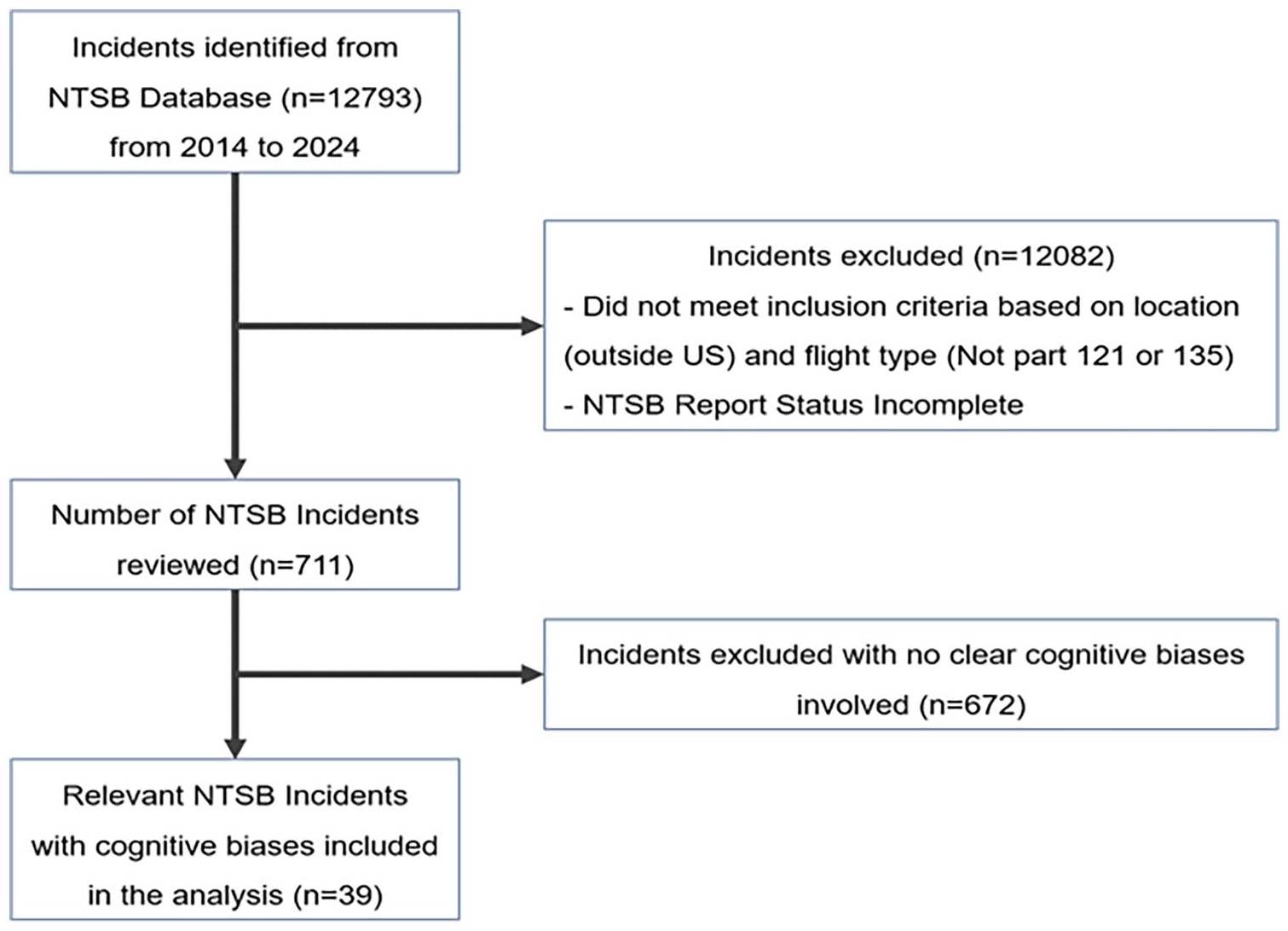
Incident search and selection process.
Data Analysis
A comprehensive analysis of 39 pertinent incidents was conducted to ascertain the various types of cognitive biases, employing the subsequent methodological approach: Initial scrutiny of the NTSB reports was undertaken to detect any reported instances of cognitive bias. Subsequently, raters examined flight crew interviews and the primary report to infer the cognitive biases likely to have influenced the incident. In situations where multiple cognitive biases were implicated in a single incident, raters discerned the most prominent bias believed to have predominantly shaped the occurrence of the event.
Expert Interview With Pilot
In addition to our incident report analysis, we conducted an in-depth qualitative interview with a seasoned pilot and flight instructor. The pilot had 375 flight hours and was a commercial pilot with Instrument Rating with experience in multiple multi-state cross country flights, training flights for the Army and Civil Air Patrol, and Training throughout multiple different states. Prior to discussing the specific incidents and biases identified in our review, we gauged the interviewee’s understanding of cognitive biases through a structured questionnaire. Next, we inquired about (a) personal familiarity with cognitive biases, (b) how cognitive biases are addressed in current training material, and (c) firsthand examples of biases encountered or observed. Additionally, we explored the interviewee’s insights on (d) unique biases prevalent in aviation, (e) how they manifest and impact commercial aviation, and (f) how well they match biases documented in aviation literature and training material. Finally, we discussed incident report results and gauged feedback.
Results
Incident Report Analysis
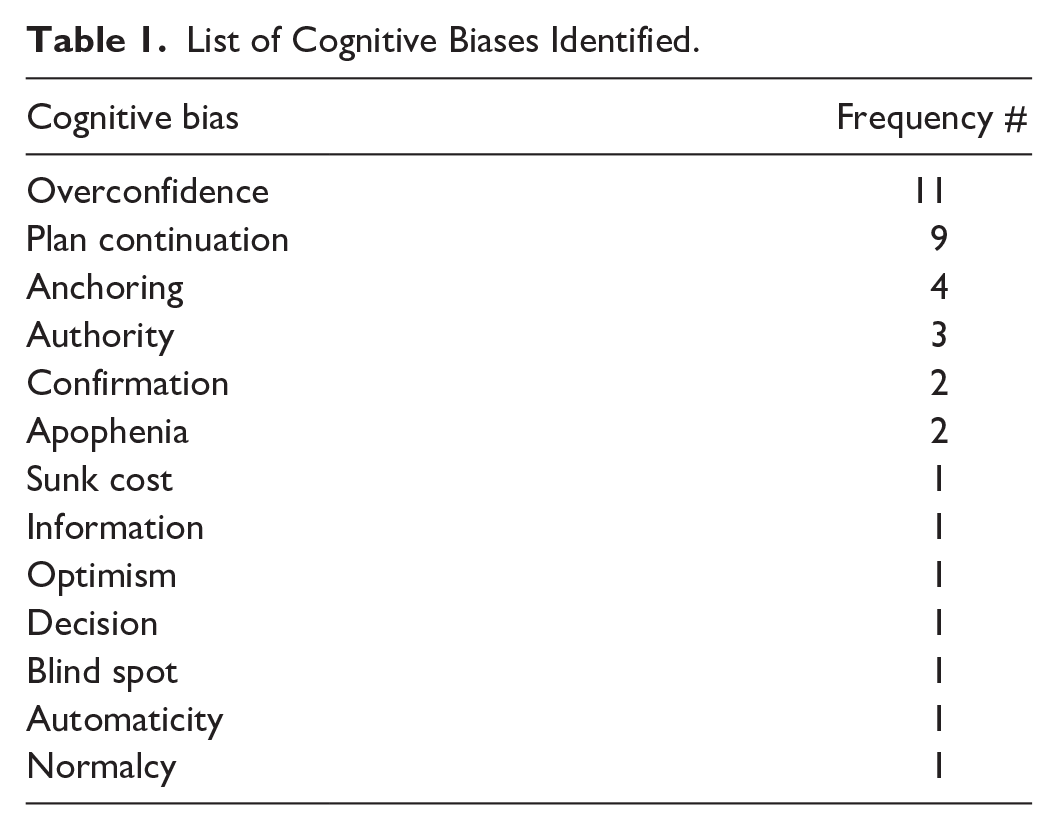
Of the 39 aviation incidents that could be attributed to cognitive biases in our analysis, a total of 23 fatalities and 25 injuries were identified. Our analysis identified (as seen in Table 1) overconfidence bias and plan continuation bias as the predominant cognitive biases in the NTSB incident reports. For instance, overconfidence manifested in flight incident ERA17MA316 included flight as the pilot misdiagnosed a failure of the rear bearing in engine No. 2, did not perform checks to identify the issue out of overconfidence, and decided to shut down engine No. 1, leading to a crash.
List of Cognitive Biases Identified.
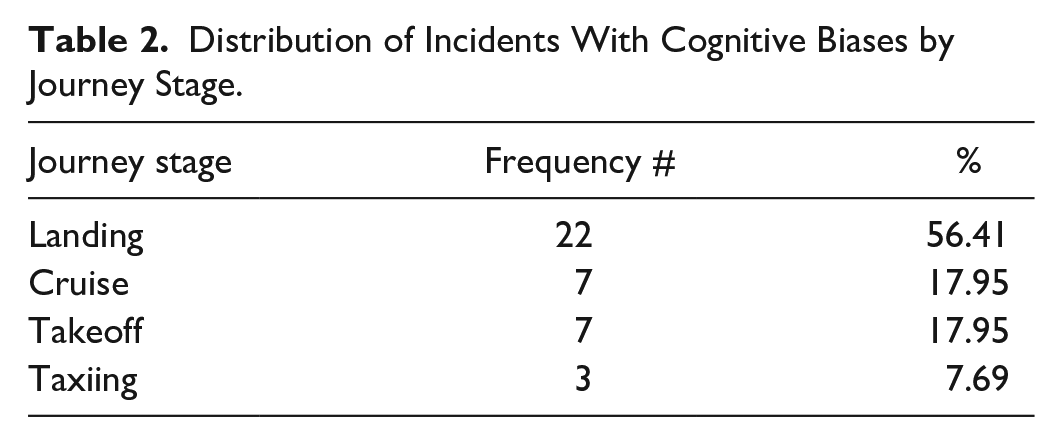
In terms of flight stage during which cognitive biases occurred, incidents happened as planes were landing and at the end of their journey, with 22 occurrences representing 56.41% of incidents (Table 2). Next, incidents happened at similar rates for the cruise phase and takeoff phase of flights. Some incidents were also noted to take place while the plane was taxiing.
Distribution of Incidents With Cognitive Biases by Journey Stage.
Pilot Expert Interview
During the qualitative expert interview with an experienced pilot and flight instructor, the interviewee highlighted cognitive biases are not adequately addressed in pilot training materials. Only a few biases, such as expectation and confirmation biases, are briefly mentioned (FAA, 2023), and there is no dedicated section on their impact on decision-making. Instructor guidelines also leave cognitive bias training to the discretion of individual instructors, who may not consistently cover it.
The pilot identified five hazardous attitudes recognized by the FAA (FAA, 2023) that interfere with decision-making: anti-authority, invulnerability, macho, impulsivity, and resignation. These attitudes often relate to the overconfidence and plan continuation biases found in our NTSB incident analysis. Although the pilot had some familiarity with cognitive biases, this knowledge was mainly gained during his training to become a flight instructor, and confirmation bias was not part of standard pilot training but was included by his training center.
The pilot provided examples of how plan continuation bias could influence decisions, such as continuing with prior landing instructions despite changing conditions and new directives from the tower. He also mentioned “get-there-i” is (Velazquez, 2018) as an attitude related to plan continuation bias and noted that overconfidence bias might become more prevalent as pilots gain experience. To mitigate these issues, the pilot suggested incorporating cognitive bias awareness into regular training, with practical examples included in the biannual training requirements.
Discussion
Our study, which conducted an analysis of a decade of NTSB incident reports and a qualitative expert interview, provides a comprehensive understanding of the influence of cognitive biases in commercial aviation. The NTSB incident analysis encompassed 39 incidents where cognitive biases were a factor, showing how these biases contribute significantly to human errors and, consequently, aviation incidents. Our findings highlight the complexity and variety of cognitive pitfalls that pilots face, which can critically affect decision-making processes in high-stakes environments.
The most prevalent biases identified were overconfidence and plan continuation. While the aviation sector has identified plan continuation bias as a cognitive bias of interest (Woods, 2020), overconfidence was not represented within course or training materials. This indicates aviation curricula should address this bias, displaying the bias in training and informing pilots of its prevalence through NTSB incident reports as examples. Additionally, our analysis uncovered the presence of other biases such as authority bias, anchoring bias, confirmation bias, and apophenia. These biases, although not being frequent primary facilitators for incidents, can be displayed to pilots to increase awareness.
Our data revealed that these cognitive biases frequently occur during the landing phase of flights, with 22 incidents (56.41%) occurring at this critical stage. This finding underscores the heightened vulnerability of pilots to cognitive biases during complex and high-pressure flight stages, particularly at the end of their journey as fatigue may set in (Wingelaar-Jagt et al., 2021). Incidents during the cruise and takeoff phases were also significant, each accounting for seven incidents (17.95%), while three incidents (7.69%) occurred during taxiing. The findings suggest that cognitive biases are linked to increased fatigue (Wingelaar-Jagt et al., 2021) and may happen more frequently at the end of flight journeys. Simulator scenarios that could display cognitive biases would benefit from focusing on landing procedures or take place at the end of simulator training sessions to better reflect cognitive bias occurrence.
The qualitative expert interview provided further insights, substantiating the significant gap in the current pilot training materials regarding cognitive biases identified in the NTSB incident analysis. The experienced pilot confirmed that cognitive biases are not directly mentioned within training materials (FAA, 2023). This omission suggests a critical area for improvement in pilot education. The pilot also aligned these biases with the FAA’s five hazardous attitudes (anti-authority, invulnerability, macho, impulsivity, and resignation), indicating that these attitudes might be manifestations of the cognitive biases identified in our study. Attitudes such as macho and invulnerability could be related to overconfidence. Furthermore, cognitive pitfalls such as get-there-itis (Velazquez, 2018) also relate to cognitive biases (plan continuation bias). This alignment suggests that addressing the cognitive biases as a core concept could support a reduction in these erroneous attitudes. This can be achieved through including cognitive bias recognition in simulator training sessions.
Moreover, the interview highlighted the need for more comprehensive training that includes cognitive biases. The interviewee stressed the importance of practical examples and situational training to enhance pilots’ cognitive bias awareness, particularly in the form of routine training to better address experience-related increases in confidence. These biases suggest a crucial need for interventions that promote flexible thinking and adaptability among pilots. This could be achieved through Virtual Reality (VR) training (Iván Aguilar Reyes et al., 2022) and through interacting within scenarios that mimic frequent biases among flight crew. Synthetic agents have previously been trained to display cognitive biases (Kumar et al., 2022). Debiasing training recommends exposure to bias situations (Larrick, 2004; Sellier et al., 2019), further suggesting interactive scenarios with flight crew falling for cognitive biases would be of interest.
Our research underscores the critical role of cognitive biases in aviation incidents and the urgent need to address these biases through improved training protocols. By integrating cognitive bias training into existing pilot education programs, aviation authorities can enhance pilots’ situational awareness and decision-making abilities, ultimately improving overall flight safety. Our study lays the groundwork for these enhancements, providing a detailed analysis of the types and frequencies of cognitive biases in aviation and offering valuable insights for developing more effective training materials.
Limitations
A limitation of our study was its identification of a single primary cognitive bias per incident reviewed. The present study aimed to elucidate primary cognitive biases that are currently inadequately understood and addressed within the context of commercial aviation, with potential for future research to explore secondary biases. Analysis of various incidents revealed that a predominant cognitive bias often significantly contributes to the occurrence of an incident, albeit accompanied by the influence of other biases that impede accurate decision-making processes. For example, in the case of flight incident WPR19FA230, the pilot’s crucial error lay in delaying the decision to abort takeoff despite evolving conditions and the absence of a NO TAKEOFF annunciation. Here, the prominent cognitive bias was identified as plan continuation bias, despite the recognition of automaticity as a contributing factor. This distinction is made due to the primary role of plan continuation bias, and subsequently, the manifestation of “get-there-i” is (Velazquez, 2018), which predominantly led to the runway excursion, with automaticity exerting a relatively minor influence on the incident’s outcome.
Conclusion
Our study provides evidence of the significant impact of cognitive biases on pilot decision-making in commercial aviation. By analyzing a decade of NTSB incident reports and conducting an expert interview, we identified a range of biases, with overconfidence and plan continuation being the most prevalent. These biases frequently occur during critical flight phases, particularly landing, underscoring the influence of fatigue and workload. The insights gained from the expert interview highlight a critical gap in current pilot training materials regarding cognitive biases. Our findings suggest that integrating comprehensive cognitive bias training into pilot education programs can enhance pilots’ situational awareness and decision-making skills, ultimately improving flight safety. Aligning cognitive biases with the FAA’s five hazardous attitudes suggests that comprehensive training could mitigate these biases, enhancing overall safety. Practical, scenario-based training, including Virtual Reality (VR) simulations, is recommended to improve pilots’ situational awareness and adaptability. Our research lays a foundation for future studies and training improvements aimed at fostering a more nuanced understanding of pilot behavior and safety.
Footnotes
Declaration of Conflicting Interests
The author(s) declared no potential conflicts of interest with respect to the research, authorship, and/or publication of this article.
Funding
The author(s) received no financial support for the research, authorship, and/or publication of this article.
