



Abstract
This paper underscores the need for increased human factors research in cancer care and the involvement of human factors professionals in this field. While human factors principles have been widely applied in aviation, driving, and some aspects of healthcare to enhance safety and usability, they remain underutilized in cancer care. The authors employed HTML parsing to extract titles and abstracts from five journals and two conference proceedings, identifying cancer-related articles through predefined keywords from 1958 to 2022. Among the total of 25,033 articles reviewed from these sources, only 28 pertained to cancer, with colorectal, breast, and prostate cancer being the most frequently discussed. Notably, 67% of the articles were found in the Human Factors National Conference Proceedings. The paper advocates for the hiring of human factors professionals in oncology departments within hospitals and emphasizes the need for special issues and funding to advance this vital research area.
Introduction
Cancer is one of the leading causes of death worldwide and in the United States (US). In 2020, there were approximately ~1.8 M new cancer cases diagnosed and 607,000 deaths in the US (Siegel et al., 2020). In 2022, the number of cancer survivors is approximately 18 M in US (American Association for Cancer Research, 2022). This number is expected to grow to 22 M by 2030 (Miller et al., 2019). Approximately 40% of humans will be diagnosed with cancer at some point in their lives (National Cancer Institute, 2020). Further, due to the COVID-19 pandemic there is an expected uptick in more late-stage diagnoses of cancer (Wells & Galvani, 2022). This onslaught of late-stage diagnoses has the potential to exacerbate challenges in cancer care safety and quality by creating an additional burden throughout the cancer care system, such as an increase in clinician and patient workload. Systems thinking is necessary to design solutions that will support clinician and patient/family cancer care work. Systems thinking is defined as “a set of synergistic analytic skills used to improve the capability of identifying and understanding systems, predicting behaviors, and devising modifications to them in order to produce desired effects” (Arnold & Wade, 2015). The application of human factors principles such as systems thinking can benefit the process of cancer care.
Consideration of the impact of system design on human performance is often traced back to the 1940s (Waterson, 2011). US Air Force scientists noted that cockpit design had an impact on pilot performance. When cognitive and perceptual capabilities and limitations of pilots did not align with cockpit design, pilots were more likely to make a mistake. Considering the capabilities and limitations of humans as part of design turned out to be an important performance and safety issue, leading to a new science that highlighted the need to consider human psychology to the design of systems and tools. The science of applying considerations of human capabilities and limitations and the understanding of human performance in context to design, known as human factors, is critical to supporting safety and risk reduction in complex domains. Despite numerous definitions, at the core of human factors is systems thinking while maintaining focus on the human.
For decades, human factors were primarily focused on applications in aviation. While the aviation examples can offer insights into the application of human factors principles, it is essential to provide context directly relevant to healthcare for a holistic understanding of the range of human factors applications. Notably, the publication of the 1999 Institute of Medicine report entitled To Err is Human, named human factors as an integral perspective in patient safety. This was the impetus to shift focus of human factors research to healthcare (Kohn et al., 1999). Continued calls to action highlighted that “health care desperately needs your involvement and your expertise to learn how to tease apart our complex systems, to redesign them using basic human factors principles to make them work” (Leape, 2004, p. 11). Later, in 2016, a devastating article was published by Makary and Daniel (2016) claiming that medical error is the 3rd leading cause of death in the US. The authors even suggested that the problem is likely to be much worse as many errors are unnoticed, unaccounted for, and unreported. Although the prevalence of medical errors has been steadily argued, the issue of safety persists, with human factors having the potential to mitigate some of these issues. Various theories and models have been developed to enhance patient safety and improve healthcare systems. One prominent model is the Systems Engineering Initiative for Patient Safety (SIEPS 3.0, Carayon et al., 2020). This model underscores how elements such as individuals, processes, tasks, tools, technologies, organizational conditions, and the physical environment all collectively influence patient safety outcomes. Further, our evolving understanding of safety management has led to the development of distinct approaches. Safety II (Hollnagel, 2018) promotes an approach wherein organizations enable their members to safely adapt to emergent situations. Adding to the discourse, Resilience Engineering emphasizes a “plan and revise” approach (Provan et al., 2020), suggesting that organizations should oscillate between stability and flexibility based on situational demands.
While these human factors models and approaches have significantly shaped the landscape of safety and efficiency in healthcare domains, relatively little attention has been given to their application to cancer care, a pivotal sector in healthcare services. This is surprising, given the relevance of human factors to all phases of cancer care—screening and diagnosis, treatment, and survivorship. Cancer care is in urgent need of systems thinking as it takes place across: (1) spaces—multiple clinical settings (e.g., outpatient, inpatient, operating room for surgical interventions, emergency department for acute events such as treatment complications) as well as contexts of daily living (e.g., home, work) and transitions between them, (2) time—potentially a long-term illness with monitoring taking place starting with diagnosis through survivorship, and (3) people—multiple providers and teams including not just oncology, but other specialties as needed (e.g., mental health, social work, cardiology). Moreover, for cancer patients, delays and deviations from prescribed care processes and standards of care have the potential for devastating consequences in terms of processes and outcomes on the short- and long-term.
There is an urgent need for the integration of human factors science into applied cancer care research. To make progress toward meeting this objective, we first need to characterize the contribution of human factors to cancer care research to date. The purpose of this paper is to provide the current state of human factors healthcare research, specifically within cancer care.
Methods
To achieve this objective, we generated a list of cancer keywords (i.e., radiation, cancer, oncology, radiology, oncological, oncologist, immunology, metastatic, tumor, cancerous, and chemotherapy). We established our focus a-priori to include work from the Human Factors and Ergonomics Society (HFES) website identified five journals and two conference proceeding databases on the Human Factors and Ergonomics Society (HFES; i.e., five journal and two conference proceedings) for several reasons: authority, relevance, and comprehensive coverage. HFES is a highly respected and long-established organization in the field of human factors and ergonomics. It has been in operation since 1957 and is considered the largest scientific society in this domain (Human Factors and Ergonomics Society, n.d.). As such, the articles published in HFES-affiliated publications are regarded as representative of the latest peer-reviewed research and practice in human factors and ergonomics. Further, the selected journals and conference proceedings were chosen because they are directly related to human factors and ergonomics research and practice, which aligns with the paper’s focus on applying human factors principles to cancer care. Therefore, these sources are expected to contain relevant articles on the subject. Lastly, the five journals and two conference proceedings were identified as key sources by the research team, who determined that they would provide comprehensive coverage of the latest findings in human factors/ergonomics research, including those related to cancer care. The five journals listed on the HFES website are Human Factors: The Journal of the Human Factors and Ergonomics Society, Ergonomics in Design: The Quarterly of Human Factors Applications, Journal of Cognitive Engineering and Decision Making, Reviews of Human Factors and Ergonomics, and Human Factors in Healthcare. The two conference proceedings on the website include: The Human Factors and Ergonomics Society Annual Meeting and The Human Factors and Ergonomics Society Health-Care Symposium.
We combined the seven periodicals (five journals and two conference proceedings) into an archive for analysis. Articles obtained were from the first publishing through August of 2022. The archive was created manually in Microsoft Excel, with HTML files for each volume downloaded separately and then combined. We gathered relevant information from the HTML files using Beautiful Soup, a Python package for parsing HTML text. Using the Beautiful Soup package, we obtained relevant text data from each file, including title and author names. Other additional information from each article included: article year, volume, type of periodical (journal or conference proceedings), authors, author affiliations, sponsors, type of article (empirical vs. nonempirical), and article format (e.g., manuscript or panel). Following the data gathering process, the keywords listed above were queried within the Excel database. The articles that contained the keywords were put onto one sheet for ease of analysis. Next, specific background information about the articles with relevant keywords was gathered such as type of cancer discussed, funding source, and author affiliation. In addition to this, qualitative information regarding the types of Human Factors methods used, the stage of cancer care researched, and the purpose of the article was gathered. From this repository the research team decided that articles that did not mention a particular type of cancer would be labeled as “general” whereas articles that did would be labeled as specific. For example, a paper written on breast cancer care was categorized as specific whereas one written on the intricacies of managing cancer care was categorized as general.
Results
Out of the 25,033 articles listed from 1958 up to 2022, there were 28 articles that included one of the cancer keywords. Specifically, 21 articles that included the word “cancer,” two articles with the word “oncology,” three articles with “radiation” and “oncology,” one article with the word “radiation,” and one article included the keywords “oncological.” A summary of the article inclusion is outlined in Figure 1. Further, 17 of the sources were empirical, and 11 were non-empirical sources. Empirical research was defined by the research team as any quantitative or qualitative experimental research. The most common non-empirical article was a literature or systematic review of a method or tool being implemented within the treatment of cancer care. The following sections will provide further description into the reporting of publication sources, cancer specification, Human Factors methodologies utilized, and funding sources, of the articles reviewed.
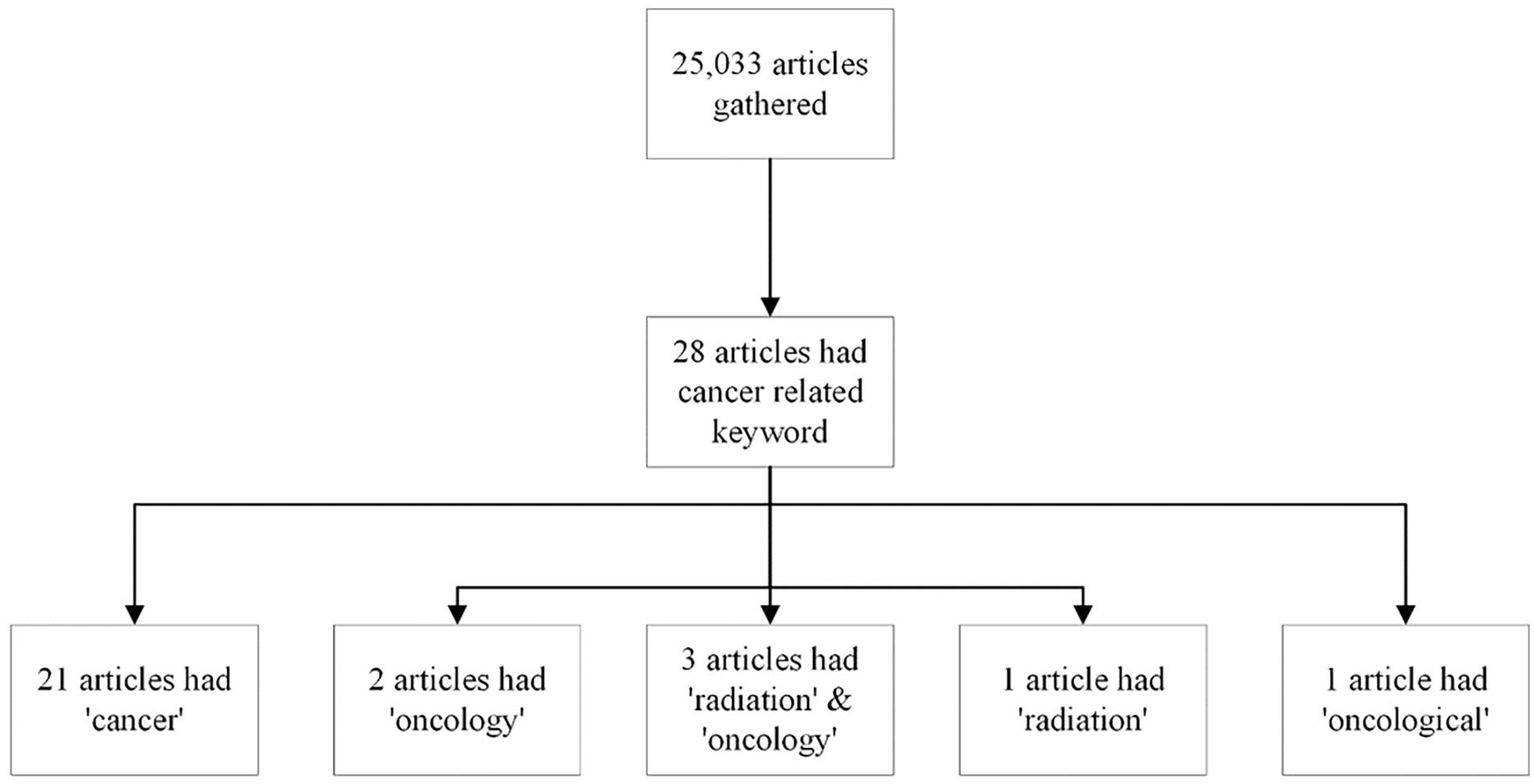
Article inclusion summary.
Publication Source
Out of the seven publication outlets reviewed, the Human Factors National Conference Proceedings published the most articles related to cancer care using the established keywords in title or abstract at 67%, 19 articles. Next, the Human Factors Healthcare National Conference had 7% of the publications related to cancer. This was followed by the Journal of Cognitive Engineering and Decision Making and Human Factors: The Journal of the Human Factors and Ergonomics Society at 4% each. The journals Human Factors in Healthcare, Reviews of Human Factors and Ergonomics, and Ergonomics in Design did not have any articles related to cancer care published since 2021.
Cancer Specification
The research team reviewed the quantity of articles that were related to a specific type of cancer or on cancer care in general. There were 18 articles on general cancer and 10 articles related to a specific cancer. The cancer types that were discussed in the articles included ovarian, colorectal, breast, and prostate. Of the articles found five were related to colorectal cancer, 2 were found for breast and prostate, and one was found for ovarian. The types of cancer were gathered to gain an understanding of what types of cancer have historically been researched within Human Factors, identifying gaps in research and providing a better understanding of funding trends. Out of the articles reviewed, 11 articles focused on treatment within cancer care followed by 6 articles that aimed to implement prevention/screening strategies. This is indicative of what stage of cancer care has been previously researched.
Human Factors Methodologies Implemented
Within the relevant articles, there was a variety of methods utilized to research various areas of cancer care. We found six articles utilized a task analysis, five had education development, and four had a thematic analysis, historical data analysis, or interview. The next common strategy was the utilization of a content analysis. Following methodologies included error analysis, heuristic evaluation, questionnaire, ethnographic observation, literature review, and interface design. Additionally, 11 articles focused on treatment, six articles focused on prevention, three articles focused on remission or all phases of care, one article focused on post treatment care, and one article focused on long-term care. The diversity of methods and phases of cancer care is representative of the heterogeneity of approaches within cancer. This also indicates that practitioners have options for approaches that can be tailored for each research goal.
Funding Sources and Institutional Affiliations
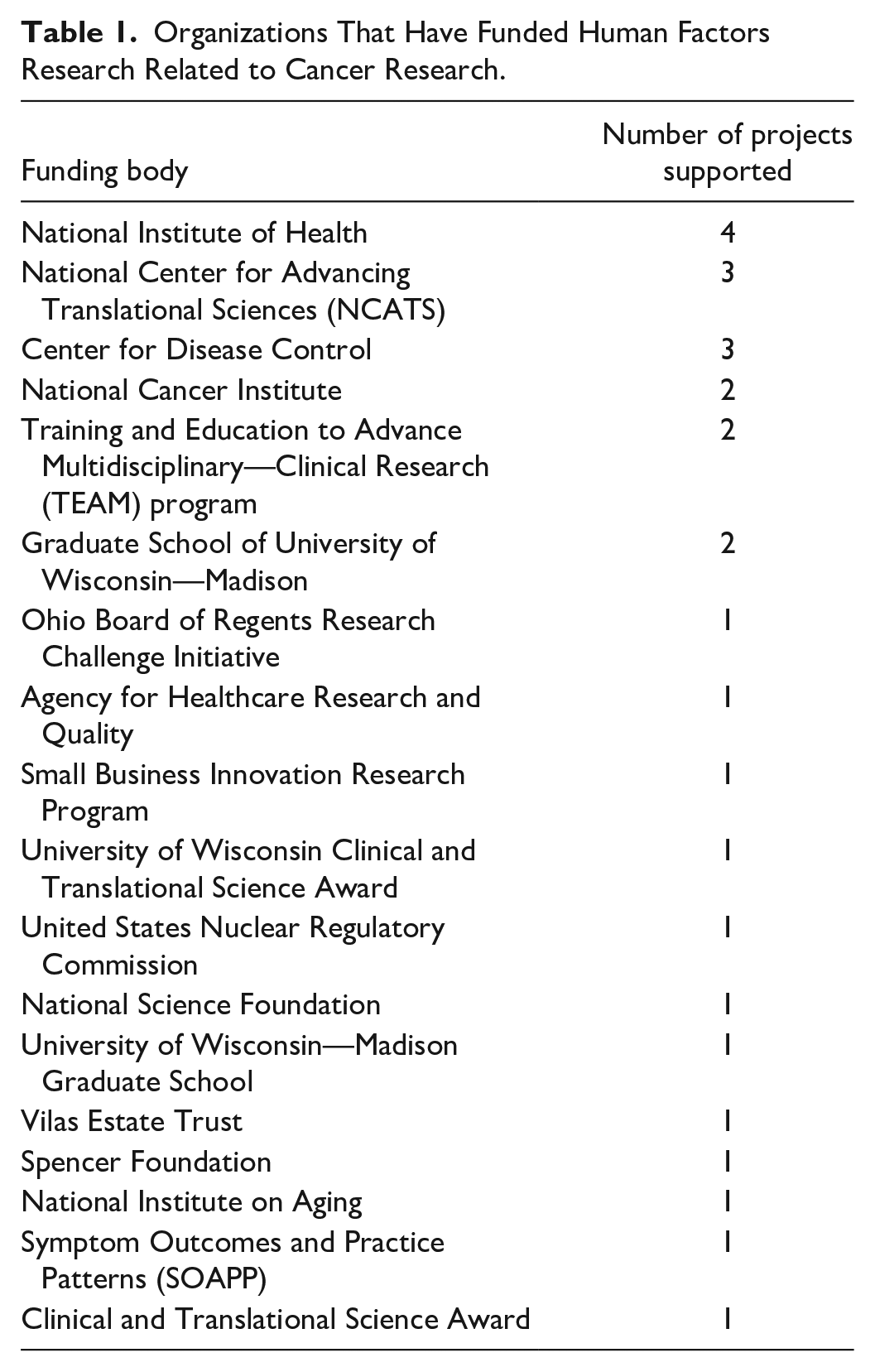
The following information regarding funding and institutional affiliations was included in this paper to support future researchers interested in furthering Human Factors research within cancer care. From the articles that reported their funding source the most common funding sources were the National Institute of Health, National Cancer Institute, and the Center for Disease Control. About 43% of the articles gathered published their funding source, and 57% did not publish their funding source. Some of the other funding sources included Ohio Board of Regents Research Challenge Initiative, Agency for Healthcare Research and Quality, Small Business Innovation Research Program, Training and Education to Advance Multidisciplinary-Clinical Research (TEAM) program, University of Wisconsin Clinical and Translational Science Award, United States Nuclear Regulatory Commission, National Science Foundation, National Institute of Health, National Center for Advancing Translational Sciences (NCATS), University of Wisconsin—Madison Graduate School, Vilas Estate Trust, National Institute on Aging, Symptom Outcomes and Practice Patterns (SOAPP), Clinical and Translational Science Award, and Spencer Foundation. Out of the 43% of articles that had published their funding source 66% of articles were funded by multiple sources with 34% being funded by solely one source. A summary of all the funding agencies for cancer care research is included in Table 1.
Organizations That Have Funded Human Factors Research Related to Cancer Research.
Discussion
Human factors is an applied science that is dedicated to studying systems to better the experience for the individuals involved. Because humans interact with a variety of systems in a myriad of applications and domains, the breadth of study of HF is vast. With this context in mind, the purpose of this paper was to determine the extent that the HF community was studying and ultimately publishing papers as they relate to cancer care. Unfortunately, our findings suggest that there is significant work needed as cancer has been largely untapped from an HF publishing perspective. To reiterate, our findings indicate that only 28 papers, out of the 25,033 articles gathered, have been published in key human factors outlets associated with the Human Factors and Ergonomics Society since 1958.
These findings are illuminating, but this study has several limitations that should be mentioned. The first limitation is that these results do not represent poster presentations at HFES National and HFES Healthcare conferences. Posters were excluded because they may not have had conference proceedings papers published and accessible outside of the actual poster session. It is possible that some work was missed; however, all published work was captured. Another limitation is that we solely focused on published human factors journals that are connected to HFES, rather than medical journals; given we are interested in the extent that cancer care research was being published within the human factors community specifically. Additionally, this work is only representative of the work completed in United States based publication outlets. It is also possible that there are articles published within healthcare focused journals that also implement Human Factors principles that are not reviewed within this paper.
Despite these limitations, these findings indicate that there is a serious deficit of HF research within the domain of cancer care. Cancer remains the second leading cause of death in the United States (Centers for Disease Control and Prevention, 2022), and many have stated that the system is broken and needing repair (Bosworth, 2019). Consequently, it is critical that the field of Human Factors begin to tackle this enormous yet crucial area.
The numerous opportunities for the application of human factors to the study of cancer care and design of support solutions is not a question, but part of the answer. Several topics in cancer care present themselves as particularly salient research and operational gaps. They include the following: (1) effective public health messaging and education for early detection and screening particularly for underserved and minority populations, as well as young adults, (2) human-centered design of clinical trials (Vogl, et al., 2021) with particular focus on built-in tailored support (e.g., transportation, parking, childcare), and (3) patient support tools and technologies for communication, coordination, and navigating complex health systems during all cancer phases. The implementation of Human Factors principles within all these research areas offers an opportunity to improve and increase safety within cancer care for both providers and patients.
To assist future researchers and advance the field, we offer a few strategies to foster the development of this important work. One way to bridge this gap would be for HF professionals to partner with medical centers to advance the systems surrounding cancer care. Such partnership would be useful as the HF professionals could offer expertise on systems thinking and safety, and clinicians would offer expertise on medicine. Another strategy would be for healthcare institutions to employ HF professionals. Many healthcare organizations have in-house HF scientists (e.g., Children’s Mercy Hospital and Cedars-Sinai Hospital), but institutions or even simply oncological departments could benefit from having HF employees at their disposal. Because issues arise organically but often need targeted solutions, HF employees can respond quickly and seamlessly when employed within the same organization.
In reflecting upon the broader landscape of healthcare research within human factors, it’s evident that the scarcity of human factors specialists plays a significant role in the areas of focus. The expansive nature of healthcare demands that human factors often prioritize broad system issues over in-depth exploration into specialized areas such as cancer care. This, to some extent, explains the observed lack of human factors research in this domain. The complexities that are inherent in cancer care mirror the multifaceted challenges seen across the entire healthcare spectrum. In fact, the very emergence of models like SEIPS 3.0 (Carayon et al., 2020) highlights a systemic response to address these intertwined complexities. While we recognize the broader challenges faced by human factors specialists, our research emphasizes the importance of delving deeper into specialized sectors like cancer care. The rationale behind this is clear: much in the way that accessible design benefits all, we believe that advancements made in human factors as applied to cancer care can yield positive ripple effects across various healthcare applications.
Conclusion
In sum, there is an urgent need for human factors research within the specific domain of cancer care. The current state of research is severely lacking and will require a tremendous effort to match the research of other domains. Consequently, we offered some potential strategies that individuals with a vested interest in advancing the fields of human factors and cancer care could leverage. Ultimately, if the human factors community wants to strengthen cancer care, then multi-disciplinary teams are needed. These teams should be developed to pursue research and further improve cancer care from both a patient and provider perspective just as other domains are researched. The integration of multiple perspectives and theories can lead to a more effective and safer cancer care.
Footnotes
Declaration of Conflicting Interests
The author(s) declared no potential conflicts of interest with respect to the research, authorship, and/or publication of this article.
Funding
The author(s) received no financial support for the research, authorship, and/or publication of this article.
