



Abstract
This study sought to identify hunters’ attitudes and practices with respect to the use of personal fall arrest systems (PFAS) when hunting from elevated (tree) stands. Hunting is a popular recreational activity in the United States (US) and the use of elevated stands (e.g., tree stands) provides hunters with several advantages in hunting large game animals, such as deer. However, hunting from an elevated position creates a hazard and the potential for serious injury or death should the hunter fall while climbing into or out of the stand or while positioned in the stand. Hunters were surveyed regarding their hunting practices, their attitudes regarding the use of Personal Fall Arrest System (PFAS) when hunting with elevated stands, reasons why they do not use a PFAS when hunting with an elevated stand, and their prior experience with falls from elevated hunting stands. Although the results varied based upon the hunter’s activity with the stand, a majority of the hunters surveyed reported not always using PFAS and that a significant percentage of hunters never use a PFAS when hunting from an elevated stand. Respondents reported several reasons for not always using a PFAS, including: time, cumbersome, hinders movement, do not think about it, and difficult to use. Discussion of the results as they relate to an earlier survey and well as approaches to increase compliance of using a PFAS will be discussed.
Introduction
Hunting has always been a popular activity; whether it is for sport, recreation, a source of food, and/or a family tradition. The US Fish and Wildlife Service (USFWS, 2014) estimated that 13.7 million people hunted in the United States (US) in 2011. The vast majority of hunters, 85%, hunted big game (e.g., deer, elk, bear, and turkey) (Terry et al., 2010; USFWS, 2014). In the state of Iowa alone, 171,000 people obtained deer hunting license for the 2016 to 2017 season (Gipp, 2017).
Different types of game are hunted in different ways. For example, small game and birds are traditionally hunted from ground level with the use of a shotgun. Whereas, deer and bear are hunted with either a rifle or bow and the hunter often positions themselves in an elevated position at heights of 20 or more feet above the ground. The Pennsylvania (PA) Game Commission (PAGC, 2014a) notes that, by far, the most popular way to hunt deer and bear with a bow and arrow is from an elevated hunting position.
Hunters use a variety of different methods and products to hunt from elevated positions. The oldest form includes handmade platforms that are built on the branches of trees with access via ladders or ropes. Over the last several decades manufacturers have developed and sold a variety of pre- fabricated products that allow the hunter to hunt from elevated positions. These include 20 plus foot tall ladder stands, that consist of a ladder with a high platform at the top that is attached to the side of a tree; 10 to 16 foot high tripod and quad stands that are essentially free standing platforms with built in access ladders or steps; hang-on tree stands that consist of a pre-fabricated cantilevered platform that is attached to a tree at elevation from one side; and climbing tree stands that are similar to hang-on style stands except they allow the hunter to climb the tree using the stand itself. 1 Hunters often position hang-on and climbing tree stands 20+ feet above the ground.
Hunting from an elevated position provides the hunter with several advantages, including (PAGC, 2014b):
Placing them above the forest floor where game animals continually look as they move about;
Keeping their scent above the ground lessening the chance the game animal will detect their presence;
Providing them with better line-of-sight and unobstructed views; and
Giving them more time to get into the proper shooting position as the game animal approaches.
However, hunting from an elevated position creates a hazard with the potential for severe injury should the hunter fall while accessing, exiting, or standing in the elevated stand. Injury statistics from various regions around the country over the last few decades highlight the fall hazard created by the use of elevated hunting stands. Terry et al. (2010) reported an estimated 46,860 elevated stand related fall injuries from 2000 to 2007 in the US with an injury rate of 45.9 per 100,000 hunters over the same time period. Crockett et al. (2010), in their study of 150 hunters admitted to two level I trauma centers in central Ohio, found that 46% of all injuries reported between 1998 and 2007 were related to falls from an elevated stand compared to 29% related to gunshot wounds. Injuries from elevated hunting stand falls include spinal and neck fractures, open head injuries, and paralysis (Crockett et al., 2010; Terry et al., 2010). Not only the fall from a tree stand will lead to spinal and lower extremity fractures but hypothermia can also lead to significant injuries when dependent upon long rescue and/or transportation times (Garrett et al., 2020; Lazzara et al., 2021). From 2005 through 2007, 41 deaths have been reported to the Consumer Product Safety Commission (CPSC, 2008) related to falls from elevated hunting stands.
To prevent hunters from falling and avoid injury, tree stand manufacturers and retailers, the Treestand Manufacturing Association (TMA), state game commissions, and hunting safety organizations recommend that hunters use a personal fall arrest system (PFAS) when using an elevated stand. Hunters are encouraged to use a PFAS any time they leave the ground, including ascending to and descending from the elevated stand. Since the mid 2000s, TMA member tree stand manufacturers have included PFAS with their climbing, hang-on, and ladder stands to help encourage hunters to use fall protection any time they leave the ground.
However, surveys conducted in the 1990s and 2000s in different parts of the US have consistently found that the majority of hunters do not always wear PFAS when leaving the ground to hunt from an elevated stand (Bruskotter & Fulton, 2007; IHEA, 2002; Kahler, 2009; Meiers, 2003; Vigilante et al., 2014). The surveys have also found that a significant number of hunters never wear a PFAS when using an elevated hunting stand. For example, Bruskotter and Fulton found that 26% of their respondents reported not using PFAS when hunting from an elevated stand. With the increased emphasis on fall protection when using elevated stands since the mid 2000s, have the practices and attitudes of hunters changed?
The purpose of this study is to compare the current safety practices and attitudes of hunters in Pennsylvania in 2012 versus online respondents from 2023 with respect to the use of PFAS when hunting from an elevated stand. The study also examined why hunters may not use PFAS each time they ascended, descended, and positioned themselves in an elevated stand.
Methods
Participants/Procedures
The first survey was completed by 69 respondents in the state of Pennsylvania in the spring of 2012. See Vigilante et al. (2014) for a detailed description of the method and results from the 2012 survey.
The second study consisted of 400 respondents that were recruited from an online consumer panel during the month of August 2023. The same survey was used in both studies. All of the 2023 respondents had to meet the following criteria: having more than one hunting excursion in the past 12 months, use a tree stand while hunting, age 18 or over and is a US resident.
Materials
A multi-page survey was created to capture the attitudes and practices of hunters regarding their use of PFAS when hunting from an elevated stand. The survey was based upon prior elevated hunting stand safety studies conducted by the Minnesota cooperative Fish and Wildlife Research unit at the University of Minnesota (Bruskotter & Fulton, 2007) and the International Hunter Education Association (IHEA, 2002).
The current survey was pilot tested to ensure the questions and language used in the survey was appropriate and understandable. Questions and responses that were deemed unclear or not relevant by the pilot participants were re-worked and/or added or deleted.
The survey consists of four sections. The first section of the survey was intended to obtain general demographic information from the respondents and included questions related to age, gender, and the highest year of school completed. Questions related to the respondents’ general hunting experience were also presented, including: the numbers of years respondents have hunted with a firearm, a bow, and from elevated hunting stands. Participants were also asked to indicate their frequency of hunting and their use of elevated hunting stands using a 9-point scale anchored with: 1 = never, 3 = yearly, 5 = monthly, 7 = weekly, and 9 = daily.
The second part of the survey was intended to capture the different types of elevated hunting stands that participants have used and how they have used them. Participants were presented with the following questions and asked to select all of the response options that applied:
What style of elevated stand have you normally hunted from? (Fixed position; ladder style; hang-on style; self- climbing style; tower/enclosed; tripod or quad style.)
Is/was the elevated stand(s) one of the following? (Home-made; commercially manufactured.)
What type of hunting equipment have you used while hunting from an Elevated Stand? (Bow; crossbow; muzzleloader; pistol; rifle; shotgun.)
What kind of Fall Restraint Device have you used when using an Elevated Stand? (None; full body harness; chest harness/strap; waist strap; rope; other.)
The third section of the survey possessed three groups of questions that were intended to capture the respondents’ practices and attitudes with respect to the use of PFAS when using elevated stands. The first group of questions concerned respondents’ attitudes and practices regarding climbing up into an elevated stand; the second group concerned climbing down out of an elevated stand; and the third group concerned the standing or sitting in the stand. The first question in each of the three groups asked respondents to rate “how often” they use a “Fall Restraint Device” when climbing up/climbing down/sitting-standing in an elevated stand using a 9 point scale anchored with: 1 = never; 3 = sometimes, 5 = half the time, 7 = frequently, 9 = always.
The second question in each group asked respondents to indicate the reasons why they “Do not always wear a ‘Fall Restraint Device’ when climbing up/climbing down/sitting- standing in an elevated stand.” Response options included: cost; time; cumbersome; difficult to use; uncomfortable; hinders movement; not practical; not necessary for safety; unavailable; do not think about it; was not aware of the need for one; other. Respondents were instructed to select all that apply.
The third question in each group asked respondents to rate how “concerned” they are with falling when climbing up/climbing down/sitting-standing in an elevated stand using a 9 point scale anchored with: 1 = not at all; 3 = somewhat; 5 = neutral, 7 = very; 9 = extremely.
The final section of the survey was intended to obtain respondents’ experience with falls from elevated stands. Participants were asked to respond either “yes” or “no” to the following two questions: “Have you ever known or heard of anyone suffering injury by falling from an Elevated Stand while they were NOT using a Fall Restraint Device?” and “Have you ever known or heard of anyone suffering injury from falling from an Elevated Stand while they were using a Fall Restraint Device?”
Results
Demographic Information
The mean age of the respondents was 46.6 years old with a SD of 13.8 years (range of 15 to 75 years old) for the 2012 study and 46.4 years old with a SD of 13.74 years for the 2023 study. All but five of the respondents were males for the 2012 study whereas 307 were males and 93 were females in the 2023 study. Respondents reported to have completed an average of 14.9 (SD = 2.8) years of school (2.9 years beyond high school) for the 2012 study and in the 2023 study most reported some college but no degree.
Table 1 presents the hunting experience results for the two studies. Both groups indicated they hunted several times a month (2012: M = 6.2, SD = 2.0; 2023: M = 4.5, SD = 1.69).
Mean and SD for Hunting Experience by Survey Year.
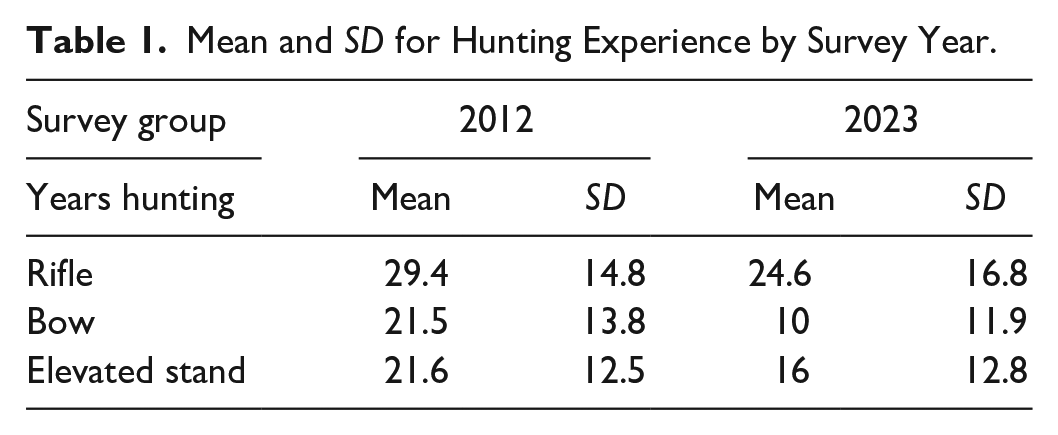
The 2012 survey respondents indicated frequently using an elevated stand while hunting (M = 7.0, SD = 1.9). Whereas, in the 2023 survey, respondents reported using an elevated stand approximately half the time while hunting (M = 5.3, SD = 2.1).
Elevated Stand Use and Experience
For the 2012 study, 90% of the respondents indicated using a bow while hunting from an elevated stand, 78% with a rifle, 35% with a shotgun, 33% a muzzleloader, 17% a crossbow, and 10% with a pistol. For the 2023 study, 61% of the respondents indicated using a bow while hunting from an elevated stand, 94% with a rifle, 46% with a shotgun, 23% a muzzleloader, 38% a crossbow, and 16% with a pistol.
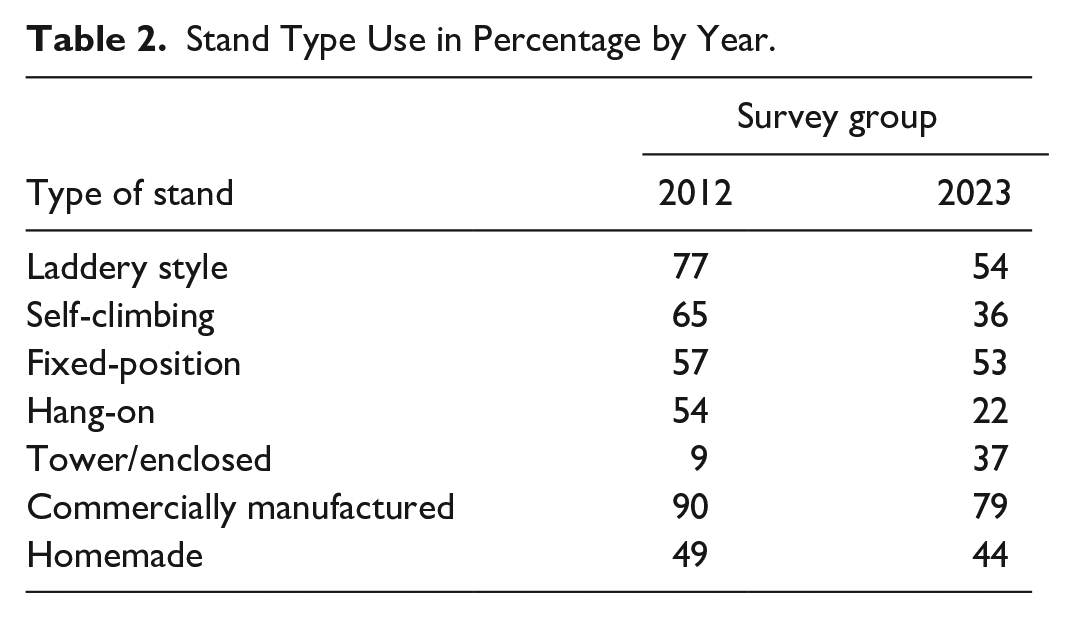
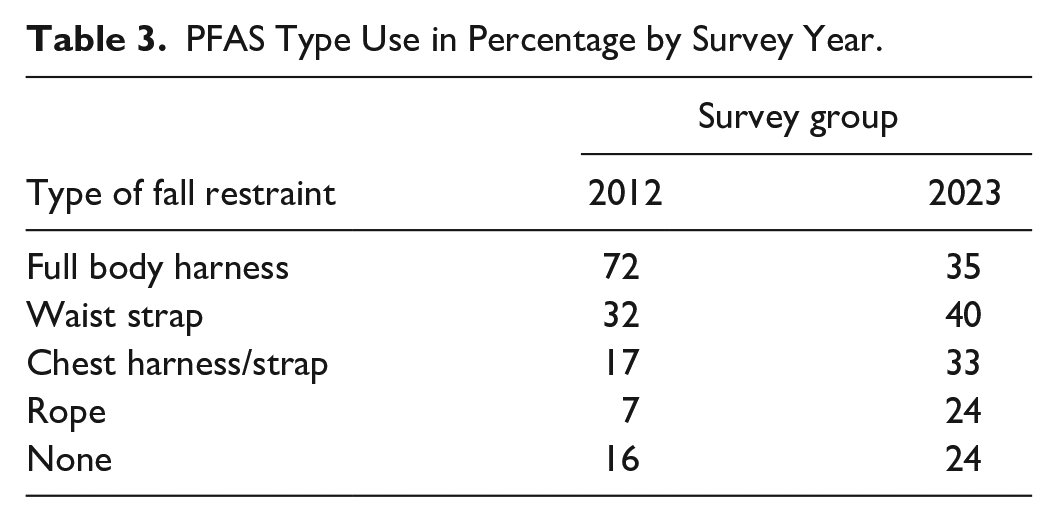
Table 2 presents the percentage of respondents in both studies that noted using the different types of elevated stands. Table 3 presents the percentage of respondents in both studies that noted using the different types of PFAS.
Stand Type Use in Percentage by Year.
PFAS Type Use in Percentage by Survey Year.
Practices and Attitudes Regarding PFAS Use
Table 4 presents the mean ratings and standard deviations for the questions regarding how often (9 = always) the participants use a PFAS and how concerned (9 = extremely) they are with falling while they are climbing up, climbing down, and standing/sitting in an elevated stand for both surveys.
Mean and SD Responses on How Often Use PFAS and Concern of Falling Responses as Reported by Survey Year.
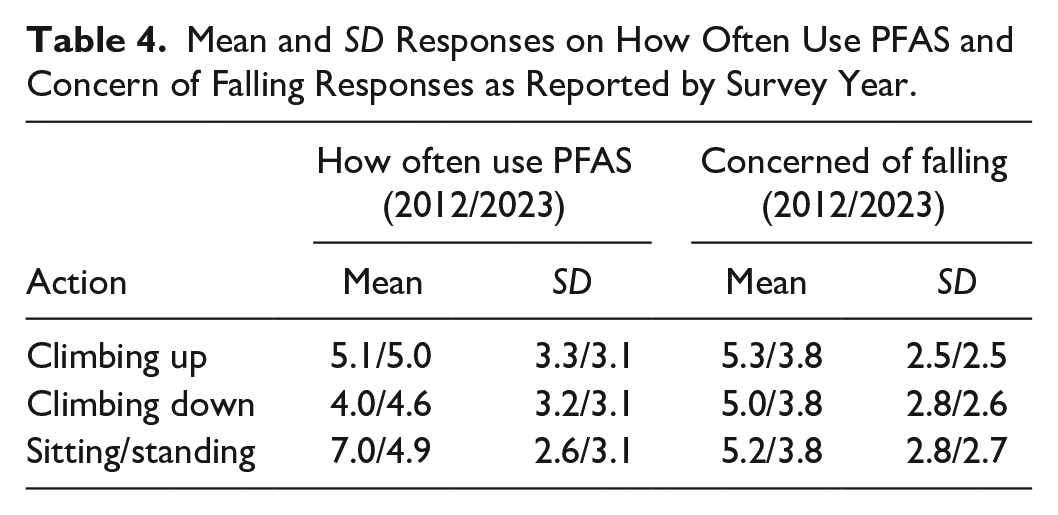
Table 5 presents the percentage of responses related to how often respondents use a PFAS while climbing up, climbing down, and sitting/standing in an elevated stand. As noted in Table 5, more respondents in both surveys indicated that they never use a PFAS when descending from an elevated stand compared to those who indicated they always use a PFAS in descent. However, this result is reversed with respect to using a PFAS while sitting or standing-in an elevated stand for both surveys. An approximately equal number of respondents in both surveys indicated always or never using a PFAS when climbing up into an elevated stand.
Rating and Percentages on How Often PFAS is Used as Reported by Year.
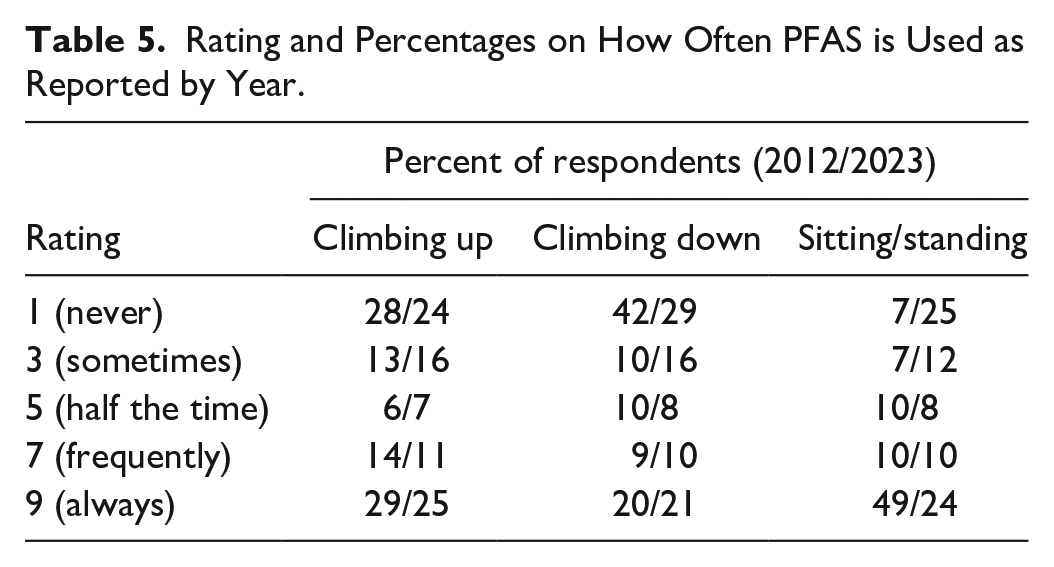
Table 6 presents the percentage of respondents’ concern about falling while they are climbing up, climbing down, or sitting/standing in an elevated stand. Contrary to the frequency of PFAS usage while descending from an elevated tree stand, respondents in both surveys were about equally split between being not at all or somewhat concerned versus very or extremely concerned about falling while descending from an elevated stand. As the similar means depicted in Table 6 indicate, the respondents’ concern about falling ratings were similarly distributed across climbing up, climbing down, and standing or sitting-in an elevated stand in both surveys.
Rating and Percentages Concerning About Falling as Reported by Year.
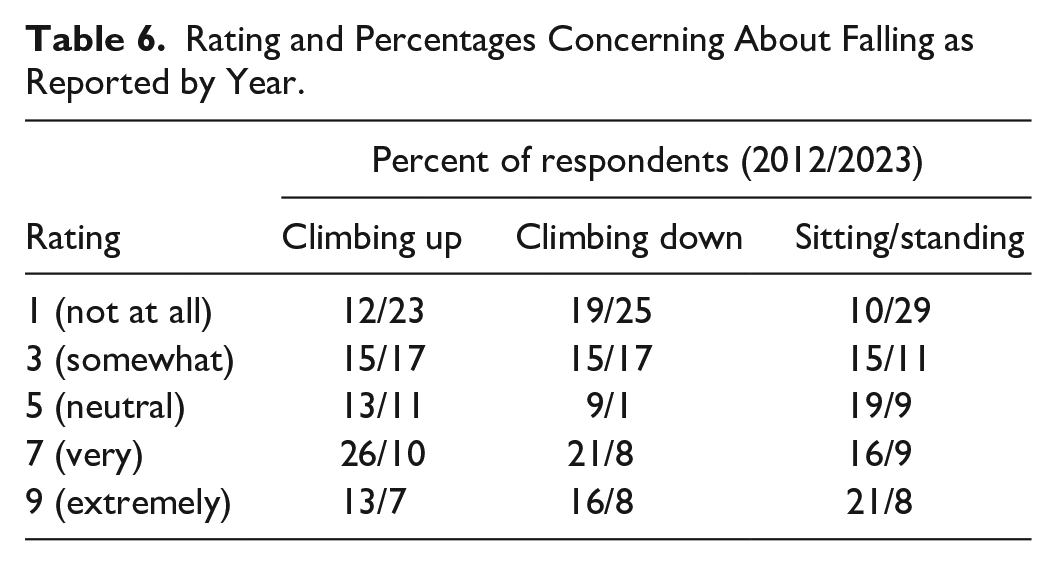
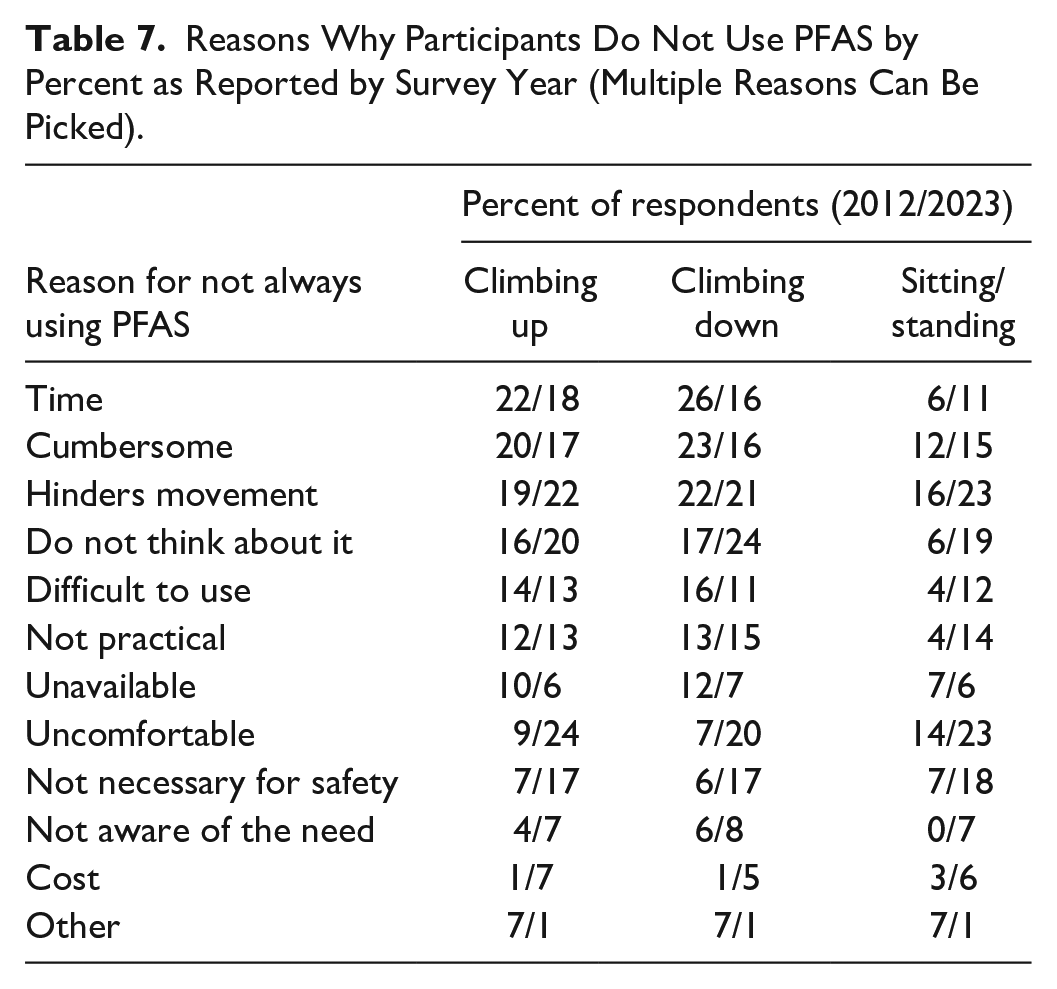
Table 7 presents the reasons why respondents do not always wear a PFAS while using an elevated stand. The percentage of respondents selecting each response choice is provided in the table.
Reasons Why Participants Do Not Use PFAS by Percent as Reported by Survey Year (Multiple Reasons Can Be Picked).
Prior Experience with Falls from Elevated Stands
Seventy-five percent of the respondents indicated that they have known or have heard of someone suffering an injury by falling from an elevated stand while not wearing a PFAS in the 2012 study whereas respondents in the 2023 study reported 56%. Twenty-eight percent of the respondents also indicated that they have known or heard of someone suffering injury by falling from an elevated stand while wearing a PFAS in the 2012 study whereas respondents in the 2023 study reported 28%.
Discussion
The present research investigated hunters’ safety practices and attitudes regarding their use of PFAS while using elevated hunting stands. Hunters were surveyed from archery and hunting related events in southeast and central Pennsylvania and among online consumers. Overall the respondents indicated being relatively experienced in hunting and with using elevated stands to hunt.
The main finding from the study was that a large majority of the hunters surveyed indicated that they do not always use a PFAS when using an elevated hunting stand. Non-use was more likely to occur when climbing down from an elevated stand as opposed to being positioned within the stand. The data also suggest that respondents were less likely to use a PFAS when climbing up versus being positioned within the elevated stand. The practice of not always using a PFAS occurs even though a large majority of the respondents indicated being at least somewhat concerned with falling and having known someone who had been injured when falling from an elevated stand.
Respondents were also asked why they do not always use a PFAS when using an elevated hunting stand. The most common reasons included: time, cumbersome, hinders movement, do not think about it, difficult to use, and not practical, particularly with respect to climbing up or down from an elevated stand. Most of the reasons given relate to cost of compliance in that the use of a PFAS requires more effort or creates a negative experience (e.g., uncomfortable). Cost of compliance has been shown to be a significant factor in both predicting behavior and motivating users to comply with product warnings and safety instructions (Vredenburgh & Helmick-Rich, 2006). When actual or perceive costs rise, product users are less likely to comply with safety instructions and warnings.
A concerning result found in the current study is the greater likelihood of PFAS non-use when seated/standing in an elevated stand in the 2023 survey compared to the 2012 survey. The trend of greater PFAS non-use is also reflected with an overall decrease in concern about falling both while sitting/standing in a stand and climbing up and down from the stand. It is not known if attitudes have changed over time or the trends are the result of a larger and more geographically diverse group of respondents. As noted in Vigilante et al. (2014), the 2012 survey respondents were also from events and clubs that catered to persons with greater interest in the archery sports and hunter safety (e.g., hunter education meeting). As such, the 2012 respondents may have been more safety conscious than the 2023 respondents overall.
In either event, the trends related to the non-usage of PFAS while hunting from elevated stands is consistent with past survey data. For example, in a 1993 survey involving over 2,300 readers of Deer & Deer Hunting magazine, 80% of the respondents indicate not using a PFAS when ascending, descending, or transition into or out of an elevated stand (Meiers, 2003). Furthermore, 50% of the respondents indicated not using a PFAS while positioned in an elevated stand (Meiers, 2003).
In 2002, the International Hunters Education Association (IHEA) conducted a telephone survey consisting of 1,056 hunters from Vermont and North Carolina. Of the survey respondents who reported experiencing a fall while using an elevated stand, 58% of the respondents were not wearing a PFAS at the time of their fall, and 78% and 57% did not use a PFAS while climbing into the stand or while in their stand on the day of their fall, respectively.
In 2007, the Minnesota Cooperative Fish and Wildlife Research Unit (MCFWRU), at the University of Minnesota (UM) conducted a survey involving 858 hunters in MN (Bruskotter & Fulton, 2007). Twenty six percent of the hunters indicated that they do not wear a PFAS when hunting from an elevated stand and 29% reported only wearing a PFAS sometimes. When asked if they wear a full body harness attached to the tree from the time they leave the ground, 72% said “no,” 16% said “sometimes,” and only 12% said “yes.” When asked why they do not use a full body harness, 42% of the hunters indicated “hinders movement,” 38% indicated “difficult to use,” 15% said “costs,” 9% said “unnecessary for safety,” 4% responded “unavailable,” and 15% stated “other.”
In October 2009, the Wisconsin Natural Resources (WNR) magazine published an article titled “Take a stand for safety” (Kahler, 2009). Within the article, the author quotes the results of 2003 survey of Wisconsin gun deer hunters which found that although 67% of the hunters owned a safety harness, fewer than 33% actually used the safety harness and more than 33% never used a harness.
Since the mid-2000s, the TMA, tree stand manufacturers, state game commissions, and hunter safety organization have made significant attempts at educating hunters of the need to use a PFAS when using elevated stands (e.g., warnings provided with the product and in hunter safety classes, the inclusion of full body harnesses with tree stands, etc.). However, the results of the current study, as well as the previous studies, reveal that a significant number of hunters remain at risk of a significant injury and death when using an elevated hunting stand because they are not using a PFAS particularly when they are most at risk of falling (i.e., ascending, descending, and transitioning into and out of the stand).
Future research should explore ways to improve the usability and ease of use of PFAS particularly for times when hunters are most at risk for falling (i.e., ascending, descending, transitioning). For example, integrated body harnesses into the hunter’s outerwear; making it easier to navigate around tree branches and limbs; improve the movement of the PFAS attachment point higher and lower in the tree as the hunter climbs, etc. Additionally, research should also be conducted to identify ways to increase compliance of hunters using PFAS to reduce risks associated with using elevated stands.
Typically, elevated tree stand safety is addressed during hunter safety courses that are often needed to obtain a hunting license. However, hunters typically only have to take the course once and the risks and benefits of elevated stand use and the need for PFAS can be forgotten as the years since taking the course increases. As such, timely and repetitive public safety announcements and campaigns can be used to help educate the public and keep the topic top of mind particularly during hunting season (e.g., in the fall for deer season).
Footnotes
Declaration of Conflicting Interests
The author(s) declared no potential conflicts of interest with respect to the research, authorship, and/or publication of this article.
Funding
The author(s) received no financial support for the research, authorship, and/or publication of this article.