




Abstract
Multiple Resource Theory, and one particular instantiation of the theory in the 4-Dimensional Multiple Resource Model have often been invoked as mechanisms to account for dual task interference. Here we present the data and analyses requirements necessary to conclude that the multiple resource model either does or does not predict an increase in the dual task decrement; and in particular we describe the need to consider and control both task difficulty and task priority in comparing conditions that are argued to contrast shared versus separate resources. We then consider one common misconception regarding what the model predicts regarding perfect time sharing, and address the importance of considering alternative theory-based mechanisms of task switching and of confusion and crosstalk, to account for patterns of multi-task interference.
Introduction
Over the last 40 years, since the concept of multiple-resource theory in time-sharing was proposed by Kantowitz and Knight (1976), North (1977), Navon and Gopher (1979), and myself (Wickens, 1976, 1980), and since a particular instantiation of that theory in the multiple resource
The objective of this paper is to provide the human factors research community with a clear, intuitive explanation of multiple resource model in order to clarify what multiple resources are, and how experimental evidence can be harnessed to provide support for or against the model in terms of its predictions of dual task interference. The reason I undertake this effort now, in spite of several oft-cited past publications about the model (Wickens, 1980, 1984, 2002, 2008, Wickens, Helton et al., 2021), is that over the past decade I have read several papers on the topic, and reviewed numerous manuscripts that have either claimed “disproof” of the multiple resources model, or support for the theory and model that is unwarranted on the basis of the data and analyses provided by the authors.
Figure 1 presents the current instantiation of the model in its “cubical” form. The figure presents in the cube three dichotomous dimensions that are argued to characterize different perceptual modalities, cognitive codes, or processing stage resources, on each side of each dichotomy (the black lines) (modalities is actually a trichotomy, now including tactile, along with the original auditory and visual).
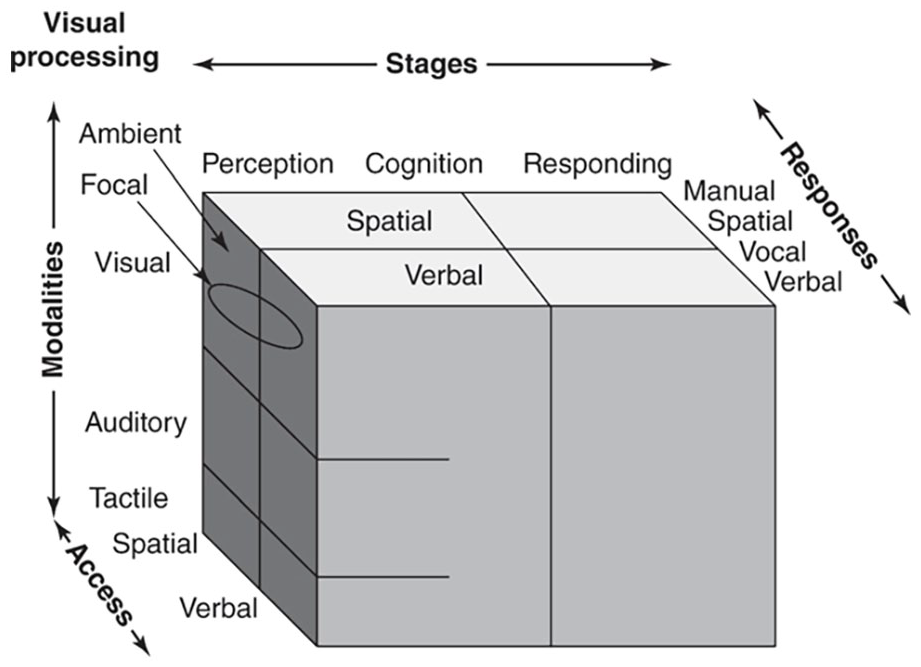
The 4 dimensional multiple resource model.
The premise of both the theory and model is that when two
Although support for the model shown in Figure 1 comes primarily from performance data in dual task time-sharing studies, it also relies upon converging evidence from neurophysiological studies which validate that the separate resources on each dimension also correspond to separate brain structures (e.g., visual vs. auditory cortex; left and right cerebral hemispheres, Wickens, 2008). As an engineering psychology model I also wish to assure that each dichotomy aligns with important design distinctions that a designer may choose in order to improve multi-tasking performance by the user.
The fundamental multiple resource model that I have proposed (e.g., Wickens, 2008) asserts that there are three relevant
(1) The extent to which the same resources are used in both conditions of the comparison (multiple resource factor).
(2) The amount of resources required, or level of difficulty (cognitive load) of the tasks (Norman & Bobrow, 1975; resource demand factor). Greater difficulty will consume more resources and hence increase the dual task decrement suffered by one or both tasks. Note that the viability of considering resources as a limited commodity is supported by the increasing evidence from neuro-ergonomics studies that oxygen consumption within the brain is both limited and supports cognitive performance (e.g., Ayaz & Dehais, 2019; Hirshfield et al., 2023).
(3) The relative priority of the two time-shared tasks, (resource allocation factor) a variable or emphasis that often leads to the definition of a primary versus a secondary task.
At this point it is important to emphasize that unless factors (2) and (3) are carefully controlled in the selection of tasks and in experimental design and instructions in making the comparison, neither support for, nor evidence against multiple resource theory and the multiple resource model can be conclusively offered.
The Prototypical Experiment
A proper experiment designed to test whether shared versus separate resources result in more dual task interference must include:
● Three baseline conditions:
– Single task performance on each of the two conditions that vary resource structure (e.g., auditory [a] and visual [v] displays). Since this is the task that is
– The
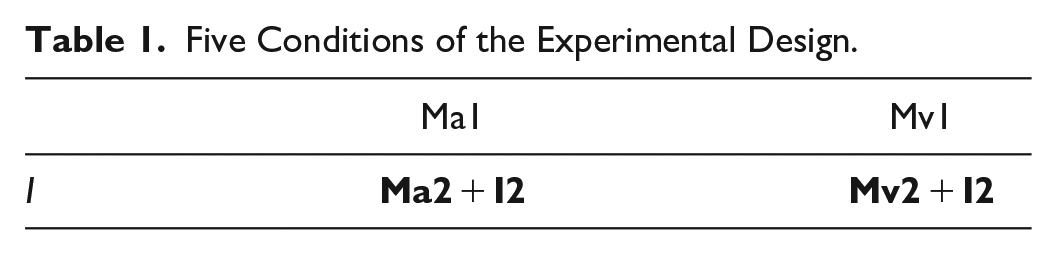
– These conditions are represented, in italics, in the top row and leftmost column of Table 1.
● Two dual task conditions sharing the interfering task with each of the two tasks whose structure is varied (the M task). Each dual task condition will in turn generate two performance measures, one for each task. These dual task conditions are shown
This 5-condition experimental design will in turn allow the computation of four
Five Conditions of the Experimental Design.
Calculation of Dual Task Decrement in the Four Cells.
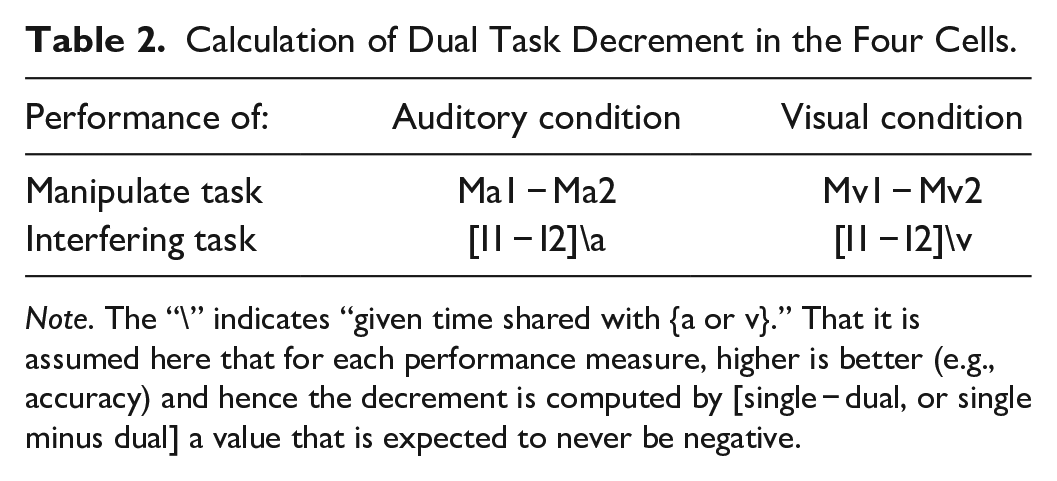
Note. The “\” indicates “given time shared with {a or v}.” That it is assumed here that for each performance measure, higher is better (e.g., accuracy) and hence the decrement is computed by [single − dual, or single minus dual] a value that is expected to never be negative.
In a prototypical experiment involving a visual interfering task (e.g., driving or flying) we would expect to find that, to the extent that visual versus auditory perception define separate resources, then [Ma1 − Ma2] and [I1 − I2]\a will be smaller than [Mv1 − Mv2] and [i1 − I2\v] for at least one, if not both of the performance measures. If at least one score is smaller and the other is not larger, then this should provide unequivocal evidence in support of the multiple resource model in which perceptual modalities defines resources.
Approach
The approach I have taken is to informally review several articles (published, or unpublished but submitted and reviewed) over the past decade, in order to extract generic examples of how the data intended to either “disprove” multiple resource theory or to validate it, have been inadequate to conclusively do so. I explicitly do NOT cite individual investigators here; rather, this is seen as a guide for future investigations, not a criticism of any particular investigator.
Findings
Given the necessary conditions to validate or invalidate described above, three common errors have occurred in:
1. Measuring the full dual task performance decrement. Investigators have sometimes used the performance decrement in only one of the two time-shared tasks (e.g., M or I) but not both to infer the degree to which this decrement is greater in the shared resource condition than the separate resource condition. However, it is impossible to establish the degree of dual task interference between tasks unless performance in both tasks is assessed. Furthermore, a
Consider for example, a case in which, in the dual task conditions, the visual interfering task (I) is given priority over the visual version of the manipulated task (Mv); but this priority is not imposed in the auditory version condition (Ma) and instead the auditory manipulated task is given priority (the case of intrusive auditory interruptions). Under these circumstances of different task emphasis or priority between conditions, an the observation of greater or equal effect when the visual interfering task is time shared with Ma does not allow inferences to be drawn about resource competition as it could be due to the priority shift. Diagnosis of this case by the researcher cannot be made unless the performance decrements of BOTH tasks in both conditions of the comparison are measured.
2. Difficulty control and difficulty confound. It needs to be established that the task whose resource is manipulated for the comparison (e.g., an auditory vs. a visual interrupting task in a visual driving environment) is
An example here is with driving (Task I) being time shared with directional guidance (Task M) that is offered through either the auditory or visual channel. Here, suppose the visual guidance is presented on a north-up map as an arrow pointing in the compass direction, N, S, E, or W while the auditory guidance is a command to “turn left” or “turn right.” Here the data might show a smaller decrement with the auditory guidance hence purporting to support the modality dimension of the multiple resource model. But it could just as well be that the smaller decrement results because it is easier to process guidance information when it is offered in an ego-frame of reference (“left-right”), rather than in a world frame (“east-west”).
A subjective workload measure is typically adequate to establish equivalent difficulty or resource demand between the two versions of the M task.
3. Priority control. It should be established, or at least imposed, that the priority instructions given to each task are the same in both of the dual task conditions of the comparison. This can be readily accomplished by either instructions that I or M is the primary (and the other secondary) task or that both are of equal priority.
A violation would obviously be if the participant treats the M task as primary in the auditory condition (Ma2); but the M task as secondary, or of equal priority to the I task, in the visual condition (Mv2).
The issue of priority can be a challenging one to address when this may vary across the two conditions in the comparison, since resource competition can be reflected differently across what may be the two different independent variables (two different tasks)—an “apples versus oranges” comparison. For example, when a tracking task is time-shared with a discrete RT task, consider tracking error versus discrete task RT. A solution to this challenge is to express both decrements in common units, and then simply sum the decrements across the two tasks, as Wickens et al. (1983) have done, to compute an overall interference measure. Common units could be achieved by transforming each decrement into z scores or effect size measures. Alternatively, raw scores could be created by subtracting a minimum value (i.e., the lowest obtained across participants) from a maximum value (the highest obtained), in order to define a scale; and then express each participant score in each condition of the comparison as a point or percentile along this range.
Note that in the three factors addressed above, I have used the case of auditory versus visual resources, because this is the one that appears most prominently in investigations that have addressed or considered the viability of multiple resources. This is in part, because choices of voice versus visual display are such frequent ones confronting interface designers. But similar guidance is also highly relevant for spatial versus linguistic codes of processing, whether at input (i.e., text vs. map display), cognition of mental representation (visual-spatial vs. phonetic: Baddeley, 2003) or response (voice control vs. key press).
Other Issues
Perfect Time-Sharing
In addition to the shortcomings of experimental design and decrement comparison a second misrepresentation of multiple resources occurs when a dual task decrement using separate resources is observed (i.e.,
Other Models and Mechanisms
Another issue of relevance here is that a multiple resource model is not the only viable model or mechanism to account for multi-tasking interference (a positive decrement). Two examples are prominent:
First, Attention switching models often assume that it is more time-consuming to switch between modalities than within, a finding that is clearly at odds with the predictions of the multiple resource model (better cross-modal time sharing). But it is of importance here that multiple resource models only apply when it is possible for the two tasks to be performed
Second, Cooperation, confusion and crosstalk models, or models of outcome conflict postulate mechanisms of dual task interference that can be operating on performance even as, or while, competition for common resources may be taking place. For example
Confusion may result when two tasks share the same kind of material; for example, both digits, as when you are engaged in digit data entry while listening to basketball scores. Here material from one task may be confused with, and hence cross-talk, by inadvertently triggering responses for the other (Navon & Miller, 1987). Here, like the multiple resource model, similarity hurts multi-tasking, but does so via a very different mechanism than via the competition for similar resources.
Conclusion
In conclusion, several factors have been identified that must be adequately controlled in order examine the viability of the multiple resource model to predict dual task decrements. Sometimes experimental constraints have prevented full compliance with these factors. While this does not imply that the data are worthless for that comparison, it does require that the conclusions drawn for or against the viability of the model must be offered with appropriate caution.
It is also the case that the existence of alternative theories invites the concern that negative results for the model can be explained by the investigator simply by arguing that “a different model dominates in this case.” This is a legitimate concern and can only be addressed by: (a) conceding that multi-tasking is extremely complex (Salvucci & Taatgen, 2008, 2010), (b) recognizing that multiple mechanisms can be operating simultaneously within a paradigm or context, and (c) invoking alternative mechanisms only when independent reasons indicate that that they should be present. For example, task switching arguments can be invoked if the spatial separation between two visual sources is sufficiently great that both cannot be simultaneously accessed in foveal vision.
Thus, a multiple resource model is not the “holy grail” of multi-task performance prediction. But it is one important tool for doing so; when appropriately applied.
Footnotes
Declaration of Conflicting Interests
The author declared no potential conflicts of interest with respect to the research, authorship, and/or publication of this article.
Funding
The author received no financial support for the research, authorship, and/or publication of this article.