



Abstract
Medical errors have been a leading cause of deaths in the U.S. and many other countries. Among different adverse events in healthcare settings, retained foreign objects (RFOs) have been identified as one of the most common sentinel events by The Joint Commission (TJC). This study fills an important gap between our knowledge of retention of foreign objects during invasive surgery procedures and their analysis based on real-world data and their trend. We received 1,371 de-identified data points of unique RFO incidents and their root causes, reported to TJC in 2010 to 2020 Q2. Using statistical methods and data analytics, this study aims to identify: (1) the most frequently retained foreign objects, (2) age distribution of the involved patients, and (3) the most influential root cause categories and subcategories of the reported RFOs. It then provides a series of recommendations to address those root causes to reduce RFO incidents and enhance patient safety.
Keywords
Objective
Medical errors have been a leading cause of deaths in the U.S. and many other countries. Among different adverse events in healthcare settings, retained foreign objects (RFOs) have been identified as one of the most common sentinel events by The Joint Commission (2024).
This study fills an important gap between our knowledge of retention of different foreign objects during an invasive surgery procedure and their analysis based on real-world data and their trend. We received 1,371 de-identified data points of unique RFO incidents and their root causes, which were reported to The Joint Commission from 2010 to the second quarter of 2020.
As for the structure of the provided data, for each of the reported RFO incidents, we had details such as the month and year of occurrence, the age range for the involved patient, the type of RFO, and the underlying causes. Each of the reported RFOs usually had multiple root causes. Each root cause was further broken down into subcategories, and some additional details were also available for them. The data was provided to us in multiple Excel files.
Using statistical methods and data analytics, this paper aims to identify: (1) the most frequently retained foreign objects, (2) age distribution of the involved patients, and (3) the top three major root causes of the reported RFOs as well as the top three subcategories of each major category. It then provides a series of recommendations to address those root causes.
In another study (Tabibzadeh & Patel, 2022), we conducted a systematic investigation of the contributing causes of RFOs using the AcciMap framework, an accident analysis methodology originally developed by Rasmussen (1997). However, the identification of the causes of RFO incidents in that study was based on a comprehensive literature review of other studies that investigated different instances of RFOs and capturing their stated causes. In this study, however, we have analyzed real data from the reported RFOs to The Joint Commission.
Method
We used PostgreSQL as our Relational Data Base Management System to store and organize the described extensive dataset efficiently. The data was structured to facilitate comprehensive analysis and reporting. The use of PostgreSQL ensures robust data management, enabling us to navigate through the information seamlessly. The dataset, spanning multiple Excel files, was made accessible and ready for in-depth examination and insights. For this purpose, we imported data from those Excel files into PostgreSQL and conducted some data cleaning using SQL. This was then used as a basis for trend analysis as well as root causes analysis. After identification of the major root causes of the reported RFO incidents, we developed a series of recommendations to address them.
We also used Tableau to visualize and analyze the collected data. Tableau served as our primary tool to create interactive and insightful visual representations of the information stored in our PostgreSQL database. With Tableau’s powerful features, we were able to generate trend analysis and reports for exploring the details of the 1,371 RFO cases during invasive surgical procedures.
Findings
Among the 1,371 investigated RFO cases, surgical sponges, with a frequency of 652 (47.56%), were the most frequently retained foreign object, followed by the categories of other (not identified) objects (43.18%) and needles (4.81%).
Out of the 1,371 RFOs, the highest frequency of incidents belonged to the Adults (18–69 years) age bracket with 1,103 cases, equivalent to 80.45%. This was followed by Geriatrics (70 years and older), Adolescent (13–17 years), Children (1–12 years), and Infants (0–12 months) with 220, 23, 17, and 8 cases, respectively.
The root cause analysis of the reported RFOs using data analytics, as discussed in the Method section, showed that Leadership, Human Factors, and Communications were the top three root causes, respectively constituting 21.80%, 21.10%, and 20% of all the causes. Figure 1 shows more details about the frequency of each of the root cause categories of the reported RFO incidents.
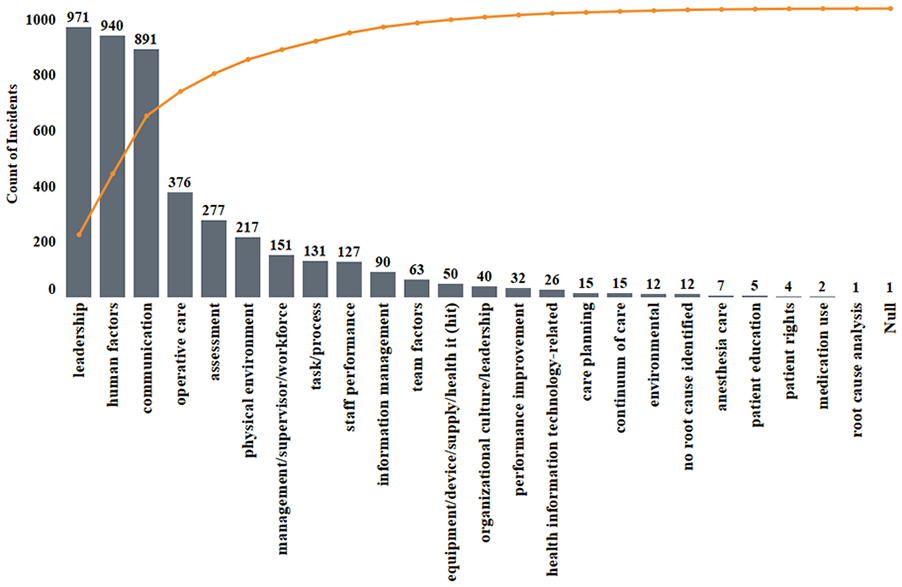
Distribution of root cause categories for all the RFOs.
In addition to the main categories of root causes, a series of root cause subcategories were provided for each main category. Among different reported subcategories for the Leadership, lack of policies and procedures, noncompliance with policies and procedures, and organizational culture with frequencies of 560, 514, and 65, respectively, were the top three root cause subcategories. The frequency for each root cause indicates the number of incidents that were due to that specific cause.
As for the Human Factors category, other human factors issues (not specifically identified) (379 instances), medical staff peer review (240), and in-service education (151) were the top three root cause subcategories. Finally, issues in communication with physicians (427), communication among staff (333), and oral communication (120) were the top three root cause subcategories for the Communication category.
As discussed before, most RFO incidents had multiple root causes. In addition, each incident usually had more than one root cause subcategory associated to each main category. That is why the total number of root causes exceeds the total number of incidents.
Takeaways
The findings presented in this study underscore the alarming prevalence of retained foreign objects during invasive surgical procedures, which continue to pose significant risks to patient safety worldwide. Our root cause analysis using data analytics identified Leadership, Human Factors, and Communication as the top three major root causes of the 1,371 investigated RFO incidents.
We have provided three levels of recommendations to hospitals, management, and staff to address the identified root causes and their major subcategories discussed in the Findings section. Some sample recommendations are as follows: Hospitals need to play a leading role in cultivating the culture of safety in their organization and committing to prioritize patient safety and make that visible through their everyday actions. Furthermore, they need to allocate enough budget and financial resources to provide their personnel with not only technical training but also non-technical training, for example, teamwork and team coordination. In this regard, management also needs to use allocated budgets and develop well-executed training programs for their personnel. In addition to teamwork training, defining clear lines of communication and designing and implementing standard and well-understood reporting infrastructures and protocols can lead to reducing risk of ineffective communication.
From another perspective, hospitals need to establish standard operating procedures, such as count policies. In addition, uniform documentation of the count process across all procedural areas provides better means to reduce risk of errors. On the other hand, staff needs to comply with the developed policies and procedures; otherwise, future errors and instances of RFOs are inevitable.
Footnotes
Acknowledgements
We would like to convey our extensive gratitude to The Joint Commission, the Office of Quality and Patient Safety, for providing us the reported data on retained foreign object incidents and their root causes, without which, we would not have been able to conduct this study.
Declaration of Conflicting Interests
The author(s) declared no potential conflicts of interest with respect to the research, authorship, and/or publication of this article.
Funding
The author(s) disclosed receipt of the following financial support for the research, authorship, and/or publication of this article: Moreover, we would like to appreciate the support of the California State Universities’ Chancellor’s Office for providing funding under the Research, Scholarship and Creative Activity (RSCA) Awards. This work, however, should not necessarily be construed as their representative position or be endorsed by them.
