



Abstract
Comfort is a widely used, but rarely defined, concept, often measured by simply asking people how comfortable a specific product or device is. However, early in the product life cycle, the device being developed may not be available for testing, parts of it may not be completely functional, or it may substantially change between iterations. The goal of this work was to develop a durable method for identifying potential sources of discomfort that would be appropriate for use early in the product life cycle. It needed to be flexible enough to use for different products at different points in the product life cycle, and without directly comparing to existing products. We developed a comfort framework which identifies potential sources of comfort and discomfort and applied the framework to develop a reusable questionnaire for a single product type (wrist-worn devices).
Introduction
Comfort is a widely used, but rarely defined, concept. Understanding user comfort is critical to the product development lifecycle, as the comfort of end users directly impacts product adoption. Products have to reach a minimum level of comfort or else people will not use them. Yet, there is still no single widely accepted definition of “comfort” (Francés-Morcillo et al., 2020). Some would say that it is simply the absence of discomfort. Others would say that discomfort is “pain prevention-oriented” while comfort is “pleasure promotion-oriented” (Kyung & Nussbaum, 2008). Other people focus on specific types of comfort like thermal comfort or visual comfort. It is clear that comfort is a unique experience for each individual and that it is impacted by multiple factors. This complex interaction across multiple distinct sources makes it incredibly difficult to measure.
Currently, the most common method of assessing comfort is simply asking people how comfortable a specific product or device is. Unidimensional scales like this may help make decisions between multiple iterations of similar types of devices or track changes in comfort over time, but fall short when comparing across devices of substantially different design due to the loss of detailed information about where differences arise. Further, early in the product life cycle, the device being developed may not be available for testing, or parts of it may not be completely functional, making a general measurement of comfort irrelevant. Without an established definition of comfort, it’s easy for the data to be invalid or unusable. For example, researchers may be interested in the impact of different physical product dimensions on user comfort, but user responses could also be affected by the user interface. Without realizing all of the factors that are contributing to user responses, product development teams may focus on the wrong problem and dedicate too much or too little time to addressing user comfort.
The goal of this work was to develop a durable method for identifying potential sources of discomfort that would be appropriate for use early in the product life cycle. It needed to be flexible enough to use for different products, at different points in the product life cycle, and without directly comparing to existing products since a comparable device may not be available for novel technologies. Most importantly, comfort assessments needed to provide directional feedback to product teams to enable rapid improvements, while still providing the ability to compare across studies to show progress.
To address this problem, we conducted a literature review with the following research questions, aiming to be as broad as possible: What factors impact user comfort? What are the relationships between different factors affecting user comfort? We then synthesized the findings into a single comfort framework which identifies potential sources of comfort and discomfort. We identified specific limitations of existing frameworks, particularly when assessing comfort of novel technology, and used these limitations to develop a new generalizable comfort framework. As a case study, we used the framework to develop a reusable questionnaire for a single product type (wrist-worn devices), although the framework could also be used to develop comfort questionnaires for other devices or products.
Framework Development
We conducted a literature review, examining existing comfort frameworks and measurement tools, but found that none provided the specificity and directional approach needed to make product decisions. Knight and Baber (2005) developed a tool providing a six-dimensional measure of comfort with emotion, attachment, harm, perceived change, movement, and anxiety as the dimensions of interest. While the tool provided a comprehensive and reliable assessment of the experience of wearing devices, it fell short in providing directional assessment for improvement, making it best suited for near-product devices or comparative evaluations. Therefore, we determined there was a need for a new approach that could be used for research very early in the product life cycle.
We synthesized the findings from the literature review into a comprehensive comfort framework that accounts for the impact of sensory inputs, perceptual thresholds, individual experiences, technology acceptance, and time in the individual experience of comfort. We expanded on the framework developed by Vink and Hallbeck (2012) by focusing on the individual experience and designing at a more detailed level, specifically, adding sensory perception. We view comfort is a complex individual perception blending physical, psychological, and social experiences in a given context. As such, comfort is ever-changing and is not universally measurable. However, the individual experience of comfort as a single experience at a moment in time could be measured.
Framework: Individual Experience of Comfort
Through our literature review, we ultimately found that the individual experience of comfort is determined by experience, individual differences, technology acceptance, and exposure time (Figure 1). Individuals’ senses determine what and how strongly they perceive signals, for example, a flashing light. While we need to reach a minimum threshold for people to perceive a signal, as the intensity increases, it may become uncomfortable or even painful. If the sensory inputs come from devices or interactions with technology, then we have to consider an individual’s technology acceptance. An individual’s acceptance of technology is influenced by several factors, including the perceived ease of use, the usefulness of the interactions, and the social acceptability of the technology, which is determined by the individual’s beliefs about how others might perceive them while using the device. Individuals’ internal beliefs, values, preferences, and even their moods serve as a filter impacting how they respond to these inputs. That filter may make individuals more or less likely to feel that something is comfortable. Past experiences can also impact the feeling of comfort. All of these things are also impacted by time. Individuals may become used to certain sensory inputs like the sound of a train, or it may become unbearable when they are exposed for a longer period of time. Time also impacts what society accepts (or not). A product on the market for longer is likely to be easier to use than when it was first released and may even have more functionality. New technology may be met with both suspicion and excitement.
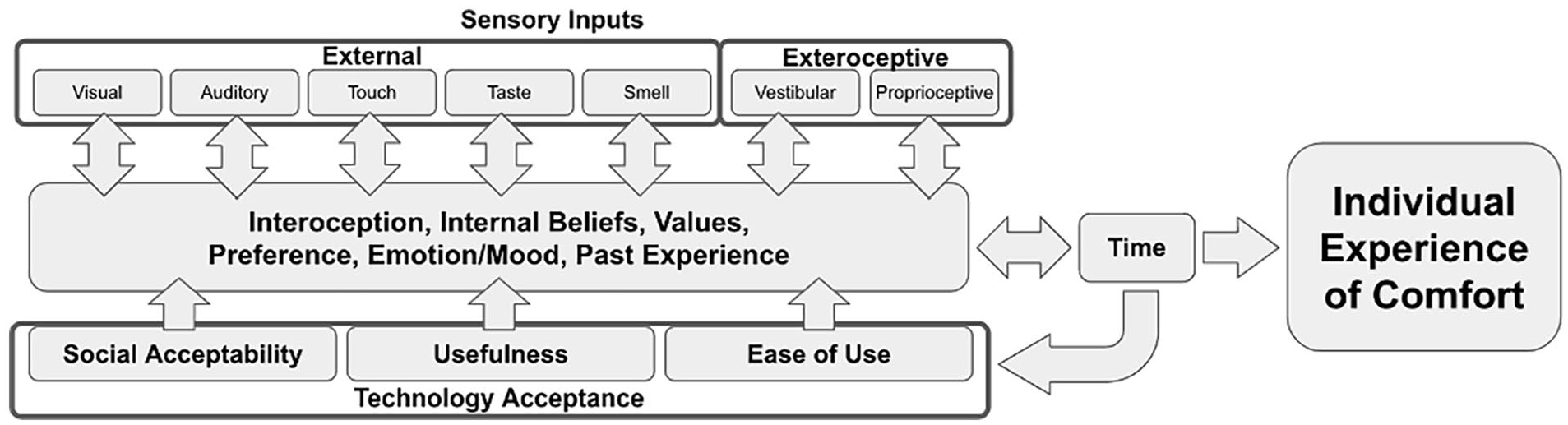
The comfort framework shows interconnections between sensory inputs, individual values/experiences, technology acceptance, and time interact, resulting in an individual experience of comfort.
The multidimensional nature of comfort highlighted by our framework is particularly relevant when assessing novel or developing products. In these cases, a unidimensional measure of overall comfort is likely to be influenced by a wide range of factors that may change substantially between product iterations. By breaking comfort down into its component dimensions, researchers can gain more detailed insights into what aspects of the product are driving user perceptions and experiences. This allows for more targeted improvements and a better understanding of how design changes impact specific facets of comfort.
Furthermore, the relative importance of different comfort dimensions may vary depending on the stage of product development. For example, early in the process, factors related to functionality and ease of use may be more critical, while aesthetics and social acceptance may become more relevant closer to market launch. A multidimensional assessment allows researchers to track these shifting priorities and ensure that the most pertinent aspects of comfort are being addressed at each stage.
Application
Methods
We applied this comfort framework to the evaluation of novel wrist-worn devices. Such evaluations are challenging because the devices were still in development, with significant changes happening between prototype iterations. Because there was a significant shift in prototypes, we needed to build the knowledge base around what generally made wrist-worn devices comfortable rather than relying only on comparative analysis between different versions. To accomplish this, we identified key dimensions of the comfort framework which we expected to have the most significant effect on end user comfort due to wrist-worn devices. We then developed a questionnaire with questions mapped to each of these dimensions (Figure 2). We included questions framed both positively and negatively to minimize the impact of survey structure on user responses. To simplify the user experience of answering questions, all responses were a 0 to 10 scale ranging from “not at all” to “very much.” Participants wore a wristband at snug (“It mostly stays in one place when I move my arm around, but I could move it with my other hand.”) or tight (“I have to loosen the strap to reposition the watch on my arm.”) for 4 hr at a time on consecutive days. During that time, participants answered survey questions every 1 to 2 hr, allowing us to track the impact of different wrist-worn devices on each individual construct.
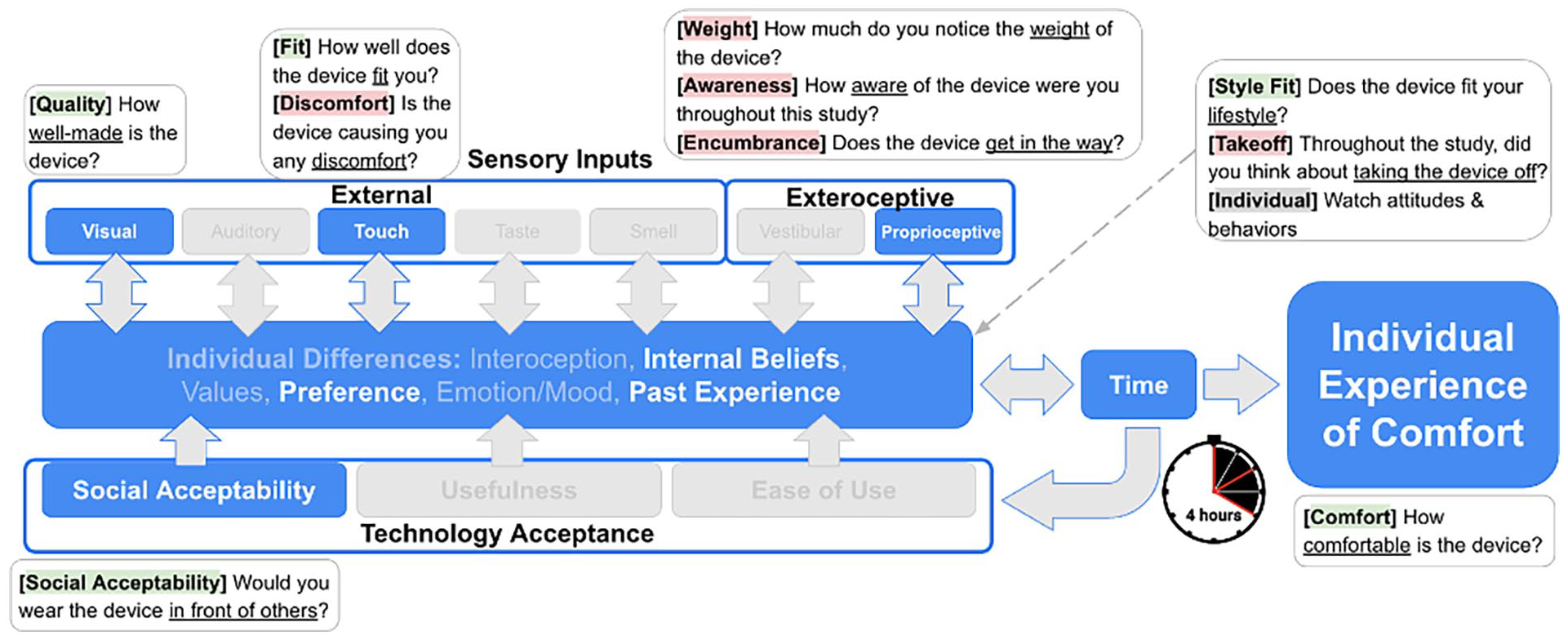
We identified individual constructs related to wrist-worn devices that were most likely to impact overall comfort (quality, fit, discomfort, weight, awareness, encumbrance, style fit, takeoff, individual differences, social acceptability, and comfort) and used them to develop a reusable and repeatable questionnaire.
Participants
After consenting to participate, 28 participants (19m, 9f) completed the study. Over 80% of participants were between 25 and 44 years old, and all were right-handed.
Analysis
Due to the exploratory nature of early product comfort research, we plotted individual responses and trendlines for each question in Figure 2 based on different device and participant characteristics (Figure 3). This exploratory analysis allowed us to quickly identify the most impactful components of comfort and discomfort for wrist-worn devices.
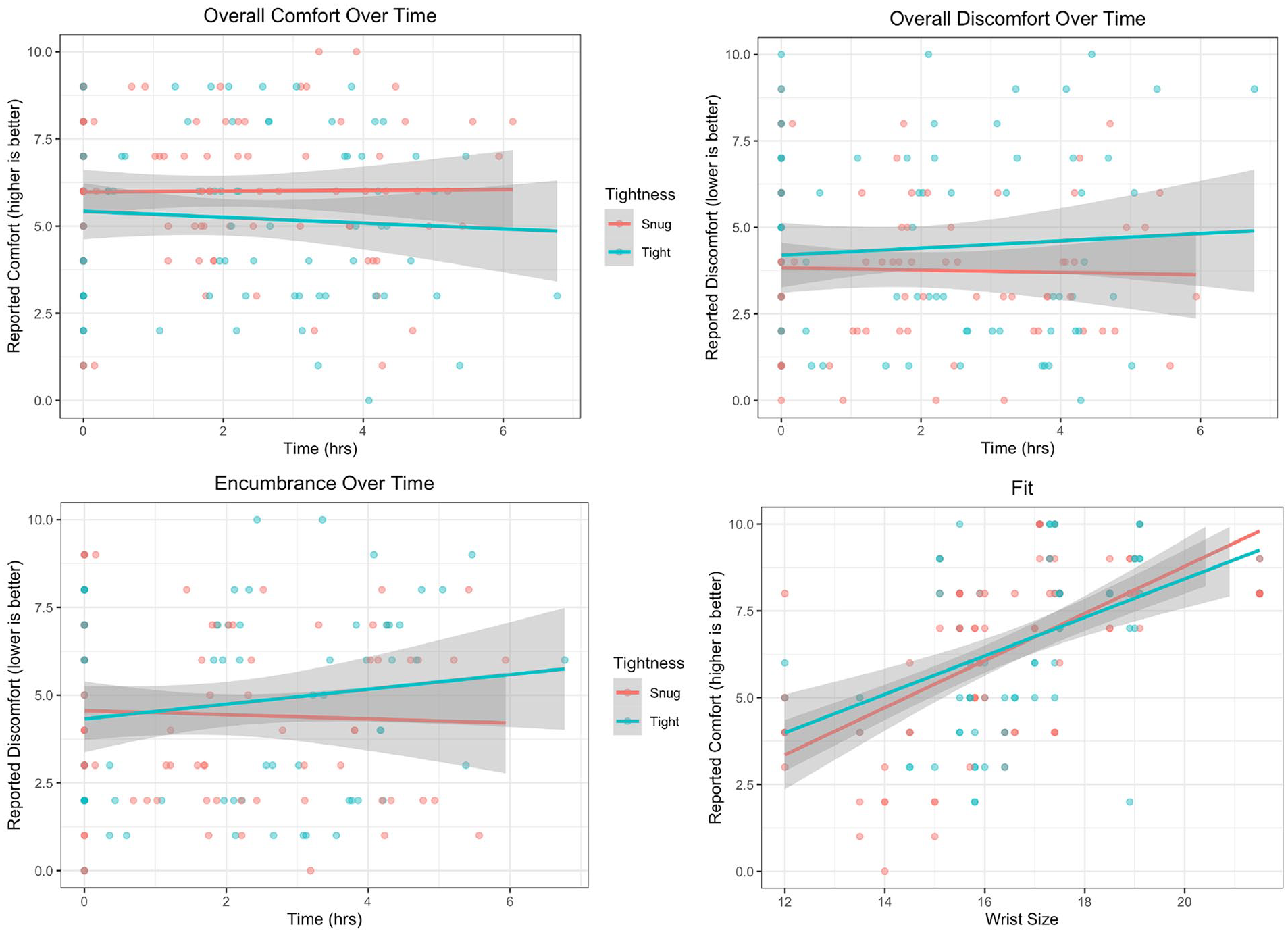
Exploratory analyses showed us that band tightness may have slightly impacted comfort and discomfort over time, and definitely impacted encumbrance. Plotting data by wrist size showed clear need to design for smaller wrist sizes.
Generally, we found that band tightness may have influenced the reported comfort and discomfort, but it particularly seemed to influence feelings of encumbrance. Based on this, if wristbands needed to be worn more tightly on the wrist, this approach gives evidence that the overall size and bulk of the wristband need to be reduced to minimize discomfort. We also showed a clear need to redesign to fit smaller wrist sizes, regardless of band tightness. By collecting data broadly across a range of factors that influence the individual experience of comfort, we were able to show the impact of design decisions on those factors and hypothesize needed improvements for next steps. This research presents a first step in conducting exploratory comfort analysis to identify different factors that might impact overall comfort.
Next Steps
For this data set, a more detailed analysis could be conducted considering different individual factors (e.g., age, tendency to adopt technology, previous wrist-worn device exposure, gender, wrist size, etc.) or device types (e.g., personal device vs. prototype). Future data collections of this kind could also assess the individual experience of comfort over longer durations.
For a given device, this framework could be refined and validated to develop a singular repeatable questionnaire to assess the individual experience of comfort for that type of device. While this paper presents a first step in that direction, we believe that some of the questions used in this work may be closely correlated (e.g., Takeoff and Encumbrance) and therefore the existing questions could potentially be reduced. Future research to expand this framework could also explore the application to different kinds of devices (e.g., head- worn) or even interactions or environments.
Conclusions
The individual experience of comfort is a combination of the environment, sensory experience, interaction required, and time. While these individually may generate some amount of comfort or discomfort, people tend to think about the overall experience as a whole unless one factor dominates all others. Therefore, we propose a framework that can be used to elucidate the factors impacting individuals’ comfort.
Early in the product life cycle, it is critical to understand what factors are driving users’ experience of comfort and discomfort. Therefore, we recommend conducting a multidimensional assessment of comfort, particularly when directional feedback is needed. Using the comfort framework provides a heuristic approach for identifying likely sources of comfort and discomfort and the relationship between those sources, which can then be used to generate research hypotheses and questions for user studies. Further, using the framework to identify as many contributing factors as possible can help researchers identify when extraneous factors that may change in the future, such as a device that looks like an unfinished prototype, might impact the overall experience of comfort.
We applied this framework and resulting questionnaire across multiple studies of wrist-worn devices, allowing us to provide directional feedback for their design. This paper provides a high-level overview of one such study. In that study, we asked questions that accounted for both positive (comfort) and negative (discomfort) impacts of the most related factors. We also compared data across studies to understand the biggest factors affecting overall wrist-worn device comfort and found that our survey was sensitive across different wrist-worn devices.
Therefore, we believe this comfort framework may be useful in assessing comfort for different devices, interactions, or environments and at different points in the product lifecycle.
Footnotes
Declaration of Conflicting Interests
The author(s) declared no potential conflicts of interest with respect to the research, authorship, and/or publication of this article.
Funding
All work was conducted as part of normal job duties. The author(s) received no additional financial support for the research, authorship, and/or publication of this article.
