




Abstract
In this research, we investigate user experiences with the Laevo exoskeletons in geriatric work. We introduce two studies where Finnish nurses used exoskeletons and identify the requirements and potential restrictions for using exoskeletons in care context. Our results show that nurses’ intentions to use the exoskeletons were mostly associated with perceived usefulness, ergonomics, and enjoyment of use. Also, social environment issues, such as other people’s reactions, are important considerations. Exoskeleton use has varying requirements depending on where it will be implemented. Thus, the end users’ ideas for the design are crucial in enabling exoskeleton use in different sectors of work.
Health care work consists of physically demanding tasks, leading to musculoskeletal injuries and a significant amount of sick leaves and early exits (K. G. Davis & Kotowski, 2015; Trydegård, 2012; Yan et al., 2017). Some tools exist that assist care workers in, say, handling the patients. However, studies imply that currently used assistive equipment is found as inconvenient to integrate in daily care work routines (ROSE Consortium, 2017). Consequently, there is a clear demand for a new generation of assistive equipment to make health care work less physically straining.
In this article, we present two pioneering studies regarding nurses’ experiences using exoskeletons in their work. The Laevo exoskeleton used in this study has been reported to relieve 40% to 50% of lower back strain. However, we still know little about the nurses’ position toward exoskeletons, including their willingness and ability to use them. We explore user experiences of exoskeletons in geriatric care work, identifying some of the requirements for and potential restrictions of exoskeleton use.
Our study not only contributes to the technology acceptance discussions but also provides tangible take-aways for exoskeleton designers and end-users considering utilizing exoskeletons especially in care work.
Accepting Exoskeletons as New Generation Equipment in Health Care Work
“Passive” exoskeletons, such as Laevo, are wearable, harness-like lifting aids powered solely through the user without an external power source such as a battery. Passive exoskeletons rely on gas spring technology and are considered relatively lightweight to wear and put on.
Drawing from the unified theory of the acceptance and use of technology (Venkatesh et al., 2003), we examine the acceptance of the Laevo exoskeleton among Finnish nurses by analyzing the nurses’ intention to use the exoskeleton in geriatric work. We will focus on five factors in specific: perceived usefulness and ease of use, trust toward the device, enjoyment of use, and anxiety toward the use. In the qualitative part of the analysis we furthermore investigate the social environment’s impact on the intention to use exoskeletons.
In the first study (S1), we investigate nursing students (N = 16, later included in “nurses”), half of whom already had years of experience in nursing. The nurses were paired up and tasked with assisting a geriatric patient from a hospital bed into a wheelchair. The experiment was conducted in a controlled environment and proceeded in three stages. First, the nurses assisted the patient without exoskeletons; then, one of the nurses wore an exoskeleton; and last, both nurses wore an exoskeleton. Video, interview, and survey data were collected. We analyze the survey data through descriptive statistics, which we use as a base for the qualitative analysis. In the second study (S2), we had nurses (N = 7) test the Laevo in authentic care home environments, where they had the exoskeleton in an individual use for a week. The nurses deployed the exoskeleton in tasks such as assisting a patient out and into a wheelchair, eating, and toileting. We interviewed the nurses before and after the trial period. The interviews were audiorecorded, transcribed, and analyzed by content analysis.
Determinants of Intention to Use Exoskeletons
In S1, most nurses reported that the exoskeleton reduced lower back strain when assisting the patient. However, only half of the nurses reported intention to use exoskeletons in their work. The correlative analysis showed that the future intention to use the exoskeleton was mostly associated with its perceived usefulness (i.e., exoskeleton’s positive impact on performance and ergonomics) and how enjoyable it was to use (i.e., making care work more pleasant), as summarized in Table 1. These correlations were supported by qualitative findings. Several nurses in both studies complained about poor fit. They felt that wearing the Laevo made them stiffer and unable to react to sudden situations as they could without an exoskeleton. Some reported that if the exoskeleton were smaller or softer, it would make its everyday usage more enjoyable. According to the participants, it would be important for the exoskeleton to be easier and quicker to put on because of the hectic nature of care work. The common view was that the smaller size would also enable the device to fit under the working clothes and therefore be unnoticeable to the patients.
Correlations (r = Pearson) for Intention to Use the Exoskeleton and its Explanatory Factors
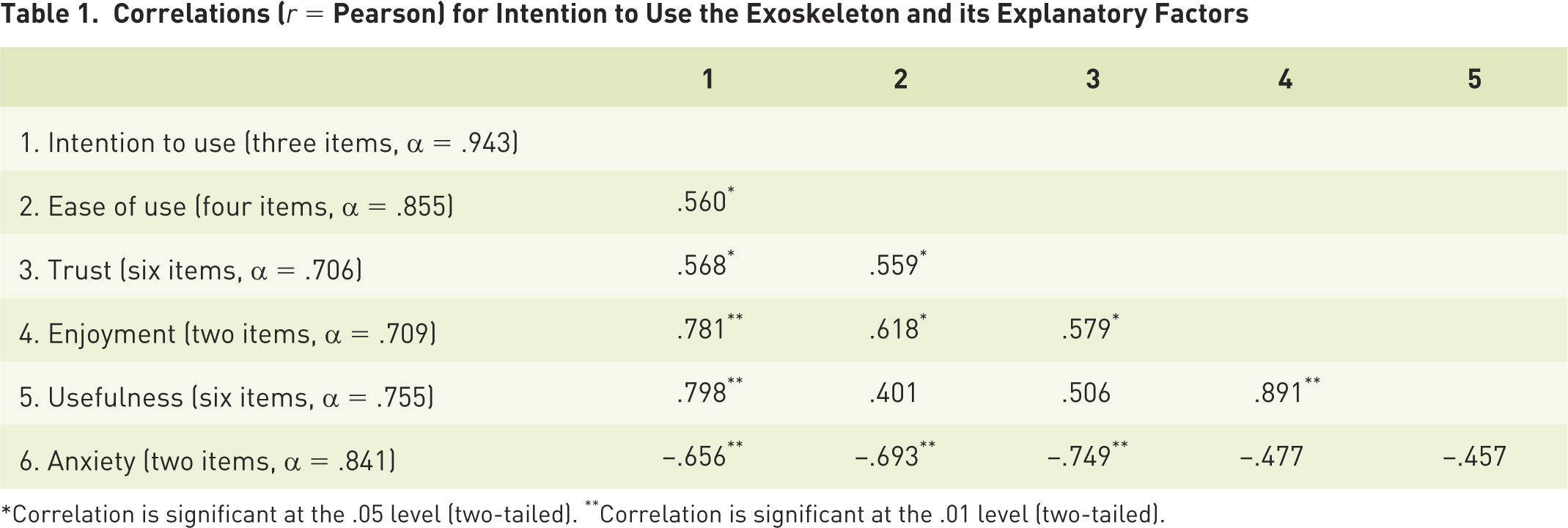
Correlation is significant at the .05 level (two-tailed). **Correlation is significant at the .01 level (two-tailed).
In both studies we found that it would be important if the exoskeleton were inconspicuous for the patient. First, the nurses were concerned about their own safety when wearing the exoskeleton, because the patients could grab onto the device. Especially in dementia care, it is quite usual that the patients grab on to the carer and the exoskeleton might even look like something the patient is meant to grasp or lean on. Second, the nurses were concerned that if the exoskeleton remained visible, the nurses’ appearance would potentially resemble robots in their patients’ eyes—possibly jeopardizing the delicate interaction and trust between the carer and the patient.
In S1, the nurses who felt anxiety using the exoskeleton also had less trust in the equipment’s reliability and safety, on average. While trust did not appear as the most significant correlates of use intention, in qualitative interviews the exoskeleton’s trustworthiness was repetitively mentioned. In fact, our observations align with studies which show that trust toward technology is not only about the characteristics of the said technology but also include personal and procedural characteristics related to the technology use (Hancock et al., 2011; Steinke et al., 2014).
Impacts of Social Environment
In the preinterviews of S2, most nurses expected the exoskeleton use would arouse interest and curiosity among patients and their relatives. Some thought the exoskeleton could cause aversion, especially if the nurses themselves expressed negative attitudes toward the exoskeleton or were unable to respond questions about it. However, some did suspect that the exoskeleton would not even draw the attention of the patients, especially patients who suffer from memory disorders. These predictions were quite accurate in our findings, but the patients also commented how the nurse and the exoskeleton “blended into each other,” forming a robot of sorts. This was something that the nurses in S2 were not expecting but what the nurses and students in S1 were worried about: Would they look like a robot?
The nurses reported that some patients in S2 produced quite negative attributions to the exoskeleton, for example calling it “a mess.” The reason for this may be that when the nurses wore the exoskeleton, their appearance came across as clumsy and awkward. The postinterview revealed that the patients showed compassion toward the nurses who “had to” use the exoskeleton.
Again, in the preinterviews of S2, the nurses assumed their colleagues would have quite mixed views about the exoskeletons. They expected that some colleagues would have a very negative opinion merely because they did not know enough about the exoskeleton’s usefulness. Some nurses anticipated that the trial period might cause the colleagues to either ridicule the device or express interest to try it on. While the postinterviews supported these presumptions, the nurses also expressed that their colleagues questioned the exoskeleton’s weight and pleasantness. The colleagues presumed that the discomfort would decrease the intention to use the exoskeleton, but the nurses in our sample expressed being motivated to use it primarily because it would improve their ergonomics, and how this promise of positive health benefits would outweigh any possible drawbacks.
As a result of the trials, the nurses did not believe there would be a lot of opposition among their colleagues or the patients toward using the exoskeleton. This was rationalized by the fact that most negativity was aimed at the exoskeleton itself, such as its appearance and ergonomics, not at the nurse wearing it. The nurses also thought that using exoskeletons would have managers’ support. Our study does not support the work community cliques and “martyrdom” related to technology use in the workplace, which has been found in similar studies (Melkas et al., 2020). According to these previous studies, some care workers felt that they need to do all the care work also on behalf of their colleagues, who, they think, concentrate on “playing with technology.” In the present study, these kinds of community level conflicts were not found.
Conclusions
It is important to design new technologies and working methods together with professionals. Our study of nurses using exoskeletons provides evidence on specific characteristics of geriatric care work that either enhance or hold up the implementation of this new technology.
According to the correlative part of the study, perceived usefulness and enjoyment of use increases and anxiety toward the use decreases nurses’ exoskeleton acceptance. The results further imply that the best way to improve the perceived usefulness is to invest in the better ergonomics and pleasantness of the use. This would mean better fit for individual users. To lower the anxiety toward the exoskeleton use, then, the users would have to trust that the equipment is reliable and safe even in demanding and changing situations.
Beside the functional characteristics of the device, many aspects of human-centered care work have to be taken into consideration when implementing exoskeletons in care context (Steinke et al., 2014). New technology has to be compatible with ethical and social norms of care work. The trust between caregivers and patients in a care context has a critical role in the nurses’ experiences of using the exoskeleton. The wearable device transforms not only the sensory but also external features of the nurses’ body, and this has consequences for caregiver–patient interaction.
Technology acceptance model for exoskeletons does not yet exist, but our results give initial evidence for modelling exoskeleton acceptance. We highlight not only the specific professional context but also cultural context in exoskeleton acceptance. For example, the ease of use has typically played a strong role in predicting the intention to use technology (Heerink et al., 2010; Turja et al., 2020), but did not appear as a prerequisite for accepting exoskeletons among Finnish nurses, who have already extensive experience using technology in their work.
Footnotes
This study was supported by the Academy of Finland, the Strategic Research Council (Project: ROSE; Decision Nos: 292980 and 314180), the Academy of Finland/JPI MYBL (Project: ORIENT; Decision No. 318837), and the LUT Research Platform on Smart Services for Digitalisation (DIGI-USER).
