



Abstract
This project aimed to improve the sleep, wellness, and mood of personnel standing watch on US Navy Information Warfare watchfloors. Data were collected from 82 participants on two US Navy watchfloors. Volunteers wore ŌURA rings and completed questionnaires at the beginning and end of the study. Our findings suggest that the 6-section/8-hour-shift watchbill is generally preferable to the 4-section/12-hour-shift watchbill. We developed general guidelines and recommendations for fatigue mitigation based on the data collected from the two watchfloors, the predicted effectiveness of the two watchbills calculated using the Sleep, Activity, Fatigue, and Task Effectiveness (SAFTE-FAST) model, and background literature on shiftwork. The recommendations for watchstanders focused on sleep hygiene practices, sleep environment, timing of sleep and naps, light management, the use of caffeine, alcohol, and nicotine, nutrition, and exercise.
Keywords
Introduction
Background
Given the need for around-the-clock offensive and defensive operations performed by information warfare (IW) units, military personnel on IW watchfloors follow rotating shiftwork schedules involving night shift work and long hours standing watch. These schedules are known to interfere with sleep timing, quality, and duration (Matsangas & Shattuck, 2020; Shattuck et al., 2019; Shattuck, Lawrence-Sidebottom et al., 2023). Studies conducted by the Naval Postgraduate School (NPS) Crew Endurance Team have identified that poor sleep quality and shorter sleep durations are associated with impairments in operationally relevant metrics of performance (Matsangas & Shattuck, 2020; Shattuck et al., 2016; Shattuck, Lawrence-Sidebottom et al., 2023).
Also, our studies on Sailors in underway USN ships have shown that schedules with more sections and shorter shifts are more favorable to personnel well-being and performance (Shattuck & Matsangas, 2019). These schedules, however, require greater manning levels which may not be feasible. Notably, off-duty periods may not be conducive to sleep because personnel may have other work-related duties, family responsibilities, and/or commutes to/from work during these off-duty periods. Even for schedules that appear to offer satisfactory opportunities for sleep, obtaining sleep during off-duty periods may be challenging. This reality highlights the need for a comprehensive view of a schedule—including the use of both on-duty and off-duty time—to understand its potential effects on readiness.
In an attempt to mitigate the problems associated with rotating (non-circadian-based) watchbills, the US Navy released in 2017 the Comprehensive Fatigue and Endurance Management Policy (Department of the Navy, 2017) which was later revised by the longer and more detailed Comprehensive Crew Endurance Management Policy (CCEMP; Department of the Navy, 2020). The introduction of the 2017 policy was an important step toward prioritizing readiness and well-being in the Navy while also potentially improving Sailor performance. Several challenges, however, remain for the effective implementation of circadian-based schedules. First, the number of watch sections available is largely dictated by manning levels. The schedule that is chosen must accommodate both the number and qualifications of available personnel. Operational requirements (e.g., mandatory training or drills) will often limit or reduce the effectiveness of a watchbill by cutting into the time available for contiguous sleep and recuperation. Ultimately, it can be challenging to select the best circadian-based watchbill; it requires knowledge of operational requirements and circadian science. Unfortunately, choosing and implementing watchbills is largely left to an organization’s leaders, who may have little training in sleep and circadian rhythms. Consequently, their scheduling decisions may not be best for their crew.
Even though the revised 2020 policy focuses on surface ships, it could also potentially benefit other operational naval settings, including shore-based facilities. However, at this time, the USN lacks a comprehensive fatigue management policy tailored to the unique needs of shore-based facilities (e.g., IW watchfloors). If available, such a policy could be adapted to many other shore-based military contexts.
Scope
The overarching aim of this project was to improve the sleep, wellness, and mood of personnel standing watch on US Navy Information Warfare watchfloors. The study had four objectives: (a) to document the watchbills used, (b) to assess the strengths and weaknesses of the watchbills, (c) to estimate the overall state of the watchstanders participating in the study, and (d) to develop watchstanding and fatigue mitigation recommendations tailored to the two watchfloors to maximize watchstanders’ readiness.
Methods
Study Design
A quasi-experimental longitudinal study design was used to assess watchstander well-being and predicted effectiveness. Using this naturalistic approach, active-duty service members (ADSMs) were observed while they performed their normal duties. The study methodology replicated methods used in several previous Crew Endurance Team efforts (Miller et al., 2012; Shattuck, Lawrence-Sidebottom et al., 2023; Shattuck & Matsangas, 2020).
Participants
Data were collected from 82 participants (62.2% males; 85.4% enlisted; median age of 27 years ranging from 19 to 54 years) in two US Navy watchfloors between February and May 2023.
One of the watchfloors being studied used a rotating 4-section/12-hour-shift watchbill with watchstanders rotating between day and night shifts every 30 days. Watchstanders on this watchfloor “4WS-12 hr” worked either between 0600 and 1800 or between 1800 and 0600.
The second watchfloor used a rotating 6-section/8-hour-shift watchbill with watchstanders rotating between days, eves, and mids every 30 days. Watchstanders on this watchfloor “6WS-8 hrs” worked either between 0600 and 1400, between 1400 and 2200, or between 2200 and 0600. All watchstanders worked on these watchbills prior to and throughout the study.
Procedures
Volunteers completed questionnaires at the beginning and end of the study. The questionnaires included four standardized tools. The Pittsburgh Sleep Quality Index (PSQI) was used to assess sleep quality (Buysse et al., 1989). Individuals with a PSQI global score of 5 or less are characterized as good sleepers, whereas scores larger than 5 are associated with poor sleep quality. Also, a PSQI global score greater than 9 suggests a higher risk of impaired psychomotor vigilance performance (Matsangas & Shattuck, 2020).
The Insomnia Severity Index (ISI) was used to assess the severity of insomnia symptoms insomnia (Bastien et al., 2001; Morin et al., 2011). The ISI cutoff criterion was derived from a clinical population; a score of 15 or higher is indicative of symptoms of clinical insomnia (Gagnon et al., 2013).
Average daytime sleepiness was assessed with the Epworth Sleepiness Scale (ESS) (Johns, 1991). An ESS score greater than 10 reflects daytime sleepiness above normal (Johns, 1991, 1992). Also, the operational utility of the ESS lies in its ability to identify individuals who are at higher risk of psychomotor performance impairment (Shattuck & Matsangas, 2015).
Lastly, the Profile of Mood States (POMS) scale was used to assess mood (McNair et al., 1971). Normalized T-scores are based on norms for adults (Nyenhuis et al., 1999).
Sleep characteristics were assessed by the Generation 2 ŌURA ring wearable devices (ŌURA Health Ltd, Oulu, Finland; https://ouraring.com/). We modeled the sleep/wake patterns of watchstanders with the Sleep, Activity, Fatigue, and Task Effectiveness model implemented in the Fatigue Avoidance Scheduling Tool (SAFTE/FAST). This assessment included the identification of weaknesses (e.g., drops in predicted effectiveness—PE) and contrasting the watchbills in terms of PE during shifts and percentage of shift time with PE < 77.5%. FAST models were developed both for excellent and good sleep quality. Detailed results from the SAFTE/FAST models can be found elsewhere (Shattuck, Matsangas, & McClernon, 2023).
Analysis
Statistical analysis was conducted with JMP statistical software (JMP Pro 17; SAS Institute; Cary, NC). First, the analysis focused on describing the study sample in terms of demographic characteristics, occupational characteristics, sleep-related behaviors, and well-being at the beginning of the study. We assessed the sleep attributes of 55 participants based on their data from the ŌURA rings. The next step was to contrast the data collected on the watchfloors with pre-collected data from Sailors on underway ships of the USN (568 Sailors, six ships). Lastly, we compared the two watchbills and assessed the acceptance and subjective preference of the watchbills used on the two watchfloors using 10 different criteria.
Results
The body weight of 57.3% of participants was above normal (i.e., BMI > 25), 97.6% reported consuming caffeinated beverages, 24.4% used nicotine products, and 85.6% had a regular exercise routine. Participants slept a median of 6.71 hr per day.; 62.3% of participants slept less than 7 hrs per day and 14.5% slept less than 6 hrs per day. Approximately 84% of the participants reported taking a nap during the data collection period; however, habitual napping was not highly prevalent with 25.5% of participants napping once every 10 days, and only 3.64% napping once every 4 days.
In total, 88.9% of the participants were classified as poor sleepers, 30.5% reported symptoms of excessive daytime sleepiness, 20.7% reported symptoms of insomnia, and 20.7% of the participants had all three conditions. Based on responses on the Profile of Mood States scale, the mood of Sailors on the two watchfloors was generally worse than that of the normal adult population with 74.1% of our participants scoring worse than the 50th percentile for total mood disturbance, 79.0% on the tension-anxiety subscale, 80.3% on the vigor-activity subscale, 72.8% on the fatigue subscale, and 80.3% on the confusion-bewilderment subscale. These results are shown in Figure 1.
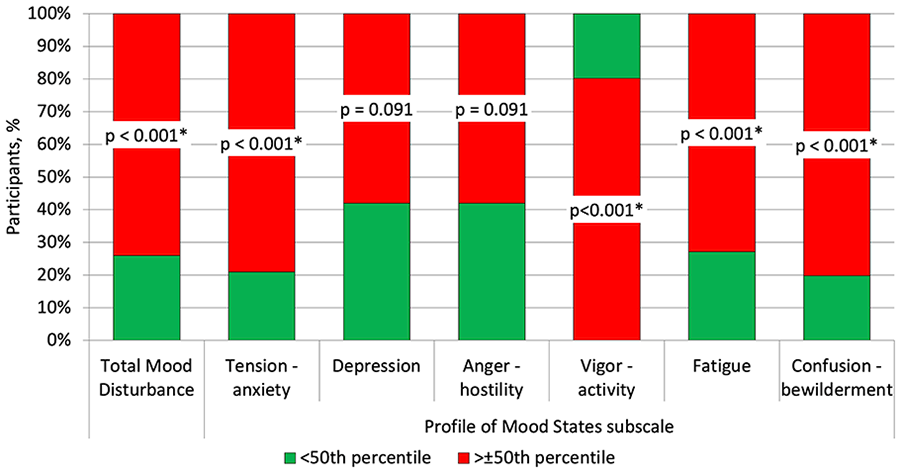
Percentage of participants at the beginning of the study with POMS scores better or worse than the 50th percentile of adult norms.
Compared to a sample of 568 Sailors underway on US Navy ships, the mood of the Sailors on the two watchfloors was worse in terms of tension-anxiety (p < .001) and confusion-bewilderment (p = .012), but was equivalent for depression, anger-hostility, vigor-activity, fatigue, and for total mood disturbance (all p > .160).
Comparisons between the beginning and the end of the study and between the two watchbills did not identify substantive systematic differences with respect to well-being, mood, and sleep-related variables (i.e., daily sleep duration, napping, and long sleep episode variables) (all p > .10). Substantive differences, however, were seen in participant satisfaction with their watchbills. In total, 40.5% of the 6WS-8hrs watchbill responses were positive and 18.7% were negative.In contrast, 45.5% of all responses for the 4WS-12 hrs watchbill were negative (i.e., dissatisfied) and 19.9% positive (i.e., satisfied). In particular, the two issues most liked were that the watchbill was predictable (61.5% positive responses) and that it allowed watchstanders to plan their day (53.9%). Aggregated results are shown in Figure 2, Figure 3 shows detailed results from responses received for the 10 criteria we used to assess satisfaction with the watchbill.
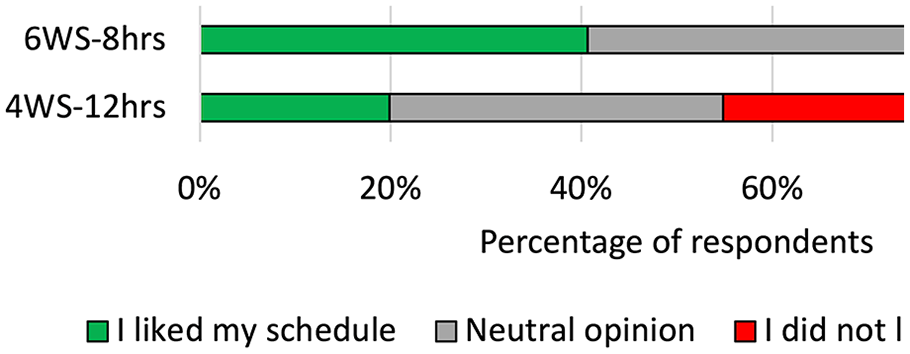
Overall satisfaction with the watchbill.
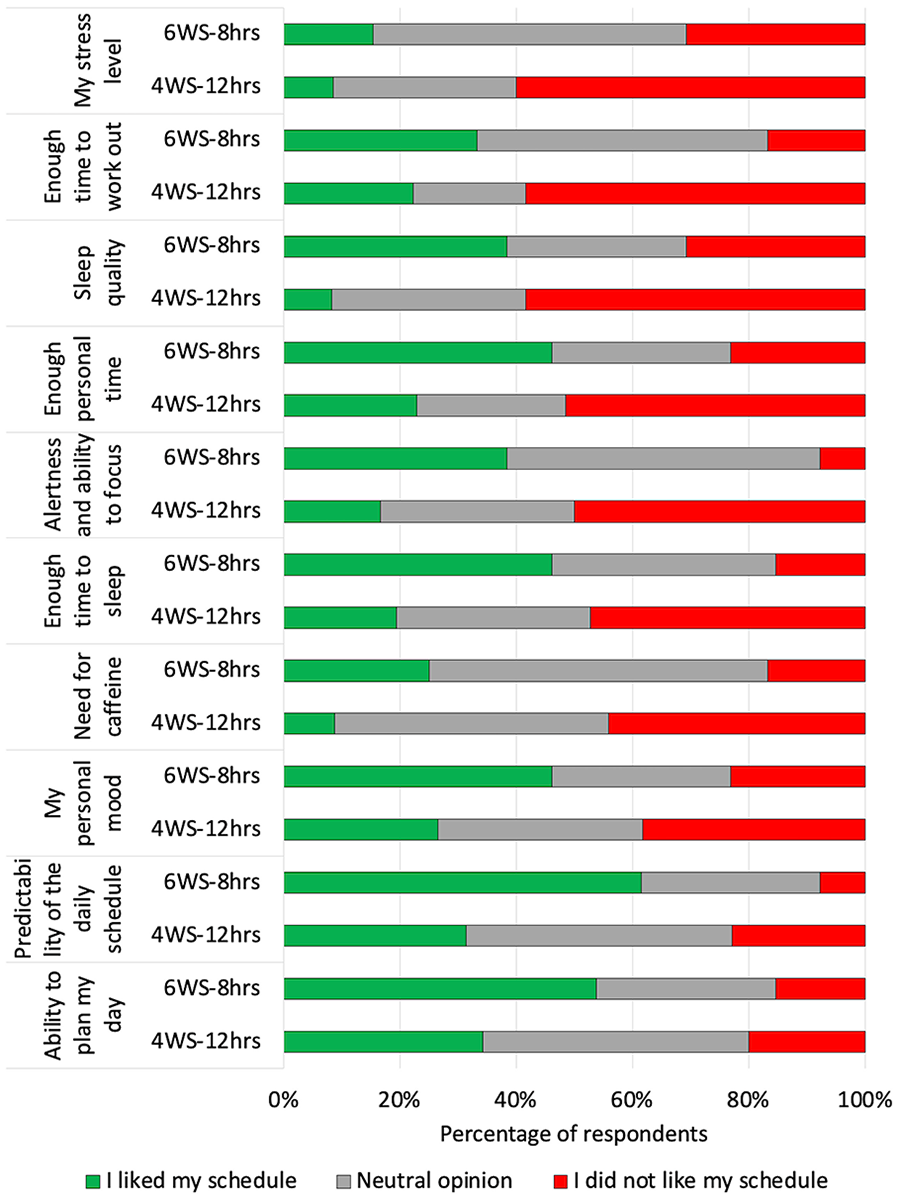
Detailed satisfaction with the watchbill.
Discussion
In general, our findings suggest that the 6WS-8hrs watchbill is generally preferred over the 4WS-12hrs. However, we did not identify substantive or systematic differences in terms of well-being, mood, and sleep attributes. These results can be explained if we consider that both watchbills share a characteristic that is problematic from a human physiology and performance standpoint: the schedules are rotating. As seen historically in other studies on shift schedules (Colquhoun, 1985; Colquhoun et al., 1968; Colquhoun & Folkard, 1985; Goh et al., 2000; Hakola et al., 1996; Kleitman et al., 1949), the research conducted over the past 20 years by the NPS Crew Endurance Team has clearly shown that from a human physiology perspective, non-circadian watchbills should be avoided (Shattuck & Matsangas, 2019, 2022a, 2022b). The problems of the rotating watchbills can only be partially ameliorated by having more watch sections which is exactly what we see in the present study findings.
We developed general guidelines and recommendations for fatigue mitigation based on the data collected from the two watchfloors, the predicted effectiveness of the two watchbills calculated using the Sleep, Activity, Fatigue, and Task Effectiveness (SAFTE-FAST) model, and background literature on shiftwork to include studies conducted by the NPS Crew Endurance Team. The recommendations for watchstanders focused on sleep hygiene, sleep environment, timing of sleep and naps, light management, use of caffeine, alcohol, and nicotine, nutrition, and exercise. Detailed information on these recommendations can be found elsewhere (Shattuck, Matsangas, & McClernon, 2023). Future studies should collect data from more watchfloors to refine the recommendations we have developed.
Footnotes
Acknowledgements
The views expressed in this study are those of the authors and do not necessarily reflect the official policy or position of the Department of the Navy, the Department of Defense, or the U.S. Government.
Declaration of Conflicting Interests
The author(s) declared no potential conflicts of interest with respect to the research, authorship, and/or publication of this article.
Funding
The author(s) disclosed receipt of the following financial support for the research, authorship, and/or publication of this article: This study was prepared for Naval Information Forces (COMNAVIFOR) and was supported by funding from the Naval Postgraduate School, Naval Research Program (PE 0605853N/2098) - NRP Project ID: NPS-23-N055-A.
