



Abstract
The purpose of this pilot study is to identify specific safety climate dimensions pertaining to firearm safety and accidental discharge of firearms. New items capture the seriousness in firearms training pertaining to safety, handling and learning. The new items were developed in cooperation with the Swedish Armed Forces. The new items together with the Nordic safety climate questionnaire and the military safety climate questionnaire were distributed to one regiment within the Swedish Armed Forces. Data was collected and analyzed through statistical methods. An exploratory factor analysis initially indicated two new factors. The confirmatory factor analysis rejected one new factor keeping Serious firearms training. A two-level factor model was created influenced by accidents and incidents relating to firearms. Two latent variables were identified Safety Voice and Safety engagement both affected by accidents and incidents relating to firearms. The employee category squad leaders, soldiers or sailors at the lowest level of the organization, display significant differences compared to others in creating a climate were incidents and accidents might not be discussed or learnt from preventing unsafe behavior. The results from this study have one dominant limitation, this being that the sample size is only from one regiment. The new factor Serious firearms training need additional testing and validation before being adopted into an instrument. Future research should focus on verifying the two-level factor model with additional data from other military installations and to incorporate other types of variables into the model.
Accidental discharge of firearms is a recurring problem for many military and law enforcement organizations. The Swedish Armed Forces (SwAF) is continuously training soldiers and engaging in different military operations. Military personnel learn gun safety in training. During operations they work with their weapon and change their behavior to something perceived as more practical. Minor adjustments transform safe gun practices to become what is perceived as faster and more lethal gun practices. The collective perception in different workgroups regarding gun safety regulations differentiates from unit to unit. Every year several cases of accidental discharges are reported to the SwAF occupations safety section. In rare cases the accidental discharge led to a fatality. In 2022 a soldier died during training from an accidental discharge. The accident investigation concluded that safety culture and safety climate affected the event. The soldiers involved in the accident had developed specific gun practices not regulated in any document or regulation.
When investigating accidental deaths during counter insurgency operations accidental discharge accounted for 35.5% of fatalities. Of the accidental gunshots reported in 2006, 77.8% was deemed as accidents (Arora et al., 2008). From a Swedish perspective accidental discharge is not commonly studied. However, some studies do exist. In a study focusing on unintentional firearm death with data from the National Board of Forensic Medicine 171 cases were identified. When classifying the cases 43 were classified as non-hunting related, 5 were military deaths. In most military cases both shooter and victim were military recruits (Junuzovic et al., 2016). Safety climate and gun safety have previously been discussed in hunting. During the 1980’s Swedish hunters were introduced to a mandatory safety education which had a positive impact on safety climate among hunters (Junuzovic & Eriksson, 2012). Safety climate is generally defined as the collective perceptions of how safety is regulated in the workplace (Neal & Griffin, 2002; Zohar, 1980). Safety climate influences safety behavior, with two important components: (1) safety compliance and (2) safety participation (Neal & Griffin, 2002). One way for employees to participate is to speak up. A literature review identified 373 articles relating to safety voice in health care. Four themes were identified: (1) hierarchies and power dynamics, (2) unsafe and/or ineffective communication, (3) embedded expectations, and (4) managers effect on safety voice (Morrow et al., 2016). Hierarchies and power dynamics were the most common theme. Organizations emphasizing a top down hierarchy create a differential in power that might silence the safety voice and instead create fear in the lower levels of the organization (Kish-Gephart et al., 2009). Participation and having a voice will also benefit other aspects of safety climate. Organizations that actively work with safety climate are also influencing the will to report incidents (Clarke, 2006; Kongsvik et al., 2012; Mearns et al., 2003).
The SwAF have participated in a research project to adjust the Nordic Safety Climate Questionnaire (NOSACQ-50) (Kines et al., 2011) and develop new military dimensions resulting in the Military Safety Climate Questionnaire (MSCQ) (Schüler & Matuszczyk, 2019; Schüler & Vega Matuszczyk, 2022). The project resulted in several new dimension relevant for measuring safety in a Swedish military context. Unfortunately, gun safety and accidental discharge was not included in the new dimensions. Firearms are an essential part of the equipment used by military personnel. When examining the safety climate literature specific dimensions for firearms, gun safety and accidental discharge seems non-existent. From a theoretical standpoint safety climate could have an impact on gun safety and accidental discharge in organizations that use firearms as tools in their work.
Traditionally safety climate dimensions seem to be developed for multiple use in different domains and sectors such as construction, health care and aviation. The specific tools used by the military organization such as firearms could therefore be judged as non-relevant in the instrument development phase.
The purpose of this pilot study is to identify specific safety climate dimensions pertaining to gun safety and accidental discharge of firearms.
Method
This study analyzes the factor structure of two different instruments measuring safety climate combined with additional items pertaining to firearms using statistical methods.
Instruments
Two validated instruments were used during this study. The NOSACQ-50 instrument with seven dimensions: (N1) Management safety priority, commitment and competence (Management commitment), (N2) Management safety empowerment (Management empowerment), (N3) Management safety justice, (N4) Workers’ safety commitment (Workers’ commitment), (N5) Workers’ safety priority and risk non- acceptance (Risk non-acceptance), (N6) Safety communication, learning, and trust in co-worker safety competence (Communication and learning), (N7) Workers’ trust in the efficacy of safety systems (Safety system) (Kines et al., 2011). The MSCQ with seven dimension: (M1) Management support for safety performance (Support performance), (M2) Workers’ knowledge of and competence in national laws regulating safety (Knowledge of laws) (Schüler & Matuszczyk, 2019), (M3) Unit ethics (Weber & Gerde, 2011), (M4) Management prioritizing physical fitness (Prioritizing fitness), (M5) Workers’ evasion from physical fitness training (Evading fitness), (M6) Fair evaluation of physical fitness (Fair evaluation), (M7) Workers’ acceptance of vulnerability (Acceptance of vulnerability) (Schüler & Vega Matuszczyk, 2022). One addition factor was added, (M8) Workers’ improvement of safe work practices (safety improvement) (results are in an ongoing review).
Item generation
Additional items relating to firearms were created after (1) conversations with military officers and specialist officers regarding firearm training and (2) reading accident reports on accidental discharge. Items were then designed inspired by NOSACQ-50 and MSCQ. Thirteen new items were developed and fitted to a 4-step rating scale ranging from 1 (strongly disagree) to 4 (strongly agree) with an additional Do not know alternative.
Designing the variable for perceived accidental discharge
The SwAF military union pamphlet describes accident reporting as a troublesome area that struggles with underreporting. To make it less unpleasant to answer questions displaying personal faults and errors reference shift was used. Instead of asking how many accidental discharges each responded had made during a 12-month period (12 months is almost equal to a training cycle of conscripts). The respondent was asked “how many incidents and accidents have you perceived during the latest 12 months?” thus rating the environment surrounding the respondent (variable is called AD).
Data collection
The questionnaire was distributed through SharePoint on the SwAF network. A web link was created and distributed through the chain of command within one regiment. Employees (600) were asked to answer the survey voluntarily and anonymously during a 3-week time frame from middle of March to the beginning of April in 2024. A reminder to participate were sent during the beginning of every week. The data collection resulted in 336 answers (56%). The low number of female employees resulted in the exclusion gender from the questionnaire, due to ethical considerations (the risk of identification).
Participants
All employment categories are represented in the data set. The 336 answers consist of civilian (Civ) n = 55, squad leader, soldier, or sailor (SSS) n = 154, specialist officer (SO) n = 83, and officer (OF) n = 44. The mean experience from the SwAF were 9.20 years and they had 2.51 years experience from their current position. Of the 336 respondents 318 reported that they had experience with firearms. Of the 318 respondents several reported experiencing incidents and accidents with firearms: Civ (M = 0.05), SSS (M = 0.73), SO (M = 0.48), and OF (M = 0.88).
Data analysis
Each item was examined in relation to the responses to ensure all response alternatives in the scale were used. Skewness and kurtosis for each item were analyzed. An exploratory factor analysis (EFA) was conducted in Mplus (Muthén & Muthén, 2017) using the 13 items. The results from the EFA were confirmed by confirmatory factor analysis (CFA) (Muthén & Muthén, 2017). The variable AD was introduced non- significant factors were removed. A two-level CFA was performed. Interpretating the two-level CFA in relation to first level factor content. Cronbach’s alpha was calculated for all factors. Inter correlation coefficient ICC1 and ICC2 was calculated for all factors to determine if items were possible to aggregate (Woehr et al., 2015). Bivariate correlations were calculated among the different factors. A one-way ANOVA and post-hoc test were conducted with the first level factors and the second level factors with the variable employment categories. G*power was used to calculate effect size, actual power, and recommended sample size (Erdfelder et al., 2009).
Result
When examining the responses alternatives one item had one alternative unused and resulted in exclusion of the item. The items averaged skewness (−1.30) and kurtosis (1.56). The items relating to firearms produces a mean skewness (−2.06) and kurtosis (4.44). Specifically, item 10 had a big influence producing skewness (−3.23) and kurtosis (12.56) (See Table 1). The effects of skewness and kurtosis could be reduce with a large sample size exceeding 200 (Tabachnick & Fidell, 2013). The data set contained no outliers and no errors.
Tested New Items Relating to Firearms Training.
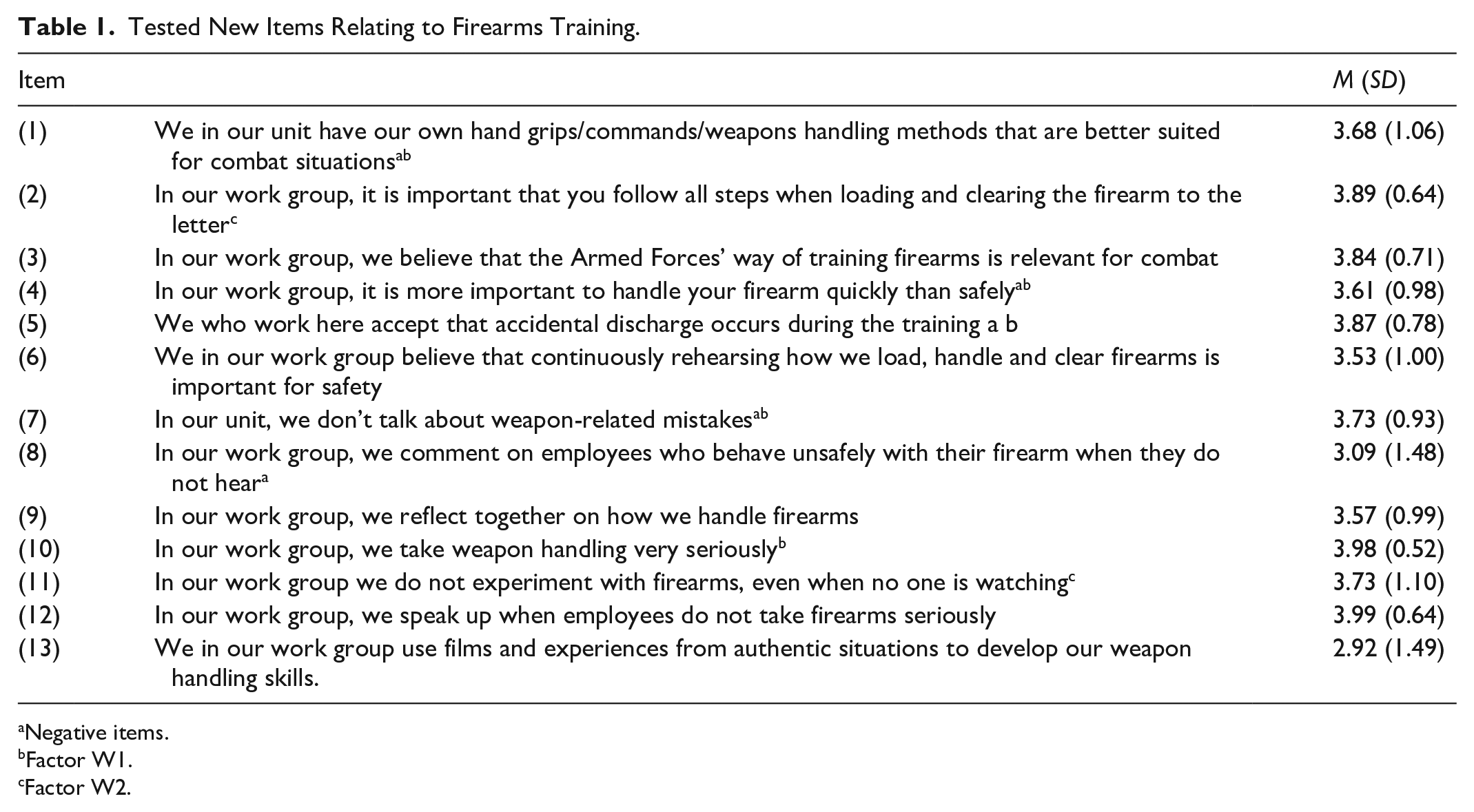
Negative items.
Factor W1.
Factor W2.
Exploratory and confirmatory factor analysis
An exploratory factor analysis indicated a four-factor structure. When examining the factor loading several items loaded on several factors. After isolating the items, a two-factor structure was identified. The CFI (0.99), TLI (0.97), and RMSEA (0.04) values was acceptable and indicated a good fit for the model. (Tabachnick & Fidell, 2013; Xia & Yang, 2019). The two new factor (W1 and W2) was fitted to the factor structure of NOSACQ-50 and MSCQ. A confirmatory factor analysis was performed on the complete structure including NOSACQ-50, MSCQ, and two new factors. The CFI (0.96), TLI (0.95), and RMSEA (0.03) values also indicate a good fit (Tabachnick & Fidell, 2013; Xia & Yang, 2019).
Item agreement
Bivariate correlations and reliability analysis was conducted on all 17 factors. The Cronbach’s alpha values ranged from .47 to .93. The new factor W2 generated the lowest value. When isolating the 89 participants with experience from accidental discharge during the last 12 months the Cronbach’s alpha value was .54. ICC1 and ICC2 for the new factors was W1 (ICC1 0.29, ICC2 0.67) and W2 (ICC1 0.30, ICC2 0.46). W1 is suitable for aggregation (ICC1 > 0.21 and ICC2 > 0.66) (Woehr et al., 2015).
Two level factor model
When the model interacted with the variable (AD) perceived incidents and accidents with firearms. Several factors had moderate and high correlations with each other. A two-level factor analysis was conducted together with the variable AD. Two latent variables were identified (X1 and X2). The CFI (0.95), TLI (0.95), and RMSEA (0.04) values also indicate a good fit (See Figure 1) (Tabachnick & Fidell, 2013; Xia & Yang, 2019).
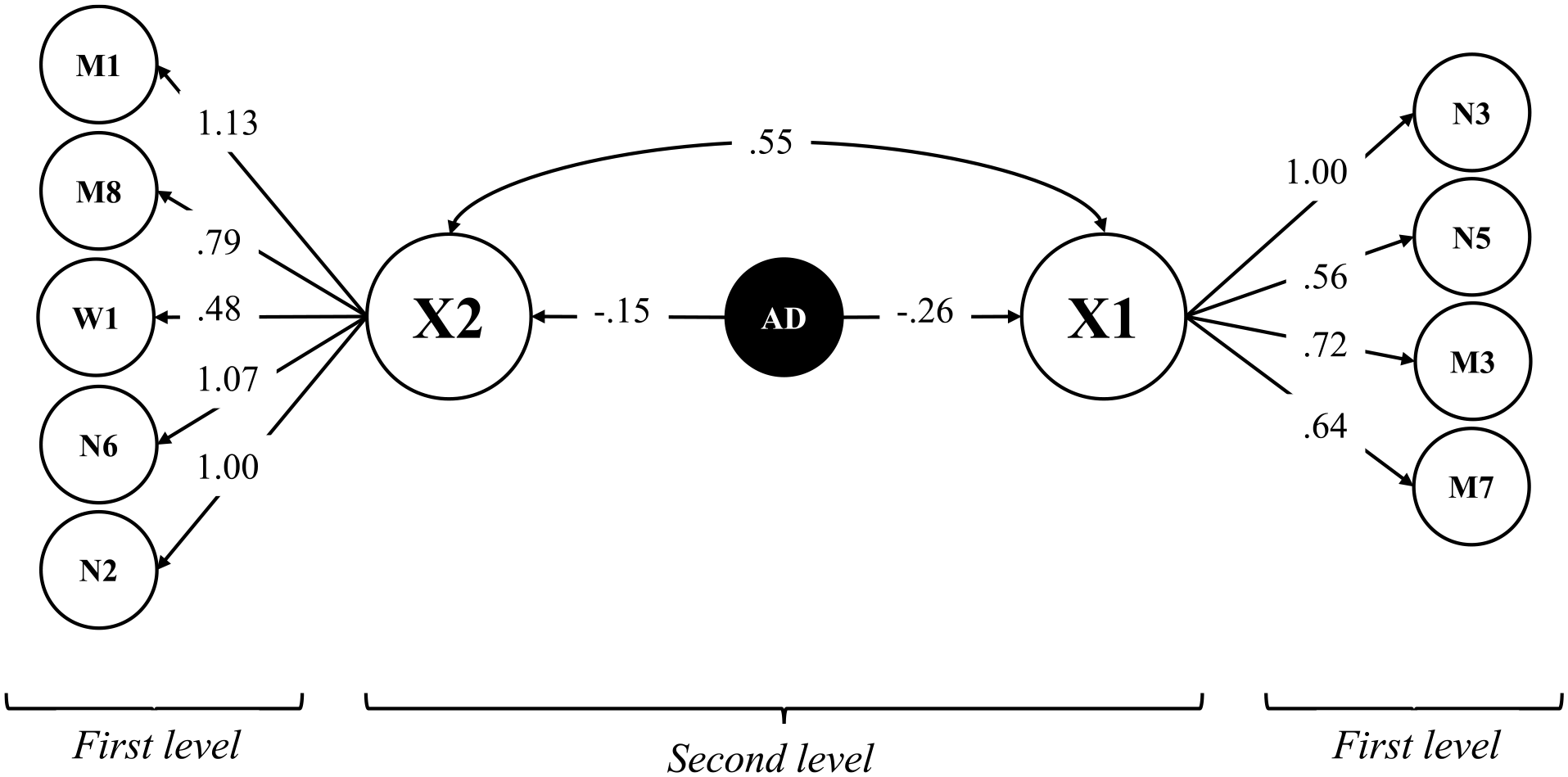
Two level factor model.
Interpretating the factors
The model illustrates how AD contributes to the latent variables X1 and X2 (See Figure 1). In short, high values of weapon related incidents and accidents corresponds with low values in X1 and X2.
When interpretating the latent variables X1 is composed of Management justice, Risk non-acceptance, Unit ethics, and Acceptance of vulnerability relating to the ability to speak creating the latent variable Safety voice. Encouraging military personnel to speak about problems without the risk of repercussions or harassment from peers.
X2 combines Management empowerment, Communication and learning, Support performance, Safety improvement, and W1 (Serious firearms training) relating to engagement creating the latent variable X2 Safety engagement. Management is both willing and encouraging toward serious improvement, constantly learning, and improving practices. Factors W1 and W2 produced several moderate correlations between 0.36 and 0.67 (Taylor, 1990) (See Table 2).
Bivariate Correlations.
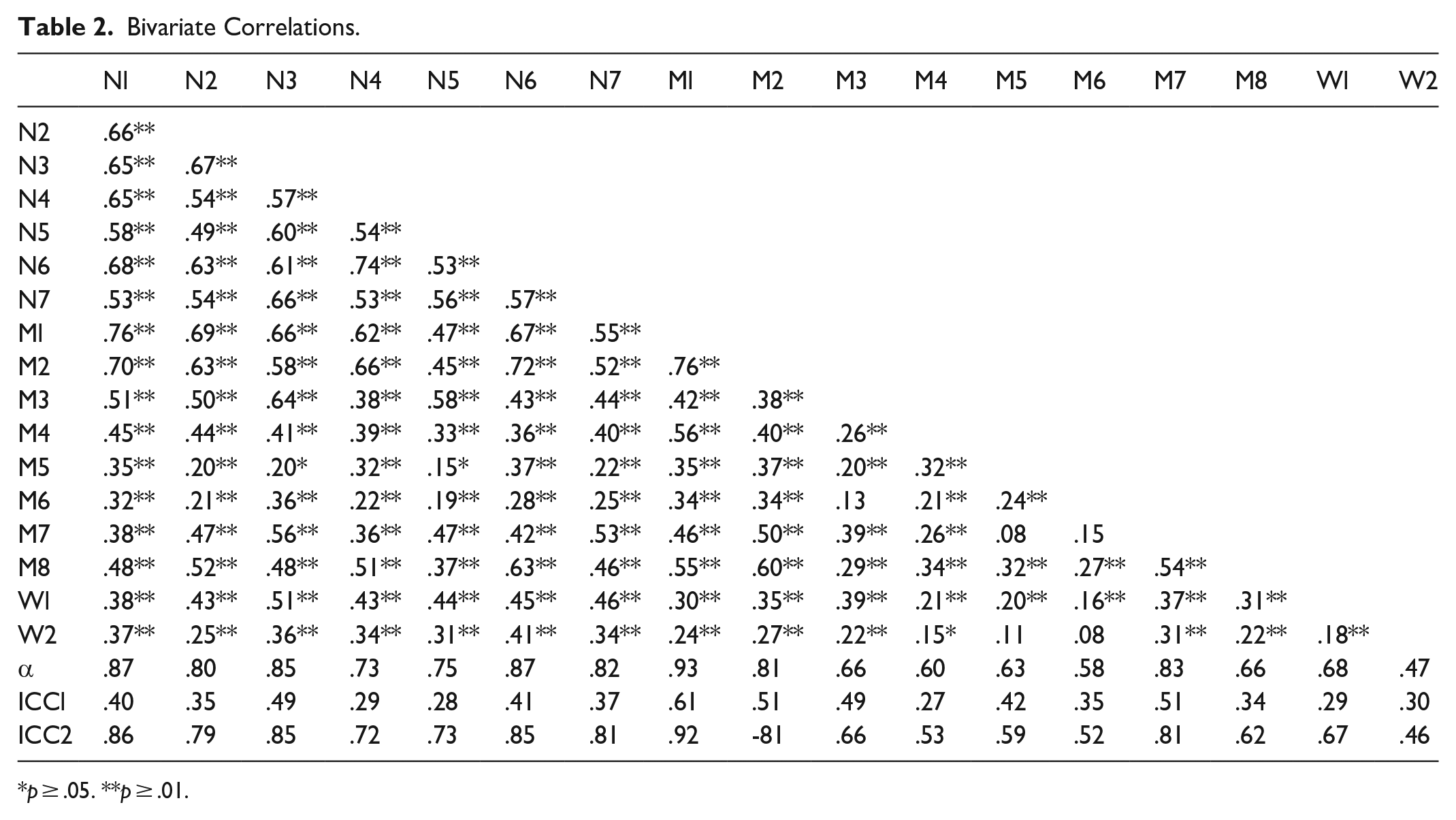
p ≥ .05. **p ≥ .01.
Differences among groups
The category SSS participate in most of the military firearm training. To better understand the differences and effects of the latent variables on employees a one-way ANOVA was conducted (see Table 3). The one-way ANOVA tests for the factors Serious firearms training (W1), Safety voice (X1), and Safety engagement (X2) and employee categories were statistically significant, factors Serious firearms training (W1) and Safety voice (X1) produced p < .01. Factor Safety engagement (X2) produced p = .05. The post-hoc test generated several differences, one common denominator is the category SSS produces the lowest values compared to other categories. In one case Safety voice (X1) the sample size is adequate for calculating effects (Faul et al., 2007). Factor Safety voice (X1) produces a moderate effect, Safety voice (X1) = 0.32 on the variable employee category. The calculated effects in Serious firearms training and Safety engagement required a larger sample size for reliable effect calculation.
Differences Between Employee Categories.
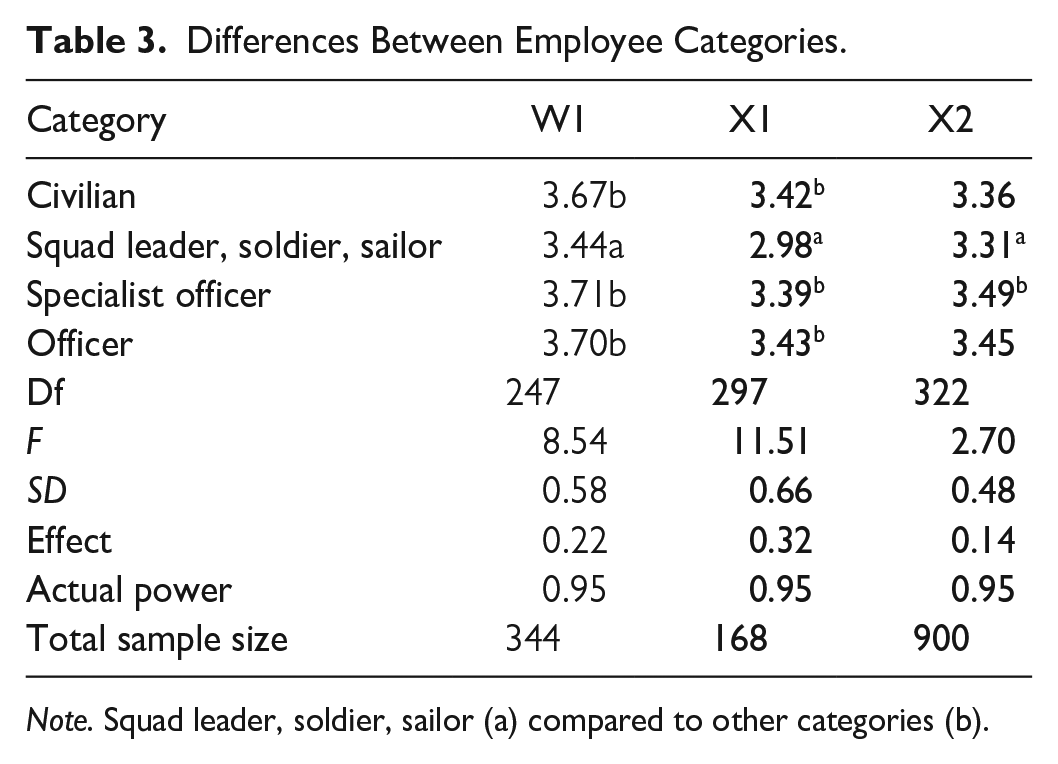
Note. Squad leader, soldier, sailor (a) compared to other categories (b).
The one-way ANOVA tests (See Table 4) for the factors Serious firearms training (W1), Safety voice (X1), and Safety engagement (X2) and organization levels were statistically significant, factors Serious firearms training (W1) and Safety voice (X1) produced p < .01. Factor Safety engagement (X2) produced p = .03.
Differences Between Organization Levels.
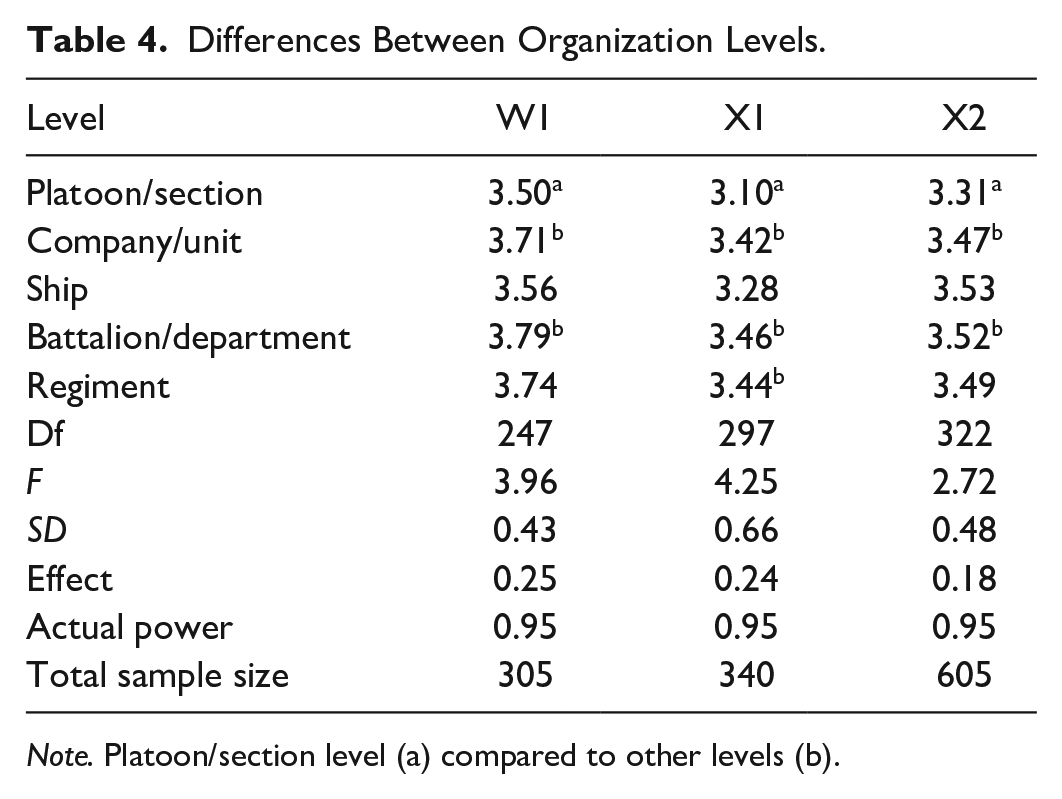
Note. Platoon/section level (a) compared to other levels (b).
The post-hoc test generated several differences; one common denominator is the lowest level platoon/section which produces the lowest values compared to other categories. In all three cases Serious firearms training (W1), Safety voice (X1), and Safety engagement (X2) the required sample size is larger than the actual sample size for reliable effect calculation (Faul et al., 2007).
Discussion
The purpose of this pilot study is to identify specific safety climate dimensions pertaining to gun safety and accidental discharge of firearms. The factor structure corresponds with the previous research on safety climate (Kines et al., 2011; Schüler & Matuszczyk, 2019; Schüler & Vega Matuszczyk, 2022; Weber & Gerde, 2011). The new firearm items produced one dimension with potential. The factor Serious firearms training relates to how military personnel’s collective perception regarding improving firearms knowledge and learning. The Cronbach’s alpha value for Serious firearms training is slightly below (0.67) the desired value of 0.7 (Tabachnick & Fidell, 2013) but the ICC1 (0.29) and ICC2 (0.67) values are above the desired threshold (ICC1 > 0.21 and ICC2 > 0.66) (Woehr et al., 2015) leading to an aggregation of the variable. This could perhaps be improved with a large more diverse sample or additional items and further investigation if item 10 could function on a more diverse group.
The second new factor W2 Responsible learning relates to the moral conduct of military personnel with hand firearms. The Cronbach’s alpha value is far from .7 but interestingly the group with experience from accidental discharge have a higher value despite fewer responses. This could indicate W2 is not suitable for everyone with firearms experience, only personnel with experience from accidental discharge. This could indicate experiencing an accidental discharge could lead to double loop learning (Argyris, 1976), a deeper understanding of firearms and dangerous hazard related to firearms.
Another result is the two latent variables Safety voice and Safety engagement. The two variables in part fit the model from Neal and Griffin (2002) with safety participation. The negative value from the variable AD on Safety voice and Safety engagement indicate learning issues in firearms training. Individuals with experience from incidents and accidents relating to firearms have lower values in both Safety voice and Safety engagement. From a safety perspective this could lead to serious safety concerns. Firearm incidents or accidents occur in a context where issues and problems are not allowed to be addressed publicly and can’t be improved or learned from generates a single loop learning (Argyris, 1976) rewarding not speaking up. The one-way ANOVA produced several significant differences among SSS compared to other personnel categories. The difference in Safety voice also produced a moderate effect. SSS have a different collective perception regarding Safety voice with the risk of creating a harmful silence regarding safety issues (Morrow et al., 2016) built on fear (Kish-Gephart et al., 2009).
A hypothesis generated from the two-level model is, experiencing an accidental discharge has a negative effect on individual learning and an increase in stress thus creating a greater risk for additional accidental discharges and a silent work group (learning to shoot accidental discharges). This hypothesis needs further investigation before it can be confirmed or discarded.
This study has several limitations mainly the diversity in the sample which could impact on the Cronbach’s alpha value. Another limitation is related to the experience from accidental discharge which relates to how items is understood.
Future research should focus on developing additional items and re-testing identified items and model. Another important area is bridging the gap between safety climate measures, stress and actual firearm incidents and accident (accidental discharge).
Footnotes
Declaration of Conflicting Interests
The author declared the following potential conflicts of interest with respect to the research, authorship, and/or publication of this article: The author is a Major and employed by both the Swedish Armed Forces and the Swedish Defense University.
Funding
The author received no financial support for the research, authorship, and/or publication of this article.
