



Abstract
Background:
Severe Gustilo-III foot injuries that combine segmental bone loss with extensive soft tissue damage remain challenging. One-stage reconstruction with a free fibular vascularized bone flap (FVBF) or free iliac vascularized bone flap (IVBF) offers the advantages of immediate skeletal stability, soft tissue resurfacing, and early mobilization, but contemporary outcome data are limited.
Methods:
From December of 2000 to November 2021, 6 patients who sustained from severe traumatic metatarsal, tarsal bone, and soft tissue defects were treated with a FVBF or IVBF incorporating soft tissue was used to reconstruct the metatarsal/tarsal bones and the soft tissue defect. Demographics, defect characteristics, perioperative variables, time to weightbearing, radiographic union, and complications were analyzed. Systematic literature review was performed to derive an evidence-graded reconstructive framework for managing Gustilo-Anderson type III open foot fractures.
Results:
Median length of follow-up is 24 months (range: 13 months to 2 years); all patients were able to walk independently and have returned to work. Six patients (mean age 32.8 ± 12.12 years) with defects of 8 to 22 cm were included. Partial weightbearing began at postoperative 10 weeks and mean return-to-work interval was 9.08 months. One partial muscle/skin necrosis (16.6%), 1 osteomyelitis (16.6%), and 1 venous congestion (16.6%) were observed postoperatively. No flap failure, nonunion, gait disturbance, instability, or amputation occurred.
Conclusion:
In this small consecutive series, single-stage free FVBF/IVBF reconstruction for Gustilo-Anderson type III foot injuries showed satisfactory union and a low infection rate. These findings support free FVBF/IVBF as a promising reconstructive strategy for complex foot trauma.
This is a visual representation of the abstract.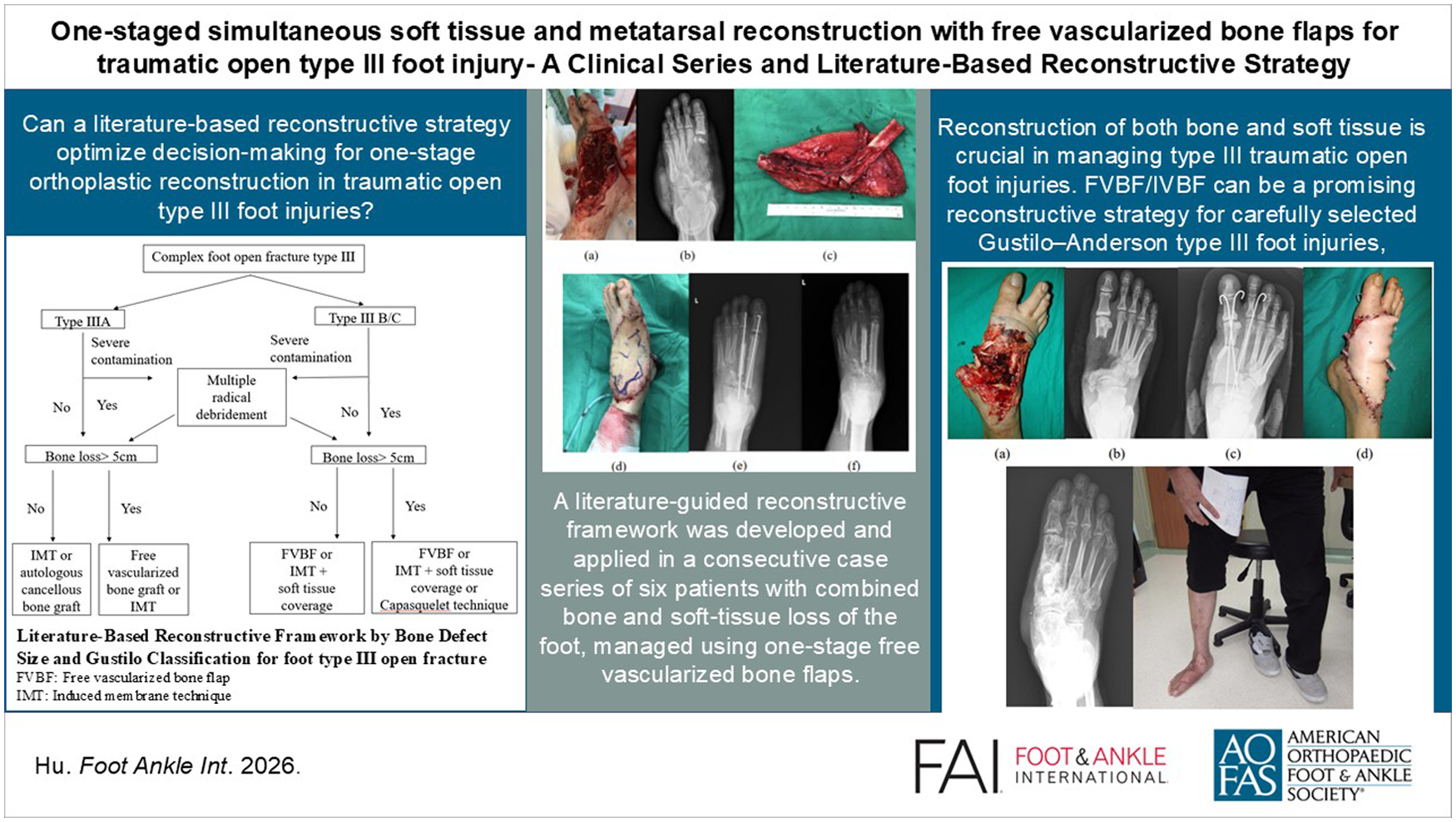
Get full access to this article
View all access options for this article.
References
Supplementary Material
Please find the following supplemental material available below.
For Open Access articles published under a Creative Commons License, all supplemental material carries the same license as the article it is associated with.
For non-Open Access articles published, all supplemental material carries a non-exclusive license, and permission requests for re-use of supplemental material or any part of supplemental material shall be sent directly to the copyright owner as specified in the copyright notice associated with the article.
