



Abstract
Background:
This study aimed to evaluate the efficacy and safety of an accelerated postoperative rehabilitation protocol (APRP), which emphasizes immediate full weightbearing (FWB), muscle strength and balance training as early as possible, after arthroscopic anterior talofibular ligament (ATFL) repair for chronic lateral ankle instability (CLAI).
Methods:
Patients with CLAI who underwent modified ATFL lasso-loop repair procedures between December 2019 and November 2022 were retrospectively screened. Based on their postoperative rehabilitation protocols, subjects were divided into the APRP group and the conventional postoperative rehabilitation protocol (CPRP) group using 1:2 propensity score matching. Clinical outcome measures comprised the Karlsson score, visual analog scale (VAS) for pain, Tegner score, anterior drawer test findings, complications, and magnetic resonance imaging–based ATFL Quality Score (ATFLQS). A receiver operating characteristic curve analysis was employed to investigate the association between preoperative ATFLQS and clinical outcomes in the APRP group.
Results:
The APRP group demonstrated comparable improvements in Karlsson score (31.8 ± 17.6 vs 36.0 ± 13.4, P = .267) and Tegner score (2 [−1 to 6] vs 2 [0 to 5], P = .168) to the CPRP group. Although the APRP group showed statistically superior VAS pain score improvement (3.5 ± 2.3 vs 2.2 ± 0.7, P < .001), the clinical significance of this 1.3-point difference remains uncertain given the lack of validated minimal clinically important difference thresholds for VAS pain in ankle ligament surgery populations. The overall complication rates between the 2 groups showed no statistically significant difference (10/54 vs 7/28, P = .492). Comparable ATFL quality was also found between the 2 groups based on the ATFLQS. The optimal ATFLQS threshold value for predicting functional outcomes was determined to be 2.5, based on the maximal Youden index, demonstrating a sensitivity of 82.4% and specificity of 83.3%.
Conclusion:
Comparable outcomes between the 2 groups were found following arthroscopic ATFL repair for CLAI, with no recurrence observed. FWB, muscle strength, and balance training as early as possible demonstrates both efficacy and safety after surgery. However, patients with preoperative ATFLQS <2.5 receiving APRP may have a significantly increased risk for suboptimal functional recovery.
This is a visual representation of the abstract.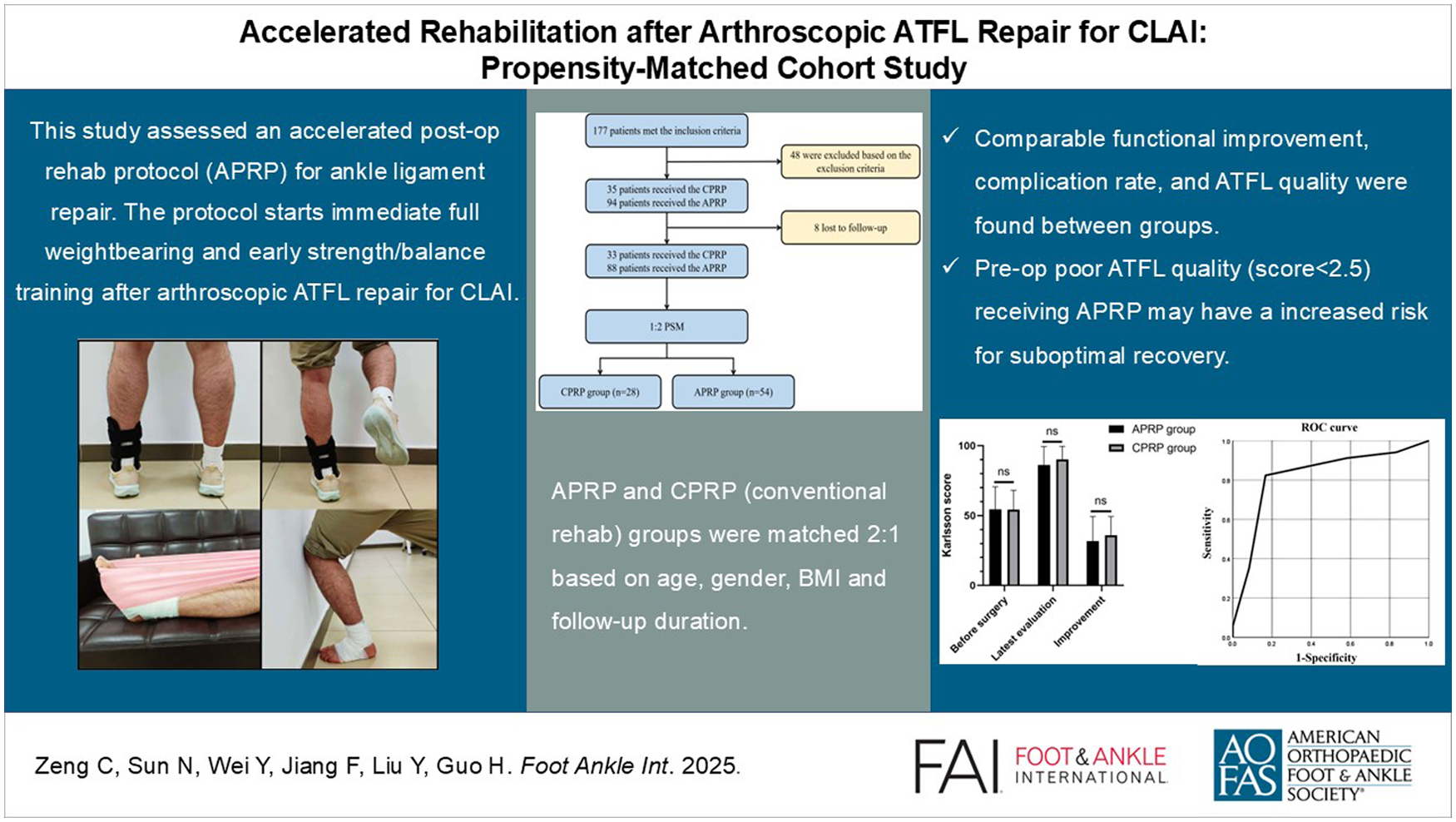
Keywords
Get full access to this article
View all access options for this article.
References
Supplementary Material
Please find the following supplemental material available below.
For Open Access articles published under a Creative Commons License, all supplemental material carries the same license as the article it is associated with.
For non-Open Access articles published, all supplemental material carries a non-exclusive license, and permission requests for re-use of supplemental material or any part of supplemental material shall be sent directly to the copyright owner as specified in the copyright notice associated with the article.
