




Abstract
Background:
Coronal wedge insoles are commonly prescribed to mitigate musculoskeletal disorders, yet their static-standing kinematic and kinetic effects on lower extremity joints remain insufficiently understood.
Methods:
This cross-sectional experimental study included 15 healthy older adults (mean 64.9 ± 6.0 y; 11 females, 4 males) who underwent CT imaging of the entire lower limbs during static standing. Ground reaction forces (GRFs) were simultaneously recorded using right and left force plates, with their sum equal in magnitude and opposite in direction to the body weight vector. Three floor conditions were tested: a 10-degree medial wedge, a flat surface, and a 10-degree lateral wedge. Lower limb alignment, GRF vector inclinations, projected GRF location at the height of the joint center, and external joint moments were assessed under 3 floor conditions.
Results:
Coronal wedges altered hip and subtalar joint angles, with medial wedges inducing hindfoot supination and hip abduction, whereas lateral wedges promoted hindfoot pronation and hip internal rotation. The GRF vector was found to generally pass lateral to the tibiotalar and subtalar joints and medial to the hip joint, generating eversion and adduction moments, respectively. Notably, these moments increased on the lateral wedge but were reduced on the medial wedge. In contrast, projected GRF location at joint height remained near the knee joint center across all conditions, resulting in minimal varus/valgus knee moments.
Conclusion:
This study provides the first quantifications of the 3-dimensional GRF vector concerning joint centers during static standing; these exploratory findings warrant confirmation during gait and in symptomatic cohorts. Our study suggests that lateral wedges tend to increase external joint moments at the hip and tibiotalar. Although further investigation is needed, these mechanical effects at the hip may have potential relevance and should be considered with caution when prescribing lateral wedge insoles.
This is a visual representation of the abstract.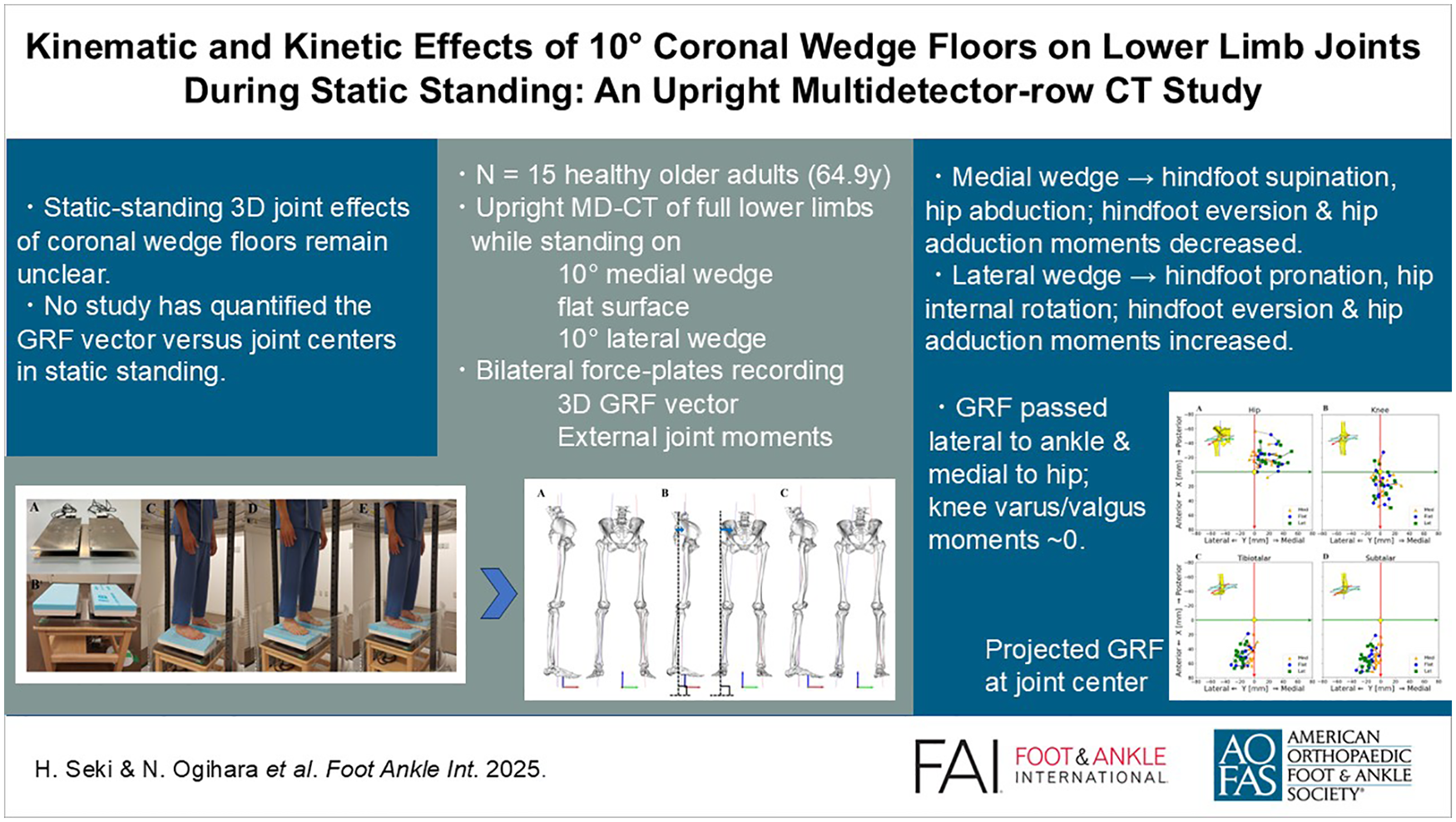
Keywords
Get full access to this article
View all access options for this article.
References
Supplementary Material
Please find the following supplemental material available below.
For Open Access articles published under a Creative Commons License, all supplemental material carries the same license as the article it is associated with.
For non-Open Access articles published, all supplemental material carries a non-exclusive license, and permission requests for re-use of supplemental material or any part of supplemental material shall be sent directly to the copyright owner as specified in the copyright notice associated with the article.
