




Abstract
Background:
According to literature, little is known regarding the effects of orthotic management of flatfoot on kinetics of vertical jump.
Objectives:
To compare the kinetic and temporal events of two-legged vertical jumping take-off from a force plate for heading a ball in normal and flexible flatfoot subjects with and without insole.
Study design:
A functional based interventional controlled study.
Methods:
Random sampling method was employed to draw a control group of 15 normal foot subjects to a group of 15 flatfoot subjects. A force platform was used to record kinetics of two-legged vertical jump shots.
Results:
Results indicate that insole did not lead to a significant effect on kinetics regarding anterior–posterior and mediolateral directions (p > 0.05). Results of kinetics related to vertical direction for maximum force due to take-off and stance duration revealed significant differences between the normal and flexible flatfoot subjects without insole (p < 0.05) and no significant differences between the normal foot and flexible flatfoot subjects with insole adoption (p > 0.05).
Conclusions:
These results suggest that the use of an insole in the flexible flatfoot subjects led to improved stance time and decrease of magnitude of kinetics regarding vertical direction at take-off as the main feature of two-legged vertical jumping function.
Clinical relevance
Adoption of the insole improved the design of the shoe–foot interface support for the flexible flatfoot athletes, enabling them to develop more effective take-off kinetics for vertical jumping in terms of ground reaction force and stance duration similar to that of normal foot subjects without insole.
Keywords
Background
The lower extremities are prone to injury if there is any form of structural foot deformity such as the flexible flatfoot. 1 Flatfoot should not simply be regarded as a problem of static alignment of the ankle and foot complex, but may be due to the consequence of a dynamic functional change of the lower extremity. 2 Foot and ankle specialists agree that flatfoot is a frequently encountered adult pathology. 1 However, it is believed that at least 20% of adults have flatfeet, 3 most of which are flexible. 4 Insoles can provide support for the longitudinal arch of the flexible flatfoot. On the other hand, Wong et al. 5 stated that the medial side of the plantar surface may be more prone to injuries, which may be alleviated by the use of a foot orthosis, and improved boot design should also be considered. In addition, James et al. 6 designed a foot orthosis as a type of shim placed between the feet near its neutral position, so that it can function more effectively. Leung et al. 7 used one force platform (FP) together with motion analysis system to investigate the immediate effect of orthotic treatment for flexible flatfoot. Various prior studies explain the characteristics of take-off as an essential prerequisite for a successful performance in the one-legged and two-legged vertical jumps that are used by athletes to propel themselves into the air in various sport activities.8,9 The shock of ground reaction force (GRF) is exerted on the lower extremities due to soccer type two-legged jumps for heading ball. Since in this project the jump is directed toward heading a ball, the recorded data can be considered as a correct measure of kinetics and temporal factors of a directed two-legged vertical jump. Therefore, the hypothesis of this study was that use of insole can improve the vertical jump pattern of flexible flatfoot subjects. The purpose of this study was to measure the magnitude of components of the kinetics in two-legged vertical jump function for heading a ball in two groups, one comprising normal foot subjects (control group) and the other comprising flexible flatfoot subjects with and without insole adoption, and to investigate the effect of insole on salient points of GRF in mediolateral, anterior–posterior, and vertical (Fx, Fy, and Fz) directions and on some related temporal factor differences.
Methods
Random sampling method was employed to draw two test groups. A group of 600 male students participating in physical training course was screened for testing to identify presence of normal and or flatfoot deformity in the test subjects. After completion of screening process, 40 subjects with flexible flatfoot were identified, and from this number, 15 volunteers were randomly selected to participate as the flatfoot group. In addition, from the remaining 560 individuals with normal foot, a control group of 15 volunteers was randomly recruited to participate in this study. All volunteers were male amateur soccer players, who gave their informed consent. This research project was approved by the University Ethical Committee. The mean ± standard deviation (SD) of age, height, and body mass of the normal foot subjects were 23.13 ± 2.72 years, 176.40 ± 5.03 cm, and 69.55 ± 8.31 kg, and those of the flexible flatfoot subjects were 22.73 ± 2.31 years, 174.60 ± 4.13 cm, and 69.87 ± 9.2 kg, respectively. All the test subjects satisfied the following overall criteria: sustain general physical health, no experience of surgery, no apparent physical deficit, and ability to perform two-legged vertical jumps safely to head a ball. In addition, the criteria inclusive to the test group include: bilateral flexible flatfoot (grades 2 and 3) and previous experience of insole adoption.
To identify the presence of flatfoot in the test subjects, a Yagami mirror box flatfoot tester model FLEXIBLE FLAT-1 (Yagami International Trading Co., Ltd, Japan) was used. If a flatfoot deformity was identified, the subject was asked to stand on tiptoes, and if the longitudinal arch appeared, it was considered that the subject has a flexible flatfoot. 10 In addition, the Feiss line test was utilized to identify the degree of flatfoot in the participating subjects as follows: 10 the examiner marked the apex of the medial malleolus and the plantar aspect of the first metatarsophalangeal joint while the subject was not bearing weight. The patient then stood with the feet 8–15 cm apart. The navicular tubercle normally lies on or very close to the line joining the two points. If the tubercle fell one-third of the distance to the floor, it represented a first-degree flatfoot; if it fell two-thirds of the distance, it represented a second-degree flatfoot; and if it was rested on the floor, it represented a third-degree flatfoot (Figure 1).
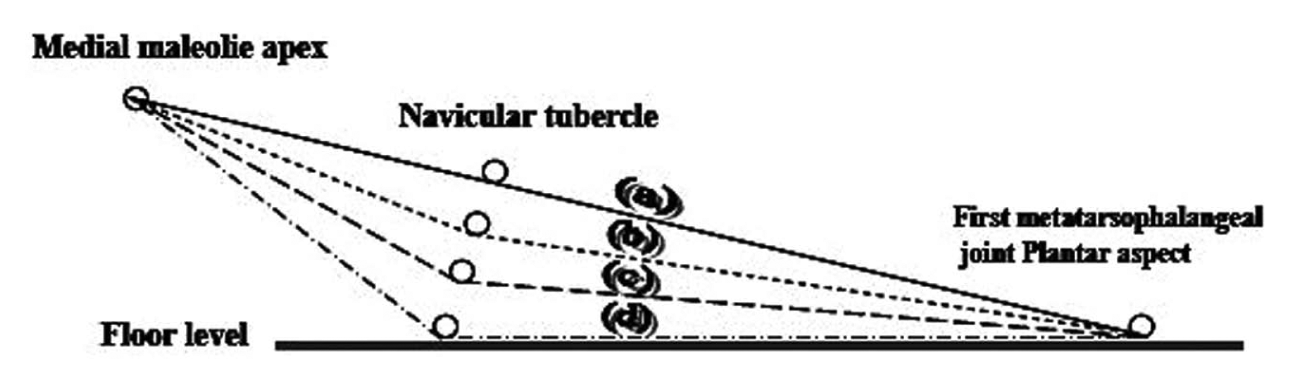
Illustration of normal and flatfoot boney landmarks to identify the degree of flatfoot from Feiss line in standing: (a) normal foot, (b) flatfoot, first degree, (c) flatfoot, second degree, and (d) flatfoot, third degree.
Testing instruments
Kinetic data were gathered at 500 Hz using a Bertec FP (MIE, UK) and the Pro-vec 5.0 software package. In order to record the resultant force of two-legged vertical jump shots of participants, a method was designed to gather the necessary data exclusively from a single FP data. This was performed to answer the hypothesis of this study. All measurements of forces (F) were normalized with respect to the percentage body weight (%BW). However, the results of this normalization were rounded off to the nearest whole number.
Since motion analysis system was not employed, temporal events were derived from the FP data. The FP’s specialized software (Pro-vec 5.0) provides an option to collect and analyze kinetic data. The collected data can be displayed on screen, and cursor keys can be used to mark the selected salient points on the three component forces Fx, Fy, and Fz. The numerical values of forces and corresponding times from the initial stance (i.e. transition time, trough time, and stance time) at the point of cursor can be displayed and computed for the statistical analysis.
In order to perform heading ball action with a maximal two-legged vertical jump, a pulley system was employed to suspend the ball above FP in the maximal convenient vertical height, adjusted for each individual subject. As the shoe is considered as a part of the foot orthotic system and will affect the kinetic parameters of jumping, the different sizes of the same type of trainer shoes were provided for all subjects during data collection sessions. A pair of one type of off-shelf insole made of a soft, durable, nonmoldable, poly-urethane of 2 mm thickness at forefoot, and 2 cm at medial longitudinal arch with longitudinal and metatarsal arch supports was used for all the flexible flatfoot subjects. Different sizes of insoles were used to match the different subject foot sizes. However, those in the control group with a normal foot arch did not use insole.
Experimental procedure
Each subject was asked to practice two-legged vertical jumping for several minutes in the Biomechanics Laboratory to become accustomed to the trainer shoes (and insole if appropriate based on the test schedule) provided for the test. The subjects were instructed to perform their maximal convenient two-legged vertical jumps. Vertical jump height was measured by the vertical jump test which was first described by Sargent; 11 this was an index height to suspend a football by a rope and pulley system to identify the most convenient maximal two-legged vertical jump height to head a ball for each individual. At the start of each test for data collection, subjects were asked to stand in a relatively upright position on a convenient start point. This start point was away from the FP to jump on the platform to ensure take-off from the two feet in a vertical direction with maximum intensity to head the suspended ball (Figure 2). Following the moment of touchdown of the two feet during the last stride of the run up on the FP, the take-off began and data collection initiated, and ended when the jump feet no longer touched the FP (Figures 2 and 3). Subjects had the option of arm swinging during data collection. Subjects were directed to do five trials with 30 s rest period intervals, and the last three successful two-legged vertical jump shots for heading the ball were taken per subject. Data acquisition comprised (a) control group with normal foot without insole adoption and (b) flatfoot group with and without insole adoption.
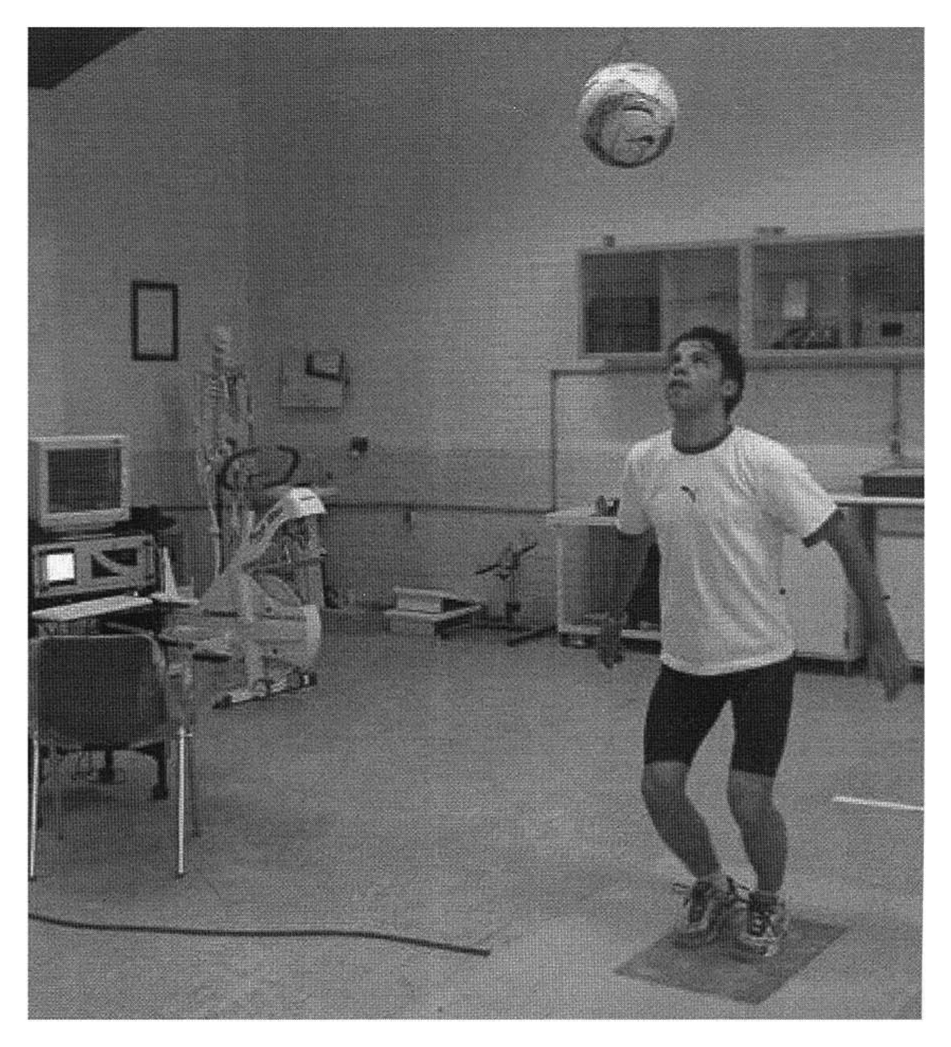
A typical test subject is performing a two-legged vertical jump on a force platform in the biomechanical laboratory, for heading a ball.
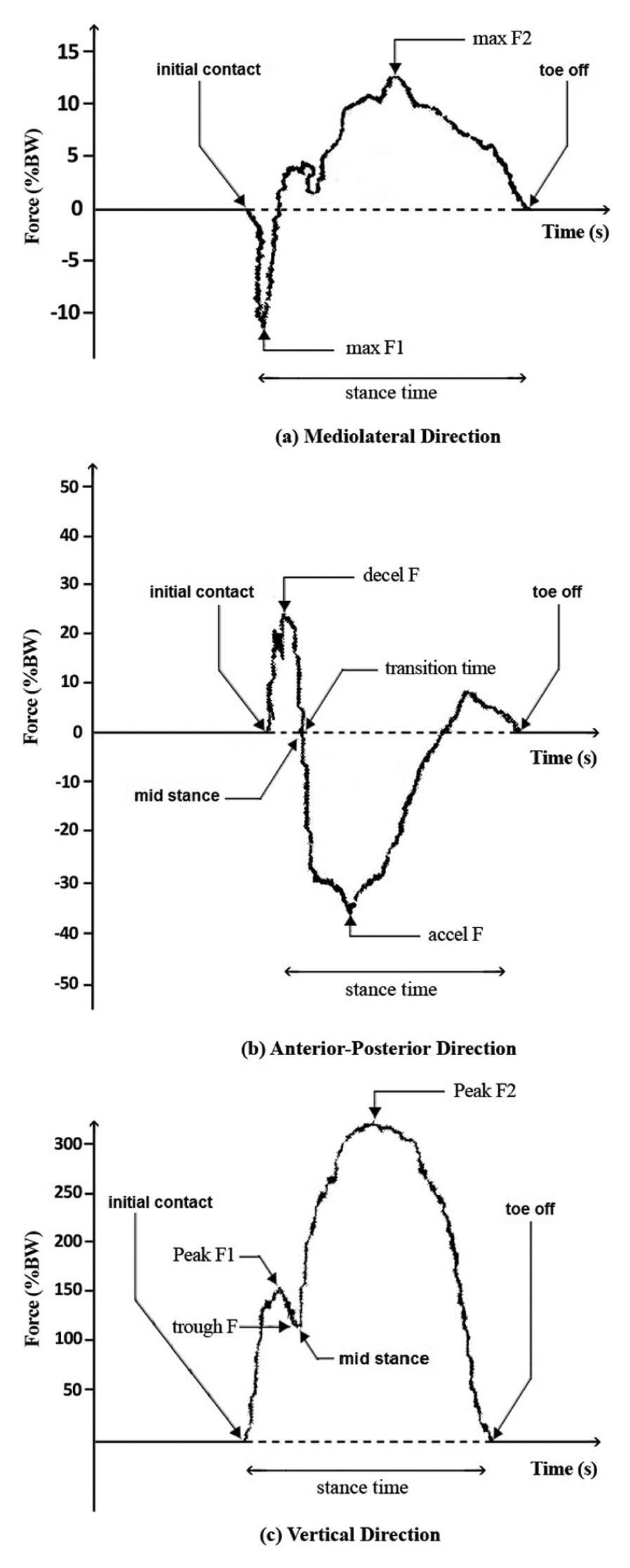
Illustration of salient points of three-dimensional ground reaction forces, that is, (a) mediolateral, (b) anterior–posterior, and (c) vertical for a typical test subject. Initial stance refers to moment of touchdown of the two feet on the force platform, and terminal stance refers to the moment the jump feet no longer touch the force platform.
Statistics
Data were analyzed by SPSS statistical software (version 16). The normal distribution of variables was tested by the Kolmogorov–Smirnov (KS) statistical test, and the normality was approved with the alpha level set at 0.05. Because it is impossible to compare the GRF plots (Fx, Fy, and Fz) of jumping entirely by simple visual assessments, kinetics and temporal parameters of salient points were selected as the basis of analysis and discussion. These salient points are labeled on the GRF plots of mediolateral, anterior–posterior, and vertical directions, in Figure 3(a) to (c), respectively. The kinetic and temporal event variables regarding the last three jump shots were averaged for each subject, and group averages were also calculated, and the discrete variables (salient points) were identified as the basis of descriptive statistics. The independent sample t-test was employed to compare participants’ characteristics. For the analysis of the group average data, the independent sample t-test was also used to compare the data of the control group (normal foot subjects) with those of the flexible flatfoot subjects before and after utilization of insoles. In addition, the paired t-test was conducted to compare the ample averages of matched pairs of the flexible flatfoot subjects with and without insole. All tests were conducted with the alpha level set at 0.05 (<0.05).
Results
Table 1 and Figures 4 to 7 demonstrate the mean values of the salient points (kinetics and temporal factors) of force plots of two-legged vertical jumping in mediolateral, anterior–posterior, and vertical directions for various conditions, respectively. Comparison of mean of the participants’ characteristics (age, height, and weight) for each group by an independent sample t-test revealed no significant differences between groups (p = 0.09, 0.06, and 0.10, respectively). In each case, the value of vertical force quoted is the change in force above the weight of the test subject. The statistical analyses of Figures 4 to 7 regarding mediolateral and anterior–posterior directions showed that the foot condition (normal vs flexible flatfoot without and with insole) does not have significant relationship with the presence of an insole (p = 0.08, 0.06, 0.15, and 0.11, respectively). According to these findings, with respect to the aforementioned foot conditions, there were no significant differences between GRF parameters related to the vertical direction regarding peak F1 and trough F (p = 0.13, 0.09, 0.11, and 0.08, respectively). However, for peak F2 in flexible flatfoot individuals with and without the use of insoles adoption, this difference was significant (p = 0.001). In addition, the comparison between peak F2 in the normal foot and flexible flatfoot with the use of insole adoption revealed no significant difference (p > 0.5). The use of an insole is beneficial with respect to stance phase duration of two-legged vertical jumping for all foot conditions, that is, comparison of normal foot with flexible flatfoot without using the insole (p = 0.01), and flexible flatfoot with and without using the insole (p = 0.001). Moreover, this comparison between normal foot and flexible flatfoot with insole adoption revealed no significant difference (p = 0.12).
Mean value and SD of kinetics of two-legged vertical jumping normalized by body weight (%BW) and temporal events time (s) for various foot conditions.
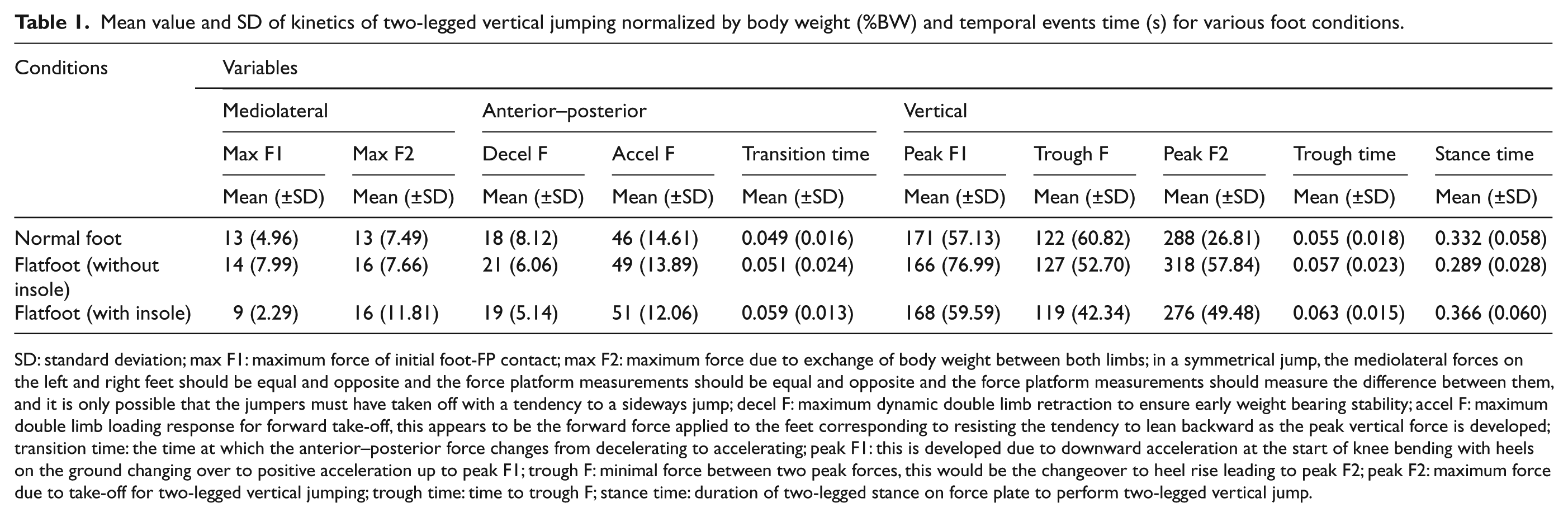
SD: standard deviation; max F1: maximum force of initial foot-FP contact; max F2: maximum force due to exchange of body weight between both limbs; in a symmetrical jump, the mediolateral forces on the left and right feet should be equal and opposite and the force platform measurements should be equal and opposite and the force platform measurements should measure the difference between them, and it is only possible that the jumpers must have taken off with a tendency to a sideways jump; decel F: maximum dynamic double limb retraction to ensure early weight bearing stability; accel F: maximum double limb loading response for forward take-off, this appears to be the forward force applied to the feet corresponding to resisting the tendency to lean backward as the peak vertical force is developed; transition time: the time at which the anterior–posterior force changes from decelerating to accelerating; peak F1: this is developed due to downward acceleration at the start of knee bending with heels on the ground changing over to positive acceleration up to peak F1; trough F: minimal force between two peak forces, this would be the changeover to heel rise leading to peak F2; peak F2: maximum force due to take-off for two-legged vertical jumping; trough time: time to trough F; stance time: duration of two-legged stance on force plate to perform two-legged vertical jump.
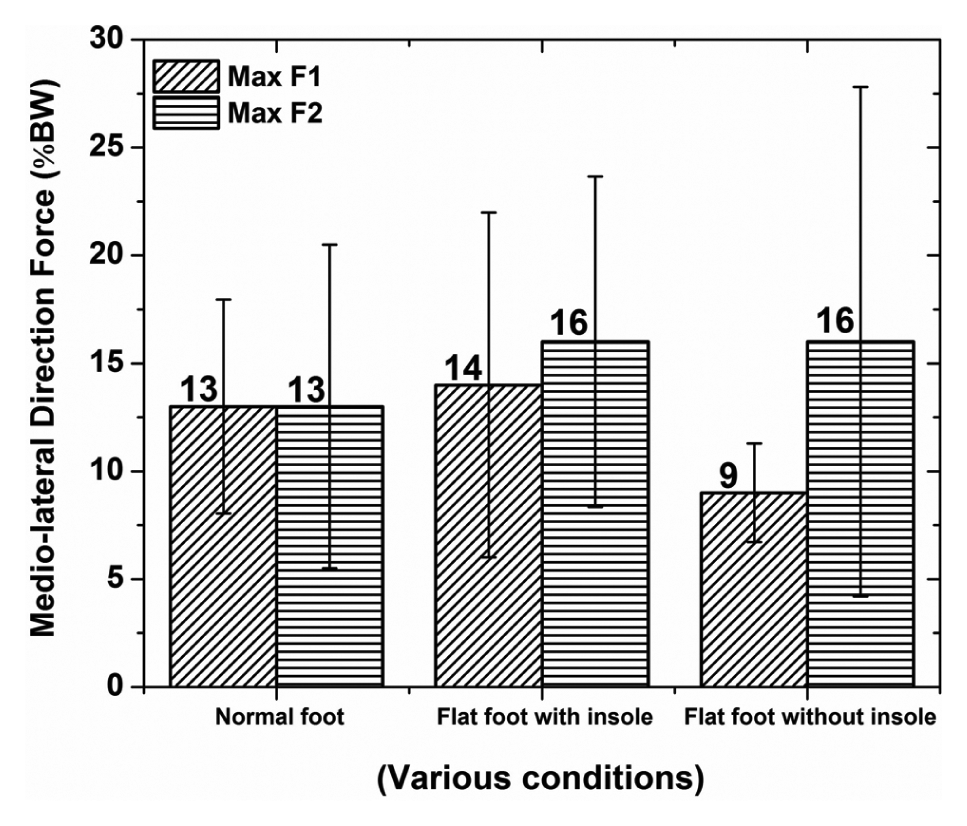
Illustration of magnitude of average mediolateral ground reaction forces of two-legged vertical jumping in various conditions.
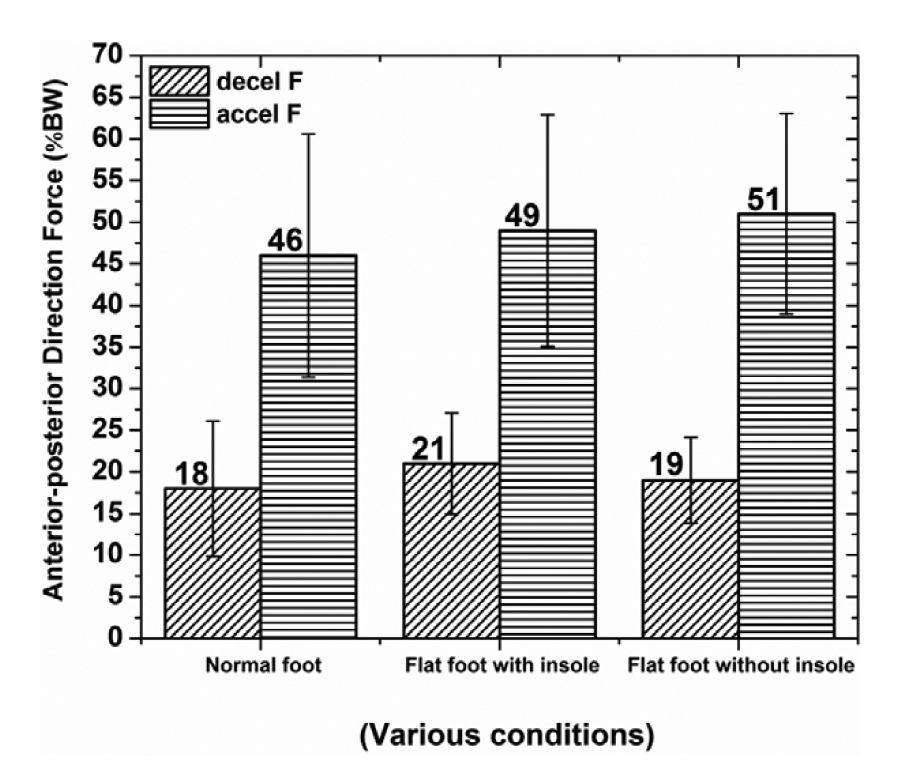
Illustration of magnitude of average anterior–posterior ground reaction forces of two-legged vertical jumping in various conditions.
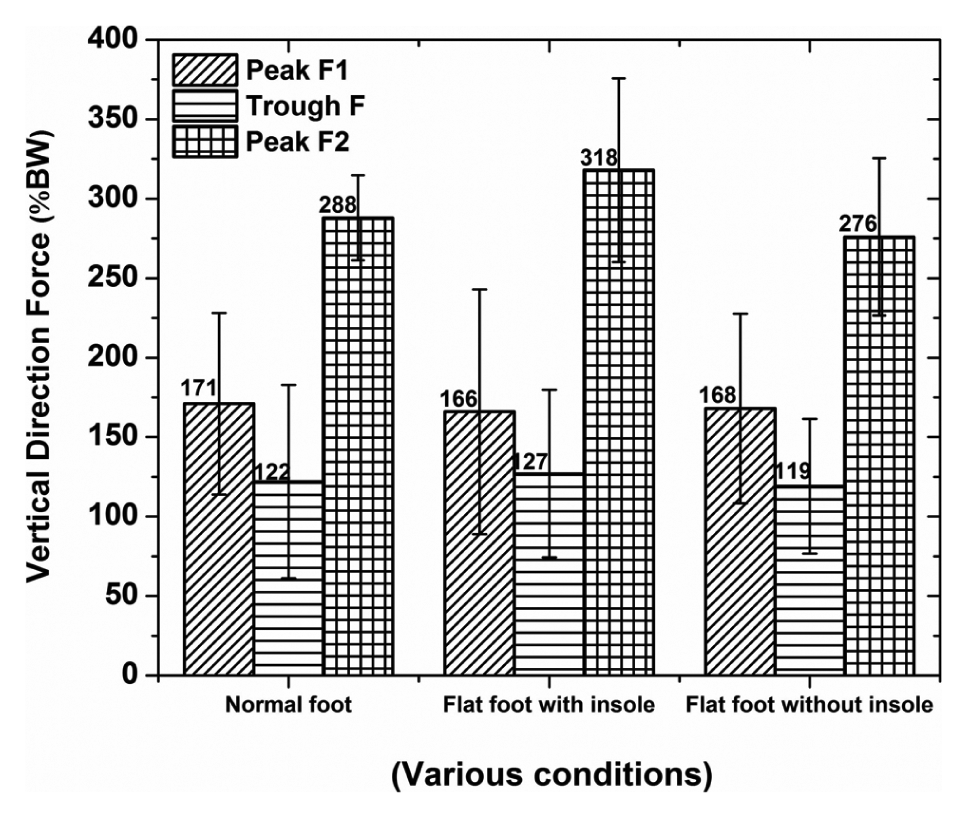
Illustration of magnitude of average vertical ground reaction forces of two-legged vertical jumping in various conditions.
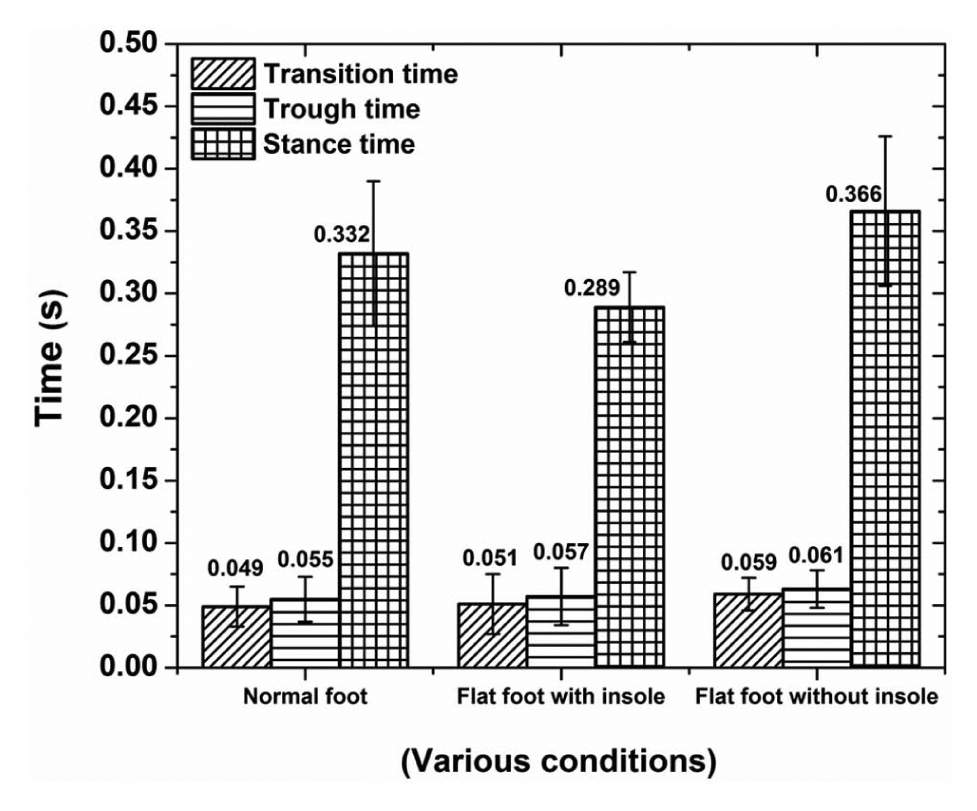
Illustration of average time course of temporal factors of two-legged vertical jumping in various conditions.
Discussion
The magnitude of the average GRF in the mediolateral direction is relatively low in various conditions of the normal foot, and flexible flatfoot without and with insole, that is, 5.6%BW, 6.1%BW, and 5.8%BW vertical load, respectively (Table 1 and Figure 4). The values reported by this study are similar to that reported by Neumann, 12 who indicated mediolateral GRF of less than 5%. In addition, the magnitude of the average GRF in the anterior–posterior direction is also relatively low in various conditions of the normal foot, flexible flatfoot without and with insole, that is, 14.0%BW, 14.4%BW, and 15.8%BW vertical load, respectively (Table 1 and Figure 5). This finding is similar to those of Neumann, 12 and Perry 13 who reported this figure to be less than 20% and 25% of vertical load, respectively. With respect to GRF in mediolateral and anterior–posterior directions, the intervention of insoles for foot conditions (i.e. flexible flatfoot without and with insole) and normal foot did not show a significant relationship between these parameters (p = 0.08, 0.06, 0.15, and 0.11, respectively). This is a multifactorial phenomenon, because the magnitude of these forces is low and also the horizontal shear force in mediolateral and anterior–posterior directions during walking and running is produced due to exchange of body weight from one limb to the other, and limb extension to ensure early weight bearing stability. 13 However, two-legged stance prior to vertical jumping in this study leads to a minimal need for exchange of weight between lower limbs. Again, this may be considered as a reason for the low magnitude of horizontal shear forces in our study.
The vertical loading is initially body weight, then body weight plus peak F1, followed by body weight plus peak F2, and finally body weight again (Figure 3(c)). This statement is in full agreement with Linthrone, 14 who indicated that during a vertical jump, the jumper must overcome body weight, and the resultant force acting on the jumper’s center of mass. Vertical force curves of two-legged vertical jumping in this study show that generally, in all foot conditions, the level of peak F1 is considerably less than the peak F2 (see Table 1 and Figure 3(c)). The increase of the peak F2 and time duration in comparison to the peak F1 in our study is due to the fact that the first peak occurs shortly after heel contact in response to weight acceptance for the stability of body over the two feet. Early transition of forces from deceleration to acceleration in the anterior–posterior direction and the trough in the vertical direction force plots (see Figure 2 and Table 1 for transition and trough times, respectively) illustrates the mid stance and reveals the fact that the second peak (peak F2) occurs in early stance in response to an effective take-off production for two-legged vertical jumping function. However, it is different from the findings of Neumann, 12 and Arastoo 15 who reported occurrence of second peak force in terminal stance during preferred gait in the normal subjects.
The findings of our study, regarding vertical GRF show that there are no major changes between various foot conditions with respect to magnitude of the first peak of vertical force (peak F1) and trough F (Table 1). This finding is similar to Leung et al. 7 who showed that the magnitude of the first peak of vertical force was not affected by the use of the insole during walking at normal speed. Interestingly, the magnitude of the peak F2 in the flexible flatfoot individuals without and with insole is 29.8%BW more and 12.5%BW less than that of the normal foot individuals, respectively. These figures revealed that the use of insole leads to decrease of vertical GRF equal to 42.3%BW in the flexible flatfoot subjects. This phenomenon may contribute to the effect of anatomical modification of the foot on kinetic parameters in the flexible flatfoot individuals. In this case, the use of the insole and its effect in supporting their medial longitudinal arch brings this benefit toward that of individuals with normal feet. In the other words, the results reported by Kim et al. 16 and the results of this study showed that GRF in the lower limbs of flatfoot individuals without insole increases more with landing height and with two-legged vertical jumping than in people with a normal foot arch. In addition, these later results revealed that flat feet without insole adoption may aggravate the risk of shock on landing from a height and vertical jumping.
The analysis of GRF signals registered during take-off enables a deeper, albeit indirect, insight into the capability of developing explosive strength in the lower extremity skeletal musculature with this take-off ability. 17 An overall consideration of findings in this study revealed that the use of insole has a marked effect on the kinetics of take-off parameters of flexible flatfoot jumping stance phase to bring them toward the normal foot values. This is because foot orthoses are designed to provide an external correction of structural imbalance in the foot to reduce or eliminate compensatory motion by allowing the foot to function as nearly as possible around the neutral position. 18 Moreover, while there is a significant difference between peak F2 of the normal foot and flexible flatfoot subjects without insole (p = 0.01), this difference is not significant after the use of insole (p = 0.2). This result looks acceptable because according to Imhauser et al., 19 while flexible flatfoot deformity caused a pattern of medial shift in plantar pressure distribution, insole orthoses stabilized both the hindfoot and the medial longitudinal arch. The significant increase of stance time in the flexible flatfoot subjects due to use of the insole in comparison to the flexible flatfoot subjects without insole (p = 0.001) (Figure 7 and Table 1) supports the idea of effectiveness of insole to decrease vertical load of peak F2. This suggests that use of the insole enables the flexible flatfoot individuals to have a longer period of push off and loading response and development of a more effective take-off for jumping with decrease of magnitude of vertical GRF (peak F2) through body in the second peak. Thus, if the player’s jump height requires improvement, the rebound time can be lengthened. 9 In contrast, the results of Leung et al. 7 showed that the shoe-insert orthotic intervention did not affect magnitude of the second peak of vertical force component and the corresponding timing parameter of the subjects walking at their normal speed. In this regard, Prapavessis and McNair, 20 indicate worth noting that high GRF may be a precipitating factor associated with an injury, and the site of tissue damage would benefit from decreased forces.
We are aware of some limitations of this study, for instance, only male participants were studied. Whereas we preferred also female participants in a separate group, but there was no female participant in the group of physical training course that was screened to identify the test subjects.
Conclusion
These results suggested that the use of an insole has no significant effect on kinetics of the mediolateral and anterior–posterior directions, while it has a significant effect on the peak F2 of the vertical direction, which is related to an effective take-off for two-legged vertical jumping. Based on kinetics findings of our study, adoption of the insole improved the shoe–foot interface support in the flexible flatfoot individuals. This enables the development of more effective take-off kinetics for vertical jump in terms of GRF and stance duration.
Footnotes
Acknowledgements
The authors would like to acknowledge the dean of Faculty of physical Education and Sport Sciences, Shahid Chamran University of Ahvaz, Ahvaz, Iran, for providing access to the Biomechanics Laboratory. Last but not the least, the authors highly appreciate Professor John P. Paul from the Bioengineering Unit, University of Strathclyde, Glasgow, UK, for his useful comments in preparation of this article.
Declaration of conflicting interest
The authors declare no conflict of interest.
Funding
The financial support of this project was provided by the Musculoskeletal Rehabilitation Research Center, Department of Physical Therapy, Ahvaz Jundishapur University of Medical Sciences, Ahvaz, Iran.