



Abstract
Background:
Hallux valgus (HV) often requires surgical intervention following the failure of conservative treatment. This study compared the minimally invasive transverse distal metatarsal osteotomy and percutaneous Akin (MITO) technique with open chevron Akin (OC) surgery over 1 year in patients with mild to moderate HV.
Methods:
In this prospective randomized controlled trial, 40 patients (40 feet) were randomized to receive MITO (20 feet) or OC (20 feet) between January 2019 and 2022. Follow-up was conducted at 6 weeks, 3 months, 6 months, and 1 year postsurgery, with evaluations including assessment of wound healing using the PWAT and ASEPSIS scores, patient-reported outcome measures (PROMs), AOFAS scale, and radiologic measures.
Results:
There were no notable differences in surgical time, PROMs, AOFAS scale, or radiologic results at the 1-year follow-up. The only significant difference observed was the PWAT score at the 6-week mark, favoring the MITO group. Overall, the complication rate stood at 15% for both groups, with no reports of significant complications.
Conclusion:
At the 6-week mark, the MITO technique demonstrated beneficial progress in postoperative soft tissue evolution. At the 1-year follow-up, both groups improved regarding radiologic outcomes. This study supports the short-term benefit of percutaneous techniques on early wound healing, while confirming similar 1-year functional and radiographic outcomes compared to open techniques.
This is a visual representation of the abstract.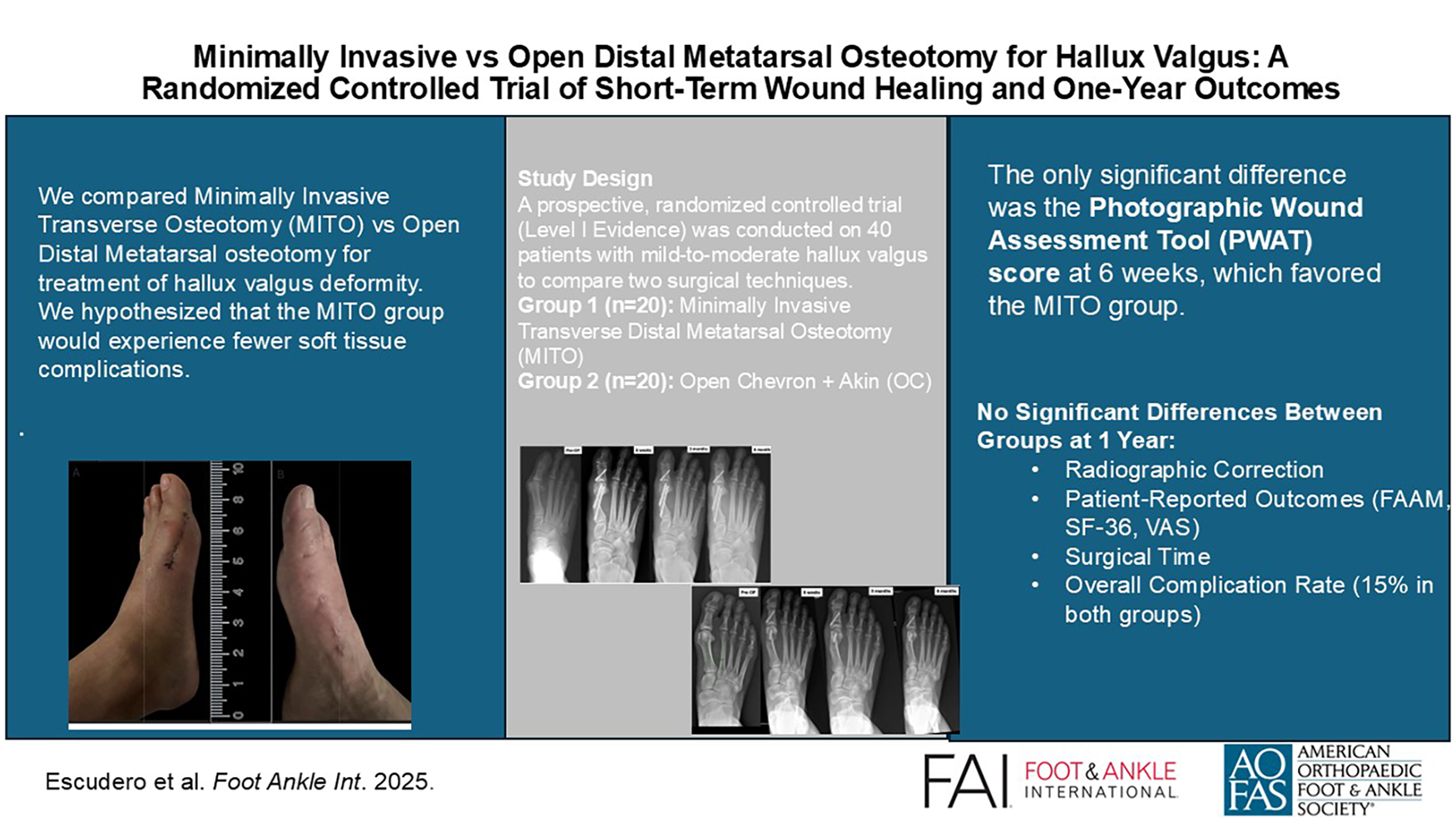
Keywords
Get full access to this article
View all access options for this article.
References
Supplementary Material
Please find the following supplemental material available below.
For Open Access articles published under a Creative Commons License, all supplemental material carries the same license as the article it is associated with.
For non-Open Access articles published, all supplemental material carries a non-exclusive license, and permission requests for re-use of supplemental material or any part of supplemental material shall be sent directly to the copyright owner as specified in the copyright notice associated with the article.
