




Abstract
Background:
In response to the opioid epidemic, many surgical specialties have adopted nonopioid pain management strategies. Ultrasound (US)-guided peripheral nerve blocks (PNBs) are effective in reducing pain and opioid consumption postsurgery. Liposomal bupivacaine (LB), shown effective in shoulder surgery, was approved in November 2023 for use in US-guided lower extremity blocks. This study compares the efficacy of LB in US-guided PNBs, surgeon-administered LB field blocks, and a control group using PNB with local anesthetic only.
Methods:
This prospective, randomized, single-anonymized controlled study enrolled patients undergoing elective foot and ankle surgery from March 2022 to January 2023. Patients were assigned to one of 3 groups: US-guided PNB with local anesthetic only, US-guided PNB with LB or local mix, or surgeon-administered LB or local mix field block. Postoperative opioid use, opioid requirements in oral morphine equivalents, block duration, and Patient-Reported Outcomes Measurement Information System (PROMIS) scores were tracked.
Results:
A total of 248 patients were included: 70 in the US-guided PNB with local anesthetic–only group, 98 in the US-guided PNB with LB group, and 80 in the surgeon-administered LB field block group. Patients in the US-guided LB group took fewer opioid pills between postoperative day (POD) 0 and POD 4 (median 4.0 pills vs. 6.5 and 5.5 pills in the other groups, P = .025). The US-guided LB group had a significantly longer block duration (P < .001). Postoperative opioid use was lower in the US-guided PNB with LB group, compared with the US-guided PNB with local anesthetic–only group and the surgeon-administered LB field block group (P < .001). One patient experienced temporary foot drop that resolved by POD 10.
Conclusion:
US-guided peripheral nerve blocks using liposomal bupivacaine were associated with reduced postoperative opioid consumption and prolonged block duration in patients undergoing foot and ankle surgery. Compared with both local anesthetic–only blocks and surgeon-administered field blocks with liposomal bupivacaine, US-guided delivery provided more sustained analgesia. These findings suggest a potential benefit of liposomal bupivacaine in regional anesthesia protocols, though further studies are warranted to assess its generalizability across surgical subtypes and to evaluate long-term safety.
This is a visual representation of the abstract.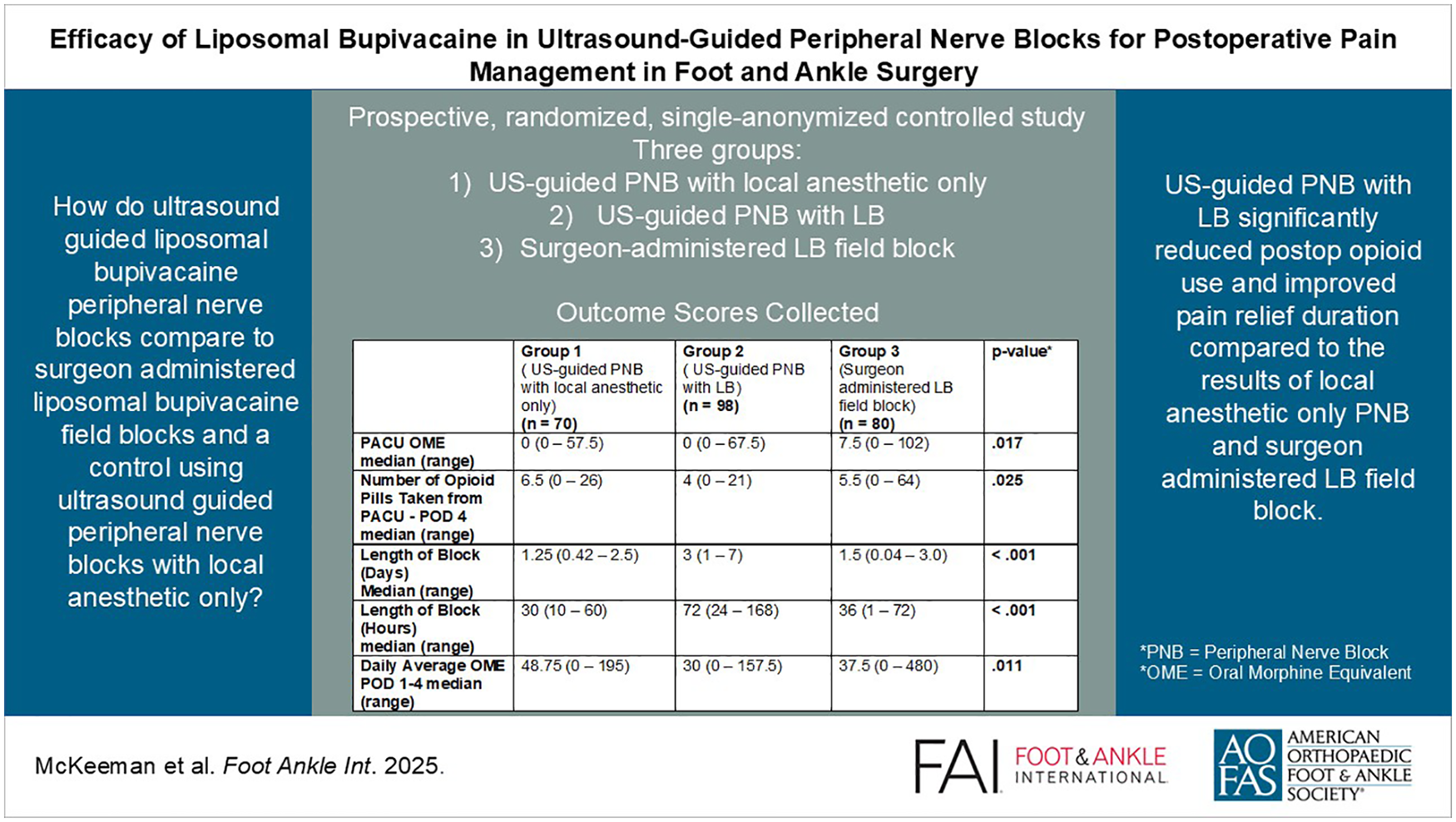
Get full access to this article
View all access options for this article.
References
Supplementary Material
Please find the following supplemental material available below.
For Open Access articles published under a Creative Commons License, all supplemental material carries the same license as the article it is associated with.
For non-Open Access articles published, all supplemental material carries a non-exclusive license, and permission requests for re-use of supplemental material or any part of supplemental material shall be sent directly to the copyright owner as specified in the copyright notice associated with the article.
