



Abstract
Background:
Most modern total ankle arthroplasty (TAA) implants have low-profile designs that minimize tibial resection and use small pegs or posts for fixation. A number of studies have identified concerning rates of lucencies around the tibial components of these implants. In this study, we evaluated a consecutive series of patients receiving an anterior approach low-profile TAA prosthesis to describe the incidence, characteristics, and progression of tibial component lucencies at short-term (minimum 1-year) follow-up.
Methods:
Patients who underwent primary TAA with a modern low-profile TAA tibial implant from 2014 through 2021 were identified from a prospectively collected TAA registry. Poorly defined lucency around the tibial component in all 4 tibial zones, as agreed on by 2 independent reviewers, was considered “global lucency.” Intraoperative, 1-year, and 2-year postoperative radiographs were assessed for periprosthetic lucencies. Patients with global lucency at 1 year were compared to the remaining patients.
Results:
554 ankles with a mean 29 ± 19 months of follow-up met inclusion criteria. Twenty-one ankles (3.8%) were revised for tibial loosening. Thirty-six ankles (6.5%) had global tibial lucency at 1 year. Of these, 15 (42%) were eventually revised and the remaining 21 (58%) were doing well clinically at final follow-up. Following multivariable regression, postoperative coronal tibiotalar offset ≥2 degrees (adjusted odds ratio [OR] = 3.60, P = .017), use of the Vantage implant (adjusted OR = 2.84, P = .006), and male sex (adjusted OR = 2.71, P = .016) were predictors of global lucency at 1 year.
Conclusion:
At 1 year after anterior approach low-profile TAA, we found a 6.5% incidence of global lucency around the tibial component, suggestive of lack of osseous integration of the prosthesis. Fifty-eight percent of patients with global lucency did not require revision and were doing well clinically at early follow-up. Higher postoperative coronal tibiotalar offset, use of the Vantage implant, and male sex were all significantly associated with development of global lucency.
This is a visual representation of the abstract.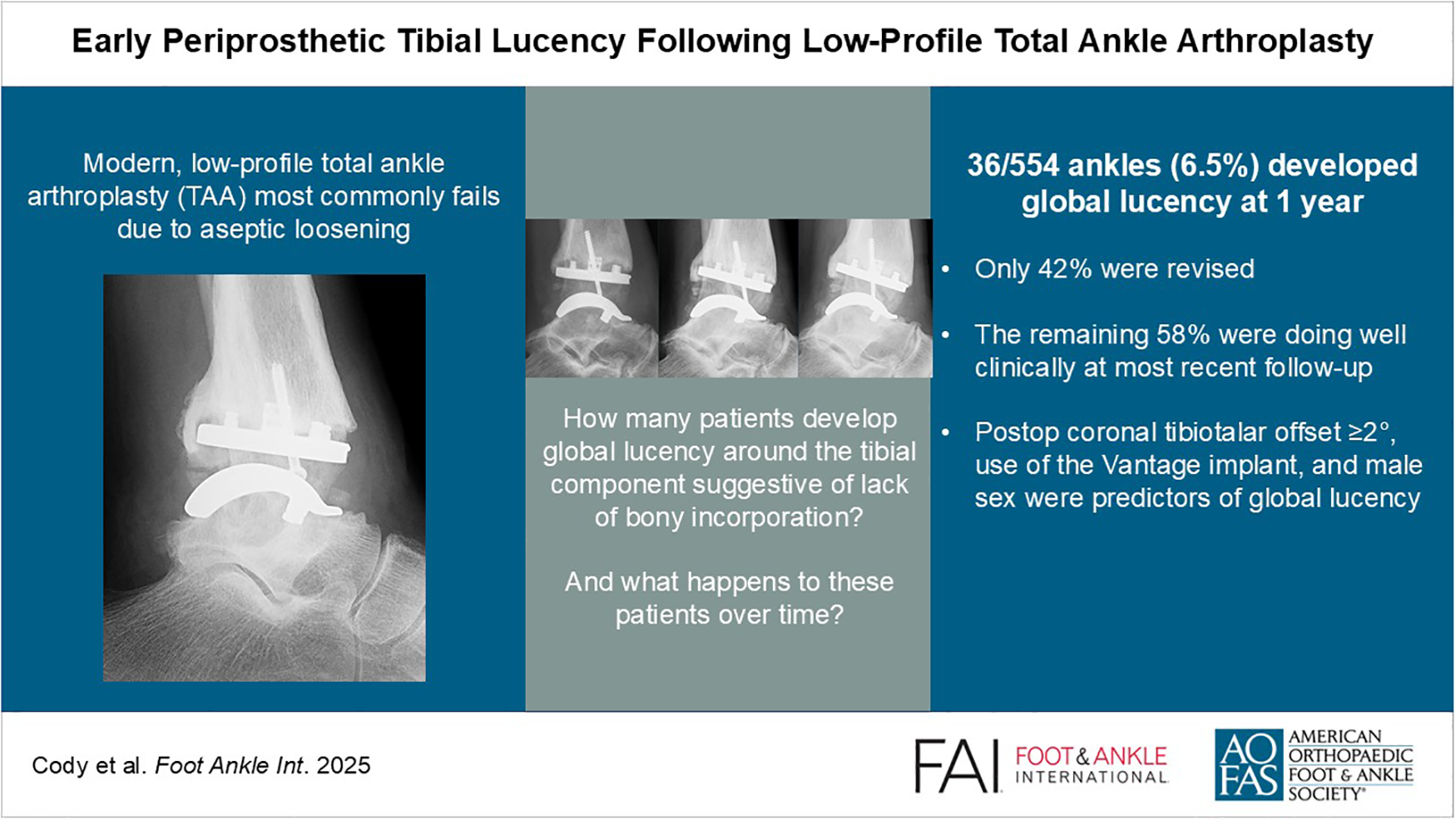
Get full access to this article
View all access options for this article.
References
Supplementary Material
Please find the following supplemental material available below.
For Open Access articles published under a Creative Commons License, all supplemental material carries the same license as the article it is associated with.
For non-Open Access articles published, all supplemental material carries a non-exclusive license, and permission requests for re-use of supplemental material or any part of supplemental material shall be sent directly to the copyright owner as specified in the copyright notice associated with the article.
