



Abstract
Background:
Plantar fasciitis is a major cause of heel pain, resulting from repetitive trauma to the plantar fascia and leading to structural changes within the fascia. It has been observed that plantar fascia thickness in plantar fasciitis patients exceeds that of normal individuals. However, the biomechanical properties of the plantar fascia in patients with plantar fasciitis remain unclear. Therefore, this study aimed to compare plantar fascia stiffness between healthy individuals and patients with plantar fasciitis across different areas.
Methods:
Fifty-eight participants were divided into 2 groups: 29 healthy individuals and 29 individuals with plantar fasciitis. B-mode ultrasonography was used to assess plantar fascia thickness, whereas shear wave elastography was employed to measure plantar fascia stiffness. The study focused on 3 distinct areas: calcaneal insertion, 1-cm distal area, and 2-cm distal area. Additionally, the most painful area reported by patients was marked in the plantar fasciitis group.
Results:
The findings showed that the plantar fasciitis group exhibited significantly greater plantar fascia stiffness in almost all areas compared to the healthy group (P < .05). Moreover, the stiffness of the plantar fascia in the most painful area demonstrated the highest value compared with other areas within the plantar fasciitis group (P < .05).
Conclusion:
This study suggests structural and mechanical changes in the plantar fascia in patients with plantar fasciitis.
This is a visual representation of the abstract.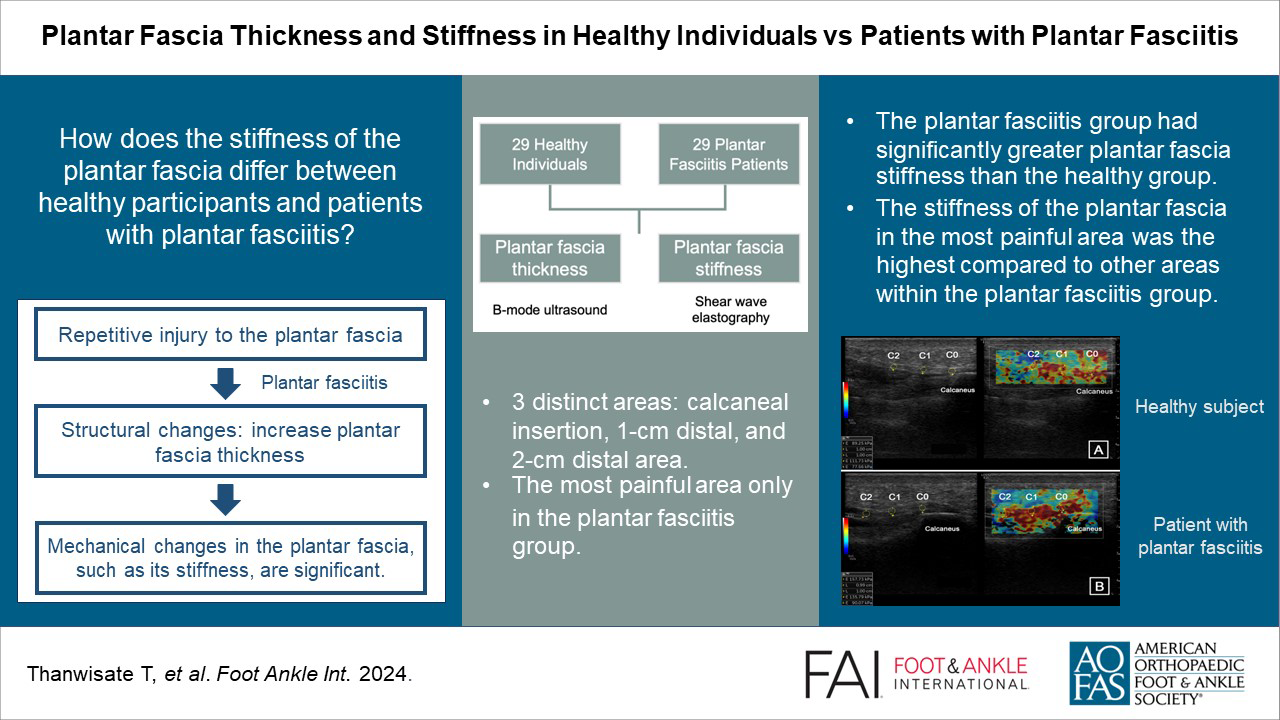
Keywords
Get full access to this article
View all access options for this article.
References
Supplementary Material
Please find the following supplemental material available below.
For Open Access articles published under a Creative Commons License, all supplemental material carries the same license as the article it is associated with.
For non-Open Access articles published, all supplemental material carries a non-exclusive license, and permission requests for re-use of supplemental material or any part of supplemental material shall be sent directly to the copyright owner as specified in the copyright notice associated with the article.
