



Abstract
Background:
Pickleball’s surging popularity has driven an increase in injuries presenting to medical providers. This study seeks to describe the epidemiology of pickleball foot and ankle injuries including patient demographics, diagnoses, and mechanism of injury.
Methods:
A retrospective review from our institutional database identified patients treated in the foot and ankle clinic whose medical records included the search terms “pickleball” and “pickle ball.” Only injuries sustained while playing pickleball were included. Patient demographics, diagnosis, mechanism of injury, and treatment were collected. Injury incidence and descriptive analyses were calculated.
Results:
A total of 198 patients with pickleball foot and ankle injuries were identified. The incidence of injuries increased 6.5-fold from 2019 to 2023. The mean age of patients was 58.3 years (SD = 12.2). Most patients were male (58.6%) and reported a traumatic injury (77.8%). The most common diagnosis was Achilles tendon rupture (39.4%). The most common mechanisms of injury were running or lunging forward (30.9%), planting the foot (16.5%), and inverting the foot and ankle (15.5%). Most injuries were treated nonoperatively (71.2%); however, 62.8% of Achilles tendon ruptures were treated surgically.
Conclusion:
The incidence of pickleball foot and ankle injuries increased dramatically from 2015 to 2023. Injuries occurred more frequently in older, male patients, with Achilles tendon rupture being the most common diagnosis.
This is a visual representation of the abstract.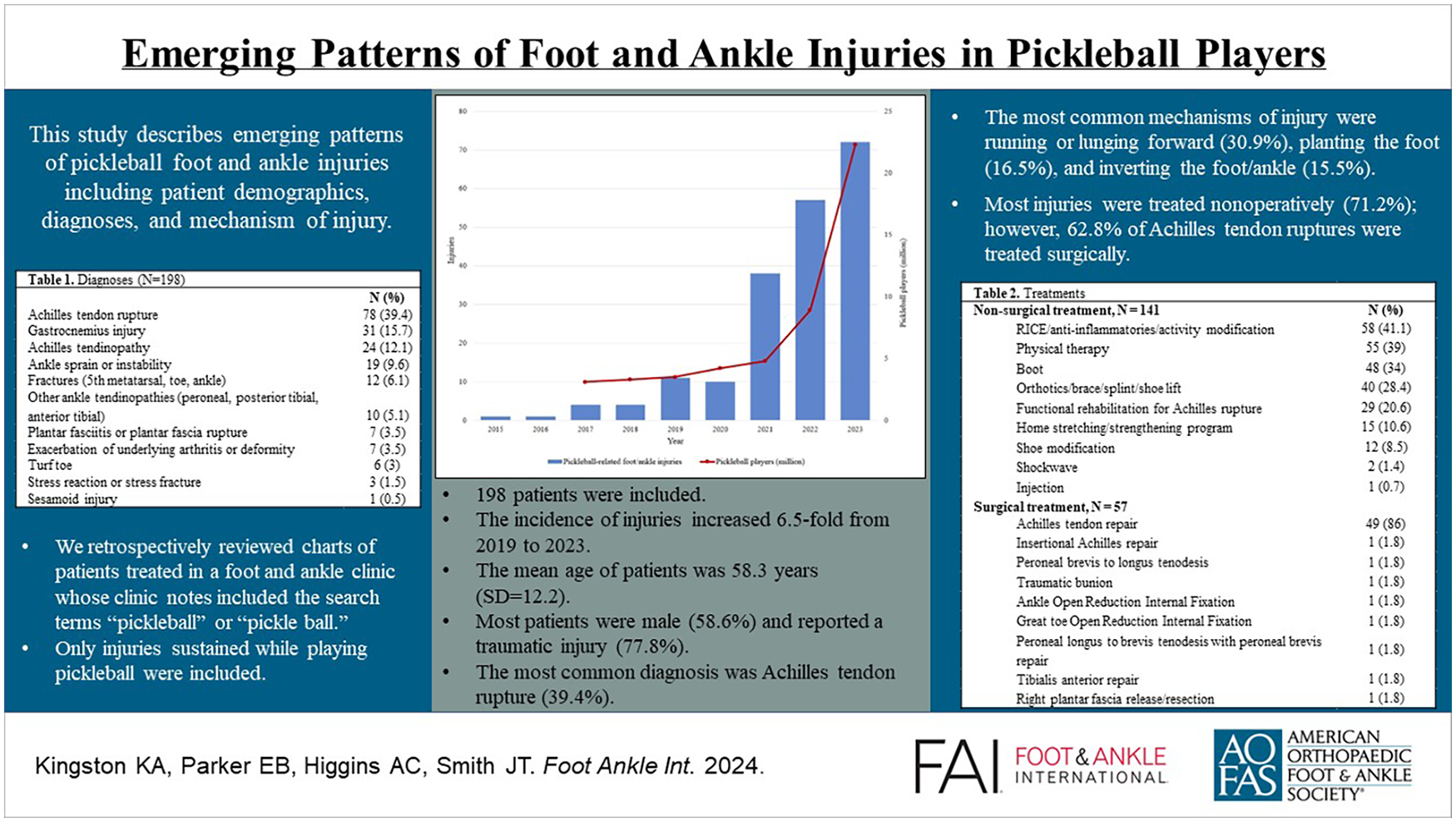
Get full access to this article
View all access options for this article.
References
Supplementary Material
Please find the following supplemental material available below.
For Open Access articles published under a Creative Commons License, all supplemental material carries the same license as the article it is associated with.
For non-Open Access articles published, all supplemental material carries a non-exclusive license, and permission requests for re-use of supplemental material or any part of supplemental material shall be sent directly to the copyright owner as specified in the copyright notice associated with the article.
