




Abstract
Coal phase-out dynamics are well theorised in industrialised contexts but poorly understood in emerging economies, where explicit phase-out commitments remain absent. This comparative study of South Africa and Indonesia (1998–2024) theorises ‘pre-phase-out’ dynamics by using a framework combining endogenous institutional change and socio-technical transitions literatures. Despite superficial similarities, the cases diverge in important ways. In South Africa, regime underperformance and contestation over centralised sector structure generate episodic destabilisation driven by a reform logic. In Indonesia, a legitimate, performant regime is sustained by coal oligarchs whose commitment is conditional on profitability rather than ideology. International economic pressures of renewables cost decline and coal export prices prove more destabilising than climate policy or Just Energy Transition Partnership (JETP) finance. Reframing regime destabilisation as a precursor to phase-out yields implications for JETP design, Carbon Border Adjustment Mechanism (CBAM) response, and just transition strategy in coal-dependent Global South contexts.
Keywords
Introduction
‘Phase-out’ has been defined as an ‘intentional, politically steered, gradual process of downscaling a substance, technology or process’ (Rinscheid et al., forthcoming, p. 3). Whilst there has been increased scholarly and political focus phasing out fossil fuels recently, strict adherence to the definition above yields very few examples of coal power phase-outs (Steckel & Jakob, 2021), and, to our knowledge, none in the developing world. There is, however, a growing literature on coal transitions in emerging economies (Diluiso et al., 2021), which spans larger comparative studies (Ohlendorf et al., 2022; Steckel & Jakob, 2021), literature reviews (Diluiso et al., 2021) and single case studies (Baker et al., 2014; Hanto et al., 2022; Strambo & González Espinosa, 2020). Much of this literature is framed around determinants of coal expansion, with only a smaller subset considering the concept of phase-out (Steckel & Jakob, 2021). There is also increasing scholarly interest in the politics of sustainability transitions (Lockwood et al., 2017; Smith & Stirling, 2010).
In this study we investigate the coal power transition dynamics of two geopolitically significant, coal power dominant developing countries, South Africa and Indonesia. These countries are grouped in the literature as primary coal producers and exporters (Diluiso et al., 2021; Steckel & Jakob, 2021), and as facing some of the most difficult phase-outs (Ohlendorf et al., 2022). We frame the investigation as one of ‘pre-phase-out’ dynamics, 1 most closely associated with the concept of, and literature on, ‘destabilisation’. Destabilisation focuses on whole-system transformation (Rinscheid et al., 2021), including that of institutions and political economy (van Oers et al., 2021), due to multi-actor processes. Whilst the destabilisation literature points to the central role of fundamental institutional transformation (Rosenbloom & Rinscheid, 2020), how and why regime actors influence institutional change is less well understood. The destabilisation literature is found to be largely coherent from a theoretical perspective, with its roots in sustainability transition scholarship (Rosenbloom & Rinscheid, 2020) where intentional phase-out is considered as a catalyst or result of destabilisation processes (Rinscheid et al., forthcoming), and ‘destabilisation’ as fundamental to phase-out (Rosenbloom & Rinscheid, 2020).
The phase-out literature is strongly focused on policy outcomes, led by the widespread use of the Actor Objective Context framework (Hanto et al., 2022; Ohlendorf et al., 2022; Ordonez et al., 2021; Steckel & Jakob, 2021) developed by Jakob et al. (2020). Less attention is paid specifically to the institutional aspects which are fundamental to destabilisation literatures, in particular power sector form, and the roles of organised vested interests. Work elaborating regime incumbents has largely focused on industrialised economies and political systems (Fuenfschilling & Truffer, 2014). There is also relatively little inter-temporal analysis, which is necessary to understand institutional transformation over time. This paper aims to enrich the scholarly discussions between destabilisation and phase-out which has implications for policies to support coal phase-out.
South Africa and Indonesia have power sectors dominated by vertically integrated, monopolistic state-owned utilities with sizeable coal power fleets. South Africa’s coal fleet is old, whilst Indonesia’s is still being built. Both countries face international pressure to decarbonise, and many of their coal plants have to be phased out before the end of their economic lives to align with the Paris Agreement temperature goals. South Africa and Indonesia were amongst the first to have negotiated Just Energy Transition Partnerships (JETPs) with the international community which mention aspects of coal phase-out. South Africa’s includes the phrases ‘move away from coal’, ‘decarbonise the electricity system’ and ‘accelerate… the retirement of coal power’ (South African Presidency, 2021), whilst the Indonesian Joint Statement is more specific, referring to ‘an expedited reduction in power sector emissions – through early retirement of coal-fired power plants’ (Indonesia-IPG JETP Joint statement in 2022). In neither country, however, are intentional domestic coal phase-out targets explicitly introduced, although Indonesia is supposedly developing a ‘coal phase-down roadmap’. In both cases, coal power generation capacity has continued expanding (Figure 1). In South Africa’s case, this expansion comprises the recent extension of the technical operating life of 17 units across five older plant (Creamer, 2024), and the consideration of life extension of the coal fleet in the latest Integrated Resource Plan (DEE, 2025). Coal power capacity in South Africa and Indonesia in GW, 2000–2023 (Source: Ember Electricity Data Explorer, ember-energy.org)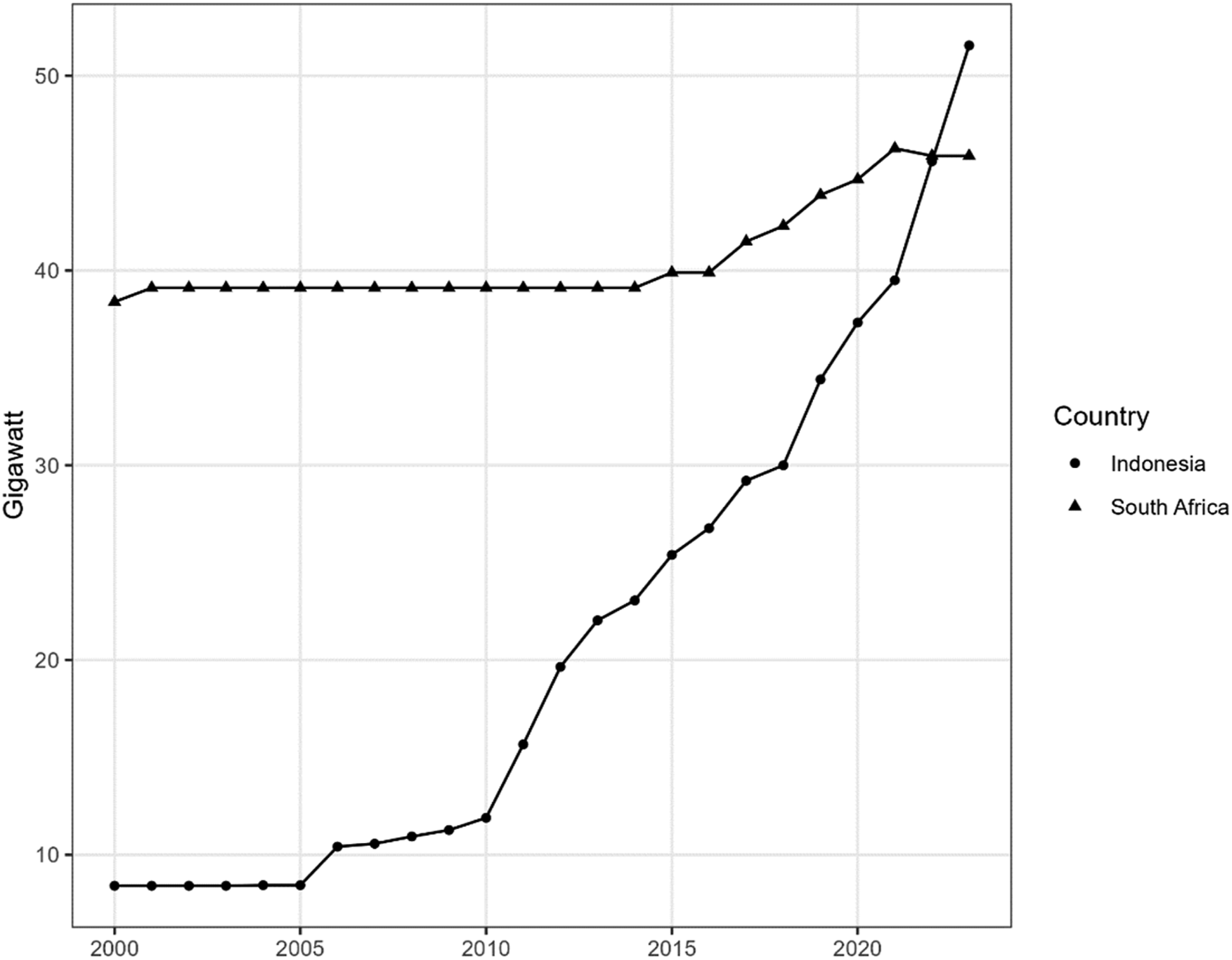
The paper investigates this outcome from an institutional and political perspective, considering the period 1998 to mid-2024, a timeframe over which the international coal phase-out signal has emerged and clarified.
Theoretical Framework
Our theoretical framework is designed to elucidate the political and institutional dynamics of pre-phase-out socio-technical regimes in developing countries over time. It draws on endogenous institutional change theory within a socio-technical transitions perspective, in particular that of the Multi-Level Perspective analytical framework (following Ting and Byrne, 2020). Socio-technical transitions literature conceptualises of a socio-technical regime which delivers a societal function, in our cases the provision of electricity, through a particular configuration of technologies and societal practices. Socio-technical regimes are theorised as being stable and self-reinforcing, due to the rules of the ‘multi-dimensional’ selection environment from which these technologies and practices are chosen being structured to favour the incumbents (Ting & Byrne, 2020). These dimensions include organisational networks, knowledge bases, discursive structures, regulation, policy, technology and infrastructure. Destabilisation plays a prominent role in socio-technical transitions literatures (Rosenbloom & Rinscheid, 2020), equated to the incumbent regime losing its stability (Geels & Schot, 2007), with destabilisation a necessary precursor to the regime’s decline (Turnheim & Geels, 2013). A socio-technical regime is considered to start destabilising when its normal functioning is threatened (Turnheim, 2023), due to external pressures (termed ‘landscape pressures’ in the Multi-Level Perspective), niche innovation or abandonment of core regime structures (Rosenbloom & Rinscheid, 2020; Turnheim and Geels, 2013).
Associating Types of Institutional Change With Actor Capacities, and Institutional Outcomes. Table Adapted From Rocco and Thurston (2014)
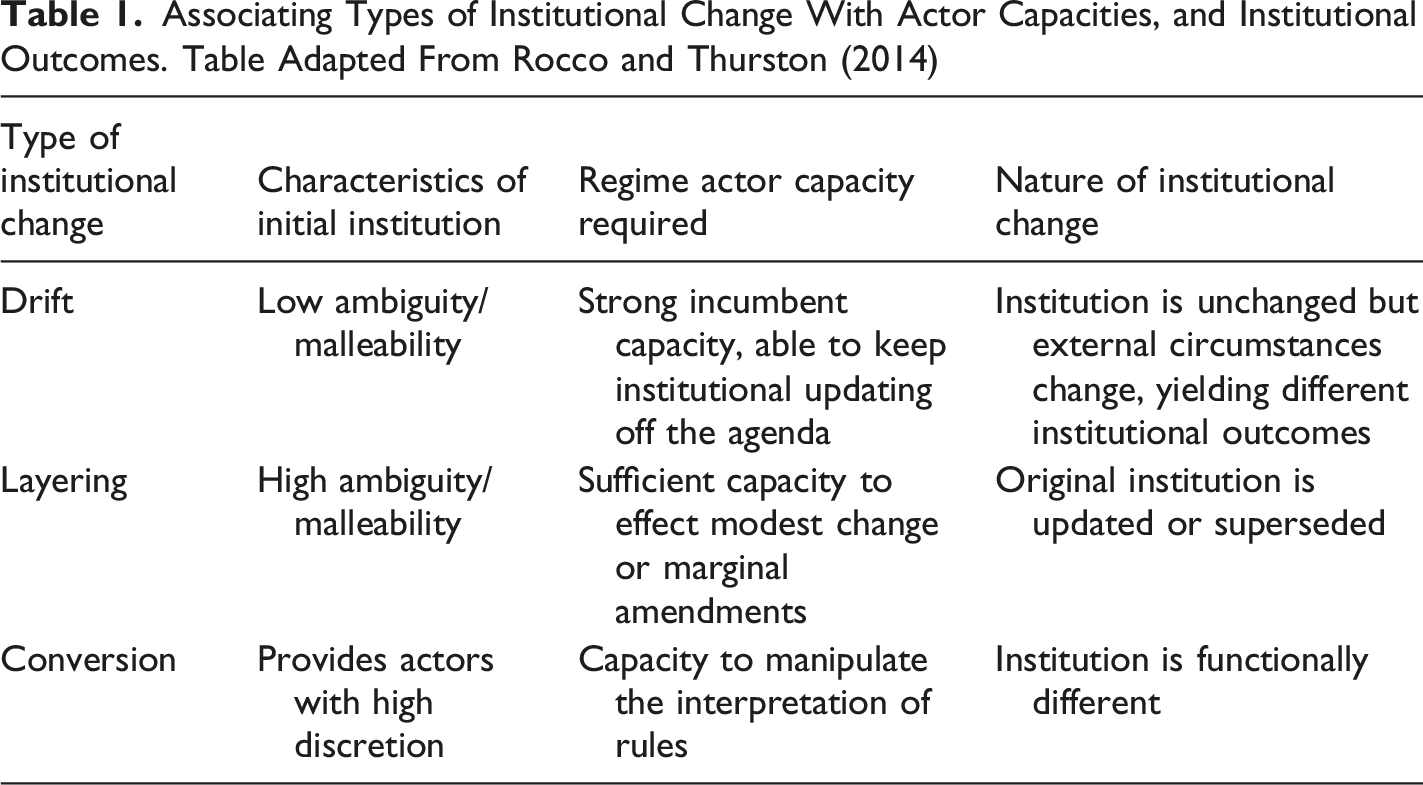
In our theoretical framework, we situate the process of endogenous institutional change within the Multi-Level Perspective’s selection environment of the socio-technical regime. Here, regime actors work across the selection environment’s dimensions to influence the regime’s institutional structures, therefore its institutional outcomes, and hence regime stability. The framework (depicted graphically in Figure 2 below) enables us to investigate and compare actor objectives and strategies to influence regime institutions in the context of external or landscape pressures and evolving regime performance. We use it to describe the resulting institutional changes according to the endogenous institutional change varieties outlined above, together with their impact on regime stability. We also acknowledge that in addition to the three types of change captured in Table 1, entirely new institutions can be added and existing ones removed to further affect the regime’s institutional form. Theoretical framework, drawing from Geels & Schot, 2017; Ting & Byrne, 2020; Streeck & Thelen, 2005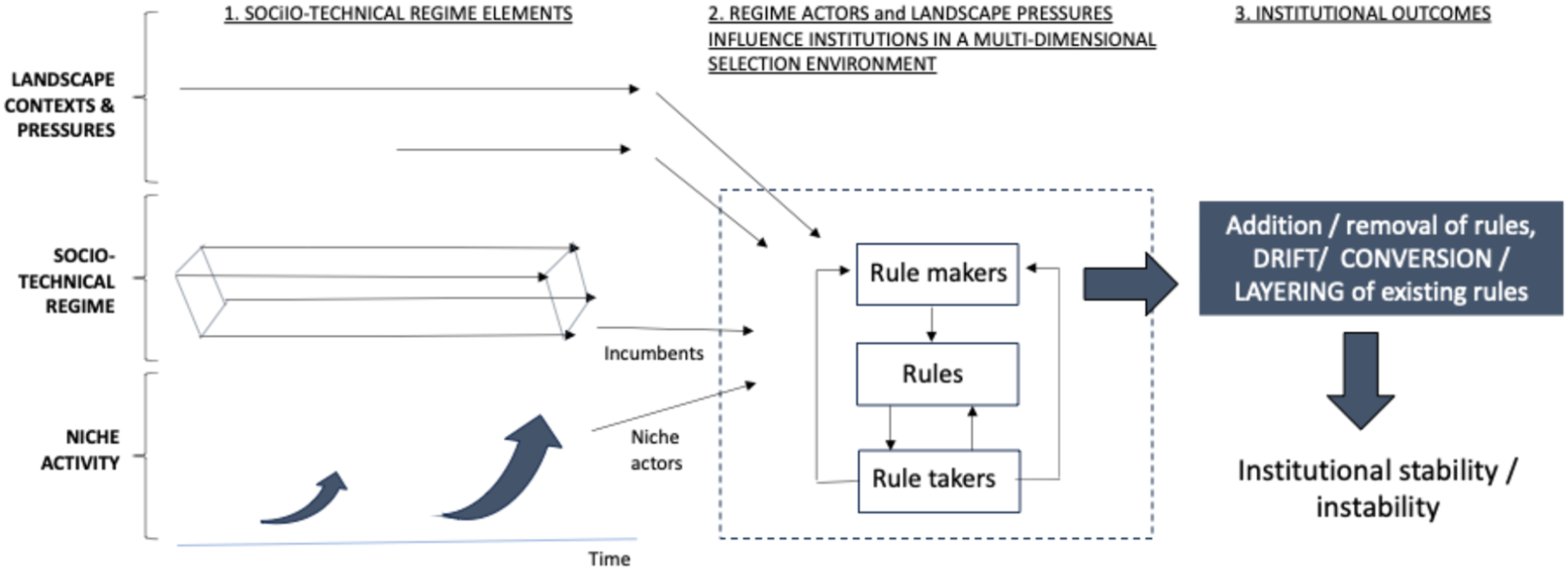
Method
The study combines cross-case comparative analysis and process tracing methods, allowing us to trace the strategies of regime actors and their objectives, together with external landscape dynamics on institutional stability in the two different contexts of South Africa and Indonesia (Collier, 2011; Mahoney, 2007; Turnheim, 2023). The theoretical framework guided both data gathering and analysis. Data collection was conducted through semi-structured interviews. Information was gathered on three themes: identifying the suite of incumbent actors, their political objectives and strategies, and relevant contextual factors.
Twenty interviews were conducted with South African and Indonesian informants in the years 2019, 2022, 2024, and 2025. The informants included a range of climate and energy stakeholders, with a focus on experts identified through the authors’ own networks, supplemented by snowballing techniques from the informants themselves. An anonymised interviewee list is found in Appendix A. We refer to this table to annotate the interview results in the cases. We then triangulated the interview findings with secondary sources to expand, corroborate, and validate the results. These sources included newspaper articles, national policy documents, legislative records and academic and non-academic research.
Data and information gathered during interviews guided the process tracing method, mainly to identify and trace the activities and objectives of the primary regime actors in the selection environment that may have led to institutional change – the causal sequences. The following example illustrates this analytical process. Some interviewees (Interview 18 and 20) suggested that the coal companies in Indonesia are neutral towards the coal power regime, acting primarily in the interest of profit rather than as regime proponents. Based on this information, we found a newsletter from the Ministry of Energy and Mineral Resources, which documented coal companies’ decisions to export coal in 2005 with profitability reasons that disturb the power sector’ coal feedstock, corroborating the interviewee’s statement. Following this event, the government decided to layer the Mining and Mineral Resource Law with the Domestic Market Obligation to stabilise domestic coal power feedstock. This resulted in a stronger coal power regime. The causal sequence was thereby uncovered: the strategy of regime actors (Domestic Market Obligation layering), their reasoning (stabilising domestic coal power feedstock), and the potential institutional change (strengthening the coal power regime), supporting the hypothesis that coal companies are not necessarily coal power regime proponents.
The process tracing method helped us find patterns within our analytical timeframe, 1999 to mid-2024. The final analysis is then grouped into phases based on the patterns identified; three phases each for both the South African and Indonesian context.
South Africa
South Africa’s coal-based socio-technical power regime has been in place since the 1950s, with the monopolistic SOE Eskom as the main incumbent and owner of the country’s coal power fleet. The regime exists to deliver low-cost and adequate electricity to the country. At the start of the period, the 1998 Energy Policy White Paper set the agenda for both power sector liberalisation and diversification of electricity sources. Subsequently, there has been ongoing struggle in the selection environment between proponents of regime change attempting to implement this agenda, and coal power incumbents, who increasingly rely on the centralised sector structure, resisting it (Ting & Byrne, 2020). We trace this struggle and its relationship to coal power phase-out until mid-2024, focusing on two primary electricity institutions: the pro-reform 2006 Electricity Regulation Act (ERA) and its amendments, and Eskom. The analysis is structured according to three periods, with the main socio-technical regime elements in the analysis outlined in Figure 3. Notably, external (landscape) pressures are categorised as domestic and international following Morone et al. (2016) to aid our comparative analysis. South African power sector’s socio-technical regime elements over the period 1998–2024. Arrows indicate the ongoing presence of (sub-)elements over time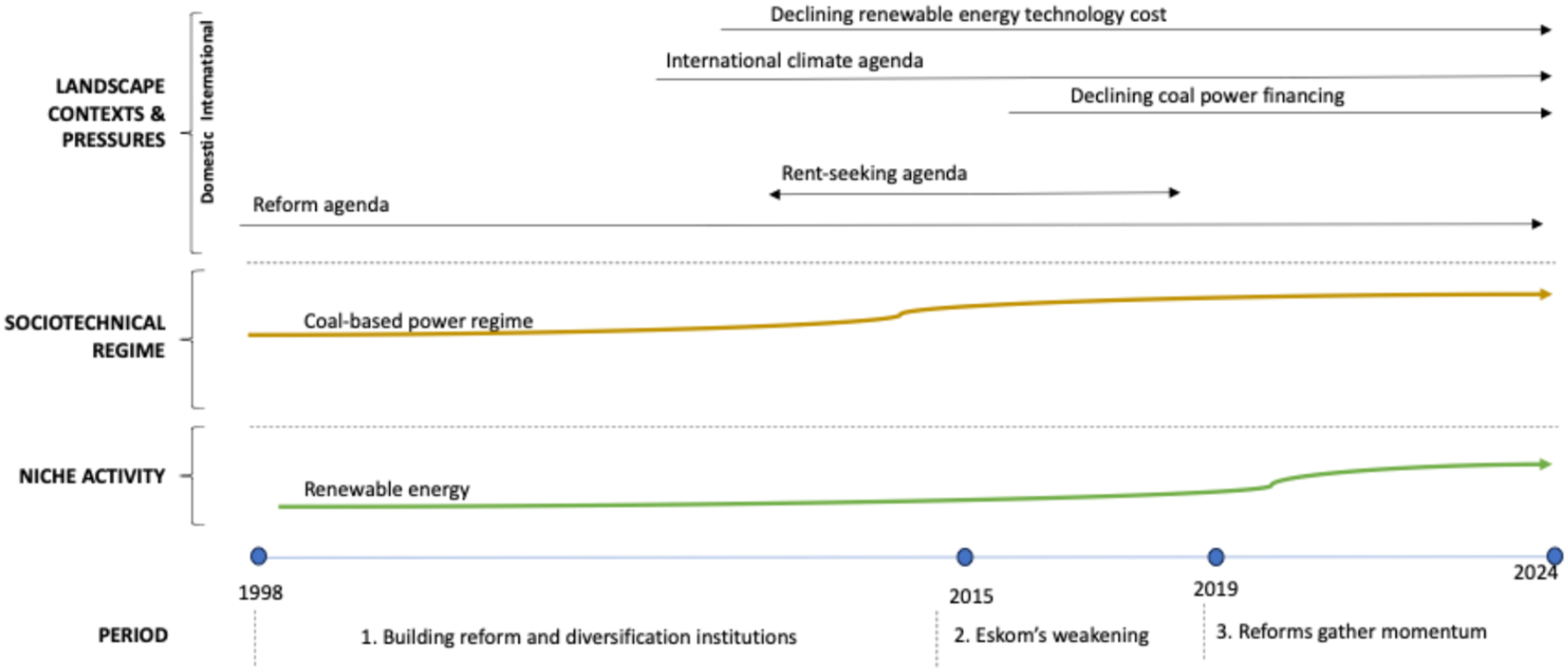
Whilst international demand for the country’s low quality coal has increased in recent years putting pressure on the cost of coal for power generation (Baker, 2022), challenges with rail infrastructure to transport coal to the ports throughout the period has placed a constraint on exports (Burton & Winkler, 2014), resulting in this landscape pressure not playing a significant role in the South African case.
1998–2015: Building Institutions for Reform and Diversification
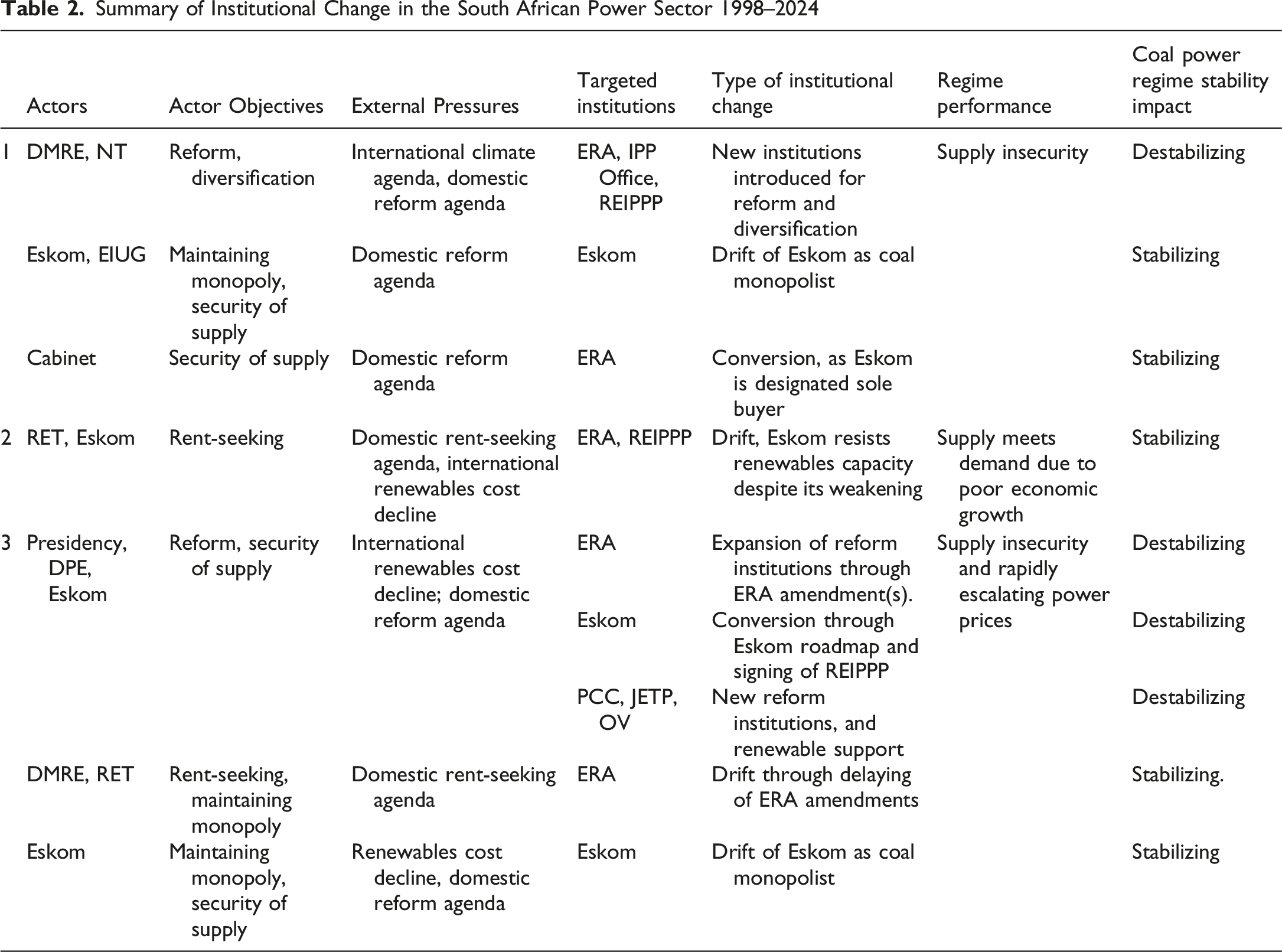
After a failed attempt to reform the electricity Distribution sector, the introduction of the ERA in 2006 started to shift electricity supply governance from Eskom to the National Energy Regulator of South Africa (NERSA), promoting competition and supply diversification. The determination of new generation capacity was transferred from Eskom to the Minister of Minerals and Energy, guided by an Integrated Resource Plan (IRP), the first of which was published in 2010. An Independent Power Producer (IPP) Office was established in 2010 to enable private participation in generation, successfully concluding three bid rounds of a Renewable Energy IPP Programme (REIPPP) in response to the international climate policy agenda.
Coal power regime incumbents weakened the influence of these reforms throughout the period, using strategies of drift (Ting and Byrne, 2020). Eskom showcased its racial transformation and electrification achievements, tapping into salient political narratives, and arguing the threat to energy security should its monopoly be disrupted (Marquard, 2006). The Utility further used its dominance of electricity sector data and policy networks to argue the efficiencies of a monopolist model. Eskom and the Energy Intensive Users Group (EIUG) used closed door networks (Interviews 8, 11) (Ting & Byrne, 2020; Trollip, 2020) to influence the IRP process, and its required biennual update was repeatedly delayed as a transparent and efficient process failed to find traction.
Unresolved ideological disputes around South Africa’s post-apartheid development and racial transformation model (Bookbinder, 2024), together with the nascence of sector reforms and Eskom using its incumbent capacity to keep necessary institutional reforms off the agenda, meant Government was unable to take action to address a growing supply inadequacy due to electrification and economic growth (Ting & Byrne, 2020). The result was a 2007/8 electricity supply crisis. Without readily available alternative options, Government authorised Eskom’s proposed building of two new, large coal power plants, significantly expanding coal power infrastructure. Also in response to the crisis, a 2007 Cabinet directive confirmed Eskom as the Sole Buyer of electricity (RSA, 2007). Eskom had used its policy insider capacity to convert key aspects of the ERA to support centralisation rather than reform.
2015–2019: Eskom’s Weakening
During this period, selection environment activity was dominated by the domestic external landscape pressure of incoming President Zuma and the ‘Radical Economic Transformation’ (RET) faction of the ANC’s agenda to capture key state entities for personal gain (State Capacity Research Project, 2017), in an attempt to secure access to the country’s natural resource wealth (Interview 1). This capture programme focused on SOEs, with Eskom at the epicentre. As a result Eskom was intentionally mismanaged, and therefore this key incumbent institution was significantly weakened financially and operationally (Interview 8) (Bookbinder, 2024; Eberhard & Godinho, 2017; National Treasury, 2022). By the end of the period the coal fleet was in a state of disrepair, with steadily declining performance and a huge maintenance backlog. The two coal plants commissioned in 2007 were subject to extensive delays and cost overruns. Regime performance in the form of security of power supply during this period was only marginally impacted however due to economic stagnation under Zuma.
The RET faction used discursive structures to activate the politically potent coal truckers, small coal miners and associated communities against ‘expensive, foreign’ renewables (Interviews 1 and 11). In public fora, narratives of coal as a resource for national development together with anti-colonial rhetoric were invoked against the imposition of decarbonisation agendas from the North. Foreign ownership of the electricity sector was problematised and muddied with privatisation in public discourse to resist reform. Regime incumbents also mobilised organised Labour, threatening that the REIPPP would cause coal decommissioning and therefore job losses (Interview 11). Despite the international climate agenda intensifying from 2015, this was no contest for Zuma’s political capacity and incumbent’s drift strategies, and implementation of the ERA and other reform measures largely petered out (Crompton, 2024). The REIPPP success of the first period was abruptly halted by captured Eskom officials (Interview 11), using Eskom’s Sole Buyer position and its dominance of infrastructure to control access to the grid. Despite a significant decline of the cost of renewable technologies during this period, the regime institutions were not updated to take advantage of South Africa’s superior renewables resource (Jain & Jain, 2017).
The international climate agenda pressure did however result in the sale of coal mines from multinational companies to local politically connected Black Economic Empowerment partners; however, this only served to lend strength to the Eskom and RET narrative of coal being important for racial transformation.
The institutional outcomes of this period were a severely weakened Eskom, and drift stabilising centralisation and coal power generation despite the ERA. This contradictory situation laid the ground for regime dynamics in the third period.
2019 – 2024: Reforms Gather Momentum
In this final period, Eskom’s capture waned as Zuma lost the presidency of both the ANC and country in 2018, and security of electricity supply worsened precipitously (Bookbinder, 2024) due to the deteriorating coal fleet and delay in procuring additional generation capacity. However, in contrast to the first period, the international pressure of renewable cost decline meant renewables now presented an economically viable solution to supply insecurity, with their modularity and potential for rapid uptake supporting regime reform proponents. Eskom’s weakness meant it was initially unable to mount resistance in this changing context.
Zuma’s successor Ramaphosa established a number of initiatives in the Presidency to respond to the poor electricity regime performance. Operation Vulindlela focused on implementing the ERA reform by dismantling red tape slowing private investment and supporting renewables (Interview 17). The Presidential Climate Commission (PCC) was tasked with facilitating ‘a just and equitable transition towards a low-emissions and climate resilient economy’ (PCC, 2025) The PCC was influential in increasing the ambition of South Africa’s first Nationally Determined Contribution, with constraining implications for coal power (Tyler & Steyn, 2021). South Africa negotiated the world’s first JETP in 2021, and in 2023 a Minister responsible for electricity together with the JETP implementation unit were added. These entities utilised the significant political power of the centre to layer institutional counterweights to ongoing incumbent resistance (Interview 17). Progress on the JETP, however, has been slow, with accusations of both inadequate concessional finance and insufficient financeable projects.
For the first half of the period, with Eskom weakened, regime resistance concentrated around the Minister of Mineral Resources and Energy, Mantashe, who represented the SOE-led side of the economic development and transformation debate, together with rent-seeking RET remnants (Interviews 1 and 6). These actors co-opted the PCC’s just transition narrative to continue to oppose renewables as causing the loss of coal region jobs (Bookbinder, 2024), again resisting institutional updating in response to the international pressure of renewables cost decline.
In 2021 Ramaphosa announced an amendment of the ERA which removed the licencing requirement for generators (NERSA licencing being a lengthy and bureaucratic process causing significant delays 2 ). This institutional expansion opened the floodgates of independent renewable generation capacity. Mantashe employed a strategy of drift to delay the drafting of the update (Interview 6) until ultimately forced to do so by Ramaphosa (Interview 17). Further, Eskom was forced to purchase REIPPP electricity again. Both of these instances of institutional updating had profound accelerating effects on the now cost competitive renewables. Simultaneously though, the political changes enabled Government (the Department of Public Enterprises) to indicate renewed support for reform, releasing a Roadmap for Eskom in a Reformed Electricity Supply Industry in 2019, which highlighted the crisis in power supply and Eskom’s finances and the need for a ‘just transition’. The Roadmap confirmed the intent to convert the Utility to a form appropriate to a liberalised sector structure. Eskom showed initial signs of converting to play a role in a reformed future, through enabling power wheeling and net billing (Eberhard, 2022), and together with National Treasury started designs for a future competitive power market.
In 2019 a pro-reform Eskom CEO was appointed who started to uncover and reverse the effects of the Zuma years, including corruption in coal supply logistics and coal power plant operation (De Ruyter, 2023). Together with other key Eskom leadership appointments, this contributed towards slow operational turnaround. However, as Eskom strengthened, the Utility started to again resist reform in a number of areas. Eskom used its modelling and data capacity to represent coal favourably in the IRP updates of 2019 and 2023, its networks to negotiate discounts for large energy users (Paton, 2023), out of view of the public or politicians, and legal channels to contest applications by independent parties for trading licences (Eskom, 2024). Most significantly, highlighting the recent supply insecurity, the Utility secured a life extension for its five oldest coal plants (Creamer, 2024) utilising its network dominance to increase its coal generation footprint, in a strategy of institutional drift. The Utility also played a key role in both securing the JETP and influencing its structure – specifically avoiding commitment to coal phase-out.
General elections in 2024 resulted in the ANC yielding to a Government of National Unity still led by Ramaphosa, with many of the remaining RET faction defecting to the opposition. Ramaphosa subsequently promulgated the 2024 Electricity Regulation Amendment Act (ERAA) in a layering process which accelerated reforms significantly. The amendment was hailed as the ‘beginning of the end for Eskom’ (Crompton, 2024), but the history recounted in this case suggests caution is warranted. Significantly, the ERAA affords wide-ranging powers to the Energy Minister, affording them the capacity to convert the ERAA to non-reform ends, and much is left to the discretion of (a weak) NERSA, with the risk of enabling further drift. The improving performance of the electricity regime has caused reform initiatives to lose legitimacy (Interview 17). Therefore, whilst the reform agenda of the ERA has been strengthened through layering and some instances of Eskom conversion in this period, coal incumbents have continued to exert their power, using drift strategies to resist reform.
Summary of Institutional Change in the South African Power Sector 1998–2024
Indonesia
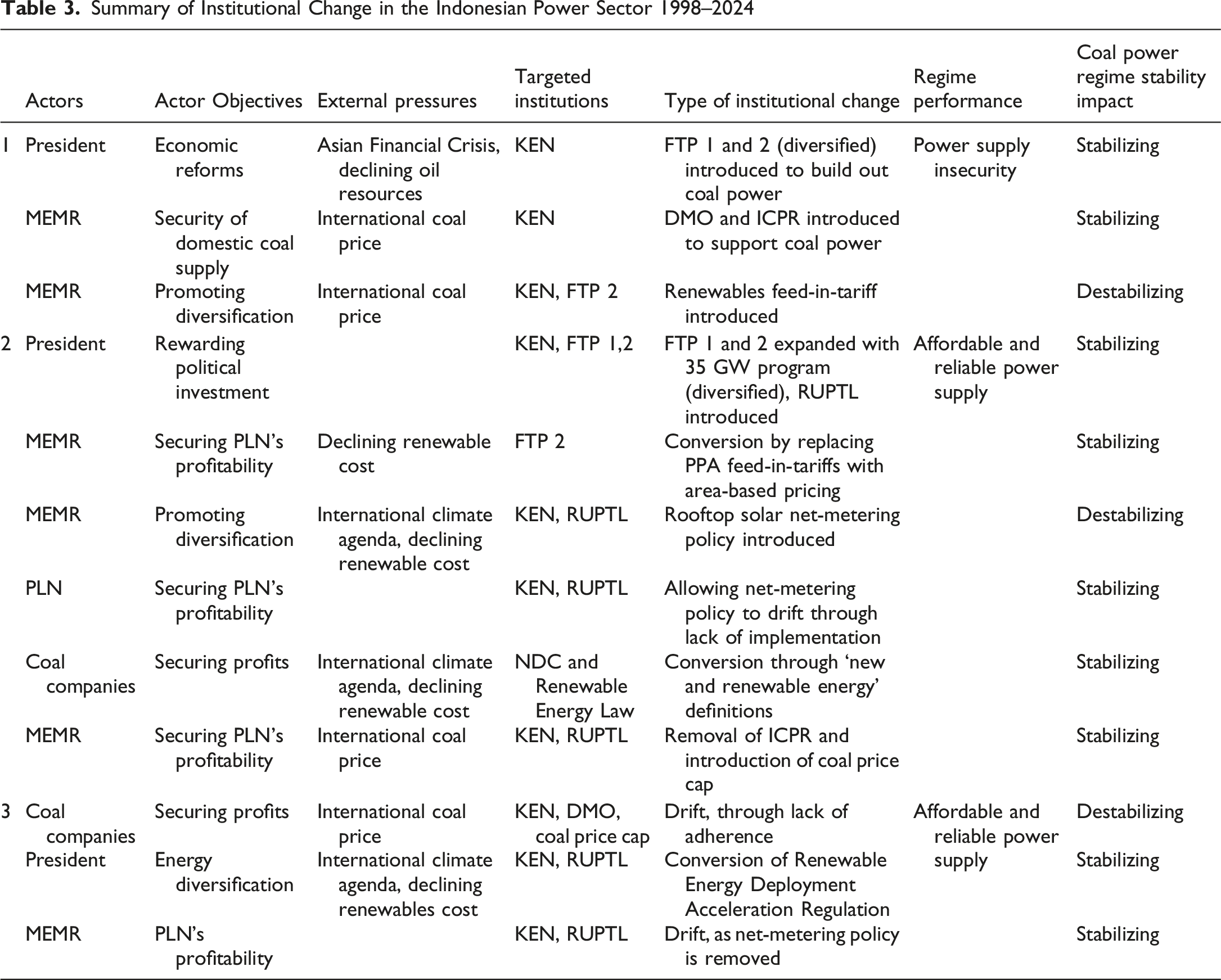
Unlike South Africa, Indonesia’s coal-based socio-technical electricity regime is young. Two primary institutions that support the regime are the market policies favouring coal (Interviews 4, 5, 7, and 18), and the excessive, coal-heavy capacity acceleration programs that started in the early 2000s (Interviews 2, 3, 5, and 18). The regime is legitimised by the general public’s support of the SOE model, which has delivered affordable and relatively secure electricity throughout the period (Interview 3, 4, 5, and 7). Correspondingly, coal incumbents have resisted external landscape pressure relatively satisfactorily throughout the period, which, similar to the South African case, is divided into three time periods. The main socio-technical regime elements active during 1998–2024 are summarized in Figure 4 and Table 3. Indonesian socio-technical regime elements over period 1998–2024. Arrows indicate the ongoing presence of (sub-) elements over time Summary of Institutional Change in the Indonesian Power Sector 1998–2024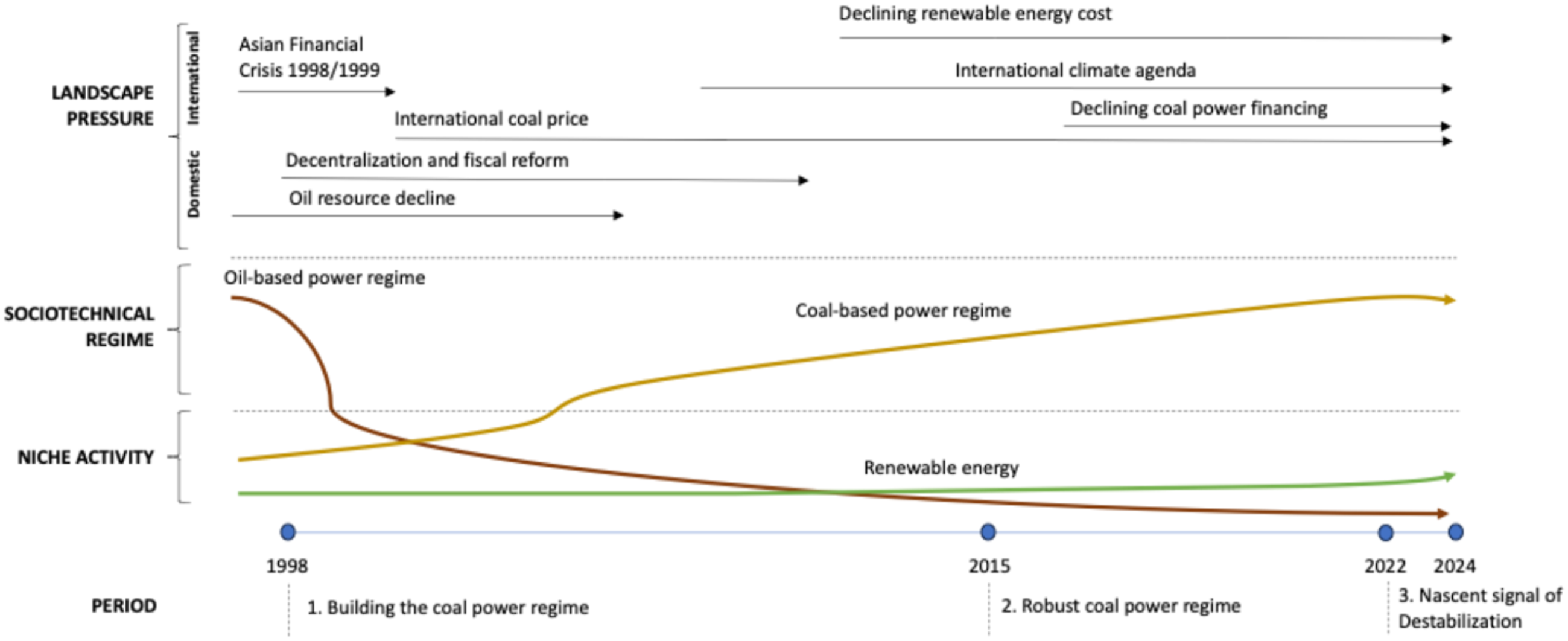
1998–2015: Building the Coal Power Regime
The start of the period saw Indonesia reforming its economy and implementing a decentralisation system after the Asian Financial Crisis and the fall of President Soeharto’s three-decade authoritarian regime, commonly known as Reformasi 1998. Domestic oil resources were exhausting and coupled with increasing energy demand, this put Indonesia’s fiscal situation under strain (Mori, 2020; Resosudarmo et al., 2012). The building of the coal power regime was initially a part of the economic reforms.
The coal power regime was solidified through the rapid installation of coal power plants, which occurred during Yudhoyono’s presidency (2004–2014). Before the Reformasi 1998, oil accounted for no less than 35% of the installed power generation capacity, while coal power plants comprised around 20% (MEMR, 2006).
In 2004, the Ministry of Energy and Mineral Resources (MEMR) issued the National Energy Policy (Kebijakan Energi Nasional/KEN) 2003–2020, emphasising domestic energy supply and value addition from the energy sector, together with secure and affordable power supply. The strategy was to push coal utilisation, seen as an abundant but underutilised resource. In 2006, KEN was strengthened, with the goal of coal contributing 33% of primary energy by 2025. KEN shaped the subsequent energy policy and discourse dimensions.
Later that same year, Yudhoyono started the implementation of KEN by layering it with the Fast-Track Programme (FTP) 1, instructing the monopolistic SOE Utility Perusahaan Listrik Negara (PLN) to construct 10 GW of coal-power capacity by 2009. In 2010, Yudhoyono issued the second FTP, which included an additional 3.3 GW of coal-powered plants and 6.6 GW of hydropower and gas power plants. The central government guaranteed the financing and, later in 2013, introduced feed-in tariffs for renewable energy to further promote the diversification introduced in FTP 2.
Despite being one of the largest coal-exporting countries, Indonesia is a price taker in the highly integrated global coal market (Batten et al., 2019). As such, the stability of the coal regime is strongly influenced by the international coal market. In 2005, high international coal prices prompted coal companies to export their coal, leading to a domestic coal power supply crisis (MEMR, 2012). To address this issue, in 2009, MEMR introduced the Domestic Market Obligation (DMO) and the Indonesian Coal Price Reference (ICPR), under the Mining and Mineral Resources Law 34/2009. The DMO required coal companies to submit around 20% of their production for domestic use, primarily the power sector; meanwhile, the ICPR ensured that the domestic coal price is competitive to the international price.
These policies, which ensure coal companies’ profitability, can be seen as a step towards strengthening the coal regime and coal oligarchs, as they have made the previously neutral coal companies (Interview 20) proponents of the coal power regime. The coal companies’ support for politicians was demonstrated during the 2014 election when they made substantial contributions to election campaigns (Interviewees 2, 4, 5, and 7). Coal companies’ involvement was strong in the executive and legislative domains at the central level, where coal figures were directly involved as part of the campaign teams, including the winning team of Joko Widodo (Akuntono, 2014; Syahni, 2019). Later, this political investment by the coal companies shaped the organisational network of Widodo’s cabinet.
In 2002, the government enacted a law on electricity, allowing for competition. It was repealed 2 years later by the Constitutional Court, mainly based on (1) PLN’s poor financial condition following the financial crisis and (2) that electricity provision, as a vital resource, is the government’s responsibility as noted in the Constitution (Hukumonline, 2004). The Court’s ruling confirmed that the centrally administered power sector is constitutionally legitimate.
It is essential to note that the narratives of climate mitigation before 2015 predominantly focused on the forest and land-use sector, as evident in Indonesia’s Nationally Appropriate Mitigation Actions (NAMAs) of 2009. Coal-supportive KEN was justified given the energy crisis, fiscal strain, and the need for economic reforms. As such, the coal power regime displaced the declining oil power regime in this period without much resistance, with coal power plants accounting for almost 40% of power production by 2015 (MEMR, 2017).
2015–2022 A Robust Coal Power Regime
From this point, a robust coal power regime materialized. Politicians and coal power companies benefited from the regime, and PLN could be described as its primary incumbent (Interviewees 2, 3, and 4). Local governments, businesses, and communities from coal-dependent regions benefitted from coal employment, royalties, and taxes (Interviewee 7). This period was marked by a political shift from clientelism to an outward oligarchy, as demonstrated by the appointment of coal figures such as Pandjaitan and Thohir to energy-related bodies (Singgih, 2022). The period was also marked by international pressures on the regime, including the climate agenda, declining coal finance, decreasing costs of renewable technology, and rising coal prices (Interviewees 2 and 7).
To reward the oligarch’s political investment (Ordonez et al., 2021), and influenced by them (Halimatussadiah et al., 2024), Widodo layered the acceleration programs with another one in 2015 – the 35 GW programme, 20 GW of which was coal-powered. This programme, including the previous FTPs, was incorporated into PLN’s 10-year electricity supply business plan (Rencana Usaha Penyediaan Tenaga Listrik/RUPTL), which MEMR approved. From this point, RUPTL became the primary development plan of the power sector.
In 2017, MEMR reformulated the pricing in renewable energy Power Purchasing Agreements (PPA) by removing the feed-in tariffs and introducing area-based pricing (BPP), which favoured coal power (Halimatussadiah et al., 2024). This institutional conversion effort undermined the competitiveness of renewable energy.
The acceleration programmes (FTP 1, 2 and the 35 GW programme) resulted in a power oversupply in this period, hampering renewable energy development (Halimatussadiah et al., 2024). Coal proponents used the issue of oversupply in the discursive and policy environments to delay diversification. For example, PLN was believed to be limiting and complicating the implementation of the 2018 net metering policy for on-grid rooftop solar, citing the power oversupply problem (Riyandanu, 2022) – a drifting strategy.
PLN also publicly complained about the high cost of investing in renewables due to land scarcity and the additional transmission infrastructure required (Interviewees 5, 7, and 18). The discourse of coal-based energy as secure, reliable, independent, and affordable dominated and did not face strong resistance, aside from a few climate and environmental policy advocates and activists, which corresponded to the legitimacy of an SOE-led brown economy (Interviewees 3, 4, and 5).
Also during this period, as the international climate agenda rose, policies intended to support renewables were instead co-opted by coal proponents. For example, coal derivatives and carbon capture were included in Indonesia’s NDC (Interviews 2, 4, 5, and 18), and the definition of ‘new and renewable energy’ in the New and Renewable Energy Law, deliberated since 2014, was expanded to include ‘liquified and gasified coal’. The implications of the latter were that coal companies had the right to obtain royalty and fee exemptions. The definition, a conversion of the Law, served to ensure domestic coal demand (Interviewee 4).
In 2018, in response to a soaring international coal price, MEMR introduced a domestic coal price cap of around $70/ton for the electricity sector, removing the ICPR, to stabilize PLN’s cost structure. This change unintentionally impacted coal mining companies' profitability, given that as high as 80% of domestic coal consumption was by the power sector during this time (MEMR, 2025), with the international coal price way beyond $70/ton. This decision implicated coal power regime stability in the following period.
In 2016, a judicial review on the electricity regulation law was filed, noting that the then-existing law still allowed for the private sector to control the power sector (DDTC, 2016). Similar to the 2004 case, this was approved by the Constitutional Court, providing another instance where PLN’s monopolistic nature is deemed legitimate.
Because the coal regime was established during the previous period, the strategies enacted by incumbents in this period have enabled them to resist external landscape pressures, leading to drifting and converting nascent diversification policies, which indicates a robust coal power regime.
2022–2024: Regime Vulnerability to the International Coal Price and Finance
In early 2022, international coal prices reached $200/ton. Coal companies opted to export, disregarding the DMO and coal price cap, which led to the drift of these policies, as this strategy yielded windfall profits of up to 400% (Mecca, 2022). Their actions put Indonesia’s power at risk as coal power stockpiles dwindled. This was quickly resolved with MEMR issuing a decree to ban coal exports between 1 and 31 January 2022.
Yet, shortly afterwards, the oligarch Pandjaitan intervened to get the decree cancelled, with profitability suggested as the reason (Idris, 2022). Following the crisis, discussions about dismantling the DMO and coal price cap policies started, advocated by prominent coal oligarchs (Guitarra, 2022). Deliberations are ongoing to replace the DMO and coal price cap with an additional coal levy (Rahayu, 2023). The scheme could benefit coal companies since it allows them to access the international market freely; however, it may impact PLN’s ability to obtain cheap coal supplies.
During this period, declining international coal power financing and the decreasing costs of renewable energy heightened the risk of failure in coal-powered plant development. For example, the new coal power plant in Cirebon was delayed due to the withdrawal of the Japan Bank for International Cooperation, among others (Trend Asia, 2021). Coal companies began to notice opportunities in renewable energy (Interviews 5, 7, 18, and 20), and showed signs of defecting from the regime driven by financial considerations. For instance, Adaro Energy and Indika Energy, among Indonesia’s largest coal companies, each established a new business line in response to renewable opportunities. Indika aims to achieve 50% non-coal revenue by 2028.
In 2022, Widodo introduced Presidential Regulation 112/2022 on Renewable Energy Deployment Acceleration, tasking PLN to level the generation playing field and MEMR to develop an early coal phase-out roadmap, which is supposed to promote diversification in the RUPTL. However, in an instance of conversion, the regulation also allowed for the development of new coal power plants if they were classified as a national strategic program, inconsistent with the early coal phasing-down roadmap, and gave PLN the power to negotiate the renewables price, contradicting the plan to level the playing field (Halimatussadiah et al., 2024). Furthermore, MEMR dismantled the solar net-metering policy in 2024.
In November 2022, Indonesia negotiated a JETP, its joint statement including the intent to phase-out coal, a first for developing countries in international fora. It has however not materialized yet, mainly due to the low financial concessionality (Damuri et al., 2023), the exclusion of captive coal-powered plants (Parapat & Hasan, 2023), and the fact that the commitment is not binding (Do & Burke, 2024).
In the third period the coal power regime remains strong; however, its vulnerability to pressure from international coal prices and coal finance is highlighted. Most importantly, the period substantiates the ambivalence of coal companies to the domestic coal power regime. They are driven mainly by profit motives.
Discussion
The case studies of the coal power regimes in South Africa and Indonesia demonstrate multiple instances of both stabilisation and destabilisation through the 1998–2024 period. This notwithstanding, the coal fleets in both countries continue to expand, and in neither case can destabilisation be definitively argued as escalating to a point of institutional transformation (although South Africa does show some signs of this in period three). There are also no clear indicators of whether and when a credible domestic phase-out signal might be adopted in either country. A comparison of the cases does, however, provide rich insight into the linkages between the interaction of actors, their objectives and strategies, external landscape pressures, regime performance and regime stability over time.
First, the nature, objectives and strategies of regime actors are significant for (de)stabilisation. The Indonesian coal oligarchs’ objectives are profiteering; therefore, they focus primarily on manipulating the market aspects of the selection environment (coal prices and quotas) to ensure profitability, at times destabilising the regime in the process. This aligns with the findings of Pratiwi and Juerges (2022) regarding Indonesia’s geothermal policy change, which is driven by a ‘development coalition’ of actors with vested interests rather than a ‘conservation coalition’. In South Africa, Eskom works throughout the timeframe to retain its monopoly status, in most instances stabilising the regime. The RET proponents, with their rent-seeking objective, focus on rent extraction, exerting an inter-period destabilisation effect through their impact on the regime’s ability to perform its societal function.
Regime performance and related regime legitimacy are a second cluster of significant (de)stabilising factors. Whilst the Indonesian coal power regime provides reliable and affordable power throughout the period, the South African regime performs poorly, and this poor performance is a key driver of destabilisation in periods one and three. Whilst both cases feature centralised electricity sector structures, the degree of legitimacy each enjoys differs significantly. This legitimacy or lack thereof, in turn, informs actor objectives and strategy, determining how external pressures impact the regime.
In South Africa, there is an ongoing ideological struggle over the role of SOEs in economic development, both within government and between coal proponents and those advocating for diversification. The centralised sector structure is highly contested. Under pressure from this sector reform agenda, centralised South African regime institutions threaten to be overcome by the economics of renewable power, the nimbleness of the private sector to implement renewable projects, and advances in storage and digitisation. Sector reform becomes intrinsically bound up with diversification and coal phase-out, destabilising the regime. In contrast, in Indonesia the centrally administered system enjoys legitimacy so that power sector structure is never significantly contested, allowing the incumbents to largely determine regime stability. Indonesian oligarchs may themselves engineer a transition to renewables to secure their own profitability.
In terms of external pressures, the international climate agenda and coal phase-out signal, including JETPs, seem to be largely irrelevant to destabilisation in either country. South Africa has no coal phase-out commitments or metrics, and disbursing JETP finance has been slow. The core destabilisation driver of sector reform does not feature. Similarly in Indonesia, the realisation of the early coal phase-out funding also appears to be sluggish, and it does not engage with the core drivers of destabilisation. Instead, the JETP works contrary to the profiteering objective of the oligarchs, as it reduces oligarchs’ profit without sufficient compensation from renewables.
International economic pressures however play significant roles in both, particularly renewables cost decline in both countries, and coal export prices in Indonesia. However, how these economic pressures influence regime institutional (in)stability is filtered through the particular characteristics of the domestic regime. In Indonesia, the interaction of coal price pressure with incumbent profit objectives drives key instances of institutional destabilisation or stabilisation over the period, but not in South Africa, which faces non-price barriers to export. In contrast, the Indonesian coal regime faces no significant domestic pressures, whereas the South African regime has two very significant ones to contend with: the ongoing reform and rent-seeking agendas. Declining coal finance availability impacts both cases in the third period, where new coal plants were unable to achieve financial close. However, whilst this driver reduced coal expansion, it had limited institutional and therefore destabilisation impact in our framework. Domestic climate policy, although well developed in each country, has had little impact on regime destabilisation nor coal phase-out. This complements Bimir’s (2025) argument on the importance of co-benefits in climate agenda setting, namely that the narrative of co-benefits should align with the incumbent objectives.
In both countries, the interactions between the various elements of the regime are characterised by a high degree of fluidity: actors switch sides (coal companies, government departments and even the Presidency in the Indonesian case both support and undermine the coal regime at various points); actors unintentionally realise the opposite of their objectives (the Zuma administration through its weakening of Eskom, and the Indonesian government in its removal of the ICPR); and interactions in one period impact on institutional change in the next (the weakening of Eskom caused supply insecurity which resulted in reforms to the ERA, and the imposition of the coal price cap in Indonesia in period two caused a coal companies to ignore the DMO in period three). This finding motivates for studying incumbent regimes over longer time periods, and understanding the full complexity of regime element interactions.
Both cases see the introduction of new institutions or the expansion of existing institutions over the timeframe considered. In both, actors use tactics of drift and conversion to impact coal regime stability. However, no clear patterns relating to the different types of institutional change emerge from the analysis.
From the discussion, a few high-level propositions about emerging economy coal power destabilisation can be proffered. First, that the nature, objectives and strategies of regime actors are highly significant in determining how and why destabilisation occurs. Second, both regime performance and regime legitimacy are important drivers of regime stability. International economic pressures such as technology and coal pricing are strong destabilising drivers, whilst climate policy and finance have not yet been. Domestic pressures, where present, are equally significant and important to understand. Again, domestic climate policy has not yet been impactful. There is a high risk of unjust transitions in emerging coal power economies. Finally, there is a high degree of fluidity of regime elements over time, emphasising the value of attending to the regime details and conducting long term analysis to understand each system. These insights are relevant to both theory and policy, which are considered in turn below.
Theoretical Implications
The study findings, achieved with a theoretical frame drawn from socio-technical transition, phase-down and institutional literatures, support the explicit theorising of institutional destabilisation as a precursor to intentional (or unintentional) coal phase-out. Such conceptualisation will in turn enable a deeper understanding of ‘pre-phase-out’ contexts, supporting research into institutional changes beyond those of climate policy for coal-dependent emerging economies.
The study also details Turnheim’s (2023) concept of ‘pressure fronts’, of multiple sources of change, and of destabilisation as non-linear, indeterminate and contingent. The complexity and context-specificity of how regime actors and external pressures interact to (de) stabilise the coal regime over time must be anticipated by theoretical endeavours. 3 Multidisciplinary frameworks, such as the one demonstrated in this study, are useful to reveal different types of levers of institutional destabilisation across contexts.
The difference in incumbent objectives both between and within the two cases speaks to the importance of unpacking ‘incumbency’ to examine a plurality of forms of incumbency at play and the depth of related socio-technical entanglements Stirling (2019) cited in Turnheim, 2023; Turnheim & Sovacool, 2019). The findings further raise questions related to transition and phase-out timing: When do regime stabilisation and destabilisation processes begin and end, are they structural or cyclical, and can destabilisation be reversed?
The typology of endogenous institutional change used in the analysis (Table 1) was useful in identifying connections between regime elements and instances of changed institutional outcomes, although it did not contribute significant explanatory value, and therefore appears to be a less productive component of the framework. Further, the authors are aware that the type of change is closely and perhaps superficially related to the analytical choice of the targeted institution, rendering its use for analytical insight potentially unreliable.
Policy Implications
To the extent that regime destabilisation is a necessary precursor to coal phase-out, the study suggests that climate policy design should be considered for its potential regime stability outcomes. The South African and Indonesian JETPs could be argued as not having delivered on phase-out because they were not attuned to the particular drivers of regime instability of each case. Identifying local instability drivers and leveraging these with policy and finance interventions over time may present a way forward.
Critically, the analysis suggests that in both cases it appears likely that the private sector will play a dominant role in phase-out, as opposed to the SOEs or government, although for very different reasons. Understanding the nature, objectives and strategies of regime actors provides information to advance regime destabilisation. For example, in Indonesia, as the coal oligarchs are less attached to the coal regime than to profits, they could themselves drive regime destabilisation if energy economics were engineered by policy and regulation to shift away from coal and towards renewables. JETP funds can be directed toward facilitating energy economics that support coal oligarchs transitioning into renewable companies, rather than focusing mainly on phasing out coal plants (following Do and Burke (2024)). In South Africa, interventions to resolve societal ambiguity around the power sector structure, promote the affordability and reliability potential of non-coal generation, support sector liberalisation and strengthen new sites of energy governance may prove effective intervention points.
This situation raises questions and concerns around how a ‘just transition’ can be ensured in each case, an important focus for policy and financing interventions. The process of coal power regime destabilisation cannot be borne by the poorest in society. Attending to justice aspects is an imperative in both cases, and a particularly important policy and financing focus of the South African and Indonesian governments and the JETPs. Given the level of fluidity observed in each case, the climate policy landscape requires constant monitoring and adjustment to respond to changes that trend back towards stability.
A notable international external pressure, the EU’s Carbon Border Adjustment Mechanism (CBAM), was nascent at the time of our informant interviews, and did not appear in our interview data. However, corresponding to our findings on the significance of international economic pressures, we believe CBAMs have the potential to play a role in regime destabilisation going forward. By reducing the profitability of exported products which have embedded electricity emissions, CBAMs reduce demand for emissions intensive power, and hence the profit and rents of power regime incumbents. Profits and rents have been demonstrated as determinant of regime (de)stabilisation in our analytical time frame. Whilst CBAMs are likely to impact both regimes, the effect may be stronger in Indonesia, due to a more pronounced profiteering objective from incumbents and the presence of many captive coal power plants supplying power directly to manufacturers. In South Africa, the CBAM pressure is somewhat mediated by the sector power structure and reform agenda. Domestic policymakers and phase-out advocates should therefore monitor CBAM developments, ensuring any domestic response aligns with the instrument’s coal power regime destabilisation potential.
Conclusion
The pre-phase-out emerging economies of South Africa and Indonesia demonstrate coal power regimes that are subject to both stabilisation and destabilisation in the period 1998–2024, as a result of multiple factors. The availability of profits and rents, renewable energy cost reductions, and regime performance, or lack thereof, drive coal regime (in)stability in both countries through complex and contextualised interactions of local regime elements. The international coal markets also play a critical role in the Indonesian case.
The comparative analysis in the study provides insights to scholars of phase-out processes. Explicitly theorising institutional destabilisation as a precursor to intentional coal phase-out supports research into the institutional dynamics of pre-phase-out contexts. The inter-disciplinary framework developed for the study reveals the contextual and complex systemic interactions at play in a country, detailing regime stability at an institutional level and providing an additional lens from which to understand sustainability transitions, pre-phase-out contexts and destabilisation processes. The paper adds empirical cases of the understudied political economy of phase-outs in the Global South to the phase-out literature, thereby extending the empirical knowledge base and strengthening scholarly understanding.
Beyond these theoretical implications, the study findings have implications for climate policy, JETP design and CBAM policy response, as well as for coal phase-out advocates more generally. Fostering regime destabilisation becomes a policy priority, by attending to complex, contextual political economy factors that translate international pressures to the local institutional level. Further, destabilisation is something to be pursued responsively over time, given that these forces can operate in unintuitive directions. It is therefore important to monitor and modify policy interventions over time.
Footnotes

Funding
The authors received no financial support for the research, authorship and/or publication of this article.
Declaration of Conflicting Interests
The authors declared no potential conflicts of interest with respect to the research, authorship, and/or publication of this article.
Notes
Author Biographies
Appendix
Interview Table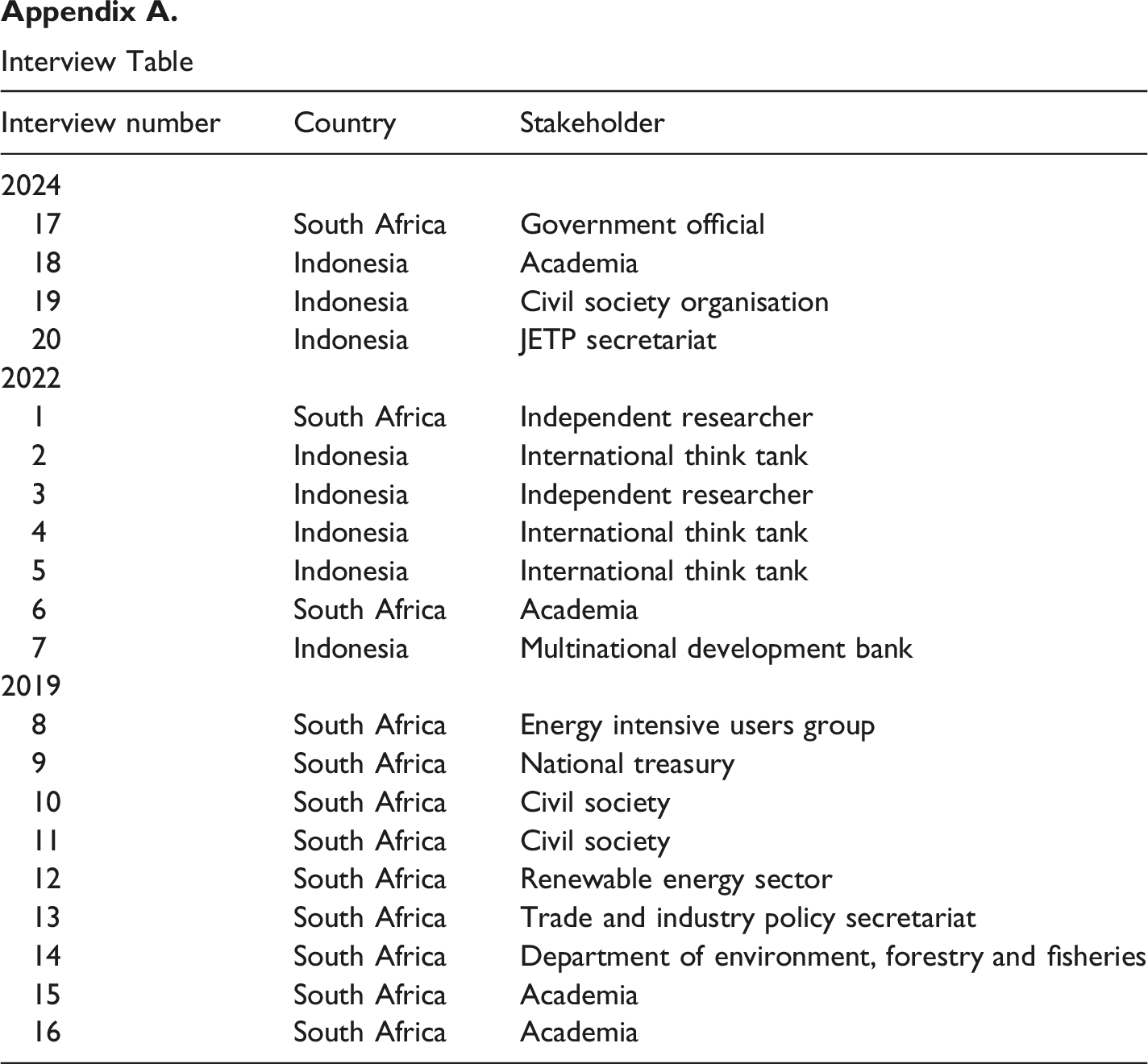
Interview number
Country
Stakeholder
2024
17
South Africa
Government official
18
Indonesia
Academia
19
Indonesia
Civil society organisation
20
Indonesia
JETP secretariat
2022
1
South Africa
Independent researcher
2
Indonesia
International think tank
3
Indonesia
Independent researcher
4
Indonesia
International think tank
5
Indonesia
International think tank
6
South Africa
Academia
7
Indonesia
Multinational development bank
2019
8
South Africa
Energy intensive users group
9
South Africa
National treasury
10
South Africa
Civil society
11
South Africa
Civil society
12
South Africa
Renewable energy sector
13
South Africa
Trade and industry policy secretariat
14
South Africa
Department of environment, forestry and fisheries
15
South Africa
Academia
16
South Africa
Academia