



Abstract
Public participation in strategic environmental decision-making has become increasingly complex amid contemporary social, economic, and political turbulence, placing greater scrutiny on the effectiveness of participation practices in Strategic Environmental Assessment (SEA). This study examines the added value of public participation in SEA, particularly for marginalised communities, where public input does not always translate into decision change and may generate resistance. Drawing on framing theory, stakeholder salience, and public participation models, the study employs a dual-method approach. First, a Public Participation Influence Score (PPIS) was developed through qualitative coding of input framing and stakeholder salience. Second, a binary logistic regression model assesses whether different framing types and stakeholder groups vary in their influence on decision outcomes. The findings show that both the framing of stakeholder input (informational, diagnostic, or prognostic) and stakeholder salience attributes (power, legitimacy, and urgency) significantly shape the likelihood of decision change in SEA processes.
Keywords
Introduction
Public participation is one of the key elements of Strategic Environmental Assessments (SEA) ensuring that affected and interested parties have a voice in decision-making processes. Its significance is further emphasised by legal frameworks such as the EU SEA Directive and the SEA Protocol to the Espoo Convention (Rega & Baldizzone, 2015), both of which highlight the need for public involvement in the assessment process. Although South Africa does not have a mandatory SEA framework, the EU Directive offers a useful benchmark because South African SEAs are often conducted voluntarily and draw on international best practice to guide participation processes. While SEA is not legally mandated in South Africa, public participation in environmental assessments (EAs) is legally required as part of broader decision-making frameworks. Decision makers are required to open their decisions to a wider public to include their opinions and values in decision-making (Maphanga et al., 2023; Patel, 2009). However, the extent to which public participation influences the outcome of environmental assessments remains unclear. Based on observed assessments and participation processes, public engagement in environmental assessments produces a wide range of inputs. These include requests for clarity, expressions of concern, and proposals for constructive modifications. The way these diverse inputs are framed likely has a considerable influence on their subsequent impact on final decisions. Clarity-seeking questions and complaint-driven objections may prove less influential in instigating tangible project alterations, while solution-oriented contributions may offer a pathway toward more substantive policy and design adjustments. Therefore, this study aims to address the following key questions; Do different types of public input have varying levels of influence on environmental decisions? Are some stakeholder groups more effective in shaping outcomes than others? What measurable impact does public participation have on environmental policy adjustments?
South Africa presents a particularly compelling context for studying public participation in strategic environmental assessments. As a country still navigating its post-apartheid transition, it remains deeply marked by historical inequalities and systemic marginalisation (Ragolane et al., 2024). Public participation mechanisms, while formally institutionalised in law and policy (Maphanga et al., 2023; Patel, 2009) operate within a society with high inequalities (Lander, 2024; Ragolane et al., 2024). Different groups may vary significantly in their access to resources, procedural knowledge, and opportunities to articulate their views. This unevenness may have implications for who participates, how inputs are framed, and the extent to which they influence outcomes, an analytical proposition that motivates the empirical analysis in this study. Studying participatory dynamics in this context thus not only reveals how framing affects influence but also uncovers broader limitations and possibilities for inclusive governance in societies undergoing democratic deepening. These socio-political disparities create a tension when contrasted with the strong legal framework mandating public participation in South Africa. Despite constitutional and legislative provisions such as the 1996 Constitution and the National Environmental Management Act 107 of 1998 (Du Plessis, 2008) that require meaningful engagement and establish expectations for public input to shape environmental decisions, implementation often falls short. In practice, some environmental assessments show limited responsiveness to public concerns. This has often resulted in decisions not supported by the public, such as the Gautrain EIA, the wild coast mineral mine EIA and the Durban South SEA (Patel, 2009), where communities argued that participation processes were inadequate or their inputs were insufficiently considered. Such instances may suggest that public participation often fulfils a procedural requirement without evolving into a meaningful tool for substantive decision-making or providing a genuine platform for the public to shape outcomes.
To address these concerns, it is essential to investigate whether varying types of public input exert differing levels of influence on environmental decisions, and whether specific stakeholder groups demonstrate a greater capacity to shape outcomes compared to others. This study aims to evaluate the influence of public participation framing on environmental decision-making in South Africa through some strategic environmental assessment exercises. Specifically, it seeks to (1) Categorise public inputs in SEAs based on their framing (2) Assess whether certain types of public input are more likely to lead to project modifications. (3) Develop a measurable framework, the Public Participation Influence Score (PPIS) integrating framing categories, stakeholder salience attributes, and decision influence metrics. (4) Provide policy recommendations for enhancing meaningful public participation in environmental assessments.
This study contributes to SEA scholarship by (1) introducing the PPIS as a measurable analytic framework linking framing, salience, and decision influence, and (2) empirically demonstrating how framing types and stakeholder characteristics shape outcomes in two South African SEA cases. The paper also contributes to global participation debates by illustrating how framing misalignments can limit influence even in inclusive processes.
Theoretical Framework
Public participation is a legally required component of decision-making in South Africa. However, effectiveness of participation may depend not only on who participates but also on how their contributions are framed and how decision-makers interpret them. By applying Framing Theory, Stakeholder Salience and Public Participation Effectiveness Models, the study aims to investigate whether certain frames and stakeholders are more influential than others in SEA decisions.
Framing Theory and Public Participation
Framing theory, which originates from communication studies, provides a useful lens for understanding how different ways of presenting information shape perceptions and influence decision-making. Framing refers to how information is selectively emphasised to shape interpretation and influence decision-making (Chong & Druckman, 2007; Entman, 1993). Although every subject can be viewed from different angles, framing narrows the focus to a specific perspective, often excluding alternative perspectives. As a result, people tend to base their opinions on the readily available and accessible information without considering other perspectives and critically evaluating all the information around the subject (Chong & Druckman, 2007). In the context of Strategic Environmental Assessments (SEAs), stakeholders engage in public participation processes through various forms of input, including clarity-seeking questions, concerns or complaints about potential environmental and social impacts, or solution-oriented contributions. This variation in framing may influence the extent to which stakeholder input is considered, prioritised, or dismissed. It may also affect decision-making because solution-oriented frames can signal actionable pathways, whereas diagnostic or informational frames may be perceived as less decision-relevant.
In South Africa, public participation is not merely encouraged – it is a legal requirement in environmental decision-making. Research has shown that meaningfulness of this participation depend on who is involved and how they are involved (González et al., 2023; Stewart & Sinclair, 2007). Participation processes that exclude key stakeholders or use tokenistic methods of involvement may be seen as ineffective and less inclusive (Arnstein, 1969; Reed, 2008). We argue that meaningful participation may also depend on how participant’s inputs are framed and how they are interpreted by decision-makers. Participation processes may be inclusive, representative, timely or provide the resources necessary for participants to fully engage in decision-making. However, their inputs may still fail to influence decisions depending on how they are received and perceived by the decision makers. This study draws insights from Framing Theory, the Stakeholder Salience framework, and models of Public Participation Effectiveness to investigate whether certain types of stakeholders and framings of stakeholder input carry more weight in Strategic Environmental Assessment (SEA) processes than others.
Types of Frames
Frames can be articulated around three main categories, diagnostic, prognostic and motivating frames. These frames may shape how stakeholders perceive, communicate, and engage in public participation processes. Diagnostic frames identify, define a problem or an issue and assign blame to a specific party (Benford & Snow, 2000; Mendelsohn et al., 2024). Stakeholders may identify environmental harm or social injustice associated with a project and assign blame accordingly. For example, a stakeholder may make comments like, ‘This development will destroy our agricultural land’. Prognostic frames move beyond identifying problems and propose solutions and recommendations. These frames focus on finding ways to address the issue rather than just highlighting the problem (Benford & Snow, 2000; Feront & Bertels, 2019). Stakeholders may recommend alternative ways to go about the projects, for example: ‘Instead of clearing the forest, the project could take up the unused agricultural land’. Motivating frames call for action, appealing to emotions or moral responsibility. These frames mobilise stakeholders to push for change. It involves organisation of stakeholders to act against an undesirable situation (Feront & Bertels, 2019; Mendelsohn et al., 2024). For example, ‘We must not accept this project because it will destroy our environment’.
While framing theory traditionally distinguishes between diagnostic, prognostic, and motivating frames, the empirical analysis in this study required a slight adaptation of this typology. No inputs in the dataset corresponded to motivating frames, which are typically associated with mobilisation and calls to action. Instead, a distinct category, termed ‘informational framing’, was identified inductively during coding to capture inputs that were primarily descriptive or clarity-seeking rather than problem-defining or solution-oriented. This adaptation reflects the nature of stakeholder engagement observed in the examined SEA processes, where participants often seek information or raise concerns without explicitly framing them as problems or actionable recommendations.
Stakeholder Theory and Power Dynamics in Public Participation
While framing shapes how input is perceived, stakeholder theory helps explain which stakeholders’ voices carry more weight in decision-making (Freeman, 1984). Not all participants in SEAs have the same influence-NGOs, government agencies, and affected communities may have varying levels of power and legitimacy in the process. This study aims to use the Stakeholder Salience Model by Mitchell et al. (1997) to understand why some stakeholders in SEA may have more influence than others.
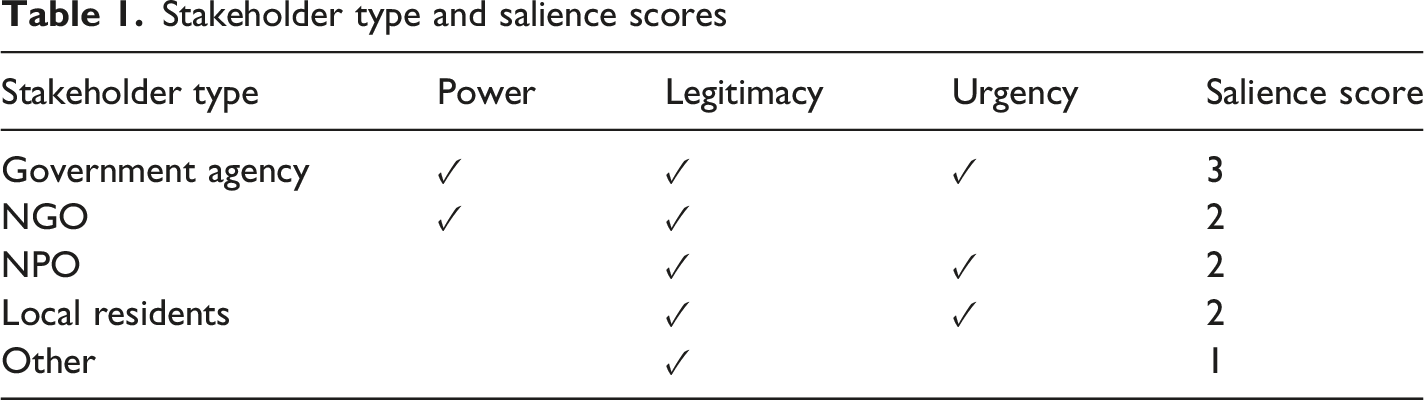
Stakeholder salience model argues that stakeholders are not treated equally. Their influence depends on three attributes: power, the ability to enforce their demands (e.g. through legal action, political influence); legitimacy which refers to a recognised right to participate and urgency which is the degree to which their concerns demand immediate attention (Mitchell et al., 1997). In many governance contexts, however, decision-making authority remains concentrated within state or elite actors, which can limit the influence of less powerful stakeholders despite formal participation mechanisms (Bruun, 2020; Han, 2017).
Stakeholder type and salience scores
Public Participation Effectiveness in SEA
To assess how framing and salience influences decision-making, it is necessary to define what constitutes good and effective public participation. Researchers have tried to define what effective participation is and what it constitutes. This study draws from the works of Arnstein (1969), Rowe and Frewer (2000) and Carrick et al. (2022) to describe the core components of effective participation.
Rowe and Frewer (2000) emphasise that effective public participation strengthens democracy and improves decision-making by ensuring that public concerns and values are considered. However, they also note that participation methods are not one-size-fits-all, arguing that effectiveness depends on contextual relevance and the extent to which participation processes meet specific evaluative criteria. While public participation is widely assumed to enhance environmental governance, empirical evidence supporting its effectiveness remains limited and inconsistent (Bernauer & Betzold, 2012).
Evaluation Criteria for Effective Participation
Rowe and Frewer (2000) propose nine criteria that should be met for a participation method to be considered effective. These criteria address both process and outcome dimensions of participation. For simplicity, they are summarised and organised into thematic categories in the subsections below (Figure 1). (1) Inclusivity and representation Factors Contributing to Effective Public Participation. Source: Authors’ compilation based on Arnstein (1969), Rowe and Frewer (2000) and Carrick et al. (2022)

Participation processes should be inclusive and representative of all relevant stakeholders, including marginalised groups, to ensure fairness and diversity of perspectives (Rowe & Frewer, 2000). (2) Accessibility and empowerment
Participants must have practical and informational access to the process. Practical access involves removing barriers such as transportation, language, cost, and internet constraints. Resource accessibility includes providing knowledge, tools, expert support, and adequate time for meaningful engagement. Access to resources enhances participants’ capacity to contribute meaningfully. Empowered participants are more able to influence outcomes (Carrick et al., 2022; Rowe & Frewer, 2000). (3) Influence
For participation to be meaningful, public inputs must have visible influence on the final decision (Arnstein, 1969; Rowe & Frewer, 2000). Participation processes in which citizens are heard but lack genuine decision-making power risk becoming tokenistic (Arnstein, 1969). (4) Transparency and clarity of task and scope
According to Rowe and Frewer (2000) participation processes should be clear about how decisions will be made, how public inputs will be used, and what impact participation will have. In addition, from the outset, participants should be informed of the purpose of the participation exercise, expected outcomes, and mechanisms for engagement. (5) Independence, early and continuous involvement
Participation should be facilitated by neutral or independent bodies to avoid bias, power imbalances, or undue influence from dominant actors. Stakeholders should be engaged as early as possible and throughout the decision-making process not only at selected stages (Carrick et al., 2022; Rowe & Frewer, 2000). (6) Cost-effectiveness and structured decision-making
Participation should provide value for money and use structured frameworks that guide discussions. Clear structure prevents inefficiencies, such as dominance of certain voices, premature closure of debate, and social loafing (Rowe & Frewer, 2000).
Linking the Criteria to Broader Theories of Participation
Arnstein’s (1969) critique of tokenism complements Rowe and Frewer’s evaluative approach. Arnstein emphasises that many participatory processes stop at consultation without transferring real power to citizens. Effective participation, therefore, requires moving towards higher levels of influence or decision-making authority. These frameworks highlight that participation is effective only when it is inclusive, accessible, meaningful, transparent, empowering, and contextually appropriate.
Empirical Studies on Framing, Stakeholder Salience and Public Participation Effectiveness
Empirical studies have explored how framing, stakeholder salience, and public participation shape environmental policy processes. This section synthesises key findings from diverse contexts to show how these dimensions influence perceptions, behaviours, and decision outcomes in environmental and climate-related governance.
Framing and Public Response
Several researchers have investigated the impact of framing on how the message is received and acted upon particularly in environmental decision-making and climate change policy. Li and Su (2018) investigated how different ways of presenting information about climate change influence individuals’ climate-related attitudes and behaviours. The findings revealed frames that emphasise the environmental, economic, and moral dimensions of climate change have small-to-medium impact on individuals’ engagement with climate change. While frames that emphasise public health implications or geographical identity had low impact. Similarly, Homar and Cvelbar (2021) tested for two types of frames, loss which emphasises negative consequences of climate inaction; and gain frames which is what individuals stand to gain by adopting pro environmental behaviours. Their findings revealed that loss frames are more effective in promoting environmental behaviour than gain frames. Rossa-Roccor et al. (2021) noted that, in some communicating policy benefits may promote its acceptance. Although gain frames were found to be more effective when the commitment to the required behaviour is low (Homar & Cvelbar, 2021). Their findings are consistent with the findings of Poortinga et al. (2023), who found framing to be effective in promoting acceptance of certain environmental policies to a limited extent. These studies demonstrate that while message framing contributes to shifting individuals’ perceptions and behaviour (Homar & Cvelbar, 2021; Li & Su, 2018; Poortinga et al., 2023; Rossa-Roccor et al., 2021), its effectiveness can be constrained by contextual factors, such as required commitments (Poortinga et al., 2023). Nevertheless, it remains a useful lens for understanding how policy messages gain or lose traction. Although these studies are not situated within SEA processes, they demonstrate how framing shapes the reception, interpretation, and effectiveness of policy-relevant input. These insights are directly relevant to SEA, where public submissions similarly compete for attention and influence within formal decision-making processes.
Stakeholder Salience and Influence
Beyond message framing, the degree to which stakeholders influence outcomes also depends on their salience, that is, how legitimate, powerful, or urgent their claims are perceived to be in a given decision-making context. Some business studies have applied the salience model to determine influence levels across different stakeholders. Some have examined the type of stakeholders that have more influence on companies disclosing their corporate social responsibility (CSR) (Majdi et al., 2023; Thijssens et al., 2015). These studies revealed that stakeholders such as business partners, customers and shareholders are less influential in CSR disclosure compared to employees, community and media (Majdi et al., 2023). Furthermore, Thijssens et al. (2015) found that stakeholders possessing the legitimacy attribute, particularly NGOs, are more likely to succeed in persuading companies to disclose their environmental information. Although salience is not always measured directly in studies, it is reflected in whose voices are heard and whose inputs shape outcomes. This is particularly relevant for SEA contexts, where multiple stakeholder groups participate formally, but institutional power and perceived legitimacy may condition whose inputs ultimately influence assessment outcomes.
Public Participation: Mechanisms and Effectiveness
Studies examining the effectiveness of public participation offer insights into when and how citizen involvement leads to meaningful influence. Researchers such Kasymova and Gaynor (2014) contributes to the discourse about public participation effectiveness in environmental decision-making through examining three cases from Newark, New Jersey; Tonawanda, New York; and Bishkek, Kyrgyzstan. The study evaluates success of participation by focusing on the benefits of engagement. The findings show that when citizens are actively engaged, they become better informed and the active engagement can lead to better collaboration which may strengthen trust among parties involved (Kasymova & Gaynor, 2014). However, while Kasymova and Gaynor (2014) emphasise the positive outcomes of public participation, other scholars caution that participatory processes avoid tokenistic involvement or elite capture (Arnstein, 1969; Reed, 2008). Gauthier et al. (2011) examined the role and effectiveness of public participation within SEA processes. The findings show that despite the inclusion of public participation mechanisms, the actual influence of public input on final decisions was limited on the cases examined. Participation processes did not create enough space for deliberation of social impacts of decisions, leaving very little room for public input to influence decisions. Such participation processes leave the public with unanswered questions, complaints and dissatisfaction about decision-making processes (Gauthier et al., 2011). Evidence from different studies further shows that exclusion from meaningful participation can lead to resistance, conflict, and perceptions of injustice among affected communities (Devine-Wright, 2011; Mkutu et al., 2019).
Involving the public in deliberative processes as partners and keeping them informed allowing them to influence decisions has a better potential to contribute to acceptance (Langer et al., 2017; Liu et al., 2020). Furthermore, perceived procedural fairness also plays a critical role in public acceptability (Liu et al., 2020). Webler et al. (2001) investigated public perceptions of what constitutes a good public involvement process. The findings showed that the public believes that participants should be given the support they need to enable them to participate and create a level playing ground. Their study further emphasised the importance of legitimacy, ensuring that participation is based on democratic values and paying special attention to power dynamics and limiting the abuse of power in decision-making processes (Webler et al., 2001). Some studies have identified obstacles hindering effective participation in SEA outcomes. These studies reveal that, lack of political willingness from proponents, insufficient public information on the SEA process and weak legal frameworks guiding participation (Rega & Baldizzone, 2015) as well as late involvement of stakeholders (Suškevičs, 2019) often hinder their influence on final outcomes. Despite several studies on participation effectiveness, the issue of limited participation influence on decisions outcomes remains a challenge. This limitation reveals the need for analytical approaches that move beyond participation presence to examine how, and under what conditions, public input influences SEA decision outcomes.
Drawing on these empirical insights and the theories discussed, it becomes clear that framing and stakeholder salience play a crucial role in shaping how participation unfolds and whether it is impactful. Effective participation requires factors such as clear task definition, transparency, empowerment, representation and inclusion of relevant participants, structured decision-making processes, timing, and adequate resources to ensure that contributors can meaningfully influence outcomes. However, an important gap remains: how can the actual influence of stakeholders be measured within environmental assessment processes, and to what extent do framing and salience shape decision outcomes? The current study aims to bridge this gap by examining how different types of frames used in public participation influence final SEA decisions and whether stakeholders vary in influence depending on their salience attributes and how they present their inputs. Although the analysis is situated in the South African context, the underlying mechanisms may have broader relevance, given that South Africa presents typological conditions for examining framing and salience dynamics. To the best of our knowledge, no existing study has systematically applied framing theory together with the stakeholder salience model to investigate how public participation shapes SEA decision outcomes, which establishes the core empirical and methodological contribution of this research.
Methodology
This study achieves its objectives through the development of salience and public participation scores, as well as statistical testing based on data collected from two SEA cases. The study used both quantitative and qualitative research methods, including qualitative content analysis using thematic coding to categorise stakeholder input.
Data Collection
This study draws on content extracted from public participation submissions contained in Strategic Environmental Assessment (SEA) reports. The reports were sourced from the Council for Scientific and Industrial Research (CSIR), South Africa, and the South African Department of Forestry, Fisheries and the Environment. Three SEA cases were initially identified for analysis: the SEA for wind and solar photovoltaic (PV) development, the SEA for the Square Kilometre Array (SKA), and the SEA for electricity grid infrastructure. However, the latter was excluded due to the absence of accessible stakeholder input records. Consequently, the empirical analysis is based on two SEA cases.
To ensure methodological rigour while maintaining analytical feasibility, the study adopts a dual-sample approach. The development of the Public Participation Influence Score (PPIS) is based on a subsample of 30 inputs, selected to enable detailed, multi-dimensional coding across framing, stakeholder salience, and decision influence. The full dataset of 100 inputs is then used for statistical analysis through logistic regression, where larger sample sizes are necessary for more reliable inference.
The collected inputs were subsequently categorised according to framing types derived from framing theory. While framing theory traditionally distinguishes between diagnostic, prognostic, and motivating frames, no inputs in the dataset correspond to motivating frames. This absence led to the introduction of a distinct category, termed ‘informational framing’, to capture inputs that were primarily descriptive or aimed at seeking clarity.
Exclusion Criteria
(1) Inputs or comments raising issues that are already addressed in the SEA study were excluded from the analysis (2) Inputs with no clear acknowledgement or action taken in response were excluded (3) Inputs that are not directly linked to the outcome of the SEA study were excluded from the analysis. For example, questions about where to access the final report.
These exclusion criteria were applied to ensure that the analysis focused specifically on stakeholder inputs with a clear and traceable capacity to influence SEA decision outcomes. Inputs that were already addressed in the SEA documentation do not provide independent evidence of influence, while inputs without any recorded acknowledgement or response cannot be reliably linked to decision-making outcomes. Similarly, inputs unrelated to the substance of the assessment (e.g. procedural or administrative queries) do not contribute to evaluating decision influence. Excluding these categories reduces noise in the dataset and enhances internal validity by ensuring that the PPIS and regression analysis are based only on inputs that can be meaningfully associated with observed decision responses.
Types of Stakeholders Involved
The two SEA studies reviewed involved diverse stakeholders. These stakeholders together with their inputs were recorded on the stakeholder participation section of the reviewed reports. Stakeholders included government departments, which were categorised as government agencies in the analysis. Although these departments were not responsible for executing the SEA studies, they were invited to contribute input during the decision-making process. The responsibility for conducting the studies lay with the appointed agency and the relevant department that commissioned the work, not the participating government agencies themselves.
Other stakeholder groups included local residents (the affected communities), non-governmental organisations (NGOs), and other non-profit organisations (NPOs) not formally classified as NGOs. Additionally, a category labelled ‘Other’ was used to classify stakeholders who were not directly affected by the decision but had an interest in the process. These individuals or groups were not affiliated with any organisation or government entity but chose to participate as concerned or interested members of the public.
Sampling and Sample Size
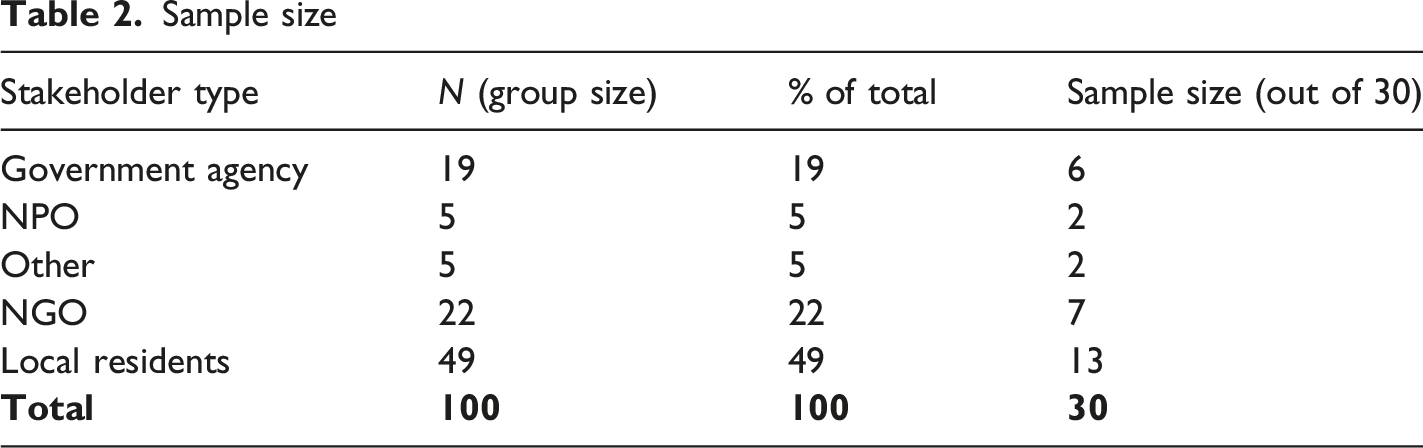
A total of 100 stakeholder inputs were extracted from the SEA reports. Because the development of the Public Participation Influence Score (PPIS) required detailed manual coding of framing type, stakeholder salience, and decision influence outcome, a stratified random sample of 30 inputs was selected for PPIS construction. Stratification ensured proportional representation of all stakeholder groups so that no group was over- or under-represented in the qualitative scoring process.
The 30-input sample was used exclusively for PPIS development, where intensive qualitative coding and multi-dimensional scoring make full-population scoring unnecessary for the development of the framework. This phase was designed to explore influence patterns, refine categorisation schemes, and develop a theoretically grounded qualitative framework for assessing participation effectiveness. No sampling was applied for the statistical analysis. To ensure adequate statistical power for the binary logistic regression model, all 100 stakeholder inputs were included in the regression. Using the full dataset satisfies recommended minimum observation requirements for logistic models and avoids the loss of information about rare decision changes. Accordingly, the study adopts a mixed-method design: 30 inputs for in-depth qualitative PPIS scoring and 100 inputs for quantitative regression analysis.
Sample size
Data Analysis
Data analysis consisted of two complementary components: (1) PPIS Construction (n = 30)
The stratified sample of 30 inputs underwent detailed qualitative coding to assign scores for framing type, stakeholder salience and decision impact. These components were combined to produce the Public Participation Influence Score (PPIS), which captures the relative influence of each input on SEA decisions.
The PPIS is based on three dimensions: Input framing type (from framing theory), Stakeholder Salience (based on Mitchell et al., 1997) and Decision Influence Outcome. Based on the inputs recorded, two types of frames according to the framing theory were identified, diagnostic and prognostic frames. An additional framing type; ‘informational frame’ was assigned to comments that were neither diagnostic or prognostic. These are inputs where stakeholders were simply sharing their concerns or seeking clarity on certain issues. The scores were assigned on framing type, stakeholder’s attributes (power, legitimacy and urgency) and how the input influenced decision-making. A. Input Framing Type (max: 3 points) (1) Informational frame – 1 point (2) Diagnostic (problem-identifying) – 2 points (3) Prognostic (solution-oriented) – 3
Prognostic frames are given a higher score with the assumption that solution-oriented input is more likely to be adopted in decisions compared to diagnostic and informational frames. B. Stakeholder Salience (max: 9 points) (1) Power: 0–3 points (e.g. legal or political leverage) (2) Legitimacy: 0–3 points (e.g. right to participate, are they directly affected?) (3) Urgency: 0–3 points (e.g. is the concern time-sensitive?)
Salience scores were then assigned to each stakeholder type. The classification is presented on able 2. Each stakeholder was assigned a salience score based on their attributes. Therefore, stakeholder salience score is fixed per stakeholder group. The salience score is calculated as Stakeholder Salience Score = Power + Legitimacy + Urgency (Table 2). C. Decision Influence Outcome (max: 3 points) (1) No response/no change – 0 points (2) Acknowledged but not acted upon – 1 point (3) Minor design tweak – 2 points (4) Significant decision change – 3 points (2) Logistic Regression (n = 100)
To test whether specific characteristics of stakeholder inputs predict the likelihood of decision modification, a binary logistic regression model was estimated using the full dataset of 100 inputs.
The dependent variable, Decision Change, was coded as • 1 = decision modified (decision impact score ≥2) • 0 = no modification
Predictor variables included: • framing type • stakeholder type • sector
Using all 100 observations ensured adequate sample size, an appropriate events-per-variable ratio, and stable coefficient estimation. Logistic regression estimates the probability that an input results in a decision modification as a function of the predictor variables (Brooks, 2008; LaValley, 2008). The model is specified as
Results and Discussion
Public Participation Influence
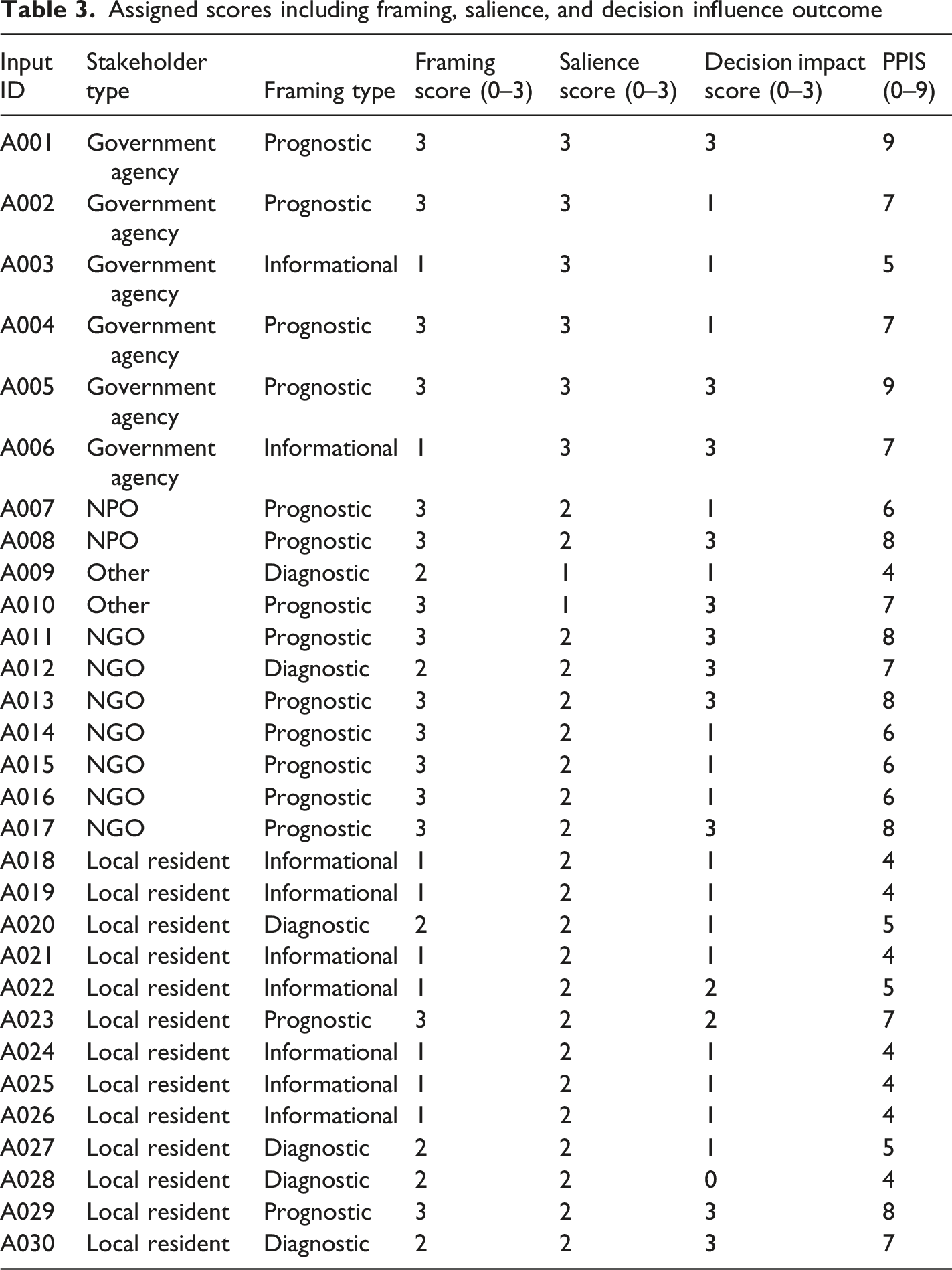
Assigned scores including framing, salience, and decision influence outcome
Framing and Decision Impact
Within the prognostic framing category (n = 15), about 53% (8 inputs) led to substantial influence on the decision (decision score = 3), while 40% (6 inputs) were acknowledged but not acted upon. Among diagnostic inputs (n = 6), 33% (2 inputs) resulted in a substantial decision change, whereas 50% (3 inputs) were acknowledged without being acted upon. Within the informational framing category (n = 9), only 11% (1 input) led to a substantial decision change, while the remaining inputs were acknowledged with explanations or additional information provided.
These patterns suggest that prognostic (recommendation-oriented) inputs are more likely to influence final decisions than informational or diagnostic inputs. Given the small number of inputs within each framing category, the observed percentages represent indicative patterns rather than precise estimates.
Public Participation Impact Score
Public Participation Influence Scores (PPIS) were categorised into three levels of influence: High influence: scores between 7 and 9; Moderate influence: scores between 4 and 6; and Low influence: scores between 0 and 3.
Of the 30 stakeholder inputs analysed (see Table 3), about 47% (14) of them were categorised as having high influence. Notably, 93% of these high-influence inputs were framed prognostically (i.e. as actionable recommendations), while only 7% were informational. This underscores the effectiveness of prognostic framing in shaping decisions.
Among the high-influence inputs: - 36% were submitted by government agencies, who possess all three salience attributes (power, legitimacy, and urgency). - 36% originated from NGOs, and 14.3% from local residents, both classified as having moderate salience.
The remaining 53% (16 inputs) fell into the moderate-influence category. Of these: - 50% were framed informationally - 25% were diagnostic (problem-identifying) - 25% were prognostic
In terms of stakeholder salience: - 63% of moderate-influence inputs came from local residents - 19% came from NGOs - The remaining 18% was evenly distributed among government agencies, NPOs, and other stakeholders.
No inputs fell into the low influence category (scores 0–3), indicating that all analysed contributions had at least a moderate level of influence on decisions.
Regression Analysis Output
Logistic regression predicting Decision Change

To aid interpretation of the logistic regression results, odds ratios were calculated by exponentiating the estimated coefficients (exp(β)). The dependent variable was Decision Change (1 = decision modified, 0 = no change). Reference categories were recommendation-oriented framing, government agencies, and the energy sector.
Framing type had a significant influence on decision change. Compared to the reference category (recommendation-oriented framing), informational (clarity-seeking) frames were associated with substantially lower odds of decision modification (β = −2.81, p < 0.001), corresponding to an odds ratio of approximately 0.06. This indicates that informationally framed inputs reduced the odds of decision change by about 94% relative to recommendation-oriented inputs. Diagnostic (problem-identifying) framing was also associated with lower odds of decision change (β = −1.32; odds ratio ≈0.27); however, this effect was not statistically significant (p = 0.12), suggesting that while problem-identifying inputs tend to be less influential than recommendation-oriented inputs, this relationship is not robust in the present sample.
Stakeholder type exhibited mixed effects. Compared to government agencies (reference group), inputs classified under the ‘Other’ stakeholder category significantly reduced the odds of decision modification (β = −2.96, p = 0.03; odds ratio ≈0.05). Inputs from NPOs showed a marginally significant negative association (β = −2.30, p = 0.06; odds ratio ≈0.10), while NGOs and local residents did not exhibit statistically significant effects.
Sector was also a significant predictor. Relative to the energy sector, inputs associated with research and development were significantly less likely to result in decision modification (β = −3.31, p = 0.003), corresponding to an odds ratio of approximately 0.04. Overall, the results indicate that recommendation-oriented framing, stakeholder institutional positioning, and sectoral context play a critical role in shaping whether stakeholder inputs influence SEA decision outcomes.
Communication and Framing as Participation Barriers
These findings suggest that framing matters, particularly when it is informational. Some of the inputs recorded were framed as clarity-seeking though they were highlighting actual problems that required solutions. The analysis shows that prognostic inputs, those offering recommendations were more likely to influence outcomes than informational or diagnostic ones. Yet, this framing is not always a function of content, but often of expression. For instance, a local resident’s input questioning the viability of predator control due to new infrastructure ‘…we will not be able to have electrified fences to control predators anymore, what will happen to us?’ (Code: A022) was coded as informational, yet it arguably highlights an important design flaw. This suggests that framing misalignments, where a valid concern is posed as a question rather than a recommendation can reduce the perceived usefulness of the input. These mis-framings likely stem from communication imbalances, stakeholders who are not familiar with planning language or procedural expectations may not know how to frame inputs in ways that align with decision-makers’ preferences. This highlights a notable limitation, decision-making processes respond not only to who is speaking, but also to how inputs are articulated. This also refers to the challenges of categorising public arguments in the frame of this research, as some inputs may fall on under more than one framing category which raises methodological concerns stemming from the interpretive nature of frame classification. Some stakeholder inputs contained elements of more than one framing type, requiring analytical judgement to identify a dominant frame. While the coding process followed predefined criteria derived from framing theory, a degree of subjectivity was unavoidable.
In cases where inputs contained elements of multiple frames, classification was based on the dominant framing, determined by the primary intent of the input. For example, input A022 raises a concern about predator control that reflects a substantive design issue; however, because it was expressed as a question rather than a clearly defined problem or proposed solution, it was therefore classified as informational. To ensure consistency, coding decisions were applied systematically across cases and refined through iterative review of ambiguous instances, whereby unclear cases were revisited and reassessed to ensure consistent application of coding criteria across the dataset. While formal inter-coder reliability testing was not undertaken, the qualitative coding process followed clearly defined criteria, whereby informational frames were identified as descriptive or clarity-seeking inputs, diagnostic frames as problem-identifying inputs, and prognostic frames as solution-oriented or recommendation-based inputs. Coding decisions were applied systematically and refined through iterative review of ambiguous cases to ensure internal consistency.
Nevertheless, some nuance may be lost when complex arguments are reduced to discrete categories, and this limitation should be considered when interpreting the results. Furthermore, the results reveal that certain stakeholder types (stakeholders under NPOs and ‘Other’ categories…) and stakeholders in certain sectors (Research and Development…) are less influential, highlighting potential biases in how decision-making processes respond to different inputs.
These findings can be interpreted in relation to established public participation effectiveness criteria (Rowe & Frewer, 2000), particularly those concerning accessibility, representativeness, and influence. When stakeholders lack the capacity to frame their inputs in ways that align with decision-making expectations, participation processes may fail to meet these criteria. Communication barriers limit accessibility by disadvantaging stakeholders unfamiliar with technical or procedural language, while framing misalignments can undermine representativeness by reducing the effective inclusion of certain voices in decision-making. Most importantly, these dynamics directly affect influence, as inputs that are not framed in actionable or decision-relevant ways are less likely to shape outcomes. In this sense, the findings demonstrate that the effectiveness of public participation is not only determined by the opportunity to participate, but also by the ability of stakeholders to communicate their inputs in forms that are recognised and acted upon within institutional decision-making processes. This aligns with broader research showing that participation mechanisms may exist without enabling meaningful influence, particularly in contexts where institutional power remains unevenly distributed (Bernauer & Betzold, 2012; Bruun, 2020).
Conclusion and Discussion
The study used a dual-method approach to assess the influence of public participation on decision outcomes: (1) a Public Participation Influence Score (PPIS) derived from qualitative coding and scoring of stakeholder input and (2) a binary logistic regression model to identify the statistical significance of various factors influencing decision change.
The PPIS method scored stakeholder input based on framing type, stakeholder salience, and changes in decision outcome on a nine-point scale. Prognostic inputs were more likely to be associated with decision change. To statistically validate the influence patterns observed in the PPIS, a binary logistic regression was conducted with decision change (Yes/No) as the dependent variable. Both the PPIS and regression analysis confirm that how stakeholders frame their input and who they are significantly affects their influence. Prognostic framing, proposing actionable recommendations consistently emerged as the most effective form of participation. Meanwhile, the institutional role and salience of the stakeholder amplified or limited this influence. Stakeholder salience appeared to align with institutional power structures. Government agencies, assigned the highest salience score (3), frequently contributed to high-impact inputs. Local residents and NGOs, with salience scores of 2, had moderate influence. Stakeholders under the ‘other’ category, with the lowest salience score (1), rarely influenced decisions. These are stakeholders who possessed legitimacy but lacked both power and urgency. Even when stakeholders possess legitimacy or urgency, lack of institutional power (‘other’ stakeholders or NPOs) diminishes their influence on outcomes.
While the conceptual structure of the Public Participation Influence Score (PPIS) framework integrating framing, stakeholder salience, and decision influence is analytically transferable, its operationalisation is context-dependent. Although empirically tested in South Africa, the model’s specific components such as scoring thresholds and stakeholder salience assignments reflect the institutional and socio-political conditions of this context and would require recalibration in other settings. The model therefore offers potential analytical value in other SEA contexts, provided it is calibrated to local institutional and socio-political settings. The model could also be a base for further methodological development. For instance, it may be useful to calibrate the model’s categorisation schemes, classifying the different arguments raised during a public participation also in a way that does not depend on the wording of the argument.
Beyond the specific empirical findings, these results have broader implications for how public participation is designed and operationalised in SEA and environmental governance more generally. Results of applying this model could not only help us to estimate the most effective contexts and actors of public participation but also support forming policy recommendations on public involvement. To enhance influence, using prognostic (recommendation) frames is more effective than informational (clarity-seeking/concerns) or diagnostic (problem-identifying) ones. Therefore, the study recommends providing capacity-building support for stakeholders, including expert facilitation to help identify key messages and guidance on effective framing techniques. Even when presenting informational content, framing it in a way that emphasises relevance to decision-making can improve influence. Improving facilitation, guidance and capacity-building for participants could enhance both the inclusivity and effectiveness of stakeholder engagement, ensuring that valuable input is not lost in translation.
Footnotes

Ethical Considerations
This article does not contain any studies with human or animal participants.
Consent to Participate
There are no human participants in this article and informed consent is not required.
Funding
The authors received no financial support for the research, authorship, and/or publication of this article.
Declaration of Conflicting Interests
The authors declared no potential conflicts of interest with respect to the research, authorship, and/or publication of this article.