



Abstract
Conservation governance requires inter-disciplinary approaches aimed at bridging science, management, and policy divides, which introduces capacity development challenges in developing countries. In particular, there is a need to establish how best to direct capacity development efforts in order to achieve long-term conservation benefits. To help meet this challenge, a deliberative-Delphi method was developed and tested in Namibia based on an integrated Delphi and workshop-based approach. Deliberative-Delphi involves rapid responses to questions followed by consensus workshops to agree emerging themes. The method was applied to researchers in the fields of conservation ecology, conservation governance, and futures thinking (FT) identifying and prioritising ten conservation themes over a two-day period. These themes were then aligned with Namibian conservation policy and explicated through literature review, providing a roadmap for capacity development interventions (through setting university curricula, research agendas, and future policy changes). The approach can be applied elsewhere to focus conservation capacity development interventions.
Keywords
Introduction
Contemporary conservation issues are complex and require a deep understanding of socio-ecological systems to design solutions that sustain both livelihoods and the natural environment. Conservation science, an inter-disciplinary field that encompasses social and natural systems and their interactions and interdependencies (Kareiva & Marvier, 2012), recognises that people are active agents in the functioning of these systems. Thus, conservation professionals need to build an understanding of both the political and governance aspects, as well as the socio-ecological systems in which they carry out their work (Alberts, Retief, Roos, et al., 2022; Black et al., 2013; Black & Groombridge, 2010). Successfully integrating conservation science with processes that effectively mobilise people to achieve conservation goals is largely a social challenge (Balmford & Cowling, 2006), involving human attitudes, values, beliefs, and behaviours, and requires an understanding and acceptance of this reality (Manolis et al., 2009). Since all conservation initiatives are embedded within a governance and policy context, there is a growing consensus that, to address conservation-related challenges and understand their potential futures, researchers must engage with both governance and future-oriented perspectives (Hulme & Murphree, 1999; Huntley, 2019; Wyborn et al., 2019).
With any environmental policies or legislation, there remains a question about the benefits that will accrue ‘if the parties lack the ability to comply’ (VanDeveer & Dabelko, 2001, p. 19). Any environmental policy imposed in a new jurisdiction creates a need for capacity building, to establish systems where they did not exist and make them effective. Doberstein (2004) cites the 1992 UN Rio conference as providing a significant boost to capacity building efforts by international aid agencies; the declaration arising highlighted the role of capacity building in helping developing countries to make appropriate policy choices through greater understanding of environmental potentials and limits.
However, capacity within any one system is not static as, for example, policies change, staff move on, best practice expectations evolve. As such, capacity has to be continually developed once it is built and remains a concern for all states (VanDeveer & Dabelko, 2001). Thus, as Clark (1999, p. 35) argues, the term ‘capacity development’ is usually preferred to ‘capacity building’ ‘as it better conveys the point that it is a dynamic process building upon an existing capacity base’. Capacity development has been defined in various ways. Bolger (2000, p. 2) describes it as ‘the approaches, strategies and methodologies used by developing country, and/or external stakeholders, to improve performance at the individual, organizational, network/sector or broader system level’.
Accordingly, it is the aim of this paper to develop and apply an approach for establishing capacity development strategies for conservation within a country. As a case study, given its need for such interventions, we apply the method to Namibia. This research comes at an opportune time for Namibia coinciding with the conclusion of Namibia’s second, and drafting of the third National Biodiversity Strategy and Action Plan (NBSAP) (Ministry of Environment and Tourism (2014), drafted in terms of the Convention on Biological Diversity (CBD).
In many ways, the Namibian context presents a unique landscape for conservation governance. Its vast and arid expanses, coupled with a sparse population, give rise to large landscape-scale conservation initiatives. While conservation remains a focal point, Namibia grapples with escalating socio-economic and developmental challenges (Gargallo, 2020; Kalvelage et al., 2021). Conservation approaches in the country are diverse, ranging from government-led efforts to the progressive and innovative communal system. It is important to note that Namibia has been extensively researched from ecological, social, and political standpoints in conservation contexts. This research is not an attempt to critique previous studies; instead, we seek to highlight important research themes to enhance understanding of future conservation governance dynamics.
Namibia implemented its first NBSAP during the period 2001 to 2010. This was internationally recognised as being one of the best first generation NBSAPs (MET, 2014), and it provided a strong foundation for the sustainable management and use of biodiversity in the country. In 2012, Namibia set about the process to develop its second NBSAP. It covers the period 2013 to 2022, and its vision is for ‘Namibia’s biodiversity to be healthy and resilient to threats, and for the conservation and sustainable use of biodiversity to be key drivers of poverty alleviation and equitable economic growth, particularly in rural areas’. (MET, 2014:v). Based on national and regional prioritisation exercises, the five strategic goals of the CBD Strategic Plan were considered highly relevant to Namibia, and these provide the overarching framework for the NBSAP. The NBSAP is both closely aligned to the CBD Strategic Plan and Aichi Targets (2011–2020), targeting Namibia’s unique conservation priorities and circumstances.
Using Namibia as a case study allows for reflection on the identified capacity development themes and their alignment with the strategic goals and objectives as set in the NBSAP. Any capacity development intervention needs to be policy compliant and relevant. At the same time, the research can inform the shaping and refining of the third NBSAP, which is currently being drafted.
The following section below sets out the methods used to identify the capacity development imperatives. The authors then present the results of applying the method in the Namibian context, and validate the ten themes against existing national conservation policy in the country. The authors then explicate the ten capacity development themes, based on literature review, so that capacity development initiatives are appropriately directed, thereafter making concluding remarks.
Method
The method was primarily based on a Delphi process, which uses consultation designed to gather opinions from subject-matter experts about the future and to prioritise issues of strategic importance (UK Government Office for Science and Technology, 2017; Hanna & Noble, 2015). As conceived, the method engages identified experts in multiple rounds of discussion to identify and prioritise important research issues within a specific context. Responses captured during this process remain anonymous, with the participants aware of each other’s participation, but not their specific inputs. This ensures that opinions are heard independently without bias, and aids in avoiding group thinking (Marchais-Roubelat & Roubelat, 2011).
It is recognised that the Delphi method is not without criticism. Some argue that the final steps of the process, which involves expert consensus, might be a by-product of group conformity and pressure (Woudenberg, 1991) or might lean towards social desirability (Ecken, Gnatzy, & Von der Gracht, 2011). There is also a concern that participant selection and attrition across Delphi rounds may result in a non-representative consensus (Bardecki, 1984; Hanna & Noble, 2015). To this end, anonymity and controlled feedback were advocated by early adopters of the method as ways to reduce the potential impacts of group pressure. Meticulous analysis by the researchers can also ensure that minority views are aptly represented in the results (Pill, 1971). Although techniques such as shared written rationales can further clarify reasons for specific stances, majority opinion may still influence the minority (Bolger, Stranieri, Wright, & Yearwood, 2011). Consequently, selecting appropriate experts for a Delphi study is a vital step (Okoli & Pawlowski, 2004).
Notwithstanding its potential limitations, the Delphi method has been argued to be an effective research tool adaptable to varied contexts (Landeta, 2006; Bañuls & Turoff, 2011; Hasson & Keeney, 2011; Von der Gracht, 2012), including in fields such as conservation governance and leadership, where the field of practice encompasses multiple disciplines and sectors. However, a significant criticism relates to the time efficiency of the Delphi method (Walker et al., 2023), given that it usually entails rounds of engagement with experts and, in some cases, the debate can develop iteratively, expert by expert. In this case, drawing on the benefits of the Delphi method, there was a need to develop a more pragmatic approach that delivered findings in a timelier manner.
A modified deliberative-Delphi approach was developed that entailed rapid responses to questions (anonymously) followed by workshopping the responses to achieve consensus on themes. To apply the deliberative-Delphi method, academics involved in the conservation governance and futures thinking disciplines from Namibia and South Africa were identified to be part of the research team. The experts were selected based on their research expertise and professional recognition in the field. Although specifically contextualised for Namibia, the inputs from South African experts were deemed useful given their experience in developing similar agendas. The process was structured into two phases.
Firstly, a fact-finding mission was undertaken in April 2022 over a period of two weeks by several of the identified expert team members to gain a better understanding of the Namibian conservation context, especially in relation to governance, leadership and FT issues. This mission covered numerous conservation areas and contexts in Namibia. In-depth discussions and interviews were held with key stakeholders and representatives, including the private sector; government departments and representatives dealing with conservation, protected areas, and environmental impact assessment (EIA); academics; and past and present conservation champions. Insights gathered from the 2022 fact-finding mission informed the experts as to the key overarching issues relating to conservation governance and FT in the country, and therefore informed the facilitation of the deliberative-Delphi method.
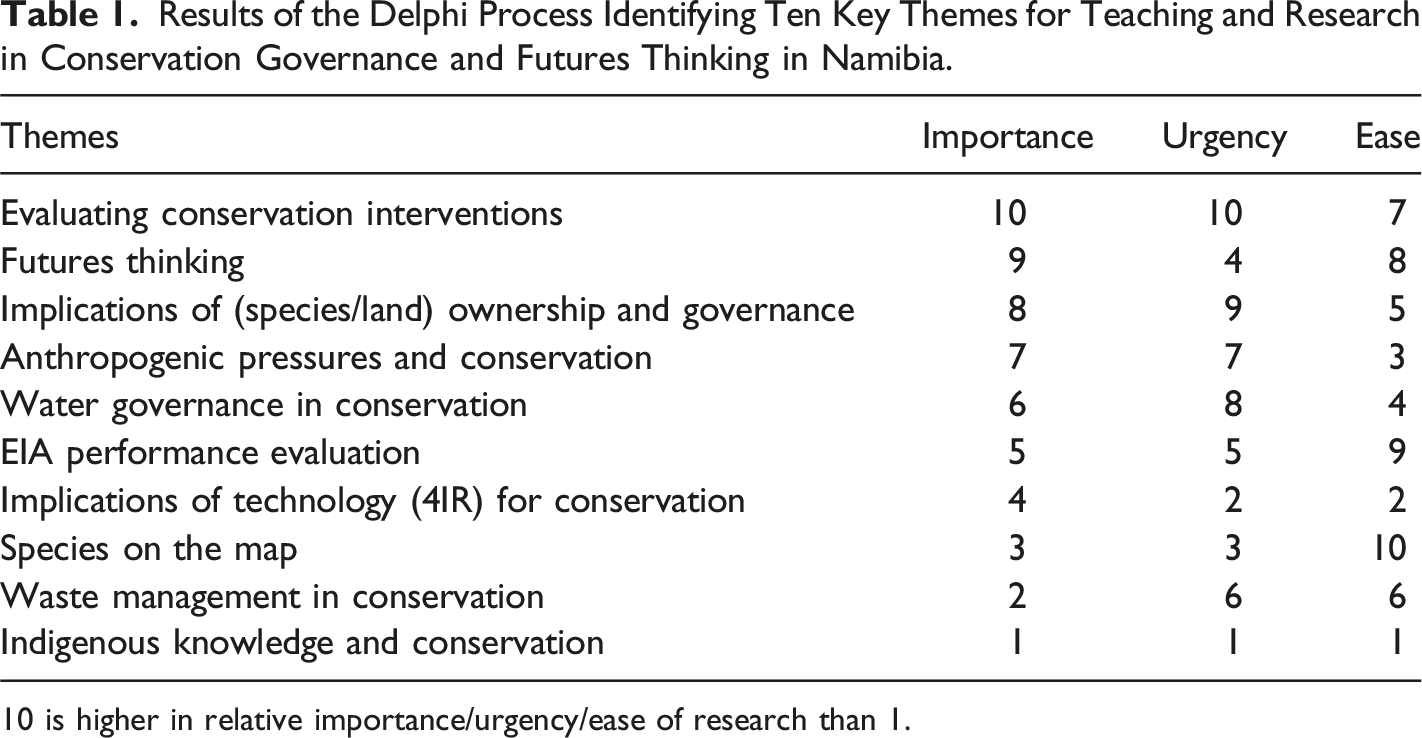
Secondly, a two-day workshop was held in Namibia between 25 and 26 April 2023. This workshop aimed to facilitate the deliberative-Delphi method, drawing upon the knowledge and insights acquired in 2022. The workshop sought the participation of eleven experts, of which six were part of the 2022 fact-finding mission. The deliberative-Delphi method was undertaken in five distinct steps, which were as follows: • Firstly, the question was posed ‘What do you believe are the key research themes/questions for conservation governance and leadership in Namibia’? Experts were invited to submit their responses, individually (and anonymously), to an online collaboration board, ensuring anonymity. Approximately 100 responses were recorded, with the facilitator subsequently reviewing and removing any duplicates. Responses were then grouped into broader themes. • Secondly, the most relevant themes from the online responses were extracted by the expert panel. This was achieved through a collaborative workshop and discussions. After a series of rigorous debates and informative dialogues, ten critical themes emerged. These were then reframed into research questions. • The third step involved the online, individual (and anonymous) ranking of the identified themes. Experts were tasked to rank the themes by way of three variables, rated from 1 (low) to 10 (high). These variables were importance (being of significance or value), urgency (requiring swift/immediate action), and ease (requiring the least amount of effort due to cost and data availability) of research (Knight & Burn, 2005). The results are presented in Table 1. • Fourthly, the rankings were reviewed in a workshop, and priority themes identified through consensus. Results of the Delphi Process Identifying Ten Key Themes for Teaching and Research in Conservation Governance and Futures Thinking in Namibia. 10 is higher in relative importance/urgency/ease of research than 1.
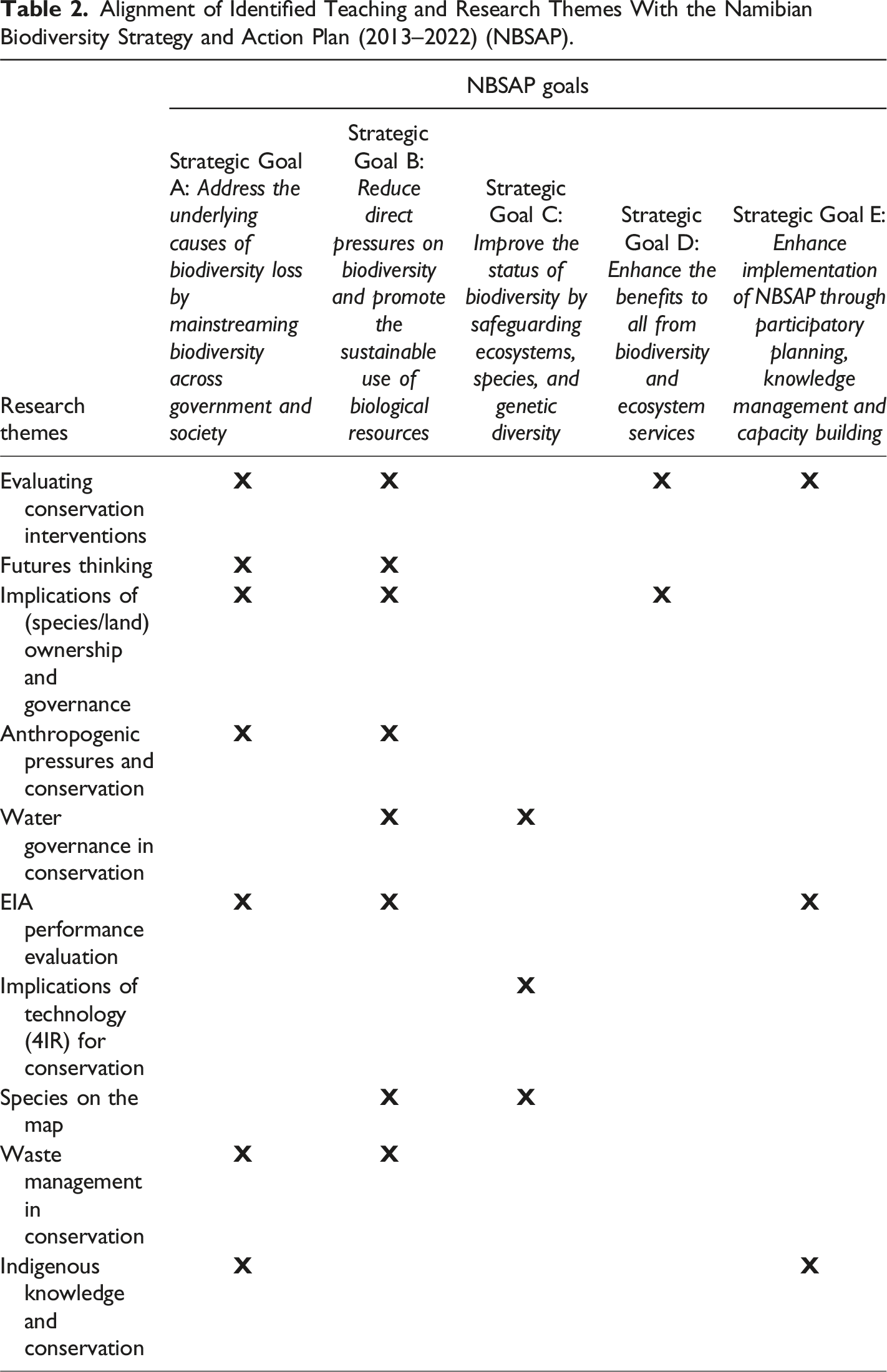
The identified themes were considered against and aligned with the strategic goals of Namibia’s NBSAP, drafted in terms of its Convention on Biological Diversity (CBD) commitments, to determine their alignment with the country’s conservation efforts. Following this, a literature review was conducted via the google scholar and scopus databases. For each theme, the search terms used was the theme title in full, and divided (e.g. both ‘Evaluating conservation interventions’ and ‘evaluating’ AND ‘conservation’ AND ‘intervention’). The purpose of this literature review was to determine to what extent the theme had been dealt with in the literature. These results are discussed in section 4.
Capacity Development Themes Emerging From the Deliberative-Delphi Method, and Examination of Alignment With National Policy
The research themes in Table 1 were identified and categorised in accordance with the method as set out above. The themes are categorised in accordance with their importance ranking. Each theme is elaborated upon in the subsequent sections.
Alignment of Identified Teaching and Research Themes With the Namibian Biodiversity Strategy and Action Plan (2013–2022) (NBSAP).
Explication of Capacity Development Themes
Theme 1: Evaluating Conservation Interventions
The evaluation of policy implementation instruments within the conservation context is a well-recognised approach for understanding the factors which influence the successful achievement of conservation policy objectives (Alberts, Retief, Roos, et al., 2022; Retief et al., 2022). This understanding supports the pursuit of the NBSAP, particularly strategic goals A, B, D and E.
Research has been conducted into expanding the protected are network in the country (Mannetti et al., 2017). Some interventions relate to Namibia’s renowned Community Based Natural Resource Management (CBNRM) programmes with numerous publications considering the opportunities, challenges, and success of these (Corrigan et al., 2018; Heffernan, 2022; Mbidzo et al., 2021; Schnegg & Kiaka, 2018; Wenborn et al., 2022). A deeper understanding of the effectiveness of conservation interventions in Namibia can shed light on the strengths and weaknesses of specific strategies within specific contexts. This knowledge can guide the design and adaptation of responses to the countries conservation challenges.
Examples of sub-themes/research questions: • How effective is the Namibian Protected Area system? • How well does the Namibian conservation policy align with protected area plans and programmes? • How has the 2013–2022 Namibian Biodiversity Strategy and Action Plan performed, and what should be considered in its review and update?
Theme 2: Futures Thinking
Futures thinking is defined as “a process of positing several informed, plausible and imagined alternative future environments in which decisions about the future may be played out, to change current thinking, improving decision making, enhancing human and organisational learning and improving performance” (Chermack et al., 2007). This approach enables the evaluation of current policies against potential future circumstances, fostering engagement with potential future problems with possible solutions (Wyborn et al., 2021).
While the application of futures thinking (FT) in conservation has not been extensively explored, instances where it has been used have yielded conspicuous results (Wardell-Johnson, 2000). The Millennium Ecosystem Assessment and the Intergovernmental Panel on Climate Change (IPCC) serve as prominent examples of where this tool has been employed to mitigate adverse negative consequences of climate change (IPCC, 2007; Millennium Ecosystem Assessment, 2005). In the broader context of Africa, as well as in Namibia, the utilisation of this tool remains limited (Hicks, 2012; Paskins, 1997). Despite this, FT is recognised as an important research theme in conservation due to the challenges confronting biodiversity (Bradford & Warren, 2014).
Examples of sub-themes/research questions: • What are the anticipated future scenarios for Namibian conservation? • What are the anticipated future scenarios for CBNRM in Namibia? • What are the anticipated future scenarios for protected areas in Namibia?
Theme 3: Implications of (Species/Land) Ownership and Governance
This theme focuses on the progressive steps taken in Namibia as early as the 1960s, which granted private landowners ownership over wildlife (Long & Jones, 2004). The devolution of ownership to private citizens inevitably led to changing perspectives and values concerning how landowners viewed wildlife. The extension of these policies to afford ownership of wildlife to communities in the 1990s also marked a progressive step forward in granting resource use rights and access to benefits derived from wildlife ownership. The concept of wildlife ownership and governance has been widely researched in the country, with numerous scientific and popular press publications dedicated to the topic (Carpenter, 2021; Lenggenhager et al., 2021; Muntifering et al., 2023). Despite being widely researched, this theme remains a contentious one, with various areas of potential research still left unexplored. Given Namibia’s progressive developments in this regard, this theme is considered as both important (8) and urgent (9) (Table 1).
Examples of sub-themes/research questions: • How does the ownership of land or species impact on their value or rights in the conservation context? • How does the value of wildlife change as they traverse different land uses in Namibia’s landscape? • What are the implications of changing wildlife values for their conservation?
Theme 4: Anthropogenic Pressures and conservation
Anthropogenic pressures on conservation have become a critical global concern due to the adverse impact of human activities on ecosystems. These pressures, which include habitat loss, fragmentation, degradation, and other indirect factors such as climate change, invasive species, and human-wildlife conflict, compromise ecosystems, jeopardising biodiversity, and threatening species survival (Giliba et al., 2021; Steffen et al., 2011). Consequently, understanding the driving forces behind these pressures is vital in formulating targeted interventions and informed decision-making to manage and safeguard ecosystems effectively. Research into the complex interplay between human activities and ecosystems in Namibia is crucial for preserving the country’s natural habitats and species, providing the necessary insights for devising effective conservation strategies (Geldmann et al., 2019).
Over the years, numerous studies have examined the effects of anthropogenic pressures on Namibia’s ecosystems and wildlife. For instance, researchers have explored farmers' perceptions of cheetahs, identified negative perceptions, and devised management practices to mitigate them (Marker et al., 2003), while other studies have investigated the relationship between humans and megafauna such as elephants and its impact on conservation efforts (Barnes, 2007; Chase & Griffin, 2009). Furthermore, Gargallo (2020) investigated some of the challenges of balancing conservation against competing land uses, such as agriculture, particularly within the context of communal conservancies. Overall, these studies highlight the importance of addressing anthropogenic pressures in Namibia to ensure the long-term preservation of the country’s ecosystems and biodiversity.
Examples of sub-themes/research questions: • How will anthropogenic pressures affect conservation areas in Namibia? • What are the key drivers contributing to anthropogenic pressures in Namibia, and how do they vary across ecosystems and regions? • How do direct and indirect anthropogenic pressures impact ecosystem health and biodiversity both inside and on the periphery of Namibia’s protected areas? • How can land tenure, property rights, and land-use planning be integrated into effective conservation strategies in Namibia? • What approaches can effectively mitigate human-wildlife conflicts, particularly with elephants and large mammals, in Namibia?
Theme 5: Water Governance in Conservation
The concept of water governance refers to the range of political, social, economic, and administrative systems necessary to ensure the sustainable development and management of water resources and the continual delivery of water service at all levels of society (Rogers & Hall, 2003). However, the failure of these water governance systems has led to a global decline in the quality and quantity of water resources (Global Water Partnership, 2000; UNEP, 2019). Consequently, the ripple effect of a degrading finite resource has negative impacts on all aspects and levels of the environment, especially the natural environment (Frederick & Major (1997). Understanding the issues and concerns surrounding water governance and the potential impact of these systems on sensitive ecosystems is vital, particularly for Namibia, where sustainable socio-economic development relies on the conservation of these ecosystems (Hoole, 2010).
While water governance research in Africa is mostly centred around institutional themes, such as arrangements for integrated water resources management and water economics (Olagunju et al., 2019), studies related to water governance and conservation highlight the broader challenges faced by conservation. These include failing water governance systems, characterised by ineffective and uncoordinated institutional structures, unreliable financial management, and outdated policy interventions (Lalika et al., 2012 & Gondo & Kolawole, 2019). Within the Namibian context, water governance research has predominantly focussed on access to water and water supply (Olivieri et al., 2022), governance challenges and shortcomings within the water sector (Remmert, 2016), and the influence of state policies and micro-politics on water governance in the country (Schnegg, 2016). This specific void created by the lack of research in water governance in conservation, presents an ideal opportunity for future investigations. It is believed that research within this niche area of water governance can greatly contribute to the understanding of how current political, social, economic, and administrative systems affect conservation in Namibia.
Examples of sub-themes/research questions: • How does water governance affect conservation efforts and livelihoods in Namibia? • How has water governance affected Namibia’s conservation landscape (mountain catchment parks/parks around water courses/wetland conservation areas)? • What are the interfaces between trans boundary water management and the management of trans frontier conservation areas? • What are the water governance implications in relation to the management of open conservation systems versus closed conservation systems? • What is the quality of water governance considerations in policy-based implementation instruments such as EIA and conservancy management plans in protected areas in Namibia? • What are the water governance implications of communal water points within conservation areas?
Theme 6: EIA performance Evaluation
Internationally, performance evaluation is recognised as a key component of any well-functioning EIA system (Sadler, 1996). Performance evaluations apply different methodologies and can vary in scope and focus, from system wide reviews (Loomis & Dziedzic, 2018), to evaluating specific aspects such as report quality (Sandham et al., 2013), process efficiency (Sandham et al., 2013), decision-making effectiveness (Alberts, Retief, Arts, et al., 2022) and cost (Retief & Chabalala, 2009). Fully understanding the performance of EIA, which is considered a crucial policy implementation instrument in the Namibian context, will help researchers and conservationists to understand the impact and effectiveness of EIA within the conservation context. Despite being a crucial instrument for understanding pressures and halting biodiversity loss, EIA plays an important role in participatory planning, knowledge management and capacity building.
Joseph (2018) researched the contribution of the EIA process to environmental governance in Namibia by reviewing a range of EIA case studies. His research concluded that ‘EIA practice for environmental governance and decision-making in Namibia is of moderate to low quality’. More specific evaluation of the effectiveness of public participation (Strauss, 2022) and procedural effectiveness (Nakwaya-Jacobus et al., 2021) was done recently. Nakwaya-Jacobus et al. (2021) concluded that ‘Namibia has a functional EIA system based on fairly good legislation, institutional arrangements and a well outlined EIA process’.
The sector specific EIA research has mostly focused on mining ( Husselmann, 2016) and/or water management related (Hunt, 1995; Nankela, 2022). This is not surprising considering the importance of mining and water management for the country. However, the lack of EIA research within the eco-tourism sector seems a particular weakness.
Examples of sub-themes/research questions: • What is the performance of the Namibian EIA system? • How should an EIA performance monitoring system be designed for Namibia? • What is the quality of EIA reports in relation to tourism development in Namibia? • What is the effectiveness of the EIA system towards ensuring sustainable development in protected areas?
Theme 7: Implications of Technology (4IR) for Conservation
The Fourth Industrial Revolution (4IR) can be defined as the digital integration of humans and machines in virtual mode to perform tasks quickly and intelligently. Considering 4IR in conservation entails smart technologies, telemetry data analysis, climatic change modelling, artificial intelligence, camera traps, drones, machine learning, real-time platforms, big data, and augmented reality. These technologies hold vast potential to impact the field of conservation in numerous ways (Louder & Wyborn, 2020).
The use of the 4IR in conservation has many implications for protecting, managing, conserving, and monitoring wildlife and their habitats. Smart technologies such as real-time platforms and Global Positioning System (GPS) collars can also be used to monitor and manage wildlife (Foley & Sillero-Zubiri, 2020; Foley & Sillero-Zubiri, 2020), and create early warning systems for communities to diffuse human-wildlife conflicts (Branco et al., 2020). Drones can facilitate accurate aerial counts and ground truthing (Hodgson et al., 2018), while remote sensing can effectively assess large areas in a cost-effective manner, that is forest assessment, assessments in support of restoration efforts, bush fire monitoring, and climatic change analysis in protected areas (Duan et al., 2020). This research theme supports the pursuit of strategic goal C of the NSBAP.
The adoption of 4IR technologies empowers conservationists and decision-makers to predict and perform tasks that surpass human capacity. Notably, machine learning and artificial intelligence excel at accurately processing and analysing extensive data from aerial sources, camera traps, and other monitoring devices, eliminating the need for human intervention and reducing resource requirements for such tasks (Borowiec et al., 2022).
Literature shows that Namibia is embracing smart technologies, such as drones, camera traps, GPS collars, and remote sensing. For example, smart drones have been used for forest assessment (Knox et al., 2018), while GPS collars are extensively used for movement ecology studies (e.g. Leggett, 2006; Seidel et al., 2019; Wenborn et al., 2022) and mapping applications (Cushman et al., 2010).
Despite several advantages offered by the 4IR, careful consideration is required in terms of and investigating the policy implications of 4IR (Popovic, 2020); and its regulation and management to ensure ethical usage and prevent potential hazards to both humans and the environment (Anshari et al., 2022; Bordas, 2022; Jarbandhan, 2021; McDougle, 2007; Tanguay, 2021).
Examples of sub-themes/research questions: • How can the full potential of 4IR be leveraged to advance the NBSAP? • What is the perception of the conservationist community towards the 4IR? • What are the challenges/risks and opportunities associated with the 4IR in conservation? • How can the ethical use of the 4IR in conservation be ensured and ethical challenges addressed?
Theme 8: Species on the Map
Spatial data on a variety of fauna and flora is readily available (Noongo & Willemse, 2004). This includes fine-scale telemetry data, contributions from citizen science initiatives, and systematically collected specimen and observation records. Predominantly, these data are utilised to investigate individual taxa, aiming to address specific questions related to either the distribution or behaviour of a species, or to manage human-wildlife conflict (Tomkiewicz et al., 2010.). The cumulative value of this information, in the grander scheme of strategic conservation decision-making, remains largely untapped unless explored and analysed through the lens of conservation governance and within the strategic context. This perspective has not been holistically embraced in Namibia thus far. A risk is also clear, pertaining to the storage and availability of the data which are largely curated by individual researchers or organisations in isolation (Di Marco et al., 2017).
Empirical modelling of telemetry data in Namibia predominantly focuses on charismatic species. This includes elephants (Benitez et al. 2022; Leggett, 2006), cheetahs (Marker et al. 2008; Melzheimer, 2021), lions (Moeller, 2014; Stander, 2004), leopards (Stein et al., 2011), and giraffes (Fennessy, 2009). However, several common but important taxa, such as antelopes, remain under-researched. Only a few studies have addressed species like springbok, eland, kudu (Hering, et al., 2022), roan, sable (Alfeus, 2022), and buffalo (Naidoo et al., 2012, 2014). Notably, multi-species analyses targeting megaherbivores in the Zambezi region have been documented (Brennan et al. 2020; Naidoo et al. 2018).
Examples of Sub-themes/research Questions • How does spatial data inform management planning and governance for wildlife corridors in Namibia? • How is telemetry movement data correlated with environmental factors such as water availability, climatic variables, predator presence, or human activity? • How does wildlife movement ecology vary across different land-use and management units, and what implications does this hold for their respective management strategies? • What ecological niches exist for species, or species-clusters, to inform conservation planning?
Theme 9: Waste Management in Conservation/Protected Areas in Namibia
Waste management poses a significant challenge for protected areas globally (Hong & Chan, 2010; Rodríguez-Rodríguez, 2012 & Roos et al., 2022). Morrison-Saunders et al. (2019) have ranked ‘responsible waste management’ as one of the top expectations of visitors to protected areas, while Wyman et al. (2011) regard waste management as one of the five indicators of ‘environmentally responsible tourism practices’ in protected areas. In the African context, the Africa Waste Management Outlook (UNEP, 2018) highlights the threats that waste management may pose to protected areas and recommends the development of ‘integrated waste management and conservation strategies’, which address waste management challenges and protect sensitive environments.
In Namibia, waste-related legislation mainly regulates the municipal management of solid waste, with a limited focus on regulating waste management within protected areas. However, in 2017, the Namibian Ministry of Environment, Forestry and Tourism (MEFT) amended the Nature Conservation Ordinance, 1974 (4 of 1875) to specifically ban the use of plastic bags in game parks and nature reserves (in terms of Government Notice 85 in Government Gazette 6285 of 13 April 2017). Furthermore, the Namibian National Solid Waste Management Strategy (NSWMS) was published in 2018 aiming to enhance solid waste management in the country. In the context of protected areas, the NSWMS aims to mitigate the impacts of waste disposal on protected areas by ‘siting new landfill sites at least 1 km from national parks and other protected areas’. Besides these requirements, the Namibian legal framework does not make specific provision for the management of waste in protected areas.
There is no published research focussing specifically on waste management within the conservation/protected areas context in Namibia in the public domain. The Waste Management Implementation Plan for the Mudumu Landscape in Namibia (Uusona et al., 2014), however, provides useful background information regarding waste management in selected communal conservancies, national parks, and community forests. Lessons can also be taken from existing publications on municipal solid waste management in Namibia by Croset (2014), Mughal (2014), Schioldborg (2014), Ndhlovu (2018), Kalonda and Govender (2021), Nambuli et al. (2021), Kadhila and De Wit (2022), as well as Zeriapi and Awofolu (2022).
Examples of sub-themes/research questions: • To what extent are waste management considerations addressed in governance instruments (i.e. EIA, environmental management plans, and conservancy management plans) for protected areas in Namibia? • What are the factors influencing waste management behaviour/practices in communal/private/state-owned protected areas in Namibia? • How can we improve waste management in protected areas in Namibia?
Theme 10: Indigenous Knowledge and Conservation
Indigenous knowledge is the accumulated knowledge, skills, and technology of local communities derived from their direct interaction with the environment (Altieri, 1990). It is argued that incorporating indigenous knowledge in addressing conservation challenges may strengthen socio-ecological resilience, maintain cultural and biological diversity, provide invaluable knowledge for gaps that currently exist in scientific knowledge, and give a voice to local communities in conservation efforts (Guto, 2020).
The United Nations Environmental Programme recognises indigenous environmental knowledge, as a subset of indigenous knowledge, as having the same status as scientific knowledge (UNEP, 2012). The UN Convention on Desertification, to which Namibia is a signatory, mandates ‘parties to protect, integrate, enhance and validate traditional and local knowledge to promote the use of relevant tradition and local technology’ (UNCCD, 1994). This stance establishes a new platform where previous arguments devaluing local indigenous knowledge, which hindered participatory development and knowledge management by local communities, no longer holds relevance (Hodgson et al., 2020).
While there is existing research on indigenous knowledge across various disciplines, limited research exists within the context of Namibian conservation. The current challenges present impediments to the integration of indigenous knowledge into conservation practices (Ens et al., 2021).
Examples of sub-themes/research questions: • How is indigenous knowledge being integrated into contemporary conservation governance in Namibia? • What are the barriers and opportunities for incorporating indigenous knowledge into conservation governance in Namibia?
Conclusions and Recommendations
This paper has aimed to identify and set a teaching and research agenda for the field of conservation governance and FT in Namibia. It outlines ten key research themes for the discipline, as identified by way of a Delphi process. These themes were weighted according to three criteria, namely, importance, urgency and ease of conducting the research. This allows for a prioritisation of the research themes, with the evaluation of conservation interventions being considered the most pressing theme to pursue. Furthermore, the themes were aligned with the relevant strategic goals of the NBSAP. It is evident that the identified themes support the strategic goals of the NBSAP across the board, and that pursuit of these themes will assist in gaining a more in-depth understanding of the strategic goals, and whether and why they are being attained or not.
The deliberative-Delphi approach facilitated the relatively rapid identification of capacity development interventions that should assist in the development of conservation in Namibia. The method has potential to be applied elsewhere.
Given that the NBSAP is currently under review, these research themes may assist in identifying and prioritising key conservation questions. To this end, it must be noted that the paper did not attempt to rank the themes in order of priority, but aimed rather to give an indication of importance, urgency and ease of research as perceived by the Delphi participants.
It is hoped that this research will aid in the setting of teaching and research priorities in the country in pursuit of conservation, and that they will inform the development of new programmes aimed at equipping future conservation practitioners and leaders with the necessary skills to address the complex and challenging issues faced by contemporary conservation initiatives. This is especially true for the fields related to the 4IR and indigenous knowledge, which are both emerging and are arguably of crucial importance to the future of conservation in Namibia. The method may be further expanded to include a wider range of actors in the conservation discipline to refine and ensure buy-in to the prioritisation of the research themes.
Footnotes
Declaration of Conflicting Interests
The author(s) declared no potential conflicts of interest with respect to the research, authorship, and/or publication of this article.
Funding
The author(s) received no financial support for the research, authorship, and/or publication of this article.
